Applied Channel Theory: Navigating Linear Palpatory Diagnostics, Subcutaneous Nodule Morphologies, and Precision Acupressure Protocols
By Antigravity Medical & Somatic Research Group
1. Opening — A Problem This Solves Today: The Somatosensory Map of Modern Burnout
Consider a familiar constellation of mid-afternoon distress: at approximately three o'clock, an insidious cognitive fog settles behind your eyes, accompanied by a subtle epigastric distension that renders your waistband uncomfortable. Your breath catches high in the clavicles; a diffuse, low-grade irritability flares at routine emails; and a persistent, dull ache gnaws at the lateral margins of your neck and shoulders. You have likely attributed these signals to ergonomic failure, occupational fatigue, or postprandial glycemic fluctuations. You may have swallowed an antacid, adjusted your monitor height, or consumed another espresso.
Yet, within the conceptual framework of classical East Asian medicine, these seemingly disparate symptoms are neither stochastic nor isolated. They represent a coherent, systemic perturbation along specific bio-physical conduits known as meridians or channels (Jingluo, 经络).
For centuries, classical acupuncture discourse suffered from an ontological divide: esoteric energetic metaphors on one side, and reductionist neuro-reflexive models on the other. This divide was bridged by the late Beijing master Dr. Wang Ju-Yi (王居易, 1937–2012), whose pioneering clinical methodology—Applied Channel Theory (Jing Luo Zhen Fa, 经络诊法)—re-established tactile channel palpation as the primary diagnostic compass of East Asian medicine.
Dr. Wang asserted a fundamental clinical maxim: the channels are living anatomical spaces, and internal visceral dysfunction inevitably imprints itself as palpable, structural anomalies in the peripheral connective tissues below the elbows and knees.
When you experience postprandial lethargy coupled with mental agitation, you are occupying the clinical terrain where the Foot Yangming (Stomach) and Foot Jueyin (Liver) channel systems intersect. Rather than guessing at internal organ status through subjective symptom questionnaires alone, Applied Channel Theory equips the clinician and the layperson alike with an objective, embodied topographical map. By learning to palpate the distal extremities, one can directly read the physical status of the internal organs and apply precise, non-invasive mechanical pressure to restore physiological equilibrium.
2. The Meridian Path — A Journey Through the Body: Classical Neijing Physiology Meets Contemporary Fascial Dynamics
To comprehend why touching a point along the shinbone alleviates gastric distension, one must dismantle the archaic Cartesian separation between the visceral core and the musculoskeletal periphery. Classical texts such as the Huangdi Neijing (Inner Canon of the Yellow Emperor, c. 1st century BCE) described the channels not as abstract metaphysical lines, but as physical conduits embedded within the Couli (腠理)—the interstitial spaces, cleavage planes, and metabolic interfaces dividing muscle bellies, vascular bundles, and bone.
Contemporary biophysics and histological research have validated this ancient intuition. Landmark studies led by Dr. Helene Langevin, published in the Journal of Theoretical Biology and indexed on PubMed, demonstrate that acupuncture meridians correspond with high statistical significance to the cleavage planes of loose, unspecialized connective tissue (fascia).
Furthermore, research published in Scientific Reports detailing the structure of the human interstitium confirms that the body is permeated by a continuous, fluid-filled, macro-structural network of collagenous bundles bathed in interstitial fluid.
+---------------------------------------------------------------------------------------+
|                 FASCIAL & INTERSTITIAL MECHANISMS OF CHANNEL DYNAMICS                |
+---------------------------------------------------------------------------------------+
| 1. Mechanical Tensegrity  | Fascia operates as a contiguous, pre-stressed structural |
|                           | network distributing mechanical strain globally.          |
| 2. Liquid Crystalline ECM | The Extracellular Matrix (ECM) functions as a low-        |
|                           | resistance conduit for hydraulic and electrical flow.     |
| 3. Mechanotransduction    | Pressure deforms fibroblasts, initiating intracellular    |
|                           | signaling cascades, cytokine release, & tissue remodeling.|
| 4. Piezoelectric Flow     | Collagen deformation generates electrical potentials that |
|                           | guide cellular repair and autonomic modulation.           |
+---------------------------------------------------------------------------------------+
When an internal organ undergoes metabolic stress or inflammatory changes, it alters autonomic outflow and vascular perfusion. Through visceral-somatic reflex arcs, this visceral distress induces neurogenic inflammation, microvascular exudation, and fibroblast activation in corresponding peripheral dermatomes and myotomes. The loose connective tissue along these planes thickens, dehydrates, or densifies, altering the local viscosity of the extracellular matrix (ECM).
The meridian is thus a living liquid-crystal conduit: a continuous, hydraulic, piezoelectric fascial continuum wherein interstitial fluid shear stress, mechanotransductive signaling, and neural pathways converge.
Mapping the Physical Pathways of the Body
- The Anterior Structural Column (The Yangming / Stomach System):
Beginning beneath the orbit of the eye, this pathway descends through the jaw, traces the anterior border of the neck, traverses the mamillary line and the rectus abdominis, and courses down the front of the thigh. Its most clinically significant diagnostic terrain begins just below the knee, running down the muscular ridge parallel to the sharp front edge of the shinbone (the anterior border of the tibia) into the ankle and out through the second and third toes. Somatically, this is the body's primary metabolic and digestive highway; when overworked, the muscular valley just lateral to the shinbone becomes taut, wooden, or nodular. - The Deep Medial Trough (The Jueyin / Liver System):
Originating at the medial corner of the big toenail, this pathway ascends across the inner arch of the foot, passes anterior to the inner ankle bone, and tracks up the inner seam of the lower leg directly behind the medial border of the tibia. It continues past the inner knee, ascends the adductor canal of the medial thigh, circles the external genitalia, and penetrates the ribcage at the hypochondrium. This pathway acts as the body's neurovascular and stress-buffering axis; emotional constraint and vascular hypertonicity manifest as sharp, wire-like cords along the inner calf groove. - The Lateral Kinetic Chain (The Shaoyang / Gallbladder System):
Beginning at the outer corner of the eye, this pathway zigzags across the temporal aspect of the cranium, cascades over the trapezius ridge, sweeps down the lateral ribcage and flank, traverses the hip joint, and descends the exact lateral seam of the outer thigh and leg—in the cleft between the lateral muscles of the calf and the fibular bone—terminating at the fourth toe. This system manages rotational movement, immunological adaptation, and the somatic transition between sympathetic and parasympathetic states.
Understanding these topographical pathways through standardized nomenclature mapped by the World Health Organization (WHO) Standard Acupuncture Point Locations transforms the human limb into a legible diagnostic interface.
3. The Tactile Semiotics of Palpation: Five Techniques and Five Pathological Signatures
The diagnostic core of Dr. Wang Ju-Yi's Jing Luo Zhen Fa resides in meticulous, systematic linear palpation of the distal extremities—specifically the segments extending from the elbows to the fingertips, and from the knees to the toes.
The Five Primary Palpatory Techniques (Zhen Fa)
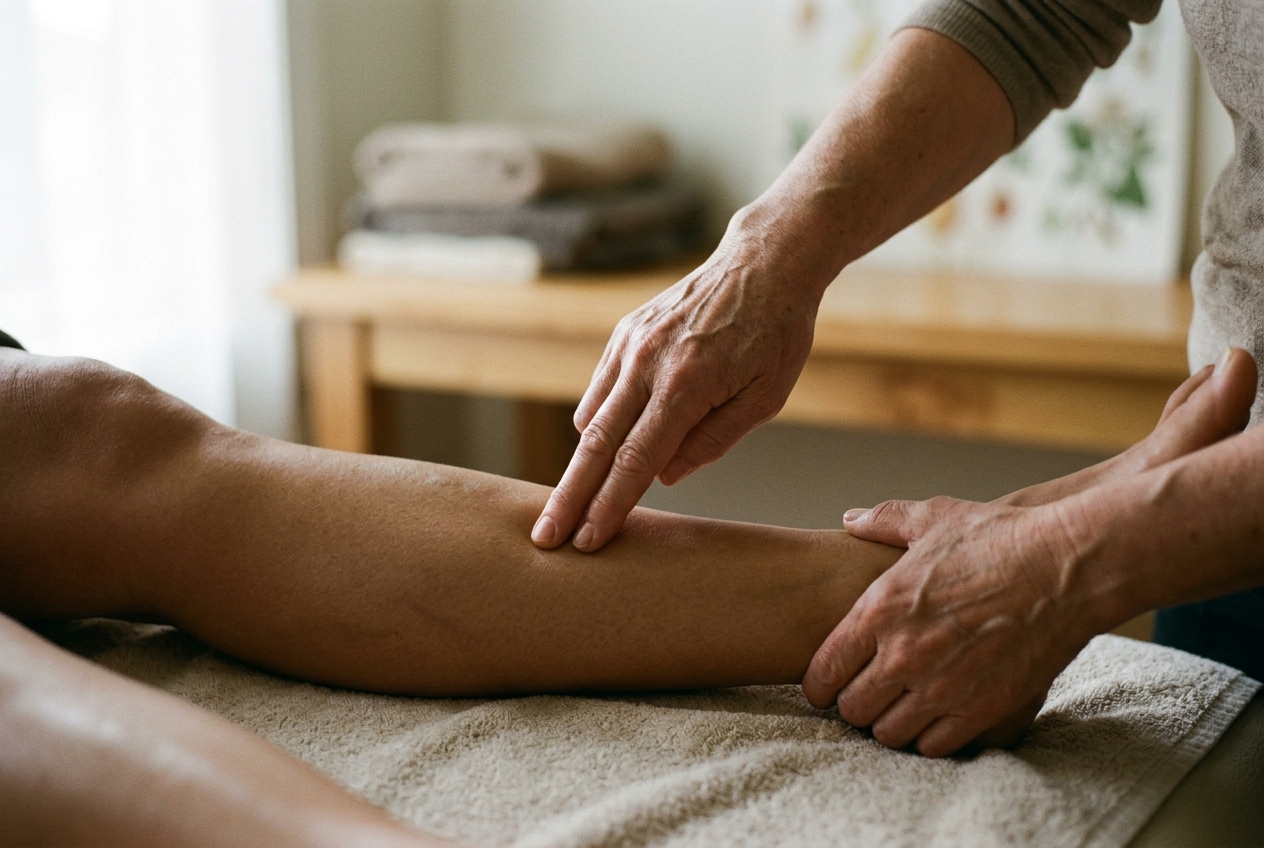
- Sliding (Xun, 循): The practitioner places the pad of the thumb or index finger into the intermuscular or osteofascial groove of a channel, applying light to moderate pressure while gliding smoothly and continuously along the conduit. Xun is an exploratory sweep designed to identify macro-disruptions in channel continuity, fascial adhesions, and contour interruptions.
- Pressing (An, 按): A static, perpendicular downward compression applied directly into the tissue using the thumb tip or finger pulp. An evaluates tissue resilience, structural depth, and the responsiveness of underlying periosteum and deep fascial layers. It distinguishes superficial subcutaneous edema from deep, structural vacancies.
- Searching (Mo, 摸): A light, planar touch executed with the relaxed palmar surface of the fingers sweeping across the cutaneous surface. Mo is calibrated to register subtle micro-fluctuations in epidermal temperature, perspiration, rough skin texture (crepitus), and localized electrostatic drag indicative of microcirculatory stasis.
- Pushing (Tui, 推): A slow, shearing maneuver in which the thumb presses into an osteofascial boundary and pushes tissue transversely or longitudinally against an adjacent bony ridge (such as the tibial or fibular crest). Tui mobilizes deeper myofascial planes to uncover submerged, fixed nodules that escape superficial sliding.
- Rolling (Rou, 揉): A focused, circular, kneading motion executed without breaking contact with the skin surface. Once a tissue anomaly is encountered, Rou interrogates its dynamic morphology: its elasticity, boundaries, degree of fixation, and pain-referral characteristics.
+----------------------------------------------------------------------------------------------------+
|                      PALPATORY TISSUE SIGNATURES & CLINICAL DIAGNOSTIC CORRELATIONS               |
+---------------------+-------------------------------+----------------------------------------------+
| PALPATORY FINDING   | TISSUE MECHANICS & HISTOLOGY  | CLINICAL INDICATION & SYSTEMIC DYSFUNCTION   |
+---------------------+-------------------------------+----------------------------------------------+
| Solid Nodules       | Dense collagenous cross-      | Chronic blood stasis (*Xue Yu*), chronic     |
| (*Jie Jie*)         | linking; localized fibrotic   | phlegm consolidation (*Tan Yin*), deep-      |
|                     | consolidation; hyaluronan gel.| seated visceral pathology of long duration.  |
+---------------------+-------------------------------+----------------------------------------------+
| String-like Cords   | Hypertonic myofascial bands;  | Qi stagnation (*Qi Zhi*), autonomic nervous  |
| (*Suo Zhuang Wu*)   | localized tenocyte traction;  | system hyperarousal, hepatic tension, smooth |
|                     | longitudinal fascial tension. | muscle spasm, emotional repression.          |
+---------------------+-------------------------------+----------------------------------------------+
| Crisp/Grainy Grits  | Micro-calcifications, tiny    | Dampness accumulation (*Shi*), early micro-  |
| (*Sha Li*)          | crystallized exudates, micro- | vascular stagnation, incomplete lymphatic    |
|                     | lymphatic congestion pockets. | drainage along peripheral cleavage planes.   |
+---------------------+-------------------------------+----------------------------------------------+
| Soft Depressions    | Atrophy of connective tissue; | Profound Qi and Blood vacuity (*Xu*), loss of|
| (*Ao Xian*)         | interstitial fluid depletion; | interstitial turgor, chronic exhaustion,     |
|                     | collapse of fascial cleft.    | organ hypofunction (e.g., Spleen vacuity).   |
+---------------------+-------------------------------+----------------------------------------------+
| Thermal/Moisture    | Vasomotor dysregulation;      | Cold/Dry = Yang/Yin deficiency; Hot/Moist =  |
| Variances           | local microvascular dilation  | Full Heat (*Re*), acute inflammatory flare,  |
|                     | or vasoconstriction.          | or damp-heat accumulation in the viscera.    |
+---------------------+-------------------------------+----------------------------------------------+
4. Clinical Case Study: Resolving Diagnostic Ambiguity Between Spleen Vacuity and Liver Stagnation
To appreciate the diagnostic power of Applied Channel Theory, consider the following clinical presentation encountered in modern outpatient care.
Patient Profile & Clinical Presentation
A 42-year-old software systems architect presented with chronic, debilitating gastrointestinal distress, postprandial epigastric fullness, erratic bowel evacuations alternating between loose stools and dry difficulty, profound mental lethargy between 2:00 PM and 4:00 PM, and persistent low-grade insomnia.
Standard medical examinations, including endoscopy and abdominal ultrasound, revealed no organic structural lesions, categorizing the condition broadly as functional dyspepsia secondary to chronic stress.
The Diagnostic Conundrum
In Traditional Chinese Medicine, this presentation exhibits profound diagnostic ambiguity between two fundamentally distinct pathological mechanisms: 1. Spleen-Stomach Qi Vacuity (Pi Wei Qi Xu): Primary metabolic weakness wherein the digestive organs lack the bio-energetic capacity to transform and transport nutrients, manifesting as postprandial distension, fatigue, and loose stools. 2. Liver-Gallbladder Qi Stagnation Invading the Spleen (Gan Qi Fan Wei / Gan Pi Bu He): Primary neuro-emotional and vascular constraint wherein sympathetic overactivity inhibits splanchnic circulation and gastrointestinal peristalsis, mimicking primary digestive weakness.
Treating Spleen vacuity requires tonifying, warm, supplementing acupressure protocols. Treating Liver stagnation demands vigorous, dispersing, unblocking interventions. Applying tonification to a case of severe Liver stagnation exacerbates the fullness; applying harsh dispersion to a vacuous Spleen induces further constitutional exhaustion. Traditional tongue and pulse evaluation in this patient yielded mixed indicators: a slightly swollen tongue body with scalloped edges (suggesting Spleen vacuity) combined with taut, wiry edges (suggesting Liver stagnation).
Palpatory Channel Investigation (Jing Luo Zhen Fa)
The clinician conducted systematic linear palpation across the distal channels of both lower extremities:
+----------------------------------------------------------------------------------------------------+
|                             PALPATORY FINDINGS FOR CASE DIFFERENTIATION                           |
+---------------------+-----------------------------+------------------------------------------------+
| CHANNEL TRACT       | PALPATION MANEUVER & REGION | PHYSICAL TISSUE FINDING                        |
+---------------------+-----------------------------+------------------------------------------------+
| Foot Yangming       | *Xun* & *An* along lateral  | Soft, spongy depressions (*Ao Xian*) at ST-36; |
| (Stomach Channel)   | tibial crest (ST-36 to      | cutaneous hypothermia; tissue lacks elastic    |
|                     | ST-40).                     | rebound; absence of hard fibrotic nodules.     |
+---------------------+-----------------------------+------------------------------------------------+
| Foot Taiyin         | *Xun* along posterior tibia | Mild doughy edema without distinct structure;  |
| (Spleen Channel)    | crest (SP-6 to SP-9).       | diffuse, non-reactive tenderness.              |
+---------------------+-----------------------------+------------------------------------------------+
| Foot Jueyin         | *Tui* & *Rou* along medial  | Distinct, tightly wound, wire-like cord        |
| (Liver Channel)     | tibial groove (LR-3 to      | (*Suo Zhuang Wu*) 5 cun above medial malleolus |
|                     | LR-6).                      | (LR-5); exquisite, sharp radiating tenderness. |
+---------------------+-----------------------------+------------------------------------------------+
| Foot Shaoyang       | *Tui* along anterior fibula | Hard, crisp, grainy nodules (*Sha Li*) directly|
| (Gallbladder Chan.) | groove (GB-34 to GB-37).    | inferior to the fibular head (GB-34).          |
+---------------------+-----------------------------+------------------------------------------------+
Diagnostic Resolution & Treatment Plan
The physical evidence recorded along the channels definitively resolved the ambiguity: * The soft depressions along the Yangming channel confirmed the presence of secondary metabolic exhaustion, but the absence of solid, chronic nodules indicated that the Stomach was not the primary, initiating seat of the disease. * The pronounced, hypersensitive, string-like cords along the Jueyin channel (LR-5) combined with crisp fibrotic nodules at the neuromuscular junction of the Shaoyang channel (GB-34) revealed high levels of active mechanical and autonomic constraint in the Hepatobiliary system.
The Diagnosis: Primary Wood (Liver) hypertonicity and stagnation mechanically and neurologically compressing Earth (Spleen/Stomach) function.
The Therapeutic Order of Operations: Direct primary mechanical stimulation to the Jueyin and Shaoyang channels to release fascial tension and unblock hepatic blood flow, followed by secondary, gentle stabilizing pressure on the Yangming channel to re-establish digestive motility.
Within four weeks of targeted acupressure protocols focused on clearing these peripheral abnormalities, the patient's postprandial bloating resolved, and the physical cords along LR-5 softened into smooth, elastic tissue.
5. Three Key Points You Can Press Right Now
To directly alter internal physiology through peripheral mechanotransduction, target these three clinically verified points. Locate each spot using anatomical landmarks and palpatory feedback.
1. Zusanli (ST-36) — "Leg Three Miles"
The Great Metabolic and Gastrointestinal Stabilizer
- Topographical Location: Sit with your knees bent at a ninety-degree angle. Locate the bottom edge of your kneecap. Place the width of your four fingers horizontally across the front of your shin directly below the kneecap. Note the level of your pinky finger. Move your finger laterally from the sharp anterior blade of the shinbone into the muscular valley (the tibialis anterior muscle) approximately one thumb-width outward. You will settle into a distinct structural notch.
- The Somatosensory Feedback (Deqi): When you engage the correct fascial plane, you will experience a deep, spreading ache, a feeling of heavy dullness, or a subtle tingling sensation radiating down the shin toward the ankle.
- Application Vector & Technique: Apply firm, sustained perpendicular pressure angled slightly inward toward the shinbone. Maintain pressure for 2 to 3 minutes while practicing rhythmic diaphragmatic breathing.
- Clinical Utility: Indicated for postprandial fullness, chronic fatigue, gastric distress, and systemic immune modulation. Clinical neuro-imaging indexed on NCBI demonstrates that stimulation of ST-36 modulates vagal tone and down-regulates pro-inflammatory cytokines via the cholinergic anti-inflammatory pathway.
2. Taichong (LR-3) — "Great Surge"
The Neurovascular and Emotional Decompressor
- Topographical Location: Trace your finger along the dorsal surface of your foot starting in the soft webbing between your big toe and second toe. Slide your finger upward (toward the ankle) along the valley between the two long bones (the first and second metatarsals). Approximately two finger-widths up, your finger will naturally drop into a pronounced V-shaped bony depression just before the bones join.
- The Somatosensory Feedback (Deqi): This point is exceptionally sensitive. Proper engagement triggers a sharp, electric, or localized expanding sensation that rapidly gives way to a profound sense of regional physical release.
- Application Vector & Technique: Apply steady, moderate-to-firm pressure angled slightly upward toward the ankle joint. Avoid violent gouging; instead, sink your thumb into the floor of the valley, sustaining continuous contact for 90 to 120 seconds per side.
- Clinical Utility: Indicated for acute stress-induced hyperarousal, tension headaches, jaw clenching (bruxism), premenstrual irritability, and intercostal tension. LR-3 acts as a powerful systemic down-regulator of sympathetic outflow.
3. Neiguan (PC-6) — "Inner Gate"
The Central Autonomic and Diaphragmatic Regulator
- Topographical Location: Turn your hand palm-upward. Locate the central crease across the inside of your wrist. Measure the width of your own thumb (or two finger-widths) upward along your forearm from this crease. Place your thumb in the exact center of your forearm between the two prominent, rope-like tendons (the flexor carpi radialis and palmaris longus) that stand out when you make a tight fist.
- The Somatosensory Feedback (Deqi): A distinct heavy, numb, or tingling sensation that frequently travels through the palm into the middle finger or tracks upward along the inner arm toward the chest.
- Application Vector & Technique: Sink your thumb deeply between the two tendons perpendicularly. Once at depth, apply a gentle, micro-circular kneading motion (Rou) without slipping across the skin surface. Maintain for 2 minutes on each arm.
- Clinical Utility: Indicated for situational anxiety, emotional palpitations, motion sickness, epigastric nausea, esophageal reflux, and shallow breathing patterns associated with thoracic tightness.
6. A Step-by-Step Point Combination for Common Conditions: The "Digital Stasis Decompression" Protocol
Modern occupational life—characterized by sustained sedentary posture, intense blue-light exposure, and cognitive multitasking—induces a specific somato-visceral pathology known clinically as Digital Stasis Syndrome.
Physiologically, this condition manifests as continuous sympathetic hyperarousal, subdiaphragmatic vascular pooling, mesenteric sluggishness, and fascial densification along the upper cervical and lateral craniosacral chains.
Execute this targeted sequence each evening before retiring to systematically uncouple the autonomic nervous system from stress patterns and restore visceral-fascial equilibrium:
Phase 1: Preparation and Mechanical Sweeping (Xun)
- Posture: Sit comfortably on the floor or a supportive chair with your spine elongated and your feet resting flat. Ensure your breathing is diaphragmatic, allowing the lower abdomen to expand on inhalation.
- The Exploratory Sweep: Using the broad pads of both thumbs, apply moderate pressure starting just below the patella on both legs simultaneously. Glide your thumbs smoothly down the anterior-lateral channel (Stomach/Yangming) to the top of the ankles. Repeat this linear sweep 6 to 8 times. Note any gritty textures, tight cords, or localized cold spots.
Phase 2: Targeted Tri-Point Protocol
- Step 1: Release Peripheral Vascular Tension at Taichong (LR-3)
Place your right thumb into the dorsal depression between the first and second metatarsals on your right foot. Apply a firm, grounding pressure directed toward the heel. Close your eyes and hold for 2 minutes. As the sharp sensation dissipates, visualize muscular tension draining out of your jaw, neck, and eyes. Repeat on the left foot. - Step 2: Liberate Diaphragmatic Motion at Neiguan (PC-6)
Position your right thumb between the central flexor tendons of your left inner forearm, two thumb-widths above the wrist crease. Press deeply until a dull, electrical spreading ache radiates toward the palm. Hold for 2 minutes while taking slow, 4-second inhalations and 6-second exhalations. Switch arms and treat the right side. This step releases the solar plexus and calms the pulse. - Step 3: Anchor Metabolic and Parasympathetic Recovery at Zusanli (ST-36)
Locate the muscular valley one thumb-width lateral to the shinbone ridge, four finger-widths below your kneecap. Place your thumb or the knuckle of your index finger into the notch. Apply steady, heavy pressure with gentle circular rolling (Rou). Maintain this deep engagement for 3 full minutes per leg. You may hear or feel audible borborygmi (stomach gurgling), an objective physiological indicator that splanchnic vasodilation and enteric peristalsis have resumed.
7. Safety, Clinical Contraindications, and Triage Boundaries
While targeted manual stimulation of the peripheral channels is inherently non-invasive and safe, it exerts profound regulatory effects upon autonomic and systemic vascular dynamics. Adhere strictly to the following clinical safety guidelines:
+----------------------------------------------------------------------------------------------------+
|                                    CONTRAINDICATIONS & SAFETY BOUNDARIES                          |
+------------------------------------+---------------------------------------------------------------+
| CATEGORY                           | MANDATORY CLINICAL RESTRICTION                                |
+------------------------------------+---------------------------------------------------------------+
| Pregnancy                          | ABSOLUTELY AVOID strong downward-draining points:             |
|                                    | • Hegu (LI-4) on the hand web                                 |
|                                    | • Sanyinjiao (SP-6) on the lower inner leg                    |
|                                    | • Jianjing (GB-21) on the trapezius                           |
|                                    | These points stimulate uterine contractility.                 |
+------------------------------------+---------------------------------------------------------------+
| Localized Tissue Pathology         | DO NOT palpate or apply pressure directly over:               |
|                                    | • Acute open skin lesions or active infections                |
|                                    | • Deep vein thrombosis (DVT) or phlebitis                     |
|                                    | • Unconsolidated bone fractures or severe varicose veins      |
+------------------------------------+---------------------------------------------------------------+
| Force & Sensation Thresholds       | Acupressure must elicit *Deqi* (dull ache, distension),       |
|                                    | NOT sharp, lancinating neural pain or mechanical bruising.    |
|                                    | If acute bruising occurs, reduce force immediately.           |
+------------------------------------+---------------------------------------------------------------+
| Red-Flag Symptoms                  | SEEK IMMEDIATE MEDICAL EVALUATION FOR:                        |
| (Requiring Medical Triage)         | • Unexplained involuntary weight loss or night sweats         |
|                                    | • Melena (black, tarry stools) or hematemesis                 |
|                                    | • Crushing substernal chest pain radiating to the left jaw/arm|
|                                    | • Sudden neurological deficits or severe focal weakness       |
+------------------------------------+---------------------------------------------------------------+
The human body's connective tissue architecture is a resilient communication matrix. Manual pressure should always be applied with clear anatomical intent, honoring the boundary between therapeutic mechanotransduction and excessive mechanical trauma.
8. Today's Takeaway: The Two-Minute Shinbone Interstitial Sweep
Before closing this guide, take two minutes to directly experience the core diagnostic principle of Applied Channel Theory on your own body.
+---------------------------------------------------------------------------------------+
|                    THE TWO-MINUTE SHINBONE INTERSTITIAL SWEEP                         |
+---------------------------------------------------------------------------------------+
| 1. Assume Position  | Sit forward on your chair with feet flat and lower legs exposed.|
| 2. Locate Channel   | Place thumbs 1 finger-width lateral to the sharp shinbone crest.|
| 3. Execute Xun      | Slide thumbs slowly downward toward the ankle with firm pressure.|
| 4. Identify State   | Note textural anomalies:                                        |
|                     | • Spongy hollows = Digestive depletion.                         |
|                     | • Hard, rice-grain grits = Damp-heat congestion.                |
|                     | • Taut, rope-like cords = Neurovascular stress.                 |
| 5. Treat the Node   | Stop on the most distinct anomaly; apply gentle, circular       |
|                     | pressure for 60 seconds while taking deep diaphragmatic breaths.|
+---------------------------------------------------------------------------------------+
As you hold that single point, observe the subtle systemic shifts: the involuntary drop of your shoulders, the softening of your abdominal wall, and the gradual return of respiratory ease.
By reclaiming the art of tactile channel palpation, you cease to be a passive observer of somatic distress. You become the conscious, articulate architect of your own internal landscape.
Authoritative Scholarly References & Further Reading
- World Health Organization: WHO Standard Acupuncture Point Locations in the Western Pacific Region — The definitive global standard for anatomical meridian coordinates.
- PubMed Central / Langevin et al.: Relationship of Acupuncture Points and Meridians to Connective Tissue Planes — Seminal histological evidence demonstrating the fascial basis of the channel network.
- Scientific Reports / Nature: Structure and Distribution of an Unrecognized Interstitium in Human Tissues — Groundbreaking research into the macro-fluid matrix permeating organ and musculoskeletal systems.
- PubMed / National Center for Biotechnology Information: Neuroanatomical Basis of Vagal Modulation and Somatosensory Reflexes via Acupoint Stimulation — Modern neurophysiological proofs of the anti-inflammatory cholinergic axis.
- Medical Literature & Clinical Compendia: Applied Channel Theory in Chinese Medicine (Wang Ju-Yi's Lectures on Channel Therapeutics) — Foundational clinical text authored by Dr. Wang Ju-Yi and Jason D. Robertson detailing the complete Jing Luo Zhen Fa system.