Spirit-Calming Herbs (An Shen Yao) Pharmacodynamics: Governing Heavy-Settling Shen Anchoring, Heart-Nourishing Sedation, Neurotransmitter Modulation, and Somatosensory Tranquilization in Traditional Chinese Medicine
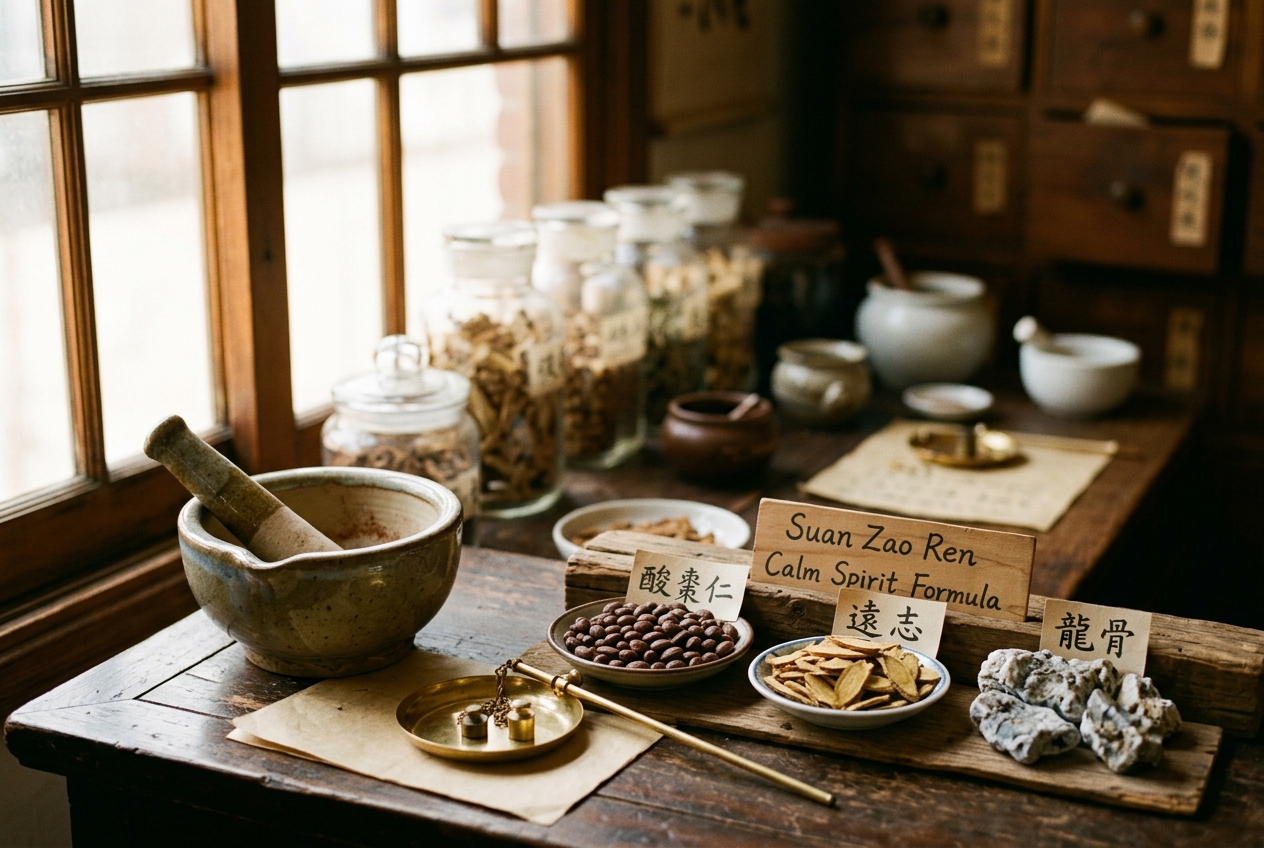
1. Opening Scene — A Moment You'll Recognise
It is 3:17 AM. You are abruptly awake, pulled from the shallow shallows of sleep not by an external sound, but by an internal percussion: your heart is thumping against your ribcage with an unsettling, fluttery cadence. Your mind, instantly electrified, begins racing through an endless loop of unresolved emails, half-remembered conversations, and catastrophic future scenarios. Your palms feel warm and dry, your throat slightly parched, and despite overwhelming physical exhaustion, your nervous system feels wired to a live high-voltage line. When you finally drift into a fitful slumber an hour later, it is punctuated by vivid, chaotic dreams of falling or being pursued, leaving you more depleted at sunrise than when your head first touched the pillow.
+-----------------------------------------------------------------------------+
|                           THE 3:00 AM PHENOMENON                            |
|                                                                             |
|  Physical Sensation: Paroxysmal tachycardia, chest flutter, dry throat       |
|  Cognitive State:   Hyper-associative ruminative loop, hyperarousal          |
|  TCM Diagnosis:     Heart-Blood & Yin Deficiency failing to anchor the Shen  |
|  Biomedical Axis:   Sympathovagal imbalance & HPA-axis glucocorticoid spike  |
+-----------------------------------------------------------------------------+
In the vocabulary of contemporary biomedicine, this nocturnal torment is categorized as hyperarousal of the autonomic nervous system, driven by a nocturnal surge of cortisol and an imbalance between sympathoexcitation and parasympathetic vagal tone. In Traditional Chinese Medicine (TCM), however, this experience represents a failure of the sovereign organ: your Heart (Xīn, 心) has lost its capacity to anchor the Shén (神)—the conscious spirit, emotional awareness, and cognitive clarity. The mind is floating unmoored like a boat whose anchor rope has snapped in a nocturnal gale.
2. What This Organ System Does: The Sovereign Emperor and the Neurocardiac Axis
In classical Chinese medical epistemology, the Heart is designated as the "Sovereign Ruler" (Jūn Zhǔ Zhī Guān, 君主之官), from whom spiritual clarity, perceptual coherence, and emotional wisdom emanate. Unlike the post-Cartesian Western division that strictly bifurcates the biological pump (the heart) from the seat of thought and affective processing (the brain), Chinese medical physiology conceives of the Heart as an integrated psychosomatic territory.
                      +-----------------------------+
                      |       THE SOVEREIGN (XĪN)   |
                      |   Master of Blood & Vessels |
                      +--------------+--------------+
                                     |
             +-----------------------+-----------------------+
             |                                               |
             v                                               v
+----------------------------+                 +----------------------------+
|    SOMATIC GOVERNANCE      |                 |    AFFECTIVE & COGNITIVE   |
|  Propels Xue (Blood)       |                 |  Houses the Shén (Spirit)  |
|  Manifests in the Complexion|                |  Controls Memory & Sleep   |
|  Opens to the Tongue       |                 |  Regulates Emotional Ease  |
+----------------------------+                 +----------------------------+
Classical texts describe two indivisible functions of the Heart: 1. Governing the Blood and Vessels (Zhǔ Xuè Mài, 主血脉): Mechanically circulating nourishment and systemic warmth throughout the micro- and macro-vasculature. 2. Housing the Spirit (Cáng Shén, 藏神): Anchoring the conscious mind, cognitive integration, long-term memory, and emotional equilibrium.
When Blood (Xuè) and Yin fluids are abundant, they provide a dense, cooling, physical substratum that anchors the immaterial, Yang-natured Spirit. The Shén resides peacefully within the Heart chamber during the night, producing deep, restorative slow-wave sleep. If Heart-Blood runs dry or Heart-Yin is depleted by chronic overwork, emotional strain, or constitutional frailty, the internal environment becomes desiccated and hot. Deprived of its anchoring matrix, the Shén becomes unrooted, drifting upward into the sensory portals, causing insomnia, paroxysmal anxiety, and hyper-associative mental restlessness.
Modern neurocardiology increasingly mirrors this classical perspective. The physical heart possesses its own intrinsic nervous system—the "heart-brain"—composed of roughly 40,000 sensory neurites capable of processing information, synthesizing neurotransmitters, and exerting significant afferent regulation over the amygdala, thalamus, and prefrontal cortex via the vagus nerve. According to research indexed on the National Center for Biotechnology Information (NCBI PubMed), vagal afferent feedback from the cardiovascular system directly modulates central emotional processing, demonstrating a profound biological substrate for the ancient axiom that the Heart governs mental and emotional life.
3. How You Can Feel It — Signs of Balance, Deficiency, and Hyperactivity
Understanding whether your Heart network is flourishing or faltering requires observing subtle shifts across your sleep architecture, cognitive agility, vascular tone, and emotional resilience.
+------------------------------------------------------------------------------------+
|                               DIAGNOSTIC MATRIX: THE HEART                         |
+----------------------+-----------------------------+-------------------------------+
| PARAMETER            | HARMONIOUS & BALANCED       | IMBALANCED & DYSREGULATED     |
+----------------------+-----------------------------+-------------------------------+
| Sleep Architecture   | Falls asleep <15 min;       | Sleep-onset latency >45 min;  |
|                      | Dreamless or peaceful;      | Waking at 1-3 AM; Vivid,      |
|                      | Wakes refreshed             | Panic-laden nightmares        |
+----------------------+-----------------------------+-------------------------------+
| Cognitive Processing | Coherent, steady focus;     | Brain fog, memory lapses;     |
|                      | Retentive memory            | Racing, fractured thoughts    |
+----------------------+-----------------------------+-------------------------------+
| Vascular & Sensory   | Warm extremities;           | Nocturnal palpitations;       |
|                      | Lustrous pink complexion;   | Flushed malar cheeks;         |
|                      | Clear articulate speech     | Tip of tongue crimson red     |
+----------------------+-----------------------------+-------------------------------+
| Affective Resonance  | Natural joy, calm poise,    | Free-floating dread, mania,   |
|                      | Unflappable equanimity      | Inappropriate giggling/grief  |
+----------------------+-----------------------------+-------------------------------+
The Pathological Bifurcation: Excess vs. Deficiency
In the clinical diagnostic arena, distress of the Heart and Shén divides into two distinct pathophysiological presentations:
- Deficiency Patterns (Xū Zhèng, 虚证): Heart-Blood or Heart-Yin deficiency. Manifests as a weak, thready pulse, pale or cracked tongue tip, mild startle response, low-grade chronic anxiety, forgetfulness, and difficulty staying asleep. The pathology is an absence of containment.
- Excess / Fire Patterns (Shí Zhèng, 实证): Heart-Fire blazing or Phlegm-Fire harassing the Heart. Manifests as intense restlessness, manic agitation, rapid bounding pulse, mouth and tongue ulcerations, bitter taste, and crimson tongue with thick yellow coating. The pathology is uncontrolled pathogenic heat.
Self-Assessment Check: Examine your tongue in natural daylight. Is the very tip distinctly redder than the rest of the body? Do you observe small red prickles or a central fissure extending toward the apex? If paired with nocturnal palpitations or restless sleep, your Heart network is displaying the classic signatures of unanchored Shén and thermal irritation.
4. Pharmacodynamics of Spirit-Calming Herbs (An Shen Yao)
In Chinese herbal pharmacology, herbs that stabilize the psyche and restore neurocardiac harmony are termed An Shen Yao (安神药, Spirit-Calming Herbs). They represent one of the most sophisticated functional classes in traditional materia medica, formally bifurcated based on whether they mechanically anchor wild pathogenic energy or nutritively replenish the cellular and vascular matrix.
                                  +---------------------------+
                                  |     AN SHEN YAO (安神药)   |
                                  |    Spirit-Calming Herbs   |
                                  +-------------+-------------+
                                                |
               +--------------------------------+--------------------------------+
               |                                                                 |
               v                                                                 v
+-------------------------------+                                 +-------------------------------+
|    ZHONG ZHEN AN SHEN YAO     |                                 |     YANG XIN AN SHEN YAO      |
|  (Heavy-Settling Mineral      |                                 |  (Heart-Nourishing Botanical  |
|         Anchors)              |                                 |          Sedatives)           |
+-------------------------------+                                 +-------------------------------+
| - Long Gu (Os Draconis)       |                                 | - Suan Zao Ren (Ziziphi Semen)|
| - Mu Li (Concha Ostreae)      |                                 | - Bai Zi Ren (Platycladi Semen)|
| - Ci Shi (Magnetitum)         |                                 | - Yuan Zhi (Polygalae Radix)  |
| - Zhu Sha (Cinnabaris)*       |                                 | - Ye Jiao Teng (Polygoni Caulis)|
|                               |                                 | - He Huan Pi (Albiziae Cortex)|
+-------------------------------+                                 +-------------------------------+
| MOA: Downregulates HPA axis;  |                                 | MOA: GABA_A allosteric        |
| Suppresses ascending cortical |                                 | potentiation; 5-HT1A agonism; |
| hyperarousal; binds excess Ca |                                 | Neurotrophic BDNF induction   |
+-------------------------------+                                 +-------------------------------+
Dual Classification & Mechanism of Action
1. Heavy-Settling / Anchor-Sedating Herbs (Zhòng Zhèn Ān Shén Yào, 重镇安神药)
Composed predominantly of dense fossilized bones, shells, and metallic ores, these agents possess dense specific gravity and cold or neutral energetics. They are indicated for acute crises of Yang ascendance: mania, extreme fright, panic attacks with soaring blood pressure, and violent palpitations. * Lóng Gǔ (Os Draconis): Fossilized mammal bone rich in calcium phosphate ($Ca_3(PO_4)_2$), calcium carbonate, and trace elements (Fe, Mg, K). Energetically astringent and heavy, it enters the Heart, Liver, and Kidney channels. Pharmacologically, it blunts sympathetic outflow, reduces central monoaminergic hyperactivity, and binds membrane receptors to suppress neuronal hyperexcitability. * Mǔ Lì (Concha Ostreae): Calcified oyster shell consisting of >90% calcium carbonate along with zinc and copper. It softens hardness, anchors floating Liver-Yang, and neutralizes stomach acid. Synergizes with Long Gu to halt sweating and consolidate leaking vital fluids. * Cí Shí (Magnetitum): Ferrosoferric oxide ($Fe_3O_4$). Enters the Kidney and Liver channels, drawing ascending fire downward to restore auditory acuity (tinnitus), relieve tremors, and anchor the breath. * Zhū Shā (Cinnabaris): Mercuric sulfide ($\alpha\text{-HgS}$). Historically used for extreme mania and delirium due to its potent central depressant effects. Contemporary toxicology mandates strict avoidance or extreme caution due to bioaccumulation and renal/neurological toxicity; it is now largely replaced in modern rational practice by botanical or non-toxic mineral alternatives.
2. Heart-Nourishing / Spirit-Quieting Herbs (Yǎng Xīn Ān Shén Yào, 养心安神药)
Botanical seeds, barks, and vines characterized by sweet, sour, or neutral properties. They nourish Heart-Blood, replenish Kidney-Yin, and tonify the neurological substrate to gently induce restorative sleep and dissipate chronic anxiety. * Suān Zǎo Rén (Ziziphi Spinosae Semen): The preeminent sovereign botanical sedative. Contains the C-glucosylflavonoid spinosin, triterpenoid saponins (jujubosides A, B, and $A_1$), and betulinic acid. * Bǎi Zǐ Rén (Platycladi Semen): Fatty-oil rich seed of Platycladus orientalis. Rich in cedrol and pinene, it moistens intestinal dryness while nourishing Heart-Blood, making it ideal for anxious insomnia accompanied by chronic constipation. * Yuǎn Zhì (Polygalae Radix): The root of Polygala tenuifolia. Contains triterpenoid saponins (tenuifolin, senegenin) and xanthones. Unique in its ability to unblock communication between the Heart (Fire) and Kidney (Water) while dissolving neuro-phlegm that clouds the intellect, enhancing cognitive retention and mood. * Yè Jiāo Téng (Polygoni Multiflori Caulis): The vine of Polygonum multiflorum. Unblocks the collateral vessels, clears inflammatory blood heat, and anchors dream-disturbed sleep. * Hé Huān Pí (Albiziae Cortex): Bark of the Persian silk tree (Albizia julibrissin). Renowned as the "herb of collective happiness," it relieves Liver-Qi stagnation, promotes microcirculation, resolves melancholia, and calms emotional grief without inducing lethargy.
Biocognitive & Neuropharmacological Correlates
Contemporary pharmacological research published in journals such as the Frontiers in Pharmacology and the Journal of Ethnopharmacology has decoded the multi-target mechanisms of An Shen Yao:
- GABAergic Neurotransmission Modulation:
- Spinosin and jujuboside A from Suan Zao Ren function as positive allosteric modulators at the $\text{GABA}_A$ receptor complex, binding sites adjacent to classic benzodiazepine receptors. This increases chloride ion channel opening frequency, hyperpolarizing postsynaptic membranes and diminishing wake-promoting neuronal firing in the locus coeruleus and tuberomammillary nucleus.
- Crucially, unlike synthetic benzodiazepines, spinosin does not alter normal sleep architecture, avoiding the suppression of deep slow-wave sleep and rapid eye movement (REM) cycles, thereby preventing daytime grogginess or dependence.
- Serotonergic (5-HT) and Dopaminergic Orchestration:
- Compounds in Albiziae Cortex and Polygalae Radix modulate the $5\text{-HT}_{1A}$ receptor subsystem. Senegenin attenuates monoamine oxidase (MAO) enzymatic degradation of dopamine and norepinephrine, preserving synaptic plasticity and producing pronounced anxiolytic and antidepressant activities.
- HPA-Axis Downregulation:
- Chronic stress hyperactivates the hypothalamic-pituitary-adrenal (HPA) axis, bathing neural structures in corticotropin-releasing hormone (CRH) and cortisol. The mineral anchors (Long Gu, Mu Li) in combination with Suan Zao Ren significantly attenuate serum corticosterone levels, downregulating c-Fos gene expression within the paraventricular nucleus (PVN) of the hypothalamus and blunting autonomic hyperarousal.
- Neurotrophic and Anti-Neuroinflammatory Action:
- Tenuifolin and polygalasaponins from Yuan Zhi cross the blood-brain barrier to stimulate Brain-Derived Neurotrophic Factor (BDNF) synthesis and activate the TrkB/Akt/mTOR signaling cascade, preventing hippocampal synaptic degradation and neuroinflammation induced by microglial activation. Further details on neurotransmitter kinetics can be referenced via the NCBI Bookshelf on Neurotransmitter Systems.
5. Classic Formulations, Processing Alchemy (Pao Zhi), and Toxicology
The true elegance of TCM spirit-calming therapeutics emerges from polyherbal architecture—where botanical constituents and mineral lattices are assembled to achieve synergistic pharmacokinetics.
+----------------------------------------------------------------------------------------------------+
|                                    CLASSIC PHARMACOLOGICAL FORMULATIONS                            |
+------------------------------+-------------------------------------+-------------------------------+
| FORMULA                      | COMPOSITION & TIERING               | CLINICAL PHARMACODYNAMICS     |
+------------------------------+-------------------------------------+-------------------------------+
| Suān Zǎo Rén Tāng            | Monarch: Chao Suan Zao Ren (18-30g) | Potentiates GABAergic tone,   |
| (Sour Jujube Decoction)      | Minister: Fu Ling, Zhi Mu           | cools internal deficiency heat|
|                              | Assistant: Chuan Xiong, Gan Cao     | modulates cerebral perfusion, |
|                              |                                     | eliminates insomnia & anxiety |
+------------------------------+-------------------------------------+-------------------------------+
| Tiān Wáng Bǔ Xīn Dān         | Monarch: Sheng Di Huang             | Deeply enriches Kidney-Heart  |
| (Emperor of Heaven Special   | Minister: Suan Zao Ren, Bai Zi Ren, | Yin; provides dense nutrient  |
| Heart-Nourishing Pill)       | Tian Dong, Mai Dong                 | base to anchor severe unrooted|
|                              | Assistant: Dang Gui, Yuan Zhi       | Shén with night sweats & grief|
+------------------------------+-------------------------------------+-------------------------------+
| Chái Hú Jiā Lóng Gǔ Mǔ Lì    | Monarch: Chai Hu, Huang Qin         | Combines mineral ballast with |
| Tāng (Bupleurum, Dragon Bone | Minister: Long Gu, Mu Li, Sheng Jiang| Liver-Qi clearing botanicals;  |
| & Oyster Shell Decoction)    | Assistant: Gui Zhi, Ban Xia, Da Huang| breaks manic-depressive cycles|
|                              |                                     | and severe autonomic panic    |
+------------------------------+-------------------------------------+-------------------------------+
Processing Alchemy (Pào Zhì, 炮制)
The biological activity of spirit-calming herbs is profoundly altered by classical pharmaceutical processing techniques: * Stir-Frying Suan Zao Ren (Chǎo Suān Zǎo Rén, 炒酸枣仁): Raw Suan Zao Ren contains thermolabile constituents that can exert a mild awakening effect. Gentle stir-frying until the seed coat crackles causes partial decarboxylation and significantly enhances the aqueous solubility of spinosin and jujuboside fractions. Clinical trials confirm that Chao Suan Zao Ren demonstrates a markedly greater sedative index and hypnotic depth than the unroasted botanical. * Calcining Mineral Anchors (Duàn Lóng Gǔ / Duàn Mǔ Lì, 煅龙骨/煅牡蛎): Subjecting Long Gu and Mu Li to high-temperature calcination transforms dense crystalline calcium structures into porous, amorphous calcium oxides and carbonates. This drastically increases mineral bioavailability during decoction, transitions their energetics from dispersing to powerfully astringent, and optimizes their capacity to bind acidic metabolic wastes.
Toxicological Safeguards and Prescribing Boundaries
- Mercury Toxicity (Zhu Sha): Cinnabar contains toxic mercuric compounds. Ingestion of unrefined, heated, or chronically administered Zhu Sha leads to irreversible nephrotoxicity, neurotoxicity, and hepatotoxicity. Modern consensus rejects its routine internal use, substituting heavy botanical and calcium-based mineral combinations.
- Mineral Satiation and Spleen Depletion: High doses of mineral anchors (Long Gu, Mu Li, Ci Shi) are heavy, cold, and difficult for the gastrointestinal system to digest. Prolonged use without harmonizing agents (such as Sheng Jiang or Bai Zhu) can impair digestive transformation (Pi Qi), leading to epigastric fullness, anorexia, and loose stools.
6. Academic Synthesis Matrix
| Pharmacological Agent (Pinyin / Botanical / Mineral) | Classical Channel Tropism & Temperature | Primary Bioactive Constituents | Target Neurobiological Pathways | Definitive Clinical Indications |
|---|---|---|---|---|
| Suān Zǎo Rén (Ziziphi Spinosae Semen) | Heart, Liver, Gallbladder, Spleen (Neutral) | Spinosin, Jujubosides A & B, Betulinic Acid, Ferulic Acid | $\text{GABA}A$ receptor positive allosteric modulation; $5\text{-HT}{1A}$ receptor activation | Sleep-onset latency, insomnia, night sweats, free-floating anxiety, dry throat. |
| Bǎi Zǐ Rén (Platycladi Semen) | Heart, Kidney, Large Intestine (Neutral) | Cedrol, Pinene, Fatty Glycerides, Sitosterol | Central autonomic down-regulation; enteric nervous system lubrication | Palpitations with memory deficit, nocturnal terrors, anxiety combined with dry stool constipation. |
| Yuǎn Zhì (Polygalae Radix) | Heart, Kidney, Lung (Slightly Warm) | Tenuifolin, Senegenin, Polygalasaponins, Polygalitol | BDNF upregulation; TrkB/Akt cascade activation; MAO enzyme inhibition | Dysalignment of Heart and Kidney, emotional numbness, brain fog, chest fullness with thick phlegm. |
| Hé Huān Pí (Albiziae Cortex) | Heart, Liver (Neutral) | Julibrosides (A1-A4), Albizzine, Lignan Glycosides | $5\text{-HT}_{1A}$ agonism; suppression of pro-inflammatory cytokines (IL-6, TNF-$\alpha$) | Melancholia, grief, emotional constriction, insomnia secondary to Liver-Qi depression. |
| Yè Jiāo Téng (Polygoni Multiflori Caulis) | Heart, Liver (Neutral) | Anthraquinones, Emodin, Stilbene Glycosides, Tannins | Endothelial nitric oxide synthase modulation; microvascular clearance | Generalized pruritus, restless legs syndrome, dream-disturbed sleep with generalized soreness. |
| Lóng Gǔ (Os Draconis / Fossilia Ossis Mastoidei) | Heart, Liver, Kidney (Neutral, Astringent) | Calcium Phosphate, Calcium Carbonate, Trace Minerals (Fe, Mg) | Neuronal membrane stabilization; suppression of central monoaminergic surges | Panic attacks with soaring pulse, unanchored Yang delirium, fright-induced palpitations. |
| Mǔ Lì (Concha Ostreae) | Liver, Kidney (Slightly Cold, Salty) | Calcium Carbonate ($>90\%$), Zinc, Copper, Amino Acids | HPA-axis normalization; gastric acid neutralization; thyroid axis stabilization | Hypertension with dizziness, night sweats, malar flush, restless agitation from Yin deficiency. |
| Cí Shí (Magnetitum) | Kidney, Liver (Cold, Pungent) | Ferrosoferric Oxide ($Fe_3O_4$), Trace Cobalt and Titanium | Downregulation of ascending reticular activating system (ARAS) | High-pitched tinnitus, visual disturbances, severe insomnia with auditory hyperarousal. |
7. Qigong & Movement Practice: The Heart Harmonising Practice (Lìu Zì Jué - Hē)
To actively restore coherence between the Heart’s electromagnetic field, vagal tone, and emotional consciousness, the ancient practice of the Six Healing Sounds (Lìu Zì Jué, 六字诀) provides an accessible neuro-somatic exercise. This specific practice uses the Heart-clearing sound "Hē" (pronounced her / haa) combined with targeted diaphragmatic kinematics to evacuate accumulated metabolic heat and downregulate sympathetic fight-or-flight states.
Step-by-Step Movement Protocol
- Starting Stance (Wújí, 无极):
- Stand with feet shoulder-width apart, knees micro-bent (never locked), weight distributed evenly across the tripod of each foot.
- Tuck the tailbone slightly to release the lumbar spine (Mìngmén), drop the shoulders, and suspend the crown of the head as if drawn upward by a silk thread.
- Rest the tip of the tongue gently against the upper palate behind the incisors to complete the energetic circuit.
- Inhalation & Ascending Phase:
- Inhale slowly through the nose over a count of 4, expanding the lower abdomen (Dāntián) 360 degrees.
- Simultaneously, bring both hands up along the midline of the torso with palms facing upward, fingers loosely pointing toward each other.
- Bring the hands to the level of the sternum (the Heart center, Dànzhōng, CV-17). Feel an open, buoyant sensation across the chest.
- The "Hē" Exhalation & Settling Phase:
- Rotate the palms to face downward.
- Begin a slow, controlled exhalation over a count of 8 through a slightly opened mouth, shaping the lips into a soft oval.
- Vocalize the subaudible, guttural sound "Hēēēē"—it should be soft, vibrating in the center of the chest rather than the throat, like warm breath fogging a mirror in cold weather.
- Simultaneously press the palms downward toward the lower abdomen, visualizing excess crimson heat, mental agitation, and frantic thoughts descending through the soles of your feet into the earth.
- Repetitions and Duration:
- Perform 6 to 12 complete breath cycles every evening before sleep or during acute moments of emotional overwhelm.
- Sensations to Observe:
- A spreading warmth in the center of the chest followed by deep somatic decompression, a spontaneous yawn, an increase in salivary flow (a direct biomarker of parasympathetic vagal re-engagement), and a noticeable slowing of resting heart rate.
8. Acupressure Points You Can Try Today
Targeting specific neurological nodes along the Heart and Pericardium meridians can alleviate acute autonomic arousal, reduce insomnia, and quiet an unsettled mind.
+----------------------------------------------------------------------------------------------------+
|                                    TARGETED ACUPRESSURE PROTOCOLS                                  |
+--------------------------+-------------------------------------+-----------------------------------+
| POINT NAME               | ANATOMICAL LOCATION                 | CLINICAL ACTION & PRESSURE GUIDE  |
+--------------------------+-------------------------------------+-----------------------------------+
| Shénmén (HT-7, 神门)     | Located at the inner wrist crease,  | Apply firm, circular pressure     |
| "Spirit Gate"            | in the depression on the radial side| with the thumb for 2-3 minutes.   |
|                          | of the flexor carpi ulnaris tendon, | Calms emotional tremors,          |
|                          | just proximal to the pisiform bone. | extinguishes sleep-onset anxiety, |
|                          |                                     | and stabilizes racing heart rate. |
+--------------------------+-------------------------------------+-----------------------------------+
| Nèiguān (PC-6, 内关)     | On the palmar aspect of the forearm,| Press directly downward between   |
| "Inner Pass"             | two thumb-widths (2 cun) above the  | the tendons with moderate-firm    |
|                          | distal wrist crease, between the two| pressure for 2 minutes per arm.   |
|                          | prominent tendons (palmaris longus  | Relieves nausea, dissolves chest  |
|                          | and flexor carpi radialis).         | tightness, and halts panic waves. |
+--------------------------+-------------------------------------+-----------------------------------+
| Yìntáng (EX-HN3, 印堂)   | Located at the midpoint between the | Use the pad of the middle finger  |
| "Hall of Impression"     | medial ends of the two eyebrows,    | to perform slow, upward strokes or|
|                          | directly over the frontal bone.     | steady compression for 3 minutes. |
|                          |                                     | Downregulates prefrontal chatter  |
|                          |                                     | and induces deep mental silence.  |
+--------------------------+-------------------------------------+-----------------------------------+
9. Food & Lifestyle — Small Changes for Today
Restoring the Heart-Blood and cooling unanchored Shén does not require rare, inaccessible botanicals. It begins with accessible dietary choices and deliberate daily habits that respect your body's circadian biology.
       ADD TO DIET (Nourishing & Cooling)            REDUCE / ELIMINATE (Hyper-Exciting)
       ==================================            ===================================
       • Red Jujube Dates (Da Zao)                   • Late-night high-caffeine beverages
       • Lotus Seeds (Lian Zi)                       • High-proof spirits & spicy dinners
       • Dark Sour Cherries & Berries                • Blue-light screens 60 min before bed
       • Magnesium-rich Steamed Greens               • Intensive cardiovascular workouts after 8 PM
       • Calming Chamomile & Oatstraw infusions      • Highly processed, high-sodium snacks
1. Dietary Therapy: Nourish Blood and Clear Internal Heat
- Embrace the Color Red and the Bitter Flavor: In five-phase (Wǔ Xíng) pharmacology, red nourishes the Heart Blood, while mild bitter flavors clear excess Heart-Fire. Integrate red dates (Dà Zǎo), goji berries, dark red cherries, and pomegranates into morning oatmeal or stews.
- The Power of Sour (Suān): The sour flavor is astringent—it prevents vital fluids from draining away. A warm cup of water with a dash of organic tart cherry juice or unsweetened lemon water in the afternoon helps pull floating heat inward.
- Cooked Lotus Seeds (Lián Zǐ): Readily found in Asian grocers and health food stores, dried white lotus seeds tonify Spleen-Qi while calming the Heart. Simmer 10–12 seeds in a slow-cooked vegetable broth or rice porridge (congee) twice weekly.
- Foods to Drastically Limit: Avoid fiery, thermogenic spices (such as excessive raw chili, cayenne, black pepper, and high-proof alcohol) in the evening. Avoid late-night meals rich in processed sugars, which spike nocturnal insulin and cortisol, triggering the exact 3:00 AM awakenings described above.
2. Circadian and Lifestyle Alignment
- The Noon Rest (Wǔ Jiào, 午休): The Heart channel reaches its peak circadian flow between 11:00 AM and 1:00 PM. Taking a 15-to-20-minute pause from screens, sitting in stillness, or taking a brief nap during this window rests the Sovereign organ and preserves afternoon mental clarity.
- Thermal Foot Baths Before Bed: Soaking your feet in warm water (optionally with magnesium salts) for 15 minutes before bed pulls stagnant blood flow away from an overstimulated head down toward the Yǒngquán (KID-1) point on the soles of the feet, grounding your energy and preparing the body for deep rest.
10. Today's Takeaway
If you do only one thing for your Heart and Shén today, let it be this five-minute evening reset: At bedtime, disconnect from all digital devices, sit upright on the edge of your bed, and place your right thumb firmly on Shénmén (HT-7) at your left inner wrist. Close your eyes, inhale deeply into your lower belly for a count of four, and exhale softly with the soothing "Hē" sound for a count of eight, repeating this cycle twelve times before switching wrists. By physically stimulating the ulnar nerve pathway while engaging diaphragmatic vagal braking, you clear mental turbulence, anchor your floating Shén, and build a biological bridge to peaceful, uninterrupted sleep.
External References & Scientific Reading
- WHO Traditional Medicine Global Initiative — Global benchmarks in pharmacognosy and safety validation.
- NCBI PubMed Database — Clinical trials on Ziziphus spinosa, spinosin pharmacology, and GABAergic modulation.
- Journal of Ethnopharmacology — Comprehensive phytochemical analyses of An Shen Yao botanicals and synergy.
- Frontiers in Pharmacology — Research on neurobiological correlates of traditional sedative-hypnotic formulations.
- NCBI Bookshelf: Neurotransmitter Systems — Neurochemical pathways, monoamine metabolism, and postsynaptic signaling mechanics.
- Wikipedia: Traditional Chinese Medicine — Foundational organ theory, five-element frameworks, and diagnostic classifications.