Spirit-Calming Formulas (An Shen Ji) Prescription Dynamics: Governing Heavy-Settling Shen Anchoring, Heart-Blood Nourishment, Neuropsychiatric Tranquilization, and Sleep-Wake Homeostasis in Traditional Chinese Medicine
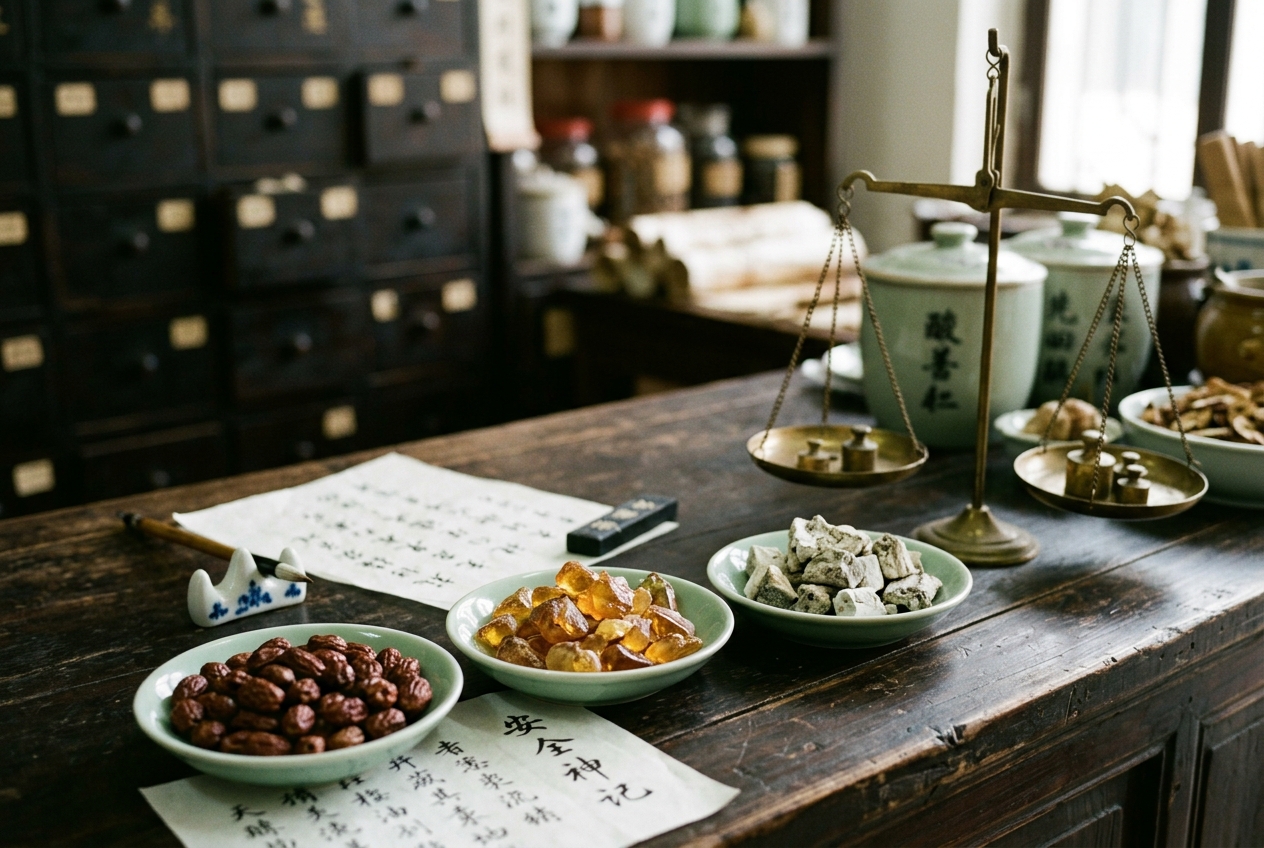
The clinical management of neuropsychiatric, psychosomatic, and sleep disorders occupies a foundational position within classical Sinitic internal medicine (Zhong Yi Nei Ke Xue). Central to this therapeutic domain is the category of Spirit-Calming Formulas (An Shen Ji, 安神劑), a sophisticated pharmacopoeial system engineered to modulate the psycho-emotional entity termed the Shen (神, Spirit/Mind). In Traditional Chinese Medicine (TCM) ontology, the Shen is not merely an abstract philosophical construct, but the overarching manifestation of vitality, consciousness, emotional equilibrium, and cognitive integration housed within the vascular and energetic matrix of the Heart (Xin, 心). When the delicate energetic homeostasis of the viscera (Zang-Fu, 臟腑) is disrupted by endogenous emotional turbulence, chronic metabolic stress, or exogenous pathogens, the Shen becomes untethered—giving rise to a spectrum of conditions designated as Shen Zhi Bing (神志病, Spirit-Mind Disorders).
To resolve these disturbances, classical formulary science developed a profound bifurcation: Heavy-Settling Spirit-Calming (Zhong Zhen An Shen, 重鎮安神) and Heart-Nourishing Spirit-Calming (Yang Xin An Shen, 養心安神). This structural analysis deconstructs the theoretical taxonomy, sovereign-minister-assistant-courier (Jun-Chen-Zuo-Shi) formula architectures, classical mineral and botanical pharmacology, contemporary neurobiological correlates, and practical clinical deployment of these foundational prescriptions.
1. Theoretical Foundations & Diagnostic Taxonomy of Shen Disturbance (Shen Zhi Bing)
Pathophysiological Etiology and the Visceral Axis
Classical psychosomatics posits that cognitive-affective functions are distributed across the five Yin viscera (Wu Zang, 五臟), each anchoring a distinct psychological faculty: 1. Heart (Xin): Houses the Shen (神, Consciousness, Coherence, Joy). 2. Liver (Gan): Stores the Hun (魂, Ethereal Soul, Vision, Ideation, Subconscious processing). 3. Spleen (Pi): Houses the Yi (意, Intellect, Intent, Cognitive processing, Reflection). 4. Lung (Fei): Stores the Po (魄, Corporeal Soul, Somatosensory integration, Instinct). 5. Kidney (Shen): Stores the Zhi (志, Willpower, Drive, Core Constitutional Memory).
Within this network, the Heart acts as the Monarch (Jun Zhu Zhi Guan, 君主之官). Its optimal function requires a continuous supply of Heart Blood (Xin Xue) and Heart Yin (Xin Yin) to provide an anchoring physical substratum (Yi Xue An Shen, 以血安神), paired with the clear descent of physiological fire (Xin Huo) to communicate harmoniously with the water of the Kidneys (Shen Shui). When this balance is compromised, Shen Zhi Bing manifests across a diagnostic continuum ranging from mild restlessness (Fan Zao), dream-disturbed sleep (Duo Meng), and panic-induced palpitations (Jing Ji / Zheng Chong) to severe mania (Kuang), cognitive withdrawal (Dian), and visceral agitation (Zang Zao).
Diagnostic Taxonomy: Excess vs. Deficiency Paradigms
Pathology is broadly categorized into two fundamental paradigms:
A. Excess Patterns (Shi Zheng, 實證)
Characterized by pathogenic agents (Heat, Fire, Phlegm, Counterflow Qi) aggressively agitating the Heart orifices or driving the Hun outward. - Phlegm-Fire Harassing the Heart (Tan Huo Rao Xin, 痰火擾心): Turbid phlegm coalesces with internal heat, obstructing the pericardial pericardial channels (Xin Bao Luo) and clouding the orifices. Manifests as aggressive insomnia, manic behavior, incoherent speech, a crimson tongue with slimy yellow coating, and a slippery, rapid (Hua Shu) pulse. - Hyperactive Liver Yang / Liver Fire Ascending (Gan Yang Shang Kang / Gan Huo Shang Yan): Unresolved emotional frustration leads to Qi stagnation (Qi Yu), which transforms into fire (Hua Huo). Fire ascends through the Jueyin channel, agitating the cerebral vessels. Manifests as throbbing headache, temporal distension, ocular injection, tinnitus reminiscent of rushing water, sudden anger, and a wiry, forceful (Xian Shuo) pulse. - Rebellious Counterflow of Chong and Heart Qi (Chong Qi Shang Ni): Somatized panic accompanied by ascending epigastric surges, severe palpitations, and motor restlessness.
B. Deficiency Patterns (Xu Zheng, 虛證)
Characterized by an insufficient material substrate (Blood, Yin, Essence) failing to house and nourish the Shen, leaving it unanchored and vulnerable to ambient perturbations. - Heart-Spleen Dual Deficiency (Xin Pi Liang Xu, 心脾兩虛): Chronic mental overexertion or nutritional depletion impairs the Spleen's ability to generate blood, starving the Heart. Symptoms include difficulty falling asleep, excessive dreaming, waking with profound fatigue, chronic paleness, anorexia, memory impairment, pale tongue, and a fine, weak (Xi Ruo) pulse. - Yin Deficiency with Effulgent Fire (Yin Xu Huo Wang, 陰虛火旺): Renal Yin (Shen Yin) exhaustion fails to ascend and moisten the upper burner, allowing Heart Fire to flare unchecked. Symptoms include severe restlessness, nocturnal waking accompanied by night sweats (Dao Han), dry throat, five-center heat (Wu Xin Fan Re), red tongue body with stripped coating, and a thin, rapid (Xi Shu) pulse. - Heart-Kidney Disharmony (Xin Shen Bu Jiao, 心腎不交): Loss of the physiological communication between Heart Fire (Yang) descending to warm Kidney Water, and Kidney Water (Yin) ascending to cool Heart Fire. Characterized by nocturnal panic, lumbar soreness, seminal emission, and acute existential dread.
The Therapeutic Bifurcation
This precise diagnostic distinction governs the fundamental therapeutic bifurcation in formula selection: 1. Heavy-Settling Spirit-Calming (Zhong Zhen An Shen Ji): Employs dense, heavy mineral, fossil, and shell substances (Zhong Zhen Zhi Pin) possessing downward vector dynamics to forcefully anchor floating Yang, suppress counterflow Qi, and extinguish blazing internal fire. Reserved primarily for acute, severe excess patterns. 2. Heart-Nourishing Spirit-Calming (Yang Xin An Shen Ji): Employs sweet, sour, moistening, and nutritive botanical and seed substances (Gan Run Zhi Pin) to tonify Heart Blood, enrich Kidney Yin, clear empty heat, and gently soothe the Mind. Reserved for subacute and chronic deficiency patterns.
2. Classical Heavy-Settling Formulations (Zhong Zhen An Shen Ji)
Heavy-settling formulas are governed by the classical maxim from the Shennong Bencao Jing and the Nei Jing: "Heaviness can settle the unanchored" (重可去怯, 重以鎮逆). Dense mineral and shell agents possess high specific gravities, yielding deep descending vectors that physically arrest rebellious energetic surges.
Deconstructive Architecture of Primary Formulations
1. Zhu Sha An Shen Wan (朱砂安神丸, Cinnabar Sedative Pill)
Original Source: Li Gao (Dongyuan), Yi Xue Fa Ming (醫學發明)
Zhu Sha An Shen Wan is the archetypal emergency formula designed for the pattern of Heart Fire Blazing with Blood Deficiency, where excess fire agitates the upper burner while underlying blood deficiency fails to hold the spirit.
- Sovereign (Jun): Zhu Sha (朱砂, Cinnabaris). Dense, cold, and red. It enters the Heart channel directly to heavily settle floating fire and quiet the agitated Shen.
- Minister (Chen): Huang Lian (黃連, Rhizoma Coptidis). Intensely bitter and cold. It drains Heart Fire (Xie Xin Huo) directly from the upper burner, neutralizing the pathological heat that drives restlessness.
- Assistants (Zuo):
- Sheng Di Huang (生地黃, Radix Rehmanniae): Sweet, bitter, cold. Enriches Heart and Kidney Yin to quench empty heat.
- Dang Gui (當歸, Radix Angelicae Sinensis): Sweet, acrid, warm. Nourishes Heart Blood to provide the physical substrate needed to harbor the Shen.
- Courier (Shi): Zhi Gan Cao (炙甘草, Radix Glycyrrhizae Preparata). Harmonizes the harsh coldness of Huang Lian and Zhu Sha while tonifying Middle Burner Qi to protect gastric physiology.
2. Ci Zhu Wan (磁朱丸, Magnetite and Cinnabar Pill)
Original Source: Sun Simiao, Beiji Qian Jin Yao Fang (備急千金要方)
Ci Zhu Wan represents a specialized dual-mineral dynamic engineered for Heart-Kidney Disharmony with Blazing Yang and Ascending Sensory Disturbance, characterized by severe insomnia accompanied by visual hallucinations, tinnitus, deafness, and manic delirium.
- Sovereign Architecture: Ci Shi (磁石, Magnetitum) paired with Zhu Sha (朱砂, Cinnabaris). Ci Shi is heavy, acrid, salty, and cold; it enters the Kidney channel to heavily anchor floating Yang downward into the lower dantian while simultaneously restoring auditory acuity (Cong Er Ming Mu). Zhu Sha enters the Heart to clear heat and pacify the Shen. This pairing establishes a magnetic-sedative polarity: Ci Shi draws Yang down into the Kidney water reservoir, while Zhu Sha clears residual flaring heat from the Heart vessel.
- Assistant/Courier: Shen Qu (神曲, Massa Medicata Fermentata). Warm, sweet, pungent. Dense minerals severely impair gastric peristalsis; Shen Qu promotes digestion, dissolves stagnation, and ensures mineral uptake without cloying the Spleen-Stomach axis.
3. Chai Hu Jia Long Gu Mu Li Tang (柴胡加龍骨牡蠣湯, Bupleurum plus Dragon Bone and Oyster Shell Decoction)
Original Source: Zhang Zhongjing, Shanghan Lun (傷寒論)
Engineered for complex Multi-Channel Pathology involving concurrent Taiyang, Shaoyang, and Yangming patterns following the improper purgation of an exterior disease. Pathological heat enters the interior and agitates the Liver-Gallbladder axis, generating rebellious counterflow Qi, somatized dread, tremors, urinary difficulty, and acute neuropsychiatric instability.
The synergy between Long Gu (龍骨, Fossilia Ossis Mastodi) and Mu Li (牡蠣, Concha Ostreae) forms the mineral-shell core of this prescription. Long Gu pacifies the Liver (Zhen Gan) and calms the Hun; Mu Li softens hardness (Ruan Jian), drains fire, and anchors floating Yang. Together with Gui Zhi (桂枝, Ramulus Cinnamomi), they stabilize the autonomic nervous system by harmonizing the exterior and unblocking internal vessel Qi.
Pharmacognosy of Dense Mineral Agents
- Long Gu (Fossilia Ossis Mastodi): Fossilized mammalian bones rich in calcium carbonate ($\text{CaCO}_3$), calcium phosphate ($\text{Ca}_3(\text{PO}_4)_2$), iron, magnesium, and trace elements. Possesses astringent (Shou Lian) and heavily anchoring qualities.
- Mu Li (Concha Ostreae): Calcified shell of Ostrea gigas, composed of greater than 90% calcium carbonate alongside bioactive micro-peptides. Counters hyperactive Liver Yang and suppresses gastric acid counterflow.
- Ci Shi (Magnetitum): Ferrous-ferric oxide ($\text{Fe}_3\text{O}_4$). Salty, cold, entering Kidney and Liver channels. Restores physiological descent of Qi and sharpens cerebral/sensory processing.
- Zhu Sha (Cinnabaris): Mercuric sulfide ($\text{HgS}$). Intensely heavy, red, cold. Directs downward force into the vascular beds of the Heart.
Safety, Toxicology, and Administration Parameters
[!WARNING] TOXICOLOGICAL ALERT: PROCESSING AND ADMINISTRATION OF CINNABARIS (ZHU SHA) Zhu Sha consists primarily of mercuric sulfide ($\text{HgS}$). When subjected to thermal processing (heating or decoction), $\text{HgS}$ undergoes thermal decomposition and oxidizes into highly toxic free elemental mercury ($\text{Hg}$) and mercuric oxide ($\text{HgO}$), which cross the blood-brain barrier and cause irreversible neuro-renal damage.
- Pao Zhi Requirement: Must NEVER be heated. It must be prepared exclusively through Water Levigation (Shui Fei, 水飛)—a meticulous wet-grinding method in cold purified water that precipitates heavy sediments and yields an ultra-fine, pure micro-powder.
- Dosage Parameters: Internal dosage must be strictly limited to 0.1 to 0.5 grams per day, administered in capsules or suspended directly in strained decoctions.
- Duration Limits: Administration must NOT exceed 3 to 7 consecutive days. It is strictly contraindicated in patients with renal impairment, hepatic dysfunction, or during pregnancy and lactation.
- Digestive Protection: High specific gravity minerals mechanically impede gastrointestinal motility. Prescriptions containing dense minerals must always be balanced with aromatic digestive stimulants (such as Shen Qu, Sha Ren, or Chen Pi) and decocted first (Xian Fen, 先煎) for 30–60 minutes to extract soluble salts while preventing digestive stagnation.
Authoritative regulatory analyses and pharmacological monographs on mineral substance safety can be cross-referenced via the World Health Organization Traditional Medicine Guidelines and toxicological evaluations indexed on PubMed.
3. Classical Heart-Nourishing Formulations (Yang Xin An Shen Ji)
Heart-Nourishing Spirit-Calming formulas address systemic depletion. They operate via sweet (Gan), sour (Suan), moistening (Run), and tonifying (Bu) dynamics, replenishing depleted fluids to anchor the Shen naturally without imposing harsh mechanical sedation.
Deconstructive Architecture of Primary Tonifying Formulations
1. Suan Zao Ren Tang (酸棗仁湯, Sour Jujube Decoction)
Original Source: Zhang Zhongjing, Jin Gui Yao Lue (金匱要略)
Suan Zao Ren Tang is the premier formula for Liver Blood Deficiency with Internal Deficiency Fire (Xu Lao Xu Fan, 虛勞虛煩), in which depleted Liver blood fails to house the Hun, precipitating restless insomnia, nocturnal hyperarousal, and night sweats.
- The Suan Zao Ren – Chuan Xiong Dynamic: A classic pairing (Dui Yao). Suan Zao Ren is sour, sweet, and astringent, functioning to gather floating Yin and replenish Liver Blood. However, sour tonics risk congealing Liver Qi (Suan Shou Zhi Qi). The addition of a small amount of Chuan Xiong (acrid, warm, dispersing) dredges Liver Qi, unblocks microcirculation, and circulates blood to the cerebral vessels. This "one astringing, one dispersing" (Yi Shou Yi San) mechanism allows blood to be replenished without inducing stagnation.
- The Zhi Mu – Fu Ling Synergy: Zhi Mu clears empty fire from the Lung and Kidney channels while moistening dryness. Fu Ling calms the Shen and safeguards the Middle Burner against damp accumulation.
2. Tian Wang Bu Xin Dan (天王補心丹, Heavenly King Heart-Nourishing Elixir)
Original Source: Daoist Master Hongji, recorded in Wang Kentang's Zheng Zhi Zhun Sheng (證治準繩)
Tian Wang Bu Xin Dan is indicated for Severe Yin Deficiency with Deficient Fire Agitating the Heart and Kidneys (Xin Shen Yin Xu, Xu Huo Shang Yan).
The incorporation of Jie Geng (Radix Platycodonis) as an ascending courier (Shang Xing Zhi Shi) ensures that this dense, Yin-enriching formula is carried upward to the chest and brain rather than sinking immediately into the lower burner.
3. Gan Mai Da Zao Tang (甘麥大棗湯, Licorice, Wheat, and Jujube Decoction)
Original Source: Zhang Zhongjing, Jin Gui Yao Lue (金匱要略)
Gan Mai Da Zao Tang is an elegant, three-ingredient prescription designed specifically for Visceral Agitation Syndrome (Zang Zao, 臟躁)—a psychosomatic condition characterized by emotional lability, unexpected weeping, profound grief, frequent yawning, disorientation, and somatic hyperarousal (frequently presenting in modern clinical settings as perimenopausal emotional dysregulation, acute hysteria, or panic disorder).
- Architecture:
- Zhi Gan Cao (炙甘草, Radix Glycyrrhizae Preparata): 9–15g. Sweet, warm. Tonifies Heart Qi, nourishes the Spleen, and relieves acute spasm (Huan Ji).
- Fu Xiao Mai or Xiao Mai (浮小麥 / 小麥, Fructus Tritici Levis / Semen Tritici): 30–60g. Sweet, cool. Enriches Heart Yin, clears heart heat, and arrests spontaneous sweating.
- Da Zao (大棗, Fructus Jujubae): 10–12 pieces. Sweet, warm. Enriches Spleen fluids, harmonizes the Middle Burner, and buffers emotional volatility.
- Mechanism: Operates through sweet and moistening tonification (Gan Run Huan Ji, 甘潤緩急). By tonifying Heart and Spleen Qi while supplying sweet moisture to soothe hyperactive Liver tension, it quickly stabilizes autonomic reactivity.
4. Modern Pharmacological Correlates & Neurobiology
Contemporary neuropharmacology has validated the classical mechanisms of An Shen Ji, identifying multi-target bioactivities across the central nervous system, neuroendocrine axes, and neuroinflammatory pathways.
1. GABAergic Neurotransmission and Ion-Channel Modulation
The central inhibitory neurotransmitter $\gamma$-aminobutyric acid (GABA) plays a crucial role in sleep initiation and anxiety reduction. * Semen Ziziphi Spinosae (Suan Zao Ren): Contains C-glycoside flavonoids (notably spinosin and 6'''-feruloylspinosin) and triterpene saponins (jujuboside A and B). Spinosin acts as a positive allosteric modulator at the $\text{GABA}\text{A}$ receptor complex, enhancing chloride ion ($\text{Cl}^-$) influx and hyperpolarizing postsynaptic neuronal membranes. Research indexed in the NCBI Bookshelf on Neurobiology of Sleep describes these inhibitory pathways, and structural characterizations of Ziziphus jujuba constituents are documented on Wikipedia: Ziziphus jujuba. * Radix Scutellariae (Huang Qin): The flavonoid baicalin and its aglycone baicalein bind directly to the benzodiazepine binding site of the $\text{GABA}\text{A}$ receptor, exerting anxiolytic effects without inducing motor ataxia or physiological dependence.
2. Hypothalamic-Pituitary-Adrenal (HPA) Axis Regulation
Chronic Shen disturbance correlates directly with HPA-axis hyperactivity, characterized by elevated corticotropin-releasing hormone (CRH), adrenocorticotropic hormone (ACTH), and hypercortisolemia. * Formulas such as Chai Hu Jia Long Gu Mu Li Tang and Suan Zao Ren Tang downregulate excessive CRH gene expression in the paraventricular nucleus (PVN) of the hypothalamus, attenuating autonomic hyperarousal and reducing nocturnal wakefulness.
3. Monoaminergic and Melatonergic Pathways
- Serotonin (5-HT): Suan Zao Ren Tang and Tian Wang Bu Xin Dan upregulate 5-HT levels in the dorsal raphe nucleus and prefrontal cortex while increasing the expression of $5\text{-HT}_{1\text{A}}$ receptors.
- Melatonin Biosynthesis: Botanical extracts from Suan Zao Ren and Bai Zi Ren upregulate the activities of arylalkylamine N-acetyltransferase (AANAT) and hydroxyindole O-methyltransferase (ASMT)—the two rate-limiting enzymes in the conversion of 5-HT to melatonin in the pineal gland.
- Radix Polygalae (Yuan Zhi): Its active constituent tenuifolin and related polygalasaponins inhibit monoamine oxidase (MAO-A and MAO-B), preserving synaptic concentrations of dopamine, norepinephrine, and serotonin. Comprehensive details on botanical pharmacology and translational sleep research can be explored via NCBI PubMed Central.
4. Neuroinflammatory Cascades and Synaptic Plasticity
Neuropsychiatric deterioration is increasingly understood as an inflammatory condition driven by microglial activation and pro-inflammatory neurocytokines (TNF-$\alpha$, IL-$1\beta$, IL-6) that degrade synaptic architecture. * Salvia miltiorrhiza (Dan Shen) and Coptis chinensis (Huang Lian): Salvianolic acid B, tanshinone IIA, and berberine suppress the NF-$\kappa$B signaling pathway, inhibiting microglial M1 phenotypic polarization. * Concurrently, these formulations upregulate Brain-Derived Neurotrophic Factor (BDNF) and stimulate the tropomyosin receptor kinase B (TrkB) and cyclic AMP response element-binding protein (CREB) cascades in the hippocampus, preserving neuroplasticity and cognitive resilience.
5. Clinical Differentiation, Modification Strategies & Case Applications
Comparative Differential Matrix
Formula Modification Strategies (Jia Jian Fa, 加減法)
Clinical success requires dynamic adjustment of core prescriptions to address complex comorbid pathologies:
1. Comorbid Phlegm-Turbidity Obstructing the Heart Orifices (Tan Mi Xin Qiao)
- Clinical Indicators: Cognitive sluggishness, sensation of heavy chest oppression, snoring with copious phlegm, greasy tongue coating, slippery pulse.
- Modification: Integrate the classical pairing Shi Chang Pu (石菖蒲, Rhizoma Acori Tatarinowii) [6–9g] and Yu Jin (鬱金, Radix Curcumae) [9–12g]. Shi Chang Pu transforms phlegm and opens sensory orifices; Yu Jin clears heart heat and cools blood. For severe phlegm-heat, add Zhu Ru (竹茹, Caulis Bambusae in Taeniam) [9g] and Dan Nan Xing (膽南星, Arisaema cum Bile) [4.5g].
2. Comorbid Blood Stasis Impeding Microcirculation (Xue Yu)
- Clinical Indicators: Sharp, localized precordial or occipital pain, dark purplish lips, sublingual vein engorgement/varicosities, purple tongue body or petechiae, choppy (Se) pulse.
- Modification: Add Dan Shen (丹參, Radix Salviae Miltiorrhizae) [15–30g], Chi Shao (赤芍, Radix Paeoniae Rubra) [9–12g], and Tao Ren (桃仁, Semen Persicae) [6–9g] to break microvascular stagnation without injuring Yin.
3. Comorbid Spleen Deficiency with Rebellious Dampness (Pi Xu Shi Sheng)
- Clinical Indicators: Epigastric fullness after eating, loose stools, nausea when taking rich herbal tonics, scalloped tongue margins.
- Modification: Incorporate aromatic digestive harmonizers: Sha Ren (砂仁, Fructus Amomi) [3–6g, added late], Chao Bai Zhu (炒白朮, Rhizoma Atractylodis Macrocephalae Praeparata) [9–12g], and Chen Pi (陳皮, Pericarpium Citri Reticulatae) [6g]. Reduce the dosages of cloying agents like Sheng Di Huang and Tian Dong.
4. Intractable Waking and Sleep-Maintenance Failure
- Modification: Augment with botanical vines that connect daytime Yang with nighttime Yin: Ye Jiao Teng (夜交藤, Caulis Polygoni Multiflori) [15–30g] and He Huan Pi (合歡皮, Cortex Albiziae) [9–15g] to relieve constrained Liver Qi and anchor the Hun.
6. Somatosensory Channel Dynamics & Acupressure Interventions
To amplify the systemic effects of herbal Spirit-Calming formulas, practitioners often integrate targeted somatic and channel-based therapies. The stimulation of specific acupoints modulates autonomic tone by reducing sympathetic outflow and enhancing parasympathetic activation.
Core Clinical Acupoints
- Shenmen (HT7, 神門 - Spirit Gate): * Location: At the wrist crease, on the radial side of the flexor carpi ulnaris tendon. * Mechanisms: As the Yuan-Source point of the Heart channel, HT7 calms the Shen, regulates Heart Blood, and clears heat. Gentle perpendicular needle insertion (0.3–0.5 cun) or circular digital acupressure for 2–3 minutes significantly improves sleep onset and reduces anxiety.
- Neiguan (PC6, 內關 - Inner Pass): * Location: 2 cun proximal to the anterior wrist crease, between the tendons of palmaris longus and flexor carpi radialis. * Mechanisms: Luo-Connecting point of the Pericardium and confluent point of the Yin Linking Vessel (Yin Wei Mai). Unbinds the chest, regulates Heart Qi, arrests nausea, and calms emotional panic.
- Sanyinjiao (SP6, 三陰交 - Three Yin Intersection): * Location: 3 cun directly superior to the prominence of the medial malleolus, along the posterior border of the medial tibia. * Mechanisms: Intersection of the Spleen, Liver, and Kidney channels. Enriches Yin, harmonizes blood, and anchors rising fire. Contraindicated during pregnancy.
- Baihui (GV20, 百會 - Hundred Convergences): * Location: At the vertex on the midsagittal line, midway between the bilateral auricular apices. * Mechanisms: Regulates ascending and descending Yang Qi, clears the cerebral orifices, and anchors floating spirit.
7. Clinical Vignettes and Real-World Applications
Case 1: Chronic Insomnia and Neuroendocrine Exhaustion (Yin Deficiency with Empty Fire)
- Patient Presentation: A 48-year-old female corporate executive presented with a 14-month history of severe sleep-maintenance insomnia, waking nightly between 01:00 and 03:00 with intense hot flushes, night sweats (Dao Han), palpitations, and racing thoughts.
- Examination: Flushed malar complexion, dry pharynx, dry stools. Tongue: Deep red body, thin cracks in the central and apical regions, completely stripped of coating (Guang Bo Tai). Pulse: Fine, rapid, and floating (Xi Shuo Wei Fu).
- Diagnostic Synthesis: Heart-Kidney Disharmony with Severe Yin Deficiency and Effulgent Fire Agitating the Upper Burner.
- Formula Prescription: Modified Tian Wang Bu Xin Dan decoction:
- Sheng Di Huang 24g, Mai Dong 12g, Tian Dong 10g, Xuan Shen 10g, Suan Zao Ren (parched) 20g, Bai Zi Ren 12g, Dan Shen 12g, Dang Gui 9g, Yuan Zhi 9g, Fu Shen 15g, Wu Wei Zi 6g, Ye Jiao Teng 20g, Jie Geng 4.5g, Zhi Gan Cao 6g.
- Treatment Course & Outcome: After 14 days of administration, nocturnal hot flushes resolved, sleep latency normalized to under 25 minutes, and nocturnal waking decreased from 4–5 times to once per night. The tongue body softened to pink with the emergence of a thin white coat, and pulse velocity normalized from 92 bpm to 74 bpm.
Case 2: Severe Post-Traumatic Agitation and Somatized Panic (Phlegm-Fire with Shaoyang-Yangming Entanglement)
- Patient Presentation: A 34-year-old male presented following a motor vehicle collision with persistent hyperarousal, explosive irritability, auditory hypersensitivity, vivid nightmares, daytime panic attacks, and severe constipation.
- Examination: Temporal headache, bloodshot conjunctiva, chest distension. Tongue: Dark red with a thick, greasy yellow coating. Pulse: Forceful, wiry, and slippery (Xian Hua You Li).
- Diagnostic Synthesis: Shaoyang-Yangming Entanglement with Phlegm-Fire Agitating the Shen and Rebellious Qi Counterflow.
- Formula Prescription: Modified Chai Hu Jia Long Gu Mu Li Tang:
- Chai Hu 12g, Huang Qin 9g, Ban Xia 9g, Sheng Jiang 6g, Sheng Long Gu (decocted first) 30g, Sheng Mu Li (decocted first) 30g, Ci Shi (decocted first) 20g, Zhi Da Huang 6g, Gui Zhi 6g, Fu Ling 15g, Shi Chang Pu 9g, Yu Jin 9g, Da Zao 4 pieces.
- Treatment Course & Outcome: Within 7 days, bowel movements normalized, relieving the Yangming interior pressure. Auditory hyperarousal and startle responses decreased significantly. By week 4, the patient was transitioned to Suan Zao Ren Tang combined with Xiao Yao San to consolidate recovery, successfully achieving restorative sleep and emotional stability.
8. Summary of Clinical Principles
Mastering Spirit-Calming Formulas (An Shen Ji) requires precise differential diagnosis: 1. Identify the Underlying State: Distinguish carefully between excess patterns (where pathogenic fire and phlegm require heavy settling and purging) and deficiency patterns (where depleted Yin, blood, and fluids require sweet, nourishing stabilization). 2. Handle Heavy Minerals with Care: When deploying heavy-settling mineral agents (Zhong Zhen Zhi Pin), prioritize patient safety. Ensure proper processing (Shui Fei for Cinnabaris), limit treatments to short courses, and always safeguard the Spleen-Stomach axis. 3. Harmonize Opposing Actions in Tonification: When using Heart-nourishing strategies (Yang Xin An Shen), pair astringent herbs with dispersing agents (such as Suan Zao Ren with Chuan Xiong) to replenish blood without causing stagnation. 4. Combine Internal and Somatosensory Therapies: Integrating targeted acupoint stimulation (HT7, PC6, SP6, GV20) with tailored herbal formulas provides a comprehensive, multi-target approach to stabilizing the Shen and restoring autonomic balance.
For further exploration of traditional East Asian botanical medicine, research databases and standardized nomenclature are accessible via the World Health Organization Western Pacific Region Traditional Medicine Portal and academic studies compiled on Wikipedia: Traditional Chinese Medicine.