An Jin Push Force: Downward Hydrostatic Compression, Bilateral Palmar Vectoring, and Sagittal Ground Reaction Projection in Classical Neigong
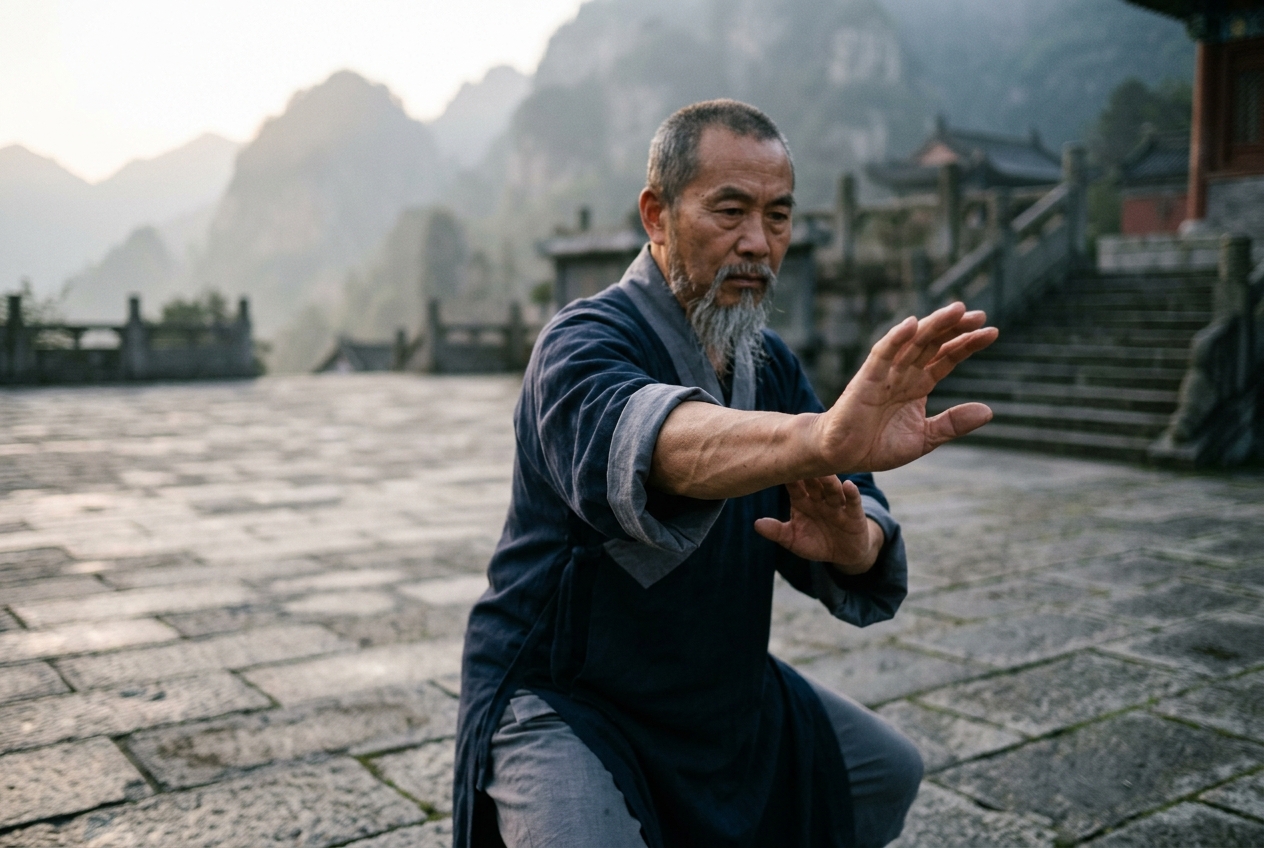
In traditional Chinese medicine and Neigong, we describe this physical experience as sinking your breath into the Dantian (the lower abdominal center of gravity located roughly two inches below your navel) and directing your intention through the Laogong acupoint (the soft depression at the center of the palm). When executed correctly, the movement feels neither rigid nor aggressive; to the practitioner, it feels like an effortless hydraulic wave, while to a training partner on the receiving end, it feels as unyielding and irresistible as a rising ocean swell.
Step-by-Step Practice Guide: The Dual-Phase Mechanics of An Jin
To master An Jin, one must understand that it is not a single linear push, but a bipartite mechanical wave composed of two indivisible phases: the downward grounding phase (An, meaning to depress, sink, or stabilize) and the forward releasing phase (Jin, the propagation of unified elastic force). The following sequence outlines the classical solo training protocol developed within the internal traditions.
1. Foundational Posture Setup (The Zhan Zhuang Base)
Begin in a standard standing meditation posture (Zhan Zhuang). Place your feet parallel, precisely hip-to-shoulder width apart. Distribute your weight evenly across the tripod of each foot—the base of the big toe, the base of the little toe, and the center of the calcaneus (heel)—with the primary energetic focus settling directly over the Yongquan point (Kidney-1, situated in the anterior midline depression of the sole).
Unlock your knees without letting them collapse inward; imagine holding an inflated sphere between your inner thighs to maintain gentle tension through the adductors. Settle your pelvis by releasing the sacrum downward as if sitting onto the edge of a high stool, which naturally elongates and softens the lumbar lordosis (the inward curve of the lower back, historically known as opening the Mingmen or "Gate of Life"). Elevate the crown of your head gently as though suspended by a silk cord from the heavens (Baihui, GV-20), allowing your chin to tuck slightly and elongating the cervical vertebrae. Let your arms rest curved in front of your chest as if holding a buoyant wooden barrel in water.
2. Phase One: The Downward Hydrostatic Sink (An / Depression)
The initial phase of An Jin is paradoxically downward, not forward. As you initiate a slow, quiet inhalation through the nose: - Allow the thoracic diaphragm to descend fully toward the abdominal cavity while simultaneously feeling the pelvic floor (Huiyin, CV-1) relax and widen slightly, generating three-dimensional intra-abdominal hydraulic pressure. - Draw both hands back slightly toward your ribs, then begin pressing the palms downward toward your hips as if submerging two buoyant corks into a pool of water. - Keep the elbows pointing downward toward the floor rather than flaring out to the sides. - Depress and stabilize the scapulae using the lower fibers of the trapezius and the serratus anterior, resisting any urge to elevate the shoulders toward the ears. - Mentally compress your body’s mass into your skeletal frame and down through your heels into the substrate, establishing an absolute, immovable root. This is the "loading" phase, where the entire myofascial matrix is pre-tensioned like an archer drawing a bow against the ground.
3. Phase Two: The Forward Discharging Phase (Push / Release)
Without pausing or resetting your posture, transition seamlessly into the discharge on a smooth, diaphragmatic exhalation: - Initiate the kinetic wave not from the hands, but from the soles of the feet. Press subtly through the heels into the floor, capitalizing on the ground reaction force generated by your downward sink. - Let this vertical ground force travel up through the tibia and femur, into the settled pelvis, and through the thoracolumbar fascia of the lower back. - Allow the hands to travel smoothly forward and slightly upward in a gentle parabolic arc at chest height. - As the arms extend to approximately eighty-five percent of full extension (never locking the elbow joints), engage active dorsiflexion of the wrists. The heel of the palm pushes forward while the fingertips remain relaxed, vibrant, and slightly drawn back, opening the Laogong (Pericardium-8) acupoint. - Vector the force horizontally outward through the palm heels. The feeling should not be that you are reaching away from yourself, but rather that your arms are rigid yet spring-like conduits through which the earth itself is expanding forward.
4. Somatic Sensation Mapping
As you cultivate this two-phase loop over dozens of repetitions, monitor your internal landscape for specific physiological landmarks: - Heaviness and Rooted Density: During Phase One, a distinct feeling of hydraulic weight settling into your lower abdomen, pelvis, and feet. - Micro-Vascular Warmth and Tingling: During Phase Two, as autonomic tone shifts and peripheral vascular resistance drops, you will frequently observe a rushing sensation of warmth, fullness, and mild electric tingling across the palmar fascia and fingertips, particularly concentrated at Laogong. - Absence of Local Muscular Burn: If you experience acute burning or fatigue in your anterior deltoids, pectorals, or triceps, your kinetic chain has broken; your body has reverted to superficial muscular pushing rather than structural fascial projection.
Partner Rooting Resistance Drills & Diagnostic Criteria
While solo forms establish postural memory, internal force cannot be verified in isolation. The internal arts rely on rigorous partner drills to identify and eliminate "postural leaks"—subtle breaks in skeletal alignment where force dissipates instead of transmitting through the floor.
The Static Palm-Root Test
- The Setup: Stand in a comfortable forward bow stance (Gong Bu), with sixty percent of your weight anchored on the rear heel and your forward knee aligned directly above your ankle. Extend both hands forward in the terminal Phase Two alignment of An Jin, resting your palm heels against the chest or outstretched hands of a partner.
- The Test: Have your partner gradually apply steady, horizontal compressive force directly into your palms, attempting to push you backward off balance.
- The Mechanical Response: - Incorrect (Muscular): If you brace with your triceps, pectorals, and shoulder caps, your partner's pressure will instantly wedge your shoulder blades upward, buckle your lower back, and lift your rear heel off the ground, causing you to stumble backward. - Correct (Internal Hydrostatic): Instead of pushing back, consciously execute Phase One sinking in real time. Relax your sternum, drop your tailbone, widen your scapulae, and direct their incoming vector diagonally downward along your spine and straight down the rear leg into the Yongquan point.
- The Diagnostic Check: If your alignment is pure, your partner will report the sensation of pushing against a massive, unyielding stone pillar rooted fifty feet into the earth. Once rooted, simply initiate a micro-extension from your rear heel through the serratus anterior; without muscular straining, your partner will be smoothly displaced backward by their own redirected kinetic energy.
Why It Works: The Body Science of Fascial Kinetics & Ground Reaction
The seemingly mystical phenomena of Neigong yield readily to contemporary biomechanics, functional anatomy, and neurophysiology. When we deconstruct An Jin, three primary physiological systems emerge as the engines of its power: tensegrity-based fascial transmission, hydrostatic intra-abdominal stabilization, and ground reaction force vectors.
1. Tensegrity and the Myofascial Web
In traditional Western biomechanics, movement is often conceptualized through simple lever-and-pulley models: a muscle contracts concentrically, pulling on a tendon to rotate a bone around a joint axis. However, functional fascia research spearheaded by modern anatomists and indexed widely on NCBI PubMed demonstrates that the body operates as a biotensegrity structure—a continuous network of tensioned cables (the fascia and connective tissues) surrounding isolated compression struts (the bones).
In An Jin, force is not produced by the localized contraction of the arm muscles. Instead, the practitioner pre-tensions the Deep Anterior and Superficial Back Arm Lines, anchored firmly through the vast sheath of the thoracolumbar fascia. When the wrists undergo active dorsiflexion while the elbows remain soft and dropped, the palmar aponeurosis, flexor retinaculum, and deep antebrachial fascia are drawn taut. This transforms the arms into hydro-elastic struts that transmit strain energy with virtually zero energetic dissipation.
+-----------------------------------------------------------------------------+
|                     CLINICAL & BIOMECHANICAL EVIDENCE                       |
+-----------------------------------------------------------------------------+
| Studies cataloged by the World Health Organization's Traditional Medicine   |
| Strategy and contemporary sports science laboratories emphasize that slow,  |
| structural martial movements actively train the viscoelastic properties of  |
| collagen matrices. Over time, chronic internal practice increases the       |
| tensile strength and cross-sectional stiffness of myofascial sheets,        |
| allowing veteran practitioners to generate high-amplitude kinetic pulses    |
| (Fajin) without the metabolic cost or cardiovascular spike of maximal       |
| voluntary muscular contractions.                                            |
+-----------------------------------------------------------------------------+
2. Intra-Abdominal Pressure (IAP) and Hydraulic Core Stability
The downward sinking phase (An) is anatomically identical to the generation of dynamic intra-abdominal hydrostatic pressure. As documented in somatic movement research published through organizations like the National Qigong Association and integrative medicine databases supported by the World Health Organization, the coordinated co-activation of the respiratory diaphragm, the pelvic floor musculature (levator ani), the transversus abdominis, and the multifidus creates a pressurized, fluid-filled cylinder within the peritoneal cavity.
This pneumatic-hydraulic cylinder accomplishes two vital mechanical goals: 1. It mechanically stabilizes the lumbar spine without requiring rigid, movement-restricting contraction of the rectus abdominis or spinal erectors. 2. It acts as an energetic coupler, seamlessly transferring force generated at the ground interface through the pelvis and up into the rib cage and shoulder girdle.
3. Scapular Anchoring via the Serratus Anterior
The fatal mechanical flaw in unrefined pushing is the activation of the upper trapezius and pectoralis minor, which elevates and anteriorly tilts the scapula. This "floating shoulder" completely disconnects the upper limb from the axial skeleton; any forward force exerted merely pushes the practitioner's own shoulder joint backward out of socket.
An Jin solves this through deliberate scapular depression and upward rotation driven by the serratus anterior (often termed the "boxer’s muscle") and the lower trapezius. The serratus anchors the medial border of the scapula flush against the rib cage, forming an unbreakable structural bridge between the arms and the thoracic spine. When you push, the load is received not by the fragile glenohumeral joint, but by the broad, stable surface of the entire dorsal torso.
4. Ground Reaction Force Vectoring
According to Newton’s Third Law of Motion, every force applied to the ground generates an equal and opposite reaction force back into the body. Muscular pushing wastes this resource by leaking force through unstable, bent joints. In An Jin, the straight-line alignment from the rear heel (Yongquan) through the pelvis, spine, scapulae, and out the Laogong point creates an unbroken, high-efficiency vector. The practitioner is not pushing the recipient with their arms; they are creating an unyielding structural wedge between the recipient's center of mass and the planet Earth.
Classical Lineage & The Daoist Energetic Continuum
To practice An Jin purely as a mechanical exercise is to separate the branch from its root. In the philosophical and martial traditions of classical China, An occupies an exalted position within the cosmology of internal alchemy (Neidan) and martial theory (Neijia).
The seminal treatises of the art, historically preserved in the Taijiquan Classics attributed to legendary masters such as Wang Zongyue and Wu Yuxiang, frame the Four Cardinal Energies as a continuous, perpetual cycle representing the dynamic interplay of Yin and Yang.
"If the opponent attacks with great strength, do not attempt to resist head-on; first yield and neutralize (Lu), expand and float their root (Peng), close their structure (Ji), and finally, sink your breath and release your whole body’s root through the hands (An)."
— The Treatise on Taijiquan (Attributed to Master Wang Zongyue)
Within the Daoist lineages associated with the sacred Wudang Mountains and the historical transmissions of the Chen, Yang, and Wu families, An corresponds to the Earth and Metal phases of the Five Element system (Wu Xing). Earth represents the absolute, nurturing density of the downward sink—the capacity to absorb, integrate, and ground any incoming disturbance. Metal represents the clean, refined, and decisive forward vector of the discharge—unbending, crystalline, and clear.
In classical Daoist somatic meditation, An Jin is also practiced as an internal self-cultivation method. The physical act of depressing the hands while sinking the breath mirrors the alchemical mandate to "lower the fiery heart energy to meet the cool water of the kidneys," calming an overactive nervous system, stabilizing emotional agitation, and establishing an unshakable psycho-physical center.
Today’s Practice Commitment
True neuromuscular rewiring does not demand exhausting hours in the gymnasium; it requires brief, immaculate repetitions performed with absolute somatic mindfulness.
+-----------------------------------------------------------------------------+
|                      DAILY 5-MINUTE INTEGRATION PLAN                        |
+-----------------------------------------------------------------------------+
| WHEN:    Tomorrow morning, immediately upon rising and before your coffee.  |
| DURATION: Exactly 5 minutes.                                                |
| PROTOCOL: 1. Stand in Zhan Zhuang alignment (2 minutes). Focus on relaxing  |
|              the sacrum and establishing the tripod foot root at Yongquan.  |
|           2. Execute 10 slow, deliberate repetitions of the two-phase An    |
|              Jin cycle (3 minutes). Spend 6 seconds sinking on the inhale   |
|              and 6 seconds discharging through Laogong on the exhale.       |
| TARGET:   Observe whether your shoulders remain relaxed and whether you     |
|           experience a distinctive warmth and pulsing fullness across your   |
|           palms during the following hour of your daily routine.            |
+-----------------------------------------------------------------------------+
By dedicating just five minutes to anchoring your kinetic chain to the earth each morning, you cease to fight gravity and begin allowing its vast, constant momentum to flow effortlessly through your life and practice.