Acupoint Injection Therapy: Navigating Pharmacological Fluid Depots, Segmental Neuro-Reflex Synergy, and Precision Acupressure Protocols
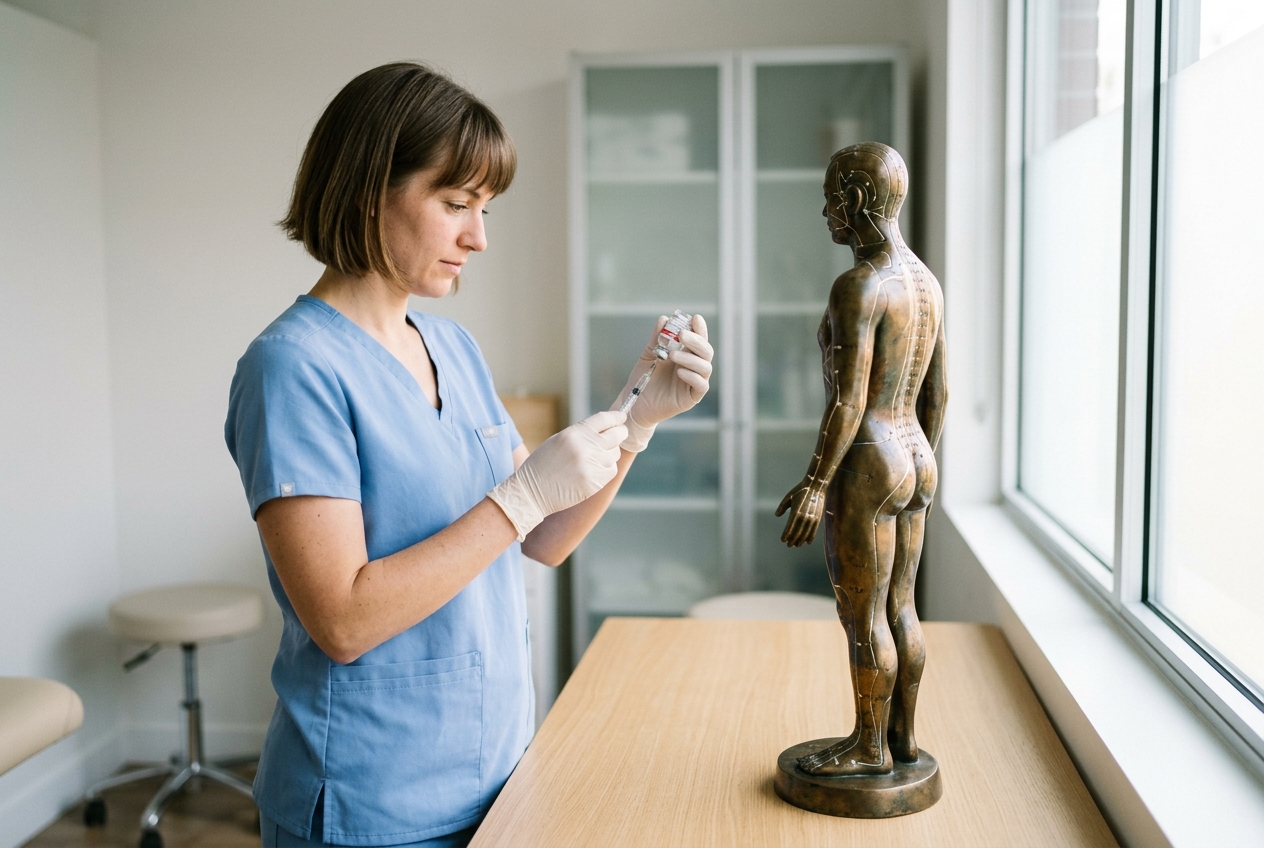
For decades, the therapeutic bridge between these ancient experiential channels and modern biomedicine has centered on standard dry filiform needling. Yet, an extraordinary clinical evolution emerged in China during the mid-20th century: Acupoint Injection Therapy (Shui Zhen / 水针, or Aqua-Acupuncture). By delivering micro-volumes of sterile biological solutions directly into acupuncture loci, practitioners discovered that combining localized pharmacotherapy with physical fluid distension produced clinical outcomes far exceeding traditional dry needling.
Recent discoveries in mechanobiology—specifically concerning the role of piezoelectric mechanosensitive ion channels (PIEZO1 and PIEZO2) and interstitial fluid dynamics—finally reveal why this technique is so potent. More importantly, understanding these physiological mechanisms allows us to translate the therapeutic dynamics of Aqua-Acupuncture into a precise, non-invasive acupressure protocol that anyone can perform at home.
1. The Meridian Path: An Interstitial Journey Through the Body
To understand how stimulating a single point on the lower limb can alleviate gastric distress or quiet a racing mind, one must dispense with the misconception that meridians are mystical conduits. Contemporary anatomical research increasingly identifies meridians with planes of low electrical resistance within the body's fascial matrix and interstitial collagen networks.
The primary pathways of the lower body trace continuous anatomical highways from the trunk to the tips of the toes:
- The Stomach Conduit (Zuyangming): Originates beside the nose, traverses downward across the cheek and neck, cascades across the chest and abdomen over the rectus abdominis, runs down the front-outer curve of the thigh, passes the lateral border of the kneecap, and travels directly down the muscular fleshy bulge of the outer shinbone (tibialis anterior) before terminating at the lateral tip of the second toe. This is the physiological axis of nutritive intake, gastrointestinal propulsion, and alert motor vitality.
- The Spleen Conduit (Zutaiyin): Begins at the medial corner of the great toe, tracks along the inner arch of the foot, ascends directly behind the inner ankle bone, climbs the posterior edge of the medial shinbone, passes the inner knee and thigh, and ascends into the lower abdomen and spleen/pancreas organ space. This path governs fluid metabolism, blood containment, and muscular tone.
- The Liver Conduit (Zujueyin): Rises from the dorsal nail bed of the big toe, travels across the webbing of the top of the foot between the first two metatarsal bones, climbs anterior to the inner ankle bone, intersects with the Spleen pathway along the inner calf, and ascends the innermost aspect of the thigh to envelope the external genitalia and enter the costal hypochondrium. It serves as the primary regulator of smooth autonomic function, vascular compliance, and neuroemotional reactivity.
When a physician performs Aqua-Acupuncture—injecting sterile agents such as cyanocobalamin (Vitamin B12), Astragalus membranaceus (Huangqi) root extracts, or Salvia miltiorrhiza (Danshen) fractions into these planes—the fluid depot creates a sustained, micro-scale fascial hydro-dissection.
The injected volume does not merely dissipate instantaneously; it creates a localized pressure gradient in the interstitial fluid space. This persistent hydraulic distension stretches adjacent collagen fibrils and fibroblasts, generating continuous mechanical strain that activates PIEZO1 and PIEZO2 mechanoreceptors. The resulting cascade triggers long-lasting neuro-reflexive arcs across segmental spinal roots and autonomic ganglia, prolonging the therapeutic response well beyond the duration of a standard dry-needle treatment.
2. Key Loci of Mechanotransduction: Three Master Points
While Aqua-Acupuncture utilizes hypodermic syringes to create this localized fluid-depot mechanostimulation, you can replicate this sustained hydraulic and fascial strain manually. By applying graded ischemic compression, sustained static loading, and rhythmic perpendicular rotation, you mechanically deform the interstitial matrix, mimic fluid-depot pressures, and elicit the classic Deqi (得气) sensation—the neurophysiological marker of effective mechanotransductive signaling.
       ST36: Four finger-widths below kneecap, one finger lateral to shinbone
       SP6:  Four finger-widths above medial ankle bone, behind the tibia
       LV3:  Webbing hollow between first and second metatarsals on foot top
Point 1: ST36 (Zusanli / 足三里 — "Leg Three Miles")
- Palpable Bodily Landmark: Sit with your knees bent at a right angle. Place the palm of your hand over your kneecap; your four fingers will rest naturally on the outer side of your shin. Locate the sharp, bony ridge of your shinbone (anterior border of the tibia). Move one thumb-width outward (laterally) into the thick, fleshy belly of the muscle that flexes your foot upward (tibialis anterior). You will feel a distinct muscular depression approximately three inches below the lower border of the kneecap.
- The Sensory Phenotype (Deqi): When properly engaged, you will not feel a sharp, cutaneous pain, but rather a profound, spreading dull ache, a sensation of localized muscle fullness or distension, and often an electrical or warm tingling propagating downward along the outer shin into the second and third toes.
- Biomechanical Application: Using the reinforced tip of your thumb or a rounded knuckle, apply firm, perpendicular pressure downward into the muscle belly. Gradually increase the load over 15 seconds until reaching a deep, satisfying ache. Maintain this static pressure for 2 minutes while performing microscopic clockwise circular rotations without sliding across the skin surface.
- Clinical Efficacy: Modern neuroimaging and electrophysiological studies published in NCBI PubMed demonstrate that ST36 stimulation activates the vagal-adrenal anti-inflammatory axis, downregulating pro-inflammatory cytokines, enhancing gastric motility, alleviating postprandial heaviness, and mitigating systemic fatigue.
Point 2: SP6 (Sanyinjiao / 三阴交 — "Three Yin Intersection")
- Palpable Bodily Landmark: Locate the prominent, rounded bony peak on the inside of your ankle (the medial malleolus). Lay your four fingers flat across the inside of your lower leg, with your little finger aligned with the crest of that ankle bone. Directly above your index finger, tucked closely behind the posterior edge of the inner shinbone, lies SP6.
- The Sensory Phenotype (Deqi): This locus is naturally sensitive in most individuals. Upon contact, you will experience an immediate, exquisitely tender ache that radiates upwards along the inner calf and downward toward the sole of the foot.
- Biomechanical Application: Hook your thumb flat against the back edge of the shinbone, directing force slightly forward and inward toward the bone's posterior surface. Apply steady, moderate compression for 90 to 120 seconds. Synchronize your pressure with slow diaphragmatic exhalations, easing back slightly during inhalation.
- Clinical Efficacy: Recognized in the World Health Organization's Standard Acupuncture Point Locations, SP6 represents the anatomical convergence of the Spleen, Liver, and Kidney channels. It modulates pelvic visceral function, dampens menstrual cramping and pelvic floor hypertonicity, regulates interstitial fluid retention, and stabilizes nocturnal restlessness.
Point 3: LV3 (Taichong / 太冲 — "Great Surge")
- Palpable Bodily Landmark: Trace your finger upward from the web space between your big toe and second toe along the top of your foot. As you move toward the ankle, your finger will slide through a valley between the two long bones (metatarsals) until it falls into a distinct, triangular depression just before the bones converge.
- The Sensory Phenotype (Deqi): Highly reactive and sensitive; precise palpation produces a distinct, spreading tenderness, often accompanied by a mild throb that feels as though a release valve has been opened across the dorsal venous network of the foot.
- Biomechanical Application: Angle your thumb at approximately 45 degrees toward the ankle joint. Press firmly into the bony cleft using a gentle, rolling motion. Sustain the compression for 1 to 2 minutes per foot, focusing on slow, continuous, non-pulsatile pressure.
- Clinical Efficacy: Documented within standardized acupuncture and clinical trial registries, LV3 acts as the primary systemic down-regulator for sympathetic nervous system arousal. It is widely indicated for tension headaches, emotional irritability, vascular hypertension, ocular strain from digital screens, and stress-induced muscle guarding.
3. Synergistic Protocol: The "Autonomic Reset" for Post-Work Burnout and Digestive Stasis
When applied in strategic combinations, these points trigger convergent neuro-reflexive cascades. Below is an evidence-based, 6-minute restorative sequence designed to transition the autonomic nervous system from sympathetic fight-or-flight dominance into parasympathetic rest-and-digest equilibrium.
Optimal Posture and Preparation
Sit comfortably on a supportive surface or recline on a yoga mat with your knees flexed at approximately 90 degrees and feet flat. Ensure your breathing is deep, nasal, and unhurried. Perform this routine at the end of the day or at least 45 minutes following your evening meal.
- Phase 1: Downregulate the HPA Axis via LV3 (Taichong)
- Execution: Place both thumbs into the metatarsal hollows of both feet simultaneously. Apply a steady, angled load toward the ankle for 90 seconds.
- Physiological Action: Triggers central autonomic suppression, dilating peripheral microvessels and relieving cranial-cervical tension.
- Phase 2: Stimulate the Gastrointestinal Neuro-Axis via ST36 (Zusanli)
- Execution: Transition your thumbs or the heels of your hands to ST36 on both outer shins. Apply deep, perpendicular compression into the tibialis anterior muscle belly for 90 seconds, adding subtle rotational shear to engage the deep fascial envelope.
- Physiological Action: Recruits the vagus nerve via spinal-medullary reflexes, stimulating gastric peristalsis, promoting enzymatic secretion, and clearing postprandial epigastric stagnation.
- Phase 3: Stabilize Visceral Fluids and Pelvic Splanchnic Reflexes via SP6 (Sanyinjiao)
- Execution: Shift your thumbs to the inner lower leg, pressing the posterior border of the tibia at SP6 for 60 seconds per limb.
- Physiological Action: Calms lower abdominal muscular tension, modulates renal-adrenal fluid distribution, and induces somatic tranquility preparatory for deep non-REM sleep.
4. Clinical Safety, Contraindications, and Physiological Boundaries
The application of mechanical force to biologically active loci is an active neuro-modulatory intervention. Adhering to safety boundaries prevents adverse autonomic reactions or structural tissue trauma.
- Pressure Calibration & Ischemic Boundaries: Therapeutic acupressure operates within a specific window: between an intensity of 5 and 7 on a 10-point subjective scale. The sensation should be experienced as a "productive, satisfying ache." Never apply sharp, excruciating, or bruising force. If you feel an electric, lancinating shock or numbness radiating into your toes, you are directly compressing a peripheral nerve trunk; immediately adjust your thumb position slightly anterior or posterior.
- Dermatological and Vascular Cautions: Do not perform acupressure over areas of acute thrombophlebitis, active deep vein thrombosis (DVT), varicose ulcerations, localized skin infections, or unhealed fractures.
- When to Seek Professional Care: Self-administered acupressure is an adjunctive, homeostatic wellness practice. It is not a substitute for medical evaluation. If you experience chronic, unremitting abdominal pain, unexplained weight loss, severe neurological deficits, or cardiac arrhythmias, consult a qualified physician or licensed medical acupuncturist certified by organizations compliant with WHO Guidelines on Basic Training and Safety in Acupuncture.
5. Today's Takeaway: The Two-Minute Vagal Reset
If you have only two minutes right now, perform this single targeted intervention to clear mental fog and reboot your gastrointestinal motility before moving to your next task:
As you maintain this static ischemic pressure, notice how your breathing naturally deepens, salivary production increases, and the resting tension across your shoulders and diaphragm begins to dissolve. You have just engaged the profound neuro-fascial architecture of the hydraulic meridian.