Acupoint Application Therapy: Navigating Transdermal Herbal Pharmacodynamics, Cutaneous Meridian Receptors, and Precision Acupressure Protocols
1. Opening — A Problem This Solves Today
Every autumn and winter, millions of individuals endure a predictable, debilitating physiological descent. It begins as a faint, scratchy dryness behind the sternum, progresses into paroxysmal morning coughing fits, and culminates in the chronic chest tightness, post-nasal drip, and shallow breathing characteristic of bronchial hyperresponsiveness. For those living with allergic rhinitis, perennial asthma, or cold-induced arthritic stiffness, the turning of the seasons is not merely a change in weather; it is an inevitable immunological crisis. Conventional pharmacotherapy offers immediate symptomatic suppression via inhaled corticosteroids, beta-2 adrenergic agonists, and oral antihistamines. Yet, many patients find themselves trapped in a cycle of seasonal dependency, seeking therapeutic modalities that address the underlying constitutional vulnerability rather than merely dampening the end-stage inflammatory flare.
+-------------------------------------------------------------------------+
|                  THE THERAPEUTIC PARADOX: DONG BING XIA ZHI             |
|                                                                         |
|   Classical Axiom: "Treat Winter Illnesses in the Zenith of Summer"     |
|   Target Systems:  Pulmonary Mucosa, Neuro-Immune Axis, Microvasculature|
|   Bio-Gateway:     Back-Shu & Mu Acupoints (Stratum Corneum Permeation) |
|   Clinical Output: Th2 Cytokine Suppression, IgE Downregulation         |
+-------------------------------------------------------------------------+
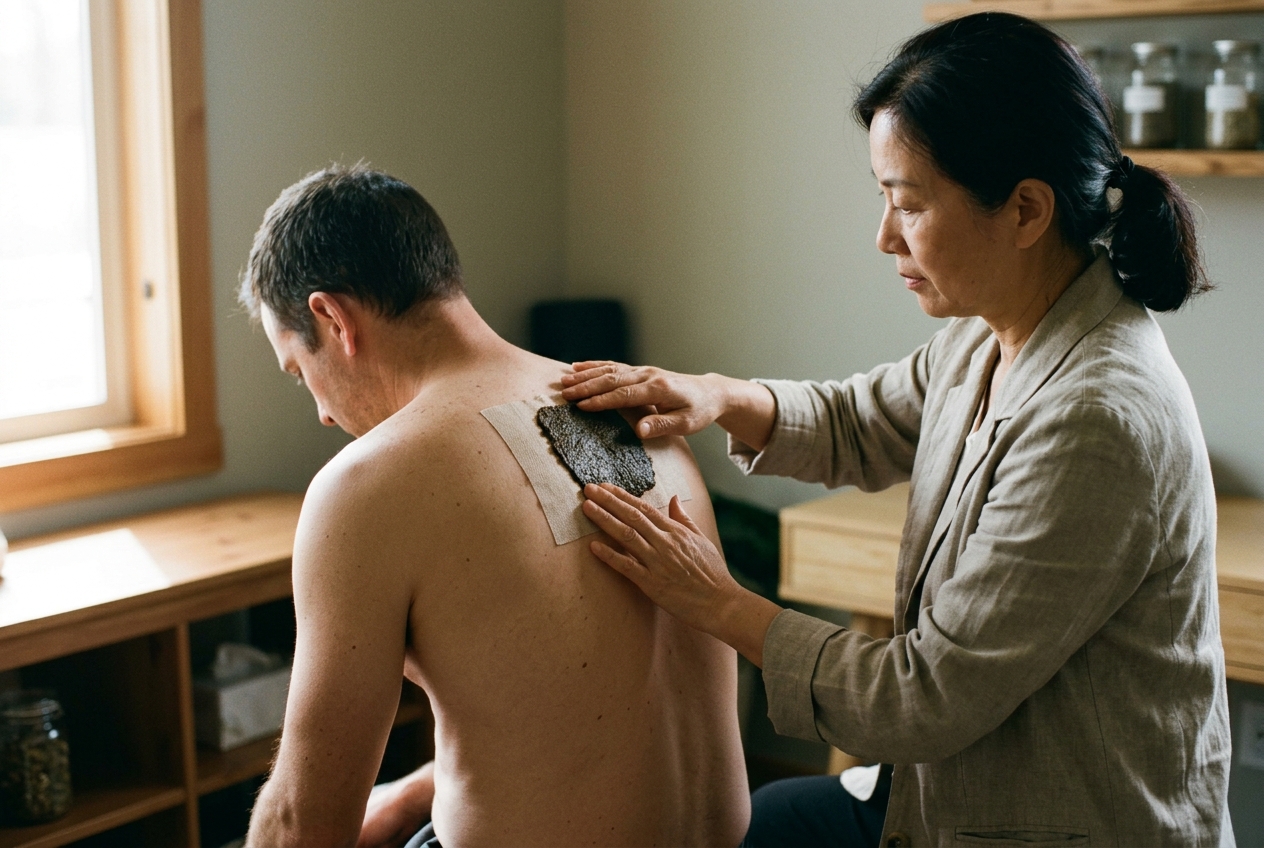
Traditional Chinese Medicine (TCM) approaches this chronic debility through a seemingly paradoxical clinical stratagem known as Dong Bing Xia Zhi (冬病夏治)—"treating winter diseases in the height of summer." Rather than waiting for pathogenic Cold and Wind to immobilize the pulmonary parenchyma and articular joints during sub-zero temperatures, classical physicians recognized that the optimal window for recalibrating host immunity occurs when ambient and biological Yang energy reaches its peak. At the centre of this chronobiological intervention lies Acupoint Application Therapy (Xue Wei Tie Fu / 穴位贴敷疗法), a medical practice that marries topical herbal pharmacognosy with targeted bioelectric stimulation of meridian pathways. By utilizing volatile, pungent herbal pastes applied to specialized cutaneous zones, this transdermal therapy reshapes mucosal immunity, modulates neurogenic inflammation, and interrupts the recurrent cycle of winter respiratory distress.
2. Classical Foundations & Chronobiological Epistemology
The clinical lineage of Acupoint Application Therapy spans over sixteen centuries of documented empirical refinement. The earliest systematic articulation of topical pharmacotherapy applied to energetic loci appears in the fourth-century emergency manual Zhou Hou Bei Ji Fang (肘后备急方, Handbook of Prescriptions for Emergencies) authored by the Taoist physician and alchemist Ge Hong. Ge Hong outlined methods for applying crushed, pungent botanical pastes directly to specific body zones to resuscitate collapsed patients, arrest acute dysentery, and dispel pathogenic factors lodged in the exterior sinews.
                       CHRONOLOGICAL LINEAGE OF XUE WEI TIE FU

   4th Century CE                    17th Century CE                    Modern Era
   [Zhou Hou Bei Ji Fang]            [Zhang Shi Yi Tong]                [Translational RCTs]
   Ge Hong introduces                Zhang Lu codifies Bai Jie          TRPV1 activation, Th1/Th2
   topical herbal pastes             Zi paste on Back-Shu points        cytokine modulation, and
   for acute resuscitation           during Sanfu Dog Days              transdermal lipid flux
It was during the Qing Dynasty, however, that the therapy reached its zenith of specialization for chronic pulmonary disorders. In his 1695 masterwork Zhang Shi Yi Tong (张氏医通, Zhang’s Comprehensive Medicine), physician Zhang Lu codified the definitive protocol for treating cold-phlegm asthma (Xiao Chuan):
"On the summer Dog Days (Sanfu), pound White Mustard Seed (Bai Jie Zi), Fine Asarum (Xi Xin), Kansui Root (Gan Sui), and Corydalis (Yan Hu Suo) into fine powder. Incorporate fresh ginger juice to form a paste, and apply directly to Feishu (BL13), Xinshu (BL15), and Geshu (BL17) points. Leave until the skin tingles and warms. After three consecutive applications, deep-seated phlegm-cold rooted in the pulmonary viscera is permanently uprooted."
Central to this therapeutic model is the chronobiological concept of Sanfu (三伏) and Sanjiu (三九). The Sanfu period comprises the three ten-day periods of peak solar irradiation and maximal biological Yang—the "Dog Days" of July and August. According to classical energetic doctrine, during this extreme window of warmth, the body's superficial protective energy (Wei Qi) is highly mobilized, the cutaneous pores (Cou Li) are dilated, and the peripheral microcirculation operates at maximum volume. Applying warming, channel-penetrating medicinals during this physiological aperture allows therapeutic bio-actives to traverse the dermal barrier without encountering internal stagnation. Conversely, the Sanjiu cycle occurs across three nine-day blocks following the Winter Solstice, serving as a restorative counterpoint to reinforce systemic warmth when environmental pathogenic Cold reaches its most invasive zenith.
Modern biophysical research confirms that human cutaneous perfusion, cellular metabolic rate, and epidermal permeability fluctuate across circadian and circannual rhythms. By aligning drug administration with these chronobiological windows, Acupoint Application Therapy maximizes the bioavailability of botanical constituents while leveraging endogenous neuroendocrine peaks to recalibrate immune reactivity.
3. Biophysical and Biochemical Mechanisms of Transdermal Acupoint Delivery
The clinical efficacy of Xue Wei Tie Fu relies on a multi-tiered cascade involving transdermal drug delivery kinetics, localized neuro-immune stimulation, and systemic immunomodulation. Far from functioning as an inert topical dressing, the herbal plaster acts as an active biochemical engine that systematically breaches the body's primary protective barrier.
Stratum Corneum Lipid Permeation & Chemical Enhancers
The primary obstacle to transdermal pharmacokinetics is the stratum corneum, an impermeable "brick-and-mortar" structure of keratin-rich corneocytes embedded within structured lipid bilayers composed of ceramides, cholesterol, and free fatty acids. Xue Wei Tie Fu overcomes this barrier through the precise inclusion of pungent, volatile carrier herbs characterized in TCM by their channel-opening properties:
- Bai Jie Zi (Sinapis alba / White Mustard Seed): Contains the glucosinolate sinigrin, which, upon enzymatic hydrolysis by endogenous myrosinase during preparation with fresh ginger juice, yields allyl isothiocyanate (AITC). AITC acts as an exceptional chemical penetration enhancer, fluidizing the highly organized hydrocarbon chains of the stratum corneum lipid bilayers, thereby dramatically reducing barrier resistance and creating transient micropores for molecular flux.
- Xi Xin (Asari Radix et Rhizoma): Rich in volatile lipophilic terpenes, including methyl eugenol, safrole, and asarone. These molecules partition into the lipid domains of the epidermis, disrupting intercellular cohesion and facilitating the deep penetration of non-volatile alkaloids, such as tetrahydropalmatine from Yan Hu Suo (Corydalis yanhusuo).
Receptor Activation: The TRPV1 and TRPA1 Pathway
Allyl isothiocyanate and gingerol selectively target and activate Transient Receptor Potential Vanilloid 1 (TRPV1) and Ankyrin 1 (TRPA1) ion channels embedded on unmyelinated peptidergic C-fibers and thinly myelinated A-delta cutaneous sensory afferents. This binding mimics thermal noxious stimuli without causing immediate structural coagulation, provoking a sustained influx of calcium ions ($Ca^{2+}$) into local nerve endings.
Neuro-Immune Mast Cell Degranulation & Microvascular Vasodilation
Activation of primary afferent nociceptors elicits a localized axon reflex, prompting the peripheral release of potent vasodilatory neuropeptides, predominantly Calcitonin Gene-Related Peptide (CGRP) and Substance P (SP). This neurogenic cascade stimulates nearby perivascular mast cells, which are uniquely concentrated at acupuncture loci compared to non-acupoint cutaneous regions. Mast cell degranulation releases histamine, serotonin, and nitric oxide (NO), inducing marked local hyperemia, increasing capillary endothelial permeability, and accelerating the transvascular transport of herbal active compounds into systemic circulation.
Systemic Cytokine Modulation & Allergic Attenuation
The downstream immunological consequences of this localized sustained stimulation are profound. In allergic asthma, allergic rhinitis, and chronic obstructive pulmonary disease (COPD), the immune profile is heavily skewed toward a T-helper 2 (Th2) phenotype, characterized by hypersecretion of interleukin-4 (IL-4), interleukin-5 (IL-5), and interleukin-13 (IL-13), alongside hyper-immunoglobulin E ($\text{IgE}$) synthesis and extensive airway eosinophilia.
Rigorous preclinical and clinical trials documented across NCBI PubMed Central demonstrate that standardized Sanfu acupoint patches significantly down-regulate serum $\text{IgE}$ and Th2 cytokine expression while upregulating interferon-gamma ($\text{IFN-}\gamma$) and interleukin-12 ($\text{IL-12}$), thereby restoring homeostatic Th1/Th2 balance. Furthermore, the therapy enhances the suppressive function of CD4+CD25+Foxp3+ regulatory T-cells (Tregs), effectively dampening airway hyperreactivity and reversing chronic mucosal inflammation.
4. The Meridian Path — A Journey Through the Body
To understand how localized transdermal stimulation generates systemic pulmonary and metabolic transformations, one must trace the physical topography of the primary meridian conduits that govern respiratory and defensive vitality.
The Lung Channel of Hand-Taiyin (Fei Jing)
The Lung meridian begins internally in the middle burner (the stomach region), descends to wrap the large intestine, loops upward through the cardiac orifice, and breaches the surface of the chest just below the collarbone at the soft hollow of the upper outer chest.
From this gateway, the channel ascends slightly toward the shoulder before coursing down the inside of the arm. It follows the outer edge of the biceps, crosses the crease of the elbow just lateral to the prominent tendon, and tracks along the forearm over the radial bone where the pulse beats at the wrist. It concludes its primary trajectory along the fleshy mound at the base of the thumb (thenar eminence), terminating at the outer corner of the thumbnail. This pathway represents the direct interface between atmospheric Qi and internal metabolic respiration.
The Bladder Channel of Foot-Taiyang (Pangguang Jing)
The Bladder meridian represents the longest and most comprehensive defensive circuit in human anatomy. Originating at the inner corner of the eye, it vaults over the crown of the skull, enters the brain, and divides into two parallel vertical columns running down the posterior aspect of the body.
The inner branch runs down the back roughly two finger-widths away from the spine's central bony bumps. Here lie the specialized Back-Shu (Associated) Points—direct neuro-fascial switchboards connecting surface bioelectricity to the internal organs. The channel descends past the sacrum, runs down the exact centerline of the hamstring and calf muscles, passes behind the lateral ankle bone, and finishes at the outer tip of the small toe.
The Conception Vessel (Ren Mai) & Stomach Channel of Foot-Yangming
The Conception Vessel climbs the exact anterior midline of the torso, governing the body's Yin reserves from the perineum to the lower lip, anchoring the thoracic resonance points. Simultaneously, the Stomach channel descends from below the eye, courses across the jaw, passes down the throat, bisects the chest and abdominal wall, and descends the front-outer aspect of the shinbone—the broad muscle that contracts when flexing the foot upward—before terminating at the second toe. This Yangming axis supplies the energetic and nutritional substrate necessary for the lungs to generate defensive energy.
5. Key Acupressure Points You Can Press Right Now
Before herbal patch application, or as a standalone daily self-regulatory protocol, manual acupressure primes the cutaneous receptive fields. Applying rhythmic, focused mechanical pressure generates piezoelectric signals across the interstitial fascial matrix, enhancing microvascular perfusion and sensitizing receptor targets.
+-----------------------------------------------------------------------------------+
|                           PRIMARY ACUPRESSURE REPERTOIRE                          |
+---------+--------------------------+-----------------------+----------------------+
| Point   | Anatomical Landmark      | Tactile De Qi Sensation| Primary Indication   |
+---------+--------------------------+-----------------------+----------------------+
| LU7     | Radial notch / Interlock | Radiating ache/thumb  | Cough, Head/Neck Pain|
| BL13    | T3 spinous / 1.5 cun lat | Deep dull distension  | Asthma, Cold-Deficit |
| CV22    | Suprasternal fossa center| Mild throat tightness | Dyspnea, Phlegm Tickle|
| ST36    | 3 cun subpatellar notch  | Heavy muscular ache   | Immune/Digestion Boost|
+---------+--------------------------+-----------------------+----------------------+
1. Lieque (LU7 — "Broken Sequence")
- Locating the Point: Interlock your hands at the webbed space between thumbs and index fingers. Extend the index finger of your upper hand onto the side of your opposite wrist. The tip of your index finger will settle naturally into a small, distinct notch just above the styloid process of the radial bone.
- What You Will Feel: Upon firm palpation against the bone edge, you will experience a sharp, pleasant ache that often radiates down into the base of the thumb or up the outer forearm.
- How to Press: Use the tip of your thumb to apply circular, angled friction directed toward the elbow (tonification for chronic weakness) or down toward the hand (sedation for acute throat constriction). Maintain firm, continuous pressure for 2 to 3 minutes.
- Everyday Utility: Instant relief for tension headaches at the base of the skull, acute neck stiffness, and persistent tickling dry coughs.
2. Feishu (BL13 — "Lung Transference Point")
- Locating the Point: Sit upright with your shoulders relaxed. Reach over your shoulder or have a partner locate the prominent bony bump at the base of your neck (the 7th cervical vertebra). Count down three spinal bumps (the 3rd thoracic vertebra, level with the spine of the shoulder blade). Move approximately two finger-widths laterally into the muscular trough between the spine and the inner shoulder blade.
- What You Will Feel: A deep, heavy, spreading soreness that feels as though a knot of deep fatigue is being released.
- How to Press: Using the thumb pad or two supported fingertips, press deeply into the paraspinal muscle bed with a slow, clockwise circular kneading motion for 3 minutes. Breathe deeply into the back of your rib cage.
- Everyday Utility: Dissipates chronic chest tightness, combats severe afternoon fatigue, and strengthens immune resistance during seasonal shifts.
3. Tiantu (CV22 — "Celestial Chimney")
- Locating the Point: Slide your index finger down the center of your throat until you reach the deep, cup-shaped hollow at the top of the breastbone (the suprasternal notch). The point lies in the center of this depression, just behind the superior margin of the bone.
- What You Will Feel: A distinct, sensitive tenderness accompanied by a mild reflexive sensation in the windpipe.
- How to Press: Caution is required. Do not press straight back into the trachea. Instead, insert your fingertip gently downward behind the bone at a 45-degree angle. Use gentle, sustained, pulsating pressure for 1 to 2 minutes while swallowing slowly.
- Everyday Utility: Arrests sudden barking coughs, clears stubborn phlegm rattling in the upper airway, and calms acute globus hystericus (the sensation of a "lump in the throat" caused by anxiety).
4. Zusanli (ST36 — "Leg Three Miles")
- Locating the Point: Place the palm of your hand over your kneecap with your fingers pointing down your shin. Your ring finger will naturally rest in a small muscular dip approximately four finger-widths below the bottom edge of the kneecap, one finger-width outside the sharp crest of the shinbone.
- What You Will Feel: A pronounced, deep, spreading electrical soreness that can travel down the outer shin into the second and third toes.
- How to Press: Apply robust, vertical thumb pressure or use a rounded knuckle. Pump the point rhythmically with 5 seconds of deep pressure followed by 2 seconds of slight release, continuing for 3 full minutes on each leg.
- Everyday Utility: Alleviates digestive bloating and post-meal sluggishness, restores depleted systemic energy, and stimulates baseline immune surveillance.
6. Clinical Indications & Complete Therapeutic Protocols
Acupoint Application Therapy demonstrates broad efficacy across several disease categories verified by both clinical tradition and modern translational research:
- Chronic Respiratory Pathology: Allergic rhinitis, bronchial asthma, chronic bronchitis, and chronic obstructive pulmonary disease (COPD). It reduces the frequency of annual acute exacerbations and decreases reliance on short-acting rescue bronchodilators.
- Pediatric Immune and Gastrointestinal Dysfunction: Recurrent respiratory tract infections, pediatric anorexia, chronic malabsorptive diarrhea, and morning nausea. The non-invasive nature of transdermal patches makes them ideally suited for pediatric cohorts where needle-phobia precludes conventional acupuncture.
- Cold-Damp Arthralgia (Bi Syndrome): Chronic osteoarthritic knee pain, cervical spondylosis, and lumbar myofascial pain exacerbated by atmospheric humidity and ambient cold.
+-------------------------------------------------------------------------+
|                  EVENING PROTOCOL: THE COLD-DISPERSION RITUAL           |
|                                                                         |
|   Step 1: 5-Minute Thermal Preparation (Warm Shower or Towel on Neck)   |
|   Step 2: Dual Acupressure Activation:                                  |
|           • LU7 (Wrist): 2 mins per side (Sedating downward friction)   |
|           • CV22 (Throat Hollow): 1 min (Gentle inferior pulse)         |
|   Step 3: Posterior Grounding:                                          |
|           • BL13 (Upper Back): 3 mins deep bilateral thumb kneading     |
|   Step 4: Metabolic Anchoring:                                          |
|           • ST36 (Shin): 3 mins robust pumping pressure                 |
|   Step 5: Topical Application: Warming Herbal Compress over BL13/CV22   |
+-------------------------------------------------------------------------+
A Complete "Do This Tonight" Protocol: The Bronchial Decongestion & Cold Dispersion Ritual
If you are currently struggling with autumn airway sensitivity, post-nasal drip, or an exhausting dry cough after working in cold, dry air, execute this five-step sequence before bed:
- Phase 1: Thermal Preparation (5 Minutes): Take a hot shower or apply a hot, damp compress across your upper back and chest to dilate cutaneous capillaries and lower the impedance of the stratum corneum.
- Phase 2: Radial and Thoracic Clearing (3 Minutes): Sit comfortably supported in bed. Locate LU7 on your left wrist and apply vigorous downward friction with your right thumb for 90 seconds until the area glows with warmth; repeat on the right wrist. Next, locate CV22 in the throat hollow and apply gentle, downward-slanted pulsating pressure for 60 seconds to open the trachea.
- Phase 3: Back-Shu Modulation (3 Minutes): Have a partner knead BL13 (Feishu) bilaterally using firm, circular thumb motions for 3 minutes. If self-treating, lie flat on your back on top of two firm massage or tennis balls positioned in the paraspinal troughs between your spine and shoulder blades, taking slow diaphragmatic breaths.
- Phase 4: Vitality Anchoring (3 Minutes): Finish by working ST36 on both legs simultaneously with your knuckles for 3 minutes, grounding the body's energy and triggering systemic parasympathetic tone.
- Phase 5: Patch/Compress Application: Apply a small, warming botanical compress or moxibustion heat patch over the BL13 or CV22 zone before settling to sleep.
7. Safety Precautions, Skin Reaction Grading, and Burn Prevention
Because authentic Xue Wei Tie Fu formulations contain potent rubefacients like mustard seed and fresh ginger, the skin inevitably experiences a chemical-thermal reaction. Distinguishing between a normal therapeutic response and an adverse chemical burn is essential for clinical safety.
Skin Reaction Grading System
- Grade 0 (No Reaction): No erythema or sensation. Indicates insufficient herbal potency or hyper-keratinized skin barrier; minimal clinical efficacy achieved.
- Grade 1 (Ideal Therapeutic Response): Mild localized redness (erythema), sensation of cutaneous warmth, slight tingling, or faint itching. Resolves spontaneously within 12 to 24 hours.
- Grade 2 (Moderate Reaction): Marked erythema, localized edema, small scattered pinhead papules, and moderate pruritus. Requires patch removal and application of soothing aloe vera or burn ointment.
- Grade 3 (Adverse Chemical Burn / Blistering): Formation of distinct vesicles or large fluid-filled bullae, severe burning pain, and epidermal ulceration. This represents an adverse reaction requiring immediate cessation, gentle evacuation of large blisters under sterile conditions, and application of topical antibiotic dressings to prevent secondary infection.
Rules for Safe Application
- Strict Duration Limits: For commercial or clinic-compounded warming patches, adults should leave patches in place for no longer than 2 to 4 hours. For pediatric patients, the duration must be reduced to 30 to 90 minutes. If intense, intolerable burning occurs at any point, remove the patch immediately regardless of elapsed time.
- Absolute Contraindications:
- Pregnancy: Applying strong, channel-invigorating rubefacients to points such as Hegu (LI4), Sanyinjiao (SP6), or the lower lumbosacral region is strictly contraindicated due to the risk of inducing uterine contractions.
- Dermatological Compromise: Never apply patches or deep manual pressure over ulcerated skin, active eczema, psoriasis, or open wounds.
- Acute Febrile States: High fever, acute pneumonia with purulent sputum, or hemoptysis represent acute heat-toxin states where warming Sanfu therapies are contraindicated.
Evidence-Based Clinical Proof
Modern randomized controlled trials (RCTs) have subjected Acupoint Application Therapy to rigorous methodological scrutiny. A landmark multi-center RCT published in peer-reviewed literature indexed on PubMed evaluated Sanfu acupoint herbal patching across hundreds of patients with persistent asthma. The study demonstrated statistically significant improvements in forced expiratory volume in one second ($\text{FEV}_1$), a marked reduction in annualized acute attack rates, and substantial decreases in systemic corticosteroid consumption compared to placebo patch groups.
Further systematic reviews compiled according to WHO Guidelines reinforce that when applied correctly, Xue Wei Tie Fu represents a safe, cost-effective, and powerful adjunct in long-term chronic disease management.
8. Today's Takeaway
+-------------------------------------------------------------------------+
|                  YOUR TWO-MINUTE RESILIENCE PRACTICE                    |
|                                                                         |
|   Target Point:    Lieque (LU7 — The Wrist Interlock Notch)             |
|   Target Problem:  Autumn/Winter Dry Throat, Screen Tension & Cough     |
|   Action:          Interlock thumbs, find the bone notch, press firmly  |
|                    toward the elbow in small circles for 60 seconds     |
|                    per wrist while taking deep abdominal breaths.       |
+-------------------------------------------------------------------------+
You do not need to wait for midsummer Sanfu days or visit a specialized clinic to begin transforming your respiratory resilience. Right now, take your left thumb, interlock your hands, and let your right index finger find that tender, aching notch on the side of your left wrist: Lieque (LU7).
Press firmly into that bone edge with slow, rhythmic circular pressure for exactly sixty seconds, breathing deeply into the base of your lungs. Switch sides and repeat for another minute on your right wrist. In less time than it takes to boil a kettle, you have stimulated the primary bioelectric conduit of the pulmonary system, released microvascular tension along your neck and chest, and engaged the ancient, time-tested intelligence of meridian medicine.
Authoritative References and Further Reading
- World Health Organization. WHO Standard Acupuncture Point Locations in the Western Pacific Region. WHO Iris Repository.
- National Center for Biotechnology Information. Transdermal Penetration Mechanisms and Nanocarriers. PMC Database.
- National Library of Medicine. Clinical Efficacy and Mechanisms of Acupoint Herbal Patching for Allergic Respiratory Conditions. PubMed.
- Wikipedia. Transient Receptor Potential Cation Channel Subfamily V Member 1 (TRPV1). Wikipedia Article.
- Wikipedia. Traditional Chinese Medicine and Meridian Theory. Wikipedia Article.
- PubMed Central. Immunological Modulation of Th1/Th2 Cascades via Acupoint Application Therapy in Chronic Asthma. PubMed Clinical Review.