Quantum Stein's Lemma: Establishing Asymptotic Error Exponents and Hypothesis Testing Bounds Via Relative Entropy
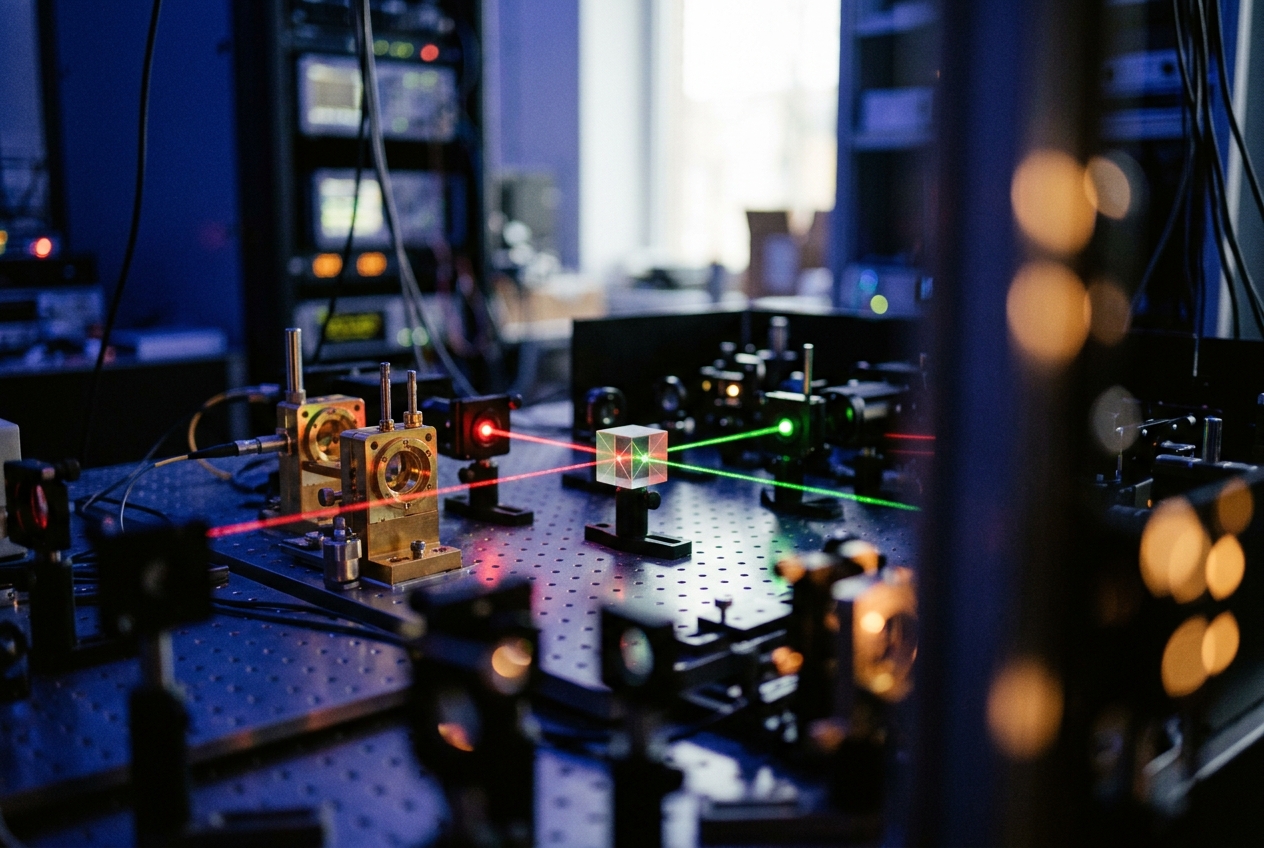
Now elevate this game of espionage to the atomic scale.
Suppose an adversary attempts to tap into a high-security quantum communication fiber, or an advanced radar system attempts to spot a stealth aircraft bathed in blinding atmospheric noise. The signals being collected are not streams of ordinary zeros and ones; they are microscopic, fragile quantum particles—photons of light whose physical states exist in delicate, overlapping clouds of probability. In this realm, distinguishing between an authentic signal and a counterfeit is not just a practical headache. It is a battle against the fundamental laws of physics.
If you make a single measurement on a single particle, the laws of quantum mechanics dictate that you cannot know for certain what you hold. But what happens if you receive a thousand identical particles? A million? How rapidly does the disguise unravel as the evidence piles up?
The answer to this question forms one of the cornerstones of modern physics and information theory. Known as Quantum Stein’s Lemma, this mathematical breakthrough defines the absolute, unyielding speed limit at which two quantum realities can be told apart. It governs the security of next-generation cryptography, dictates the ultimate resolution of quantum sensors, and reveals a profound truth about our universe: nature keeps a strict ledger on how much information separates any two physical states, and no amount of clever engineering can ever bypass it.
The Idea in Plain English: From Loaded Coins to Quantum Shadows
To grasp why distinguishing quantum states is so elusive, it helps to start with an ordinary game of chance.
Imagine someone hands you a coin and tells you it is either perfectly fair (a 50% chance of heads) or slightly biased (a 51% chance of heads). If you flip the coin once and get heads, you learn almost nothing; both coins frequently land on heads. But if you flip the coin ten thousand times and record 5,100 heads, the law of large numbers comes to your rescue. The slight bias, initially hidden inside statistical noise, announces itself with overwhelming clarity.
In classical statistics, the mathematical measure of this difference is known as the Kullback-Leibler divergence—a metric that quantifies how much surprise or "information loss" occurs when you mistake the biased coin for a fair one.
In the quantum domain, the problem becomes vastly richer and stranger. A quantum object—such as an electron's spin or the polarization of a photon—is not a simple coin waiting to land on heads or tails. It is a quantum state, conventionally represented as a density matrix.
While a classical system is described by a single, definite list of probabilities, a quantum system is described by a density matrix—a mathematical object that encodes not only ordinary probabilities, but also the quantum superpositions, phase relationships, and non-classical correlations (entanglement) that the system shares with its environment. In plain English, it is the complete physical identity card of a quantum state.
If you are handed a sequence of identical quantum particles, you face a profound dilemma that has no classical counterpart: quantum measurement disturbs the system. The moment you measure a photon to see if it belongs to state $A$ or state $B$, you inevitably collapse its quantum wavefunction, destroying the delicate phase information that might have told the two states apart.
Furthermore, different quantum measurements are mutually exclusive; measuring polarization at one angle permanently erases your ability to know what it was at another.
Distinguishing between two quantum candidates—call them state $\rho$ (the legitimate signal) and state $\sigma$ (the noise or impostor)—is called quantum hypothesis testing. If you are allowed to test an arbitrary number of identical particles, say $n$ copies prepared independently and identically, how fast does your error drop toward zero as $n$ grows toward infinity?
How It Actually Works: The Mechanics of Asymmetric Distinction
To understand the machinery of Quantum Stein’s Lemma, we must first distinguish between two entirely different ways of being wrong.
Symmetric vs. Asymmetric Testing
In a symmetric test, both types of mistakes carry equal weight. You are handed an unknown particle and must make your best 50-50 guess: is it $\rho$ or is it $\sigma$?
In 1967, the physicist Carl W. Helstrom derived the famous Helstrom Bound, which proves that the minimum possible probability of making a mistake in a single-shot symmetric test is strictly determined by the trace distance—a geometric measure of the physical separation between the two quantum states on the Bloch sphere.
Real-world scenarios, however, are rarely symmetric. Consider a quantum radar scanning the horizon for an incoming stealth missile. * A Type I Error (a false alarm) occurs when the radar detects a harmless patch of empty sky (state $\rho$) and mistakenly declares that a missile is present. * A Type II Error (a missed detection) occurs when an actual incoming missile (state $\sigma$) slips past the radar undetected because the system mistook it for empty sky.
In national defense, biomedical diagnostics, and cryptography, these errors are not treated equally. You might decide to strictly fix your tolerance for a false alarm at an acceptable, constant threshold—say, no more than an $\varepsilon = 1\%$ error rate. Within that rigid constraint, your goal is to make the probability of a missed detection (the Type II error, denoted as $\beta_n$) drop to zero as rapidly as humanly possible as you collect more particles $n$.
This asymmetric setup is known as the Chernoff-Stein paradigm.
The Quantum Stein’s Lemma Statement
When you collect $n$ independent copies of the authentic state, written mathematically as $\rho^{\otimes n}$, versus $n$ copies of the alternative state $\sigma^{\otimes n}$, the optimal quantum detection strategy involves designing a collective quantum measurement across all $n$ particles simultaneously.
In 1991, Japanese mathematicians Fumio Hiai and Dénes Petz established a landmark result, which was later completed with a strong converse proof by Tomohiro Ogawa and Hiroshi Nagaoka in 2000. They proved that as the number of available quantum samples $n$ grows, the probability of mistakenly accepting the impostor state decays exponentially:
$$\lim_{n \to \infty} -\frac{1}{n} \log \beta_n(\varepsilon) = D(\rho \,|\, \sigma)$$
Here, $\beta_n(\varepsilon)$ is the smallest possible Type II error achievable when the Type I error is capped at $\varepsilon$, and the constant governing this exponential decay rate is the celebrated Umegaki Quantum Relative Entropy, defined as:
$$D(\rho \,|\, \sigma) = \operatorname{Tr}\left(\rho (\log \rho - \log \sigma)\right)$$
This deceptively compact formula carries enormous physical significance. In plain words, it calculates the net statistical distance between two quantum density operators by measuring how much their internal probabilities and non-commuting wave alignments diverge from one another.
If $\rho$ and $\sigma$ are completely identical, $D(\rho|\sigma) = 0$, meaning the impostor can never be unmasked; if the states are orthogonal (completely distinct quantum realities), the relative entropy becomes infinite, meaning a single measurement can tell them apart with absolute certainty.
One of the most astonishing aspects of Quantum Stein's Lemma is that the decay exponent $D(\rho|\sigma)$ is completely independent of your chosen false alarm tolerance $\varepsilon$. Whether you demand an ultra-stringent false alarm rate of $\varepsilon = 0.0001\%$ or tolerate a loose rate of $\varepsilon = 99\%$, the asymptotic rate at which the impostor's disguise dissolves is identical. If an engineer attempts to force the error to decay at a rate faster than $D(\rho|\sigma)$, the probability of a false alarm immediately surges to $100\%$, destroying the test entirely.
The Anatomy of the Proof: Typicality and Quantum Pinching
Why does this specific entropy formula emerge as the master rate? The mathematical architecture behind the proof relies on two elegant concepts: quantum typical subspaces and quantum pinching maps.
- Quantum Typical Projections: In classical information theory, Claude Shannon showed that long sequences of random letters inevitably concentrate into a "typical set" of highly probable outcomes. In quantum mechanics, the tensor product state $\rho^{\otimes n}$ concentrates its probability mass onto a restricted geometric subspace called the typical eigenspace. By constructing a quantum measurement that acts as a projection operator $\Pi_n$ onto this typical subspace, one captures virtually all of state $\rho$ (keeping false alarms below $\varepsilon$) while capturing only an exponentially sliver-thin slice of state $\sigma$:
$$\operatorname{Tr}\left(\rho^{\otimes n} \Pi_n\right) \ge 1 - \varepsilon \quad \implies \quad \operatorname{Tr}\left(\sigma^{\otimes n} \Pi_n\right) \approx 2^{-n D(\rho \,|\, \sigma)}$$
- The Pinching Map: The primary hurdle in quantum mechanics is that the operators $\rho$ and $\sigma$ generally do not commute—their quantum properties cannot be measured simultaneously without interference. To bypass this, modern formulations of the proof (pioneered by Andreas Winter and Masahito Hayashi) utilize a mathematical operation known as a quantum pinching map. This map decomposes the alternative state $\sigma^{\otimes n}$ along the spectral measurement planes of $\rho^{\otimes n}$, flattening out non-commuting interference terms while losing at most a harmless polynomial factor in precision.
Through these techniques, the messy, non-commuting geometry of Hilbert space collapses into an exact, beautifully clean asymptotic rate.
Real-World Applications Today (2024–2026)
Far from being a dusty theoretical curiosity, Quantum Stein’s Lemma is actively driving breakthroughs across the landscape of modern quantum physics and industry engineering.
1. Quantum Cryptography and Secret Key Distillation
- Active Entities: Toshiba Europe, ID Quantique, and IBM Quantum
- The Mission: Guaranteeing unbreakable communication via Device-Independent Quantum Key Distribution (DI-QKD).
- The Quantum Advantage: In quantum cryptography, two parties (Alice and Bob) transmit quantum states to create a shared secret key. If an eavesdropper (Eve) intercepts the photons, she inevitable introduces subtle disturbances. To prove that a key is 100% secure, cryptographers must evaluate Eve's worst-case knowledge.
Using Quantum Stein's Lemma, researchers model Eve's eavesdropping as an asymmetric hypothesis test: Alice and Bob want to verify their authentic entangled state against Eve's counterfeit intercepted states. Stein's lemma provides the fundamental mathematical bound that converts quantum relative entropy directly into the asymptotic secret key rate. Without this lemma, mathematicians could not rigorously prove that modern QKD protocols remain immune to sophisticated collective quantum attacks.
2. Quantum Illumination and Radar
- Active Entities: MIT Research Laboratory of Electronics, Raytheon BBN Technologies
- The Mission: Detecting low-reflectivity stealth targets buried deep within high-power background thermal jamming.
- The Quantum Advantage: Classical radar works by broadcasting microwave pulses and listening for their reflections. Stealth aircraft deflect these pulses or bury them under artificial electronic noise. Quantum radar, or quantum illumination, creates pairs of entangled photons: one photon is stored locally (the idler) while its partner (the signal) is beamed into the sky.
When the reflected signal returns, the radar must perform a high-stakes asymmetric hypothesis test: is the incoming photon the genuine entangled partner ($\rho$), or is it just random environmental background noise ($\sigma$)? Because false alarms must be kept virtually non-existent, Quantum Stein’s Lemma dictates the exact optical receiver design needed to achieve the maximum theoretical exponential discrimination rate, providing up to a 6-decibel sensitivity boost over any classical radar transmitter.
3. Calculating the True Capacity of Quantum Internet Channels
- Active Entities: QuTech, AWS Center for Quantum Networking
- The Mission: Designing quantum repeaters and determining how much quantum information can travel through optical fibers without decohering.
- The Quantum Advantage: Just as Claude Shannon calculated the maximum data carrying capacity of classical copper wires, quantum computer scientists must calculate the coherent channel capacity and private capacity of quantum networks.
Through a theoretical framework known as the "Mother of All Protocols" in quantum information theory, the ability to send quantum data or distill pure entanglement over a noisy fiber optic line is mathematically dual to an asymmetric hypothesis testing problem. Quantum Stein’s Lemma acts as the engine in the proof of the Devetak-Winter theorem, defining the ultimate bandwidth limits for transmitting quantum qubits across long-distance networks.
4. Quantum Machine Learning and Supremacy Verification
- Active Entities: Google Quantum AI, Nature Physics Research Consortia
- The Mission: Verifying that experimental quantum processors are generating true non-classical entanglement rather than mimicking classical thermal ensembles.
- The Quantum Advantage: As quantum computers scale to hundreds of noisy qubits, classical supercomputers can no longer simulate their exact output states. How do you verify that a chip like Google’s Sycamore is actually performing quantum computations rather than merely outputting clever noise?
Scientists construct hypothesis tests that contrast the processor's output against classically simulable states. The relative entropy of entanglement—evaluated through the lens of Quantum Stein’s Lemma—provides the mathematical criterion that guarantees a physical quantum device has crossed the threshold into authentic quantum advantage.
Summary Comparison: Distinguishing Regimes
| Metric / Framework | Helstrom Single-Shot Bound | Quantum Chernoff Bound | Quantum Stein’s Lemma |
|---|---|---|---|
| Testing Philosophy | Symmetric (Equal error penalties) | Symmetric (Asymptotic $n \to \infty$) | Asymmetric (Fixed Type I error $\le \varepsilon$) |
| Optimization Target | Minimum overall error probability | Exponential decay of total error | Maximum exponential decay of Type II error $\beta_n$ |
| Mathematical Governing Rate | Trace Distance: $\frac{1}{2}|\rho - \sigma|_1$ | Quantum Chernoff Exponent: $-\log \inf_{0 \le s \le 1} \operatorname{Tr}(\rho^s \sigma^{1-s})$ | Umegaki Relative Entropy: $D(\rho \,|\, \sigma)$ |
| Role of Measurement | Single-shot POVM | Multi-copy collective POVM | Projection onto Typical Eigenspaces / Pinching |
| Primary Domain | Instantaneous decision making | Symmetrical data classification | Cryptography, Radar, Channel Capacities |
What This Means for You
It is easy to look at quantum mechanics and see only a bizarre world of subatomic paradoxes with little relevance to everyday life. Yet Quantum Stein’s Lemma touches the foundational architecture of the digital world you inhabit.
Every time you log into a banking portal, transmit medical records, or send an encrypted text message, your privacy relies on mathematical assumptions—specifically, the assumption that an adversary cannot compute prime factors quickly enough. As quantum processors mature, those classical assumptions will crumble.
The security replacing them—the physics-based quantum cryptography that will safeguard national infrastructure, power grids, and personal bank accounts—does not rely on mathematical difficulty. It relies on the ironclad laws of state discrimination.
Quantum Stein’s Lemma is the mathematical guarantor of that future. It tells us precisely how quickly an eavesdropper's deception is exposed when they touch a quantum stream. It proves that no matter how sophisticated a hacker's quantum computer becomes, they cannot alter the fundamental entropy deficit between their forged signal and the genuine state.
On a more profound level, Stein's Lemma reveals that distinguishability is a tangible physical resource. Just as thermodynamics taught us that energy cannot be created from nothing, quantum information theory teaches us that you cannot extract certainty from uncertainty faster than the rate allowed by quantum relative entropy.
Today's Takeaway
If quantum mechanics teaches us that a single particle can keep its secrets hidden behind a veil of probability, Quantum Stein’s Lemma reveals what happens when those particles speak in unison. It proves that when we hold our tolerance for false alarms fixed, the rate at which an impostor quantum state reveals its true identity is governed entirely and exclusively by the Umegaki Quantum Relative Entropy.
Whether applied to hunting stealth aircraft with quantum radar, verifying the outputs of world-class quantum processors, or locking the digital vaults of global finance, Stein’s Lemma stands as the ultimate mathematical law of state distinction—the unbreakable speed limit at which reality separates truth from illusion.