Quantum State Merging: Resolving Negative Conditional Entropy and Distributing Multipartite Entanglement Across Quantum Networks
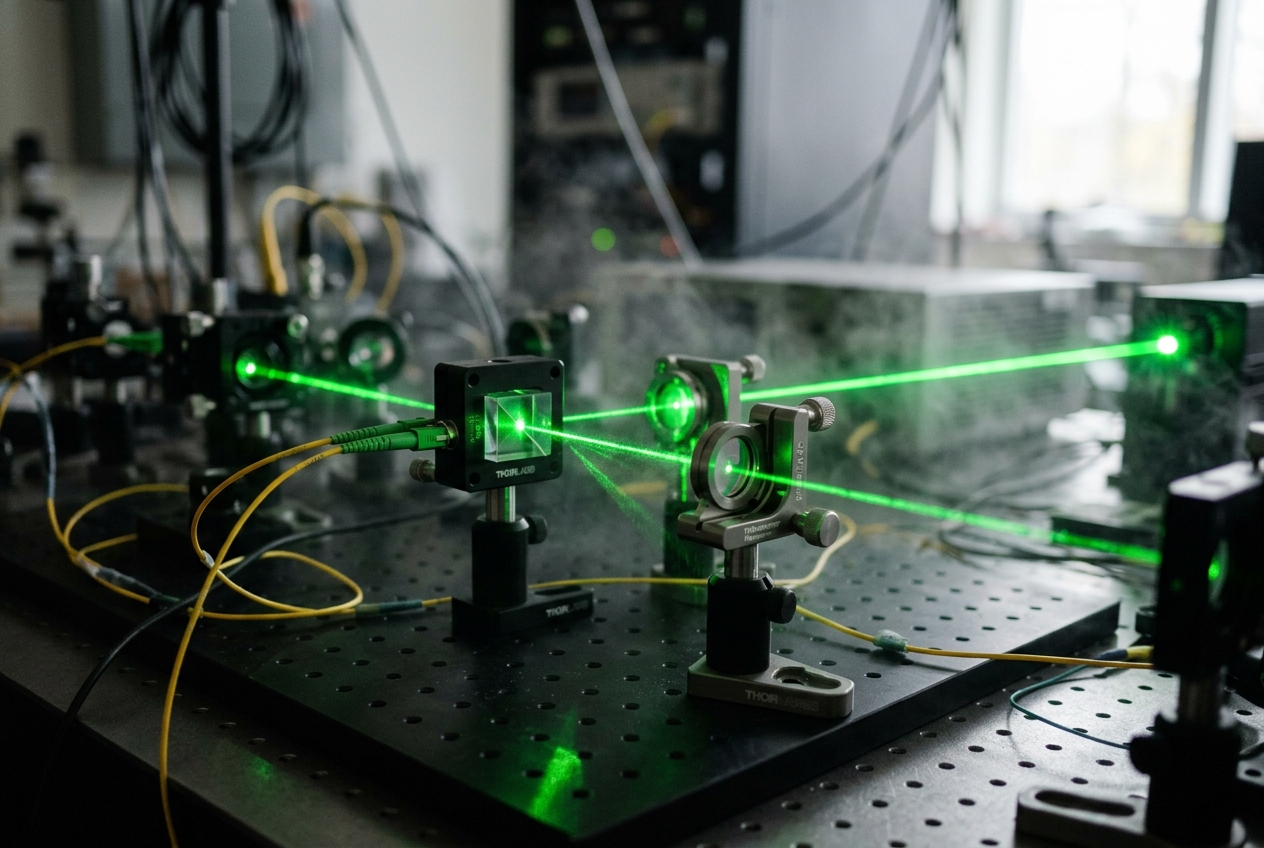
In the deepest basements of modern computing laboratories, researchers are confronting an engineering problem that sounds like science fiction: how to transmit quantum information across cities without destroying the delicate physical states that make quantum computation possible. If you try to copy a quantum state, nature forbids it under the no-cloning theorem. If you measure it directly, its delicate tapestry of superpositions collapses into mundane classical bits. Today, the world's major financial institutions, government networks, and cloud providers are investing billions into building an unhackable "quantum internet." Yet the fundamental blueprint that makes this decentralized quantum network possible rests on an idea so counterintuitive it baffled classical physicists for a century: the mathematical existence of negative information, and a procedure known as quantum state merging.
1. Opening Hook — Why You Should Care
The encryption securing your bank accounts, medical records, and digital identity relies on mathematical complexity—problems like prime factorization that would take a conventional supercomputer millennia to untangle. A fully realized quantum computer could dismantle these defenses in a single afternoon. To counteract this looming vulnerability, physicists are building distributed quantum communication networks where data is secured not by mathematical puzzles, but by the immutable laws of quantum mechanics.
       +-------------------------------------------------------------------+
       |                       THE CORE PARADOX                            |
       |  In our ordinary world, knowledge is always zero or positive.     |
       |  You can be entirely ignorant of a secret, or you can know it.   |
       |  You cannot possess "less than nothing."                         |
       |                                                                   |
       |  In the quantum realm, if two observers share entanglement,      |
       |  one party can know the other's state BETTER than perfectly.      |
       |  This manifests as NEGATIVE CONDITIONAL ENTROPY.                 |
       +-------------------------------------------------------------------+
In ordinary life, if you want to ship a fragile package from London to New York, you pay a courier a fee. If the package is heavy, the cost goes up. In classical information theory, if Alice wants to send a message to Bob, she must spend communication bandwidth. But in the quantum realm, something staggering occurs: under certain conditions, when Alice transfers her portion of an entangled system to Bob, she does not pay a communication fee. Instead, the universe pays them back in the form of pristine, reusable entanglement.
This process is known as quantum state merging. It is not merely a theoretical curiosity; it provides the operational mechanism for routing quantum data between remote processors, underpins how quantum repeaters will bridge continents, and has even revealed how information might escape from the interior of evaporating black holes.
2. The Idea in Plain English
To understand how state merging works, we must first examine how classical information measures uncertainty. In 1948, Claude Shannon established the foundations of modern communication by defining entropy as a measure of surprise or ignorance. If you flip a fair coin, your ignorance is exactly one bit: you have no idea whether it will land on heads or tails. If someone whispers the result into your ear before you look, your conditional ignorance drops to zero. In Shannon’s classical world, conditional entropy can never fall below zero. You can be completely ignorant, or you can possess complete knowledge. You cannot possess "negative ignorance."
Now consider the quantum counterpart. A quantum bit, or qubit, is not merely a switch set to zero or one; it can exist in a superposition of both states simultaneously—like a coin spinning in mid-air. When two qubits become entangled, their physical properties become inextricably linked across space.
Imagine two spinning coins, one held by Alice and one by Bob. If Alice measures her coin and sees heads, Bob’s coin instantly resolves to tails, every single time, regardless of the physical distance separating them.
 CLASSICAL INFORMATION                      QUANTUM ENTANGLEMENT
 (Independent / Correlated)                 (Inseparable State)

Alice          Bob                         Alice          Bob
  [Coin A]      [Coin B]                    (====[SHARED PAIR]====)
     |             |                                   |
 Ignorance >= 0 always                      Ignorance can be NEGATIVE:
 S(A|B) >= 0                                S(A|B) < 0
 "I know something or nothing."             "Bob holds the key to Alice's
                                             identity before Alice speaks."
Here is where the quantum world diverges radically from classical logic. If Alice's qubit is fully entangled with Bob's, Alice looking at her own qubit sees total randomness—pure noise. Her individual entropy is high. Yet the combined two-qubit system is in a pure, perfectly ordered state with an entropy of zero.
When physicists calculate Alice's uncertainty conditioned on what Bob already holds, the mathematics yields a negative number. Bob’s existing correlations hold more information about Alice’s qubit than Alice herself possesses locally. Negative conditional entropy means that Bob already holds the missing puzzle pieces; Alice does not need to send Bob the entire picture, only a subtle classical hint to help him assemble it.
3. How It Actually Works — The Mechanics
The foundational framework of quantum state merging was formulated in 2005 by physicists Michał Horodecki, Jonathan Oppenheim, and Andreas Winter in a landmark paper published in Nature. To understand their protocol, consider a tripartite quantum system consisting of three parties: Alice ($A$), Bob ($B$), and an external Reference system ($R$) that purifies the entire arrangement into a global pure quantum state, denoted as $|\psi\rangle_{RAB}$.
The operational objective of state merging is straightforward: Alice wants to transfer her subsystem $A$ to Bob, such that Bob ultimately holds both $A$ and $B$, while leaving all initial quantum correlations with the Reference system $R$ completely intact.
       INITIAL STATE:                              FINAL STATE:

         [Reference R]                              [Reference R]
          /         \                                    |
         / (correl)  \ (correl)                          | (preserved)
        v             v                                  v
     [Alice A] <---> [Bob B]                        [Bob: (AB)]
       (entangled)                               (Alice is decoupled)
Quantifying the Uncertainty
In quantum mechanics, entropy is calculated using the von Neumann entropy $S(\rho) = -\text{Tr}(\rho \log_2 \rho)$, where $\rho$ is the density matrix describing the statistical state of the system. For a bipartite subsystem shared between Alice and Bob, the conditional quantum entropy is defined as:
$$S(A|B) = S(AB) - S(B)$$
In classical information theory, $S(AB)$ is always greater than or equal to $S(B)$, ensuring that conditional entropy remains non-negative. But in quantum mechanics, if Alice and Bob share an entangled state, the joint entropy $S(AB)$ can be zero while the local entropy $S(B)$ is strictly positive. This causes $S(A|B)$ to become strictly negative.
The Horodecki-Oppenheim-Winter protocol establishes the exact currency needed to perform this transfer:
$$\text{Entanglement Cost} = S(A|B) \text{ ebits}, \qquad \text{Classical Communication} = \frac{1}{2} I(A:R) \text{ bits}$$
Here, an "ebit" represents a maximally entangled pair of qubits (a Bell state), and $I(A:R) = S(A) + S(R) - S(AR)$ denotes the quantum mutual information between Alice and the Reference system.
========================================================================
                      THE DUAL REGIMES OF STATE MERGING
========================================================================

REGIME 1: Positive Entropy S(A|B) > 0
  - Alice and Bob share weak or zero entanglement.
  - Alice must CONSUME S(A|B) ebits of shared entanglement to send her state.
  - Alice must send (1/2) I(A:R) classical bits to Bob.

REGIME 2: Negative Entropy S(A|B) < 0
  - Alice and Bob share strong quantum entanglement.
  - Alice CONSUMES ZERO prior entanglement.
  - The protocol DISTILLS and YIELDS |S(A|B)| fresh, pure ebits for future use!
  - Alice still transmits (1/2) I(A:R) classical bits to Bob.
========================================================================
When $S(A|B) < 0$, the net entanglement cost becomes negative, representing an entanglement gain:
$$\Delta E = |S(A|B)| \text{ ebits distilled}$$
Alice and Bob end up with Bob holding the full state $AB$, their joint entanglement with the outside world $R$ perfectly preserved, and an additional stockpile of $|S(A|B)|$ pure Bell pairs left over in their quantum memory.
The Decoupling Engine: Haar Unitaries and Uhlmann's Theorem
How does Alice physically achieve this transfer without measuring the state and destroying it? The mathematical engine powering state merging is quantum decoupling, an essential concept accessible via advanced curricula such as MIT OpenCourseWare Quantum Information Science.
                 ALICE's LABORATORY DECOUPLING

    [ Qubits A_1 ] --+
    [ Qubits A_2 ] --+--> [ Random Haar Unitary U ] --+--> [ Small Slice A_1 ] (Measured)
    [ Qubits A_3 ] --+                                 |          |
    [ Qubits A_n ] --+                                 |          v
                                                       |    (Classical Bits to Bob)
                                                       +--> [ Retained Slice A_2 ]
                                                            (Decoupled from Reference R!)
- Random Unitary Mixing: Alice takes her $n$ identical copies of subsystem $A$ and applies a collective transformation drawn randomly from the uniform Haar measure (or implemented via pseudo-random quantum circuits). This operation scrambles the quantum information across all her local qubits.
- Subspace Projection & Slicing: Alice divides her transformed qubits into two slices: a small auxiliary slice and a primary slice. By tuning the size of the slice to match the quantum mutual information $\frac{1}{2}I(A:R)$, Alice performs a projective measurement on the small slice and transmits the classical measurement outcomes to Bob.
- Decoupling from the Reference: Because of the scrambling, this measurement completely decouples Alice’s remaining primary system from the Reference system $R$.
- Bob’s Reconstruction via Uhlmann's Theorem: According to Uhlmann’s theorem—a cornerstone of von Neumann entropy analysis—if Alice’s remaining qubits are completely decoupled from $R$, then the purifier of $R$ must reside entirely within Bob’s laboratory. Bob applies a local unitary rotation conditioned on Alice's classical bits, effortlessly absorbing subsystem $A$ into his own quantum registers.
The "Mother Protocol" of Quantum Shannon Theory
State merging is celebrated as the "Mother Protocol" of quantum information theory because nearly every major primitive in quantum communication can be derived directly from it as a special case:
                          +-------------------------------+
                          |    QUANTUM STATE MERGING      |
                          |      (The Mother Protocol)    |
                          +---------------+---------------+
                                          |
         +--------------------------------+--------------------------------+
         |                                |                                |
         v                                v                                v
+------------------+            +-------------------+            +--------------------+
|   TELEPORTATION  |            | SUPERDENSE CODING |            | STATE REDISTRIBUTE |
| (Send state via  |            | (Send 2 classical |            | (Multi-party state |
|  ebits + bits)   |            |  bits via 1 ebit) |            |  routing in nets)  |
+------------------+            +-------------------+            +--------------------+
- Quantum Teleportation: When the initial system has no prior correlation with Bob ($S(B) = 0$), $S(A|B) = S(A)$. State merging reduces to standard teleportation, consuming $S(A)$ ebits and $2S(A)$ classical bits.
- Superdense Coding: By reversing the flow of classical and quantum resources within the state merging duality, one recovers the transmission of two classical bits per entangled pair.
- Quantum Channel Capacity: The rate at which noisy quantum channels can transmit quantum states is obtained by merging the output of the channel back into a coherent receiver.
4. Real-World Applications Today
Far from being confined to chalkboards, state merging and its decoupling mechanics are driving active breakthroughs across several cutting-edge domains between 2024 and 2026:
A. Distributed Quantum Cloud Computing
- Organizations: IBM Quantum and the open-source Qiskit development community.
- The Goal: Connecting modular quantum processing units (QPUs) using photonic interconnects to form large-scale distributed quantum computers.
- The Quantum Advantage: Individual quantum chips are limited by physical crosstalk and thermal noise. By implementing state merging protocols, an algorithm running on chip $A$ can merge its intermediate quantum state into chip $B$ across optical links. Because entangled states between chips can yield negative conditional entropy, inter-chip communication consumes fewer networking resources, allowing multiple modular processors to behave as a single, cohesive quantum supercomputer.
       CHIP A (London QPU)                      CHIP B (New York QPU)
     +---------------------+                  +---------------------+
     | [Q1] [Q2] [Q3] [Q4] |                  | [Q5] [Q6] [Q7] [Q8] |
     +----------+----------+                  +----------+----------+
                \                                        /
                 \             OPTICAL LINK             /
                  +=======> (State Merging) <==========+
                            Transfers state without
                            measuring or collapsing
B. Quantum Network Routing & Quantum Repeaters
- Organizations: QuTech (Delft University of Technology) and the Harvard-AWS Quantum Networking Center.
- The Goal: Developing multi-node quantum repeaters capable of transmitting quantum keys and entangled states across continental distances.
- The Quantum Advantage: Direct transmission of photons over optical fiber suffers exponential signal loss after roughly 100 kilometers. Classical amplifiers cannot copy quantum states due to the no-cloning theorem. State merging protocols enable quantum repeaters to distill noisy, distributed entanglement across intermediate nodes. When negative conditional entropy is achieved, intermediate nodes route quantum states across network hubs while generating residual entanglement buffers, dramatically raising network throughput.
C. Black Hole Information Recovery & Scrambling Physics
- Organizations: The Institute for Advanced Study (IAS) and Stanford University's Institute for Theoretical Physics.
- The Goal: Resolving Stephen Hawking’s Black Hole Information Paradox using the Hayden-Preskill thought experiment.
- The Quantum Advantage: In 2007, Patrick Hayden and John Preskill demonstrated that an evaporating black hole behaves like a quantum information mirror. If Alice tosses a quantum diary into an old black hole that is already entangled with its prior Hawking radiation, the black hole scrambles the diary rapidly. By treating the black hole as Alice, the radiation as Bob, and the diary as the reference, researchers proved via quantum state merging that Bob needs to collect only a few photons of new radiation to reconstruct Alice's entire diary. Decoupling theorems show how gravitational spacetime geometry naturally processes quantum information.
                         HAYDEN-PRESKILL EXPERIMENT

      Alice's Diary              Old Black Hole               Early Radiation
         [State A] -----------> ( Highly Entangled ) <=====> ( Held by Bob )
                                       |
                                (Fast Scrambler)
                                       |
                                       v
                              [Few New Photons] ----> Bob decodes entire diary!
D. Multi-Party Quantum Cryptography and Private State Sharing
- Organizations: Toshiba Europe (Cambridge Research Laboratory) and Quantum Xchange.
- The Goal: Establishing multi-tenant quantum key distribution (QKD) and secure multiparty quantum computation across complex metropolitan fiber rings.
- The Quantum Advantage: Traditional key distribution relies on point-to-point links. State merging allows multiple participants to combine partially shared quantum states into a central trusted node without revealing the individual states to eavesdroppers. The protocol guarantees that quantum privacy is preserved by ensuring that decoupling mathematically purges any correlation with external wiretappers.
5. What This Means for You
It is easy to perceive negative entropy and quantum state merging as abstract mathematics, but their practical consequences will shape the digital infrastructure of your daily life over the coming decades.
+-----------------------------------------------------------------------------+
|                      WHAT THIS MEANS FOR YOUR FUTURE                        |
+-----------------------------------------------------------------------------+
|  1. UNBREAKABLE CLOUD PRIVACY:                                              |
|     State merging will allow your local device to offload quantum-encrypted |
|     computations to cloud mainframes without the cloud host ever learning  |
|     the data it is calculating.                                             |
|                                                                             |
|  2. ACCELERATED MOLECULAR MEDICINE:                                         |
|     Distributed quantum computers linked via state merging can simulate     |
|     complex proteins, designing targeted therapies for intractable diseases |
|     in days rather than decades.                                            |
|                                                                             |
|  3. SECURE CRITICAL INFRASTRUCTURE:                                         |
|     Power grids, water supplies, and financial ledgers will run on quantum  |
|     networks where physical interception is forbidden by nature's laws.     |
+-----------------------------------------------------------------------------+
When you log into a banking portal or transmit sensitive medical data today, your privacy rests on the assumption that adversaries lack the computing horsepower to reverse certain mathematical operations. Quantum networks eliminate this gamble. By using state merging to link distributed quantum processors, humanity is constructing a global computational fabric where data security is guaranteed by the physics of entanglement.
Furthermore, distributed quantum supercomputers linked via state merging will simulate molecular interactions with exact precision, transforming pharmacological drug discovery and accelerating the development of room-temperature superconductors and high-density battery chemistries.
6. Today's Takeaway
+-----------------------------------------------------------------------------+
|                             TODAY'S TAKEAWAY                                |
|                                                                             |
|  Negative conditional entropy proves that in a quantum universe, shared     |
|  entanglement represents more than passive connection—it is a tangible fuel.|
|  Through quantum state merging, when two systems share deep quantum         |
|  correlations, information can be transferred without consuming energy or   |
|  bandwidth, leaving both parties with more quantum entanglement than when   |
|  they began.                                                                |
+-----------------------------------------------------------------------------+
By unmasking the operational reality of negative information, quantum state merging transformed our understanding of communication from a process of merely pushing bits across wires into a rich geometry of entanglement distillation, unifying classical communication, quantum computing, and the fundamental physics of spacetime itself.
Further Reading & Authoritative References
- The seminal paper on quantum state merging: Nature: Partial quantum information (Horodecki, Oppenheim, & Winter).
- Comprehensive foundational theory: arXiv Quantum Physics Repository.
- Mathematical formulations of quantum entropy: Wikipedia: Quantum State Merging and Von Neumann Entropy.
- Course curricula on decoupling and Shannon theory: MIT OpenCourseWare Quantum Information Science.
- Interactive quantum software & hardware implementations: IBM Quantum and the Qiskit Learning Portal.