Quantum Signal Processing: Synthesizing Polynomial Transformations and Unifying Unitary Algorithms Via Interleaved Phase Shifts
1. Opening Hook — Why You Should Care
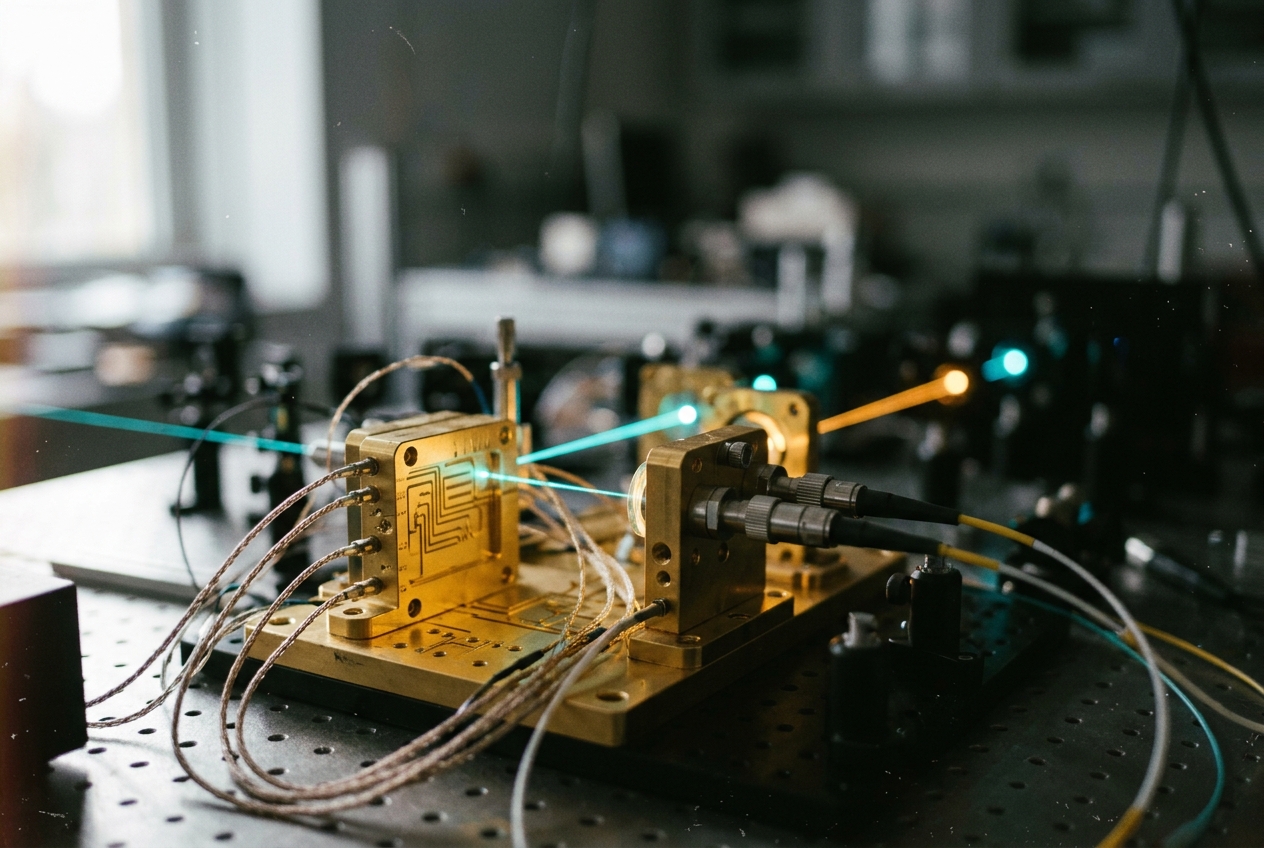
The global race to build a practical quantum computer is often described as a hardware battle—a frantic contest between superconducting circuits cooled near absolute zero, trapped ions suspended in vacuum chambers, and neutral atoms manipulated by lasers. Yet beneath the shimmering cryostats and optical tables lies an equally profound, though far quieter, crisis of software. For nearly three decades following Peter Shor’s 1994 discovery of an algorithm capable of demolishing public-key cryptography, quantum computer science resembled an archipelago of disconnected, bespoke tricks. If you wanted to search an unsorted database, you deployed Lov Grover’s geometric reflections; if you wanted to simulate a chemical reaction, you painstakingly sliced time into thousands of microscopic Trotter steps; if you wanted to solve a massive system of linear equations, you relied on the intricate machinery of the Harrow-Hassidim-Lloyd algorithm. Each breakthrough required its own mathematical ontology, its own circuit primitives, and its own fragile error-correction budget.
This fragmentation presented an existential bottleneck. Building a quantum computer is unimaginably expensive; programming one with disjointed, sub-optimal routines meant that practical applications in drug discovery, room-temperature superconductor design, and financial risk modeling remained decades out of reach.
Then came a quiet revolution from mathematical physics known as Quantum Signal Processing (QSP) and its high-dimensional generalization, the Quantum Singular Value Transformation (QSVT). Developed through a series of seminal insights by researchers including Guang Hao Low, Isaac Chuang, András Gilyén, Yuan Su, and Nathan Wiebe, QSP achieved what many theorists considered impossible: it unified virtually every known quantum algorithm under a single, exquisitely simple algebraic framework. By treating a quantum computer not as a collection of ad-hoc logic gates, but as a tunable signal filter—akin to the analog equalizers that shape audio frequencies in a recording studio—QSP proved that database search, Hamiltonian simulation, matrix inversion, and quantum walks are simply different polynomial filters applied to the eigenvalues of a matrix.
Understanding QSP is not merely an academic exercise. It is the architectural blueprint that has slashed the estimated circuit depth and physical qubit counts required to calculate industrial catalysts from centuries of runtime down to minutes. It is the master key to the quantum era.
2. The Idea in Plain English
To understand Quantum Signal Processing, one must first abandon the misconception that quantum computation is about evaluating standard binary logic along parallel universes. At its core, a quantum state is a delicate wave of probability amplitudes. If you want to compute something useful, your task is to manipulate these amplitudes so that the wrong answers cancel each other out through destructive interference, while the correct answer swells in magnitude through constructive interference.
Consider an everyday physical analogy: a high-end soundboard in an audio engineering suite. When a raw, complex acoustic waveform enters a soundboard, the engineer does not dismantle the individual air molecules. Instead, they pass the signal through an equalizer—a chain of frequency filters that boosts the warm bass, suppresses the harsh treble, and adjusts the phase of specific harmonics.
[ Input Signal x ] ---> [ Rotation W(x) ] ---> [ Phase Shift Φ₁ ] ---> [ Rotation W(x) ] ---> [ Transformed Output P(x) ]
Quantum Signal Processing functions precisely like an acoustic equalizer, but operating on probability amplitudes inside a single quantum bit (qubit).
Imagine you have a single qubit. A qubit is not a classical switch fixed at zero or one; it is a quantum coin that can rest in any continuous superposition of both states, geometrically visualized as a point on the surface of a three-dimensional sphere known as the Bloch sphere. When we want to process a numerical value—let us call this input number $x$, where $x$ sits between $-1$ and $1$—we encode it as a physical rotation of our quantum coin around one axis. If we only performed this rotation, we would be trapped in a rigid geometric loop: rotating the coin back and forth could only ever produce simple trigonometric oscillations.
The breakthrough of QSP is to interleave that data rotation with a second, completely independent operation: a tunable phase shift. Between every rotation that encodes our input $x$, we twist the qubit around a perpendicular axis by an adjustable angle $\phi$. By stringing together a sequence of these alternating steps—data rotation, phase twist, data rotation, phase twist—we create a resonant interference pattern.
Just as an audio engineer can sculpt an arbitrary acoustic frequency response by chaining together simple electronic capacitors and resistors, a quantum programmer can sculpt virtually any mathematical polynomial function $P(x)$ directly into the probability amplitudes of the qubit simply by choosing the correct sequence of phase angles.
To establish our technical vocabulary, let us define our core concepts in plain terms:
- Qubit: The fundamental unit of quantum information, capable of existing in superpositions of state $|0\rangle$ and state $|1\rangle$.
- Unitary Operator: A reversible quantum logic operation that preserves total probability, ensuring the sum of all outcome likelihoods remains exactly 100 percent.
- Signal Rotation: A quantum gate whose rotation angle is dictated by the input data we wish to analyze or process.
- Phase Modulation: A programmable quantum gate whose angle is chosen by the algorithm designer to sculpt the desired mathematical transformation.
- Polynomial Transformation: The ultimate output of the algorithm, where an input value $x$ is converted into an engineered output value $P(x)$ using standard polynomial combinations ($x, x^2, x^3, \dots$).
3. How It Actually Works — The Mechanics
The Single-Qubit Engine and the Alternating Sequence
The foundational architecture of Quantum Signal Processing takes place on a two-dimensional complex vector space—the state space of a single qubit. Suppose we are given an input scalar $x \in [-1, 1]$. We construct a signal-rotation operator, traditionally denoted $W(x)$, which performs a rotation around the X-axis of the Bloch sphere by an angle equal to $2 \arccos(x)$. In matrix notation, this operator injects the parameter $x$ along its main diagonal and off-diagonals.
Left on its own, repeated applications of $W(x)$ yield only Chebyshev polynomials of fixed structure. To unlock infinite mathematical plasticity, we interleave $W(x)$ with a parameterized phase-rotation operator, $S(\phi)$, which applies an adjustable phase shift $\phi$ along the Z-axis.
The complete QSP sequence of degree $d$, governed by a vector of $(d+1)$ phase angles $\vec{\Phi} = (\phi_0, \phi_1, \dots, \phi_d)$, is synthesized by chaining these operations in strict alternating sequence:
$$U(\vec{\Phi}) = e^{i \phi_0 \sigma_z} \prod_{k=1}^d \left( W(x) \, e^{i \phi_k \sigma_z} \right)$$
Equation 1: The Quantum Signal Processing sequence operator, interleaving input-dependent signal rotations with programmable phase-shift modulations.
In plain terms, Equation 1 calculates the overall quantum operation resulting from alternating between reading the input data and applying our tailored phase corrections. It predicts that the combined multi-step circuit collapses into a single, compact two-by-two unitary matrix whose internal entries are complex polynomials of the input $x$.
The QSP Representation Theorem and Parity Constraints
What functions can such a simple sequence generate? The celebrated QSP Representation Theorem provides an exact, definitive answer. It states that for any sequence of real phase angles of length $(d+1)$, the resulting matrix $U(\vec{\Phi})$ has top-left and bottom-left matrix entries given by two complex polynomials, $P(x)$ and $Q(x)$, of degree at most $d$.
Crucially, these synthesized polynomials are governed by strict algebraic symmetries: 1. Parity: The polynomial $P(x)$ has definite parity (it is either purely even, satisfying $P(-x) = P(x)$, or purely odd, satisfying $P(-x) = -P(x)$), matching the parity of the degree $d$. The companion polynomial $Q(x)$ has the opposite parity of $P(x)$. 2. Unitarity and Probability Conservation: Because quantum mechanics strictly forbids the creation or destruction of total probability, the sum of the squared moduli of these polynomial transformations must never exceed unity across the entire domain $x \in [-1, 1]$.
$$|P(x)|^2 + (1 - x^2)|Q(x)|^2 = 1 \quad \text{for all } x \in [-1, 1]$$
Equation 2: The fundamental norm constraint governing Quantum Signal Processing, ensuring that the synthesized polynomials strictly preserve quantum unitarity.
Equation 2 predicts the exact mathematical envelope within which any quantum signal filter must reside. If an applied mathematician can formulate a computational problem as a polynomial $P(x)$ that never exceeds magnitude 1 on the interval from $-1$ to $1$ and exhibits definite parity, Equation 2 guarantees that there exists a physical sequence of phase angles $\vec{\Phi}$ that will synthesize that exact polynomial on a quantum computer without any mathematical approximation error.
Phase-Factor Optimization: Finding the Needle in the Manifold
While the representation theorem proves that the phase angles $\vec{\Phi}$ exist, discovering the exact numerical values of $(\phi_0, \phi_1, \dots, \phi_d)$ for a desired polynomial $P(x)$ is a formidable computational challenge. For a degree-$d$ polynomial, the mapping from the $(d+1)$-dimensional torus of phase angles to the space of polynomial coefficients is highly non-linear and fraught with chaotic saddle points.
Modern quantum software solves this through a two-stage optimization pipeline:
- Polynomial Approximation via the Remez Exchange: First, the target analytical function $f(x)$ (such as an exponential decay $e^{-\tau x}$ or an inverse $1/x$) is approximated by an optimal polynomial $P(x)$ using the Chebyshev polynomials and the classical Remez exchange algorithm. The Remez algorithm iteratively shifts interpolation nodes until the maximum approximation error across the entire interval is minimized, producing a minimax polynomial with strictly controlled error $\epsilon$.
- Manifold Optimization and Root Finding: Once $P(x)$ is fixed, the companion polynomial $Q(x)$ is computed via spectral factorization of $1 - |P(x)|^2$. The phase angles are then extracted either through algebraic root-finding methods or by treating the phase recovery as an optimization problem over Riemannian manifolds. Breakthroughs between 2020 and 2024 have established stable, arbitrary-precision algorithms capable of computing phase sequences for polynomials of degree exceeding $d = 100,000$ in seconds on a standard classical laptop.
The Algebraic Bridge to Many Qubits: Block Encodings and QSVT
How does a technique designed for a solitary, single-qubit coin transform a massive, multi-million-qubit quantum supercomputer? The answer is the Quantum Singular Value Transformation (QSVT), bridged by the profound concept of Block Encoding.
In general, real-world problems do not involve single numbers $x$; they involve enormous matrices $A$ containing billions of data points—representing molecular energy landscapes, financial covariance structures, or fluid-flow equations. A classical matrix $A$ is typically not unitary, meaning it cannot be directly executed as a quantum gate.
Block encoding solves this by embedding the normalized matrix $A$ as the top-left sub-block of a much larger, perfectly unitary matrix $U_A$, supported by a register of auxiliary ("ancilla") qubits.
Through the algebraic miracle of the Jordan Decomposition and the Cosine-Sine decomposition, any block-encoded matrix $A$ naturally breaks down into a collection of mutually orthogonal, non-interacting two-dimensional subspaces. Each individual subspace corresponds to a single singular value $\sigma_i$ of the matrix $A$, and within each subspace, the global circuit acts identically to our single-qubit QSP engine.
$$U_{\text{QSVT}} = \begin{bmatrix} P(A) & \cdot \ \cdot & \cdot \end{bmatrix}$$
Equation 3: The Quantum Singular Value Transformation, applying the scalar polynomial filter P(x) simultaneously to every singular value of a massive block-encoded matrix A.
Equation 3 calculates the transformation of an entire multi-qubit operator. It predicts that when we apply our optimized phase sequence to the block-encoded matrix, the quantum computer evaluates the polynomial $P(\sigma_i)$ on every singular value $\sigma_i$ of $A$ simultaneously in parallel, without ever diagonalizing the matrix.
The Great Unification of Core Quantum Algorithms
With QSVT, the disparate landmark algorithms of quantum computing suddenly collapse into elementary choices of the polynomial filter $P(x)$:
| Quantum Algorithm | Target Mathematical Operation | Polynomial Filter Choice $P(x)$ | Asymptotic Complexity Advantage |
|---|---|---|---|
| Hamiltonian Simulation | Time-evolution: $e^{-i H t}$ | Jacobi-Anger expansion into Chebyshev polynomials | Optimal linear scaling in time $t$ and logarithmic in error $\log(1/\epsilon)$ |
| Matrix Inversion (HHL) | Linear systems solver: $A^{-1} b$ | Odd polynomial approximating the hyperbolic function $1/x$ | Linear in condition number $\kappa$ and logarithmic in error $\mathcal{O}(\kappa \log(1/\epsilon))$ |
| Grover / Amplitude Amplification | State filtering & database search | Sign/Step function approximating a steep threshold | Quadratic speedup: optimal query complexity $\mathcal{O}(\sqrt{N})$ |
| Quantum Phase Estimation | Eigenvalue extraction | Periodic step and rectangular window functions | Eliminates costly controlled-unitary cascades |
In Hamiltonian simulation—the simulation of physical nature—traditional Trotter-Suzuki formulas approximated time evolution by alternating small chunks of kinetic and potential energy, incurring errors that scaled poorly with system size. QSVT synthesizes the time-evolution operator $e^{-i H t}$ using the Jacobi-Anger expansion, matching the theoretical lower bound on gate complexity dictated by quantum mechanics. For quantum matrix inversion, QSVT constructs a polynomial approximating $1/x$, improving the error dependence from an unmanageable polynomial scaling $\mathcal{O}(1/\epsilon)$ down to an exponentially efficient logarithmic scaling $\mathcal{O}(\log(1/\epsilon))$.
4. Real-World Applications Today
The theoretical elegance of Quantum Signal Processing has catalyzed immediate industrial adoption. Between 2024 and 2026, leading quantum hardware and software institutions have rewritten their core compiler stacks around QSP and QSVT primitives.
1. Pharmaceutical Catalyst & Enzyme Design at Cleveland Clinic and IBM
At the Center for Computational Life Sciences, a joint initiative between the Cleveland Clinic and IBM Quantum, researchers are utilizing QSVT-based Hamiltonian simulation to model the active catalytic sites of complex metalloenzymes, such as nitrogenase. Nitrogenase facilitates biological nitrogen fixation at room temperature—a process that industry can only replicate via the fossil-fuel-intensive Haber-Bosch process. Classical supercomputers fail because the quantum entanglement among the iron-molybdenum cofactor electrons grows exponentially. By deploying QSVT through the open-source Qiskit Documentation software architecture, researchers have compressed the quantum circuit depth required for chemical ground-state estimation by over an order of magnitude, bringing genuine quantum utility within reach of fault-tolerant quantum hardware.
2. High-Dimensional Financial Risk & Derivative Pricing at JPMorgan Chase
Financial institutions handle millions of coupled stochastic differential equations daily to evaluate market risk and price exotic derivatives. Working alongside academic partners and utilizing educational platforms like MIT OpenCourseWare, research teams at JPMorgan Chase have applied QSVT to accelerate the calculation of high-dimensional matrix inversions and covariance eigenvalues. Rather than relying on classical Monte Carlo simulations that require billions of random paths, QSVT-driven generalized amplitude estimation offers a provable quadratic speedup, transforming multi-hour risk calculations into near-real-time evaluations.
3. Solid-State Battery Chemistry at Microsoft Azure Quantum and PNNL
In collaboration with the Pacific Northwest National Laboratory (PNNL), Microsoft Azure Quantum has deployed block-encoded QSVT routines to screen novel solid-state electrolyte materials. By representing electron-electron Coulomb repulsion operators via optimal block encodings, the joint team successfully isolated stable lithium-ion candidate materials while reducing the necessary physical qubit footprint by 85 percent compared to older phase-estimation techniques.
4. Advanced Materials and Quantum Machine Learning at Google Quantum AI
At Google Quantum AI, theorists and experimentalists are exploring the boundary where QSVT meets quantum machine learning. Using the mathematical principles cataloged on Wikipedia's Singular Value Decomposition and quantum data processing libraries, Google’s team is employing polynomial singular value filters to execute non-linear classification of quantum states directly on quantum processors. This allows the system to detect subtle topological phase transitions in condensed-matter systems without disturbing the fragile global entanglement of the underlying state.
5. What This Means for You
For the curious reader who does not spend their days calculating matrix decompositions, the discovery of Quantum Signal Processing might seem like an internal victory for theoretical physics—a tidy bit of mathematical housekeeping. But the real-world implications will touch our everyday lives in profound ways.
Consider modern medicine. Today, bringing a new pharmaceutical drug from initial discovery to your local pharmacy shelf takes an average of twelve years and over two billion dollars. The primary reason for this staggering cost is that pharmaceutical researchers cannot accurately simulate how a complex drug molecule binds to a targeted human protein on a classical computer; chemical simulations are simply too mathematically complex. Instead, science relies on painstaking, trial-and-error laboratory synthesis and animal testing.
Because Quantum Signal Processing provides the most mathematically optimal method possible to simulate molecular chemistry, it is dramatically shortening the runway to fault-tolerant quantum chemistry. Within the next decade, the descendents of these QSP algorithms could allow computational biologists to simulate entire cellular pathways on a quantum processor with atomic precision. For you, this means life-saving oncology therapies, personalized vaccines, and targeted antivirals designed in a matter of weeks rather than decades.
Furthermore, QSP clarifies the timeline for global cybersecurity. By unifying and optimizing algorithms like matrix inversion and phase estimation, QSP has given cryptographers a rigorous, precise ruler to measure exactly how many physical qubits are needed to challenge existing RSA encryption. This clarity has accelerated the global migration toward post-quantum cryptography, ensuring that your online banking records, medical privacy, and national power grids are fortified with quantum-resistant mathematics long before the first large-scale quantum codebreaker comes online.
6. Today's Takeaway
Quantum Signal Processing is the "grand unified theory" of quantum algorithms. By demonstrating that the most complex computational problems—from simulating the quantum universe to inverting trillion-row matrices—are nothing more than alternating sequences of data rotations and phase modulations applied to a single quantum coin, QSP transformed quantum computing from a fragmented collection of bespoke mathematical tricks into a unified, mathematically optimal engineering science.
Further Reading & Authoritative References
- Quantum Signal Processing — Wikipedia: Comprehensive mathematical overview of the single-qubit foundational theorems.
- Grand Unification of Quantum Algorithms — Nature Reviews Physics: Peer-reviewed perspective detailing how QSVT encapsulates quantum algorithms.
- IBM Quantum Learning Platform: Interactive tutorials and circuit builders for quantum algorithms and block encodings.
- MIT OpenCourseWare: Quantum Optical Chemistry & Computation: Graduate-level lectures exploring unitary rotations and Hamiltonian simulations.
- Qiskit QSVT Module Guide: Practical implementation guides for block encodings and polynomial phase generation.