Quantum Random Access Memory: Structuring Bucket-Brigade Architectures and Coherent Address Routing in Quantum Algorithms
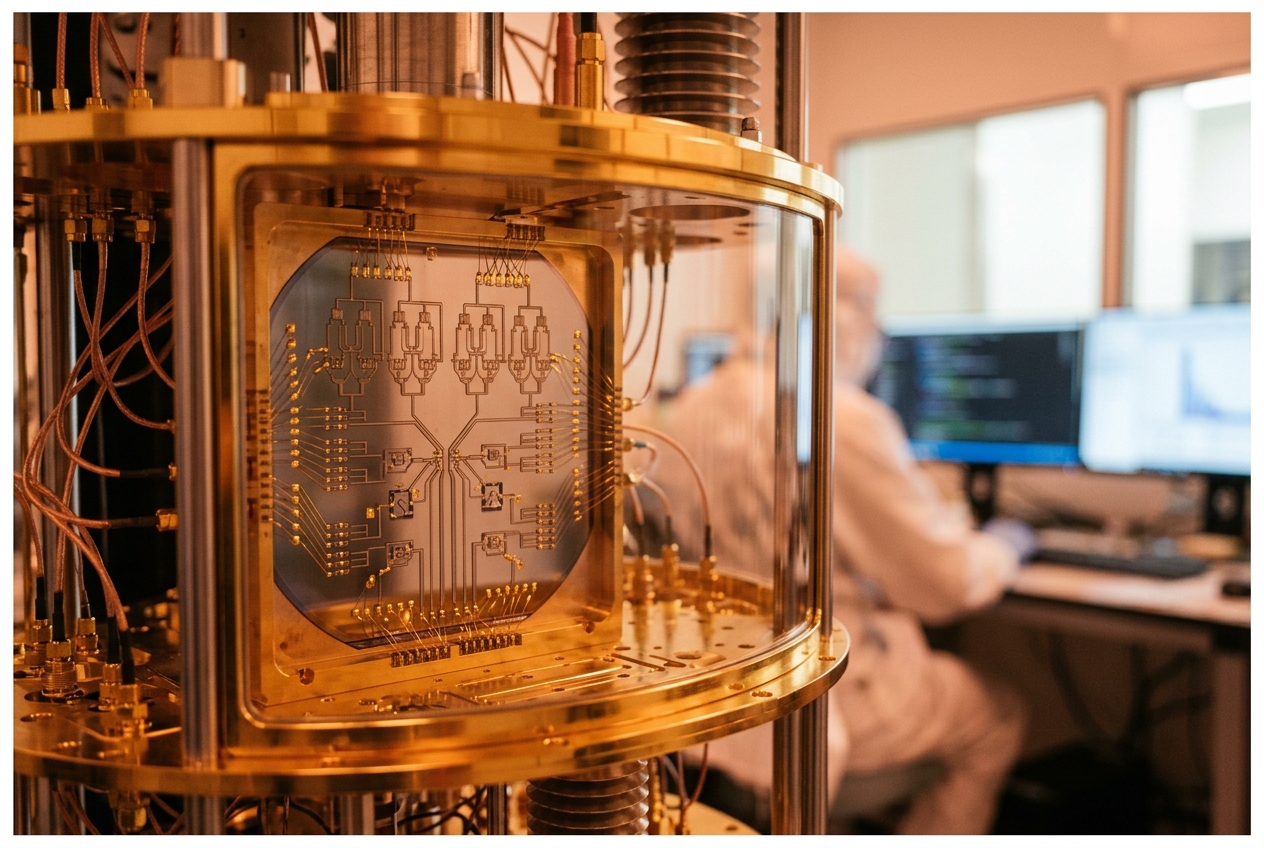
Yet in the subterranean cleanrooms of quantum computing laboratories, a profound architectural crisis looms. While quantum processors can now maintain superpositions of trillions of simultaneous mathematical states, they possess no working equivalent of a memory bus. If a quantum computer wishes to analyze a massive database—whether searching for genetic sequences, optimizing global supply logistics, or inverting matrices to simulate novel pharmaceutical molecules—it faces a catastrophic bottleneck: the very act of loading classical data into a quantum superposition threatens to destroy the fragile quantum coherence upon which its exponential computational speedup depends.
To bridge this chasm, theoretical physicists have formulated the architecture of Quantum Random Access Memory (QRAM). A functional QRAM would enable a quantum computer to query an entire library of information simultaneously, returning a quantum superposition of records entangled with their respective addresses. The realization of scalable, fault-tolerant QRAM represents one of the most formidable and decisive frontiers in contemporary physics.
1. Theoretical Motivation & Formal Definition: Superposition Addressing
In classical computing, a memory bus functions as a spatial demultiplexer. Given an $n$-bit classical address $j \in {0, 1}^n$, where the address space spans $N = 2^n$ distinct memory locations, address decoding lines activate a single physical wire. This electrical pathway enables the read-out of the stored $p$-bit classical word $D_j \in {0, 1}^p$ onto a dedicated output bus:
$$j \xrightarrow{\text{Classical RAM}} D_j$$
In this classical regime, memory querying is fundamentally disjoint: activating address $j$ precludes the simultaneous activation of address $k \neq j$.
The Quantum Memory Mapping
In the realm of quantum information, a query is not restricted to a single deterministic index. An address register consisting of $n$ qubits may exist in an arbitrary, coherent quantum superposition parameterized by complex probability amplitudes $\alpha_j \in \mathbb{C}$:
$$|\psi_{\text{addr}}\rangle = \sum_{j=0}^{N-1} \alpha_j |j\rangle_A \quad \text{such that} \quad \sum_{j=0}^{N-1} |\alpha_j|^2 = 1$$
When presented with an empty target data register initialized in the fiducial state $|0\rangle_D^{\otimes p}$, an ideal QRAM executes a global unitary transformation $\hat{U}_{\text{QRAM}}$ that coherently correlates the address register with the corresponding stored data $D_j$:
$$\hat{U}{\text{QRAM}} \left( \sum{j=0}^{N-1} \alpha_j |j\rangle_A |0\rangle_D \right) = \sum_{j=0}^{N-1} \alpha_j |j\rangle_A |D_j\rangle_D$$
If the memory contents themselves are arbitrary quantum states $|\phi_j\rangle$ (a fully quantum memory, or qQRAM), the mapping generalizes to:
$$\hat{U}{\text{qQRAM}} \left( \sum{j=0}^{N-1} \alpha_j |j\rangle_A |0\rangle_D \right) = \sum_{j=0}^{N-1} \alpha_j |j\rangle_A |\phi_j\rangle_D$$
+-----------------------------------------------------------------------------------------+
|                                    QRAM QUERY TYPES                                     |
+-------------------+---------------------------------------+-----------------------------+
| Type              | Input State                           | Output State                |
+-------------------+---------------------------------------+-----------------------------+
| Classical RAM     | Deterministic address j               | Deterministic data D_j      |
| Quantum-Classical | Superposition: ∑ α_j |j⟩ |0⟩         | ∑ α_j |j⟩ |D_j⟩ (Classical) |
| Quantum-Quantum   | Superposition: ∑ α_j |j⟩ |0⟩         | ∑ α_j |j⟩ |φ_j⟩ (Quantum)   |
+-------------------+---------------------------------------+-----------------------------+
Unitary State Synthesis vs. Coherent Oracle Querying
It is essential to distinguish an active QRAM query from unitary state synthesis via sequential quantum logic gates. To prepare an arbitrary target state $|\Phi\rangle = \sum_{j=0}^{N-1} c_j |j\rangle$ on an $n$-qubit register without an auxiliary memory oracle, the Solovay-Kitaev Theorem and general quantum compilation bounds dictate a circuit depth of $\mathcal{O}(2^n) = \mathcal{O}(N)$ using elementary single- and two-qubit gates.
Executing such a circuit for large $N$ requires time exponential in the address register size $n$, completely negating any downstream algorithmic speedup.
A viable QRAM circumvents this limitation. By offloading data storage to an addressable hardware lattice, the query time scales as $\mathcal{O}(\text{poly}(n)) = \mathcal{O}(\log N)$, transforming an intractable exponential state synthesis routine into an efficient logarithmic memory fetch.
2. The Fan-Out Problem vs. The Bucket-Brigade Architecture
The central obstacle in engineering physical QRAM is the quantum fan-out problem.
Consider a naive quantum memory architecture modeled directly on a classical binary demultiplexer circuit. In a classical tree decoder, a set of $n$ control bits routes an electrical signal through $N-1$ routing nodes. Because unselected pathways carry zero current, classical demultiplexers dissipate negligible dynamic power in idle branches.
In a naive quantum circuit, however, routing an address superposition $\sum_j \alpha_j |j\rangle$ across $N$ physical memory cells requires every single routing node to participate in coherent quantum gate operations. An address register must apply controlled-NOT ($\text{CNOT}$) and controlled-SWAP ($\text{Fredkin}$) gates across all $2^n - 1$ spatial junctions:
If $N = 10^9$ (a standard gigabyte of data), the naive fan-out circuit mandates approximately one billion active quantum logic operations per single query. Because every active quantum gate introduces an operational error $\epsilon_g$ and interacts with environmental thermal reservoirs, the total fidelity $\mathcal{F}$ of the query decays exponentially with database size:
$$\mathcal{F}_{\text{naive}} \sim (1 - \epsilon_g)^{\mathcal{O}(N)} \approx e^{-\epsilon_g N}$$
For any macroscopic $N$, this decoherence rate is catastrophic: $\mathcal{F}_{\text{naive}} \to 0$, rendering naive quantum memory physically impossible.
+-----------------------------------------------------------------------------------------+
|                                FAN-OUT VS. BUCKET-BRIGADE                               |
+--------------------------+------------------------------+-------------------------------+
| Metric                   | Naive Fan-Out Circuit        | GLM Bucket-Brigade            |
+--------------------------+------------------------------+-------------------------------+
| Active Nodes per Branch  | O(N) = O(2^n)                | O(log N) = O(n)               |
| Total Physical Nodes     | 2^N - 1                      | 2N - 1                        |
| Error Rate Scaling       | Exponential: 1 - e^(-ε N)    | Logarithmic: O(ε log N)       |
| Routing Node States      | 2-level (|0⟩, |1⟩)           | 3-level (|wait⟩, |L⟩, |R⟩)    |
+--------------------------+------------------------------+-------------------------------+
The Giovannetti-Lloyd-Maccone (GLM) Bucket-Brigade Protocol
In 2008, Vittorio Giovannetti, Seth Lloyd, and Lorenzo Maccone published a breakthrough architecture in Physical Review Letters known as the Bucket-Brigade QRAM.
The GLM protocol organizes $2N - 1$ quantum routing nodes into a balanced binary tree of depth $n = \log_2 N$. Crucially, each routing node is not a standard two-level qubit, but a three-level quantum system (qutrit) spanning the Hilbert space $\mathcal{H}_3 = \text{span}{|\text{wait}\rangle, |0\rangle \equiv |\text{left}\rangle, |1\rangle \equiv |\text{right}\rangle}$.
GLM Bucket-Brigade Binary Tree Hierarchy:

[ Root Node ] (Depth 0)
                         /          \
                        /            \
               [ Node 0 ]            [ Node 1 ] (Depth 1)
               /        \            /        \
             (00)      (01)        (10)      (11) (Leaves / Data Cells)
Initially, prior to the arrival of an address signal, every node in the entire binary tree rests in the passive ground state $|\text{wait}\rangle$. The query proceeds via a sequence of distinct stages:
Stage 1: Path Carving
The $n$ address qubits $|a_1 a_2 \dots a_n\rangle$ are injected into the root node sequentially: 1. The first address qubit $|a_1\rangle$ arrives at the root node (which is in the $|\text{wait}\rangle$ state). An internal cross-Kerr or conditional interaction swaps the state of the incoming qubit into the node's internal degree of freedom: $$|\text{wait}\rangle_{\text{root}} \otimes (\alpha |0\rangle + \beta |1\rangle) \longrightarrow \alpha |\text{left}\rangle_{\text{root}} + \beta |\text{right}\rangle_{\text{root}}$$ 2. The root node is now activated and serves as a directional switch. When subsequent address qubits ($|a_2\rangle, |a_3\rangle, \dots$) enter the root, they encounter a node that is no longer in the $|\text{wait}\rangle$ state. The node simply deflects them to the left child if the node is in $|\text{left}\rangle$, or to the right child if in $|\text{right}\rangle$, without altering its own internal state. 3. When $|a_2\rangle$ reaches the selected depth-1 node (which is still in state $|\text{wait}\rangle$), it alters that child node's state to $|\text{left}\rangle$ or $|\text{right}\rangle$. 4. This process continues recursively. After $n$ address qubits have entered the tree, exactly $n = \log_2 N$ nodes along any branch of the superposition have transitioned out of $|\text{wait}\rangle$, carving a coherent path of active switches from the root to the target leaf memory cells.
Stage 2: Data Bus Readout
An auxiliary quantum bus qubit, initialized to $|0\rangle_D$, is injected into the root. It traverses the path determined by the active switches, reaches the target leaf cell $j$, and interacts via a local unitary gate (e.g., a $\text{CNOT}$ gate targeting the bus if the stored data is classical, or a $\text{SWAP}$ gate if quantum), transforming the bus state into $|D_j\rangle_D$.
Stage 3: Uncomputation
Because the internal states of the routing nodes remain entangled with the spatial trajectory of the query, leaving them configured would destroy the quantum superposition through which-path information leakage (decoherence via entanglement with the environment).
To restore the tree to its pristine ground state, the address qubits are transmitted through the network in reverse order, executing the hermitian conjugate operations and mapping every routing node back to $|\text{wait}\rangle$:
$$|\text{left}\rangle \to |\text{wait}\rangle, \quad |\text{right}\rangle \to |\text{wait}\rangle$$
Because only $\mathcal{O}(\log N)$ nodes are modified throughout this entire procedure for each branch of the superposition, the vast majority of the $2N - 1$ physical nodes remain undisturbed in their uncoupled ground state $|\text{wait}\rangle$.
3. Error Scaling & Decoherence Analysis: Mathematical Proof
The definitive theoretical achievement of the bucket-brigade architecture is its resilience to physical decoherence. To rigorously demonstrate this advantage, we model the memory tree using open quantum systems theory, as detailed in academic frameworks available via MIT OpenCourseWare.
Let $\rho$ represent the density matrix of the entire QRAM apparatus (address register, routing nodes, and bus). Consider an open quantum channel characterized by local error generators acting on individual nodes. We categorize noise into two distinct physical channels:
- Dynamic Operational Errors ($\mathcal{E}_{\text{act}}$): Gate infidelities, photon loss, and dephasing occurring inside actively configured nodes ($|\text{left}\rangle$ or $|\text{right}\rangle$).
- Static Environmental Errors ($\mathcal{E}_{\text{pass}}$): Spontaneous emission, thermal excitation, and stray coupling acting upon passive nodes in state $|\text{wait}\rangle$.
+-----------------------------------------------------------------------------------------+
|                              NOISE CHANNEL REPRESENTATIONS                              |
+--------------------------+--------------------------------------------------------------+
| Error Mechanism          | Kraus Operators                                              |
+--------------------------+--------------------------------------------------------------+
| Phase Dephasing (Active) | K_0 = √(1-p) I,   K_1 = √(p) (|L⟩⟨L| - |R⟩⟨R|)              |
| Photon Loss / Damping    | K_0 = |wait⟩⟨wait| + √(1-γ) (|L⟩⟨L| + |R⟩⟨R|),  K_1 = √(γ) |wait⟩(⟨L|+⟨R|) |
| Static Vacuum Leakage    | K_0 = √(1-η) |wait⟩⟨wait|,   K_1 = √(η) (|L⟩⟨wait| + |R⟩⟨wait|) |
+--------------------------+--------------------------------------------------------------+
Derivation of Dynamic Error Scaling
Let $\epsilon$ be the error probability associated with a single active routing node interaction during the traversal of a quantum bus photon. In a bucket-brigade tree of depth $n = \log_2 N$, any specific branch of the address superposition $|j\rangle$ involves exactly $n$ active routing nodes.
Let $\mathcal{N}_{\text{act}}$ be the number of active nodes encountered along a path:
$$\mathcal{N}_{\text{act}} = \log_2 N$$
The overall quantum state of the system during the read phase, in the absence of noise, is:
$$|\Psi_{\text{ideal}}\rangle = \sum_{j=0}^{N-1} \alpha_j |j\rangle_A |D_j\rangle_D |\text{Path}j\rangle{\text{tree}}$$
Under independent local dynamic noise channels $\mathcal{E}k(\rho) = (1-\epsilon)\rho + \epsilon \mathcal{K}_k \rho \mathcal{K}_k^\dagger$ acting on each node $k$ in the path, the state fidelity $\mathcal{F} = \langle \Psi{\text{ideal}} | \rho_{\text{actual}} | \Psi_{\text{ideal}} \rangle$ along a single trajectory evaluates to:
$$\mathcal{F}{\text{branch}} = (1 - \epsilon)^{\mathcal{N}{\text{act}}} = (1 - \epsilon)^{\log_2 N}$$
Applying the binomial expansion for $\epsilon \ll 1$:
$$(1 - \epsilon)^{\log_2 N} = \exp\left( \log_2 N \cdot \ln(1 - \epsilon) \right) \approx \exp\left( -\epsilon \log_2 N \right) \approx 1 - \epsilon \log_2 N$$
Thus, the probability of an uncorrectable operational failure throughout the memory access scales as:
$$P_{\text{error}}^{\text{dynamic}} = 1 - \mathcal{F}_{\text{branch}} \approx \epsilon \log_2 N = \mathcal{O}(\log N)$$
This is an extraordinary result: doubling the size of the database from $N$ to $N^2$ does not square the error probability; it merely doubles it.
Fidelity Scaling Comparison (Database size N = 2^n):
Fidelity (F)
1.0 |====================---\ GLM Bucket-Brigade: F ~ 1 - ε log_2(N)
    |                        \
    |                         \
0.5 |                          \
    |                           \
    |                            \
0.0 |__\__________________________\_____________________
    0  Naive Fan-Out: F ~ e^(-ε N)                     N (Memory Size)
The Arunachalam et al. Critique: The Passive Node Limit
While the dynamic error scaling of the bucket brigade is logarithmic, a rigorous analysis must account for the passive nodes. In a 2015 study published in New Journal of Physics, Srinivasan Arunachalam and colleagues examined the effect of static decoherence.
Although each passive node in state $|\text{wait}\rangle$ interacts weakly with its environment, there are $N - \log_2 N \approx N$ such passive nodes in the device. If each passive node undergoes spontaneous dephasing or thermal excitation at a rate $\gamma_{\text{pass}}$, the aggregate passive density operator evolves over the query duration $\Delta t \sim \mathcal{O}(\log N)$ as:
$$\mathcal{F}{\text{pass}} \approx \left( 1 - \gamma{\text{pass}} \Delta t \right)^{N} \approx \exp\left( - \gamma_{\text{pass}} N \log_2 N \right)$$
4. Algorithmic Dependence & The QRAM Bottleneck
A critical fraction of the algorithms that establish the theoretical supremacy of quantum computation implicitly assume the existence of an efficient QRAM oracle. Without QRAM, the theoretical speedups promised by these algorithms collapse under the weight of input-output bottlenecks.
========================================================================================
ALGORITHMIC DEPENDENCE ON COHERENT DATA ACCESS
========================================================================================
Quantum Algorithm           | Stated Speedup               | Without QRAM Oracle
----------------------------+------------------------------+----------------------------
HHL (Matrix Inversion)      | Exponential: O(poly(log N))  | Vanishes: O(N) to load |b⟩
Quantum PCA (Lloyd et al.)  | Exponential: O(poly(log N))  | Vanishes: O(N) density prep
Quantum Recommendation (KP) | Polynomial: O(poly(log MN))  | Dequantized classically
Grover Database Search      | Quadratic: O(√N)             | Overhead: O(N) to set up
========================================================================================
1. The Harrow-Hassidim-Lloyd (HHL) Algorithm
Published in Physical Review Letters, the HHL Algorithm solves linear systems of equations $A \vec{x} = \vec{b}$ for an $N \times N$ Hermitian matrix $A$ in time $\mathcal{O}(\kappa^2 s^2 \log(N) / \epsilon)$, offering an exponential acceleration over the classical conjugate gradient method $\mathcal{O}(N s \kappa \log(1/\epsilon))$.
However, HHL requires: 1. The preparation of the quantum state $|b\rangle = \sum_{i=1}^N b_i |i\rangle$. 2. The simulation of the Hamiltonian $e^{-i A t}$, which requires coherent access to matrix entries $A_{ij}$.
If the vector $\vec{b}$ or matrix $A$ is derived from classical real-world data (such as financial portfolios, structural engineering meshes, or fluid dynamics grids), loading these entries into the processor without a QRAM requires $\mathcal{O}(N)$ gate operations, instantly destroying the exponential speedup.
2. Quantum Principal Component Analysis (qPCA)
Seth Lloyd, Masoud Mohseni, and Patrick Rebentrost demonstrated that a quantum computer can find the dominant eigenvectors and eigenvalues of an unknown covariance matrix $\rho$ in time logarithmic in the dimension $N$. The algorithm functions by transforming repeated coherent samples of a data matrix stored in QRAM into density operators $\rho$, subsequently applying quantum phase estimation to the unitary operator $e^{-i \rho t}$.
Without a QRAM capable of querying high-dimensional feature vectors in quantum superposition, the generation of the quantum states simulating $\rho$ requires macroscopic measurements and classical data synthesis, scaling as $\mathcal{O}(N^2)$.
3. Recommendation Systems & The Tang Dequantization Shock
In 2016, Iordanis Kerenidis and Anupam Prakash formulated a groundbreaking quantum algorithm for recommendation systems (the mathematical model behind platforms like Netflix or Amazon). The algorithm achieved a run time of $\mathcal{O}(\text{poly}(\log(MN)))$, where $M$ is the number of users and $N$ is the number of products, an exponential acceleration over existing classical algorithms operating in $\mathcal{O}(\text{poly}(MN))$.
The Kerenidis-Prakash algorithm relied on a binary-tree QRAM data structure that stored matrix norms at each routing node, permitting both superposition queries and quantum state sampling.
                    Kerenidis-Prakash Binary Tree Node:
                             [ ||M_root|| ]
                             /            \
                   [ ||M_left|| ]     [ ||M_right|| ]
In 2018, 18-year-old researcher Ewin Tang analyzed this assumption. Tang realized that if a classical algorithm is granted access to an identical data structure—namely, classical memory with access to normalized sampling distributions ($L_2$-norm sampling)—the classical machine can compute recommendations via randomized singular value decomposition in $\mathcal{O}(\text{poly}(\log(MN)))$ time.
Tang's proof systematically "dequantized" the algorithm, demonstrating that the celebrated exponential speedup was not an exclusive property of quantum interference, but rather an artifact of the powerful sampling capabilities endowed by the QRAM data structure.
Alternative State Preparation Paradigms
In response to the physical challenges of building hardware QRAM, researchers in quantum algorithms have developed mathematical frameworks to bypass explicit memory storage:
+-----------------------------------------------------------------------------------------+
|                               STATE PREPARATION PARADIGMS                               |
+--------------------------+--------------------------------------------------------------+
| Paradigm                 | Mechanism & Trade-offs                                       |
+--------------------------+--------------------------------------------------------------+
| Linear Combination of    | Decomposes non-unitary operators into A = ∑ c_l U_l.        |
| Unitaries (LCU)          | Avoids physical QRAM but requires deep multi-qubit controls. |
+--------------------------+--------------------------------------------------------------+
| Block Encodings          | Embeds arbitrary matrix A into top-left block of a larger    |
|                          | unitary U = [ A  * ; *  * ]. Basis of Quantum Singular Value|
|                          | Transformation (QSVT), documented on Nature.com.             |
+--------------------------+--------------------------------------------------------------+
| Clifford + T Synthesis   | Unary encoding networks using discrete fault-tolerant gates.|
|                          | Requires immense physical qubit overhead for deep circuits.  |
+--------------------------+--------------------------------------------------------------+
5. Hardware Realizations & Fault-Tolerant Challenges
Translating the mathematical binary tree of the bucket brigade into real-world physical systems is one of the most demanding engineering problems in modern experimental physics. Several leading quantum computing hardware modalities are currently pursuing physical realizations of QRAM routing nodes.
+-----------------------------------------------------------------------------------------+
|                                PHYSICAL PLATFORM TRADEOFFS                              |
+-------------------+----------------------------+----------------------------------------+
| Hardware Platform | Physical Advantages        | Primary Physical Failure Modes         |
+-------------------+----------------------------+----------------------------------------+
| Circuit QED       | Long coherence times (ms)   | Spatial 3D interconnect complexity;    |
| Resonators        | in 3D superconducting pits | cross-talk between high-density modes  |
+-------------------+----------------------------+----------------------------------------+
| Photonic Wave-    | Operates at room temp;     | Non-deterministic single-photon        |
| guide Circuits    | zero passive decoherence   | source routing; waveguide propagation loss |
+-------------------+----------------------------+----------------------------------------+
| Neutral Atoms     | Identical natural qubits;  | Finite optical trap lifetimes; atomic  |
| (Optical Tweezers)| reconfigurable geometries  | loss during high-speed routing         |
+-------------------+----------------------------+----------------------------------------+
1. 3D Circuit Quantum Electrodynamics (cQED)
Pioneered at laboratories such as Yale University and IBM Quantum, 3D cQED utilizes macroscopic superconducting microwave cavities to store quantum information in high-$Q$ electromagnetic field modes.
A single transmon qubit coupled to a multimodal 3D cavity array can implement a compact bucket-brigade node. By driving selective sideband transitions, a single transmon can route microwave photon states between distinct harmonic oscillator modes representing $|\text{left}\rangle$ and $|\text{right}\rangle$ paths.
The primary challenge lies in the physical scaling of 3D microwave cavities: packing millions of electromagnetic cavities into a cryogenic dilution refrigerator without creating catastrophic electromagnetic crosstalk remains an open engineering problem.
2. Integrated Photonic Systems
Optical photons represent the ideal physical information carrier for QRAM because they do not suffer from thermal excitations at room temperature ($\hbar \omega \gg k_B T$). The $|\text{wait}\rangle$ state is naturally represented by the vacuum state (zero photons), which boasts an infinite lifetime—completely eliminating the passive decoherence catastrophe highlighted by Arunachalam et al.
In a photonic QRAM, routing nodes are constructed from integrated Mach-Zehnder interferometers and electro-optic switches on silicon-on-insulator (SOI) or lithium niobate ($\text{LiNbO}_3$) platforms. Address photons modulate the refractive index of the waveguide, mechanically routing the payload photon down the tree.
However, photonic systems suffer from non-deterministic photon generation and waveguide propagation loss, which degrades the overall query fidelity as the tree depth $\log_2 N$ increases.
3. Fault-Tolerant QRAM on 2D Surface Codes
Deploying QRAM within a fault-tolerant quantum computer protected by 2D surface codes introduces severe geometric constraints.
Surface codes arrange physical qubits on a strictly two-dimensional planar lattice, detecting topological phase errors via local stabilizer measurements ($X$ and $Z$ checks). Performing non-local routing across a binary tree embedded within a 2D surface code requires lattice surgery—the dynamic merging and splitting of planar code patches:
When an address qubit routes data across physical space, an ancilla routing channel must be established between distant code patches. This process incurs a space-time volume penalty. To maintain a fault-tolerant code distance $d$, each logical routing operation consumes:
$$\text{Space-Time Overhead} \sim \mathcal{O}(d^3) \text{ physical qubit cycles}$$
Furthermore, implementing the non-Clifford conditional gates (such as the controlled-controlled-phase or Toffoli gates required for routing logic) demands continuous magic state distillation.
Distilling a high-fidelity $|T\rangle = \cos(\pi/8)|0\rangle + \sin(\pi/8)|1\rangle$ state requires factories consisting of hundreds of physical qubits per logical gate. As a result, a fault-tolerant QRAM storing a gigabyte of data would require millions of physical qubits dedicated purely to error correction and routing logic, as detailed across the literature on arXiv.
6. Real-World Applications & Industry Initiatives
Across industrial and academic research centers globally, the race to implement rudimentary QRAM architectures and mitigate the quantum data-loading bottleneck is driving major technological initiatives:
+-----------------------------------------------------------------------------------------+
|                                    ACTIVE INITIATIVES                                   |
+-------------------+----------------------------+----------------------------------------+
| Organization      | Focus Area                 | Target Quantum Advantage               |
+-------------------+----------------------------+----------------------------------------+
| AWS Center for    | Cat-qubit resonators &     | Hardware-efficient QRAM using acoustic |
| Quantum Computing | acoustic delay lines       | resonators with high-density storage   |
+-------------------+----------------------------+----------------------------------------+
| Harvard / MIT /   | Neutral atom reconfigur-   | Coherent optical routing via Rydberg   |
| QuEra Computing   | able tweezer arrays        | blockade and dynamic atom transport    |
+-------------------+----------------------------+----------------------------------------+
| Xanadu Quantum    | Photonic continuous-       | Native photonic database querying for  |
| Technologies      | variable QRAM              | quantum machine learning pipelines     |
+-------------------+----------------------------+----------------------------------------+
1. Quantum Chemistry and Materials Science
Pharmaceutical and materials discovery relies heavily on calculating the ground-state energies of complex molecular Hamiltonians:
$$\hat{H} = \sum_{p,q,r,s} h_{pqrs} a_p^\dagger a_q^\dagger a_r a_s$$
For complex macromolecules (such as nitrogenase or complex catalytic enzymes), the number of two-electron integral coefficients $h_{pqrs}$ reaches millions. Storing these coefficients in a QRAM allows quantum algorithms like Quantum Phase Estimation to execute block encodings of $\hat{H}$ in polylogarithmic time, transforming multi-year molecular simulations into calculations completed in minutes.
2. High-Dimensional Optimization and Supply Chains
Global supply chains, airline networks, and power grids require the solution of massive quadratic unconstrained binary optimization (QUBO) problems. Using QRAM-assisted quantum algorithms, entities can search through combinatorial parameter spaces without needing to rebuild problem matrices on every gate cycle, allowing real-time trajectory optimization across interconnected infrastructure networks.
7. What This Means for You: The Practical Stakes
For the broader technological world, QRAM represents the invisible boundary line separating quantum computing as a specialized physics tool from quantum computing as a universal data platform.
Without functional QRAM, the practical utility of quantum processors will remain restricted to computationally native problems—systems where the input is mathematically compact but the state space is huge, such as simulating quantum mechanical wavefunctions or calculating discrete logarithms to test cryptographic keys.
Conversely, if physicists successfully construct fault-tolerant QRAM: * Medical Discovery: Quantum processors could parse planetary-scale genomic and proteomic databases in superposition, discovering bespoke therapeutic molecules tailored to specific patient biologies within hours. * Financial Integrity: Large-scale financial modeling could simulate the systemic risk of global banking networks containing billions of interdependent transactions in real time. * Machine Learning: True quantum AI models could process raw multi-modal datasets directly in Hilbert space, shattering classical limits on parameter capacity and training convergence.
8. Summary & Concluding Takeaway
Core Synthesis: The Essence of QRAM
Quantum Random Access Memory (QRAM) resolves the fundamental data-loading paradox of quantum computation. By structuring memory queries into a balanced binary tree of three-state routing switches ($|\text{wait}\rangle, |\text{left}\rangle, |\text{right}\rangle$) via the Giovannetti-Lloyd-Maccone (GLM) bucket-brigade architecture, QRAM restricts active physical interactions to $\mathcal{O}(\log N)$ nodes per branch of an address superposition $\sum_j \alpha_j |j\rangle$. This logarithmic scaling suppresses dynamic decoherence from an intractable exponential decay $e^{-\epsilon N}$ down to a manageable linear bound $\mathcal{O}(\epsilon \log N)$.
The physical realization of QRAM across superconducting cavities, integrated photonics, and 2D surface codes remains the definitive hardware milestone required to unlock the full computational power of quantum algorithms on classical big-data landscapes.
Authoritative References and Further Reading
- Vittorio Giovannetti, Seth Lloyd, and Lorenzo Maccone. "Quantum Random Access Memory." Physical Review Letters (PRL)
- Aram W. Harrow, Avinatan Hassidim, and Seth Lloyd. "Quantum Algorithm for Linear Systems of Equations." Physical Review Letters (PRL)
- Detailed introductions to quantum algorithms, oracles, and quantum information processing via MIT OpenCourseWare.
- Comprehensive overviews of fault-tolerant memory, quantum processors, and physical architectures at IBM Quantum and Nature.
- Conceptual guides to quantum memory structures and historical algorithm developments on Wikipedia's Quantum RAM entry and open preprints on arXiv.