NOON States: Achieving Heisenberg-Limited Phase Sensitivity and Multiphoton Interference in Quantum Metrology
1. Opening Hook — Why You Should Care
Modern science is fundamentally a discipline of measurement. When the Laser Interferometer Gravitational-Wave Observatory detected the collision of black holes a billion light-years away, it did so by measuring a displacement in its detector mirrors smaller than one ten-thousandth the diameter of a single proton. When semiconductor manufacturers fabricate microprocessors with billions of microscopic transistors, they rely on light waves focused with sub-nanometer accuracy. When biomedical researchers observe cellular enzymes repairing strands of DNA, optical sensors track shifts in light wavelengths that are almost imperceptibly faint.
Yet for more than a century, every optical measurement in human history has been constrained by an uncompromising barrier known as the shot-noise limit, or standard quantum limit. In classical optics, light consists of a random stream of independent, uncorrelated photons—much like raindrops hitting a corrugated tin roof. If you wish to double the precision of a classical laser interferometer, statistical randomness dictates that you must blast four times as many photons through the system.
Herein lies an inescapable physical paradox: many of the most crucial systems we need to measure cannot survive the sheer power of our instruments. High-intensity lasers boil and rupture living biological tissues, induce devastating thermal fluctuations in cryogenic gravitational-wave mirrors, and destabilize delicate chemical reactions.
Quantum mechanics offers an astonishing escape from this brute-force dilemma. By entangling multiple particles of light into a unified, all-or-nothing quantum superposition—known mathematically as a NOON state—physicists can forge optical probes that sense changes in time, space, and refractive index up to $N$ times faster than individual photons ever could. Rather than turning up the laser's destructive power, these entangled states reach the ultimate precision allowed by the laws of nature: the fundamental Heisenberg limit.
2. The Idea in Plain English
To understand how an entangled quantum state can out-measure a classical laser, consider a physical analogy involving two rival exploration teams tasked with measuring the exact difference in length between two parallel hiking trails.
The classical team takes a brute-force approach. They dispatch ten independent runners down the two paths. Five runners choose the left trail, and five take the right trail. Each runner wears their own stopwatch. Because every runner runs at a slightly fluctuating individual pace and starts at an uncoordinated moment, the team's leader must calculate a statistical average of all ten arrival times to estimate the difference in trail lengths. Statistical noise cancels out gradually: with ten runners, the uncertainty in the measurement shrinks only by the square root of ten (roughly a factor of 3.16). To improve precision by a factor of one hundred, the classical team would have to dispatch ten thousand runners.
CLASSICAL SCHEME (Uncorrelated Photons)
Path A: [Photon]  [Photon]  [Photon]  (Independent clocks)
Path B: [Photon]  [Photon]            (Average uncertainty: 1/√N)

NOON STATE SCHEME (Entangled Macroscopic Superposition)
Path A: [Photon + Photon + Photon + Photon + Photon]
                         OR                       (All-or-nothing collective)
Path B: [Photon + Photon + Photon + Photon + Photon] (Phase evolves N times faster: 1/N)
Now consider the quantum team. Instead of sending ten autonomous runners, they deploy a single, deeply entangled collective of ten runners bound together in an indivisible quantum state. Through the counterintuitive magic of quantum superposition, this collective exists in two mutually exclusive realities at the exact same moment: in one branch of reality, all ten runners simultaneously travel down the left trail; in the parallel branch of reality, all ten runners simultaneously travel down the right trail.
Because all ten runners act as a single composite super-entity, their collective physical momentum is ten times larger, and their effective spatial wavelength is compressed tenfold. As they traverse the paths, their collective quantum clock ticks ten times faster than any individual runner's watch. A minuscule shift in path length creates a phase discrepancy that is ten times larger than what a single particle would experience.
When the two branches recombine at the finish line, the interference pattern oscillates at ten times the frequency of ordinary light. The uncertainty in the measurement drops not by the square root of the number of particles, but directly in proportion to the total number of particles: a tenfold improvement in precision from just ten photons.
This is the essence of the NOON state: an optical state containing a fixed number of photons ($N$) where every single photon is in the first path (mode A) while zero photons are in the second path (mode B), superposed with the exact reverse scenario where zero photons are in mode A and all $N$ photons are in mode B. Written out in the mathematical notation of quantum physics, the state literally spells out its own name: $N$-zero-zero-$N$.
3. How It Actually Works — The Mechanics
The mathematical architecture of quantum metrology rests upon bipartite photonic modes within a two-arm interferometer, such as a Mach-Zehnder or Michelson setup. In standard Dirac bra-ket notation, an $N$-photon NOON state prepared at the input of an interferometer takes the form:
$$|\psi_{\text{NOON}}\rangle = \frac{1}{\sqrt{2}}\left(|N,0\rangle + e^{iN\theta}|0,N\rangle\right)$$
In this state, $|N,0\rangle$ denotes a quantum state with $N$ photons occupying the spatial arm A and zero photons in arm B, while $|0,N\rangle$ denotes zero photons in arm A and $N$ photons in arm B. The parameter $\theta$ represents an unknown optical phase shift induced by an external physical influence—such as a gravitational displacement, a biological specimen's refractive index, or an optical medium's thickness.
                    [ 50:50 Beam Splitter / State Synthesizer ]
                                      |
                     +----------------+----------------+
                     |                                 |
           Arm A: |N photons⟩               Arm B: |0 photons⟩
              [Phase Shift θ]                          |
                     |                                 |
                     +----------------+----------------+
                                      |
                         (Superposition of |N,0⟩ + |0,N⟩)
                                      |
                     [ Quantum Interference / Detection ]
Phase Super-Resolution vs. Phase Super-Sensitivity
When an unentangled, single-photon state passes through an interferometer arm containing a phase shifter, it acquires a unitary phase transformation represented by the complex exponential factor $e^{i\theta}$. If $N$ independent, unentangled photons pass sequentially through the device, each photon independently acquires this phase factor. The resulting interference fringe oscillates as a function of $\theta$ with an intensity profile proportional to $1 + \cos(\theta)$.
By contrast, when the $N$-photon entangled superposition enters the interferometer, the operation acts collectively on the entire $N$-particle Fock state. Because all $N$ photons simultaneously traverse the phase-shifting element in the second arm, the state accumulates an overall relative phase shift of $N\theta$, yielding the characteristic complex exponential factor $e^{iN\theta}$.
This accumulation gives rise to phase super-resolution: the resulting quantum interference pattern oscillates as $1 + \cos(N\theta)$, narrowing the width of the interference fringes by a factor of $N$.
Surpassing the Shot-Noise Barrier: Quantum Fisher Information
To rigorously determine how accurately the unknown phase $\theta$ can be extracted from an optical state, physicists utilize parameter estimation theory and the Quantum Cramér-Rao bound. This mathematical theorem establishes that the minimum achievable phase uncertainty ($\Delta \theta$) from any unbiased estimator is strictly bounded by the inverse square root of the Quantum Fisher Information, a metric that quantifies the statistical distinguishability of neighboring quantum states along a trajectory of parameter variation.
For any classical laser beam or unentangled ensemble of $N$ photons, the photon statistics follow a Poisson distribution. The variance of the phase generator scales linearly with $N$, which sets the Standard Quantum Limit (SQL), also known as the shot-noise limit:
$$\Delta \theta_{\text{SQL}} = \frac{1}{\sqrt{N}}$$
For an $N$-photon NOON state, the quantum variance of the photon-number difference operator across the two interferometer arms achieves the maximum theoretical value possible for an $N$-photon state. Consequently, the Quantum Fisher Information scales quadratically as $N^2$. Inserting this value into the Quantum Cramér-Rao inequality demonstrates that the phase uncertainty achieves the Heisenberg Limit:
$$\Delta \theta_{\text{HL}} = \frac{1}{N}$$
Breaking the standard quantum limit to achieve true phase super-sensitivity means that an experimenter utilizing a 100-photon NOON state could theoretically obtain the same measurement precision as a classical laser containing 10,000 photons, drastically reducing the optical energy deposited into the sample.
Generating Entangled Light: Hong-Ou-Mandel Interference and Non-Linearities
Generating these macroscopically entangled photonic states is one of the most formidable challenges in experimental quantum optics. For the baseline case of a two-photon NOON state ($N=2$), physicists rely on the celebrated Hong-Ou-Mandel effect.
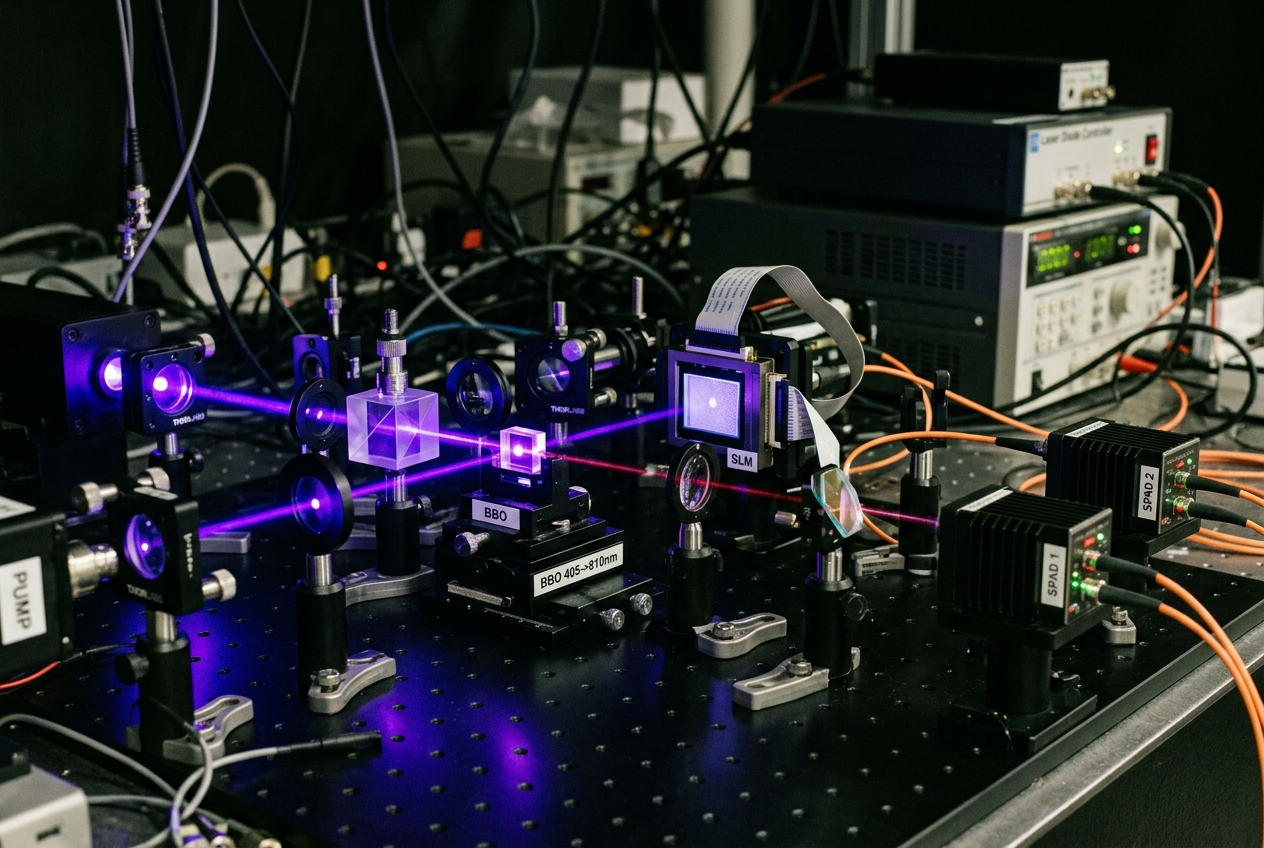
First, a high-energy pump laser illuminates a non-linear optical crystal—such as beta-barium borate or periodically poled potassium titanyl phosphate—inducing spontaneous parametric down-conversion (SPDC). This non-linear process splits single pump photons into pairs of identical, frequency-matched daughter photons.
Next, these twin photons are directed into the two opposing input ports of a lossless 50:50 beam splitter. Because photons are bosons (particles that obey Bose-Einstein statistics and symmetric wavefunctions), the quantum probability amplitudes for both photons to be transmitted cancel out perfectly through destructive quantum interference with the amplitudes for both photons to be reflected.
As a consequence of this destructive interference, the photons are physically compelled to "bunch" together. They exit the beam splitter in a quantum superposition of both emerging from output port A or both emerging from output port B:
$$|\psi_{\text{out}}\rangle = \frac{1}{\sqrt{2}}\left(|2,0\rangle + |0,2\rangle\right)$$
Synthesizing higher-order NOON states ($N \ge 3$) requires escalating experimental complexity. Researchers employ high-order non-linear optical interactions, cross-Kerr media, or post-selected multi-photon state engineering. By interfering squeezed vacuum states with coherent laser beams and triggering on specific measurement outcomes at photon-number-resolving detectors, scientists have successfully synthesized pure states up to $N=5$.
Parity Detection and Multi-Photon Coincidence
Extracting the phase information without washing out the super-resolution fringes requires sophisticated measurement strategies. Standard intensity detectors simply measure the average macroscopic flow of optical power, which averages away the subtle multi-photon quantum correlations.
Instead, physicists employ parity detection and $N$-fold multi-photon coincidence counting. Parity detection measures whether the total number of photons emerging from a designated output port is even or odd. The expectation value of the quantum parity operator oscillates symmetrically with the full $N\theta$ dependence, exhibiting sharp, sub-Rayleigh interference fringes that yield maximal sensitivity precisely at the zero-crossings of the signal.
[!NOTE]
Core Metric Comparison: Classical vs. Quantum Metrology
- Standard Quantum Limit (SQL): $\Delta \theta = 1/\sqrt{N}$
- Physical Basis: Uncorrelated Poissonian photon statistics (classical lasers).
- Scaling Penalty: Requires a $100\times$ increase in photon energy to gain a $10\times$ improvement in precision.
- Heisenberg Limit (HL): $\Delta \theta = 1/N$
- Physical Basis: Maximally entangled multi-photon superpositions (NOON states).
- Scaling Advantage: A $10\times$ increase in entangled photon number provides a direct $10\times$ improvement in precision.
- Critical Vulnerability: High susceptibility to single-photon absorption and scattering loss, which collapses the entangled superposition into an unentangled mixed state.
The Achilles' Heel: Optical Loss and Environmental Decoherence
Despite their theoretical perfection, NOON states possess an acute, existential vulnerability: decoherence caused by photon loss.
Because an $N$-photon NOON state is a macroscopic, cat-like superposition involving every constituent particle of light, it lacks any internal redundancy. If an interferometer arm suffers an optical loss efficiency characterized by a transmission coefficient $\eta$, the probability that all $N$ photons successfully survive the round trip scales exponentially as $\eta^N$.
The moment a single photon out of the $N$-photon collective is absorbed, scattered, or reflected away by an imperfect mirror, the environment acquires "which-way" information regarding which arm the photon traversed. This leak instantly collapses the pure quantum superposition into an incoherent statistical mixture of unentangled states.
Mathematical evaluations demonstrate that if total photon loss across an optical system exceeds a critical threshold (often less than 20% for moderate values of $N$), the phase sensitivity of a pure NOON state deteriorates so severely that it performs worse than a standard, unentangled classical laser. Mitigating this vulnerability represents one of the major research frontiers in modern quantum metrology.
4. Real-World Applications Today
The unique properties of entangled photon states are driving active research across leading academic, industrial, and national laboratories:
+-----------------------------------------------------------------------------+
|                     FRONTIERS OF NOON STATE METROLOGY                      |
+-----------------------------------------------------------------------------+
| 1. Optical Lithography   --> Beating Rayleigh's limit for microchip etching |
| 2. Quantum Microscopy    --> Non-destructive imaging of delicate live cells |
| 3. Inertial Gyroscopes   --> High-precision navigation without satellite GPS|
| 4. Astro-Interferometry  --> Detecting sub-atomic gravitational ripples     |
+-----------------------------------------------------------------------------+
1. Sub-Rayleigh Optical Lithography and Microelectronics
- Institutions & Initiatives: MIT OpenCourseWare photonics initiatives, national nanotechnology facilities, and advanced semiconductor consortia.
- The Objective: To etch circuit features onto silicon wafers that are substantially smaller than the classical diffraction limit of light.
- The Quantum Advantage: Classical optical lithography cannot resolve features smaller than approximately half the wavelength of the illuminating light (Rayleigh's criterion). By exposing specialized photoresists to $N$-photon NOON states, the effective de Broglie wavelength of the light is compressed from $\lambda$ down to $\lambda/N$. This enables sub-diffraction quantum lithography, allowing nanofabrication systems to expose ultra-dense semiconductor features without relying on harsh, destructive, and expensive extreme ultraviolet or X-ray radiation sources.
2. Non-Invasive Quantum Biological Microscopy
- Institutions & Initiatives: Quantum optics groups published in Nature, alongside teams at the Max Planck Institute for the Science of Light.
- The Objective: To track real-time structural dynamics in fragile biological specimens, such as living neural synapses, molecular motors, and transparent living cell membranes.
- The Quantum Advantage: Many transparent biological structures induce tiny, nanoradian phase shifts in transmitted light. Using a bright classical laser to resolve these weak phase shifts dumps thermal energy into the specimen, causing photothermal damage, cellular stress, or cell death. By illuminating specimens with low-intensity NOON states and entangled photon pairs, researchers achieve high signal-to-noise ratios and sub-nanometer spatial resolution at photon flux levels orders of magnitude below the threshold of biological damage.
3. Quantum-Enhanced Optical Gyroscopes and Inertial Navigation
- Institutions & Initiatives: Aerospace research laboratories, national defense quantum initiatives, and leading quantum computing pioneers including IBM Quantum.
- The Objective: To develop autonomous, ultra-precise inertial navigation systems that operate without access to GPS satellite signals.
- The Quantum Advantage: Optical gyroscopes detect mechanical rotation via the Sagnac effect: when an optical ring rotates, light traveling in the direction of rotation takes slightly longer to complete the circuit than light traveling in the opposite direction, creating a measurable phase shift. Injecting NOON states into a fiber-optic Sagnac interferometer multiplies this rotational phase shift by a factor of $N$, drastically reducing angular drift and allowing submarines, aerospace vehicles, and deep-space probes to navigate with extreme precision over long durations.
4. Gravitational Wave Detection and Fundamental Physics
- Institutions & Initiatives: The LIGO-Virgo-KAGRA Collaboration, in research published across the American Physical Society (APS).
- The Objective: To resolve sub-atomic mirror displacements caused by cosmic gravitational waves passing through Earth.
- The Quantum Advantage: Modern gravitational-wave observatories already inject squeezed quantum states of light into their output ports to reduce shot noise. Ongoing theoretical and experimental roadmaps explore hybrid entangled schemes and multi-photon quantum states to push detector sensitivity beyond the standard quantum limit across wider frequency bands. This enables astronomers to detect more distant stellar collisions while suppressing quantum radiation-pressure noise, which occurs when high-power lasers physically push the detector's suspended mirrors.
5. What This Means for You
For anyone outside the cleanrooms of quantum physics, it is easy to assume that multi-photon entanglement is purely an academic abstraction. In reality, quantum metrology is quietly transforming the foundations of the technologies that shape daily life.
Consider the medical realm. Modern early-stage cancer screening and drug discovery depend heavily on optical biosensors that detect single viral capsids or aberrant protein assemblies in a blood sample. The ability to measure phase shifts at the fundamental quantum limit means diagnostic devices will soon identify diseases at the level of individual molecules, months before physical symptoms manifest, all without destroying the fragile biological sample under examination.
In navigation and infrastructure, quantum-enhanced optical gyroscopes will eliminate our dangerous societal dependence on vulnerable GPS satellite networks. Commercial airliners, self-driving vehicles, and maritime shipping vessels will maintain pinpoint positioning across oceans or through underground tunnels without fear of satellite signal jamming or solar geomagnetic disruptions.
Furthermore, as the consumer electronics industry approaches the physical limits of Moore’s Law, quantum lithography and quantum-enhanced sensing provide the metrological tools needed to inspect and fabricate the next generation of energy-efficient microchips. NOON states fundamentally alter the ancient trade-off of measurement: they prove that observing the physical universe with maximum precision does not require brute-force energy, but rather an elegant orchestration of quantum entanglement.
6. Today's Takeaway
NOON states reveal one of the most profound truths in modern physics: by binding individual particles of light into a unified, macroscopic quantum collective, we compress their effective wavelength and force nature's clocks to tick $N$ times faster. This breakthrough shatters the classical shot-noise limit that has bounded optical instruments for centuries, unlocking the ultimate Heisenberg precision bound. In the emerging era of quantum metrology, the deepest secrets of our universe—from the fragile mechanics of living cells to the distant echoes of colliding black holes—are illuminated not by shining more light, but by entangling the light we have.