No-Hiding Theorem: Proving Information Conservation and Subsystem Reconstruction in Open Quantum Dynamics
1. Opening Hook — Why You Should Care
If you take a confidential letter, throw it into a roaring furnace, and watch it reduce to ash, common sense tells you the message is obliterated forever. In classical thermodynamics, recovering that text would require tracking trillions of chaotic gas molecules, capturing every photon of radiated heat, and performing a computational reconstruction far beyond the reach of human ingenuity. Yet in the classical world, nature allows a secret to simply dissolve into diffuse entropy—hidden away in messy correlations between the smoke, the ash, and the chimney.
In the quantum universe, however, nature refuses to let a secret dissolve.
Imagine typing a line of code into a quantum computer, only for atmospheric noise to scramble the circuit and completely wipe your data from the processor’s memory. If you inspect the physical chips, every trace of your calculation is gone, replaced by pure, featureless thermal noise. You would reasonably assume the information was destroyed.
It was not.
Under the fundamental laws of quantum mechanics, your erased calculation has not leaked into an irreversible void, nor has it smeared itself into unreachable, shared microscopic static. Instead, it has leaped—intact, pristine, and mathematically whole—into the surrounding physical environment. If you hold the correct mathematical key and possess access to the room's escaping heat and stray vibrations, you can completely resurrect your lost quantum state without ever touching the computer that lost it.
This startling principle is known as the Quantum No-Hiding Theorem. Established in 2007 by physicists Samuel L. Braunstein and Arun K. Pati, this foundational law provides an ironclad proof: quantum information cannot be hidden in the correlations between a system and its environment. If information is completely wiped from its original physical container, it must move entirely into the environment's auxiliary degrees of freedom, where it remains 100% reconstructible through local operations.
Today, this theorem is not merely an esoteric curiosity for philosophers of physics. It forms the bedrock of modern quantum error correction, dictating how companies like IBM and Google safeguard delicate quantum computations. It governs the ongoing debate over the black hole information paradox, and it redefines our understanding of entropy, privacy, and the permanent memory of the physical cosmos.
2. The Idea in Plain English
To understand why the No-Hiding Theorem is so revolutionary, we must first contrast classical information with its quantum counterpart.
The Classical Notebook vs. The Quantum Spin
In classical computing, information is modular and localized. A bit is a physical switch: it is definitively a 0 or a 1. If you write a secret message in a notebook, you can hide the message across multiple pages using a cryptographic cipher. If someone steals half the notebook, they cannot read the message because the information is "hidden" in the correlations between the two halves. Furthermore, if you burn the notebook, the information slowly dissipates into the environment, becoming hopelessly scrambled among the surrounding particles.
A quantum bit, or qubit, does not behave like a classical switch. Instead of being locked into a rigid 0 or 1, a qubit exists in a linear superposition—a continuous combination of both possibilities simultaneously, possessing both magnitude and phase.
+-------------------------------------------------------------------------+
| CLASSICAL INFORMATION VS. QUANTUM INFORMATION DISSIPATION               |
+-------------------------------------------------------------------------+
|                                                                         |
| Classical Dissipation:                                                  |
| [ Message Bit ] ---> (Heat & Noise) ---> Scrambled across correlations  |
|                                          between system & environment.  |
|                                          Information is locally lost.   |
|                                                                         |
| Quantum Bleaching (No-Hiding Theorem):                                  |
| [ Quantum State |ψ⟩ ] ---> (Decoherence) ---> System becomes static (σ) |
|                                          ALL information shifts into    |
|                                          ancillary environment space.   |
|                                          100% locally recoverable!      |
+-------------------------------------------------------------------------+
When a quantum system interacts with an open environment—a process known as decoherence—its delicate superposition appears to decay into random classical probabilities. If this decay is total, the primary system undergoes what physicists call "complete bleaching." Every measurement performed on the original system yields pure randomness, totally independent of the initial input.
In our everyday classical intuition, when an object is bleached of all its distinguishing features, the lost information is presumed to be shared between the object and the bleach. In classical statistical mechanics, missing information can reside in the complex cross-correlations between the container and the bath.
Braunstein and Pati proved that in the quantum world, this classical intuition is flatly impossible.
The Core Intuition: If a quantum process erases an unknown quantum state so thoroughly that the original physical medium retains zero mathematical memory of it, the information cannot hide in the joint entanglement between the medium and the outside world. Linearity and conservation laws force the entire, uncorrupted quantum state to migrate wholly into the environment. The environment becomes the new, perfect bearer of the secret.
3. How It Actually Works — The Mechanics
The No-Hiding Theorem belongs to a distinguished family of quantum "no-go" theorems that establish the immutable operational boundaries of quantum physics. These include the No-Cloning Theorem (which forbids creating an identical copy of an arbitrary unknown quantum state) and the No-Deleting Theorem (which forbids the reversible deletion of one copy of a quantum state when two identical copies are supplied).
All of these principles flow directly from two foundational pillars of quantum theory: linearity and unitarity.
- Linearity states that quantum operations act distributively across superpositions. If a process knows how to transform state $A$ and state $B$, its action on any combination of $A$ and $B$ is strictly fixed as the sum of those individual transformations.
- Unitarity guarantees that the total probability of all possible outcomes in an isolated quantum system always sums to exactly 1 (100%), and that all fundamental physical evolutions are reversible, preserving the geometric angles (inner products) between distinct quantum states.
To explore how these properties govern open quantum dynamics, physicists utilize mathematical frameworks taught in advanced courses at institutions like MIT OpenCourseWare.
The Mathematical Mechanism of No-Hiding
Let us follow the step-by-step logic of Braunstein and Pati’s proof, translating the mathematical machinery into physical intuition.
Suppose we prepare an arbitrary, unknown quantum state $|\psi\rangle$ within an initial physical system $A$. This state can be expressed as a linear superposition of orthogonal basis states $|k\rangle_A$ weighted by complex probability amplitudes $c_k$:
$$|\psi\rangle_A = \sum_{k} c_k |k\rangle_A$$
We now introduce an ancillary environment $E$, initialized in a known, standard reference state $|0\rangle_E$. According to the Stinespring dilation theorem—a mathematical cornerstone of quantum information theory—any physical noise, measurement, or loss channel acting on system $A$ can be modeled as a global, unitary transformation $U$ acting on the combined Hilbert space of the system and its environment ($A \otimes E$).
Now, we impose the strict condition of complete information loss (bleaching). We assume the physical interaction transforms system $A$ such that its final state, described by the reduced density operator $\rho_A'$, becomes a constant, fixed state $\sigma$ that contains zero dependence on the input coefficients $c_k$:
$$\rho_A' = \text{Tr}_E \left[ U \left( |\psi\rangle\langle\psi|_A \otimes |0\rangle\langle 0|_E \right) U^\dagger \right] = \sigma$$
Because quantum evolution is strictly linear, the global unitary operator $U$ must act on each individual basis state $|k\rangle_A$ independently:
$$U \left( |k\rangle_A \otimes |0\rangle_E \right) = \sum_{j} \sqrt{p_j} |j\rangle_A \otimes |q_{kj}\rangle_E$$
Here, $|j\rangle_A$ represents the orthonormal basis states of the primary system, $p_j$ are the fixed probabilities that define the static state $\sigma = \sum_j p_j |j\rangle\langle j|A$, and $|q{kj}\rangle_E$ are the resulting normalized states of the environment.
Here lies the mathematical heart of the proof: because the final state $\sigma$ of the primary system is completely invariant regardless of which state $|k\rangle_A$ was fed in, the environment states $|q_{kj}\rangle_E$ must maintain perfect distinguishability. For every fixed index $j$, the environmental vectors must satisfy strict orthonormality:
$$\langle q_{lj} | q_{kj} \rangle = \delta_{lk}$$
Because these environmental states are mutually orthogonal across all input indices, the environment's state space has not degraded into chaotic thermal entropy. Instead, it has formed a high-dimensional, structured tensor product.
By applying a local unitary transformation $V_E$ that operates exclusively on the environment $E$, one can factorize the environmental Hilbert space into two distinct sub-registers, $E_1$ and $E_2$:
$$(I_A \otimes V_E) U \left( |\psi\rangle_A \otimes |0\rangle_E \right) = \left( \sum_{j} \sqrt{p_j} |j\rangle_A \otimes |j\rangle_{E_1} \right) \otimes |\psi\rangle_{E_2}$$
Look closely at what this equation reveals: 1. The primary system $A$ and the first environmental register $E_1$ are locked in an entangled state that accounts for the fixed mixed state $\sigma$. 2. The second environmental register $E_2$ contains the exact, original, uncorrupted state $|\psi\rangle$. 3. Most remarkably, this reconstruction requires zero physical access to the original system $A$.
| Physical Property | Classical Dissipation | Quantum Dissipation (No-Hiding) |
|---|---|---|
| Information Location | Shared across microscopic cross-correlations | Migrates entirely into environmental ancilla |
| Reversibility | Computationally impossible; entropy is strictly mixed locally | Mathematically exact via local unitary rotation on bath |
| Primary System Access | Must gather all particles (system + bath) | Zero access to primary system needed for recovery |
| Underlying Mechanism | Classical probability & phase-space spreading | Linearity, unitarity, and Stinespring isometry |
Experimental Proof: From Chalkboard to Laboratory
For years, the No-Hiding Theorem was debated as a theoretical principle. However, pioneering experimentalists soon brought it into the physical laboratory.
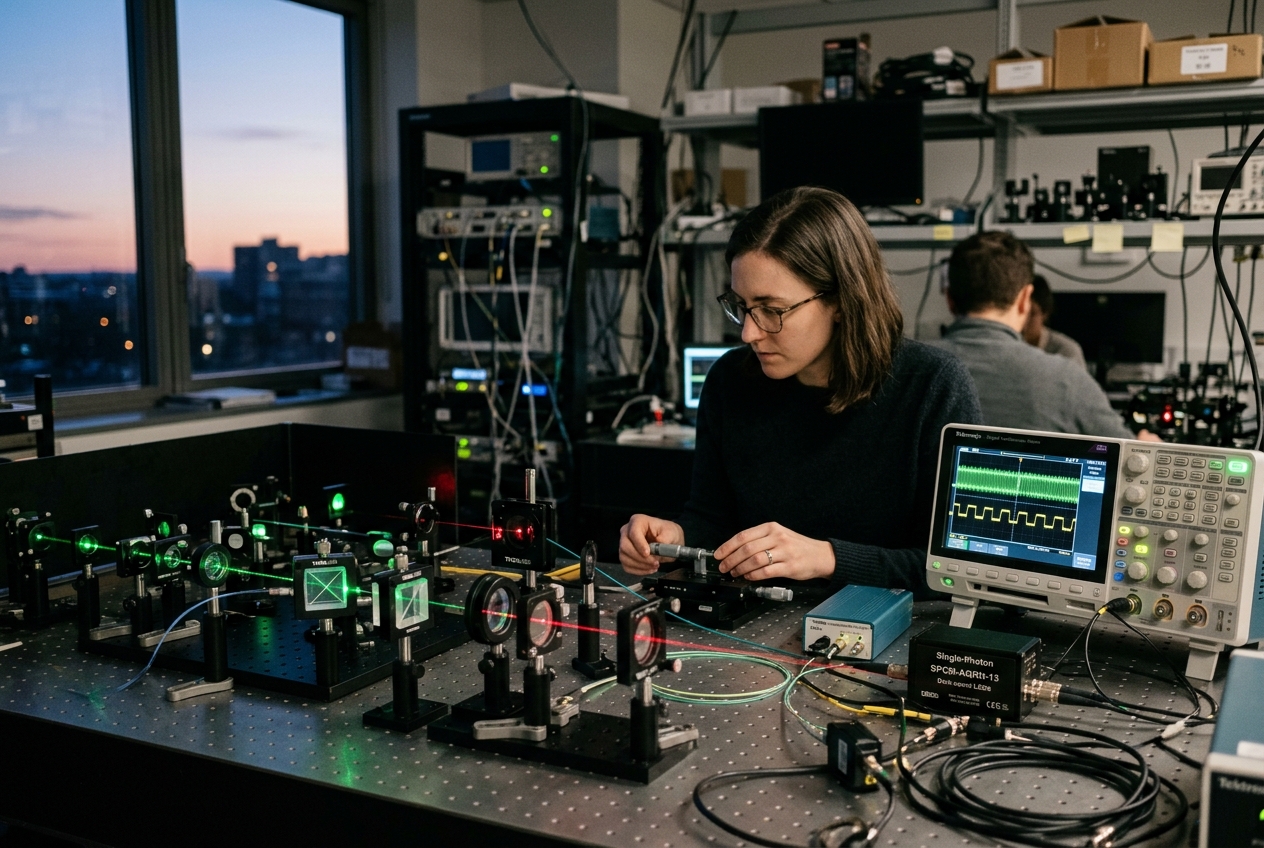
In a landmark experiment published in Physical Review Letters and highlighted across physics communities including Nature Physics, an international team of researchers utilized liquid-state Nuclear Magnetic Resonance (NMR) to demonstrate the theorem in action. Using the nuclear spins of carbon and hydrogen atoms in an engineered molecule, the researchers encoded an unknown qubit into a target nuclear spin (System $A$).
They then subjected the spin to a randomized dephasing channel that completely randomized the qubit, reducing its density matrix to a state of maximum entropy—total quantum bleaching. By applying targeted radio-frequency pulses exclusively to the surrounding solvent spins (the environment $E$), the physicists performed the unitary decoding operation $V_E$. As predicted by Braunstein and Pati, the original, fragile quantum state was revived in the ancillary nuclear spins with near-unity fidelity, without ever probing or altering the original bleached spin.
Subsequent experiments using quantum optical circuits and entangled photons have repeatedly confirmed this truth: quantum information cannot be destroyed, nor can it hide.
4. Real-World Applications Today (2024–2026)
Far from being a museum piece of mathematical physics, the No-Hiding Theorem provides practical engineering principles across leading quantum technologies and theoretical astrophysics.
+-------------------------------------------------------------------------+
| CONTEMPORARY RESEARCH & INDUSTRIAL APPLICATIONS                         |
+-------------------------------------------------------------------------+
|                                                                         |
| 1. FAULT-TOLERANT QUANTUM COMPUTING                                     |
|    Institution: IBM Quantum & MIT                                       |
|    Application: Surface code error correction & syndrome extraction     |
|                                                                         |
| 2. BLACK HOLE INFORMATION & QUANTUM SCRAMBLING                          |
|    Institution: Caltech (IQIM) & Harvard University                     |
|    Application: Hayden-Preskill recovery protocols & Page curve dynamics|
|                                                                         |
| 3. QUANTUM RESERVOIR ENGINEERING & REPEATERS                            |
|    Institution: Max Planck Institute of Quantum Optics                  |
|    Application: Coherent photon capture in open optical memory networks |
|                                                                         |
| 4. QUANTUM CRYPTOGRAPHY & PHYSICAL UNCLONABILITY                        |
|    Institution: ID Quantique & University of Bristol                    |
|    Application: Provable eavesdropping detection via entropy bounds     |
+-------------------------------------------------------------------------+
1. Quantum Error Mitigation and Fault-Tolerant Architectures
- Institutions: IBM Quantum, MIT Center for Quantum Engineering
- The Initiative: Developing fault-tolerant quantum computing architectures based on surface codes and subsystem codes within the open-source Qiskit framework.
- The Quantum Advantage: In physical quantum computing chips, superconducting qubits suffer continuous decoherence caused by thermal fluctuations and stray electromagnetic fields. Classical error correction works by making multiple redundant copies of data bits (e.g., repeating 0 as 000). But because the No-Cloning Theorem forbids copying unknown quantum states, quantum computers must use entangled ancilla qubits. When noise strips a data qubit of its phase information, the No-Hiding Theorem guarantees that this missing phase information has moved cleanly into the auxiliary ancilla register. By executing non-destructive syndrome measurements on the ancilla, quantum processors can determine the exact unitary correction required to reverse the error, maintaining long-lived logical qubits without collapsing the underlying computation.
2. Resolving the Black Hole Information Paradox
- Institutions: Caltech Institute for Quantum Information and Matter (IQIM), Harvard University, Google Quantum AI
- The Initiative: Simulating quantum gravity, black hole evaporation, and quantum information scrambling on multi-qubit quantum processors.
- The Quantum Advantage: In 1974, Stephen Hawking showed that black holes emit thermal radiation and eventually evaporate, seemingly destroying all the information about the matter that formed them. This contradiction with quantum unitarity became known as the black hole information paradox. The No-Hiding Theorem, alongside the Hayden-Preskill thought experiment, resolved this dilemma. A black hole acts as a rapid quantum scrambler. When an object falls past the event horizon, its quantum state is bleached from the black hole's interior and transferred into the emitted Hawking radiation. The No-Hiding Theorem proves that once a black hole passes the halfway point of its evaporation (the Page time), any newly tossed-in quantum information escapes almost instantly in the subsequent Hawking photons, where it can be fully decoded without entering the black hole.
3. Open Quantum Systems and Quantum Reservoir Engineering
- Institutions: Max Planck Institute of Quantum Optics, University of Oxford
- The Initiative: Building high-efficiency quantum repeaters and quantum memories for continental-scale quantum communication networks.
- The Quantum Advantage: When photons travel through fiber-optic cables, optical attenuation inevitably leads to packet loss. In classical telecom, amplifiers read and boost the signal. In quantum networks, reading the photon destroys it. By applying the Stinespring dilation framework behind the No-Hiding Theorem, engineers design "reservoir-engineered" optical cavities. When a flying optical qubit leaks into the cavity walls, auxiliary optical modes are tuned to collect the escaping energy. Using an environmental unitary decoding pulse, the lost photonic state is harvested from the cavity's auxiliary modes and restored into a stationary solid-state quantum memory.
4. Quantum Cryptography and Anti-Tamper Verification
- Institutions: ID Quantique, University of Bristol Quantum Engineering Technology Labs
- The Initiative: Designing tamper-proof physical unclonable functions (PUFs) and quantum key distribution (QKD) verification protocols.
- The Quantum Advantage: If an adversarial eavesdropper attempts to intercept a quantum communication stream and hide their physical intrusion by replacing the intercepted signal with a dummy state, the No-Hiding Theorem imposes an inescapable physical penalty. Any eavesdropping channel that scrubs the transmission inevitably leaves an exact, reconstructible quantum imprint in the eavesdropper's local apparatus. By monitoring entropy fluxes and correlation bounds across the communication channel, the legitimate parties can detect even the most sophisticated interception attempts.
5. What This Means for You
For anyone navigating our increasingly digital and automated world, the quantum No-Hiding Theorem offers a profound conceptual shift: at the fundamental level of the universe, true deletion does not exist.
In our everyday interactions with classical computers, we take the concept of the "trash bin" for granted. We delete an email, wipe a hard drive, or shred a financial statement, assuming the record has ceased to be. Yet even in classical devices, forensic investigators can often recover discarded files because electric charges linger in flash memory chips.
+-------------------------------------------------------------------------+
| WHAT THIS MEANS FOR YOUR FUTURE                                         |
+-------------------------------------------------------------------------+
|                                                                         |
| • Quantum Encryption Security:                                          |
|   Future communications secured by quantum keys cannot be covertly      |
|   intercepted, because any data leak leaves an indelible, measurable    |
|   footprint in the environment.                                         |
|                                                                         |
| • Resilient Medical & Material Computing:                               |
|   Simulations of molecular drugs on quantum processors will not crash   |
|   irretrievably when noise hits; errors can be mathematically scooped   |
|   out of ancilla registers.                                             |
|                                                                         |
| • A Cosmic Ledger:                                                      |
|   The physical universe never forgets. Every quantum interaction        |
|   conserves information, merely shifting it between subsystems.         |
+-------------------------------------------------------------------------+
In the emerging era of quantum networks and post-quantum cybersecurity: * Your Personal Privacy: The mathematical conservation laws proven by the No-Hiding Theorem ensure that quantum-encrypted banking channels cannot be tapped without altering the physical state of the network. If an adversary attempts to steal your encryption keys, the information cannot be quietly skimmed; it is diverted into environmental channels where the breach becomes instantly evident. * The Reliability of Advanced Science: When quantum supercomputers eventually design life-saving personalized pharmaceuticals or discover room-temperature superconductors, their computations will run across millions of noisy physical qubits. The No-Hiding Theorem gives engineers the exact mathematical blueprint needed to scoop errors out of the computer's environment, ensuring calculations remain uninterrupted and accurate. * The Conservation of Reality: On a philosophical level, the theorem reveals that our universe is an unbroken, unitary continuum. The past is never truly erased; it is merely transferred into the wider cosmic environment.
6. Today's Takeaway
The Quantum No-Hiding Theorem shatters our classical intuition about loss and entropy by proving that when quantum information vanishes completely from a physical system, it is never destroyed or dispersed into unreachable correlations—it is transferred intact into the surrounding environment, waiting to be perfectly recovered. In a cosmos governed by the strict rules of quantum mechanics, information is immortal: reality does not have a recycle bin, only an endless series of new addresses.