No-Broadcasting Theorem: Proving the Impossibility of Replicating Mixed Quantum States and Non-Commuting Density Matrices
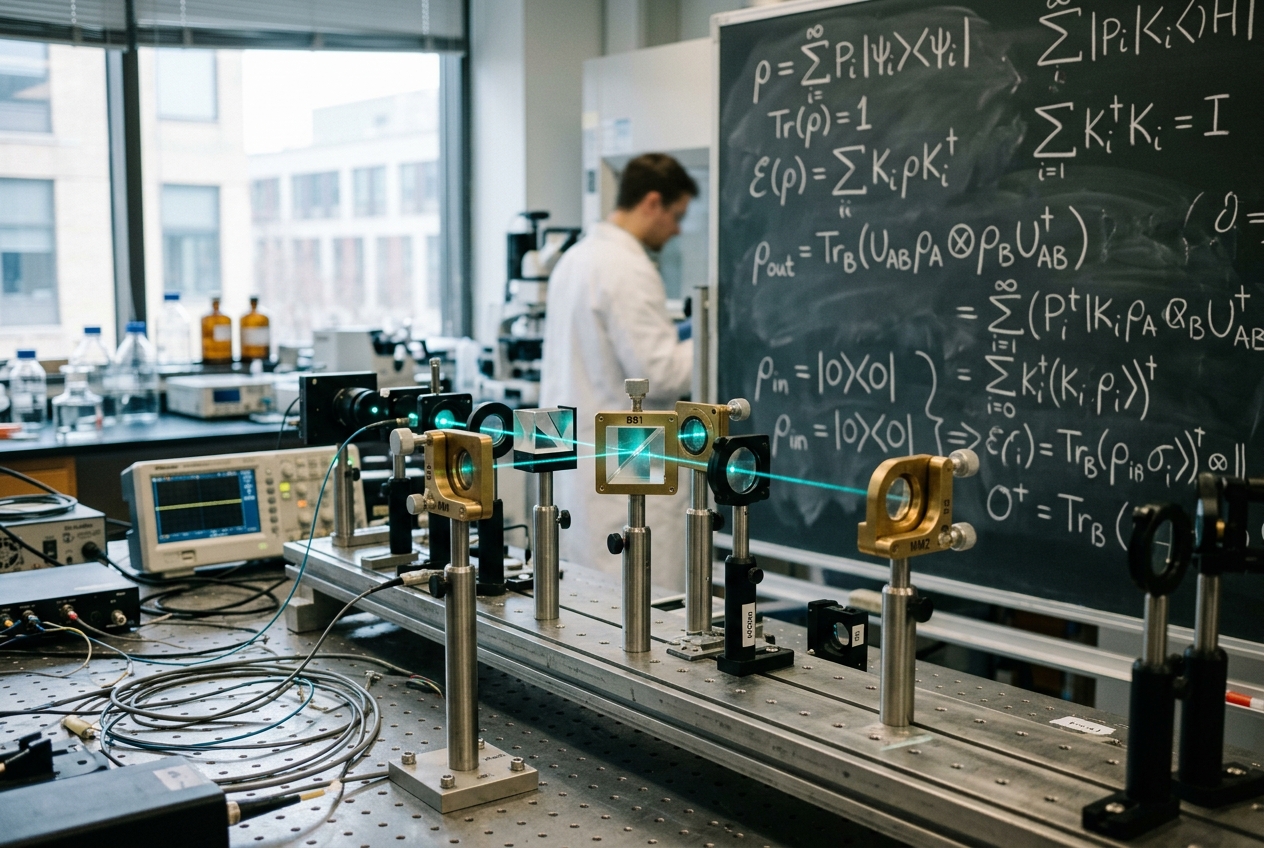
1. OPENING HOOK — WHY YOU SHOULD CARE
The entire architecture of the modern digital economy rests upon an unspoken assumption: information can be copied cleanly, silently, and indefinitely. Every time an email travels across the Atlantic, every time a financial ledger synchronizes between banks in Frankfurt and New York, and every time a streaming server distributes a video to millions of households simultaneously, trillions of identical digital duplicates are spawned. In the classical computing paradigm, duplication is essentially costless, and classical surveillance has historically thrived on this fact. An eavesdropper tapping a fiber-optic cable does not need to confiscate your data; they simply clone the light pulses, read their own illicit copy at leisure, and let the original stream flow uninterrupted to its destination.
Quantum mechanics, however, breaks this foundational paradigm.
If humanity transitions its communications to the quantum realm—encoding sensitive credentials into the fragile physical states of individual photons—the universe imposes an absolute physical lockdown. The laws of quantum physics do not merely make copying difficult; they make it fundamentally impossible.
For decades, physicists celebrated the celebrated No-Cloning Theorem, which established that an unknown, pristine quantum state cannot be replicated. Yet a lingering, dangerous loophole remained: what if an attacker does not need an identical, separate twin of the particle? What if a spy or a noisy environment merely wants to share that quantum information across two receivers, allowing both to hold a slightly blurred, statistical version of the original secret?
The answer arrived in 1996 with a landmark result known as the No-Broadcasting Theorem. It proved mathematically that whenever quantum information is tinged with statistical uncertainty or mixed with thermal noise, nature still flatly refuses to let it be distributed to multiple parties unless the states in question are entirely classical. This mathematical barricade is not a temporary engineering hurdle; it is a fundamental law of physics that dictates the limits of quantum computers, safeguards quantum cryptography against the most sophisticated eavesdropping strategies, and explains why our classical reality looks so radically different from the bizarre quantum substrate underneath.
2. THE IDEA IN PLAIN ENGLISH
To grasp why broadcasting is impossible, one must first dismantle the classical intuition of what "information" actually is.
In everyday life, an object exists in a definite state regardless of whether someone looks at it. A standard coin resting on a desk is either showing heads or tails. If you want to convey that state to a friend across the room, you look at the coin, note that it is heads, and place a second coin on their desk showing heads. Both of you now possess the exact same information.
In the quantum domain, things are fundamentally weirder. A quantum bit, or qubit, is often likened to a coin spun vigorously on a tabletop. While it spins, it is not merely "heads" or "tails" hidden beneath a hand; it occupies a continuous, delicate superposition of both possibilities simultaneously. If the coin is spinning in complete isolation from the rest of the universe, physicists call it a pure state. The famous No-Cloning Theorem—discovered independently by William Wootters, Wojciech Zurek, and Dennis Dieks in 1982—showed that if someone hands you an unknown spinning coin in a pure state, you cannot build a machine that takes a stationary blank coin and sets both coins spinning in that exact same quantum orientation. The act of forcing the machine to interact with the coin inevitably collapses the superposition.
Real laboratory physics, however, rarely deals with perfectly isolated, pristine pure states. In the real world, quantum systems bump against air molecules, suffer from fluctuating magnetic fields, and exchange thermal heat with their environment. Such a compromised system is described as a mixed state.
A mixed state is not just a spinning quantum coin; it is a spinning coin that has been tossed through turbulent air, where you only have an incomplete statistical distribution over several different possible quantum superpositions. It represents a hybrid of genuine quantum uncertainty and ordinary classical ignorance.
This brings us to the crucial difference between cloning and broadcasting:
- Cloning means taking one unknown quantum state and producing two entirely independent, uncorrelated, identical replicas of it.
- Broadcasting is a much more relaxed, permissive ambition. You do not demand that the two final particles be independent of each other. You merely demand that if Alice inspects particle $A$ alone, it looks statistically indistinguishable from the original particle, and if Bob inspects particle $B$ alone, it also looks statistically indistinguishable from the original particle. They are allowed to be entangled or correlated in any way behind the scenes, provided their individual local descriptions match the original.
Broadcasting seems modest. It permits correlations, requires no pristine purity, and accepts the unavoidable messiness of open environments. Yet, the No-Broadcasting Theorem delivers an astonishing verdict: even with these relaxed conditions, you still cannot broadcast an arbitrary set of quantum states. Nature permits broadcasting if, and only if, the states share a very specific mathematical alignment known as pairwise commutativity—which is physics code for saying the states are, at heart, purely classical.
3. HOW IT ACTUALLY WORKS — THE MECHANICS
To understand the mathematical engine driving this restriction, one must inspect how open quantum systems evolve. When a quantum system is open to its surroundings, its state cannot be written as a simple wave vector. Instead, it is represented by a mathematical object called a density operator, traditionally denoted by the Greek letter $\rho$ (rho).
A density operator is essentially a matrix that bundles together all the probabilities of finding a system in various quantum configurations, while keeping track of the quantum interferences between them. When a physical operation acts on this density matrix—whether it is a quantum logic gate, a noisy telecommunications channel, or an attempted copying machine—it must obey the foundational postulate of quantum mechanics: physical transformations are linear, and they must preserve the laws of probability. Such physical processes are formally described as Completely Positive Trace-Preserving (CPTP) maps, or quantum channels.
Suppose we construct a candidate broadcasting machine. The machine takes our target state $\rho$, drawn from an ensemble of possible states ${\rho_1, \rho_2, \dots}$, combines it with an auxiliary standard blank state $\sigma$, and applies a global CPTP physical transformation $\mathcal{E}$.
$$\mathcal{E}(\rho \otimes \sigma) = \rho_{AB}$$
For this device to qualify as a legitimate broadcasting machine, it does not need $\rho_{AB}$ to equal $\rho \otimes \rho$. Instead, it only requires that when we take the partial trace—the mathematical operation of ignoring or averaging over one of the subsystems—the remaining marginal state perfectly reproduces $\rho$:
$$\mathrm{Tr}B(\rho{AB}) = \rho \quad \text{and} \quad \mathrm{Tr}A(\rho{AB}) = \rho$$
In 1996, physicists Howard Barnum, Carlton Caves, Christopher Fuchs, Richard Jozsa, and Benjamin Schumacher published their definitive proof in Physical Review Letters. They analyzed what happens algebraically when a linear, trace-preserving superoperator attempts to satisfy this marginal matching condition across a set of diverse density operators.
+-------------------------------------------------------------------------------+
|                      THE BARNUM-CAVES-FUCHS-JOZSA-SCHUMACHER                   |
|                              NO-BROADCASTING THEOREM                          |
|                                                                               |
| A set of quantum states {ρ_i} can be broadcast by a physical (CPTP) operation |
| if and only if every pair of states in the set commutes:                      |
|                                                                               |
|                     [ρ_i, ρ_j] = ρ_i ρ_j - ρ_j ρ_i = 0                        |
|                                                                               |
| If even one pair fails to commute, no physical process in the universe can    |
| broadcast the ensemble without corrupting the marginal information.           |
+-------------------------------------------------------------------------------+
The crux of the proof lies in the algebraic incompatibility between quantum non-commutativity and linear trace preservation.
When two density matrices commute ($[\rho_i, \rho_j] = 0$), they can be diagonalized simultaneously. This means they share a single, common set of orthogonal quantum states; they differ only in the classical probabilities assigned to each state in that basis. Because they share a coordinate frame, a machine can measure the system in that basis without destroying the underlying information, read the classical outcome, and prepare as many matching marginal copies as desired. Commuting states are effectively classical information disguised in quantum notation.
However, when states do not commute ($[\rho_i, \rho_j] \neq 0$), they embody the Heisenberg uncertainty principle. They point along incompatible axes in the quantum state space. Because quantum superoperators are strictly linear, any physical map $\mathcal{E}$ capable of reproducing the marginal states for $\rho_i$ inevitably scrambles the off-diagonal quantum coherence terms of $\rho_j$.
To satisfy the broadcasting condition for one state, the machine must establish subtle quantum correlations (entanglement) between systems $A$ and $B$. But for non-commuting partner states, these very same correlations bleed entropy into the subsystems, distorting the local partial traces. The mathematics demands a compromise that nature refuses to grant: you can preserve the linearity of the transformation, or you can match the marginal probabilities, but you cannot do both.
4. REAL-WORLD APPLICATIONS TODAY
Far from being an esoteric footnote in abstract algebra, the No-Broadcasting Theorem provides the theoretical bedrock for cutting-edge quantum technologies currently advancing in industry and academia.
1. Quantum Key Distribution (QKD) Against Mixed-State Eavesdropping
In real-world optical networks, commercial quantum cryptography companies such as ID Quantique and Toshiba Europe's Quantum Technology Division transmit encryption keys using faint laser pulses traveling through standard telecommunications fiber. In practice, thermal noise, polarization drift, and channel attenuation turn these photon streams into mixed states.
An eavesdropper, "Eve," attempting to intercept these keys cannot rely on simple no-cloning defenses because the states are already impure and noisy. Eve might instead attempt a broadcasting attack, applying a CPTP map to split the incoming mixed state into two correlated marginal signals—one for herself and one to pass along to Bob. The No-Broadcasting Theorem guarantees that because the cryptographic protocols use non-commuting signal bases, Eve’s broadcasting machine will mathematically alter the marginal state received by Bob. This disturbance inevitably manifests as an elevated Quantum Bit Error Rate (QBER), instantly exposing the intrusion before any key material is decrypted.
2. Fault-Tolerant Quantum Error Correction
Leading quantum computing developers like IBM Quantum and Google Quantum AI face a fundamental dilemma: how do you protect fragile quantum calculations from noise without making backup copies of the data? In classical servers, data redundancy is trivial: redundant arrays of independent disks (RAID) simply duplicate binary files across multiple drives.
Because the No-Cloning and No-Broadcasting theorems forbid copying or broadcasting active qubits into secondary backup registers, quantum computer scientists engineered an entirely different architecture: topological error-correcting codes, such as the surface code. Instead of copying local density matrices, these architectures entangle a logical qubit across a non-local lattice of physical qubits. Error syndromes are extracted by measuring collective commuting parity operators without ever measuring or broadcasting the stored quantum state itself, adhering strictly to the constraints outlined in MIT OpenCourseWare Quantum Computation.
3. Quantum Metrology and State Estimation Limits
In precision sensing experiments—such as laser-interferometer gravitational-wave observatories like LIGO and advanced atomic magnetometry projects at institutions like the National Institute of Standards and Technology (NIST)—researchers must extract maximum information from ultra-weak, noisy quantum signals.
The No-Broadcasting Theorem dictates the ultimate operational limits of quantum amplifiers and multi-parameter state estimation. Because a single unknown mixed state cannot be broadcast to multiple sensors without fundamental distortion, metrologists cannot divide a single quantum probe among multiple parallel measurement apparatuses to beat standard quantum limits. This insight has propelled the development of non-destructive quantum non-demolition (QND) measurement schemes and squeezed-light injection techniques that operate within the strict boundaries of quantum thermodynamics.
+---------------------------------------------------------------------------------------------------+
|                            APPLICATIONS MATRIX: NO-BROADCASTING AT WORK                           |
+----------------------------+-----------------------------------+----------------------------------+
| FIELD                      | LEADING INSTITUTION / ENTERPRISE  | QUANTUM ADVANTAGE / MECHANISM    |
+----------------------------+-----------------------------------+----------------------------------+
| Quantum Cryptography       | ID Quantique, Toshiba Europe      | Guarantees eavesdropping induces |
| (QKD Networks)             |                                   | detectable marginal noise on QBER|
+----------------------------+-----------------------------------+----------------------------------+
| Fault-Tolerant Computing   | IBM Quantum, Google Quantum AI    | Informs surface code design via  |
|                            |                                   | non-local syndrome measurement   |
+----------------------------+-----------------------------------+----------------------------------+
| Quantum Metrology          | NIST, Max Planck Institute        | Sets rigorous sensitivity bounds |
|                            |                                   | for dissipative sensor arrays    |
+----------------------------+-----------------------------------+----------------------------------+
| Open Quantum Systems       | Caltech, Oxford Quantum           | Constrains information flow in   |
| & Black Hole Physics       |                                   | dissipative master equations     |
+----------------------------+-----------------------------------+----------------------------------+
4. Open-System Quantum Thermodynamics and Dissipative Channels
In the study of non-equilibrium quantum thermodynamics and information dissipation—frequently documented in research published across Nature Physics and theoretical physics repositories—the No-Broadcasting Theorem provides the foundational law for quantum entropy conservation.
When an open system interacts with a thermal bath via a Lindblad master equation, the total quantum information cannot simply "diffuse" into duplicate copies throughout the environment. The theorem enforces the monogamy of entanglement: information shared with environmental degrees of freedom permanently degrades local purity, preventing open dissipative reservoirs from acting as passive broadcast antennas for quantum coherence.
5. WHAT THIS MEANS FOR YOU
It is easy to view quantum mechanical theorems as rarefied abstractions confined to cryogenic dilution refrigerators and blackboard equations. But the No-Broadcasting Theorem directly shapes the security and privacy of the digital world you inhabit.
Consider your personal data today: your medical records, banking credentials, and private conversations are constantly harvested, cloned, backed up, and analyzed across server farms without your direct knowledge or consent. Once classical information enters the ether, you lose sovereign control over how many iterations of it exist.
The No-Broadcasting Theorem guarantees a future where information can have physical exclusivity. In an emerging quantum internet, a quantum cryptographic token or an encrypted message cannot be silently duplicated by an intelligence agency, a rogue cloud provider, or an algorithm. If an entity attempts to intercept or broadcast your quantum data to their own surveillance servers, the laws of the universe force that interaction to irreversibly degrade the message, sounding an immediate, mathematically guaranteed alarm.
Furthermore, this theorem explains why the macroscopic world around us feels stable and predictable. If quantum states could be broadcast willy-nilly, quantum superpositions and macroscopic entanglements would replicate uncontrollably throughout the biosphere, destroying classical reality as we know it. The theorem acts as a cosmic filter: only classical, commuting information can be widely broadcast and shared across our everyday environment, which is why a chair remains solidly in one corner of the room rather than broadcasting its quantum wave function into a haze of simultaneous locations.
6. TODAY'S TAKEAWAY
The No-Broadcasting Theorem reveals one of nature's most elegant boundaries: while classical computing treats information as an infinite, cheap resource that can be mirrored at will, quantum physics treats non-commuting information as fundamentally unique and rivalrous. By proving that no physical process can distribute non-commuting mixed quantum states to multiple parties, the theorem cements the unbreakable security of quantum communications, dictates the architecture of tomorrow's quantum supercomputers, and confirms that in a noisy, uncertain universe, a quantum secret shared is always a quantum secret lost.