Gate Set Tomography: Eliminating SPAM Errors and Self-Consistently Calibrating Fault-Tolerant Quantum Gates
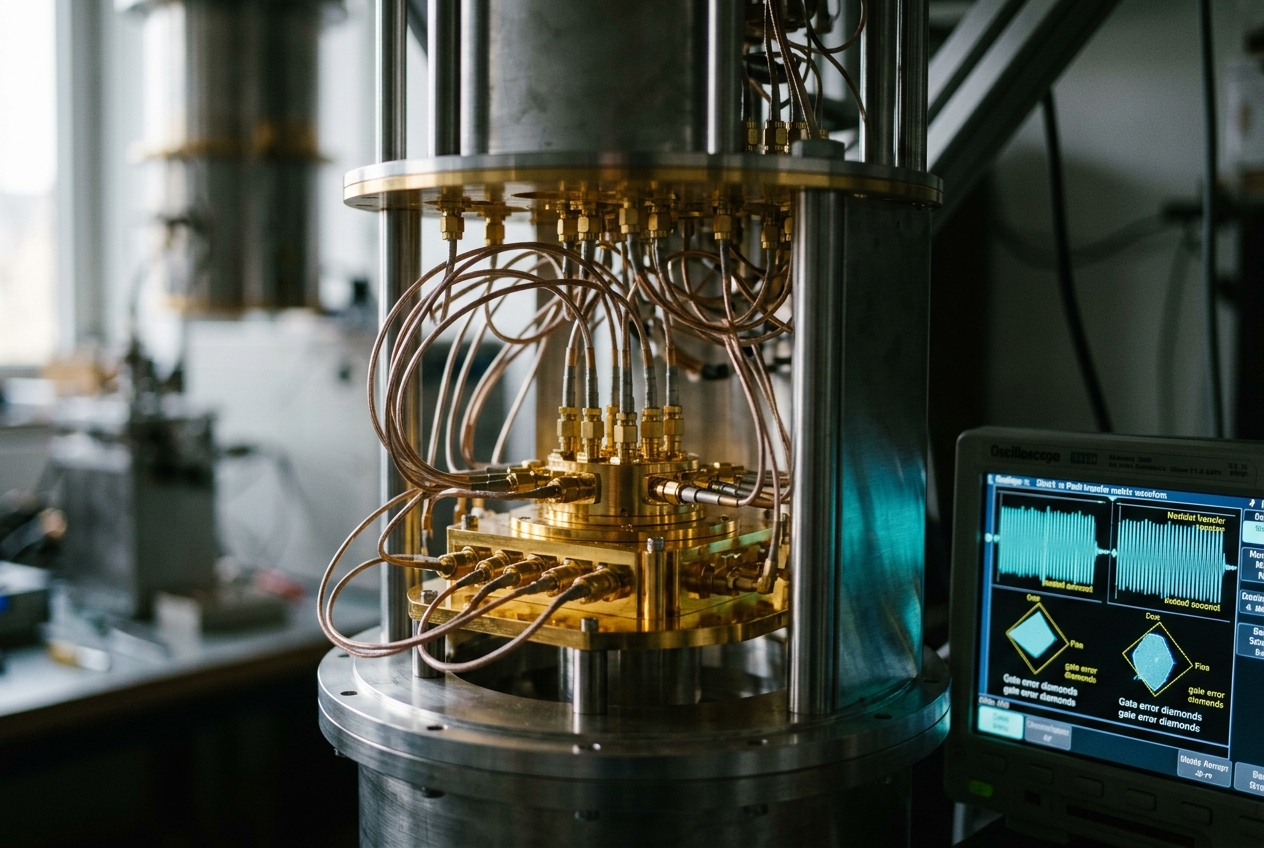
The global race to build a fault-tolerant quantum computer is frequently presented as a struggle over numbers: how many physical qubits can be crammed onto a silicon chip, or what headline fidelity percentage a research team can claim in a press release. We are routinely told that a quantum processor with two-qubit logic gates operating at $99.9\%$ fidelity is hovering on the precipice of commercial revolution—capable of breaking public-key cryptography, revolutionizing battery chemistry, and unraveling complex molecular dynamics.
Yet behind these glittering figures lies an uncomfortable reality well known to experimental physicists: many of these reported metrics are statistical illusions.
A single logic gate that appears to operate with $99.9\%$ fidelity under standard randomized benchmarks can harbor hidden, systematic directional errors—such as subtle coherent over-rotations or stray microwave crosstalk—that compound catastrophically when stitched into deep quantum circuits. If a quantum error correction code like the surface code is fed physical operations with uncharacterized coherent biases, its mathematical threshold collapses. The entire architecture fails to protect the fragile logical information encoded within it.
The central roadblock in resolving this crisis has historically been a profound measurement paradox: how do you calibrate an imperfect quantum operation when the instruments you use to prepare and measure that operation are themselves built out of the very same imperfect quantum operations?
Until recently, quantum engineers were attempting to construct atomic-scale chronometers using rulers whose tick marks expanded and contracted with every measurement. The protocol that fundamentally solved this circularity problem is known as Gate Set Tomography (GST). By establishing a completely self-consistent, holistic calibration framework, Gate Set Tomography provides the definitive diagnostic ledger for physical quantum processors, transforming quantum computing from an era of heuristic trial-and-error into a rigorous, predictive discipline.
2. The Idea in Plain English
To understand why characterizing a quantum computer is so difficult, consider an earthly analogy: a team of cartographers tasked with mapping an uncharted island.
Suppose these cartographers possess a set of optical surveying instruments. To measure the precise distance between two mountain peaks, they must first set up their tripod at an accurately known reference point (state preparation) and read the bearing through their telescope's reticle (measurement). But what happens if the tripod legs are warped by an unknown angle, and the telescope's lenses are misaligned? Any map they produce of the landscape will be distorted. More insidiously, if they try to calibrate their telescope by sighting their base camp, they cannot separate the physical error in the lens from the physical error in the position of the base camp itself.
This is precisely the failure mode of classical Quantum Process Tomography (QPT), documented extensively across foundational literature on Wikipedia: Quantum Tomography. In standard QPT, an experimentalist attempts to reconstruct the full mathematical matrix of a quantum logic gate. However, standard QPT strictly requires that the initial quantum states injected into the gate are known with absolute perfection, and that the measurement apparatus reading out the state is completely error-free. In real-world quantum hardware—whether superconducting transmons or trapped atomic ions—this assumption is impossible. The microwave pulses and laser bursts used to initialize and measure qubits (collectively termed SPAM, for State Preparation and Measurement) suffer from physical imperfections of the exact same order of magnitude as the logic gates being evaluated. Standard process tomography ends up blaming the gate for errors caused by the detector, or crediting the detector for errors masked by the gate.
Gate Set Tomography sidesteps this chicken-and-egg dilemma through a technique analogous to global satellite triangulation. Instead of treating state preparation, gate operations, and measurement as separate, isolated stages, GST groups them together into an interconnected, closed family of operations called a gate set.
GST does not ask: "What does this individual gate do to an idealized, perfect state?"
Instead, it asks: "If I take this collection of imperfect native gates, string them together into hundreds of structured geometric sequences of varying lengths, and measure the final readout probabilities, what unique, self-consistent mathematical model of states, gates, and measurements simultaneously explains every single observed outcome?"
By analyzing how errors compound or cancel out across long sequences of operations, GST extracts the true physical identity of the quantum gates while remaining entirely immune to preparation and measurement distortions.
3. How It Actually Works — The Mechanics
The mathematical and operational machinery of Gate Set Tomography operates across three interconnected layers: vectorized superoperator spaces, self-consistent algebraic inversion, and long-sequence sensitivity amplification.
Superoperators and the Pauli Transfer Matrix
In quantum mechanics, the state of an open $n$-qubit quantum system is represented by a density matrix $\rho$, which is a positive semi-definite operator acting on a $2^n$-dimensional complex Hilbert space, as explored in graduate curricula like MIT OpenCourseWare Quantum Physics. A quantum logic gate acting on this state is not merely a unitary matrix; due to environmental decoherence and control noise, it is a completely positive and trace-preserving (CPTP) linear map $\mathcal{G}$, commonly termed a superoperator.
To make these superoperators tractable for tomography, we map the space of $2^n \times 2^n$ density matrices into a real $4^n$-dimensional vector space equipped with the Hilbert-Schmidt inner product. Under this transformation, known as operator vectorization, the density matrix $\rho$ becomes a real column vector $|\rho\rangle!\rangle$, and a measurement effect $E$ (an element of a positive operator-valued measure, or POVM) becomes a real row vector $\langle!\langle E|$.
Within this framework, any quantum channel $\mathcal{G}$ is represented as a real $4^n \times 4^n$ matrix called the Pauli Transfer Matrix (PTM). The elements of the Pauli Transfer Matrix capture exactly how the gate transforms each element of the orthonormal $n$-qubit Pauli basis ${\sigma_0, \sigma_1, \sigma_2, \sigma_3}^{\otimes n}$ into another:
$$R_{\mu\nu}(\mathcal{G}) = \frac{1}{2^n}\mathrm{Tr}\left(\sigma_\mu \mathcal{G}(\sigma_\nu)\right)$$
In this language, the experimental probability $p$ of preparing an initial state $\rho$, executing a sequential chain of quantum gates $\mathcal{G}_1, \mathcal{G}_2, \dots, \mathcal{G}_m$, and detecting a measurement outcome $E$ simplifies to a straightforward scalar product of vectors and matrices:
$$p = \langle!\langle E | \mathcal{G}_m \cdots \mathcal{G}_2 \mathcal{G}_1 | \rho \rangle!\rangle$$
Linear Inversion GST (LGST) and the Gram Matrix
The first foundational step of GST is Linear Inversion Gate Set Tomography (LGST). To establish a coordinate frame without assuming prior knowledge of SPAM, the experimentalist selects a set of informational complete short gate sequences called fiducials: * A set of state-preparation fiducials ${F_i}$ designed to rotate the crude initial state into an information-spanning set of states. * A set of measurement fiducials ${H_j}$ designed to rotate the measurement axis across all non-trivial measurement bases.
By combining every preparation fiducial with every measurement fiducial, the protocol constructs an experimental Gram matrix $\tilde{g}$, whose entries correspond directly to measured macroscopic click probabilities: $\tilde{g}_{ji} = \langle!\langle E | H_j F_i | \rho \rangle!\rangle$.
Simultaneously, by inserting a target gate $\mathcal{G}k$ between the fiducials, we measure a gate-shifted Gram matrix: $(\tilde{g}{\mathcal{G}k}){ji} = \langle!\langle E | H_j \mathcal{G}_k F_i | \rho \rangle!\rangle$.
Because the Gram matrix $\tilde{g}$ acts as a transfer operator linking the internal Hilbert-Schmidt space to experimental observations, simple matrix inversion allows us to isolate the gate matrix directly:
$$\mathcal{G}k^{\mathrm{LGST}} = \tilde{g}^{-1} \tilde{g}{\mathcal{G}_k}$$
Notice the mathematical triumph of this step: the specific, unknown details of the preparation state $|\rho\rangle!\rangle$ and measurement vector $\langle!\langle E|$ cancel out entirely within the inverted linear system. The protocol computes the gate representation using raw data alone.
+-------------------------------------------------------------------------------+
|                       THE SPAM CIRCULARITY PROBLEM                            |
|                                                                               |
|   Standard QPT:      |rho_ideal>> ----> [ Target Gate G ] ----> <<E_ideal|    |
|                      (Assumes state & measurement are perfectly known)        |
|                                                                               |
|   GST Triangulation: |rho_raw>> -> [F_i] -> [ G^L ] -> [H_j] -> <<E_raw|      |
|                      (Simultaneous reconstruction of rho, G, and E via        |
|                       Gram matrix inversion and germ amplification)           |
+-------------------------------------------------------------------------------+
The Gauge Freedom Problem
Although LGST provides an immediate, closed-form reconstruction of the gate set, it reveals a profound fundamental property of quantum systems: gauge freedom.
Because an experimentalist only ever accesses scalar measurement probabilities $\langle!\langle E | \mathcal{G}_1 \cdots \mathcal{G}_m | \rho \rangle!\rangle$, one can insert the identity operator in the form of $B^{-1}B$ (where $B$ is any invertible $4^n \times 4^n$ matrix) between every operation without altering a single observable prediction. The entire physical gate set transforms under this similarity transformation:
$$\left( |\rho\rangle!\rangle \mapsto B |\rho\rangle!\rangle, \quad \mathcal{G}_k \mapsto B \mathcal{G}_k B^{-1}, \quad \langle!\langle E_j| \mapsto \langle!\langle E_j| B^{-1} \right)$$
This mathematical symmetry means that the raw coordinate matrix of an isolated quantum gate is unphysical; only gauge-invariant quantities (such as the trace of a gate sequence, the eigenvalues of a superoperator, or the overall circuit fidelity) possess objective physical reality.
Consequently, raw LGST outputs cannot be naively compared to theoretical target gates. Instead, the gate set must undergo gauge optimization: an algorithmic routine that searches over the Lie group of invertible matrices $B$ to find the transformation that brings the experimental gate set as close as possible to the target design (typically by minimizing the Frobenius distance while strictly preserving the CPTP physical boundary conditions).
Germ Circuits and Heisenberg-Limited Sensitivity
While LGST establishes a self-consistent coordinate system, its statistical accuracy is limited by standard projection noise (shot noise), scaling as $1/\sqrt{N}$, where $N$ is the number of experimental repetitions. To achieve the sub-microscopic precision needed to calibrate fault-tolerant devices, GST introduces the concept of germs.
A germ is a short periodic sequence of gates—such as a single $\pi/2$ pulse, or a composite sequence like $X(\pi/2) - Y(\pi/2)$—engineered so that repeating the sequence $L$ times amplifies every possible generator of error in the Lie algebra of the gate set. * A tiny coherent over-rotation $\epsilon$ around the $X$-axis on a single gate will multiply linearly across $L$ repetitions into an accumulated error angle of $L\epsilon$. * A subtle Hamiltonian crosstalk coupling will cause a phase drift that sweeps predictably across the Bloch sphere.
By constructing experimental circuits containing germ repetitions scaled in powers of two ($L = 1, 2, 4, 8, 16, \dots, 2^k$), GST transforms standard tomographic sensitivity. The observable error signal grows proportional to $L$, allowing parameter estimation precision to scale as $1/L$—attaining the fundamental Heisenberg-limited scaling permitted by quantum mechanics.
+-------------------------------------------------------------------------------+
|                    HEISENBERG SENSITIVITY AMPLIFICATION                       |
|                                                                               |
|   Single Gate (L=1):     [ Gate + eps ]  -----> Error signal ~ eps            |
|   Repeated Germ (L=16):  [ Gate + eps ]^16 ---> Error signal ~ 16 * eps       |
|                                                                               |
|   Result: Parameter sensitivity scales as 1/L down to 10^-5 precision!       |
+-------------------------------------------------------------------------------+
Non-Linear Maximum Likelihood Estimation and Model Violations
The linear estimates from LGST serve as a seed for a global, non-linear optimization pipeline. Real quantum processors execute thousands of distinct germ-power circuits, producing an exhaustive dataset of photon counts or electrical state readouts.
To consolidate this massive dataset into a single physical model, the open-source pyGSTi Software Framework developed at Sandia National Laboratories performs Constrained Maximum Likelihood Estimation (MLE) or Weighted Least Squares (WLS). The algorithm fits a parameterized, physical gate set $\mathcal{G}$ by minimizing the total discrepancy between the observed counts $n_s$ and predicted probabilities $p_s(\mathcal{G})$ across all circuits $s$:
$$\chi^2(\mathcal{G}) = \sum_{s} \frac{\left(n_s - N_s p_s(\mathcal{G})\right)^2}{N_s p_s(\mathcal{G})(1 - p_s(\mathcal{G}))}$$
Crucially, this non-linear optimization includes a built-in diagnostic metric: the goodness-of-fit test. If the optimized physical model cannot fit the experimental data within rigorous statistical confidence intervals (governed by Wilks' theorem), GST flags a model violation.
A model violation indicates that the physical qubit is experiencing non-Markovian noise, such as: * Low-frequency $1/f$ magnetic flux drift or charge fluctuations. * Coherent coupling to parasitic two-level fluctuators (TLFs) in the substrate dielectric. * Pulse-distortion memory effects where the execution of one gate alters the physical waveform of the next.
GST does not just tell the engineer what the gate is doing; it reveals when the underlying physical system violates the standard mathematical axioms of quantum circuit theory.
4. Real-World Applications Today
The unique ability of Gate Set Tomography to diagnose coherent Hamiltonian errors, non-unitary dissipation, and non-Markovian noise has made it an indispensable instrument across the quantum industry between 2024 and 2026.
+-------------------------------------------------------------------------------+
|                    GATE SET TOMOGRAPHY IN INDUSTRY (2024-2026)                |
+-----------------------------------+-------------------------------------------+
| Institution / Enterprise          | Primary Diagnostic Application            |
+-----------------------------------+-------------------------------------------+
| Sandia National Laboratories      | Open-source pyGSTi engine & QEC benchmarking|
| IBM Quantum                       | Heavy-hex transmon ZZ crosstalk isolation |
| Quantinuum & IonQ                 | Trapped-ion optical phase drift tuning    |
| Rigetti & Silicon Consortia       | Two-level system (TLS) defect discovery   |
+-----------------------------------+-------------------------------------------+
1. Sandia National Laboratories: The Pioneer of pyGSTi
Researchers at Sandia National Laboratories originally formulated Gate Set Tomography and maintain the definitive open-source package pyGSTi. Today, Sandia collaborates with the United States Department of Energy and academic quantum centers globally to validate high-precision physical qubits designed for quantum error correction. By applying GST to single- and two-qubit logical primitives, Sandia researchers provide mathematical certification that physical gates meet the fault-tolerant threshold of topological quantum memories, as reported across publications in Nature Physics.
2. IBM Quantum: Isolating Coherent Microwave Crosstalk
At IBM Quantum, multi-qubit superconducting processors configured on heavy-hexagonal lattices experience subtle electromagnetic parasitic couplings, known as static and dynamic $ZZ$ crosstalk. When a microwave drive excites a target transmon, neighboring unaddressed qubits can undergo unintentional micro-rotations. IBM engineers deploy variants of GST to isolate these coherent crosstalk terms from incoherent energy relaxation ($T_1$) and pure dephasing ($T_2$). This enables automated control software to compute precise microwave cancellation tones and dynamically adapt cross-resonance drive pulses.
3. Quantinuum & IonQ: Trapped-Ion Phase Control and Transport Calibration
In trapped-ion architectures developed by companies like Quantinuum and IonQ, shuttling barium or ytterbium ions through microfabricated surface traps requires intricate sequences of laser pulses and radiofrequency voltages. While trapped ions possess nearly identical natural coherence times, experimental gates suffer from minute optical phase drifts and Raman laser intensity jitter. GST is actively used in these systems to detect residual over-rotations down to angles smaller than $10^{-4}$ radians, enabling two-qubit entangling gate fidelities exceeding $99.9\%$, a prerequisite for fault-tolerant logical qubit demonstration.
4. Rigetti Computing and Silicon Spin Qubit Consortia
In scalable silicon quantum dot and superconducting foundry ecosystems—including Rigetti Computing and European silicon spin-qubit initiatives—GST serves as a post-fabrication structural auditor. By analyzing model violation spectra generated by GST routines, chip designers can pinpoint specific material defects, such as interface two-level fluctuators in superconducting coplanar waveguides or charge noise traps in silicon-germanium heterostructures.
5. What This Means for You
For anyone outside a low-temperature physics laboratory, Gate Set Tomography might seem like an esoteric mathematical exercise. Yet the implications of this protocol directly touch the timeline of when quantum computing will impact everyday human society.
Cybersecurity and the Post-Quantum Timeline
Modern global commerce—from your online bank logins to sovereign encrypted communications—rests on public-key cryptographic protocols like RSA and Elliptic Curve Cryptography. A quantum computer running Shor's algorithm can shatter these defenses, but only if it can execute billions of coherent logic gates without physical error avalanche.
GST acts as the uncompromising reality check on this timeline. When an enterprise claims to be nearing a cryptographically relevant quantum computer, GST is the diagnostic auditor that proves whether their physical gates are genuinely robust or hopelessly corrupted by hidden systematic noise. This gives cybersecurity agencies and standard bodies like NIST the exact empirical data needed to schedule the global transition to post-quantum cryptography.
The Material and Pharmaceutical Frontier
The most transformative promise of quantum computing is the exact simulation of molecular systems: designing catalysts that fix atmospheric nitrogen for clean fertilizer production, discovering room-temperature superconductors that eliminate power grid transmission losses, or designing custom targeted enzymes for incurable diseases.
None of these simulations can succeed on noisy, uncalibrated hardware. A simulation running on an uncharacterized quantum processor produces chemical gibberish. Gate Set Tomography provides the mathematical foundation that allows quantum computers to graduate from scientific curiosities into precision computational microscopes, ensuring that when a quantum computer designs a new pharmaceutical drug, the underlying physics is fundamentally true.
6. Today's Takeaway
Gate Set Tomography is the self-consistent, SPAM-free foundation of quantum metrology: by abandoning the impossible demand for perfect instruments and measuring how errors compound across long geometric sequences of native gates, GST extracts the true physical reality of a quantum processor, providing the rigorous diagnostic roadmap required to realize fault-tolerant quantum technology.