Fluxonium Qubits: Overcoming Transmon Anharmonicity Limits and Extending Coherence Via Superinductance
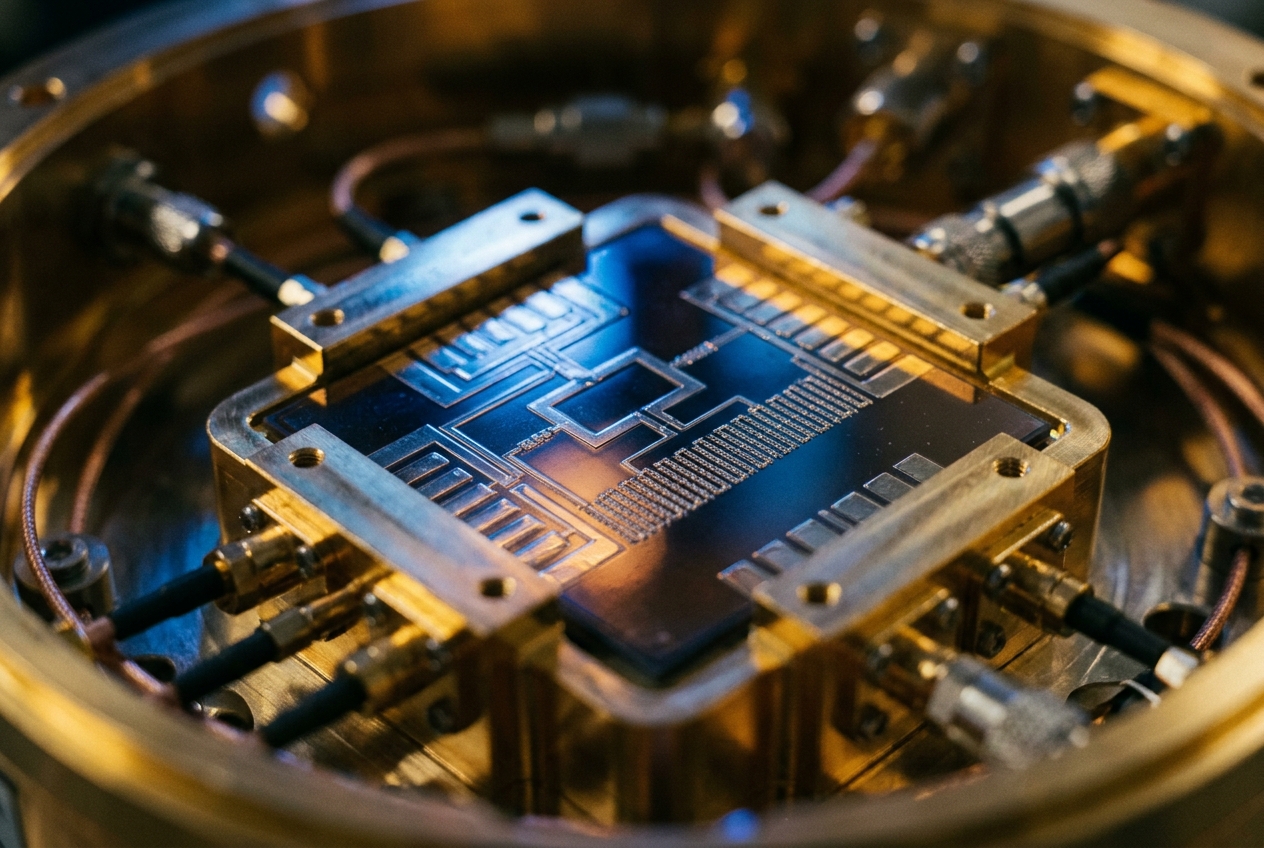
However, the hardware foundation upon which the tech industry has wagered billions of dollars—the transmon qubit—is running into fundamental physical constraints. Trapped between the competing demands of noise protection and operational speed, the transmon is showing its age. In research laboratories from Yale to Paris, a revolutionary alternative is taking center stage: the fluxonium qubit. By exploiting the strange physics of superinductance and quantum tunneling in a microscopic double-well energy landscape, fluxonium offers a path toward quantum coherence times measured not in fragile microseconds, but in robust milliseconds, potentially altering the timeline of the entire quantum era.
1. The Idea in Plain English
To understand why quantum hardware engineers are redesigning their circuits, one must first confront the deceptively difficult task of building an artificial atom. In classical computing, a bit is a macroscopic light switch: it is unambiguously on or off, 1 or 0. A quantum bit, or qubit, behaves instead like a spinning coin. While in motion, it exists in a simultaneous blend of possibilities known as a superposition. Only when the coin settles on the table—when a measurement is made—does it collapse into a definitive state.
       CONVENTIONAL TRANSMON                      FLUXONIUM ARCHITECTURE
 (Nearly Harmonic / Crowded States)            (Deep Double-Well / Isolated States)

Energy E                                      Energy E
             |                                             |      |2> (High Energy)
             |      |2>                                    |     -----
             |     -----                                   |
             |     ----- |1>                               |  |0>     |1>
             |     ----- |0>                               | ---     ---
             +----------------->                           +----------------->
              Phase Coordinate                              Phase Coordinate
   [ Transitions bleed together ]               [ States separated by giant energy gap ]
For two decades, the leading method for creating this spinning coin on a microchip has relied on superconducting quantum computing. Engineers cool circuits made of aluminum or niobium to fractions of a degree above absolute zero. At these cryogenic temperatures, electrical resistance vanishes, and billions of electrons bind into unified pairs that flow collectively as a single macroscopic quantum wave.
To turn this circuit into a controllable qubit, physicists introduce a microscopic bottleneck known as a Josephson junction—a razor-thin insulating barrier through which electron pairs must tunnel. In plain terms, a Josephson junction acts as a non-linear electrical spring. While an ordinary electrical circuit behaves like a grandfather clock's pendulum—swinging back and forth at a single, unchanging musical pitch regardless of how hard it is pushed—the junction makes the pendulum swing differently depending on how much energy it contains.
This property is called anharmonicity. Anharmonicity ensures that the energy required to nudge the circuit from its lowest energy state ($|0\rangle$) to its first excited state ($|1\rangle$) is distinctly different from the energy required to kick it from the first state to an unwanted second state ($|2\rangle$). Without anharmonicity, a laser or microwave pulse aimed at controlling the qubit would inadvertently excite every higher energy level at once, spraying quantum information into the environment like water from a broken garden hose.
The industry-standard qubit, the transmon, solved an early hardware crisis by drowning out electrical charge noise with a massive capacitor. But in doing so, it sacrificed nearly all of its anharmonicity. The transmon's energy levels remain crowded closely together, forcing engineers to use slow, delicate control pulses to avoid accidental leakage into higher states.
The fluxonium qubit resolves this dilemma through a radically different mechanical design. Imagine replacing the pendulum with a heavy particle placed inside a corrugated valley—a landscape featuring two distinct, symmetrical hollows separated by a central ridge. The qubit's computational states ($|0\rangle$ and $|1\rangle$) do not correspond to barely distinguishable swings of a pendulum; instead, they represent the particle resting peacefully in the left-hand well or the right-hand well, or tunneling gracefully between the two. Higher, unwanted states ($|2\rangle$ and above) are pushed far up the steep outer walls of the valley. By decoupling the computational states from higher-energy escape routes, fluxonium achieves extraordinary structural stability.
2. How It Actually Works: The Mechanics of Fluxonium
To appreciate the mathematical elegance of fluxonium, one must first dissect the fundamental limitation that doomed its predecessor to weak anharmonicity.
The Transmon Bottleneck
In circuit quantum electrodynamics, the Hamiltonian (the total energy operator) of a standard transmon is governed by the competition between two terms: the electrostatic charging energy $E_C = e^2 / (2C)$, which measures the energy cost of adding individual Cooper pairs to the island capacitance $C$, and the Josephson energy $E_J = I_c \Phi_0 / (2\pi)$, which quantifies the tunneling strength of pairs across the junction with critical current $I_c$.
In the earliest superconducting designs, known as Cooper-pair boxes, $E_C$ was comparable to $E_J$. This provided massive anharmonicity, but left the circuit violently susceptible to microscopic fluctuations in background electrical charge—charge noise—which caused the qubit's frequency to jitter chaotically, destroying quantum information in nanoseconds.
The transmon solved this by shunting the junction with a huge capacitance, driving the ratio into the deep asymptotic regime where $E_J / E_C \gg 1$ (typically between 50 and 100). As demonstrated in foundational work documented across MIT OpenCourseWare's quantum circuits curricula, this geometric modification exponentially flattens the energy bands against charge fluctuations. However, treating the transmon as a weakly perturbed Duffing oscillator reveals its inherent cost:
$$\hat{H}{\text{transmon}} \approx \hbar \omega{01} \hat{a}^\dagger \hat{a} - \frac{E_C}{2} \hat{a}^\dagger \hat{a}(\hat{a}^\dagger \hat{a} - 1)$$
Here, $\hat{a}^\dagger$ and $\hat{a}$ represent the standard creation and annihilation operators that raise or lower the energy excitations of the circuit, while $\omega_{01} \approx \sqrt{8 E_J E_C}/\hbar - E_C/\hbar$ denotes the primary transition frequency.
The negative shift in the energy spacing—the absolute anharmonicity $\alpha = \omega_{12} - \omega_{01}$—is clamped directly to the charging energy: $\alpha \approx -E_C / \hbar$. Because practical fabrication constraints limit $E_C / h$ to roughly $200\text{ to }300\text{ MHz}$, the computational transition ($|0\rangle \leftrightarrow |1\rangle$ at $\approx 4\text{ to }5\text{ GHz}$) sits uncomfortably close to the non-computational leakage transition ($|1\rangle \leftrightarrow |2\rangle$). If an engineer attempts to execute a single-qubit logic gate faster than roughly 10 to 20 nanoseconds, the spectral bandwidth of the microwave pulse inevitably overlaps with the $|1\rangle \rightarrow |2\rangle$ transition, causing fatal gate errors.
+------------------------------------------------------------------------------------+
|                             THE TRANSMON TRADE-OFF                                 |
|                                                                                    |
|   Large Capacitance (High C)  ===>  Shields against Charge Noise                   |
|                               ===>  Crushes Anharmonicity (α ≈ -200 MHz)           |
|                               ===>  Forces Slow Gates & Leakage Susceptibility     |
+------------------------------------------------------------------------------------+
The Superinductor: Taming Phase Fluctuations Without Resistance
Fluxonium breaks this compromise by introducing a third circuit element: a dissipation-free superinductor.
In classical electronics, an inductor is simply a wire coil that resists changes in current. However, building an on-chip geometric inductor with sufficient inductance to isolate a qubit requires millions of turns of wire, which introduces devastating parasitic capacitance to the ground plane, short-circuiting the circuit at microwave frequencies.
To overcome this, physicists exploit the kinetic inductance of Cooper pairs or arrays of Josephson junctions. When Cooper pairs accelerate through a constricted superconducting channel, their inertial mass creates an effective electrical inductance without generating any frictional heat or resistance. By fabricating a chain of hundreds of large Josephson junctions in series, or by sputtering thin films of disordered superconductors such as granular aluminum (grAl) or niobium nitride ($\text{NbN}$), researchers synthesize a pure, non-dissipative superinductance $L$ exceeding hundreds of nanohenries ($L > 500\text{ nH}$).
Crucially, this superinductance exhibits a characteristic impedance $Z_L = \sqrt{L/C}$ that vastly exceeds the fundamental quantum resistance of Cooper pairs, $R_Q = h / (4e^2) \approx 6.45\text{ k}\Omega$. This massive impedance confines and tames the quantum phase fluctuations across the primary junction, preventing dangerous phase slips while granting complete immunity to low-frequency offset charge noise.
                    FLUXONIUM CIRCUIT TOPOLOGY

                          ---[ Superinductor (L) ]---
                         |      (grAl or JJ Array)   |
                         |                           |
               ---(+)----+-----[ Josephson (EJ) ]----+----(-)---
                         |                           |
                          ------[ Capacitor (C) ]-----
The Fluxonium Circuit Hamiltonian
When a single small Josephson junction is shunted simultaneously by a large capacitor $C$ and a superinductor $L$, and threaded by an external magnetic flux $\Phi_{\text{ext}}$, the total quantum Hamiltonian of the circuit is derived from first principles as:
$$\hat{H} = 4 E_C \hat{n}^2 + \frac{1}{2} E_L \hat{\varphi}^2 - E_J \cos(\hat{\varphi} - \varphi_{\text{ext}})$$
In this canonical expression: * $\hat{n} = -i \frac{\partial}{\partial \varphi}$ is the quantum charge operator representing the number of Cooper pairs transferred across the junction. * $\hat{\varphi} = 2\pi \hat{\Phi} / \Phi_0$ is the gauge-invariant superconducting phase operator across the small junction (where $\Phi_0 = h/(2e)$ is the superconducting magnetic flux quantum). * $E_C = e^2 / (2C)$ represents the electrostatic charging energy. * $E_L = (\Phi_0 / 2\pi)^2 / L$ represents the inductive energy of the superinductor. * $E_J$ represents the Josephson tunneling energy. * $\varphi_{\text{ext}} = 2\pi \Phi_{\text{ext}} / \Phi_0$ represents the dimensionless external magnetic flux bias.
In the distinctive parameter hierarchy of fluxonium, the inductive energy is engineered to be much smaller than both the charging and Josephson energies: $E_L \ll E_C, E_J$. Typically, $E_L / h \approx 0.5\text{ GHz}$, $E_C / h \approx 1.0\text{ GHz}$, and $E_J / h \approx 5.0\text{ GHz}$.
Because $E_L$ is small, the parabolic confining potential $\frac{1}{2}E_L \varphi^2$ generated by the superinductor is shallow and wide. It allows the phase variable $\varphi$ to explore multiple local minima created by the corrugated periodic term $-E_J \cos(\varphi - \varphi_{\text{ext}})$, rather than being tightly pinned to a single harmonic well.
The Half-Flux Sweet Spot and Millisecond Coherence
The true quantum mechanical power of fluxonium emerges when an external magnetic field is applied to bias the loop precisely at half a flux quantum, setting $\varphi_{\text{ext}} = \pi$. At this exact bias point, the total potential energy landscape $U(\varphi)$ simplifies into a perfectly symmetric double-well:
$$U(\varphi) = \frac{1}{2} E_L \varphi^2 + E_J \cos(\varphi)$$
                           THE DOUBLE-WELL SWEET SPOT (φ_ext = π)

            Potential Energy U(φ)
                      |            Barrier (E_J)
                      |                 /\
                      |    |0>         /  \         |1>
                      |   \   /       /    \       \   /
                      |    \_/ \_____/      \_____/ \_/
                      |       Left Well        Right Well
                      +---------------------------------------->
                                Superconducting Phase (φ)
                      <--- Clockwise I_c ---> <--- Counter-CW I_c --->
This double-well potential yields two profound physical consequences that solve the dual challenges of quantum decoherence:
-
First-Order Insensitivity to Flux Noise (Dephasing Protection, $T_2$): Low-frequency magnetic fluctuations in the environment—known as $1/f$ flux noise—are the primary cause of pure dephasing in flux-sensitive circuits. However, because the potential at $\varphi_{\text{ext}} = \pi$ is strictly symmetric, the first derivative of the transition frequency with respect to magnetic flux vanishes completely: $$\left. \frac{\partial \omega_{01}}{\partial \varphi_{\text{ext}}} \right|{\varphi{\text{ext}}=\pi} = 0$$ Operating at this parabolic extrema—the so-called flux sweet spot—shields the qubit from linear magnetic perturbations, stretching dephasing times ($T_2^*$) from tens of microseconds into the hundreds of microseconds or milliseconds regime.
-
Wavefunction Orthogonality and Parity Selection Rules (Relaxation Protection, $T_1$): The ground state $|0\rangle$ and first excited state $|1\rangle$ are formed by the symmetric and antisymmetric linear combinations of persistent current states circulating clockwise and counter-clockwise around the superconducting loop. Because the wavefunctions of these two computational states are localized in distinct potential wells separated by a wide barrier, their spatial overlap is tiny. The dipole transition matrix element $|\langle 0 | \hat{\varphi} | 1 \rangle|$, which dictates the rate at which the qubit relaxes and dissipates energy into dielectric losses in surrounding substrate materials, is exponentially suppressed. Consequently, the energy relaxation time $T_1$ can routinely exceed 1.0 to 1.5 milliseconds—a full order of magnitude longer than conventional transmons.
Giant Anharmonicity and Zero-Leakage Gates
While the $|0\rangle \leftrightarrow |1\rangle$ computational transition frequency at the sweet spot is extraordinarily low (often engineered between $500\text{ MHz}$ and $1.5\text{ GHz}$, corresponding to quantum tunneling across the barrier), the transition to the second excited state $|1\rangle \rightarrow |2\rangle$ involves jumping out of the well into a higher plasmonic excitation band at $4\text{ to }8\text{ GHz}$.
This results in a staggering positive anharmonicity $\alpha = \omega_{12} - \omega_{01}$ of $+3\text{ to }+6\text{ GHz}$—more than twenty times larger than that of a transmon.
Because the computational transition and the leakage transitions inhabit completely different frequency regimes, control engineers can bombard fluxonium qubits with intense, ultrashort microwave pulses lasting only 1 to 3 nanoseconds without any risk of populating higher states. This completely eliminates the trade-offs imposed by the transmon, providing a clear path toward high-speed, high-fidelity single-qubit gates exceeding $99.99\%$ fidelity.
3. Two-Qubit Gates and the Road to Scalable Fault Tolerance
A solitary qubit, however coherent, is computationally useless without the ability to interact with its neighbors. The challenge in scaling superconducting systems lies in executing fast, high-fidelity two-qubit entangling operations while preventing parasitic $ZZ$ crosstalk—an unwanted, continuous interaction where the energy level of one qubit is unintentionally shifted by the state of its neighbor, causing rapid phase corruption.
                       SCALABLE FLUXONIUM ARCHITECTURE

                Qubit A                                 Qubit B
             (Fluxonium)                             (Fluxonium)
          +---------------+                       +---------------+
          |  (EJ, EC, EL) |                       |  (EJ, EC, EL) |
          +-------+-------+                       +-------+-------+
                  |                                       |
                  |          +-----------------+          |
                  +----------+ Tunable Coupler +----------+
                             |   (SQUID Loop)  |
                             +-----------------+
                         [ Static ZZ Shift Cancelled ]
                         [ Microwave-Activated f-Sim ]
In fluxonium architectures, two-qubit entanglement is achieved by interconnecting adjacent qubits via tunable inductive couplers (such as small rf-SQUIDs or auxiliary transmon-like junctions), as detailed in recent breakthroughs published in Physical Review Letters.
Because fluxonium possesses rich selection rules and multi-GHz energy separation between plasmonic and fluxon levels, engineers can design interactions where the virtual exchange paths that cause static $ZZ$ coupling naturally interfere destructively and cancel out. The residual crosstalk rate can be suppressed below a negligible $1\text{ kHz}$.
When a two-qubit operation is required, an external microwave drive illuminates the coupler or qubit, activating high-speed resonant interactions: * Microwave-Activated Controlled-Z ($CZ$) and iSWAP Gates: By driving higher transitions (such as $|11\rangle \leftrightarrow |02\rangle$ or $|11\rangle \leftrightarrow |20\rangle$), state-dependent phase shifts accumulate rapidly, completing entangling gates in under 30 nanoseconds. * Compatibility with the Surface Code: The fault-tolerant surface code—the leading mathematical algorithm for quantum error correction—requires two-qubit gate error rates strictly below the theoretical threshold of $1\%$, and ideally below $0.1\%$. Fluxonium systems have already demonstrated two-qubit gate fidelities surpassing $99.8\%$, placing them firmly within the threshold required for active error correction lattices.
4. Real-World Applications Today (2024–2026)
The transition of fluxonium from an academic curiosity to an industrial-grade hardware architecture is being accelerated by elite research consortiums and innovative commercial startups around the globe:
+----------------------------------------------------------------------------------------------------+
|                                    INDUSTRIAL FRONTIERS (2024–2026)                                |
+-----------------------------+----------------------------------+-----------------------------------+
| Institution / Enterprise    | Technical Objective              | Quantum Advantage Mechanism       |
+-----------------------------+----------------------------------+-----------------------------------+
| SQMS Center & Fermilab      | 3D Cavity Integration            | Millisecond T₁ allows deep-memory |
|                             | for Dark Matter Axion Searches   | photon-state storage.             |
+-----------------------------+----------------------------------+-----------------------------------+
| Rigetti Computing & Yale    | Planar Fluxonium Arrays for      | High anharmonicity eliminates     |
|                             | Molecular Catalyst Simulations   | leakage in multi-qubit chemistry. |
+-----------------------------+----------------------------------+-----------------------------------+
| Alice & Bob / ENS Paris     | Superinductive Cat-Qubits        | Granular aluminum superinductors  |
|                             | for Autonomous Error Correction  | provide hardware-level protection.|
+-----------------------------+----------------------------------+-----------------------------------+
| Max Planck & Princeton      | Strongly Correlated Quantum      | Multi-GHz tunable Hamiltonians    |
|                             | Spin Chain Simulators            | map directly to spin lattices.    |
+-----------------------------+----------------------------------+-----------------------------------+
1. Rigetti Computing and Yale Quantum Institute: Scalable Molecular Simulators
- The Mission: Simulating complex transition-metal catalysts, such as the iron-molybdenum cofactor responsible for biological nitrogen fixation in the industrial Haber-Bosch process.
- The Fluxonium Advantage: In standard transmons, simulating multi-orbital electron interactions requires deep quantum circuits that quickly exceed coherence limits, while gate crosstalk corrupts the electronic phase. Rigetti and Yale are engineering multi-qubit planar fluxonium lattices where zero-leakage single-qubit gates and suppressed $ZZ$ coupling allow algorithms to run across hundreds of consecutive gate cycles without decohering.
2. Alice & Bob and ENS Paris: Superinductive Autonomous Error Correction
- The Mission: Constructing hardware-efficient quantum processors that reduce the million-qubit overhead of fault-tolerant computing by utilizing continuous-variable cat-states and superinductance.
- The Fluxonium Advantage: By incorporating granular aluminum superinductors directly into stabilized bosonic cavities, researchers in France are creating hybrid circuits where bit-flip errors are exponentially suppressed at the hardware level, leaving only phase-flip errors for software algorithms to correct.
3. Superconducting Quantum Materials and Systems Center (SQMS / Fermilab): Fundamental Physics and Axion Detection
- The Mission: Searching for ultra-light dark matter candidates (axions) and simulating quantum chromodynamic field theories.
- The Fluxonium Advantage: SQMS pairs ultra-pure superconducting niobium 3D microwave cavities—possessing photon lifetimes of several seconds—with fluxonium qubits acting as ultra-sensitive non-demolition photon counters. The millisecond-scale $T_1$ of fluxonium allows long measurement cycles that dramatically enhance the signal-to-noise ratio in searches for rare cosmological events.
4. Max Planck Institute and Princeton University: Frustrated Quantum Magnetism
- The Mission: Unraveling high-temperature superconductivity mechanisms by simulating frustrated spin-1/2 Heisenberg models on triangular lattices.
- The Fluxonium Advantage: Fluxonium arrays can be dynamically configured across vastly different parameter regimes ($E_J / E_L$), allowing researchers to directly map artificial quantum spins to exotic solid-state materials without suffering from the high-frequency parasitic resonances typical of older architectures.
5. What This Means for You
It is easy to view quantum hardware debates as esoteric academic disputes confined to cryogenic cleanrooms. Yet the physics governing these microscopic circuits will dictate the timeline on which quantum computing transforms everyday life.
       CONVENTIONAL TRANSMON ROADMAP               NEXT-GEN FLUXONIUM ROADMAP

    [ Microsecond Coherence (T₁ ≈ 80 μs) ]     [ Millisecond Coherence (T₁ > 1.2 ms) ]
                   |                                          |
    [ Massive Error Correction Overhead  ]     [ Streamlined Hardware Requirements   ]
    (1,000,000 physical qubits needed)         (10,000 physical qubits needed)
                   |                                          |
    [ Scalable Fault Tolerance: ~2035+   ]     [ Scalable Fault Tolerance: ~2028-2030]
Consider the development of life-saving medicines. Today, pharmaceutical research relies on brute-force laboratory trials and classical simulations that approximate molecular behavior through severe mathematical simplifications. A quantum computer capable of accurately modeling complex protein folding and enzyme-drug binding could shorten the timeline for designing novel treatments from fifteen years to a few weeks.
If quantum hardware remains tethered to the transmon, achieving fault-tolerant computation will require massive multi-million-qubit machines the size of aircraft hangars simply to correct for intrinsic qubit fragility.
By delivering a ten-to-hundred-fold increase in coherence and banishing gate leakage, fluxonium dramatically lowers the threshold for scalable quantum computing. It means the transition from experimental prototypes to practical quantum supercomputers—capable of synthesizing room-temperature superconductors, discovering efficient carbon-capture materials, and redesigning industrial chemistry—is not a distant mid-century aspiration, but a transformation unfolding within this decade.
6. Today's Takeaway
The defining lesson of quantum hardware is that more qubits cannot compensate for poor physical foundations. By replacing the fragile, crowded energy states of the transmon with the deeply protected double-well potential of a superinductive circuit, the fluxonium qubit achieves millisecond-scale coherence, multi-gigahertz anharmonicity, and intrinsic noise immunity—establishing the resilient hardware architecture essential for the fault-tolerant quantum era.
Further Exploration and Authoritative References
- Explore interactive quantum circuit construction on IBM Quantum Documentation and Qiskit Guides.
- Read foundational lectures on superconducting circuit Hamiltonian derivation at MIT OpenCourseWare Quantum Physics.
- Review peer-reviewed breakthroughs in fluxonium two-qubit gate fidelities in Physical Review Letters.
- Investigate the latest advances in fault-tolerant surface codes on Nature Physics.
- Trace the fundamental theoretical derivations of superinductive arrays via the open-access arXiv Quantum Physics Archive.