Floquet Codes: Dynamically Protecting Logical Qubits Via Periodic Measurement Schedules on Honeycomb Lattices
1. Opening Hook — Why You Should Care
The encryption securing your banking transactions, confidential medical dossiers, and national power grids relies upon mathematical problems that would take conventional supercomputers millennia to unravel. A fault-tolerant quantum computer could neutralize these cryptographic fortifications in a matter of hours. Beyond cybersecurity, such machines hold the key to simulating complex molecular dynamics, promising to unlock room-temperature superconductors, design carbon-neutral fertilizers, and map life-saving oncology therapeutics at the atomic scale.
Yet, for all this transformative potential, practical quantum computation faces a monumental physical barrier: quantum information is extraordinarily fragile. The fundamental unit of quantum processing, the quantum bit or qubit, is prone to environmental noise. A stray thermal fluctuation, a microscopic magnetic tremor, or even an ambient cosmic ray can corrupt its delicate state within microseconds.
For nearly three decades, the consensus roadmap to overcoming this fragility has centred on static quantum error correction, epitomized by the planar surface code. In this orthodox framework, fragile physical qubits are wired together in a rigid, grid-like geometry to synthesize a single, long-lived "logical" qubit. However, these static architectures carry a crippling engineering penalty: they demand complex physical layouts, extensive wiring overhead, and multi-qubit measurement operations that severely strain physical hardware.
In 2021, theoretical physicists Matthew Hastings and Jeongwan Haah introduced an iconoclastic alternative that upended this foundational assumption: the Floquet code. Instead of forcing quantum states to remain static within fixed, commuting check networks, Floquet codes protect information dynamically through a continuous, periodic choreography of simple two-qubit measurements. By trading static equilibrium for rhythmic, non-equilibrium dynamics, this approach drastically simplifies physical device architectures. Understanding Floquet quantum error correction reveals how embracing motion over stasis may finally bridge the chasm between fragile laboratory prototypes and commercially transformative quantum computers.
2. The Idea in Plain English
To understand the conceptual leap of Floquet codes, one must first appreciate how classical and quantum information differ when errors strike. In a classical computer, information resides as discrete bits—switches that are definitively either 0 or 1. If thermal noise flips a bit, the system can protect itself using simple redundancy: copy the bit three times ($0 \rightarrow 000$) and take a majority vote.
Quantum mechanics forbids this brute-force approach. According to the foundational no-cloning theorem, an arbitrary, unknown quantum state cannot be copied. Furthermore, any direct measurement of a quantum superposition—a state where a qubit behaves like a coin spinning in mid-air, simultaneously exploring possibilities of heads and tails—forces the coin to land flat, instantly destroying the superposition.
Traditional quantum error correction circumvents this dilemma using stabilizer codes. Instead of measuring the qubits directly, engineers measure parity checks between neighbouring qubits—for instance, asking whether two spinning coins are rotating in the same direction or opposite directions, without ever revealing which side is up. In the standard surface code, physical data qubits sit on a checkerboard lattice interleaved with auxiliary "ancilla" qubits. These ancillas continuously measure four-qubit parity checks (weight-4 stabilizers) to detect errors without destroying the stored quantum information.
Think of the traditional surface code as a classical choir attempting to sustain a single, complex chord indefinitely. Every singer must hold their exact pitch; if any voice wavers, auxiliary conductors (the ancilla measurements) frantically signal corrections to restore the static harmony.
A Floquet code, named after the 19th-century French mathematician Gaston Floquet who developed the mathematics of periodic differential systems, takes an entirely different philosophical path. Instead of holding a single chord motionless, the system performs a perpetual, three-part round song—a fugue. In this architecture, individual pairs of physical qubits are measured in a repeating cycle: Step 0, then Step 1, then Step 2, and back to Step 0.
Individually, these measurements do not commute; each step changes the instantaneous quantum state, wiping out the stabilizers of the previous step. Yet, like a sequence of cinematic frames projected in rapid succession, the global topological information does not perish. Instead, the logical quantum information dances through the lattice, living inside an Instantaneous Stabilizer Group (ISG) that is dynamically regenerated with every cycle. The harmony is preserved not despite the motion, but through it.
KEY PRINCIPLE: THE FLOQUET PARADIGM
Static quantum error-correcting codes protect information within a time-invariant subspace defined by mutually commuting operators. In contrast, Floquet error-correcting codes protect quantum information within a dynamically generated, time-periodic subspace governed by sequences of strictly non-commuting, low-weight measurements. Information is preserved globally while its local representation continuously migrates across the physical lattice.
3. How It Actually Works — The Mechanics
To see the mathematical elegance of dynamically generated quantum error correction, consider its archetype: the Hastings-Haah Honeycomb Model, first introduced in arXiv research and subsequently expanded across the quantum information community.
The Honeycomb Lattice Geometry
Consider a two-dimensional hexagonal (honeycomb) lattice where physical qubits reside exclusively at the vertices (nodes). In a honeycomb graph, every vertex connects to exactly three edges. These edges can be partitioned into three distinct directional classes, conventionally labeled as 0-edges (vertical), 1-edges (positive slope), and 2-edges (negative slope), forming a periodic 3-colouring of the lattice.
                  (0-edge: XX check)
                        |
                        |
                      ( q1 )
                     /      \
      (2-edge: ZZ)  /        \  (1-edge: YY)
                   /          \
                ( q2 )      ( q3 )
                   |          |
To each edge $e = (j, k)$ of type $k \in {0, 1, 2}$, we assign a specific two-body Pauli measurement operator: * 0-edges (Red): Pauli-$X$ interactions, measuring the operator $X_j X_k$ * 1-edges (Green): Pauli-$Y$ interactions, measuring the operator $Y_j Y_k$ * 2-edges (Blue): Pauli-$Z$ interactions, measuring the operator $Z_j Z_k$
Here, $X$, $Y$, and $Z$ denote the standard single-qubit Pauli matrices representing orthogonal spin-polarization measurements.
The Periodic Measurement Schedule
The measurement protocol operates in discrete, sequential time rounds indexed by $r = 0, 1, 2, 3, \dots$. At round $r$, an experimentalist simultaneously measures all two-body Pauli checks on edges of type:
$$r \pmod 3$$
- Round $r \equiv 0 \pmod 3$: Measure $X_j X_k$ for all 0-edges.
- Round $r \equiv 1 \pmod 3$: Measure $Y_j Y_k$ for all 1-edges.
- Round $r \equiv 2 \pmod 3$: Measure $Z_j Z_k$ for all 2-edges.
Notice a crucial property: a 0-edge operator $X_j X_k$ shares vertices with adjacent 1-edge operators ($Y_j Y_m$) and 2-edge operators ($Z_j Z_n$). Because Pauli matrices anti-commute on the same site ($XY = -YX = iZ$), the operators measured at round $r+1$ do not commute with those measured at round $r$. Measuring round 1 fundamentally destroys the eigenstate structure established during round 0.
Dynamic Generation of Plaquette Stabilizers
How can a quantum state survive when its defining properties are systematically destroyed every round? The answer lies in the geometry of the hexagonal faces (plaquettes).
Consider a single hexagonal plaquette $h$ bounded by six physical qubits, numbered sequentially from 1 to 6 around the perimeter. The six boundary edges alternate cyclically: 0-edge, 1-edge, 2-edge, 0-edge, 1-edge, 2-edge.
                    q1 -----(0: XX)----- q2
                   /                       \
             (2: ZZ)                       (1: YY)
                 /                           \
               q6                             q3
                 \                           /
             (1: YY)                       (2: ZZ)
                   \                       /
                    q5 -----(0: XX)----- q4
When we multiply the six two-body edge operators surrounding the plaquette, we construct the static 6-body plaquette operator $\mathcal{S}_h$:
$$\mathcal{S}_h = (X_1 X_2)(Y_2 Y_3)(Z_3 Z_4)(X_4 X_5)(Y_5 Y_6)(Z_6 Z_1) = - Z_1 Z_2 X_3 X_4 Y_5 Y_6$$
Because every two-body measurement on any edge commutes with the overall 6-body product $\mathcal{S}_h$ of every adjacent plaquette, the eigenvalue of $\mathcal{S}_h$ remains an absolute invariant of the system.
More remarkably, the value of $\mathcal{S}_h$ does not need to be measured in a single, complex 6-qubit operation. Instead, as the protocol cycles through rounds 0, 1, and 2, the classical outcomes of the two-body edge checks are multiplied together. After three consecutive rounds, the system dynamically generates the eigenvalue of $\mathcal{S}_h$.
The group of valid stabilizers at any discrete instant $t$ is termed the Instantaneous Stabilizer Group (ISG). While the edge checks in the ISG are replaced every round, the plaquette stabilizers form an underlying topological bedrock, dynamically preserved through the sequence:
$$\text{ISG}(r) = \langle \text{Edge Checks at round } r \pmod 3, \; \text{Plaquette Stabilizers generated at rounds } r-1, r-2 \rangle$$
Logical Qubits and Topological Invariants
When the honeycomb lattice is embedded on a closed two-dimensional surface such as a torus, the physical qubits encode two protected logical qubits. If planar boundary conditions are introduced (using alternating rough and smooth boundaries), it encodes one or more logical qubits.
Unlike standard codes where a logical operator is a fixed string of Pauli operators stretching across the grid, the logical operator of a Floquet code is a dynamic entity. As the measurement round cycles from 0 to 1 to 2, the logical string operator $\bar{X}(t)$ is projectively updated by the edge checks, morphing in real time across the lattice while maintaining its global topological non-triviality. Its minimum spatial length defines the effective code distance $d$, guaranteeing fault-tolerant protection against any arbitrary sequence of fewer than $d/2$ physical Pauli errors.
Decoding Errors in 3D Spacetime
When a physical Pauli error ($X, Y,$ or $Z$) occurs on a qubit, or when a measurement device yields a faulty classical readout, it does not create an isolated spatial symptom. Instead, it creates a pair of defect nodes in a three-dimensional spacetime syndrome graph, where the vertical axis represents the progress of time rounds $r$.
Graph-based decoders, such as Minimum-Weight Perfect Matching (MWPM) via the Blossom algorithm and the fast linear-time Union-Find decoder, operate directly on this 3D spacetime syndrome lattice. By pairing defect endpoints along minimum-weight spacetime paths, these decoders identify whether the underlying disruption was a transient measurement fault or a permanent physical qubit error, applying classical software corrections without ever halting the physical measurement cycle.
4. Real-World Applications Today (2024–2026)
The shift from static 4-body stabilizers to dynamic 2-body Floquet checks has sparked an explosion of experimental and theoretical development across global quantum laboratories.
+--------------------------+------------------------------+-------------------------------------+
| Institution / Enterprise | Target Architecture          | Dynamic Floquet Advantage           |
+--------------------------+------------------------------+-------------------------------------+
| Google Quantum AI        | Superconducting Transmons    | Eliminates ancilla routing grids,   |
| (Santa Barbara, CA)      |                              | suppressing capacitive crosstalk.   |
+--------------------------+------------------------------+-------------------------------------+
| Harvard Univ. / QuEra    | Neutral-Atom Optical Arrays  | Native 2-qubit Rydberg interactions |
| (Cambridge & Boston, MA) |                              | with dynamic zone shuttling.        |
+--------------------------+------------------------------+-------------------------------------+
| Quantinuum               | Trapped-Ion Shuttling Traps  | All-to-all connectivity validates   |
| (Broomfield, CO)         |                              | non-Abelian anyon braid dynamics.   |
+--------------------------+------------------------------+-------------------------------------+
| IBM Quantum              | Heavy-Hex Superconducting    | Direct mapping onto low-degree      |
| (Yorktown Heights, NY)   | Processors                   | planar coupling topologies.         |
+--------------------------+------------------------------+-------------------------------------+
1. Google Quantum AI (Santa Barbara, California)
Google Quantum AI has pioneered experimental implementations of dynamic topological memories on planar superconducting transmon architectures. In traditional surface code implementations (such as Google’s Sycamore processor), measuring a weight-4 stabilizer requires interleaving data qubits with dedicated ancilla qubits, requiring intricate four-way microwave drive couplers that exacerbate parasitic crosstalk.
By implementing Floquet honeycomb protocols, Google’s researchers can execute error correction exclusively through pairwise two-body resonance gates between adjacent transmons. This eliminates the need for dedicated ancilla measurement qubits in the interior of the code, drastically reducing the physical chip’s routing congestion and suppressing unwanted multi-qubit capacitive interactions.
2. Harvard University & QuEra Computing (Cambridge & Boston, Massachusetts)
In the neutral-atom ecosystem, teams led by Harvard University, MIT, and QuEra Computing utilize optical tweezer arrays to manipulate neutral rubidium and cesium atoms. In these architectures, atoms are dynamically moved across optical zones using steerable laser beams.
Floquet codes are exceptionally well-suited for neutral-atom hardware. Because neutral atoms interact via transient, two-body Rydberg excitation pulses, executing high-weight stabilizer checks has historically required complex multi-step gate compilations. With Floquet codes, optical tweezers shuttle atom pairs into proximity to perform rapid, two-body entangling checks before rearranging them for the subsequent round. In 2023 and 2024, milestone demonstrations showed that dynamic topological codes on neutral atoms could sustain logical quantum states across dozens of continuous measurement cycles with hardware-level fault tolerance.
3. Quantinuum (Broomfield, Colorado & Cambridge, UK)
Quantinuum’s trapped-ion quantum computers use precision electromagnetic fields to shuttle ionized ytterbium or barium atoms through linear and junctioned trap geometries. Because trapped ions exhibit near-perfect optical measurement fidelities and long coherence times, they serve as an ideal testbed for complex non-Abelian topological physics.
Using Floquet-style dynamic measurement sequences, Quantinuum demonstrated the creation and braiding of non-Abelian anyonic excitations—exotic quasiparticles whose quantum wavefunctions retain a topological memory of their geometric paths. This demonstrated that Floquet codes are not merely protective vaults for data; they provide a dynamic operational canvas where quantum logic gates can be executed via measurement-induced topological transformations.
4. IBM Quantum (Yorktown Heights, New York)
IBM Quantum has optimized its quantum processors around the "heavy-hex" architecture—a graph layout where qubits connect to only two or three nearest neighbours to maximize yield and minimize cross-resonance errors. Traditional surface codes map inefficiently onto heavy-hex layouts, requiring high overheads to synthesize four-body checks.
IBM research teams have leveraged Floquet codes and generalized subsystem codes that naturally conform to low-degree graphs. By matching the 3-colourable measurement schedule of the Honeycomb code directly onto heavy-hex superconducting devices, IBM can run topological error detection without constructing synthetic multi-qubit interaction circuits, significantly lowering the physical error floor.
5. What This Means for You
To the non-physicist, the mechanics of non-commuting Pauli operators on honeycomb lattices might seem like abstract mathematics. However, the architectural streamlining enabled by Floquet codes has profound, tangible implications for how quickly quantum technologies will intersect with everyday life.
1. Accelerating Life-Saving Pharmaceuticals
The design of highly targeted molecular drugs relies on calculating electron correlations in complex enzyme active sites—a task fundamentally impossible for classical supercomputers due to the exponential scaling of quantum mechanics. Traditional static error correction demanded millions of physical qubits to simulate a single complex molecule like nitrogenase (the enzyme responsible for natural nitrogen fixation). By reducing physical qubit overhead and simplifying hardware connectivity, Floquet codes accelerate the arrival of fault-tolerant quantum chemistry by years, bringing breakthroughs in targeted cancer therapeutics, synthetic enzymes, and clean-energy materials into our lifetime.
2. Securing Critical Infrastructure and Personal Privacy
The cryptographic infrastructure protecting global banking networks, private messages, and medical databases will eventually be vulnerable to Shor’s algorithm on a quantum computer. The transition to post-quantum cryptography (PQC) is already underway across government and enterprise systems. Understanding the rapid development of fault-tolerant techniques like Floquet codes underscores that the timeline for quantum advantage is accelerating. It serves as an urgent reminder for organizations to adopt quantum-resistant standards today, ensuring personal data stored now cannot be harvested and decrypted retroactively tomorrow.
3. Economic and Environmental Scalability of Computing
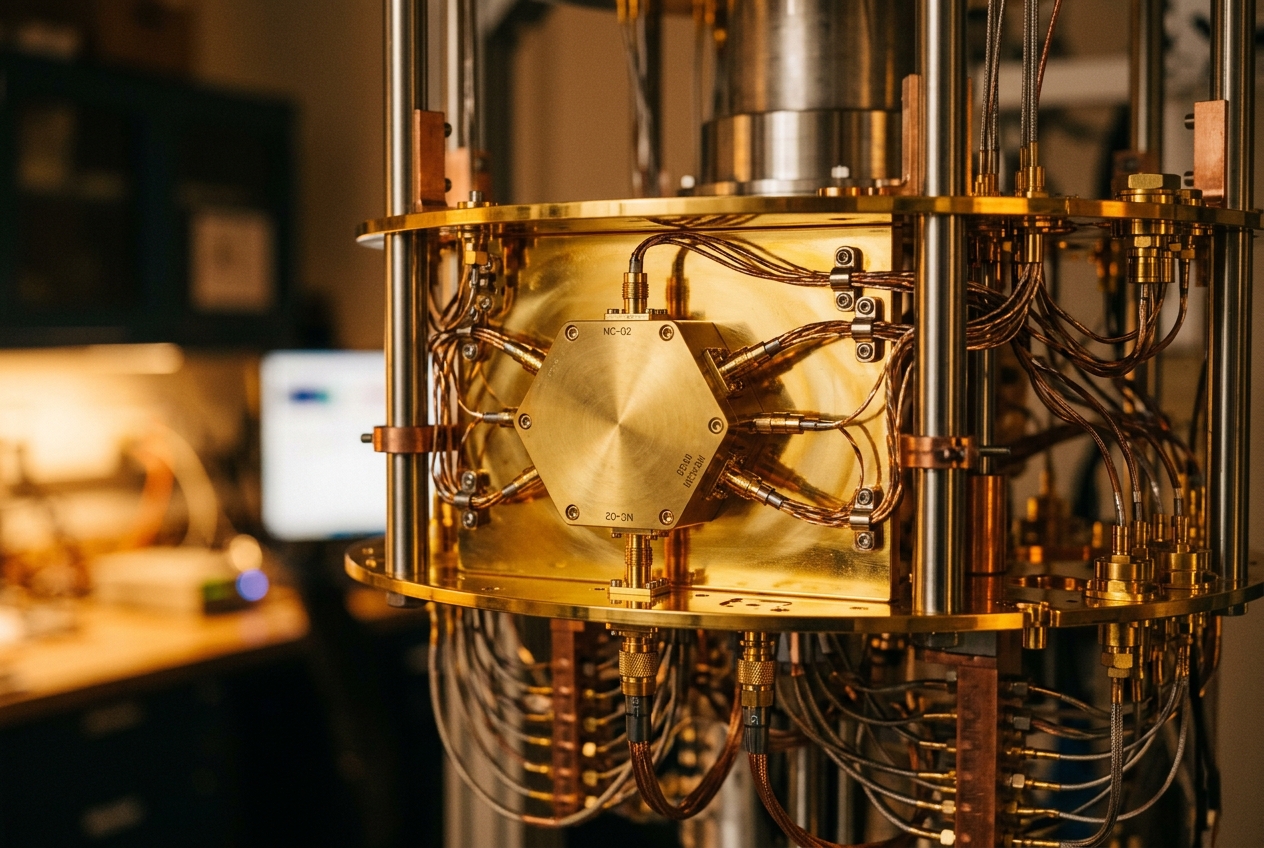
Superconducting quantum computers require massive dilution refrigerators cooled to millikelvin temperatures—colder than deep space. Wiring thousands of coaxial cables into a cryostat to drive complex four-body stabilizer measurements creates immense thermal load and electrical complexity. Because Floquet codes require only nearest-neighbor, two-body checks, they drastically reduce the physical cabling and control electronics required per logical qubit. This directly translates to smaller, more energy-efficient cryogenic footprints, transforming quantum computers from multi-million-dollar laboratory curiosities into commercially deployable enterprise infrastructure.
6. Today's Takeaway
Quantum error correction does not require our machines to hold fragile quantum states rigid and motionless against the tide of environmental noise. By choreographing a rhythmic, periodic cycle of simple two-qubit measurements, Floquet codes prove that quantum information can be dynamically preserved within a moving topological dance—vastly simplifying physical hardware and charting an accelerated, fault-tolerant path to the quantum computing era.
Further Reading & Authoritative Resources
- MIT OpenCourseWare: Quantum Physics and Quantum Computation Modules
- Nature: Realizing Fault-Tolerant Quantum Error Correction Protocols
- IBM Quantum: Fundamentals of Quantum Error Mitigation and Correction
- Wikipedia: Quantum Error Correction and Topological Stabilizer Codes
- arXiv Quantum Physics: Original Hastings-Haah Honeycomb Code Formulations