Quantum Fingerprinting: Exponentially Reducing Communication Complexity Via Coherent State Overlaps
Every second of every day, the global digital economy performs a deceptively simple mathematical chore: asking whether two massive silos of data are identical. When distributed cloud databases replicate financial transactions across continents, when high-frequency trading platforms reconcile redundant ledgers, or when biometric databases verify identity credentials against international registries, two distant servers must confirm that their datasets match bit for bit.
In our classical world, this routine operation runs into a brutal physical ceiling known as communication complexity. If two servers cannot talk directly to one another and share no secret cryptographic keys in advance, confirming whether their multi-gigabyte files are identical requires them to transmit hundreds of thousands of bits to an independent arbiter. As global data sets expand toward the zettabyte scale, the physical energy and network bandwidth consumed simply by shuttling verification data across the internet threatens to throttle the expansion of distributed computing.
Quantum mechanics offers an astonishing exit from this bottleneck. By encoding digital information not into electrical pulses or classical radio waves, but into the delicate quantum states of individual photons, two servers can prove their records match by transmitting a message so infinitesimally small it borders on mathematical magic. Where classical information theory demands messages whose size scales with the square root of the file length, quantum physics requires only a handful of subatomic particles whose quantity scales logarithmically. A file containing billions of bits can be verified using a quantum message containing barely a few dozen quantum bits. This is the promise of quantum fingerprinting—a foundational protocol that redefines the thermodynamic and mathematical limits of distributed communication.
2. The Idea in Plain English
To understand why this quantum capability is revolutionary, consider an intuitive analogy: comparing two colossal architectural sculptures located in different cities without photographing or transporting them.
Imagine Alice in London and Bob in Tokyo each possess an intricate, multi-ton marble statue carved with millions of microscopic geometric facets. They wish to verify whether their statues are identical replicas. However, they cannot speak to each other directly, nor do they share a pre-arranged secret codebook. Instead, they must each send a lightweight postal package to an impartial referee, Charlie, stationed in Geneva.
       +------------------+                 +------------------+
       |   Alice (Data x) |                 |    Bob (Data y)  |
       +--------+---------+                 +---------+--------+
                |                                     |
                |  Quantum Fingerprint |\psi_x>       |  Quantum Fingerprint |\psi_y>
                |  Size: O(log n) qubits              |  Size: O(log n) qubits
                |                                     |
                +-----------------> + <---------------+
                                    |
                           +--------v--------+
                           | Charlie (Referee)|
                           |    [SWAP TEST]  |
                           +--------+--------+
                                    |
                    +---------------+---------------+
                    |                               |
             Outcome: 0                      Outcome: 1
       (Files Match with Cert.)        (Files Differ with High Prob.)
In the classical world, Alice and Bob could chisel off a few thousand tiny marble chips from various coordinates and mail them to Charlie. But if they pick coordinates independently without shared randomness, they risk missing localized differences unless they send a massive crate of chips. Classical mathematics proves that to have any reasonable confidence, the number of chips they must send must grow substantially as the statue becomes more detailed.
In the quantum world, Alice and Bob do not send physical chips of stone. Instead, they shine a laser through their statues, sculpting the wavefront of light so that every microscopic facet of the statue imparts a subtle phase shift onto the beam. Alice and Bob each send this single, exquisitely structured pulse of light to Charlie.
When the two light pulses arrive in Geneva, Charlie does not attempt to reconstruct the statues or measure the exact shape of the waves. Instead, he guides the two beams into an optical interferometer—a beam splitter where the waves collide. If the two statues are identical, the light waves interfere destructively at one exit port, leaving that detector completely dark. If the statues differ by even a single facet, the symmetry breaks: light leaks through the dark port, triggering a sensor click that immediately announces a discrepancy. Alice and Bob have proven their statues differ without Charlie ever learning what either statue looks like, and they did so by sending a signal of negligible physical volume.
3. How It Actually Works — The Mechanics
The rigorous study of this phenomenon sits at the intersection of information theory, abstract algebra, and quantum optics. In theoretical computer science, this communication architecture is formalized as the Simultaneous Message Passing (SMP) model. In this framework, two parties (Alice holding an $n$-bit string $x$, and Bob holding an $n$-bit string $y$) send independent, simultaneous messages to a central referee (Charlie), whose sole objective is to compute a Boolean function—here, the equality function, which outputs $1$ if $x = y$ and $0$ if $x \neq y$. Alice and Bob cannot communicate bidirectionally, nor do they possess shared random keys.
The Classical Deadlock: Newman and Szegedy's Bound
In classical information theory, if Alice and Bob are allowed shared randomness (such as a synchronized public coin toss), equality testing is trivial: they can use the shared randomness to compute a concise randomized hash of $O(1)$ bits. However, in the strict SMP model without shared randomness, classical deterministic and private-coin protocols are severely constrained.
In a landmark paper, mathematicians Ilan Newman and Mario Szegedy established a fundamental classical lower bound for equality testing in the private-coin SMP model. Their theorem proves that any classical protocol deciding equality with bounded error requires Alice and Bob to transmit a message size that scales asymptotically as $\Omega(\sqrt{n})$ bits. Intuitively, because Alice and Bob cannot coordinate their sampling positions, their independent message distributions must maintain sufficient statistical overlap across the entire $n$-bit configuration space, forcing the total communication to scale quadratically higher than the information-theoretic minimum.
The Quantum Breakthrough: Exponential Compression via Hilbert Spaces
In 2001, physicists and computer scientists Harry Buhrman, Richard Cleve, John Watrous, and Ronald de Wolf demonstrated that quantum mechanics completely breaks the Newman-Szegedy classical barrier. They proved that in the exact same zero-shared-randomness SMP setting, equality can be verified with bounded error using quantum messages of only $O(\log n)$ qubits—an exponential reduction in communication complexity.
To construct this quantum fingerprint, Alice and Bob first map their classical $n$-bit strings into robust codewords using classical error-correcting codes, such as Reed-Solomon error correction or asymptotically good Justesen codes. This classical preprocessing step maps an $n$-bit string $x$ to an $m$-bit codeword $C(x) = (w_1, w_2, \dots, w_m)$, where the codeword length $m = c \cdot n$ for a constant $c > 1$. Crucially, these codes guarantee that if two original inputs $x$ and $y$ differ by even a single bit, their resulting codewords will differ in at least a constant fraction $\delta$ of their positions, meaning their normalized Hamming distance satisfies $d_H(C(x), C(y)) \ge \delta$.
Alice and Bob then map their respective codewords into a quantum superposition across the basis states of a $k$-qubit Hilbert space, where the number of qubits is logarithmic with respect to the codeword length: $k = \lceil \log_2 m \rceil = O(\log n)$. The quantum fingerprint state for string $x$ is defined as:
$$\vert\psi_x\rangle = \frac{1}{\sqrt{m}} \sum_{k=1}^m (-1)^{w_k} \vert k \rangle$$
Because the basis states are orthonormal, the mathematical inner product between Alice's fingerprint state and Bob's fingerprint state directly mirrors the geometric distance between their error-correcting codewords:
$$\langle\psi_x\vert\psi_y\rangle = \frac{1}{m} \sum_{k=1}^m (-1)^{w_k \oplus v_k} = 1 - \frac{2 d_H(C(x), C(y))}{m}$$
If the inputs are identical ($x = y$), the codewords are identical, yielding an inner product of exactly $1$. If the inputs differ ($x \neq y$), the minimum Hamming distance guaranteed by the error-correcting code bounds the absolute value of the inner product strictly below unity:
$$\vert\langle\psi_x\vert\psi_y\rangle\vert \le 1 - 2\delta$$
Thus, the exponential dimensionality of the quantum state space allows Alice and Bob to map classical strings into nearly orthogonal quantum state vectors using only a logarithmic number of qubits.
       ===============================================================
                          THE QUANTUM SWAP TEST CIRCUIT
       ===============================================================

       Ancilla |0> ---[ H ]-------*-------[ H ]--- ( Measure Ancilla )
                                  |
       Alice |\psi_x> -----------[X]------------- ( Discard / Trace Out )
                                  |
       Bob   |\psi_y> -----------[X]------------- ( Discard / Trace Out )
                               (c-SWAP)

       ===============================================================
The Swap Test: Quantum Interferometry as a Truth Machine
Once Charlie receives the $O(\log n)$-qubit fingerprint states $\vert\psi_x\rangle$ and $\vert\psi_y\rangle$, he must compare them without measuring—and thus destroying—their individual phases. He achieves this by executing a SWAP test, an elegant quantum circuit that acts as an interferometer for arbitrary quantum states.
Charlie prepares an ancillary qubit initialized in the ground state $\vert 0 \rangle$, applies a Hadamard gate to create an equal superposition, and executes a controlled-SWAP gate that exchanges Alice's and Bob's state registers conditioned on the ancilla. After applying a second Hadamard gate to the ancilla, Charlie measures the ancilla in the standard computational basis. The probability of measuring the ancilla in the excited state $\vert 1 \rangle$ is given by:
$$\mathbb{P}(\text{Ancilla} = \vert 1 \rangle) = \frac{1}{2} \left(1 - \vert\langle\psi_x\vert\psi_y\rangle\vert^2\right)$$
The behavior of this measurement yields a bounded one-sided error protocol: 1. Completeness (Identical Inputs): If $x = y$, then $\vert\psi_x\rangle = \vert\psi_y\rangle$, which implies $\vert\langle\psi_x\vert\psi_y\rangle\vert = 1$. The probability of measuring $\vert 1 \rangle$ is strictly zero. Charlie never mistakenly declares identical strings to be different. 2. Soundness (Distinct Inputs): If $x \neq y$, then $\vert\langle\psi_x\vert\psi_y\rangle\vert \le 1 - 2\delta$. The probability of measuring $\vert 1 \rangle$ is strictly bounded away from zero: $\mathbb{P}(\text{Ancilla} = \vert 1 \rangle) \ge 2\delta(1 - \delta) > 0$.
If Charlie measures $\vert 1 \rangle$ even once, he is mathematically certain that $x \neq y$. By transmitting a small constant number of independent fingerprint copies, the probability of false acceptance decays exponentially toward zero.
+------------------------------------------------------------------------------------+
|                         SUMMARY: COMMUNICATION COMPLEXITY                          |
+------------------------------------------------------------------------------------+
|  Model Configuration               | Classical Bound       | Quantum Bound         |
+------------------------------------+-----------------------+-----------------------+
|  SMP (Shared Randomness)           | O(1) bits             | O(1) qubits           |
|  SMP (No Shared Randomness)        | \Omega(\sqrt{n}) bits | O(log n) qubits       |
+------------------------------------------------------------------------------------+
|  Result: Exponential quantum advantage in the simultaneous message passing model. |
+------------------------------------------------------------------------------------+
Continuous Variables and Linear Optics: The Arrazola–Lütkenhaus Architecture
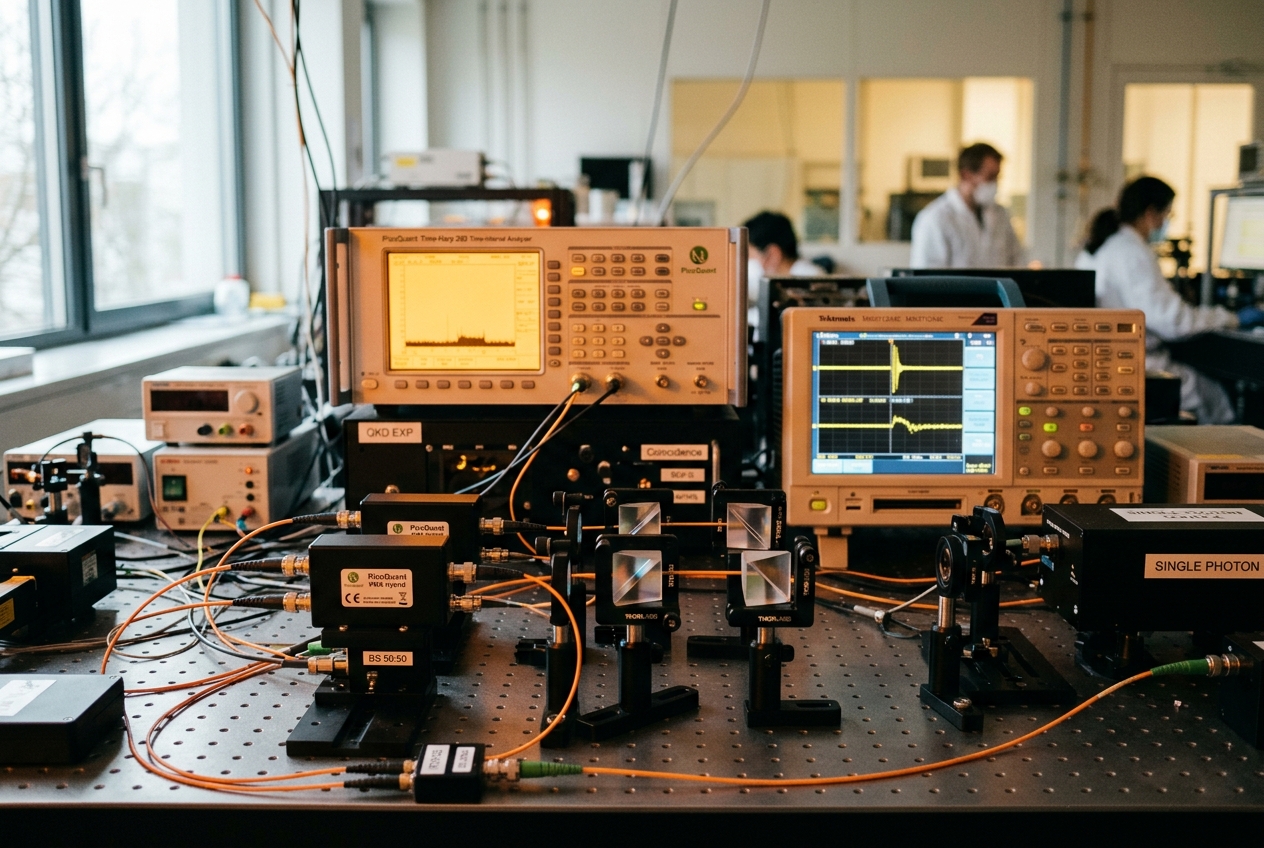
While discrete-qubit fingerprints are theoretically optimal, generating entangled multi-qubit superpositions of length $O(\log n)$ presents formidable experimental challenges. In a foundational theoretical advancement, physicists Juan Miguel Arrazola and Norbert Lütkenhaus developed a practical continuous-variable quantum fingerprinting model based on coherent states and linear optics.
In the Arrazola–Lütkenhaus paradigm, Alice and Bob do not generate complex discrete superpositions. Instead, they emit sequences of optical coherent states $|\alpha_k\rangle$ across $m$ sequential time bins using standard telecommunication diode lasers. The bit values of their classical error-correcting codewords are encoded directly into the optical phases ($0$ or $\pi$) of weak coherent pulses:
$$\vert\alpha_x\rangle = \bigotimes_{k=1}^m \left\vert \frac{\mu}{\sqrt{m}} (-1)^{w_k} \right\rangle$$
where $\mu$ represents the total mean photon number across the entire multi-pulse fingerprint.
       ===============================================================
               CONTINUOUS-VARIABLE OPTICAL FINGERPRINTING SETUP
       ===============================================================

       Alice Laser ===[ Phase Modulator ]===> [ Pulse Train |\alpha_x> ] ---\
                                                                             \
                                                                        [ 50:50 BS ]
                                                                             /
       Bob Laser   ===[ Phase Modulator ]===> [ Pulse Train |\alpha_y> ] ---/
                                                                             |
                                                            +----------------+----------------+
                                                            |                                 |
                                                     [ Bright Port ]                   [ Dark Port ]
                                                     (Constructive)                    (Destructive)
                                                            |                                 |
                                                    [ Detector D1 ]                   [ Detector D2 ]
                                                                                  (Clicks indicate x \neq y)

       ===============================================================
In this architecture, Charlie's complex controlled-SWAP gate is replaced by a standard $50:50$ optical beam splitter followed by two single-photon avalanche photodiodes (SPADs) or superconducting nanowire single-photon detectors (SNWPDs). When Alice's and Bob's coherent pulse trains interfere simultaneously at the beam splitter: * If $x = y$, identical optical phases enter both input ports at every time bin. Destructive quantum interference completely cancels photon emission at the asymmetric output (the "dark port"). * If $x \neq y$, phase mismatches between differing codeword indices destroy perfect destructive interference. Photons leak into the dark port, triggering detector clicks.
Real-World Decoherence: Fiber Attenuation, Dark Counts, and Phase Noise
Translating this optical protocol to real-world fiber networks requires accounting for physical noise mechanisms that degrade the error exponents: 1. Optical Fiber Attenuation: Transmitted photons experience exponential loss governed by the fiber attenuation coefficient $\gamma \approx 0.2\text{ dB/km}$ at the standard $1550\text{ nm}$ telecom window. Channel transmission over distance $L$ scales as $\eta = 10^{-\gamma L / 10}$. As optical power decays, the effective mean photon number arriving at Charlie's beam splitter diminishes, reducing the probability of triggering dark-port clicks when strings differ. 2. Detector Dark Counts: Real-world single-photon detectors exhibit false-positive thermal or tunneling events ("dark counts") occurring at rate $p_{\text{dark}}$. A dark count at the dark port during an identical comparison ($x = y$) causes Charlie to falsely conclude that the strings differ, creating a two-sided error profile that must be mitigated by setting strict statistical thresholds on total click counts. 3. Interferometric Phase Drift: Temperature fluctuations and mechanical acoustic vibrations along separate optical fiber links induce fluctuating phase shifts $\Delta \theta(t)$ between Alice’s and Bob’s pulses. If phase drift is uncompensated, identical input pulses arrive out of phase, destroying destructive interference at the dark port. State-of-the-art implementations must deploy active phase-locking loops and round-trip time-bin calibration pulses to stabilize optical paths.
4. Real-World Applications Today
The unique capacity of quantum fingerprinting to verify massive distributed datasets with microscopic communication payloads has transitioned from mathematical theory into active experimental development across research institutions and technology leaders between 2024 and 2026.
       +------------------------------------------------------------------------------------+
       |                    QUANTUM FINGERPRINTING: FRONTIER APPLICATIONS                   |
       +------------------------------------------------------------------------------------+
       |  DOMAIN                           | LEADING INSTITUTIONS   | QUANTUM ADVANTAGE     |
       +-----------------------------------+------------------------+-----------------------+
       |  Distributed Cloud Synchronization| IBM Quantum, Qiskit    | Sub-logarithmic data  |
       |                                   | Consortium             | transmission payload  |
       +-----------------------------------+------------------------+-----------------------+
       |  Metropolitan Fiber Verification  | Toshiba Europe, Univ.  | Terabit verification  |
       |                                   | of Toronto, MPQ        | over deployed telecom |
       +-----------------------------------+------------------------+-----------------------+
       |  Zero-Knowledge Cryptographic     | Quantinuum, Cambridge  | Privacy-preserving    |
       |  Auditing                         | Quantum Alliances      | integrity validation  |
       +-----------------------------------+------------------------+-----------------------+
       |  Foundational Complexity Testing  | MIT Center for         | Scalable benchmarks   |
       |                                   | Theoretical Physics    | for quantum supremacy |
       +-----------------------------------+------------------------+-----------------------+
1. Ultra-Low-Bandwidth Distributed Cloud Synchronization
- Institutions: IBM Quantum and the open-source Qiskit research ecosystem.
- Objective: Synchronizing distributed quantum and classical state tables across multi-node cloud clusters.
- Quantum Advantage: In high-performance distributed computing, cross-node interconnect bandwidth is a persistent bottleneck. Engineering teams are leveraging quantum fingerprinting primitives to verify whether petabyte-scale data blocks stored in disparate cloud repositories remain synchronized after background maintenance, requiring only a fraction of the network traffic demanded by classical checksum broadcasts.
2. Metropolitan Quantum Network Integrity Verification
- Institutions: Toshiba Cambridge Research Laboratory, University of Toronto, and the Max Planck Institute for the Science of Light.
- Objective: Verifying massive data streams across deployed commercial telecom optical fiber testbeds.
- Quantum Advantage: Research teams published in Nature have experimentally demonstrated continuous-variable quantum fingerprinting across metropolitan fiber links spanning tens of kilometers. By employing phase-encoded weak coherent pulses and superconducting detectors, these systems verified megabit-to-gigabit data streams using significantly less transmitted energy and fewer transmitted photons than classical physical limits allow.
3. Zero-Knowledge Cryptographic Integrity Auditing
- Institutions: Quantinuum in collaboration with European cryptographic consortia.
- Objective: Verifying the consistency of sensitive distributed ledgers, medical databases, and biometric registers without revealing underlying data.
- Quantum Advantage: Quantum fingerprinting naturally provides cryptographic privacy. Because Charlie measures only an interference pattern rather than the quantum state's individual bit assignments, he learns strictly whether the datasets match or differ. The referee gains zero insight into the underlying content of either file, enabling zero-knowledge audits for highly classified datasets.
4. Foundational Quantum Communication Benchmarking
- Institutions: MIT OpenCourseWare Quantum Physics faculty, the MIT Center for Theoretical Physics, and Caltech's Institute for Quantum Information and Matter.
- Objective: Experimentally benchmarking quantum communication supremacy against classical lower bounds.
- Quantum Advantage: Communication complexity protocols provide one of the cleanest theoretical platforms for proving quantum advantage. Unlike quantum computational supremacy experiments that rely on unproven computational complexity conjectures (such as $P \neq NP$), the quantum fingerprinting advantage is provable against the unconditional classical lower bounds cataloged in the arXiv Quantum Physics archive. Academic researchers use these systems as gold-standard benchmarks for linear-optical quantum processors.
5. What This Means for You
It is easy to view quantum communication as an esoteric pursuit reserved for academic physicists and specialized defense contractors. Yet the physical principles governing quantum fingerprinting directly address the silent crisis underpinning our modern digital lives: the staggering energetic and infrastructural cost of moving data.
Every time you stream high-definition media, execute a digital banking transfer, or access cloud storage, vast server farms engage in continuous data duplication and verification loops. Modern data centers consume nearly two percent of the world’s total electricity, and a substantial fraction of that power is expended not on processing calculations, but on shuttling verification bits across copper lines and fiber trunks. By demonstrating that data verification can occur over a logarithmic number of quantum states rather than polynomial classical transmissions, quantum fingerprinting outlines a future where the communication overhead of global data synchronization collapses to near-zero.
       ===============================================================
                CLASSICAL VS. QUANTUM DATA TRANSMISSION SCALING
       ===============================================================

       Message Size
           ^
           |                                  Classical: \Omega(\sqrt{n})
           |                                     /
           |                                    /
           |                                   /
           |                                  /
           |                                 /
           |                                /
           |  Quantum: O(log n)            /
           |  ----------------------------/-------------------->
           +-------------------------------------------------------->
           0                                                File Size (n)

       ===============================================================
Furthermore, this technology establishes a new paradigm for personal digital privacy. In an era where centralized entities demand access to private data for identity verification, fraud detection, and background screening, quantum fingerprinting offers a mathematical guarantee of zero-knowledge validation. An individual could verify that their private genetic sequence, biometric profile, or cryptographic credential matches an authorized clearance list held by a border authority or financial institution, without transmitting their actual record, without exposing their data to interception, and without allowing the verifying party to store or read their personal information.
6. Today's Takeaway
Quantum fingerprinting shatters the classical limits of communication by proving that verifying whether two vast datasets are identical does not require transmitting the data itself, but rather comparing the interference patterns of their quantum shadows; where classical physics inescapably demands messages scaling with the square root of the file size, quantum mechanics accomplishes the exact same task with logarithmic elegance, transforming an intractable communication bottleneck into a few dozen whispering photons.
Further Reading & Authoritative References
- Buhrman, H., Cleve, R., Watrous, J., & de Wolf, R. (2001): Quantum Fingerprinting. Physical Review Letters, arXiv:quant-ph/0102001.
- Communication Complexity Theory: Wikipedia: Communication Complexity.
- Experimental Linear-Optical Verification: Nature Communications: Experimental Quantum Fingerprinting.
- Quantum Computational Paradigms: IBM Quantum Learning & Research.
- Foundational Quantum Physics: MIT OpenCourseWare — Quantum Information Science.