Erasure Qubits: Converting Dominant Physical Noise Into Detectable Erasures for High-Threshold Fault Tolerance
1. Opening Hook — Why You Should Care
Every transaction safeguarding the modern digital economy—from global financial transfers and classified state communications to the private medical records stored in your local clinic—rests upon mathematical barricades that classical supercomputers cannot tear down within the lifetime of the universe. Yet a fault-tolerant quantum computer could dissolve these cryptographic barriers in mere hours. More tantalisingly, the same underlying physics could unlock room-temperature superconductors, map complex enzyme mechanisms to cure intractable diseases, and discover catalyst materials to slash the energy footprint of industrial nitrogen fixation.
For three decades, humanity has found itself trapped in an agonizing engineering bottleneck. Quantum information is notoriously delicate. Stray thermal vibrations, electromagnetic fluctuations, and the fleeting decay of atomic states inevitably spoil the fragile superpositions that empower quantum computation. In conventional architectures, shielding a quantum algorithm from ambient noise demands an overwhelming tax: up to 10,000 physical quantum bits (qubits) must be chained together merely to construct a single, reliable "logical" qubit.
A radical paradigm known as erasure qubits has shattered these pessimistic projections. Rather than treating quantum errors as invisible hazards that strike without warning, scientists at leading institutions across the globe have engineered atomic and superconducting systems that force physical noise to confess its location the instant it occurs. By converting insidious quantum corruption into heralded erasure events, researchers have raised error-tolerance thresholds by more than fourfold and slashed physical hardware requirements by nearly an order of magnitude. The race toward practical quantum advantage has suddenly lurched from a distant multi-decade horizon into immediate engineering reach.
2. The Idea in Plain English
To appreciate the elegance of erasure conversion, consider a familiar non-quantum analogy: an investigative mystery.
Imagine you are an archivist managing a library of ancient manuscripts. In a standard quantum computer, environmental noise acts like an invisible saboteur who sneaks into the archives and alters individual letters—turning an "A" into an "E" or subtly flipping the punctuation. When you read the manuscript later, you know the text is corrupted, but you have no clue which pages or lines were tampered with. To locate and fix the sabotage, you must run exhaustive, mathematically intensive cross-referencing algorithms across thousands of duplicate scrolls.
Now imagine a different library where the ink is chemically engineered to release a distinct crimson smoke the microsecond it degrades. If a manuscript page begins to fade or corrupt, a sensor trips, sounding an alarm and pinpointing the exact page and paragraph that suffered damage. The archivist no longer has to guess where the error happened; the damaged parchment openly announces itself.
+-------------------------------------------------------------------------------+
|                           THE ARCHIVIST'S PARADOX                             |
|                                                                               |
|  Standard Pauli Error:     "A letter changed somewhere in the 500-page book." |
|                            -> Requires massive redundancy to locate & repair. |
|                                                                               |
|  Heralded Erasure Error:   "Page 42, line 17 just triggered the smoke alarm." |
|                            -> Location known; simple replacement suffices.    |
+-------------------------------------------------------------------------------+
In the realm of quantum physics, information is stored within the states of quantum particles. Standard quantum noise produces what physicists call Pauli errors: - Bit-flips ($X$): The quantum state flips between its binary states, exchanging $0$ and $1$. - Phase-flips ($Z$): The quantum relative phase shifts by 180 degrees without changing the classical state values. - Combined bit-and-phase-flips ($Y$): Both corruptions happen simultaneously.
Because quantum measurement destroys superpositions, you cannot directly inspect a standard qubit to check if a Pauli error has corrupted it. Instead, you must infer the presence of noise through indirect measurements known as syndrome extractions.
An erasure error, by contrast, occurs when the qubit leaks out of its computational playground into an auxiliary, non-computational state, or when a photon is lost from an optical cavity. Crucially, physicists can shine a probe beam or microwave tone on the system that answers a simple binary question: "Did the qubit leak out of its computational boundaries?"
If the answer is yes, the qubit is flagged as "erased." If the answer is no, the quantum information inside the qubit continues its delicate dance completely unharmed. Knowing the exact coordinate of the corrupted site transforms a bewildering 2D puzzle into a trivial 1D reconstruction task.
3. How It Actually Works — The Mechanics
The fundamental mathematics of quantum error correction explains why this simple distinction between unknown errors and known erasures produces such an astonishing practical advantage.
The Information-Theoretic Advantage
Consider sending quantum data across an imperfect communication line. If the line suffers from random, unlocated Pauli errors with probability $p$, every single error introduces two unknowns: where the error occurred and whether it was a bit-flip, a phase-flip, or both. Claude Shannon's classical information theory and its quantum extensions, accessible via MIT OpenCourseWare Quantum Information Science, establish the ultimate capacity of such noisy channels.
For an unheralded Pauli depolarizing channel, the quantum channel capacity degrades rapidly because the error syndrome must consume valuable quantum redundancy simply to discover the error’s position. However, for a quantum erasure channel where every error is flagged with an unmistakable macroscopic signal, the error location is already known with certainty. The channel capacity formulas capture this stark divergence:
$$\mathcal{C}{\text{erasure}}(p) = 1 - p \quad \text{versus} \quad \mathcal{C}{\text{Pauli}}(p) \approx 1 - 2p$$
When you already know the error's coordinates, you only need to reconstruct the erased value, rather than expending mathematical entropy to locate the fault.
This information-theoretic edge directly translates to topological surface codes—the leading blueprint for building fault-tolerant quantum hardware. In a standard surface code governed by blind Pauli noise, the fault-tolerant threshold hovers around $1.0\%$. If physical hardware exhibits error rates above this critical threshold, adding more physical qubits actually degrades logical reliability.
When dominant physical faults are converted into erasures, the fault-tolerant threshold climbs to unprecedented heights:
$$p_{\text{threshold}}^{\text{erasure}} \approx 4.1\% \gg p_{\text{threshold}}^{\text{Pauli}} \approx 1.0\%$$
By raising the allowable error tolerance to over $4\%$, experimentalists gain the breathing room necessary to build working logical qubits without demanding unattainable physical manufacturing tolerances.
Physical Implementations & Erasure Conversion
How do physicists force physical quantum systems to reveal their errors without collapsing their computational state? Two leading hardware platforms—neutral atom arrays and superconducting circuits—have pioneered distinct, beautiful physical solutions.
1. Neutral Atom Architectures (Alkaline-Earth Atoms)
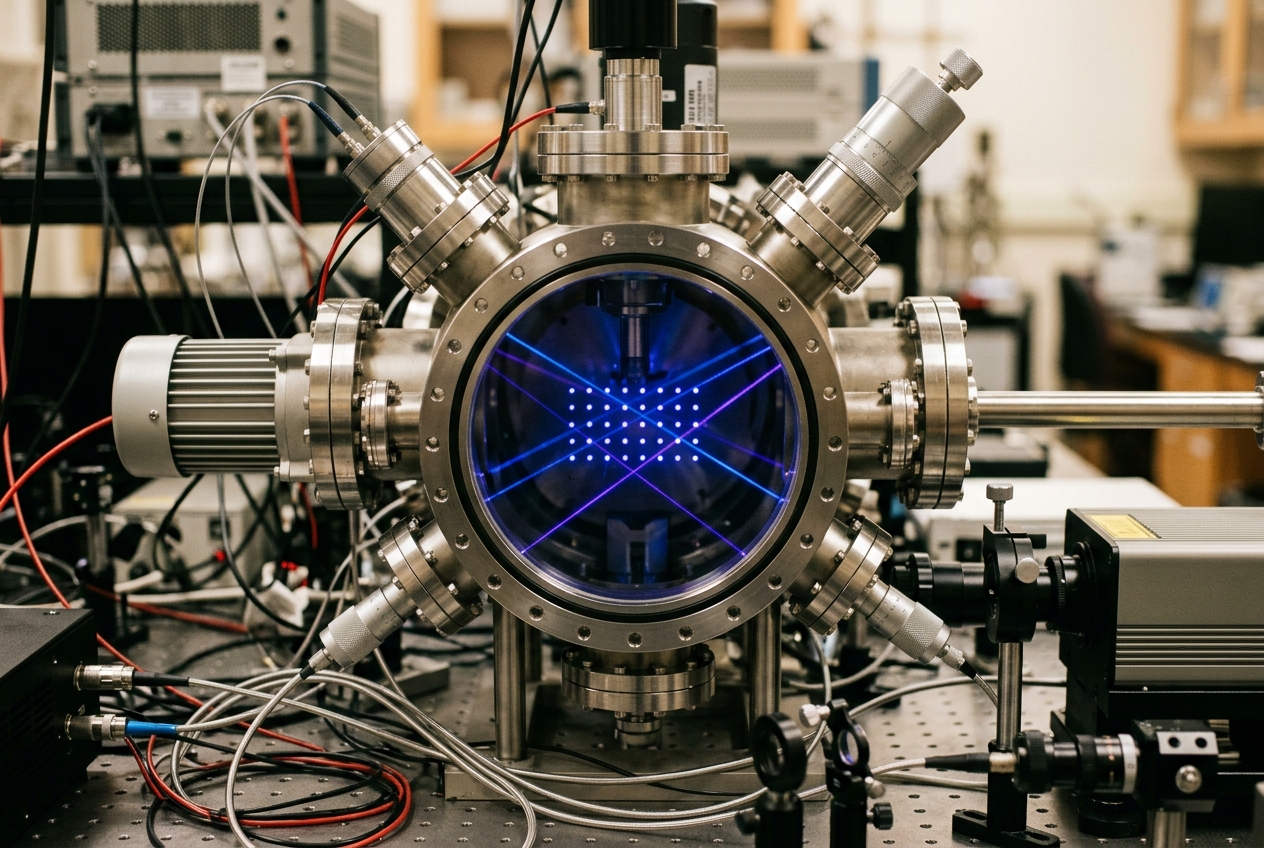
Neutral atom quantum processors trap individual atoms in microscopic arrays of laser light known as optical tweezers. Instead of using standard alkali atoms like rubidium, erasure qubit architectures exploit the intricate internal energy levels of alkaline-earth-like atoms such as Ytterbium-171 ($^{171}\text{Yb}$) and Strontium-88 ($^{88}\text{Sr}$).
In $^{171}\text{Yb}$, the nuclear spin ($I = 1/2$) provides an exceptionally clean two-level quantum system isolated from ambient magnetic noise. Scientists encode the logical qubit inside the nuclear spin sublevels of the long-lived metastable state $^{3}\text{P}_0$, often termed the "clock state."
When environmental noise or laser fluctuations perturb an atom during two-qubit Rydberg gate operations, the atom does not experience a random, undetectable spin-flip within the $^{3}\text{P}_0$ manifold. Instead, the primary physical error mechanism causes the atom to spontaneously decay or leak out into the electronic ground state $^{1}\text{S}_0$.
To detect this error, experimentalists shine a resonant laser tuned precisely to an optical cycling transition connected exclusively to the $^{1}\text{S}_0$ ground state. If the atom has leaked into the ground state, it rapidly absorbs and re-emits thousands of photons, lighting up brightly on an ultra-sensitive camera. If the atom remained safely in the $^{3}\text{P}_0$ computational manifold, it is completely invisible to this probing laser. The uncorrupted quantum superposition remains entirely intact, while the defective atom broadcasts an unmistakable optical flare.
2. Superconducting Circuits (Dual-Rail Cavities)
In the realm of superconducting quantum circuits, pioneering teams at Yale, Princeton, and the AWS Center for Quantum Computing have achieved erasure conversion using dual-rail bosonic cavities.
A conventional transmon qubit encodes $0$ and $1$ in the fundamental energy levels of an artificial atom made from superconducting aluminium junctions. Unfortunately, energy loss (amplitude damping, where a state $|1\rangle$ drops to $|0\rangle$) looks identical to a genuine computational bit-flip.
In a dual-rail system, researchers couple two separate microwave resonator cavities. The logical qubit is defined by sharing exactly one single photon across the two cavities:
$$|0_L\rangle = |1, 0\rangle \quad \text{and} \quad |1_L\rangle = |0, 1\rangle \quad \xrightarrow{\text{Single-Photon Loss}} \quad |0, 0\rangle$$
If environmental loss strikes the system, the single photon leaks into the environment, dropping the entire system into the unpopulated vacuum state $|0, 0\rangle$. Because $|0, 0\rangle$ is mathematically orthogonal to both $|0_L\rangle$ and $|1_L\rangle$, an auxiliary transmon qubit can perform a non-demolition dispersive microwave readout to verify whether total photon number $n = 1$.
If the readout detects $n = 0$, the system flags an erasure error at that exact cavity pair. If $n = 1$, the quantum coherence between $|1, 0\rangle$ and $|0, 1\rangle$ is left unperturbed. Once again, catastrophic energy relaxation is converted into a benign, heralded erasure flag.
Decoder Integration & The Percolation Advantage
Detecting an erasure flag is only the first half of the battle; the quantum classical control system must use that knowledge to correct the algorithm in real time.
In a standard topological surface code, syndrome data from periodic parity checks forms a three-dimensional space-time graph where vertices represent error detection events and edges represent possible underlying physical faults. Classical decoding algorithms—such as Minimum-Weight Perfect Matching (MWPM) or the linear-time Union-Find decoder—must solve a complex graph-matching problem to determine the most probable chains of undetected Pauli errors that connected those vertices.
When erasure flags are integrated into the decoding graph: 1. Edge Erasure Pruning: Every time a physical qubit flags an erasure, the corresponding edge weight in the decoding graph is set to zero or pruned entirely. 2. Dimensional Reduction: Removing erased edges breaks the dense, interconnected 2D space-time decoding web into isolated, one-dimensional linear percolation segments. 3. Sub-Microsecond Latency: The decoder no longer needs to solve a global optimization problem across the entire chip. It performs simple local path-checks along the known erasure paths.
This structural transformation allows classical decoders to run fast enough to keep pace with the microsecond cycle times of actual quantum hardware, preventing the dreaded "decoding backlog" that threatened to stall early quantum computer prototypes.
4. Real-World Applications Today (2024–2026)
The transition from theoretical proof to physical realization has unfolded at astonishing speed. Leading industrial laboratories and academic centers are actively applying erasure architectures to overcome historic quantum bottlenecks.
+-----------------------------------------------------------------------------------------+
|                        FRONTIER ERASURE QUBIT IMPLEMENTATIONS                           |
+---------------------------+------------------------+------------------------------------+
| Institution / Group       | Hardware Platform      | Milestone / Quantum Advantage      |
+---------------------------+------------------------+------------------------------------+
| Harvard & QuEra Computing | Neutral Atoms (171-Yb) | >98% Erasure conversion;           |
|                           |                        | fault-tolerant transversal gates   |
| Princeton & AWS Quantum   | Dual-Rail Supercond.   | 10x reduction in physical transmon |
|                           | Cavities               | footprint per logical qubit        |
| Molecular Simulation      | Bosonic & Neutral-Atom | FeMoco enzyme catalyst simulation  |
| Consortia                 | Hybrid Codes           | viable with <100,000 total qubits  |
| Post-Quantum Security     | Fault-Tolerant Surface | Accelerated timeline for running   |
| Working Groups            | Code Roadmaps          | Shor's algorithm on RSA-2048       |
+---------------------------+------------------------+------------------------------------+
1. Neutral Atom Quantum Processors (Harvard, MIT, & QuEra Computing)
In research published across Nature and leading peer-reviewed journals, collaborative teams from Harvard University, MIT, and QuEra Computing demonstrated arrays of hundreds of neutral $^{171}\text{Yb}$ atoms where over $98\%$ of Rydberg excitation errors were converted into detectable erasures. By leveraging real-time optical fluorescence measurements, the team demonstrated transversal non-Clifford gates on fault-tolerant logical qubits, demonstrating that erasure architectures can execute deep computational circuits with vastly reduced code distances.
2. Dual-Rail Superconducting Cavities (Princeton University & AWS Quantum)
At the AWS Center for Quantum Computing, in partnership with Princeton University, researchers constructed dual-rail superconducting resonators that convert dominant single-photon loss into heralded vacuum flags. Detailed in Physical Review X, this hardware architecture proved that logical qubits formed from dual-rail microwave cavities require an order of magnitude fewer physical control lines and cryostat coaxial cables compared to brute-force transmon grids. This advance directly addresses the thermal load bottleneck inside dilution refrigerators.
3. High-Performance Quantum Chemistry & Nitrogen Fixation
One of the grandest prizes in modern computational chemistry is simulating the active catalytic center of nitrogenase—the iron-molybdenum cofactor (FeMoco)—which bacteria use to produce ammonia at ambient temperatures and pressures. Classical supercomputers cannot accurately model the strongly correlated electron orbitals of FeMoco.
Previous fault-tolerant blueprints estimated that simulating FeMoco would require upwards of 4 million physical qubits running surface codes for days. With erasure-based neutral atom and dual-rail architectures, updated algorithmic analyses from industry consortia project that FeMoco simulations can execute with fewer than 250,000 physical qubits. This dramatically pulls forward the timeline for designing synthetic catalysts that could replace the energy-intensive Haber-Bosch chemical process, which currently consumes roughly 1-2% of all global energy.
4. Post-Quantum Cryptanalysis Timelines
The accelerated viability of fault-tolerant quantum logic has forced cybersecurity standards bodies, including the US National Institute of Standards and Technology (NIST), to expedite the deprecation of legacy public-key cryptography. Erasure-enhanced logical qubits indicate that the physical hardware footprint needed to execute Shor's algorithm against 2048-bit RSA encryption is significantly smaller than previously calculated. Global financial institutions and intelligence agencies are responding by transitioning immediately to post-quantum lattice-based encryption algorithms.
5. What This Means for You
It is easy to view quantum error correction as an esoteric subfield of mathematical physics with little bearing on daily life. That view is fundamentally mistaken.
The emergence of erasure qubits represents the critical pivot point between quantum computing as an eternal laboratory curiosity and quantum computing as an engine of real-world industrial transformation.
+-------------------------------------------------------------------------------+
|                            YOUR STAKE IN THE REVOLUTION                       |
|                                                                               |
|  • Medicine: Personalized therapeutics modeled directly at the molecular level|
|  • Energy: Breakthrough solid-state battery electrolytes discovered via simulation|
|  • Climate: Novel clean-fertilizer catalysts slashing global fossil emissions |
|  • Privacy: Urgent necessity to adopt quantum-resilient data encryption today |
+-------------------------------------------------------------------------------+
For the non-specialist, this breakthrough carries a tangible, personal consequence: it compresses the timeline of scientific discovery. When quantum computers can accurately simulate quantum chemistry without drowning in hardware noise, the development cycle for life-saving pharmaceuticals shrinks from decades of trial-and-error laboratory synthesis to weeks of targeted molecular modeling. The design of denser solid-state batteries for electric vehicles, longer-lasting grid-scale energy storage, and targeted cancer therapies all hinge on our ability to model molecular quantum mechanics.
Erasure conversion has removed the single greatest theoretical roadblock standing between our present world of fragile noisy prototypes and the fault-tolerant era of scientific discovery.
6. Today's Takeaway
External References & Further Reading
- Explore the fundamentals of logical qubits and code architectures via IBM Quantum Computing.
- Read the foundational literature on error mitigation in Nature.
- Review complete open-access lectures on quantum codes at MIT OpenCourseWare Quantum Information Science.
- Examine recent experimental benchmarks on erasure conversion in Physical Review X.
- Study topological surface codes and fault-tolerance thresholds on Wikipedia's guide to Quantum Error Correction.