Ekert91 Protocol: Establishing Cryptographic Key Distribution Via Entangled Photon Pairs and Bell Inequality Violations
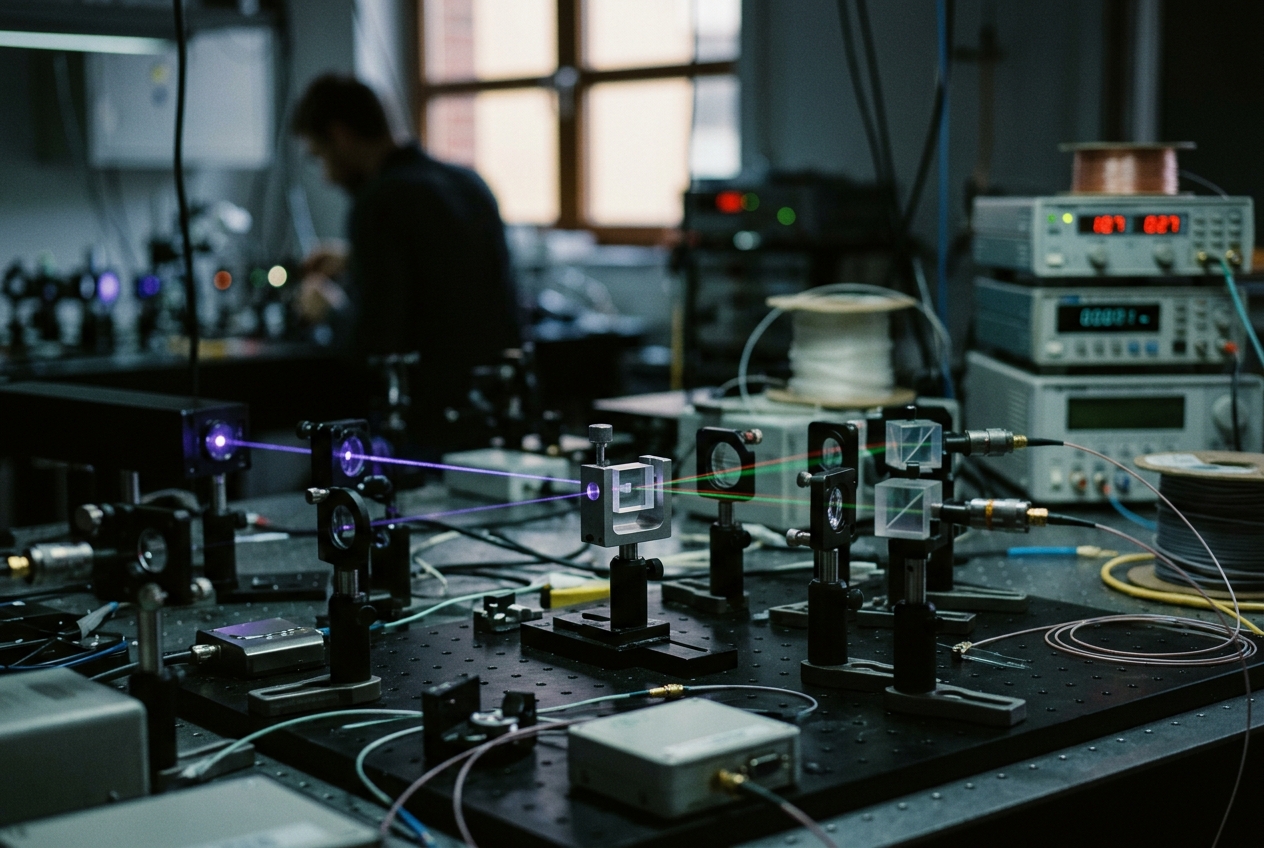
In 1991, an Oxford doctoral researcher named Artur Ekert introduced a paradigm shift that moved cryptography away from computational difficulty and anchored it in the unalterable laws of quantum mechanics. Published in Physical Review Letters, the Ekert91 (E91) protocol transformed Albert Einstein’s deepest philosophical grievance with quantum theory—what Einstein famously derided as "spooky action at a distance"—into the ultimate cryptographic tripwire. By weaving together the phenomena of quantum entanglement and the experimental tests of Bell's theorem, Ekert demonstrated that two communicating parties can generate a shared, completely random secret key across space while proving, with mathematical certainty, that no eavesdropper has intercepted their transmission.
The Idea in Plain English: Taming Quantum Ghostliness
To grasp why Ekert’s protocol represents such a radical departure from classical security, one must first understand the distinction between classical randomness and quantum entanglement.
Imagine two coins minted in an ordinary workshop. If you flip one coin in London and a collaborator flips the second coin in Tokyo, classical physics dictates that each flip is independent. If you want the two coins to always show identical or exactly opposite faces, you must manufacture them with identical internal mechanisms or program them via radio signals. In the classical paradigm, the state of the coin—whether it lands on heads or tails—is determined the moment it leaves the thumb, governed by deterministic physical forces like velocity, angle, and air resistance. An eavesdropper who peeks at the coin mid-flight can discover its trajectory and outcome without changing the result of the toss.
Quantum mechanics upends this assumption. When two particles, such as photons of light, become entangled, they cease to exist as separate, independent physical entities. Instead, they form a single, unified quantum system described by a joint state, regardless of the physical distance separating them.
Returning to our coin analogy: an entangled pair of quantum coins behaves as if neither coin has chosen to be heads or tails while in flight. They spin in a state of suspended potentiality known as a superposition. If you catch your coin in London and force it to land, the universe makes a genuinely random choice at that exact microsecond—say, it lands on heads. Instantly, across thousands of miles of empty space, your collaborator’s coin in Tokyo collapses into the complementary outcome—tails—with absolute correlation.
Before Ekert, the prevailing model of quantum cryptography was the pioneering BB84 protocol, formulated in 1984 by Charles Bennett and Gilles Brassard. BB84 operates on a "prepare-and-measure" paradigm: the sender (traditionally named Alice) deliberately prepares single photons in specific polarization states and transmits them across a fiber-optic cable to the receiver (Bob). If an eavesdropper (Eve) intercepts a photon, quantum measurement inevitably perturbs the photon’s state—a consequence of the Heisenberg uncertainty principle and the quantum no-cloning theorem—introducing detectable errors into Bob's received sequence.
Ekert recognized that while BB84 is secure, it requires Alice to possess a trustworthy, pre-calibrated quantum source that prepares specific classical information into quantum carriers. Ekert asked a deeper question: What if the cryptographic key does not exist anywhere in the universe prior to the moment of measurement?
In the E91 protocol, neither Alice nor Bob prepares the key. Instead, an independent, untrusted central source generates pairs of entangled photons and beams one photon to Alice and the other to Bob. Because the measurement outcomes are genuinely non-local and fundamentally indeterminate until the instant of detection, the secret key is created simultaneously at both endpoints out of pure quantum randomness.
More crucially, Ekert realized that Bell's inequality provides an absolute mathematical benchmark. If an eavesdropper attempts to intercept, clone, or measure the flying photons, that intervention breaks their delicate quantum entanglement, forcing the particles into classical states governed by local realism. By statistically testing whether their measurements violate Bell's inequality, Alice and Bob can verify the physical integrity of their quantum channel without placing any trust in the hardware source that emitted the particles.
How It Actually Works: The Mechanics of E91
The elegance of the Ekert91 protocol lies in its dual-purpose use of quantum measurements: the same stream of entangled particles provides both the cryptographic raw key and the mathematical proof that the channel is uncompromised.
       +-------------------------------------------------------------+
       |               ENTANGLED PHOTON SOURCE                       |
       |             |psi-> = (|01> - |10>) / sqrt(2)                |
       +-------------------------------------------------------------+
                        /                           \
       Photon A        /                             \        Photon B
                      v                               v
       +-----------------------------+ +-----------------------------+
       |      ALICE'S DETECTOR       | |       BOB'S DETECTOR        |
       |  Bases: {0, pi/4, pi/2}     | |  Bases: {pi/4, pi/2, 3pi/4} |
       +-----------------------------+ +-----------------------------+
                      \                               /
                       \                             /
                        v                           v
       +-------------------------------------------------------------+
       |                 PUBLIC CLASSICAL CHANNEL                    |
       |                                                             |
       |  1. Reconcile Basis Choices:                                |
       |     * Matching Angles (pi/4, pi/2)   ==> Raw Secret Key     |
       |     * Non-Matching Angles            ==> CHSH Test (S)      |
       |                                                             |
       |  2. Bell Inequality Verification:                           |
       |     * S = 2*sqrt(2) ≈ 2.828  ==> Perfectly Secure Channel   |
       |     * S <= 2                 ==> Eavesdropper Detected!     |
       +-------------------------------------------------------------+
1. The Entangled Singlet State
The protocol begins with an optical source generating pairs of spin-1/2 particles or polarization-entangled photons prepared in the maximally entangled antisymmetric Bell singlet state:
$$\left|\psi^-\right\rangle = \frac{1}{\sqrt{2}} \left( |01\rangle - |10\rangle \right) = \frac{1}{\sqrt{2}} \left( |\uparrow\downarrow\rangle - |\downarrow\uparrow\rangle \right)$$
In optical implementations documented in modern quantum computing curricula such as IBM Qiskit's Quantum Information Science guides, $|0\rangle$ and $|1\rangle$ correspond to orthogonal photon polarization states, such as horizontal $|H\rangle$ and vertical $|V\rangle$. The singlet state possesses rotational invariance: regardless of the spatial axis along which Alice and Bob measure their respective particles, if they choose identical measurement orientations, their binary measurement outcomes ($+1$ or $-1$) will be perfectly anti-correlated. When Alice observes $+1$, Bob unfailingly observes $-1$, and vice versa.
2. Selection of Non-Orthogonal Measurement Bases
To enable both key generation and eavesdropper detection, Alice and Bob each randomly and independently rotate their polarization analyzers among three distinct coplanar angles for each incoming photon:
-
Alice's Measurement Angles: $$\theta_1^A = 0^\circ, \quad \theta_2^A = 45^\circ \left(\frac{\pi}{4}\right), \quad \theta_3^A = 90^\circ \left(\frac{\pi}{2}\right)$$
-
Bob's Measurement Angles: $$\theta_1^B = 45^\circ \left(\frac{\pi}{4}\right), \quad \theta_2^B = 90^\circ \left(\frac{\pi}{2}\right), \quad \theta_3^B = 135^\circ \left(\frac{3\pi}{4}\right)$$
Notice that Alice and Bob share two common measurement orientations: $\theta_2^A = \theta_1^B = 45^\circ$ and $\theta_3^A = \theta_2^B = 90^\circ$.
For every photon pair, Alice and Bob record their chosen orientation and the resulting measurement outcome ($+1$ or $-1$). After registering a statistically significant block of photons, Alice and Bob communicate over an open, unencrypted classical channel (such as the standard internet) to announce the list of orientations they used for each trial. They do not reveal their actual measurement outcomes.
3. Sifting the Raw Key
Alice and Bob partition their measurement trials into two distinct categories:
-
Coincident (Matching) Orientations: Instances where Alice and Bob measured in the same orientation ($\theta_2^A = \theta_1^B$ or $\theta_3^A = \theta_2^B$). Because their analyzers were aligned, quantum mechanics guarantees their measurement outcomes are perfectly anti-correlated. Bob simply inverts all his binary outcomes (converting $-1$ to $+1$ and $+1$ to $-1$), instantly producing a bitstring that is completely identical to Alice’s. This data forms their raw secret key.
-
Non-Coincident (Disparate) Orientations: Instances where Alice and Bob selected different orientations. In a classical protocol, mismatched measurements are useless and discarded. In E91, these mismatched trials form the foundation of their security audit.
4. Evaluating the CHSH Correlation Parameter
Alice and Bob publicly disclose the actual measurement values for all trials in which their orientations did not match. They use these public outcomes to compute the quantum correlation coefficient $E(\theta_i^A, \theta_j^B)$, defined as the expectation value of the product of their measurement results:
$$E(\theta_i^A, \theta_j^B) = P_{++}(\theta_i^A, \theta_j^B) + P_{--}(\theta_i^A, \theta_j^B) - P_{+-}(\theta_i^A, \theta_j^B) - P_{-+}(\theta_i^A, \theta_j^B)$$
For the singlet state $\left|\psi^-\right\rangle$, quantum mechanics predicts that the correlation between two polarization measurements separated by relative angle $\Delta\theta = |\theta_i^A - \theta_j^B|$ is given by:
$$E(\theta_i^A, \theta_j^B) = -\cos\left(2(\theta_i^A - \theta_j^B)\right)$$
Alice and Bob combine the correlation coefficients from their four complementary, non-identical basis pairs ($\theta_1^A$ with $\theta_1^B$, $\theta_1^A$ with $\theta_3^B$, $\theta_3^A$ with $\theta_1^B$, and $\theta_3^A$ with $\theta_3^B$) into the Clauser-Horne-Shimony-Holt (CHSH) test statistic, $S$:
$$S = \left| E(\theta_1^A, \theta_1^B) - E(\theta_1^A, \theta_3^B) + E(\theta_3^A, \theta_1^B) + E(\theta_3^A, \theta_3^B) \right|$$
Let us evaluate the theoretical prediction for an ideal, uncompromised quantum channel:
- For $\theta_1^A = 0^\circ$ and $\theta_1^B = 45^\circ$, $\Delta\theta = 45^\circ$, giving $E = -\cos(90^\circ) = -\frac{1}{\sqrt{2}} \approx -0.7071$.
- For $\theta_1^A = 0^\circ$ and $\theta_3^B = 135^\circ$, $\Delta\theta = 135^\circ$, giving $E = -\cos(270^\circ) = +\frac{1}{\sqrt{2}} \approx +0.7071$.
- For $\theta_3^A = 90^\circ$ and $\theta_1^B = 45^\circ$, $\Delta\theta = 45^\circ$, giving $E = -\cos(90^\circ) = -\frac{1}{\sqrt{2}} \approx -0.7071$.
- For $\theta_3^A = 90^\circ$ and $\theta_3^B = 135^\circ$, $\Delta\theta = 45^\circ$, giving $E = -\cos(90^\circ) = -\frac{1}{\sqrt{2}} \approx -0.7071$.
Substituting these values into the CHSH equation yields:
$$S_{\text{quantum}} = \left| -\frac{1}{\sqrt{2}} - \left(+\frac{1}{\sqrt{2}}\right) - \frac{1}{\sqrt{2}} - \frac{1}{\sqrt{2}} \right| = \left| -\frac{4}{\sqrt{2}} \right| = 2\sqrt{2} \approx 2.8284$$
The value $2\sqrt{2}$ is known as Tsirelson's bound—the maximum correlation allowable in nature under the laws of quantum mechanics.
The Bell Violation Threshold
In any universe governed by local realism—where particles possess predetermined physical values before measurement and signals cannot propagate faster than light—the CHSH parameter is strictly bounded by:
$$S_{\text{classical}} \le 2$$
When Alice and Bob observe $S \approx 2\sqrt{2}$, they mathematically demonstrate that their photon measurements were non-locally connected, proving that the measurement outcomes were truly indeterminate until observed.
5. Why Eavesdropping Inevitably Exposes Itself
Suppose an eavesdropper, Eve, attempts an intercept-and-resend attack. Because Eve does not know which measurement angles Alice and Bob will select in advance, she must measure the passing photons along some chosen orientation and prepare fresh photons to send onward to Bob.
The moment Eve measures a photon, the fragile singlet state collapses into a separable product state. By measuring the quantum state, Eve forces the particle to adopt a definite, classical polarization value before it reaches Bob. In doing so, Eve replaces the non-local quantum link with a classical local hidden-variable system.
When Alice and Bob evaluate the CHSH parameter $S$ across their public test trials, the entanglement-breaking effect of Eve's measurement reduces the correlation to the classical domain:
$$S_{\text{eavesdropped}} \le 2$$
If $S \le 2$, or if environmental decoherence has degraded $S$ below a predetermined security threshold, Alice and Bob immediately abort the protocol. They discard the sifted key without transmitting a single byte of sensitive ciphertext.
If, however, $S > 2$ (and sufficiently close to $2\sqrt{2}$ after accounting for experimental noise), Alice and Bob can mathematically quantify the maximum possible mutual information an adversary could possess. They then apply classical error correction to eliminate transmission errors and privacy amplification (hashing) to compress the raw key into a shorter, perfectly secure cryptographic key.
Real-World Applications Today: From Quantum Satellites to Device Independence
What began as a theoretical paper in 1991 has evolved into the cornerstone of 21st-century quantum infrastructure. Between 2024 and 2026, entanglement-based quantum key distribution transitioned from laboratory optical tables to operational telecommunication networks and planetary-scale space links.
+-----------------------------------------------------------------------------------+
|               FRONTIERS OF ENTANGLEMENT-BASED QUANTUM CRYPTOGRAPHY                |
+-----------------------------------------------------------------------------------+
|  1. Space-to-Ground Links       |  Micius Satellite, ESA Eagle-1 (1,200+ km links)|
|  2. Device-Independent QKD      |  Zero-trust hardware architectures (Oxford, MPQ)|
|  3. Metro Quantum Backbones     |  Toshiba, BT, ID Quantique (Commercial fibers)  |
|  4. Entanglement Repeaters      |  US DOE, Fermilab, Argonne Quantum Network      |
+-----------------------------------------------------------------------------------+
1. Satellite Quantum Communications: Space-Based Entanglement Distribution
- Institutions: Chinese Academy of Sciences (Micius Satellite Team), European Space Agency (ESA Eagle-1 Project).
- Objective: Establishing global-scale quantum key distribution across intercontinental distances without relying on vulnerable terrestrial fiber repeaters.
- Quantum Advantage: In standard optical fiber, photon absorption limits direct quantum transmission to a few hundred kilometers. By placing an entangled photon pair source aboard a satellite in low Earth orbit, researchers at the Chinese Academy of Sciences demonstrated entanglement distribution to ground stations separated by over 1,200 kilometers, as detailed in reports published by Nature. Using the E91 framework, the satellite acts as an untrusted transmitter: even if an adversary gains physical control of the satellite, they cannot forge the secret key because any tampering collapses the CHSH violation observed between the two ground stations.
2. Device-Independent Quantum Key Distribution (DI-QKD)
- Institutions: University of Oxford, Max Planck Institute of Quantum Optics, University of Geneva.
- Objective: Eliminating "side-channel" attacks arising from imperfect physical hardware, such as detector-blinding attacks or manufacturing backdoors.
- Quantum Advantage: In conventional cryptography and prepare-and-measure protocols like BB84, users must trust that their physical devices (lasers, beam splitters, single-photon detectors) operate precisely according to mathematical specifications. E91 is the intellectual progenitor of Device-Independent QKD. Because security is verified solely through the statistical violation of Bell's inequality ($S > 2$), the security proof holds true even if the photon detectors are manufactured by a malicious competitor. As long as the Bell test passes, the cryptographic output is physically guaranteed to be secret.
3. Critical Infrastructure & Financial Core Backbones
- Institutions: Toshiba Europe, BT Group, ID Quantique, HSBC.
- Objective: Hardening financial settlement networks and sovereign government inter-datacenter backbones against quantum decryption attacks.
- Quantum Advantage: Modern financial institutions process trillions of dollars in daily transactions using keys that must remain confidential for decades. In metropolitan testbeds across London, Frankfurt, and Zurich, commercial consortia have deployed entanglement-based QKD links alongside classical high-speed fiber infrastructure. These links continually refresh one-time-pad encryption keys, rendering intercepted bank data permanently immune to future supercomputing breakthroughs.
4. Quantum Internet Testbeds and Entanglement Swapping
- Institutions: U.S. Department of Energy (DOE), Argonne National Laboratory, Fermi National Accelerator Laboratory.
- Objective: Constructing scalable quantum repeater networks that daisy-chain entangled states across thousands of miles.
- Quantum Advantage: Using a technique known as entanglement swapping, intermediate quantum nodes can entangle two distant photons that have never interacted. This allows the E91 protocol to scale over nationwide quantum network backbones, creating an un-hackable routing fabric that underpins the emerging distributed quantum cloud.
What This Means for You: The Personal Stake in Quantum Physics
It is easy to view quantum cryptography as an abstract domain reserved for particle physicists and aerospace engineers. Yet, the security protocols derived from Ekert’s insight have direct implications for personal privacy in a hyper-connected society.
Every aspect of your modern life produces data intended to remain private permanently:
- Electronic Health Records: Genomic profiles and medical diagnostics that must remain confidential across your entire lifetime and that of your descendants.
- Biometric Authentication: Facial scans, retinal prints, and fingerprint hashes used to verify your identity. Unlike passwords, compromised biometrics cannot be changed.
- Smart Grid Stability: The industrial supervisory control systems (SCADA) operating municipal water filtration, nuclear facilities, and national power distribution grids.
If an adversary captures and stores your encrypted personal data today, any future quantum computer will eventually expose your medical records, financial histories, and private communications. The E91 protocol proves that physics offers an absolute countermeasure. By grounding security in nature's fundamental non-locality rather than temporary computational bottlenecks, society can build communications networks where secrecy is guaranteed by the universe itself.
Key Differences: BB84 vs. Ekert91 (E91)
| Feature | Bennett-Brassard 1984 (BB84) | Artur Ekert 1991 (E91) |
|---|---|---|
| Physical Foundation | Uncertainty Principle & No-Cloning Theorem | Quantum Entanglement & Bell's Theorem |
| Source Paradigm | Prepare-and-Measure (Alice creates state) | Entangled Pair Source (Centralized / Untrusted) |
| Key Generation | Sifted identical measurement bases | Sifted matching measurement angles |
| Eavesdropping Detection | Quantum Bit Error Rate (QBER) analysis | Violation of CHSH Bell Inequality ($S > 2$) |
| Hardware Trust Model | Requires trusted, calibrated source | Foundation for Device-Independent Security |
| Philosophical Root | State collapse upon single-particle observation | Non-local rejection of Local Realism |
Today's Takeaway
The Ekert91 protocol remains one of the most profound reconciliations of foundational physics and practical engineering in scientific history. By showing that the violation of Bell’s inequality is not just a philosophical refutation of Einstein’s local realism, but an infallible indicator of cryptographic privacy, Artur Ekert proved that the quantum universe possesses an intrinsic immunity to eavesdropping. When we measure entangled photons, we do not merely transmit information—we participate in a cosmic protocol where secrecy is not a mathematical assumption, but an absolute physical law.