Duan-Lukin-Cirac-Zoller Protocol: Scaling Long-Distance Quantum Repeaters Through Collective Atomic Excitations and Heralded Entanglement
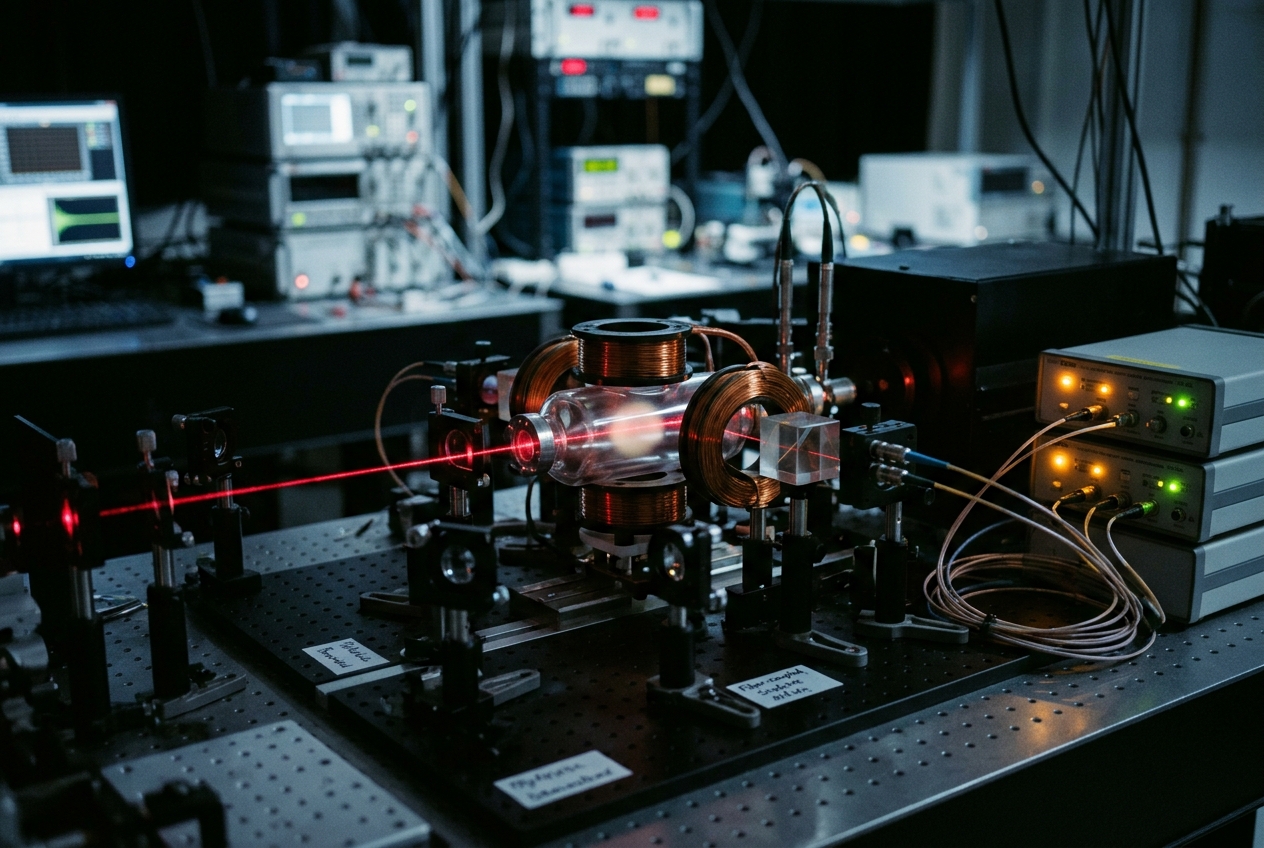
Yet this promise encounters a brutal physical barrier. The single photons carrying this delicate quantum information cannot travel across ordinary glass fiber-optic networks for more than a few dozen kilometers without being absorbed. In classical telecommunications, light pulses are refreshed every eighty kilometers using optical amplifiers that clone the passing signal millions of times over. In the quantum realm, the No-Cloning Theorem establishes that an unknown quantum state cannot be copied without irrevocably destroying it. As a result, direct quantum communication over global scales is impossible using conventional fiber architectures.
To overcome this fundamental impasse, physicists turned to a radical architectural paradigm: the quantum repeater. In 2001, physicists Lu-Ming Duan, Mikhail Lukin, Juan Ignacio Cirac, and Peter Zoller published a milestone framework in Nature—now universally known as the DLCZ protocol. By harnessing macroscopic clouds of neutral atoms, collective quantum spin waves, and single-photon interference, the DLCZ protocol bypassed the need for complex single-atom quantum gates, establishing the blueprint for scalable, fault-tolerant quantum repeaters across continental distances.
1. The Idea in Plain English: An Orchestrated Choir of Light and Matter
To understand how the DLCZ protocol works, consider an analogy from everyday acoustics. Imagine two concert halls located on opposite sides of a vast mountain range. A solo violinist in the first hall plays a single, faint note. Transmitted through a long, acoustic tube through the mountain, the note would inevitably fade into complete silence long before reaching the second hall. Furthermore, you cannot place an automated recording device halfway through to re-record and re-broadcast the note, because any measurement of a quantum note alters its pitch and phase.
The DLCZ approach solves this by changing both the source and the detection method. Instead of relying on a single, isolated violinist—which corresponds to a single atom trapped in an ultra-high-vacuum optical cavity—the protocol places a choir of millions of singers in each hall. When a conductor waves a baton (an optical laser pulse), the choir sings a collective, harmonious chord. Because all singers participate as a unified body, the note they emit is naturally focused into a coherent, highly directional acoustic beam.
                                  CENTRAL STATION
  [ Ensemble A ]                                                    [ Ensemble B ]
+----------------+          +------------------------------+       +----------------+
|  Write Pulse   |          |      50:50 Beam Splitter     |       |  Write Pulse   |
|       ==>      | ~~~~~~~> |              /               | <~~~~ |      ==>       |
|  Atomic Cloud  |  Photon  |             / \              | Photon|  Atomic Cloud  |
|  (Spin Wave)   |          |            v   v             |       |  (Spin Wave)   |
+----------------+          |       Detector 1  Detector 2 |       +----------------+
                            +------------------------------+
                                          |
                                          v
                           Heralded Entanglement Between
                                Ensemble A and B
Now, place a single microphone equidistant between the two concert halls at a central station. Both choirs sing simultaneously at an extremely low volume, such that there is only enough acoustic energy for the microphone to detect a single pulse. When the microphone registers a click, the listener knows with certainty that one of the two choirs sang—but because the sound paths were perfectly balanced, it is physically impossible to determine which hall produced the note.
In quantum mechanics, erasing path information forces the two distant choirs into a shared, non-local reality: they become quantum mechanically entangled. Neither hall holds a distinct state; instead, the physical system exists in an entangled superposition where Hall A has sung and Hall B has not, plus Hall B has sung and Hall A has not.
By linking multiple pairs of these halls along a transmission corridor and swapping the entanglement between adjacent nodes, we can propagate quantum connectivity across thousands of kilometers without ever transmitting a single fragile qubit directly across the entire span.
2. How It Actually Works: The Mechanics of Collective Quantum Memories
The physics of the DLCZ architecture can be broken down into four coordinated stages: mitigating exponential attenuation, generating collective spin excitations, creating heralded entanglement via single-photon interference, and retrieving stored excitations through directional optical readout.
The Physics of Attenuation and the Exponential Wall
When a single photon travels through an ultra-pure silica optical fiber, its survival probability decays exponentially according to the classical Beer-Lambert relation:
$$P_{\text{trans}}(L) = e^{-\alpha L}$$
This equation calculates the transmission probability $P_{\text{trans}}$ of a single photon over a fiber distance $L$, where $\alpha$ represents the fiber's linear attenuation coefficient.
In standard telecom fibers operating at the optimal telecommunication wavelength of $1550\text{ nm}$, the attenuation coefficient is approximately $\alpha \approx 0.2\text{ dB/km}$ (or $\approx 0.046\text{ km}^{-1}$). Over a modest distance of $50\text{ km}$, roughly $10\%$ of single photons survive. Over $1,000\text{ km}$, the transmission probability plummets to $10^{-20}$. To transmit a single qubit at a gigahertz source rate across such a distance, one would have to wait over three centuries for a single photon to reach the destination.
The DLCZ protocol circumvents this exponential penalty by dividing the total distance $L$ into $N$ short elementary segments of length $L_0 = L/N$. The communication time across the network then scales polynomially with distance rather than exponentially, fundamentally transforming the physics of long-range quantum transmission.
Direct Transmission:  Node A =====================================> Node B
                      Loss scales exponentially: P ~ exp(-alpha * L)

DLCZ Repeater Chain:  Node A <---> Node 1 <---> Node 2 <---> ... <---> Node B
                      Loss scales polynomially: T ~ (L / L_0)^p
Raman Transitions and Collective Dicke States
At each node of the network sits an atomic ensemble consisting of $N_{\text{at}} \sim 10^6 - 10^8$ identical alkali atoms (typically rubidium-87 or cesium-133) arranged in a three-level $\Lambda$-type electronic configuration. The three states involved are: 1. An initial ground state $|g\rangle$, 2. A metastable storage ground state $|s\rangle$, and 3. An optically excited electronic state $|e\rangle$.
           |e>  (Excited State)
          /   \
         /     \
Write   /       \ Stokes Photon (Scattered)
Pulse  /         \
      v           v
    |g> -------- |s>  (Metastable Storage Ground State)
Initially, optical pumping prepares every atom in the cloud into the ground state $|g\rangle$, forming the collective product state $|G\rangle = |g_1, g_2, \dots, g_{N_{\text{at}}}\rangle$.
To initiate the protocol, an off-resonant, weak optical "write" laser pulse irradiates the atomic cloud, coupling the transition $|g\rangle \to |e\rangle$ with a large detuning $\Delta$. Through spontaneous Raman scattering, an excited atom can decay into the metastable storage state $|s\rangle$, emitting a forward-scattered "Stokes" photon on the $|e\rangle \to |s\rangle$ transition.
Crucially, because the atoms are closely packed and identical, it is impossible to determine which specific atom in the macroscopic cloud underwent the Raman transition. The atomic ensemble is projected into a symmetric quantum superposition known as a collective Dicke state or spin wave (magnon):
$$|\psi_{\text{spin}}\rangle = \frac{1}{\sqrt{N_{\text{at}}}} \sum_{j=1}^{N_{\text{at}}} e^{i (\mathbf{k}{\text{w}} - \mathbf{k}{\text{s}}) \cdot \mathbf{r}j} |g_1, \dots, s_j, \dots, g{N_{\text{at}}}\rangle$$
This formula defines the collective quantum state of the atomic cloud after scattering a single photon, where $\mathbf{k}{\text{w}}$ is the wavevector of the incoming write laser, $\mathbf{k}{\text{s}}$ is the wavevector of the emitted Stokes photon, and $\mathbf{r}_j$ represents the spatial position of the $j$-th atom.
The spatial phase factor $e^{i (\mathbf{k}{\text{w}} - \mathbf{k}{\text{s}}) \cdot \mathbf{r}j}$ records the momentum imprint of the scattering event across the entire ensemble. Because of constructive quantum interference across all $N{\text{at}}$ atoms, any subsequent optical interaction aligned with this phase pattern experiences a massive collective enhancement proportional to the optical depth of the atomic cloud. The probability of directed, coherent photon emission scales directly with atomic density, eliminating the requirement for complex high-finesse optical cavities.
Heralded Entanglement via Single-Photon Interference
To generate non-local entanglement between two spatially separated nodes, Node A and Node B (separated by an elementary distance $L_0$), both ensembles are simultaneously excited by weak write pulses. The excitation probability $p$ is kept intentionally small ($p \ll 1$) to suppress the unwanted generation of multiple spin excitations.
The emitted Stokes photons from Ensembles A and B are collected into single-mode optical fibers and directed toward a central 50:50 beam splitter situated halfway between the nodes. At the output ports of the beam splitter sit two high-efficiency single-photon detectors.
When a single photon registers at one of the central detectors, the beam splitter erases all distinguishing information regarding the photon's origin. The detection event acts as a quantum non-demolition projection, heralding the successful generation of a maximally entangled state between the two macroscopic atomic memories:
$$|\Psi^{\pm}\rangle = \frac{1}{\sqrt{2}} \left( |1_a, 0_b\rangle \pm e^{i \phi} |0_a, 1_b\rangle \right)$$
This expression represents the heralded Bell-type entangled state shared between Ensembles A and B, where $|1_a, 0_b\rangle$ indicates a collective spin excitation stored in Node A and none in Node B, $|0_a, 1_b\rangle$ indicates an excitation stored in Node B and none in Node A, and $\phi$ is an optical phase difference determined by the path lengths.
The term "heralded" is central to the elegance of the DLCZ framework: the classical signal indicating a detector click confirms that entanglement has been successfully created and stored in the atomic clouds without perturbing the stored quantum state itself. If no photon is detected, the nodes simply repeat the write sequence until a success is confirmed.
[!NOTE]
Summary Box: The DLCZ Operational Cycle
- Initialization: Optical pumping cools and prepares ensembles $A$ and $B$ in the collective ground state $|G\rangle$.
- Write Phase: Weak, off-resonant laser pulses induce spontaneous Raman scattering, producing a Stokes photon and a collective spin wave $|\psi_{\text{spin}}\rangle$.
- Interference & Heralding: Stokes channels merge at a central 50:50 beam splitter. A single click heralds the Bell state $|\Psi^{\pm}\rangle = \frac{1}{\sqrt{2}} (|1_a, 0_b\rangle \pm |0_a, 1_b\rangle)$.
- Storage: The spin excitation is stored in the atomic coherence of the ground-state Zeeman or hyperfine levels.
- Readout & Swapping: Resonant "read" pulses convert stored magnons into directional anti-Stokes photons via phase-matched constructive interference, enabling entanglement swapping across cascading repeater links.
The Readout Phase and Cascaded Entanglement Swapping
Once entanglement is heralded between adjacent elementary segments $(A-B)$ and $(B-C)$, the stored spin waves must be connected to establish long-range entanglement between the distant endpoints $A$ and $C$.
This is accomplished by applying an intense, resonant "read" laser pulse to the intermediate nodes. The read pulse drives the atomic transition $|s\rangle \to |e\rangle$. Due to the spatial phase profile previously imprinted on the atomic cloud, the atoms decay back to $|g\rangle$ via stimulated collective emission, outputting an "anti-Stokes" photon. Because of strict phase matching—dictated by the condition $\mathbf{k}{\text{as}} = \mathbf{k}{\text{w}} + \mathbf{k}{\text{r}} - \mathbf{k}{\text{s}}$—the emitted anti-Stokes photon is cast into a well-defined spatial mode with near-unity directional efficiency.
The anti-Stokes photons retrieved from intermediate nodes are interfered on a second set of beam splitters in a process known as entanglement swapping. By cascading this swapping protocol through nested, hierarchical stages ($L_0 \to 2L_0 \to 4L_0 \dots \to L$), quantum entanglement is extended across continental scales, with total distribution time scaling as a polynomial function of distance: $T \propto (L/L_0)^{\beta}$, where $\beta \approx 1.5 - 2$.
For deeper explorations of quantum information theory and repeater architectures, readers can consult advanced university courses such as MIT OpenCourseWare's Quantum Information Science and reference repositories on IBM Quantum Learning.
3. Physical Implementations and Modern Experimental Testbeds
Translating the DLCZ framework from theoretical elegance into operational hardware has driven two decades of atomic, molecular, and optical (AMO) physics. Today, researchers employ three primary physical architectures, each balancing distinct trade-offs between storage lifetime, optical depth, and decoherence mechanisms.
+------------------------------------+------------------------------------+------------------------------------+
| Alkali Vapor Cells                 | Magneto-Optical Traps (MOTs)       | Rare-Earth Doped Solids            |
+------------------------------------+------------------------------------+------------------------------------+
| • Warm gas (Rb, Cs) with buffer gas| • Laser-cooled to microkelvins     | • Pr3+:Y2SiO5, Eu3+:Y2SiO5 crystals|
| • High optical depth, low cost     | • Doppler broadening eliminated    | • Solid-state, ultra-long storage  |
| • Limit: Atomic wall collisions    | • Limit: Thermal ballistic motion  | • Limit: Cryogenic (4K) operation  |
+------------------------------------+------------------------------------+------------------------------------+
Warm Alkali Vapor Cells
Warm vapor cells contain gaseous rubidium or cesium mixed with paraffin wall coatings and inert noble buffer gases (such as helium or neon). The buffer gas restricts atomic motion via diffusive Brownian dynamics, preventing atoms from colliding with container walls and losing their spin phase.
- Advantages: High optical depth at room temperature or mild heating ($40^\circ\text{C} - 60^\circ\text{C}$); minimal experimental footprint; no complex cryogenic or ultra-high-vacuum laser-cooling apparatus required.
- Decoherence Limit: Collisional dephasing and spin-exchange collisions limit coherence lifetimes to the millisecond ($1 - 10\text{ ms}$) regime.
Laser-Cooled Cold Atomic Ensembles (Magneto-Optical Traps)
Magneto-optical traps (MOTs) cool neutral atomic clouds down to microkelvin temperatures ($10 - 100\ \mu\text{K}$) using Doppler cooling and magnetic gradient fields.
- Advantages: Doppler broadening is virtually eliminated. When loaded into far-off-resonance optical dipole traps (FORT) or optical lattices, the atomic positions are tightly localized.
- Decoherence Limit: Residual thermal motion leads to spatial diffusion across the spin-wave period, causing phase washout. State-of-the-art implementations utilizing "clock transitions" (hyperfine transitions with zero first-order Zeeman shift to magnetic fluctuations) reach coherence times exceeding $100\text{ milliseconds}$ to several seconds. Fundamental analyses and empirical data are routinely cataloged across the Physical Review Letters Archive and preprint servers like the arXiv Quantum Physics Repository.
Rare-Earth-Ion-Doped Solid-State Crystals
Solid-state analogues utilize transparent crystals doped with trivalent rare-earth ions, such as praseodymium ($\text{Pr}^{3+}:\text{Y}_2\text{SiO}_5$) or europium ($\text{Eu}^{3+}:\text{Y}_2\text{SiO}_5$), cooled to liquid-helium temperatures ($\sim 4\text{ K}$).
- Advantages: Solid-state platform compatible with on-chip nanophotonic waveguides and resonators; natural integration with macroscopic crystal storage volumes.
- Decoherence Limit: Host crystal lattice vibrations (phonons) and fluctuating nuclear spin baths. By applying external magnetic fields under Zero First-Order Zeeman (ZEFOZ) configurations, coherence times in europium crystals have reached hours, providing a compelling pathway toward deployable quantum memory cassettes.
4. Real-World Applications and Global Initiatives
The DLCZ protocol and its hybrid descendants form the core architecture of international quantum internet testbeds. Several leading institutions and consortia are currently translating these principles into functional regional networks:
GLOBAL QUANTUM REPEATER & INTERNET TESTBEDS (2024–2026)

[ QuTech / TU Delft ]           [ USTC Pan Lab ]            [ Harvard-AWS / CQE ]
   The Netherlands                 Hefei, China                United States
   * Metropolitan QID Network      * Long-distance memory      * Solid-state spin memories
   * Atomic & solid-state nodes    * 50+ km deployed fiber     * Nanophotonic cavity coupling
   * Multi-node quantum routing    * Real-time telecom QST     * 124-mile Chicago Quantum Loop
1. QuTech and TU Delft (The Netherlands)
- The Initiative: The Quantum Internet Demonstrator (QID) consortium, led by QuTech alongside European telecommunications partners, is building a multi-node quantum network connecting Delft, The Hague, Leiden, and Amsterdam.
- Objective & Quantum Advantage: Moving beyond point-to-point QKD, QuTech uses atomic ensembles and color-center memory nodes to demonstrate heralded entanglement delivery on demand. This enables quantum state teleportation across metropolitan links without classical interception vulnerabilities.
2. University of Science and Technology of China (USTC - Pan Jianwei Group)
- The Initiative: The USTC team has established multi-node quantum repeater chains using cold atomic rubidium ensembles connected over deployed commercial fiber lines in the city of Hefei.
- Objective & Quantum Advantage: To bridge the wavelength gap between atomic transitions ($780\text{ nm}$ or $795\text{ nm}$) and low-loss fiber bands ($1550\text{ nm}$), USTC integrated atomic ensembles with high-efficiency periodically poled lithium niobate (PPLN) difference-frequency generation waveguides. In recent benchmarks, they achieved heralded entanglement across atomic memories separated by over $50\text{ kilometers}$ of standard telecom fiber.
3. Harvard University, MIT, and AWS Center for Quantum Networking (USA)
- The Initiative: Collaborative research between Mikhail Lukin’s laboratory at Harvard, Marko Lončar’s nanophotonics group, and the AWS Center for Quantum Networking.
- Objective & Quantum Advantage: This initiative focuses on hybrid DLCZ implementations that integrate atomic and solid-state quantum memories (such as silicon-vacancy centers in diamond and rare-earth crystals) inside nanophotonic cavity resonators. Cavity quantum electrodynamics (cQED) enhances the photon emission rate via the Purcell effect, boosting single-photon retrieval efficiency above $90\%$.
4. Chicago Quantum Exchange & Argonne National Laboratory (USA)
- The Initiative: Operating the 124-mile (200-kilometer) Chicago Quantum Loop across the metropolitan Chicago region.
- Objective & Quantum Advantage: Argonne and the University of Chicago use this urban testbed to benchmark the environmental resilience of atomic memories and entangled photon sources against thermal fluctuations, seismic vibrations, and fiber birefringence under real-world municipal conditions.
5. What This Means for Society: Privacy, Computing, and Telescopes
For non-physicists, the realization of scalable quantum repeaters based on the DLCZ protocol unlocks capabilities far beyond incremental speedups in data processing:
                               THE PILLARS OF A QUANTUM INTERNET
                                               |
        +--------------------------------------+--------------------------------------+
        |                                      |                                      |
        v                                      v                                      v
 [ Sovereign Security ]           [ Blind Cloud Computing ]          [ Quantum Sensor Arrays ]
 Information-theoretic privacy    Run private quantum algorithms     Intercontinental baseline
 for medical, financial, and      on remote servers with             telescopes resolving exoplanet
 electoral data infrastructure.   mathematically zero data leakage.  atmospheres and biosignatures.
Information-Theoretic Sovereignty
Unlike classical public-key infrastructure (such as RSA and elliptic-curve cryptography), which relies on unproven mathematical assumptions regarding the difficulty of factoring large integers or solving discrete logarithms, quantum networks distribute encryption keys secured by quantum mechanics. Even if an adversary possesses an arbitrarily powerful quantum supercomputer in the distant future, intercepted historical traffic protected by quantum entanglement can never be decrypted.
Blind Quantum Cloud Computing
As commercial quantum processors scale in capability, most users will access them via cloud platforms. Quantum repeaters enable blind quantum computation: a client connects their local quantum node to a centralized quantum supercomputer, executing complex pharmaceutical simulations, machine learning models, or financial optimizations without the cloud host ever discovering the input data, the operational program, or the computed output.
Planetary-Scale Quantum Interferometry
Linking astronomical optical telescopes via long-distance quantum repeater networks allows distant observatories to combine their incoming light fields through non-local quantum entanglement. This creates an optical baseline the width of an entire continent, increasing the angular resolution of astronomical imaging by orders of magnitude and allowing direct imaging of exoplanet surfaces and black hole event horizons.
6. Today's Takeaway
Direct single-photon transmission across global optical fibers is fundamentally bounded by the exponential law of absorption, and classical amplifiers cannot circumvent this limit without destroying quantum information. The Duan-Lukin-Cirac-Zoller (DLCZ) protocol resolves this challenge by turning macroscopic clouds of millions of atoms into collective quantum memories.
By exciting these atomic ensembles with laser pulses to create collective spin waves, heralding entanglement via single-photon interference at intermediate stations, and reading out stored excitations through phase-matched optical pulses, the DLCZ architecture converts the exponential scaling barrier of quantum communication into an efficient polynomial pathway. In doing so, it provides the essential hardware foundation for a secure, continental-scale quantum internet.