Diamond Norm: Quantifying Quantum Gate Errors and Operational Distinguishability in Fault-Tolerant Circuits
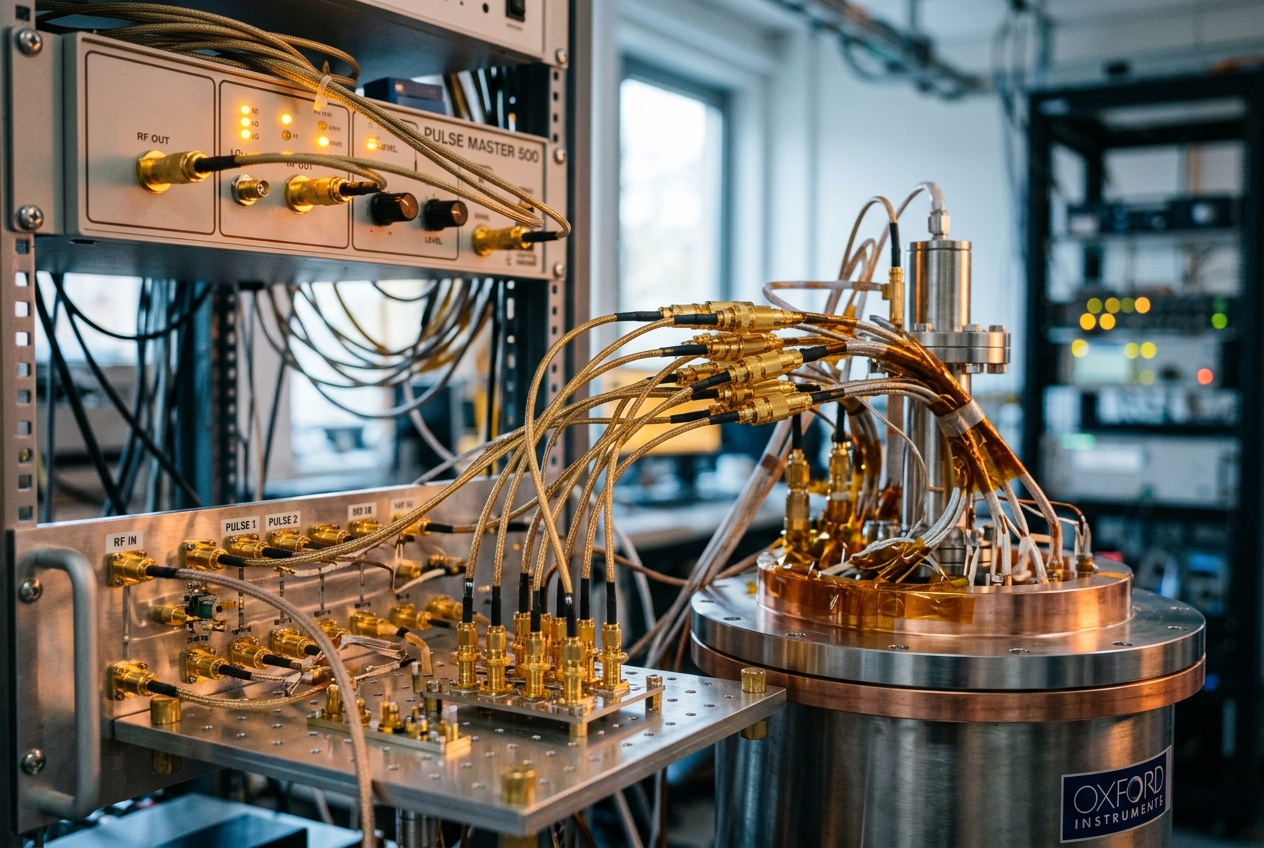
In ordinary microchips, an error is straightforward. A transistor switch either flips from a zero to a one, or it does not. The reliability of classical hardware is measured in straightforward failure percentages. If a server rack operates with 99.999% fidelity, an engineer can reliably predict how many bit flips will occur across a million calculations.
In the quantum domain, this comfortable intuition collapses completely. A quantum processor does not manipulate binary bits; it manipulates delicate waves of probability known as quantum states. When an experimentalist sends a microwave pulse to execute a logical operation, the noise that creeps in is rarely a simple random failure. Instead, it often manifests as a coherent over-rotation—a minuscule systematic drift of half a degree in the phase of the quantum wave.
If you benchmark this single gate in isolation using standard average-case tests, it appears immaculate, registering an average fidelity of 99.99%. But when thousands of these operations are linked together inside a large algorithm, those tiny coherent phase errors do not cancel out randomly. They accumulate constructively, multiplying in power until the delicate quantum computation derails into pure noise.
To build a quantum computer that can actually run long calculations without disintegrating, physicists had to discover a mathematical yardstick capable of capturing the absolute worst-case damage an operation can cause—especially when the particle being manipulated is entangled with another particle on the other side of the chip. That definitive metric is the diamond norm, or completely bounded trace distance. Without it, the celebrated Quantum Threshold Theorem—the mathematical proof that practical quantum computing is physically possible—would be an unprovable conjecture.
The Idea in Plain English: The Phantom in the Mirror
To understand why traditional measurements fail in quantum mechanics, imagine you are tasked with testing the optical quality of a newly invented glass lens.
In a conventional test, you shine a single beam of light through the lens, measure how much the beam dims or bends, and assign the glass an optical purity score of 99.9%. Satisfied, you install the glass into an astronomical telescope. But to your astonishment, the telescope produces disastrously blurred images.
What went wrong? In the quantum realm, particles possess a property called entanglement—a deep physical correlation where two particles behave as a single unified system, even when separated by light-years. When light passes through a medium in the quantum world, it is not acting alone. It can be entangled with a "twin" photon that never touches the lens.
       [ Input Qubit A ] --------> [ Noisy Quantum Gate ] --------> [ Output A' ]
              |                                                           |
       (Entangled Pair ρ)                                         (Distorted System)
              |                                                           |
       [ Ancilla Qubit B ] -------> [ Identity Channel (Idle) ] ----> [ Output B  ]
If you evaluate the lens only by sending single, isolated photons through it, you are testing it with standard "unentangled trace distance." You are measuring how well you can distinguish the distorted light from pristine light under the simplest possible circumstances. But if you instead create an entangled twin pair, keep one photon safely locked in a vacuum chamber as an untouched reference, and send the other photon through the lens, an astonishing phenomenon emerges: the tiny imperfections in the glass distort the joint relationship between the two twins.
By measuring both photons together after the experiment, an observer can detect microscopic distortions that were completely invisible when testing the photon in isolation. The presence of the spectator particle acts as an amplifier for error.
The diamond norm is the mathematical formulation of this exact test. It evaluates a quantum process not by looking at how it treats isolated inputs, but by evaluating the worst possible error it can inflict on a quantum system that is maximally entangled with an external reference system. It represents the ultimate stress test: the absolute maximum distinguishability between what a quantum gate was supposed to do and what it actually did.
How It Actually Works: The Mechanics of Completely Bounded Distances
To understand the mathematical mechanics of the diamond norm, we must look at how quantum operations—formally known as quantum channels or completely positive, trace-preserving (CPTP) superoperators—transform physical states.
In quantum information theory, the physical state of a system is represented by a density matrix, denoted by the Greek letter $\rho$ (rho). When we wish to measure how different two quantum states are from one another, we use the trace distance. The trace distance between two states represents the maximum physical probability that any measurement allowed by the laws of physics can successfully tell them apart. If two states have a trace distance of zero, they are physically identical; if their trace distance is one, they can be distinguished with absolute certainty.
However, a quantum gate is not a static state; it is an active transformation that takes an input state and maps it to an output state. Suppose we have an ideal quantum gate, represented by the mathematical operation $\mathcal{U}$, and an experimental gate riddled with noise, represented by $\mathcal{E}$. One might naively try to define the error of the gate by finding the single quantum state that maximizes the trace distance between the outputs.
Mathematically, this naive operator distance is defined by searching over all possible input states $\rho$:
$$|\mathcal{E} - \mathcal{U}|{1} = \sup{\rho} |\mathcal{E}(\rho) - \mathcal{U}(\rho)|_1$$
This unentangled metric is dangerously misleading. In the late 1990s, the theoretical physicist Alexei Kitaev proved that this standard distance is not stable under quantum composition. If you take a noisy gate that appears to have an unentangled error of 1% and apply it to one half of an entangled pair while applying a perfect identity operation to the other half, the actual distinguishable error of the combined system can jump significantly.
To capture the true operational reality, Kitaev introduced the stabilized trace distance, known in operator algebra as the completely bounded trace norm and in quantum physics as the diamond norm (denoted with a diamond subscript, $|\cdot|_\diamond$).
First, we write out the formal definition of the diamond norm. In plain language, this equation states that to find the true worst-case error of a quantum process, we must pair our primary quantum system with an auxiliary reference system of dimension $d$, create the most sensitive entangled state possible across both systems, pass only our primary system through the noisy process while leaving the reference untouched, and then calculate the resulting trace distance:
$$|\Delta|\diamond = \sup{\rho} \left| \left(\Delta \otimes \mathcal{I}_d\right)(\rho) \right|_1$$
In this equation, $\Delta$ represents the difference superoperator between our two channels ($\mathcal{E} - \mathcal{U}$), $\mathcal{I}_d$ is the identity superoperator acting on an untouched reference system of dimension $d$, and $\rho$ is a joint density matrix across both spaces with unit trace.
A critical mathematical question arises: how large must that reference system be? Could an infinitely large entangled ancilla reveal even worse errors? In a foundational mathematical milestone known as Kitaev’s Theorem, it was proven that the reference system never needs to be larger than the input dimension $d$ of the channel being tested. For a single qubit ($d = 2$), an auxiliary system of just one single reference qubit is mathematically sufficient to expose the absolute maximum worst-case error.
+-------------------------------------------------------------------------------+
|                        THE CHANNEL DISCRIMINATION GAME                        |
|                                                                               |
|  1. Alice prepares an unknown black box containing either Channel A or B.     |
|  2. Bob prepares a joint entangled state across his system and an ancilla.    |
|  3. Bob routes his primary system through the black box.                     |
|  4. Bob performs an optimal joint measurement on both systems.                |
|  5. His maximum possible winning probability is directly governed by the     |
|     Diamond Norm Distance between Channel A and Channel B.                   |
+-------------------------------------------------------------------------------+
This brings us to the operational meaning of the diamond norm, formulated through the Optimal Channel Discrimination Game. Imagine a scenario where a challenger gives you a black box containing one of two possible quantum channels, $\mathcal{E}_1$ or $\mathcal{E}_2$, with equal 50% probability. Your goal is to determine which channel is inside the box by sending in a probe and measuring the result.
Our second equation calculates your maximum probability of winning this game. In plain terms, it predicts that your ability to successfully identify an unknown quantum process is strictly bounded by the diamond distance between the two candidate operations:
$$P_{\text{success}} = \frac{1}{2} + \frac{1}{4} |\mathcal{E}1 - \mathcal{E}_2|\diamond$$
If the diamond distance between the two channels is zero, your success probability is exactly one half—a blind guess. If the diamond distance is two (the maximum possible value for normalized channels), your success probability is exactly 1.0, meaning you can distinguish them perfectly on a single attempt.
Calculating this supremum over an infinite space of entangled density matrices might appear computationally intractable. However, quantum information theorists solved this by applying the Choi-Jamiołkowski Isomorphism, a mathematical bridge that maps dynamic quantum channels into static quantum states. Using this isomorphism, John Watrous demonstrated that computing the diamond norm between any two quantum channels can be cast as a Semidefinite Program (SDP)—an efficient, convex optimization algorithm that can be solved in polynomial time on classical computers.
The Coherent Disaster: Diamond Norm vs. Average Gate Fidelity
To see why the diamond norm is indispensable for fault-tolerant engineering, we must contrast it with the metric most commonly published in laboratory press releases: Average Gate Infidelity ($r_{\text{avg}}$), measured via Randomized Benchmarking as taught across MIT OpenCourseWare quantum curricula.
When experimental physicists calibrate hardware, they typically randomize sequences of thousands of gates across a single qubit and measure how frequently the qubit ends up in the expected state. This yields an average infidelity score. If an experimentalist has a systematic rotation error $\theta$ (for instance, a laser pulse that rotates a qubit by $\pi + \epsilon$ radians instead of $\pi$), the average gate infidelity scales quadratically with the small angle $\epsilon$:
$$r_{\text{avg}} \approx \mathcal{O}(\epsilon^2)$$
Because the angle is squared, an error of $\epsilon = 0.01$ radians produces an average infidelity of just $r_{\text{avg}} \approx 0.0001$ (a seemingly triumphant 99.99% fidelity).
However, the diamond norm does not measure the average behavior over random Clifford gates; it measures the worst-case coherent accumulation when operations align constructively. For that exact same physical pulse, the diamond norm error ($\epsilon_\diamond$) scales linearly with the rotation angle:
$$\epsilon_\diamond \approx \mathcal{O}(\epsilon) \approx \sqrt{r_{\text{avg}}}$$
Our third equation captures this severe mathematical relationship, demonstrating that the worst-case error bounded by the diamond norm can be quadratically worse than the average gate error reported in randomized benchmarking experiments:
$$\epsilon_\diamond \le \sqrt{d(d+1) \cdot r_{\text{avg}}}$$
| Physical Error Parameter ($\epsilon$) | Average Infidelity ($r_{\text{avg}}$) | Worst-Case Diamond Distance ($\epsilon_\diamond$) | Practical Consequence |
|---|---|---|---|
| $\epsilon = 0.10$ radians | $0.01$ (99.0% Fidelity) | $\approx 0.10$ (10.0% Error) | Fatal error blowout in surface codes |
| $\epsilon = 0.01$ radians | $0.0001$ (99.99% Fidelity) | $\approx 0.01$ (1.0% Error) | Breaches fault-tolerance threshold |
| $\epsilon = 0.001$ radians | $0.000001$ (99.9999% Fidelity) | $\approx 0.001$ (0.1% Error) | True scalable fault tolerance achieved |
This quadratic penalty is the primary reason why quantum computers cannot simply rely on optimistic average metrics. If a quantum error-correcting code (such as the Surface Code) requires a physical error rate below the rigorous fault-tolerance threshold of $10^{-2}$ to prevent exponential error propagation, an engineer who measures an average infidelity of $10^{-4}$ might assume their machine is well within the safety zone.
Yet, if that noise is coherent over-rotation or unwanted inter-qubit crosstalk, the diamond norm distance is actually $10^{-2}$—placing the device right at the brink of catastrophic failure. The diamond norm is submultiplicative under composition ($|\mathcal{E}1 \circ \mathcal{E}_2|\diamond \le |\mathcal{E}1|\diamond |\mathcal{E}2|\diamond$) and stable under tensor products ($|\mathcal{E} \otimes \mathcal{I}|\diamond = |\mathcal{E}|\diamond$). These crucial mathematical properties guarantee that error bounds calculated via the diamond norm remain strictly valid when composing circuits containing millions of sequential gates.
Real-World Applications Today: Building the Quantum Future (2024–2026)
Across the world's leading quantum computing laboratories, moving beyond average benchmarking to diamond-norm-bounded verification has become the defining challenge of the mid-2020s.
       [ Classical Compilation Layer ]
                      |
        (Diamond Norm Error Budgeting)
                      |
       +--------------+--------------+
       |                             |
[ Randomized Compiling ]   [ Surface Code Thresholds ]
 (Tailors Coherent Noise    (Ensures Worst-Case Error
  into Pauli Stochastic)     Decays Below 0.57%)
       |                             |
       +--------------+--------------+
                      |
       [ Physical Hardware Execution ]
        (IBM, Google, Quantinuum, AWS)
1. IBM Quantum: Randomized Compiling and Crosstalk Suppression
At IBM Quantum facilities in Yorktown Heights, researchers working on the Heron and Condor superconducting architectures must combat persistent microwave crosstalk between adjacent transmon qubits. When multiple two-qubit cross-resonance gates fire simultaneously, parasitic interactions introduce coherent Z-rotations.
Using techniques implemented within the Qiskit software ecosystem, IBM engineers use diamond-norm bounded randomized compiling (twirling). By inserting random single-qubit Pauli gates before and after noisy operations, they mathematically convert worst-case coherent errors into harmless, un-correlated stochastic noise. This collapses the diamond norm error back toward the average infidelity, preventing destructive phase buildup across deep quantum circuits.
2. Google Quantum AI: Surface Code Fault-Tolerance Thresholds
In Santa Barbara, Google Quantum AI has focused on demonstrating that physical qubits arranged in a two-dimensional grid can suppress logical errors exponentially as the code distance increases—a milestone documented across landmark papers in Nature.
To prove that their Willow and Sycamore processors meet the mathematical criteria for fault tolerance, Google's theory teams model their gate noise budgets strictly in terms of diamond distance. The rigorous mathematical threshold for the surface code under general noise demands a diamond error below approximately $0.57\%$. Google uses semidefinite programming relaxations of the diamond norm to verify that cryogenic thermal fluctuations and flux noise do not exceed this critical threshold.
3. Quantinuum: Transversal Gate Verification in Trapped-Ion Systems
Quantinuum, operating trapped-ion systems utilizing shuttled barium and ytterbium ions, holds world records for two-qubit gate fidelities. However, when executing fault-tolerant transversal logic gates across multiple error-corrected zones, minute laser phase instabilities can cause subtle correlated multi-qubit phase drifts.
Quantinuum researchers use the diamond norm to evaluate the fidelity of logical state teleportation and non-Clifford magic-state distillation. Because magic-state injection is extremely vulnerable to non-Pauli phase noise, diamond-distance bounding is the only method that guarantees distilled states are pure enough to achieve quantum computational advantage.
4. AWS Center for Quantum Computing: Biased-Noise Cat Qubits
At the Amazon Web Services Center for Quantum Computing on the Caltech campus, physicists are pioneering bosonic "cat qubits"—circuits that use continuous-variable microwave resonators to autonomously suppress bit-flip errors at the physical level.
Because cat qubits possess highly asymmetric noise (where phase flips occur far more frequently than bit flips), standard isotropic error metrics completely fail. AWS theorists rely on specialized variants of the diamond norm to rigorously prove that their asymmetric noise channels retain their fault-tolerant properties when concatenated into outer quantum codes, dramatically reducing the hardware overhead needed to build a practical machine.
What This Means for You: The Invisible Foundation of Digital Trust
For the non-physicist, the diamond norm might sound like an arcane exercise in functional analysis. Yet, it serves as the invisible structural engineering that will dictate when and how the quantum era touches your everyday life.
Consider the development of life-saving pharmaceuticals. Today, developing a new drug takes an average of ten years and billions of dollars in laboratory trial-and-error, largely because classical supercomputers cannot simulate the quantum mechanical interactions of complex enzymes and protein molecules. When quantum computers eventually simulate the active catalytic centers of nitrogen-fixing bacteria or complex human receptors, they will be calculating energy eigenstates through algorithms that execute billions of consecutive quantum operations.
If those future machines were built based only on the naive metrics of average gate fidelity, their simulations would quietly produce false results due to coherent error drift—potentially leading researchers to design ineffective therapeutic molecules. The diamond norm is the mathematical guarantee that prevents these hidden failures. It ensures that when a quantum computer claims to have discovered the molecular configuration for a room-temperature superconductor, a revolutionary battery chemistry, or a targeted cancer therapy, the result is physically accurate.
Furthermore, the transition to post-quantum cryptography—the global upgrade of every secure server, smartphone, and financial ledger to withstand quantum decryption—is timed based on realistic estimates of when fault-tolerant quantum hardware will scale. The diamond norm provides the rigorous metric that separates commercial hype from genuine, fault-tolerant capability. It allows national laboratories and cybersecurity agencies to know precisely how many physical qubits are required to run an error-corrected attack on modern RSA-2048 keys, ensuring that global digital infrastructure is fortified long before a capable adversary brings an error-corrected quantum computer online.
Today's Takeaway
In the quantum world, the average is an illusion; the true character of a system is revealed only in how it treats the invisible bonds of entanglement. The diamond norm is the uncompromising metric that unmasks worst-case coherent errors, transforming quantum error analysis from an optimistic guess into the rigorous, mathematically sound engineering discipline required to build the future of computing.