Delayed-Choice Quantum Eraser: Resolving Wave-Particle Duality and Entangled Which-Way Information Post-Detection
Yet deep inside the physics that underpins modern microprocessors and emerging quantum networks, this fundamental intuition shatters. What if the decision you make after a particle has already struck a barrier dictates whether it behaved as a single localized bullet or an undulating wave passing through multiple openings simultaneously?
This is not the plot of a science-fiction novella; it is the laboratory-verified reality of the delayed-choice quantum eraser. Far from being an esoteric curiosity confined to dusty optics benches, the mechanisms unveiled by this experiment provide the foundational physics behind quantum error correction, fault-tolerant supercomputing, and the next generation of tamper-proof communications. Understanding why the universe behaves this way is not merely a philosophical exercise—it is the master key to decoding how information itself operates at the smallest scales of nature.
1. The Idea in Plain English: The Receipt and the Footprint
To understand the quantum eraser, we must first abandon the temptation to imagine quantum particles—such as photons or electrons—as tiny, hard billiard balls traveling through space.
Imagine instead a coin spun vigorously on a glass tabletop. While spinning, it is not definitely "heads" nor definitely "tails"; it exists in a dynamic blur of both possibilities. If you slap your hand down on the coin, you force it to declare a single outcome. In quantum mechanics, a particle left to itself travels not as a localized point, but as a wave of possibilities spanning every available path. When it encounters two parallel slits, its wave passes through both, rippling outward on the other side and interfering with itself—much like ripples from two pebbles dropped into a pond colliding to create a pattern of alternating calm water and high crests.
However, the moment you install a sensor at the slits to determine which specific slit the particle passed through—what physicists call "which-way" (or welcher-Weg) information—the wave collapses. The interference pattern vanishes, replaced by two dull, classical clumps. For nearly a century, textbook wisdom attributed this collapse to physical disturbance: the measurement device allegedly kicked the fragile particle, disrupting its delicate trajectory.
The quantum eraser proves this explanation entirely wrong. The destruction of the wave pattern does not occur because of a clumsy physical collision. It happens because information exists in the universe.
Think of which-way information as a footprint left in wet sand. If a photon leaves a permanent record of which path it took, the universe forbids it from exhibiting wave-like interference. But what if we could systematically wash away that footprint—destroying every trace of the record—after the photon has already made its journey?
When we erase the receipt of the measurement, the wave behavior miraculously reappears. The universe does not care whether a human eye reads the record; it only cares whether the record is physically knowable.
2. How It Actually Works: From Young’s Slits to Kim’s Crystal Maze
The conceptual journey to the delayed-choice quantum eraser spans two centuries of optical physics, evolving from early nineteenth-century wave optics to modern nonlinear crystal interferometry.
The Historical Lineage
- Thomas Young (1801): Demonstrated the wave nature of light using his famous double-slit experiment, generating alternating bright and dark spatial interference fringes on a distant viewing screen.
- John Archibald Wheeler (1978): Proposed a revolutionary thought experiment—the Wheeler's delayed-choice experiment. Wheeler asked: What if we choose whether to observe the particle path after the particle has already traversed the double slit?
- Scully and Drühl (1982): Formulated the theoretical framework of the quantum eraser, predicting that interference could be recovered by erasing which-way markers without any direct physical perturbation of the primary particle.
- Kim, Yu, Kulik, Shih, and Scully (1999): Realized the definitive experimental architecture using entangled photon pairs produced via spontaneous parametric down-conversion, formally published in Physical Review Letters (Kim et al., 2000).
The Architecture of the Kim et al. Experiment
To realize Wheeler's concept without ambiguity, the 1999 Kim et al. setup uses an intricate optical labyrinth combining nonlinear optics, beam splitters, and high-speed single-photon detectors:
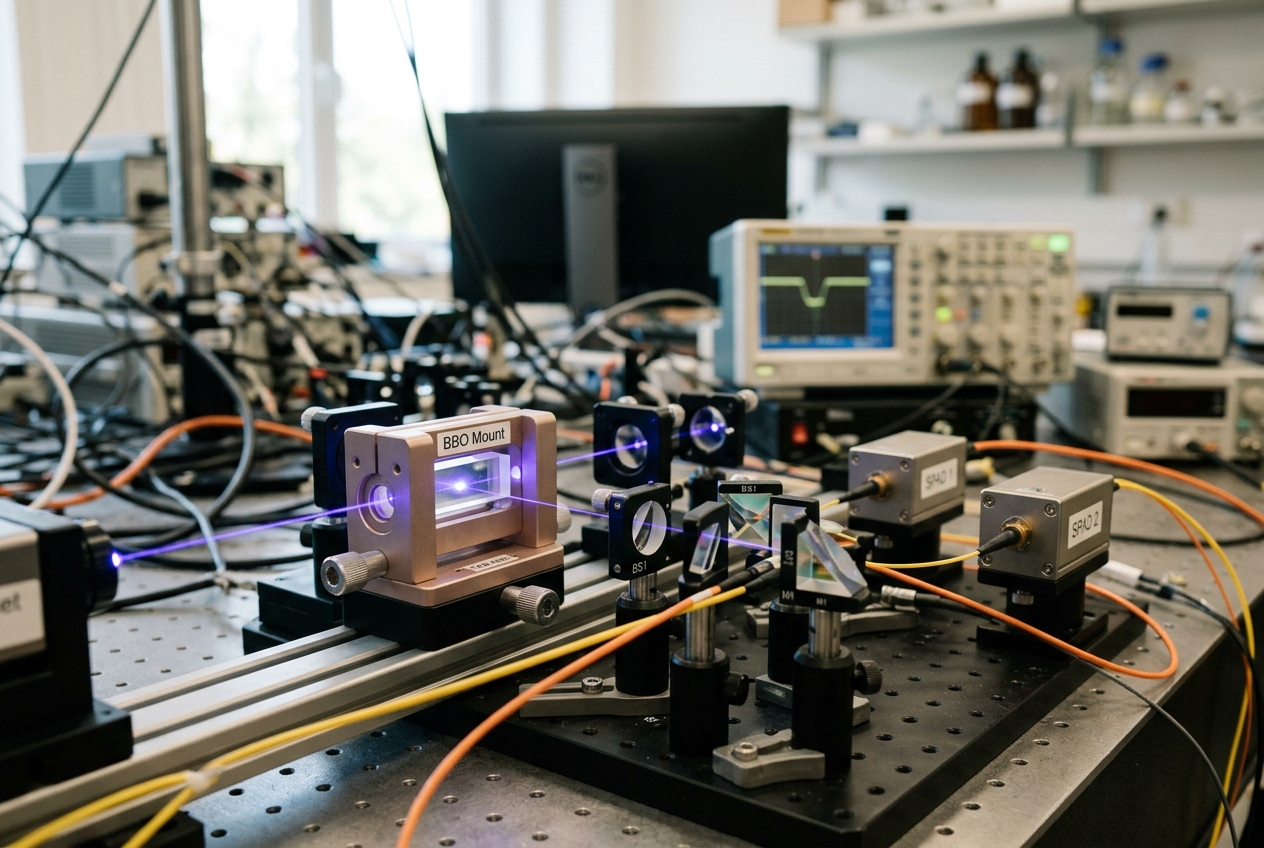
- Generation of Entanglement: A pulsed ultraviolet pump laser strikes a double slit (Slits $A$ and $B$). Directly behind the slits sits a nonlinear crystal of Beta-Barium Borate ($\beta\text{-BaB}_2\text{O}_4$ or BBO). Through a quantum optical process known as Spontaneous Parametric Down-Conversion (SPDC), a single incident UV photon decays into a pair of lower-energy, polarization-entangled photons: a signal photon and an idler photon.
- The Signal Photon: Sent directly to a primary detector, $D_0$, which sits on a motorized translation stage to record its spatial arrival position along an axis $x$. This path is short, so the signal photon always registers at $D_0$ first.
- The Idler Photon: Sent through a much longer optical path containing an array of prisms, mirrors, and symmetric (50:50) beam splitters. This geometric delay ensures that the idler photon reaches its final detection point approximately 7.7 nanoseconds after the signal photon has already registered at $D_0$.
The Mathematical State
When the photon pair is created at the two slits, its quantum state is described by an entangled superposition of emission from Slit $A$ and Slit $B$:
$$\lvert \Psi \rangle = \frac{1}{\sqrt{2}} \Big( \lvert s_A \rangle \lvert i_A \rangle + \lvert s_B \rangle \lvert i_B \rangle \Big)$$
Here, $\lvert s_A \rangle$ and $\lvert s_B \rangle$ represent the spatial quantum states of the signal photon emerging from Slits $A$ and $B$, while $\lvert i_A \rangle$ and $\lvert i_B \rangle$ represent the corresponding paths of the entangled idler photon.
Path Tracing and Which-Way Sorting
The idler photon travels toward an array of four single-photon detectors ($D_1, D_2, D_3, D_4$):
- Which-Way Preservation ($D_3$ and $D_4$): If the idler photon originated at Slit $A$, it encounters the 50% beam splitter $BSA$. If reflected, it directly strikes detector $D_3$. Similarly, if it originated at Slit $B$, it encounters $BSB$; if reflected, it strikes detector $D_4$. A click at $D_3$ unambiguously proves the photon came from Slit $A$; a click at $D_4$ proves it came from Slit $B$. When we examine the signal photon detections at $D_0$ that coincide with clicks at $D_3$ or $D_4$, no interference fringes exist—only a smooth, broad distribution.
- Quantum Erasure ($D_1$ and $D_2$): If the idler photon is transmitted through $BSA$ or $BSB$, mirrors redirect it into a final 50:50 symmetric beam splitter ($BS$). This final beam splitter thoroughly mixes the paths: an idler photon reaching detector $D_1$ or $D_2$ could have originated from Slit $A$ or Slit $B$ with equal 50% probability. The which-way information has been irrevocably erased.
When we isolate the signal photon arrivals at $D_0$ that correspond only to clicks at $D_1$ or $D_2$, distinct interference fringes re-emerge. The spatial intensity distribution recorded in coincidence with $D_1$ follows an oscillatory wave interference pattern:
$$I_{01}(x) \propto 1 + \cos\left( \frac{2\pi d}{\lambda L} x \right)$$
where $d$ is the slit separation, $\lambda$ is the photon wavelength, and $L$ is the focal distance. Crucially, the pattern recorded in coincidence with detector $D_2$ is phase-shifted by exactly $\pi$ radians ($180^\circ$):
$$I_{02}(x) \propto 1 - \cos\left( \frac{2\pi d}{\lambda L} x \right)$$
Because $D_1$ produces a peak wherever $D_2$ produces a trough, adding the two distributions together ($I_{01} + I_{02}$) yields a completely uniform, featureless bell curve.
Popular accounts often claim that detecting the idler photon at $D_1$ sends a signal backward in time to transform the signal photon from a particle into a wave. This is a profound misunderstanding. The raw signal photon data collected at $D_0$ never changes. It always looks like a formless, messy blob of points. The wave pattern only appears when you use a coincidence circuit to correlate $D_0$ detections with $D_1$ or $D_2$ detections.
The Analytical Proof: Density Matrix and the No-Signaling Theorem
To prove rigorously why no faster-than-light (superluminal) or backward-in-time signaling can occur, we employ the density matrix formalism. The global state of the entangled signal-idler pair is the pure state density operator $\rho = \lvert \Psi \rangle \langle \Psi \rvert$.
To determine what an observer at the signal detector $D_0$ measures locally—without access to the idler data—we take the partial trace over the idler photon's Hilbert space:
$$\rho_{\text{signal}} = \text{Tr}_{\text{idler}}(\lvert \Psi \rangle \langle \Psi \rvert) = \frac{1}{2} \Big( \lvert s_A \rangle \langle s_A \rvert + \lvert s_B \rangle \langle s_B \rvert \Big)$$
Notice that the off-diagonal interference terms—the cross-terms $\lvert s_A \rangle \langle s_B \rvert$ and $\lvert s_B \rangle \langle s_A \rvert$ that generate spatial wave fringes—have identically vanished!
The local density matrix of the signal photon is a statistical mixture of independent single-slit trajectories. No manipulation of the idler photon—whether absorbing it, measuring its path, or sending it through a hundred beam splitters—can alter $\rho_{\text{signal}}$. Causality is preserved, and the no-signaling theorem remains inviolable. For foundational derivations of partial traces and open quantum systems, consult the lecture notes from MIT OpenCourseWare Quantum Physics.
3. Real-World Applications Today (2024–2026)
Far from being merely an intellectual curiosity for debates over quantum interpretation, the physical principles governing quantum erasure—erasing path information to restore quantum coherence—form the technological backbone of twenty-first-century quantum information science.
1. Quantum Error Correction and Fault-Tolerant Computing
- Leading Institutions: IBM Quantum, Google Quantum AI, and Quantinuum.
- The Challenge: Quantum bits (qubits) are hypersensitive to environmental thermal noise, which destroys delicate superpositions and injects bit-flip and phase-flip errors.
- The Quantum Eraser Solution: In surface codes and stabilizer circuits, quantum computers perform syndrome measurements. Ancilla qubits interact with data qubits to extract information about whether an error occurred without measuring the actual data stored inside the qubit. By carefully entangling and then measuring the ancilla in a rotated basis, the circuit erases the error history while preserving the overarching quantum coherence of the computational state.
2. Device-Independent Quantum Key Distribution (DI-QKD)
- Leading Institutions: Toshiba Europe, ID Quantique, and the University of Geneva.
- The Challenge: Securing high-speed optical communications against eavesdroppers who possess arbitrary, theoretically unlimited computing power.
- The Quantum Eraser Solution: Modern entanglement-based QKD systems employ delayed measurement bases. If an adversary attempts an intercept-resend or side-channel attack, they inadvertently extract which-path information from the traveling photons. By randomly choosing to erase or measure path markers at the receiver stations, the communicating parties can detect eavesdropping through the destruction of Bell-inequality correlations, achieving mathematically proven security.
3. Topological State Verification in Quantum Matter
- Leading Institutions: Microsoft Quantum, QuTech, and the Harvard Quantum Initiative.
- The Challenge: Verifying the existence of non-Abelian anyons and topological Majorana zero modes in semiconductor-superconductor nanowires.
- The Quantum Eraser Solution: Topological quantum computing protects information globally rather than locally. Researchers use quantum-eraser-style interferometry to braid anyons. By measuring parity in complementary bases, they erase local environmental fluctuations, verifying that the quantum state has undergone topological phase transitions without collapsing the non-local topological memory.
4. Quantum Metrology and Imaging with Undetected Photons
- Leading Institutions: The Austrian Academy of Sciences (IQOQI Vienna) and the Nature Physics Quantum Information Community.
- The Challenge: High-resolution biological imaging of sensitive living tissues that degrade or die when exposed to high-energy optical illumination.
- The Quantum Eraser Solution: Utilizing SPDC entanglement configurations identical to the Kim et al. setup, scientists illuminate a biological sample with an infrared idler photon while detecting only its entangled visible signal counterpart. By erasing path markers across successive down-conversion crystals, an image of the specimen is reconstructed with dramatic contrast—even though the light hitting the camera never passed through the specimen itself.
4. What This Means for You
It is easy to look at diagrams of beam splitters and down-conversion crystals and feel that quantum mechanics belongs to a parallel reality disconnected from daily life. But the principles exposed by the delayed-choice quantum eraser directly shape the technological infrastructure of our immediate future.
+-------------------------------------------------------------------------+
|                  THE CORE TAKEAWAYS FOR THE DIGITAL CITIZEN             |
+-------------------------------------------------------------------------+
|  1. ABSOLUTE PRIVACY:                                                   |
|     Security no longer relies on hard math (which computers can crack), |
|     but on the laws of physics (which cannot be broken).                |
|                                                                         |
|  2. STABLE COMPUTING:                                                   |
|     Erasing error footprints enables scalable quantum supercomputers,   |
|     accelerating drug discovery and materials science.                  |
|                                                                         |
|  3. THE NATURE OF REALITY:                                              |
|     Information is not a passive human record; it is an active physical |
|     quantity that dictates how physical matter behaves.                 |
+-------------------------------------------------------------------------+
First, consider digital security and personal privacy. Current banking and authentication systems rely on mathematical complexity—problems like factoring massive prime numbers that classical supercomputers struggle to solve. But mathematical barriers are vulnerable to better algorithms and faster processors. Quantum technologies rooted in eraser mechanics do not rely on mathematical difficulty; they rely on the fundamental structure of information. If an intruder attempts to spy on an entanglement-secured communication link, their very presence creates a which-way record that instantly destroys quantum interference, alerting the network and neutralizing the intrusion before data can be stolen.
Second, consider the transformation of medicine and materials science. The molecular interactions that govern how a drug binds to a protein or how a catalyst splits water are quantum mechanical. Classical computers cannot accurately simulate these processes because tracking every quantum state requires an impossible amount of memory. Scalable quantum computers—made possible entirely by the quantum-eraser principles of syndrome error correction—will simulate chemistry at the subatomic level, cutting drug discovery timelines from decades to months.
Finally, the quantum eraser delivers a profound philosophical revelation about our place in the universe. Information is not merely an abstract concept stored in books or hard drives; it is an intrinsic physical property of the cosmos. The universe does not maintain a rigid, pre-determined script of classical attributes behind the scenes. Reality remains fluid, holding multiple possibilities open until an indelible mark is etched into the physical world.
5. Today's Takeaway
The delayed-choice quantum eraser proves that wave-particle duality is governed not by the mechanical intrusion of physical measuring instruments, but by the availability of information itself. If the universe retains the potential to know which path a particle took, that particle behaves like a classical bullet; if that which-way record is erased, wave-like interference returns without violating causality or sending messages backward in time. Far from an abstract paradox, this ability to erase, restore, and manipulate quantum coherence is the exact foundation upon which tomorrow's fault-tolerant quantum computers and tamper-proof global networks are being constructed.