Decoy-State Protocol: Neutralizing Photon-Number-Splitting Attacks in Practical Quantum Key Distribution
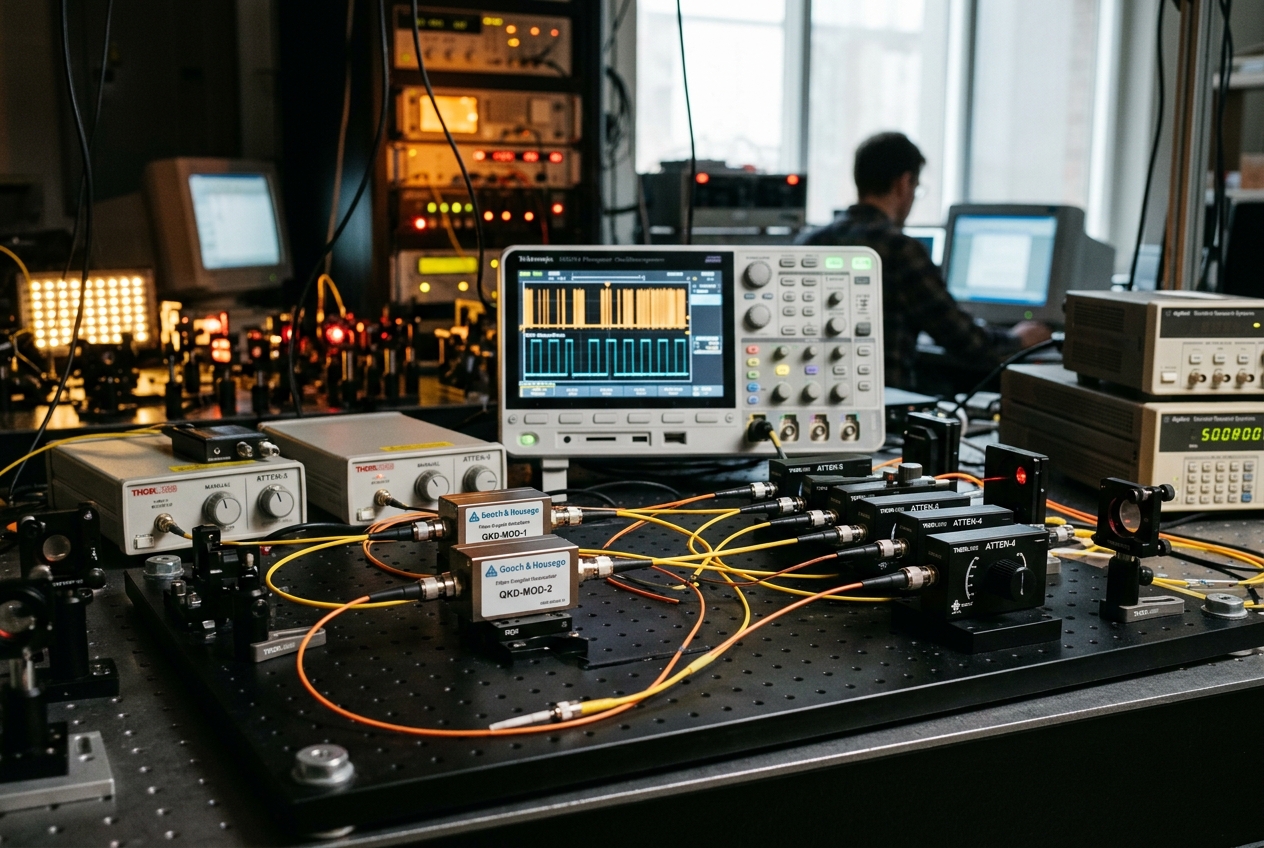
In response to this looming computational reckoning, physicists proposed a radical alternative: Quantum Key Distribution (QKD). Rather than relying on unproven mathematical complexity, QKD stakes its security on the fundamental laws of quantum mechanics. According to the Heisenberg uncertainty principle and the quantum no-cloning theorem, any attempt by an eavesdropper to measure or replicate an unknown quantum state inevitably alters that state, leaving an unmistakable signature of intrusion. In theory, QKD offers "information-theoretic security"—an encryption key whose secrecy is guaranteed by the structure of the universe itself.
However, when physicists stepped out of the blackboard realm of pure theory and into the noisy reality of experimental optics, they encountered a dangerous flaw. The original 1984 protocol, devised by Charles Bennett and Gilles Brassard (BB84), assumed that the sender could transmit information using ideal, single-photon pulses. In practice, true on-demand single-photon sources remain among the most elusive devices in modern experimental physics. Engineers had to compromise by using standard semiconductor laser diodes attenuated to faint intensities.
That compromise nearly destroyed the security promise of quantum cryptography. By emitting pulses that occasionally contained multiple photons, commercial QKD systems inadvertently handed eavesdroppers a master key: the Photon-Number-Splitting (PNS) attack. For nearly two decades, this vulnerability threatened to confine quantum cryptography to short, impractical distances.
The breakthrough that rescued quantum cryptography was not a multimillion-dollar hardware breakthrough, but an ingenious conceptual technique: the decoy-state protocol. By turning the eavesdropper’s own physical intervention into an inescapable statistical trap, decoy states transformed quantum key distribution from a fragile laboratory demonstration into a robust, global security architecture.
The Idea in Plain English: Trapping a Quantum Thief
To understand why quantum cryptography was vulnerable—and how decoy states cured it—imagine a secure courier service operating between two bank branches run by Alice and Bob.
In an ideal world, Alice communicates with Bob by sending couriers who carry exactly one fragile, wax-sealed envelope per trip. The wax seal is so delicate that if an eavesdropper, Eve, intercepts the courier, opening the envelope destroys the seal irreparably. When Bob receives a broken seal, he immediately phones Alice, and both discard the compromised secret.
In the real world, Alice does not have access to perfectly reliable couriers. Instead, she relies on an imperfect automated dispatch machine—an attenuated laser diode. Most of the time, the machine fires blanks, sending empty envelopes. About ten percent of the time, it successfully produces an envelope containing exactly one wax-sealed letter. But every so often, the machine glitches and accidentally places two or three identical carbon copies into the same envelope.
This imperfection creates an opportunity for Eve. Hiding along the optical fiber, Eve does not need to break the laws of physics or attempt to read the fragile single-letter envelopes. Instead, she acts as a selective filter. Whenever an envelope with a single letter arrives, she simply drops it into the gutter, pretending it was lost due to natural line friction. But whenever a multi-letter envelope arrives, Eve carefully removes one copy for herself, stores it in a secure locker (a quantum memory), and forwards the remaining envelope to Bob.
Because Bob still receives an intact envelope with an unbroken wax seal, he detects no errors. Furthermore, because real-world optical fibers naturally absorb light, Bob expects most signals to be lost along the way; he assumes the missing single-letter envelopes were simply absorbed by the glass. Once Alice and Bob finish their transmission, Alice publicly announces how Bob should read his letters. Eve then opens her stored copies and reads the exact secret key without ever revealing her presence. This is the essence of the Photon-Number-Splitting (PNS) attack.
+-----------------------------------------------------------------------------------+
|                        THE CORE INTUITION OF DECOY STATES                         |
|                                                                                   |
| Alice randomly varies the brightness (intensity) of her laser pulses without      |
| telling Eve. Because Eve cannot determine how many photons are inside a pulse     |
| without altering it, any attempt to selectively steal from multi-photon pulses    |
| inevitably distorts the transmission rates between bright and dim states.         |
| Eve's selective theft creates an unmistakable statistical anomaly that exposes   |
| her intervention instantly.                                                       |
+-----------------------------------------------------------------------------------+
The decoy-state method, proposed by Won-Young Hwang in 2003 and rigorously formalized by Hoi-Kwong Lo, Xiongfeng Ma, Kai Chen, and Xiang-Bin Wang in 2005, solves this problem through an elegant statistical tripwire. Alice deliberately and randomly modulates the intensity of her laser pulses between different brightness settings—typically a brighter "signal" state and one or two dimmer "decoy" states.
Crucially, Eve cannot tell whether an incoming pulse belongs to a signal state or a decoy state; she can only measure the total number of photons contained in that specific wavepacket. If Eve attempts her photon-splitting strategy, she will disproportionately suppress pulses that originally came from dim states (which contain almost exclusively single photons) while passing pulses from bright states (which contain more multi-photon events).
When Alice and Bob compare the overall detection rates across their different intensity settings at the end of the session, any mismatch from expected transmission statistics exposes Eve's intervention. Decoy states transform hardware imperfection from a fatal vulnerability into a transparent, monitored parameter.
How It Actually Works: The Mechanics and Mathematics
To grasp the quantitative elegance of the decoy-state method, one must first look at the mathematical nature of laser light. When a laser operates above its threshold, it emits a quantum state known as a coherent state, denoted in quantum optics as $|\alpha\rangle$. When physicists attenuate this beam using neutral-density optical filters to create weak pulses, the number of photons $n$ in any given pulse is not fixed; instead, it fluctuates according to a Poisson distribution.
1. The Poissonian Dilemma
If the average photon intensity per pulse is $\mu$, the probability $P_n(\mu)$ of finding exactly $n$ photons in that pulse is given by:
$$P_n(\mu) = \frac{\mu^n e^{-\mu}}{n!}$$
Here, $\mu$ represents the mean photon number, $n$ is the discrete photon count (where $n = 0, 1, 2, \dots$), and $e$ is Euler’s constant.
For a typical weak coherent source set to an intensity of $\mu = 0.5$, the statistical breakdown is revealing: * $P_0(0.5) \approx 60.65\%$ (the pulse is completely empty), * $P_1(0.5) \approx 30.33\%$ (a genuine single-photon state), * $P_{\ge 2}(0.5) \approx 9.02\%$ (a multi-photon state vulnerable to PNS attacks).
In standard silica optical fibers used in telecommunications, light attenuates at a rate of approximately $0.2 \text{ dB/km}$ at the standard telecommunications wavelength of $1550 \text{ nm}$. Over a distance of $100 \text{ kilometers}$, the optical channel experiences $20 \text{ dB}$ of loss, meaning that only $1\%$ of the transmitted light reaches Bob’s detectors.
If Eve replaces this lossy $100\text{-km}$ fiber with an ideal, lossless superconducting optical channel, she can selectively suppress all single-photon pulses while forwarding multi-photon pulses to Bob. Because multi-photon emissions account for nearly $9\%$ of all pulses, Eve can easily match the expected $1\%$ arrival rate at Bob’s end while reading every transmitted bit. Under standard BB84 protocol analysis, Alice and Bob would have to assume that every multi-photon pulse was intercepted, forcing their secure key rate to zero beyond roughly $20$ to $30 \text{ kilometers}$.
2. Formulating Gains and Error Rates
The decoy-state protocol neutralizes this attack by defining two fundamental observable quantities for each chosen intensity: the overall gain and the error gain.
Let Alice modulate her laser among several intensity levels: a signal state with intensity $\mu$, a weak decoy state with intensity $\nu$, and a vacuum state $\omega = 0$ (where $\mu > \nu > 0$).
When Alice transmits pulses with intensity $\mu$, the total probability that Bob registers a detection event—termed the overall gain $Q_\mu$—is the sum over all possible photon numbers of the yield $Y_n$ weighted by the Poisson emission probability:
$$Q_\mu = \sum_{n=0}^{\infty} Y_n P_n(\mu) = \sum_{n=0}^{\infty} Y_n \frac{\mu^n e^{-\mu}}{n!}$$
In this formulation, the yield $Y_n$ is the conditional probability that an $n$-photon pulse emitted by Alice results in a detection click at Bob’s receiver. This yield accounts for all physical channel properties: transmission loss through the fiber, coupling inefficiencies, and detector dark counts (spurious thermal clicks occurring when no light is present).
Similarly, we define the quantum bit error rate (QBER), denoted $E_\mu$. The product of the error rate and the overall gain—termed the error gain—represents the total probability of an erroneous click at Bob:
$$E_\mu Q_\mu = \sum_{n=0}^{\infty} e_n Y_n P_n(\mu) = \sum_{n=0}^{\infty} e_n Y_n \frac{\mu^n e^{-\mu}}{n!}$$
Here, $e_n$ represents the intrinsic error rate of an $n$-photon state. For background noise and detector dark counts ($n=0$), the error rate is completely random, such that $e_0 = 1/2$. For genuine optical signals ($n \ge 1$), $e_n$ is determined by optical misalignment in the interferometers, typically on the order of $1\%$ to $3\%$.
3. The Unbreakable Invariance Condition
The decisive mathematical insight established by researchers publishing in Physical Review Letters is the invariance of yields:
The Yield Invariance Principle: For any eavesdropper Eve interacting with the physical channel, the yield $Y_n$ and the error rate $e_n$ of an $n$-photon Fock state are strictly independent of the average intensity ($\mu, \nu, \omega$) of the source that generated it.
Because an $n$-photon state $|n\rangle$ carries no memory of whether it was created by an attenuated pulse of average brightness $\mu$ or average brightness $\nu$, Eve cannot treat an $n$-photon state from a signal pulse differently from an $n$-photon state from a decoy pulse without violating the laws of quantum mechanics.
By measuring the macroscopic parameters $Q_\mu, Q_\nu, Q_\omega$ and the associated error rates $E_\mu, E_\nu, E_\omega$ across thousands of pulses, Alice and Bob construct a set of linear equations.
In the practical vacuum + weak decoy-state method: 1. The vacuum state ($\omega = 0$) emits no photons ($P_0(0) = 1$, $P_{n>0}(0) = 0$), directly revealing the background dark count rate: $Y_0 = Q_0$. 2. The weak decoy state ($\nu$) provides an independent constraint on the single-photon yield $Y_1$ and two-photon yield $Y_2$. 3. By combining the linear expressions for $Q_\mu$ and $Q_\nu$, Alice and Bob calculate a rigorous analytical lower bound on the single-photon yield $Y_1$ and an upper bound on the single-photon error rate $e_1$.
Once $Y_1$ and $e_1$ are bounded, Alice and Bob apply the GLLP security formula (derived by Gottesman, Lo, Lütkenhaus, and Preskill) to compute the net asymptotic secret key generation rate $R$:
$$R \ge q \left{ P_1(\mu) Y_1 \left[ 1 - H_2(e_1) \right] - Q_\mu f(E_\mu) H_2(E_\mu) \right}$$
where $q$ is the protocol efficiency factor (typically $1/2$ for standard BB84 due to basis mismatch), $H_2(x) = -x \log_2(x) - (1-x)\log_2(1-x)$ is the binary Shannon entropy function, and $f(E_\mu) \ge 1$ is the error-correction inefficiency coefficient.
Because $Y_1$ can now be accurately estimated rather than pessimistically assumed to be zero, the secret key rate remains positive across massive distances, scaling linearly with channel transmittance rather than collapsing quadratically.
+-----------------------------------------------------------------------------------+
|                        FINITE-KEY FLUCTUATION ANALYSIS                            |
|                                                                                   |
| In real-world deployments, communication sessions transmit a finite number of     |
| pulses (e.g., N = 10^8 to 10^10). Finite sampling introduces statistical         |
| fluctuations. To prevent Eve from hiding within statistical deviations, modern    |
| protocols employ Chernoff bounds and Hoeffding's inequality to bound yields      |
| with failure probabilities below ε_sec ≤ 10^(-10), guaranteeing unconditional     |
| composable security.                                                              |
+-----------------------------------------------------------------------------------+
Real-World Applications Today (2024–2026)
The decoy-state protocol is not a theoretical curiosity; it is the operational engine powering nearly every production-grade quantum communication network in existence today. Researchers learning through platforms like MIT OpenCourseWare and IBM Quantum Learning will find decoy-state principles at the core of quantum network engineering.
Here are four major real-world domains where decoy-state QKD is actively safeguarding data:
1. Satellite-to-Ground Global Quantum Links
- Institution/Consortium: University of Science and Technology of China (USTC) / QuantumCTek
- Project: The Micius Quantum Satellite and low-Earth orbit constellations.
- The Mission: Terrestrial optical fiber absorbs light exponentially, creating a practical distance ceiling of a few hundred kilometers without quantum repeaters. Micius solved this by transmitting decoy-state pulses through the vacuum of space, where photon absorption is near zero.
- The Quantum Advantage: Using a dual-decoy state protocol ($\mu \approx 0.6$, $\nu \approx 0.2$, and vacuum), Micius achieved robust quantum key generation between an orbiting spacecraft moving at $7.6 \text{ km/s}$ and ground observatories over distances exceeding $1,200 \text{ kilometers}$. This established the world's first intercontinental quantum-encrypted video conference between Beijing and Vienna, proving that decoy-state methods can scale globally.
2. Commercial Banking and High-Frequency Financial Corridors
- Institution/Consortium: Toshiba Europe, British Telecom (BT), and HSBC
- Project: The London Metro Quantum Network.
- The Mission: Protecting daily multi-billion-pound foreign exchange transactions against "Harvest Now, Decrypt Later" operations, where malicious actors intercept and archive encrypted communications to decrypt once quantum hardware matures.
- The Quantum Advantage: Toshiba’s commercial QKD systems deploy high-speed gigahertz semiconductor transmitters running active three-intensity decoy-state protocols over standard commercial fiber infrastructure. By continuously multiplexing quantum decoy signals alongside dense classical data channels on the same physical fiber, Toshiba achieved sustained key generation rates in excess of megabits per second over tens of kilometers, enabling real-time quantum encryption of live financial data.
3. Pan-European Cross-Border Infrastructure
- Institution/Consortium: EuroQCI (European Quantum Communication Infrastructure) Initiative
- Project: Integrated European Quantum Backbone (spanning France, Germany, Spain, and Italy).
- The Mission: Establishing sovereign, continent-wide quantum-secured communication links to protect government data centers, energy distribution grids, and military commands across EU member states.
- The Quantum Advantage: EuroQCI testbeds leverage decoy-state BB84 protocols implemented with standard telecom-grade single-photon avalanche photodiodes (SPADs) and superconducting nanowire single-photon detectors (SNSPDs). By standardizing on finite-key decoy-state models vetted by national cybersecurity agencies, the network achieves composable security without requiring unproven single-photon emitters.
4. Critical Energy Grid and Industrial Telemetry
- Institution/Consortium: US Department of Energy (DoE), Argonne National Laboratory, and the Chicago Quantum Exchange
- Project: The Chicago Quantum Network.
- The Mission: Protecting supervisory control and data acquisition (SCADA) telemetry for civil electrical grids, nuclear generation facilities, and municipal water supplies from state-sponsored cyberattacks.
- The Quantum Advantage: Standard cryptography updates across remote substations often introduce latency and key-distribution bottlenecks. Decoy-state quantum links establish continuously refreshing one-time pads across metropolitan fiber loops, securing industrial control signals against both classical penetration and future quantum algorithmic decryption.
What This Means for You: The Personal Stake in Quantum Secrecy
To the average citizen, quantum key distribution might seem like an abstract exercise in high-energy physics, relevant only to intelligence agencies and academic laboratories. In reality, the security of your most intimate personal information is already bound to the success of these protocols.
Consider your personal data ecosystem: * Long-Term Medical Records and Genomic Sequences: Your genetic code will remain unchanged for your entire life—and will be shared by your children and grandchildren. If your sequenced DNA is intercepted in transit between a hospital and a cloud repository today, classical encryption may protect it for five or ten years. But when quantum computers break RSA and elliptic curves, that captured data will become an open book. * Financial and Identity Records: Mortgages, retirement pensions, legal trusts, and government identity registries require decades-long confidentiality guarantees that exceed the life expectancy of classical mathematical algorithms. * The "Harvest Now, Decrypt Later" Threat: Hostile intelligence services and criminal syndicates are systematically siphoning encrypted internet traffic from undersea cables and data hubs today. They do not need to read it right now; they are simply warehousing it until a cryptanalytically relevant quantum computer (CRQC) becomes available.
The decoy-state protocol provides the critical bridge that makes quantum-secured communication physically and commercially viable. By allowing ordinary telecommunication lasers to achieve the mathematical security of pure, individual photons, decoy states took quantum key distribution out of idealized physics equations and installed it into the physical fibers that underpin modern society. It ensures that when quantum computers finally arrive, the personal, financial, and civil data we transmitted decades earlier remains permanently beyond their reach.
Today's Takeaway
The decoy-state protocol is one of the most elegant conceptual triumphs in applied quantum mechanics: it turned the physical imperfection of laser sources from an existential security vulnerability into an inescapable statistical trap for eavesdroppers. By randomly varying the intensity of weak light pulses and monitoring the resulting yields, Alice and Bob force any eavesdropper attempting a photon-number-splitting attack to expose her own presence. In doing so, decoy states extended the reach of quantum key distribution from short laboratory benches to thousands of kilometers of fiber and open space, providing the foundation for an unhackable quantum internet.
Authoritative References & Further Reading
- Nature: Experimental Decoy-State Quantum Key Distribution Over Long Distance
- Wikipedia: Decoy State Protocol and Photon-Number Splitting
- Physical Review Letters: Decoy-State Quantum Key Distribution (Lo, Ma, & Chen)
- MIT OpenCourseWare: Quantum Information Science & Quantum Communication Systems
- IBM Quantum Learning & Qiskit: Fundamentals of Quantum Information
- arXiv: Practical Decoy-State Quantum Key Distribution Formalisms (quant-ph/0205099)