Quantum De Finetti Theorem: Decomposing Permutation-Symmetric States and Structuring Quantum Cryptographic Proofs
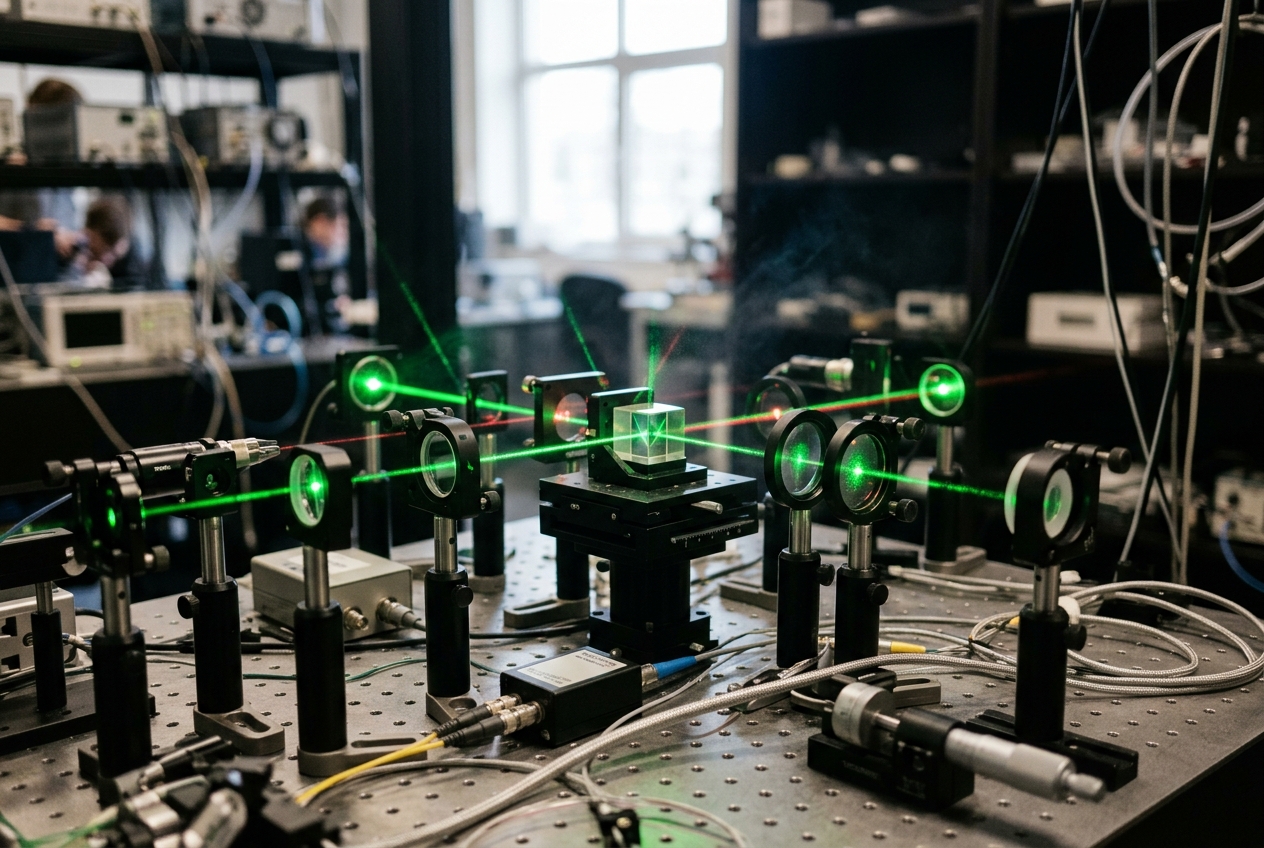
The modern world runs on the fragile assumption that certain mathematical puzzles are too exhausting for our computers to solve. When you check your bank balance, transmit medical records, or send an encrypted message, your privacy relies on algorithms such as RSA and elliptic-curve cryptography. These protocols do not offer physical immunity; they simply offer a head start, requiring classical supercomputers to grind through astronomical timelines to factor enormous numbers. A mature quantum computer threatens to vaporize that mathematical head start in an afternoon.
Physicists have long offered an antidote in the form of quantum key distribution (QKD), an encryption methodology grounded not in computational difficulty, but in the immutable laws of quantum mechanics. The promise is beguiling: if an eavesdropper attempts to intercept the secret key encoded on single photons, the very act of observation disturbs the quantum states, alerting the legitimate communicators immediately.
Yet, for decades, this ironclad promise was haunted by a terrifying mathematical nightmare known as the coherent attack. What if an adversary does not measure photons one by one, but instead entangles a colossal, multi-particle quantum memory across every single photon transmitted over weeks, waiting to perform one hyper-complex, collective measurement across the entire message? Proving security against such an omniscient, conspiratorial adversary seemed almost hopelessly intractable. The mathematics required to analyze every conceivable entangled configuration in an infinite-dimensional space was an insurmountable labyrinth.
The breakthrough that neutralized this existential threat came not from designing better lasers or more sensitive photodetectors, but from an exquisite piece of mathematical physics: the Quantum de Finetti Theorem. By exploiting the fundamental power of symmetry, this theorem proves that even the most devious, globally entangled quantum states look—for all practical purposes—like simple, independent, and identically distributed particles. It is the mathematical cornerstone that transforms quantum cryptography from a theoretical curiosity into a verifiably unbreakable reality.
The Idea in Plain English
To understand how symmetry tames quantum complexity, we must first travel back to classical probability theory and the work of Italian statistician Bruno de Finetti.
Imagine you are handed a bag containing an unknown mixture of black and white marbles. You draw a marble, record its colour, place it back, shake the bag, and repeat the process a thousand times. Even if you do not know the exact ratio of black to white marbles beforehand, you know one crucial fact: the order in which the marbles appear does not change the overall statistical likelihood of the sequence. Drawing three white marbles followed by two black marbles is just as likely as drawing two black followed by three white. This property is known as exchangeability or permutation symmetry.
Classical Exchangeability:
Order of extraction does not alter joint probability distribution:
P(X_1, X_2, ..., X_n) = P(X_π(1), X_π(2), ..., X_π(n))
In 1937, de Finetti proved a theorem: whenever a sequence of random variables is infinitely exchangeable, the variables behave as if they were drawn independently from a single, fixed probability distribution, averaged over all possible parameter values. You do not need to model complex, hidden interdependencies across hundreds of draws; the symmetry of the process guarantees that the draws are conditionally independent and identically distributed (i.i.d.).
Now, translate this idea into the quantum arena. In quantum information science, our "coins" are quantum bits, or qubits. Unlike a classical coin that must land strictly on heads or tails, a qubit can exist in a superposition of both states until it is measured. Even more profoundly, multiple qubits can be woven together via quantum entanglement—a non-local correlation so intimate that measuring one qubit instantaneously dictates the state of its partner, regardless of the spatial distance separating them.
If an eavesdropper attacks a sequence of $n$ qubits sent across an optical fibre, she could theoretically weave an intricate web of entanglement linking every single particle together. Analyzing such an arbitrarily entangled state is a mathematical impossibility; the number of parameters required to describe the joint state grows exponentially with the number of qubits.
Here is where the quantum de Finetti principle works its magic. If the sender and receiver randomly shuffle the order of their transmitted qubits—or test random subsets to ensure that swapping any two particles leaves the overall statistical properties unchanged—they impose permutation symmetry onto the system. The quantum de Finetti theorem proves that if you extract a smaller subset of $k$ qubits from a large, permutation-symmetric pool of $n$ qubits, that subset is nearly indistinguishable from a simple, unentangled mixture of identical, independent states. Symmetry dismantles the adversary's complex entanglement, reducing a global conspiracy to a collection of isolated, manageable events.
How It Actually Works — The Mechanics
To appreciate the theoretical depth of this principle, we must examine why translating de Finetti's insight from classical statistics to quantum mechanics occupied mathematical physicists for over three decades.
+-------------------------------------------------------------------------------+
|                        THE DE FINETTI REDUCTION HIERARCHY                     |
|                                                                               |
|  1. Classical de Finetti (1937)                                               |
|     P_n(x_1,...,x_n) = ∫ P_θ(x_1)...P_θ(x_n) dμ(θ)                           |
|     (Requires infinite exchangeability; non-contextual probability)           |
|                                                                               |
|  2. Infinite Quantum de Finetti (Størmer 1969; Hudson & Moody 1976)           |
|     ρ_k = ∫ σ^⊗k dμ(σ)                                                        |
|     (Requires infinitely extendible symmetric density matrices)               |
|                                                                               |
|  3. Finite Quantum de Finetti (Christandl, König, Mitchison, Renner 2007)      |
|     || Tr_{n-k}(ρ_n) - ∫ σ^⊗k dμ(σ) ||_1 ≤ 2kd / n                           |
|     (Quantitative error bound depending on subsystem dimension d)             |
|                                                                               |
|  4. Exponential de Finetti & Post-Selection (Christandl, König, Renner 2009)  |
|     ρ_n ≤ (n+d-1 choose n) ∫ σ^⊗n dσ                                          |
|     (Reduces coherent eavesdropping to i.i.d. collective attacks)             |
+-------------------------------------------------------------------------------+
The Quantum Obstacle: Entanglement and Non-Commutativity
In classical probability, random variables are represented by functions over a sample space, where values commute unconditionally ($a \cdot b = b \cdot a$). In quantum theory, physical states are represented by density matrices (positive semi-definite operators of trace one) acting on a complex Hilbert space $\mathcal{H}$, as explored in foundational curricula like MIT OpenCourseWare Quantum Physics.
Because quantum operators do not necessarily commute, and because quantum states admit entanglement, two particles can be correlated in ways that have no classical analogue. For instance, consider two qubits in the maximally entangled Bell state:
$$\lvert \Phi^+ \rangle = \frac{1}{\sqrt{2}} (\lvert 00 \rangle + \lvert 11 \rangle)$$
This state is symmetric under particle exchange (swapping qubit 1 and qubit 2 leaves the state invariant). However, the state of the two qubits is fundamentally entangled; it cannot be written as a product of individual states $\sigma \otimes \sigma$, nor as a convex sum of independent product states. If classical de Finetti logic held unconditionally for small finite systems, symmetric states would always decompose into independent product mixtures. The Bell state demonstrates why a finite quantum generalization is inherently non-trivial.
Infinite Exchangeability: The Størmer-Hudson-Moody Theorem
The first rigorous quantum extensions addressed infinite sequences of systems. Erling Størmer (in 1969, within the framework of $C^$-algebras) and later Robin Hudson and Philip Moody (in 1976, for quantum probability) proved what is known as the Infinite Quantum de Finetti Theorem*.
Let $\rho$ be a state on an infinite tensor product of identical Hilbert spaces $\mathcal{H}^{\otimes \infty}$. The state is defined as exchangeable if it is invariant under any finite permutation of the tensor factors:
$$U_\pi \rho U_\pi^\dagger = \rho \quad \text{for all } \pi \in S_\infty$$
The Størmer-Hudson-Moody theorem establishes that any such infinitely exchangeable quantum state can be uniquely represented as a convex integral over pure, independent, and identically distributed (i.i.d.) product states:
$$\rho_k = \operatorname{Tr}{\mathcal{H}^{\otimes \infty} \setminus \mathcal{H}^{\otimes k}}(\rho) = \int{\mathcal{S}(\mathcal{H})} \sigma^{\otimes k} \, d\mu(\sigma)$$
Here, $\mathcal{S}(\mathcal{H})$ denotes the set of density operators on $\mathcal{H}$, and $\mu$ is a classical probability measure over this state space.
This result was mathematically profound, but physically incomplete. In the physical universe, no experimenter transmits an infinite sequence of photons. We deal strictly with finite systems: an optical transmitter sends $n = 10^8$ pulses, and an eavesdropper interacts with this finite collection. Because finite exchangeable states can harbor residual entanglement (as seen in the two-qubit Bell state), an infinite theorem cannot guarantee the safety of finite communication protocols.
The Finite Quantum de Finetti Theorem
The modern era of quantum information theory was transformed in 2007 when Matthias Christandl, Robert König, Graeme Mitchison, and Renato Renner formulated the Finite Quantum de Finetti Theorem. They asked: if we have a state $\rho_n$ acting on $n$ subsystems that is invariant under permutations, how close is its reduced state on $k$ subsystems ($k < n$) to a convex combination of independent product states?
They measured this closeness using the trace distance (denoted by $|\cdot|_1$), which quantifies the maximum possible probability that any physical measurement could distinguish between two quantum states. Their central result established an explicit, quantitative bound:
$$\left| \operatorname{Tr}{n-k}(\rho_n) - \int{\mathcal{S}(\mathcal{H})} \sigma^{\otimes k} \, d\mu(\sigma) \right|_1 \le \frac{2kd}{n}$$
Let us unpack what this formula predicts in plain language: * The left side calculates the physical distinguishability between the real, potentially entangled state of $k$ particles and an idealized classical mixture of identical product states $\sigma^{\otimes k}$. * The right side provides a strict upper bound on this distinguishability, governed by three parameters: the number of particles you keep ($k$), the Hilbert space dimension of each particle ($d$, which is $2$ for qubits), and the total size of the original symmetric pool ($n$).
The Exponential de Finetti Theorem and Post-Selection
While the trace-distance bound of Christandl et al. was revolutionary, the linear dimension factor $d$ becomes problematic when subsystems are large or continuous. To provide an even sharper tool for cryptography, Christandl, König, and Renner introduced the Post-Selection Technique (often termed the Exponential Quantum de Finetti Theorem).
Instead of tracing out a large fraction of the systems and accepting an approximation error, the post-selection technique compares an arbitrary permutation-symmetric state $\rho_n$ directly against a canonical de Finetti target state $\tau_n$ on the entire symmetric subspace $\operatorname{Sym}(\mathcal{H}^{\otimes n})$. They proved that for any permutation-invariant state $\rho_n$, there exists an operator inequality:
$$\rho_n \le g(n, d) \int_{\mathcal{S}(\mathcal{H})} \sigma^{\otimes n} \, d\sigma$$
where $g(n, d) = \binom{n + d^2 - 1}{n} \le (n + 1)^{d^2 - 1}$ is a polynomial factor representing the dimension of the space of symmetric operators.
This result is the ultimate cryptographic lever. In cryptography, if a security property holds for an i.i.d. state $\sigma^{\otimes n}$ with an exponentially small failure probability $\epsilon$, the post-selection technique guarantees that the same security property holds for any arbitrary, globally entangled symmetric state $\rho_n$, with a failure probability increased by at most the polynomial factor $(n+1)^{d^2-1}$.
This single mathematical mechanism reduced the daunting task of proving security against arbitrary coherent attacks (where the eavesdropper entangles all signals together) to analyzing simple collective attacks (where the eavesdropper interacts with each qubit independently).
Real-World Applications Today
The quantum de Finetti theorem is not merely an abstract mathematical curiosity; it is an active engineering and theoretical workhorse driving modern quantum technologies between 2024 and 2026.
+--------------------------------------------------------------------------------+
|                   APPLICATIONS OF THE QUANTUM DE FINETTI THEOREM               |
+--------------------------------------------------------------------------------+
| 1. Quantum Key Distribution (QKD)                                              |
|    • Organizations: Toshiba Europe, ID Quantique, QuantumCTek                  |
|    • Function: Compresses coherent eavesdropping security proofs to i.i.d.     |
+--------------------------------------------------------------------------------+
| 2. Device-Independent QKD (DI-QKD)                                             |
|    • Organizations: ETH Zurich, Oxford Quantum, University of Geneva           |
|    • Function: Certifies untrusted hardware via de Finetti-based Bell tests    |
+--------------------------------------------------------------------------------+
| 3. Quantum State Tomography & Shadow Estimation                                |
|    • Organizations: IBM Quantum, NIST Boulder                                  |
|    • Function: Bounds sample complexity for characterizing multi-qubit chips   |
+--------------------------------------------------------------------------------+
| 4. Multi-Party Entanglement Verification                                       |
|    • Organizations: Max Planck Institute of Quantum Optics, Harvard Quantum    |
|    • Function: Distinguishes macro-entanglement from separable thermal mixtures|
+--------------------------------------------------------------------------------+
1. Security Proofs for Commercial Quantum Key Distribution
- Key Players: Toshiba Europe Quantum Information Group, ID Quantique, QuantumCTek.
- The Objective: Deploy commercial, metropolitan-scale fiber-optic QKD networks capable of transmitting provably secure cryptographic keys at gigabit rates over hundreds of kilometres.
- The Quantum Advantage: Prior to de Finetti reductions, security proofs against general coherent attacks required massive, conservative error margins that drastically reduced the final secret key generation rate. By applying the post-selection technique, engineers can calculate tight, realistic key rates. The theorem mathematically guarantees that testing a small fraction of the transmitted pulses certifies the security of the entire stream, enabling high-rate key transmission across real-world telecom networks.
2. Device-Independent Quantum Key Distribution (DI-QKD)
- Key Players: ETH Zurich (Renner Group), University of Oxford, University of Geneva.
- The Objective: Achieve cryptographic security without trusting the manufacturing integrity of the quantum devices themselves. Even if the photon source or detectors were constructed by a malicious competitor, the system must remain secure.
- The Quantum Advantage: DI-QKD protocols rely on violating Bell's inequalities. However, proving that an adversary cannot exploit memory effects across successive rounds of a Bell experiment was historically an intractable problem. Variants of the quantum de Finetti theorem (such as the Entropy Accumulation Theorem, its direct theoretical descendant) allow researchers to treat sequential, non-independent Bell trials as if they were independent iterations, proving security for fully device-independent setups recently demonstrated in flagship optical laboratories.
3. Quantum State Tomography and Sample Complexity
- Key Players: IBM Quantum Learning, National Institute of Standards and Technology (NIST).
- The Objective: Efficiently verify and benchmark the output states generated by 100+ qubit noisy intermediate-scale quantum (NISQ) processors.
- The Quantum Advantage: Full quantum state tomography requires a number of measurements that scales exponentially with the number of qubits ($2^N$). However, when characterising permutation-invariant states or benchmarking quantum memories, the finite quantum de Finetti theorem places rigorous mathematical bounds on sample complexity. It guarantees that an engineer only needs to perform a polynomial number of measurements on small subsystems to accurately estimate the macroscopic fidelity of the full system, drastically reducing calibration overhead on modern quantum hardware.
4. Entanglement Verification in Quantum Many-Body Systems
- Key Players: Max Planck Institute of Quantum Optics (MPQ), Harvard Quantum Initiative.
- The Objective: Certify genuine multi-particle entanglement in ultracold atomic gases and optical tweezers containing thousands of neutral atoms.
- The Quantum Advantage: Determining whether a cloud of $10^4$ rubidium atoms is genuinely entangled or merely occupying a classical thermal mixture is mathematically challenging. Because cold atomic ensembles exhibit natural permutation symmetry, researchers use de Finetti representation bounds to establish strict mathematical inequalities. If an experimental witness measurement exceeds the bound allowed for any convex mixture of product states $\int \sigma^{\otimes k} d\mu(\sigma)$, genuine multi-particle entanglement is mathematically guaranteed.
What This Means for You
It is easy to dismiss the quantum de Finetti theorem as an esoteric theorem buried inside mathematical physics journals. Yet its consequences directly safeguard the future of your personal digital life.
Consider the sensitive data you generate every day: your medical history, your biometric identity, bank transactions, and diplomatic correspondence. Much of this data is subject to what intelligence agencies call "Harvest Now, Decrypt Later" attacks. Hostile actors intercept and store vast quantities of encrypted internet traffic today, anticipating the day when a fault-tolerant quantum computer will allow them to decrypt it retroactively.
If the security of future communication networks rested entirely on classical algorithms, our privacy would exist on borrowed time. Quantum key distribution provides an absolute physical defense, but QKD is only as reliable as the mathematical proofs that certify its security.
Without the Quantum de Finetti Theorem, security engineers would have been forced to introduce unprovable assumptions or accept ultra-conservative key generation rates that would make quantum networks too sluggish for practical use. The theorem bridges the gap between clean physical theory and messy real-world engineering. It guarantees that when you swipe your card or transfer sensitive data across a quantum-secured network, no adversary—regardless of how sophisticated their quantum supercomputer or coherent eavesdropping strategy—can silently clone your cryptographic keys.
Today's Takeaway
Authoritative References & Further Study
- Renner, R. "Security of Quantum Key Distribution." PhD Thesis, ETH Zurich (arXiv:quant-ph/0512258)
- Christandl, M., König, R., Mitchison, G., & Renner, R. "Postselection Technique for Quantum Channels with Applications to Quantum Cryptography." Phys. Rev. Lett. (2009)
- Nature Review on Quantum Cryptography & Communication Networks
- MIT OpenCourseWare: Quantum Information Science & Quantum States
- IBM Quantum Learning: Foundations of Quantum Information & Tomography
- Wikipedia: Bruno de Finetti's Representation Theorem