Calderbank-Shor-Steane Codes: Constructing Fault-Tolerant Quantum Memory From Classical Dual Linear Codes
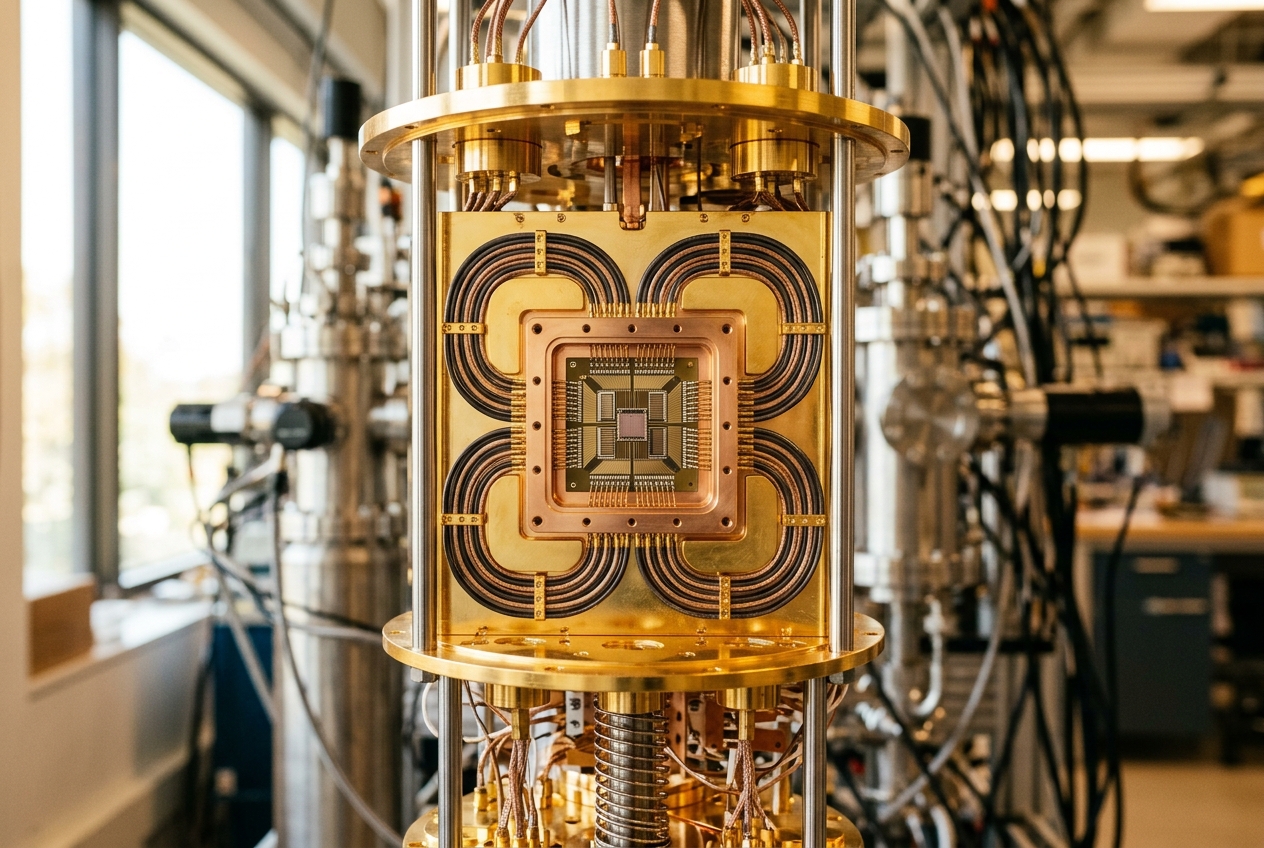
Opening Hook — Why You Should Care
The digital foundation of modern civilization rests upon mathematical problems designed to be intractable. Every encrypted transaction securing online banking, state intelligence, medical repositories, and global supply chains relies on public-key cryptographic architectures, such as RSA and elliptic-curve cryptography, that would demand millions of years of computation from the world's most powerful classical supercomputers. Yet a fault-tolerant quantum computer executing Shor's algorithm could dismantle these mathematical ramparts in a matter of hours. Beyond cryptography, the ability of quantum machines to natively simulate the quantum mechanical behavior of matter promises to revolutionize molecular chemistry, catalyzing room-temperature superconductors, dramatically more efficient solar cells, and synthetic pathways for nitrogen fixation that could transform global agriculture.
However, a formidable physical barrier stands between theoretical quantum algorithms and physical reality: quantum decoherence. Quantum information is extraordinarily fragile. Stray magnetic fluctuations, microkelvin thermal vibrations, and cosmic rays continually corrupt the delicate superpositions and entanglements within quantum processors. In classical computing, a bit flipped by stray electrical noise is easily protected by redundancy—simply copying the bit multiple times and taking a majority vote. In the quantum realm, fundamental laws of physics forbid copying unknown quantum states, while the act of measuring a quantum state destroys the very superposition holding the computation.
Calderbank-Shor-Steane (CSS) codes, formulated independently by Robert Calderbank and Peter Shor, and Andrew Steane in 1996, represent the theoretical breakthrough that solved this fundamental impasse. By mapping the deep algebraic structure of classical linear error-correcting codes into quantum stabilizer spaces, CSS codes established that quantum information can be protected indefinitely without ever measuring—and therefore destroying—the encoded data. Today, CSS codes form the mathematical bedrock of nearly every scalable quantum computing architecture on Earth.
The Idea in Plain English
To understand why protecting quantum information is uniquely challenging, consider the difference between a classical light switch and a spinning coin. A classical bit is a switch: it is either completely off (0) or completely on (1). If an error occurs, the switch flips from 0 to 1 or vice versa. Correcting this requires only measuring the switch and flipping it back.
A quantum bit, or qubit, behaves instead like a coin spinning dynamically on a tabletop. At any given moment, its state is a continuous blend—a quantum superposition—of both heads ($|0\rangle$) and tails ($|1\rangle$). Furthermore, the coin possesses a relative orientation or quantum phase, representing the exact angle of its spin relative to a clock face. Consequently, quantum information is susceptible to two distinct classes of degradation:
- Bit-Flip Errors ($X$-errors): The physical equivalent of the coin toppling onto the wrong face ($|0\rangle \leftrightarrow |1\rangle$).
- Phase-Flip Errors ($Z$-errors): The coin continues spinning on its edge, but its rotational timing shifts out of phase, altering the sign of the quantum superposition ($|0\rangle + |1\rangle \leftrightarrow |0\rangle - |1\rangle$).
Classical Bit Error:
[ 0 ] ------------ Bit Flip ------------> [ 1 ]

Quantum Qubit Errors:
[ α|0⟩ + β|1⟩ ] -- Bit Flip (X) --------> [ α|1⟩ + β|0⟩ ]
[ α|0⟩ + β|1⟩ ] -- Phase Flip (Z) ------> [ α|0⟩ - β|1⟩ ]
[ α|0⟩ + β|1⟩ ] -- Combined (Y = iXZ) --> [ iα|1⟩ - iβ|0⟩ ]
Two profound quantum principles prevent the naive application of classical error correction: - The No-Cloning Theorem (Wootters & Zurek, 1982) proves mathematically that it is impossible to create an identical copy of an arbitrary, unknown quantum state. We cannot simply duplicate a qubit three times to protect it. - Wavefunction Collapse dictates that directly observing a spinning coin forces it instantly to land on either heads or tails, irreversibly annihilating the continuous quantum amplitudes $\alpha$ and $\beta$ that encode the computation.
The genius of CSS codes lies in indirect parity measurements. Instead of inspecting individual physical qubits, the system entangles multiple physical qubits into collective configurations and measures only their relative parity—asking questions such as: "Do these two qubits have the same or opposite orientation?" without revealing what that orientation is.
By employing pairs of classical linear codes that satisfy an exact algebraic orthogonality condition, CSS codes decouple the detection of bit-flip errors from phase-flip errors. This allows two independent classical decoding algorithms to diagnose and correct quantum errors simultaneously, effectively quantizing continuous physical noise into discrete, fixable events.
How It Actually Works — The Mechanics & Algebraic Foundations
To appreciate the mathematical architecture of CSS codes, we begin with the algebra of classical linear block codes over the Galois field of two elements, $\mathbb{F}_2 = {0, 1}$.
1. Classical Linear Codes and Dual Spaces
A classical binary linear code $C$ with parameters $[n, k, d]$ is a $k$-dimensional linear subspace of the $n$-dimensional vector space $\mathbb{F}_2^n$. The code encodes $k$ logical bits into $n$ physical bits, with a minimum Hamming distance $d$ representing the minimum number of bit differences between any two distinct codewords.
The code $C$ is uniquely characterized by: - A Generator Matrix $G \in \mathbb{F}_2^{k \times n}$, whose rows form a basis for $C$, such that any codeword $c \in C$ is generated by $c = m G$ for an information vector $m \in \mathbb{F}_2^k$. - A Parity-Check Matrix $H \in \mathbb{F}_2^{(n-k) \times n}$, satisfying the kernel condition: $$C = {x \in \mathbb{F}_2^n \mid H x^T = 0 \pmod 2}$$
The Dual Code $C^\perp$ is the orthogonal complement of $C$ with respect to the standard binary inner product $u \cdot v = \sum_{i=1}^n u_i v_i \pmod 2$: $$C^\perp = {y \in \mathbb{F}_2^n \mid x \cdot y = 0 \pmod 2, \; \forall x \in C}$$
The dual code $C^\perp$ has parameters $[n, n-k, d^\perp]$, where the generator matrix of $C^\perp$ is the parity-check matrix $H$ of $C$, and vice versa: $G H^T = 0 \pmod 2$.
Classical Linear Code Duality:
   Codewords (Subspace C) ⊆ F₂ⁿ   <====== Orthogonal ======>   Dual Space C^⊥ ⊆ F₂ⁿ
   Dimension: k                                                Dimension: n - k
   Check condition: H xᵀ = 0                                   Check condition: G yᵀ = 0
2. The Quantum Stabilizer Formalism and Commutation Constraints
In quantum mechanics, multi-qubit errors are operators in the $n$-qubit Pauli Group $\mathcal{G}_n = {\pm 1, \pm i} \times {I, X, Y, Z}^{\otimes n}$. The single-qubit Pauli operators satisfy algebraic anti-commutation relations: $$X = \begin{pmatrix} 0 & 1 \ 1 & 0 \end{pmatrix}, \quad Z = \begin{pmatrix} 1 & 0 \ 0 & -1 \end{pmatrix}, \quad Y = iXZ = \begin{pmatrix} 0 & -i \ i & 0 \end{pmatrix}$$ where $X Z = -Z X$.
In the stabilizer formalism, a quantum code subspace $V \subseteq (\mathbb{C}^2)^{\otimes n}$ is defined as the joint $+1$ eigenspace of an abelian subgroup $S \subset \mathcal{G}_n$ that does not contain $-I$: $$V = {|\psi\rangle \in (\mathbb{C}^2)^{\otimes n} \mid M |\psi\rangle = |\psi\rangle, \; \forall M \in S}$$
For $S$ to be abelian, every pair of stabilizer generators $M_i, M_j \in S$ must commute: $[M_i, M_j] = 0$.
A general Pauli operator acting on $n$ qubits can be expressed up to a global phase as $P(u, v) = X^{u_1} Z^{v_1} \otimes X^{u_2} Z^{v_2} \otimes \cdots \otimes X^{u_n} Z^{v_n}$, mapped to a binary vector $(u \mid v) \in \mathbb{F}_2^{2n}$. Two Pauli operators $P(u, v)$ and $P(u', v')$ commute if and only if their symplectic inner product vanishes: $$u \cdot v' + u' \cdot v = 0 \pmod 2$$
3. The Calderbank-Shor-Steane (CSS) Construction
CSS codes simplify this symplectic structure by separating stabilizer generators strictly into pure $X$-type operators and pure $Z$-type operators.
Let $C_1$ and $C_2$ be two classical binary linear codes with parameters $[n, k_1, d_1]$ and $[n, k_2, d_2]$ respectively, such that the dual of $C_2$ is a subcode of $C_1$: $$C_2^\perp \subseteq C_1 \quad (\text{or equivalently, } C_1^\perp \subseteq C_2)$$ The quantum CSS code, denoted $\text{CSS}(C_1, C_2)$, is an $[[n, k, d]]$ quantum stabilizer code defined by: - Parity-check matrix for $X$-type stabilizers: $H_X = H(C_2) \in \mathbb{F}_2^{(n-k_2) \times n}$ - Parity-check matrix for $Z$-type stabilizers: $H_Z = H(C_1) \in \mathbb{F}_2^{(n-k_1) \times n}$
For every row $h_X \in H_X$ (generating an $X$-stabilizer $M_X = X^{h_X}$) and every row $h_Z \in H_Z$ (generating a $Z$-stabilizer $M_Z = Z^{h_Z}$), the commutation condition $[M_X, M_Z] = 0$ requires: $$h_X \cdot h_Z = 0 \pmod 2 \implies H_X H_Z^T = 0 \pmod 2$$
Because $C_2^\perp \subseteq C_1$, every row of $H(C_2)$ belongs to $C_2^\perp \subseteq C_1 = \ker(H(C_1))$. Thus, every row of $H_X$ is orthogonal to every row of $H_Z$, guaranteeing that all stabilizer generators commute unconditionally.
4. Logical State Basis and Parameter Derivation
The logical subspace is spanned by quantum superpositions over cosets of $C_2^\perp$ in $C_1$. For any codeword $x \in C_1$, the corresponding quantum basis state $|x + C_2^\perp\rangle_L$ is defined as: $$|x + C_2^\perp\rangle_L = \frac{1}{\sqrt{|C_2^\perp|}} \sum_{y \in C_2^\perp} |x \oplus y\rangle$$
- Invariance under $X$-stabilizers: For any $h_X \in C_2^\perp$, the operator $X^{h_X}$ acts on the basis state as: $$X^{h_X} |x + C_2^\perp\rangle_L = \frac{1}{\sqrt{|C_2^\perp|}} \sum_{y \in C_2^\perp} |x \oplus y \oplus h_X\rangle = |x + C_2^\perp\rangle_L$$ since shifting the summation index by $h_X \in C_2^\perp$ simply permutes the elements of $C_2^\perp$.
- Invariance under $Z$-stabilizers: For any $h_Z \in C_1^\perp$, the operator $Z^{h_Z}$ introduces phases $(-1)^{h_Z \cdot (x \oplus y)}$. Since $x \in C_1$ and $y \in C_2^\perp \subseteq C_1$, both $x$ and $y$ are orthogonal to $h_Z \in C_1^\perp$. Thus, $h_Z \cdot (x \oplus y) = 0 \pmod 2$, yielding eigenvalue $+1$.
Code Parameters $[[n, k, d]]$: 1. Physical Qubits ($n$): Equal to the block length $n$ of the classical codes. 2. Logical Qubits ($k$): The number of independent cosets of $C_2^\perp$ in $C_1$ is $|C_1| / |C_2^\perp| = 2^{k_1} / 2^{n - k_2} = 2^{k_1 + k_2 - n}$. Therefore: $$k = k_1 + k_2 - n = k_1 - (n - k_2) = \dim(C_1) - \dim(C_2^\perp)$$ 3. Quantum Distance ($d$): A logical Pauli operator must commute with all stabilizers without belonging to the stabilizer group itself. Logical $Z$ operators correspond to vectors in $C_1 \setminus C_2^\perp$, while logical $X$ operators correspond to vectors in $C_2 \setminus C_1^\perp$. The minimum weight required to perform a non-trivial logical operation is bounded by: $$d \ge \min(d(C_1), d(C_2))$$
5. Decoupled Syndrome Measurement and Independent Decoding
The structural separation of $H_X$ and $H_Z$ allows error syndromes to be extracted independently: - An arbitrary Pauli error $E = X^{e_X} Z^{e_Z}$ corrupts the state. - Measuring $Z$-stabilizers $M_Z = Z^{h_Z}$ measures the bit-flip error vector $e_X \in \mathbb{F}_2^n$, producing the binary syndrome: $$s_Z = H_Z e_X^T = H(C_1) e_X^T$$ - Measuring $X$-stabilizers $M_X = X^{h_X}$ measures the phase-flip error vector $e_Z \in \mathbb{F}_2^n$, producing the binary syndrome: $$s_X = H_X e_Z^T = H(C_2) e_Z^T$$
Because the measurements of $s_Z$ and $s_X$ do not interfere with one another, quantum error decoding reduces entirely to two parallel classical syndrome decoding problems: 1. Run classical decoder for $C_1$ on syndrome $s_Z$ to determine correction $\hat{e}_X$. 2. Run classical decoder for $C_2$ on syndrome $s_X$ to determine correction $\hat{e}_Z$. 3. Apply physical correction operator $C = X^{\hat{e}_X} Z^{\hat{e}_Z}$.
6. Canonical Example: The Steane [[7,1,3]] Code
The archetypal CSS code is the Steane 7-qubit code, constructed by setting both $C_1$ and $C_2$ equal to the classical $[7, 4, 3]$ Hamming code, $\mathcal{H}_7$.
The classical $[7,4,3]$ Hamming code has parity-check matrix: $$H = \begin{pmatrix} 0 & 0 & 0 & 1 & 1 & 1 & 1 \ 0 & 1 & 1 & 0 & 0 & 1 & 1 \ 1 & 0 & 1 & 0 & 1 & 0 & 1 \end{pmatrix}$$
Its dual code $\mathcal{H}_7^\perp$ is the $[7, 3, 4]$ simplex code, spanned by the rows of $H$. Since every row of $H$ has an even Hamming weight (weight 4) and any two rows overlap at exactly two positions (even intersection), we have: $$H H^T = 0 \pmod 2 \implies \mathcal{H}_7^\perp \subset \mathcal{H}_7$$
Thus, the Steane code is defined with $H_X = H$ and $H_Z = H$: - Qubits: $n = 7$ - Encoded Logical Qubits: $k = 4 + 4 - 7 = 1$ - Distance: $d = \min(3, 3) = 3$ (capable of correcting any arbitrary single-qubit error)
The stabilizer generators for the Steane code are explicitly: $$\begin{aligned} M_{X, 1} &= X_4 X_5 X_6 X_7, & \quad M_{Z, 1} &= Z_4 Z_5 Z_6 Z_7 \ M_{X, 2} &= X_2 X_3 X_6 X_7, & \quad M_{Z, 2} &= Z_2 Z_3 Z_6 Z_7 \ M_{X, 3} &= X_1 X_3 X_5 X_7, & \quad M_{Z, 3} &= Z_1 Z_3 Z_5 Z_7 \end{aligned}$$
The logical state $|0\rangle_L$ is an equal superposition of all 8 even-weight codewords of the classical $[7,4,3]$ Hamming code: $$|0\rangle_L = \frac{1}{\sqrt{8}} \sum_{c \in \mathcal{H}_7^\perp} |c\rangle = \frac{1}{\sqrt{8}} \Big( |0000000\rangle + |0001111\rangle + |0110011\rangle + |0111100\rangle + |1010101\rangle + |1011010\rangle + |1100110\rangle + |1101001\rangle \Big)$$ and $|1\rangle_L = X^{\otimes 7} |0\rangle_L$.
7. Comparison: Shor's [[9,1,3]] Code
Before the generalized CSS framework, Peter Shor constructed the first quantum error-correcting code in 1995: the $[[9,1,3]]$ code. Shor's code concatenates a 3-qubit phase-flip repetition code with a 3-qubit bit-flip repetition code: $$|0\rangle_L = \frac{1}{2\sqrt{2}} (|000\rangle + |111\rangle)(|000\rangle + |111\rangle)(|000\rangle + |111\rangle)$$ $$|1\rangle_L = \frac{1}{2\sqrt{2}} (|000\rangle - |111\rangle)(|000\rangle - |111\rangle)(|000\rangle - |111\rangle)$$
While Shor's code can be framed within the CSS formalism, its classical component codes are asymmetric: - $C_1$ is a repetition code with distance $d_1 = 3$ protecting against bit-flips. - $C_2^\perp$ is a concatenation of parity checks providing distance $d_2 = 3$ against phase-flips.
In contrast to the self-dual Steane code, Shor's code requires 9 physical qubits rather than 7 to achieve distance $d=3$, illustrating the parameter efficiency gained by utilizing optimal classical linear codes like Hamming codes within the CSS architecture.
Fault-Tolerant Transversal Gates and the Eastin-Knill Theorem
A critical challenge in quantum computing is performing logic gates on encoded qubits without spreading errors. If a single physical fault on one qubit cascades during a gate operation to infect multiple qubits within the same code block, the code's error-correcting capacity is overwhelmed.
An operation is transversal if it acts strictly bitwise (or qubit-wise) across independent physical qubits: $$U_{\text{transversal}} = \bigotimes_{i=1}^n U_i$$ Transversal operations prevent intra-block error propagation: a single fault on qubit $i$ remains isolated on qubit $i$.
Transversal CNOT in CSS Codes
CSS codes naturally support transversal Controlled-NOT (CNOT) operations between two code blocks.
Let block $A$ and block $B$ be encoded in the same CSS code. Applying physical CNOT gates bitwise between qubit $i$ of block $A$ (control) and qubit $i$ of block $B$ (target) for all $i \in {1, \dots, n}$ transforms basis states as: $$\text{CNOT}^{\otimes n} |x\rangle_A |y\rangle_B = |x\rangle_A |x \oplus y\rangle_B$$
For CSS code states $|x + C_2^\perp\rangle_A$ and $|y + C_2^\perp\rangle_B$: $$\text{CNOT}^{\otimes n} \left( \sum_{u \in C_2^\perp} |x \oplus u\rangle \right) \left( \sum_{v \in C_2^\perp} |y \oplus v\rangle \right) = \sum_{u, v \in C_2^\perp} |x \oplus u\rangle |x \oplus y \oplus u \oplus v\rangle$$ Since $C_2^\perp$ is a linear subspace closed under addition ($u \oplus v \in C_2^\perp$), re-indexing the sum demonstrates that the target state remains precisely inside the coset $x \oplus y + C_2^\perp$. The bitwise transversal CNOT executes an exact, fault-tolerant logical CNOT: $$\text{CNOT}_L |x\rangle_L |y\rangle_L = |x\rangle_L |x \oplus y\rangle_L$$
The Eastin-Knill Barrier and Magic State Distillation
In self-dual CSS codes like the Steane code, the entire Clifford group generators—Hadamard ($H$), Phase ($S$), and CNOT—can be implemented transversally. However, universal quantum computing requires a non-Clifford gate, such as the $T$-gate ($T = \text{diag}(1, e^{i\pi/4})$).
The Eastin-Knill Theorem (Eastin & Knill, 2009) establishes a fundamental limitation in quantum information theory:
No quantum error-correcting code can implement a universal set of logical gates through purely transversal operations.
To circumvent this limitation, modern fault-tolerant architectures combine transversal Clifford gates on CSS codes with Magic State Distillation (Bravyi & Kitaev, 2005). Noisy non-Clifford ancilla states ($|T\rangle = \cos(\pi/8)|0\rangle + \sin(\pi/8)|1\rangle$) are purified through specialized CSS check routines and consumed via gate teleportation to achieve universal, fault-tolerant computation.
Evolution into Modern Architectures: Topological and Quantum LDPC Codes
The CSS principle extends far beyond small block codes, serving as the mathematical backbone for leading modern scalable architectures:
- Topological Surface Codes: Proposed by Alexei Kitaev, surface codes arrange physical qubits on a 2D square lattice. Stabilizers are local 4-qubit star operators ($A_s = \bigotimes_{j \in star(s)} X_j$) and plaquette operators ($B_p = \bigotimes_{j \in \partial p} Z_j$). As geometrically local CSS codes, they exhibit high fault-tolerance thresholds ($\sim 1\%$), making them the primary architecture pursued by industrial developers.
- Color Codes: 2D topological CSS codes defined on 3-valent, 3-colorable lattices (such as hexagonal-octagonal-square tilings). Because their $X$ and $Z$ checks share identical geometric supports on every face, color codes support the entire Clifford group transversally.
- Quantum Low-Density Parity-Check (qLDPC) Codes: Traditional surface codes require thousands of physical qubits to protect a single logical qubit ($k/n \to 0$ as $n \to \infty$). Modern qLDPC codes, such as Bivariate Bicycle codes and Hypergraph Product codes, utilize generalized CSS constructions over non-abelian groups and polynomial rings. These achieve constant encoding rates $k/n = \Theta(1)$ and macroscopic distances $d = \Theta(\sqrt{n})$ or $\Theta(n)$, reducing the physical qubit overhead for fault-tolerant quantum computers by up to an order of magnitude.
Real-World Applications Today (2024–2026)
The theoretical framework of CSS codes has moved from whiteboard mathematics into operational quantum hardware:
| Institution / Enterprise | Core Technology & Milestone | CSS Implementation & Quantum Advantage |
|---|---|---|
| IBM Quantum | Heron & Star Architecture Processors | Implemented Bivariate Bicycle qLDPC codes with long-range coupler buses, encoding dozens of logical qubits into hundreds of physical qubits at a fraction of the surface code overhead. |
| Google Quantum AI | Sycamore & Willow Superconducting Processors | Demonstrated fault-tolerant scaling thresholds on 2D CSS surface codes, showing that increasing code distance from $d=3$ to $d=5$ and $d=7$ exponentially suppresses logical error rates. |
| Quantinuum | H1 & H2-Series Trapped-Ion Processors | Leveraged all-to-all ion connectivity to demonstrate fault-tolerant logical entangling gates across Steane $[[7,1,3]]$ and 2D color codes with state-of-the-art logical fidelities exceeding physical operations. |
| QuEra Computing & Harvard | Neutral-Atom Shuttling Arrays | Utilized dynamic optical tweezers to execute fault-tolerant transversal entangling gates and magic state distillation across 48 encoded logical qubits using transversal CSS block and color codes. |
What This Means for You
For anyone outside a quantum physics laboratory, the maturation of CSS error correction marks the definitive boundary between theoretical curiosity and technological disruption.
For the past two decades, quantum computing has operated in the "Noisy Intermediate-Scale Quantum" (NISQ) era—a regime of fragile, uncorrected qubits whose calculations are constrained by accumulated errors. The successful physical deployment of CSS-based fault tolerance shifts quantum technology into the Logical Era.
The Quantum Transition:
[ NISQ Era: 2016-2023 ] ------------> [ Fault-Tolerant Logical Era: 2024-2030+ ]
• Fragile physical qubits             • Stabilized logical CSS qubits
• Error rates ~ 10⁻³                  • Logical error rates ~ 10⁻⁸ to 10⁻¹⁵
• Small, noisy heuristic algorithms   • Scalable Shor's and Grover's algorithms
This transition has immediate, concrete stakes: - Global Data Security: Encrypted data intercepted today ("harvest-now, decrypt-later" intelligence operations) will be decrypted once logical quantum machines scale. This timeline has forced the National Institute of Standards and Technology (NIST) to standardize post-quantum cryptography (such as ML-KEM and ML-DSA), compelling every bank, enterprise, and government to overhaul their digital infrastructure. - Biomedical & Materials Acceleration: Fault-tolerant CSS logical processors will accurately compute transition states in catalytic enzyme chemistry (such as the FeMoco nitrogenase cluster) and simulate battery electrolyte degradation at the quantum mechanical level, replacing years of empirical laboratory trial-and-error with ab initio algorithmic design.
Today's Takeaway
The Calderbank-Shor-Steane (CSS) construction resolved the paradox of quantum error correction by recognizing that quantum noise can be decoupled into orthogonal classical domains. By enforcing the algebraic commutation condition $H_X H_Z^T = 0 \pmod 2$ across dual linear code spaces, CSS codes allow us to continuously detect and correct quantum bit-flips and phase-flips using classical decoding algorithms—without ever measuring or destroying the encoded quantum information. From the 7-qubit Steane code to modern topological surface codes and high-rate qLDPC architectures, CSS theory provides the foundational blueprint that makes large-scale, fault-tolerant quantum computing physically and mathematically possible.