Out-of-Time-Ordered Correlators: Diagnosing Operator Growth and Information Scrambling in Many-Body Quantum Systems
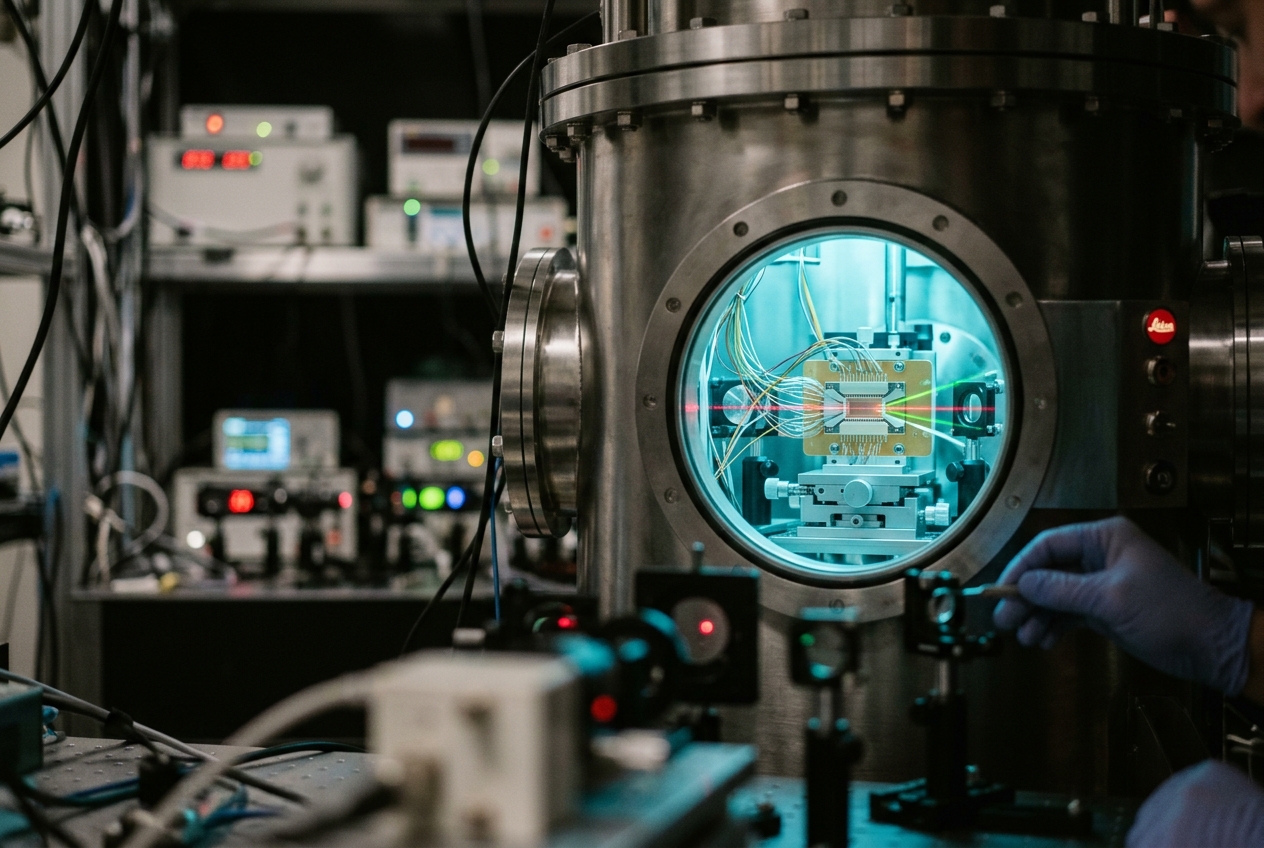
This counter-intuitive conservation of information is governed by unitarity—the foundational principle that quantum states evolve deterministically without losing their historical pedigree. But while the information is never truly erased, it undergoes a transformation so extreme that it becomes practically irretrievable to any localized observer. Physicists call this phenomenon quantum information scrambling.
Understanding and quantifying this bewildering process has emerged as one of the defining frontiers of twenty-first-century physics. At the heart of this revolution lies a sophisticated mathematical instrument known as the Out-of-Time-Ordered Correlator (OTOC). Originally conceived in the late 1960s within the theory of superconductivity, the OTOC has been reborn as the premier diagnostic tool for many-body quantum chaos, operator spreading, and quantum error correction. Even more astonishingly, it has built an unexpected theoretical bridge between the microscopic circuits etched onto silicon wafers and the grandest astrophysical mysteries of Einsteinian spacetime: the event horizons of black holes.
The Idea in Plain English: Ripples, Dye, and Quantum Entanglement
To grasp what an out-of-time-ordered correlator measures, we must first distinguish between two easily conflated ideas: classical thermalization and quantum scrambling.
+-------------------------------------------------------------------------------+
|                           TWO FORMS OF DISPERSAL                              |
+-------------------------------------------------------------------------------+
|  Classical Dilution:                                                          |
|  [ Ink Drop ] ---> Disperses evenly across water ---> Local density evens out  |
|                                                                               |
|  Quantum Scrambling:                                                          |
|  [ Local Qubit ] ---> Spreads into non-local entanglement ---> Encoded across  |
|                       the collective state of the entire system               |
+-------------------------------------------------------------------------------+
When you add a single drop of blue food colouring to a clear glass of water, the dye gradually spreads until the liquid turns an even, pale blue. Classically, the dye has simply diffused: local concentrations have smoothed out, and the system has settled into thermodynamic equilibrium. If you sample any single droplet of water from the top, middle, or bottom of the glass, it looks identical to any other.
In a quantum system—such as a chain of interacting quantum bits (qubits) inside a processor—something vastly more subtle occurs. If you flip a single qubit from $|0\rangle$ to $|1\rangle$, that localized perturbation does not merely diffuse like dye in water. As the qubits interact through quantum mechanical coupling, the local information stored in that single qubit becomes scrambled into complex, multi-particle quantum entanglement.
After a characteristic duration known as the scrambling time, no measurement performed on that single initial qubit—nor on any other single qubit in the register—will reveal whether the flip ever occurred. The information is no longer stored in the individual parts; it resides exclusively in the intricate, collective entanglement shared among all the qubits simultaneously. To recover the original secret, an experimenter must perform a coordinated measurement across the entire entangled network.
The Out-of-Time-Ordered Correlator is the precision mathematical radar that tracks this invisible contagion of entanglement as it propagates across a quantum system.
How It Actually Works: The Formalism of Operator Growth
To rigorously measure how a localized quantum secret disperses across a many-body system, physicists work in the Heisenberg picture of quantum mechanics, where quantum states remain static while operators evolve dynamically in time according to the system's Hamiltonian $H$:
$$W(t) = e^{iHt/\hbar} W(0) e^{-iHt/\hbar}$$
1. The Breakdown of Conventional Two-Point Correlators
In standard statistical mechanics and condensed matter physics, dynamics are typically probed using standard two-point chronological correlation functions, such as:
$$G(t) = \langle V^\dagger(t) V(0) \rangle_\beta = \frac{1}{Z} \text{Tr}\left( e^{-\beta H} V^\dagger(t) V(0) \right)$$
where $\beta = (k_B T)^{-1}$ represents the inverse temperature of the thermal ensemble and $Z = \text{Tr}(e^{-\beta H})$ is the partition function.
These conventional two-point correlators describe local relaxation and dissipation—such as how quickly an excited atom emits a photon, or how rapidly an electrical current decays due to resistance. However, two-point correlators suffer from a profound blind spot: they decay to an equilibrium value whenever local memory is lost, completely failing to distinguish between a system that has succumbed to external noise (decoherence) and a closed system that has coherently scrambled its information into deep multipartite entanglement.
CHRONOLOGICAL TWO-POINT SAMPLING:
Time Step:  t = 0 -------------> t = T
Action:     Apply V(0)           Measure V(T)
Limitation: Cannot detect whether coherence went into external bath or global entanglement.

NON-CHRONOLOGICAL FOUR-POINT INTERROGATION (OTOC):
Time Step:  t = 0 ------> t = T ------> t = 0 ------> t = T
Action:     Apply V(0)    Apply W(T)    Evolve back   Re-evaluate interference
Advantage:  Directly isolates coherent many-body operator spreading.
2. The Four-Point Out-of-Time-Ordered Correlator
To expose the hidden architecture of scrambling, we choose two spatially separated, initially commuting local unitary operators, $V$ and $W$. For example, in an array of $N$ qubits, $V$ might act exclusively on qubit 1 at position $x=0$, while $W$ acts on qubit $N$ at position $x=L$. Because they act on distinct spatial degrees of freedom, at time $t=0$ they commute perfectly:
$$[W(0), V(0)] = 0$$
Now, allow operator $W$ to evolve forward in time under the many-body Hamiltonian $H$. As time progresses, $W(t)$ ceases to remain a simple single-qubit operator. Through interactions with neighbouring particles, $W(t)$ expands into a macroscopic superposition of increasingly long strings of Pauli operators across the lattice.
Eventually, the growing footprint of $W(t)$ reaches the spatial location of $V(0)$. Once the spatial support of $W(t)$ overlaps with the site of $V$, the two operators no longer commute:
$$[W(t), V(0)] \neq 0$$
To quantify this non-commutativity across the entire state space, we define the thermal expectation value of the squared commutator:
$$C(t) = \langle [W(t), V(0)]^\dagger [W(t), V(0)] \rangle_\beta = \langle |[W(t), V(0)]|^2 \rangle_\beta$$
Assuming $V$ and $W$ are unitary operators ($V^\dagger V = I$ and $W^\dagger W = I$), we can expand the squared commutator algebraically:
$$C(t) = \langle (W^\dagger(t) V^\dagger(0) - V^\dagger(0) W^\dagger(t))(W(t) V(0) - V(0) W(t)) \rangle_\beta$$
Multiplying out the four terms yields:
$$C(t) = \langle W^\dagger(t) V^\dagger(0) W(t) V(0) \rangle + \langle V^\dagger(0) W^\dagger(t) V(0) W(t) \rangle - \langle W^\dagger(t) V^\dagger(0) V(0) W(t) \rangle - \langle V^\dagger(0) W^\dagger(t) W(t) V(0) \rangle$$
Using the cyclicity of the trace and the unitarity of the operators, the final two terms reduce to identity expectations ($-\langle I \rangle - \langle I \rangle = -2$). Defining the complex four-point Out-of-Time-Ordered Correlator as:
$$F(t) = \langle W^\dagger(t) V^\dagger(0) W(t) V(0) \rangle_\beta$$
we arrive at the foundational identity:
$$C(t) = 2 \left( 1 - \text{Re}[F(t)] \right)$$
================================================================================
           FUNDAMENTAL IDENTITY OF QUANTUM INFORMATION SCRAMBLING
================================================================================

     C(t) = \langle |[W(t), V(0)]|^2 \rangle = 2 \left( 1 - \text{Re}[F(t)] \right)

  * At t = 0:          [W(0), V(0)] = 0  ===> F(0) = 1  ===> C(0) = 0
  * Early-Stage Growth: F(t) departs from 1 exponentially
  * Scrambled Regime:  F(t) -> 0         ===> C(t) saturates to 2
================================================================================
The temporal sequence encoded in $F(t)$ explains its non-chronological name: tracing the operators from right to left, the system begins at time $0$ with $V(0)$, evolves forward to time $t$ to apply $W(t)$, steps backward to time $0$ to apply $V^\dagger(0)$, and finally steps forward to time $t$ to apply $W^\dagger(t)$. It is this very forward-and-backward dance through time that prevents the correlation function from decaying via trivial phase cancellation, directly isolating the genuine geometric growth of quantum operators.
Operator Spreading, the Butterfly Velocity, and Chaos
The physical mechanism underlying the decay of $F(t)$ is the expansion of local operators over the Hilbert space basis, a concept known as operator spreading.
1. The Pauli String Expansion
In a quantum lattice of $N$ spin-1/2 particles, the full operator space has dimension $4^N$. Any time-evolved operator $W(t)$ can be expanded uniquely in the orthonormal basis of Pauli strings:
$$W(t) = \sum_{\mu_1, \mu_2, \dots, \mu_N \in {0, x, y, z}} c_{\mu_1 \dots \mu_N}(t) \left( \sigma_1^{\mu_1} \otimes \sigma_2^{\mu_2} \otimes \dots \otimes \sigma_N^{\mu_N} \right)$$
At $t=0$, if $W$ is a single-qubit Pauli operator acting on site $j$, the only non-zero coefficient corresponds to a string of length 1 (with identity operators $I = \sigma^0$ everywhere else).
As time advances under an interacting Hamiltonian, the unitary transformation creates non-zero coefficients $c(t)$ for progressively longer strings containing non-identity Pauli matrices across multiple sites. The average operator size $\mathcal{S}(t)$ grows from $\mathcal{S}(0)=1$ to an extensive value proportional to the system volume $\mathcal{S}(t) \sim \mathcal{O}(N)$.
TIME EVOLUTION OF AN OPERATOR STRING:
t = 0:        [ I ]-[ I ]-[ I ]-[ Z ]-[ I ]-[ I ]-[ I ]   (Size = 1)
t = t_1:      [ I ]-[ I ]-[ X ]-[ Z ]-[ Y ]-[ I ]-[ I ]   (Size = 3)
t = t_scramble:[ Y ]-[ Z ]-[ X ]-[ X ]-[ Z ]-[ Y ]-[ X ]   (Size = N, fully scrambled)
2. The Butterfly Velocity and Lieb-Robinson Bounds
In spatial dimensions, this operator expansion is constrained by geometry. For non-relativistic quantum systems with short-range interactions, the celebrated Lieb-Robinson bound proves the existence of an effective "speed of light" $v_{LR}$ that limits how fast information can propagate across a discrete lattice.
Within this light cone, chaotic dynamics cause the operator to spread ballistically at a characteristic butterfly velocity $v_B \le v_{LR}$. If operator $V$ is located at spatial coordinate $x$ relative to $W(0)$, the squared commutator exhibits an expanding wavefront:
$$C(x, t) \sim \exp\left( \lambda_L \left( t - \frac{x}{v_B} \right) \right)$$
The boundary where $C(x,t) \sim \mathcal{O}(1)$ defines the butterfly light cone. Inside this cone, the operator $W(t)$ has engulfed site $x$, driving $F(t) \to 0$ and scrambling any local quantum information initially stored between those sites.
SPATIAL OPERATOR CONE (BUTTERFLY LIGHT CONE):

Space (x)
   ^
   |        /  UNSCRAMBLED REGION  \
   |       /     [W(t), V(0)] = 0   \
   |      /      F(t) ≈ 1, C(t) ≈ 0  \
   |     /                            \
   |    /    SCRAMBLED REGION          \
   |   /     [W(t), V(0)] ≠ 0           \
   |  /      F(t) -> 0, C(t) -> 2        \
   | /   Slope = Butterfly Velocity (v_B) \
---+----------------------------------------> Time (t)
   0
The Quantum Lyapunov Exponent and the MSS Bound
In classical mechanics, deterministic chaos is characterized by extreme sensitivity to initial conditions: two trajectories in phase space separated by an infinitesimal distance $\Delta x(0)$ diverge exponentially over time:
$$\Delta x(t) \sim \Delta x(0) e^{\lambda_{classical} t}$$
where $\lambda_{classical}$ is the classical Lyapunov exponent.
In quantum mechanics, Heisenberg's uncertainty principle forbids the concept of well-defined point-trajectories in phase space, rendering the classical definition obsolete. The OTOC resolves this dilemma by offering the true quantum analogue of the Poisson bracket ${x(t), p(0)}^2 \to \frac{1}{\hbar^2} [x(t), p(0)]^2$.
In semiclassical and strongly coupled quantum systems, during the early-time regime preceding the scrambling time ($t_{dissipation} \ll t \ll t_{scramble}$), the squared commutator exhibits a transient phase of exponential growth:
$$C(t) \sim \frac{1}{N} e^{\lambda_L t}$$
Here, $\lambda_L$ is designated as the quantum Lyapunov exponent.
================================================================================
             THE MALDACENA-SHENKER-STANFORD (MSS) CHAOS BOUND
================================================================================

                       \lambda_L \le \frac{2\pi k_B T}{\hbar}

  Proved rigorously in 2016 by Juan Maldacena, Stephen Shenker, and Douglas
  Stanford using complex analytic properties of thermal Green's functions.
  It establishes a fundamental upper limit on how fast ANY physical system
  can scramble quantum information at temperature T.
================================================================================
This remarkable theorem, documented extensively on Wikipedia's Quantum Chaos monograph, reveals that nature enforces a cosmic speed limit on chaos:
- Weakly Interacting Systems: Ordinary materials and weakly coupled electronic gases scramble sluggishly, with $\lambda_L \propto T^2$ or $\lambda_L \ll \frac{2\pi k_B T}{\hbar}$.
- Fast Scramblers: Systems that saturate the bound—achieving $\lambda_L = \frac{2\pi k_B T}{\hbar}$—are known as maximally chaotic or fast scramblers.
The primary physical models known to saturate this bound are: - Black Holes: In the context of the AdS/CFT correspondence (holographic duality), the gravitational event horizon of a black hole scrambles infalling quantum information at the maximum rate permitted by quantum mechanics. - The Sachdev-Ye-Kitaev (SYK) Model: A solvable quantum-mechanical model of $N$ Majorana fermions interacting via random, all-to-all quartic couplings, detailed on Wikipedia: Sachdev–Ye–Kitaev Model. The SYK model serves as a direct, non-gravitational laboratory for holographic quantum gravity.
Experimental Measurement Protocols: Reversing the Arrow of Time
Measuring an Out-of-Time-Ordered Correlator in a physical laboratory presents a formidable engineering challenge: the mathematical definition of $F(t) = \langle W^\dagger(t) V^\dagger(0) W(t) V(0) \rangle$ requires evolving a quantum state forward in time to $t$, applying a local perturbation $W$, evolving backward in time to $0$ under $-H$, applying $V^\dagger$, and repeating the forward-backward cycle.
How can experimentalists invert the arrow of time in a real quantum device? Researchers have developed three primary methodologies across superconducting circuits, trapped ions, and neutral Rydberg atoms.
+-----------------------------------------------------------------------------------+
|               EXPERIMENTAL OTOC INTERFEROMETRIC CIRCUIT ARCHITECTURE              |
+-----------------------------------------------------------------------------------+
|                                                                                   |
|  Ancilla:  |0> ---[ H ]-----------*-----------------------------*---[ H ]--- (M)  |
|                                   |                             |                 |
|  Qubit 1:  |ψ> ---[ e^{-iHt} ]---[ W ]---[ e^{+iHt} ]---[ V ]---|                 |
|  Qubit 2:  |ψ> ---[ e^{-iHt} ]-----------[ e^{+iHt} ]-----------|                 |
|  Qubit 3:  |ψ> ---[ e^{-iHt} ]-----------[ e^{+iHt} ]-----------|                 |
|                                                                                   |
|  Key Steps:                                                                       |
|  1. Ancilla initialized into superposition (|0> + |1>)/√2.                         |
|  2. Forward evolution under H (+t), local perturbation W applied conditionally.    |
|  3. Backward evolution under -H (-t) by inverting gate phases / pulse sequences.  |
|  4. Local perturbation V applied; final interference read out on ancilla qubit.   |
+-----------------------------------------------------------------------------------+
1. Direct Hamiltonian Inversion (Loschmidt Echo Protocols)
In digital quantum computers (such as those programmed via IBM Qiskit Documentation), time evolution is implemented as a sequence of discrete quantum logic gates $U = \prod_k U_k$. Reversing the sign of the effective Hamiltonian $H \to -H$ corresponds to applying the inverse unitary operator:
$$U^\dagger = \left( \prod_k U_k \right)^\dagger = \prod_k U_k^\dagger$$
By inverting the phase of microwave pulses or the temporal order of multi-qubit entangling gates, platforms based on superconducting transmons or trapped ions can execute exact forward-and-backward time travel on their quantum registers. Measuring the overlap of the final state with the initial state yields the real component of the OTOC.
2. Ancilla-Assisted Ramsey Interferometry
To measure the complex value of $F(t)$ without relying entirely on global inversion fidelity, an auxiliary probe qubit (an ancilla) can be entangled with the system. The ancilla is prepared in a superposition state $\frac{|0\rangle + |1\rangle}{\sqrt{2}}$. Controlled operations conditioned on the state of the ancilla apply the forward evolution, the perturbation $W$, and the backward evolution.
When the ancilla undergoes a final Hadamard gate and measurement, the resulting interference pattern directly reveals both the real and imaginary components of $F(t) = \text{Re}[F(t)] + i \text{Im}[F(t)]$ in a single experimental configuration.
3. Randomized Measurement Protocols (Statistical Correlators)
When exact Hamiltonian inversion is unfeasible—such as in analog quantum simulators without single-gate programmability—physicists employ randomized measurement schemes. By evolving the system forward under $H$ following random local unitary rotations $u_i \in \text{CUE}(2)$ applied to each qubit, researchers can reconstruct OTOCs from the statistical correlations of simple projective measurement outcomes, bypassing the need for backward time evolution entirely.
Real-World Applications Today (2024–2026)
Far from being a purely theoretical curiosity, the Out-of-Time-Ordered Correlator has become a crucial industrial and scientific metric across advanced quantum technologies.
+-----------------------------------------------------------------------------------------+
|                  APPLICATIONS OF OTOCS IN MODERN SCIENCE AND INDUSTRY                   |
+-----------------------------------------------------------------------------------------+
|  Domain                   Institution / Company       Core Objective                    |
+-----------------------------------------------------------------------------------------+
|  1. Quantum Benchmarking  Google Quantum AI           Distinguishing coherent scrambling |
|                           IBM Quantum                 from environmental noise/decoherence|
|                                                                                         |
|  2. Holographic Gravity   Caltech / Harvard / MIT     Simulating traversable wormholes   |
|     Simulations           Q-FARM Consortium           via ER=EPR quantum teleportation   |
|                                                                                         |
|  3. Materials Science     Max Planck Institute        Diagnosing "strange metals" and   |
|                           MIT Department of Physics   high-Tc unconventional superconductors|
|                                                                                         |
|  4. Quantum Error         Quantinuum                  Designing topological codes that   |
|     Correction Design     QuEra Computing             scramble errors away from syndromes|
+-----------------------------------------------------------------------------------------+
1. Precision Benchmarking of Quantum Processors
As leading quantum hardware developers—including Google Quantum AI and IBM Quantum—scale their processors beyond 100 qubits, standard verification techniques fail. Classical computers cannot simulate the state space to confirm whether a multi-qubit algorithm ran correctly.
By executing scrambling circuits and extracting OTOCs, engineers can quantitatively evaluate whether a processor maintains deep many-body quantum coherence or has degraded into classical randomness. If an OTOC decays while a Loschmidt echo remains coherent upon time-reversal, the team is guaranteed that their hardware executed genuine, entangled multi-body computation rather than succumbing to environmental noise. Detailed research methodologies are outlined regularly in Nature Physics.
2. Simulating Holographic Wormholes and Quantum Gravity
In a landmark series of experiments conducted collaboratively across Caltech, Harvard University, and MIT, physicists programmed the dynamics of the SYK model into programmable quantum processors. Using an ancilla-assisted OTOC protocol, researchers demonstrated wormhole-inspired quantum teleportation: sending a qubit into one entangled cluster, scrambling it across all degrees of freedom, and observing it refocus coherently on a second entangled cluster after an operator insertion that is mathematically dual to a negative-energy shockwave in an anti-de Sitter (AdS) spacetime.
These experiments provide the very first empirical tests of the famous ER=EPR conjecture proposed by Leonard Susskind and Juan Maldacena, which posits that quantum entanglement (Einstein-Podolsky-Rosen) is fundamentally identical to geometric wormholes (Einstein-Rosen bridges).
3. Diagnosing Exotic Quantum Materials and Strange Metals
In condensed matter physics, traditional band theory breaks down completely when describing strange metals—unusual materials (such as cuprate high-temperature superconductors) where electrical resistivity scales linearly with temperature down to absolute zero, defying Fermi-liquid theory.
Theoretical groups at the Max Planck Institute for the Structure and Dynamics of Matter and the MIT Department of Physics (whose advanced curriculum can be explored via MIT OpenCourseWare Quantum Physics) utilize OTOCs to model electron transport in these strongly correlated regimes. Because strange metals exhibit Planckian dissipation ($t \sim \hbar / k_B T$), OTOC calculations reveal that their electrons scatter and scramble at the maximal MSS chaos bound, providing the definitive theoretical framework explaining their unconventional superconductivity.
4. Designing Fault-Tolerant Quantum Error Correction
Engineers at Quantinuum and QuEra Computing are leveraging the mathematics of operator growth to design resilient quantum error-correcting codes. By understanding the exact speed and structure of butterfly velocity fronts, architects can construct quantum networks that deliberately scramble local environmental errors across delocalized degrees of freedom before those errors can coalesce and corrupt logical qubits, creating fundamentally more robust quantum memories.
What This Means for You
Why should someone who does not spend their days manipulating laser-cooled ions or calculating path integrals care about Out-of-Time-Ordered Correlators?
The answer touches the core of our technological future and our philosophical understanding of reality:
+-------------------------------------------------------------------------------+
|                       WHY IT MATTERS: A PERSONAL SUMMARY                      |
+-------------------------------------------------------------------------------+
|  1. Cryptography & Security:                                                  |
|     Understanding scrambling is the blueprint for creating post-quantum       |
|     ciphers that even next-generation quantum supercomputers cannot crack.   |
|                                                                               |
|  2. Clean Energy & High-Tc Superconductors:                                   |
|     Deciphering the maximal scrambling of strange metals unlocks materials    |
|     that conduct electricity with ZERO loss at room temperature.              |
|                                                                               |
|  3. The Fabric of Reality:                                                    |
|     Proves that space, time, and gravity may not be fundamental building     |
|     blocks, but emergent macroscopic illusions woven from entangled bits.     |
+-------------------------------------------------------------------------------+
- The Ultimate Unhackable Future: The mathematical principles of quantum scrambling underpin modern research into quantum-resistant cryptography. By designing cryptographic protocols whose internal dynamics mimic maximal scramblers, mathematicians are developing data-protection mechanisms that are mathematically impervious to decryption, securing everything from global banking infrastructure to national power grids against future quantum attacks.
- Room-Temperature Superconductivity and Clean Power: The global transition toward renewable energy loses enormous amounts of power to thermal resistance in standard copper wires. The chaotic scrambling dynamics illuminated by OTOCs provide the key to unlocking the secrets of strongly correlated materials, bringing materials scientists closer to synthesizing room-temperature superconductors that can transmit electricity across continents with zero energetic loss.
- The Architecture of Space and Time: On the most fundamental level, OTOC research has revealed that spacetime itself—the very stage upon which our physical universe unfolds—is likely not a fundamental entity. Instead, geometry and gravity appear to be macroscopic properties that emerge from the underlying quantum information scrambling of deeply entangled qubits. When you contemplate an OTOC, you are looking at the thread that weaves the fabric of the cosmos.
Today's Takeaway
The Out-of-Time-Ordered Correlator has fundamentally transformed modern science by demonstrating that when information appears to be lost in a complex quantum system, it has not perished—it has merely dissolved into an intricate, non-local tapestry of many-body entanglement. By measuring the squared commutator of time-separated operators through forward-and-backward temporal evolution, the OTOC quantifies the speed of quantum chaos, enforces the universal speed limits of nature, benchmarks the world's most powerful quantum processors, and reveals that the mysterious event horizons of black holes and the nanoscale architectures of quantum chips are two expressions of the exact same underlying law of information conservation.