Clifford Hierarchy: Classifying Fault-Tolerant Quantum Logic and Transversal Gate Limits Beyond the Stabilizer Group
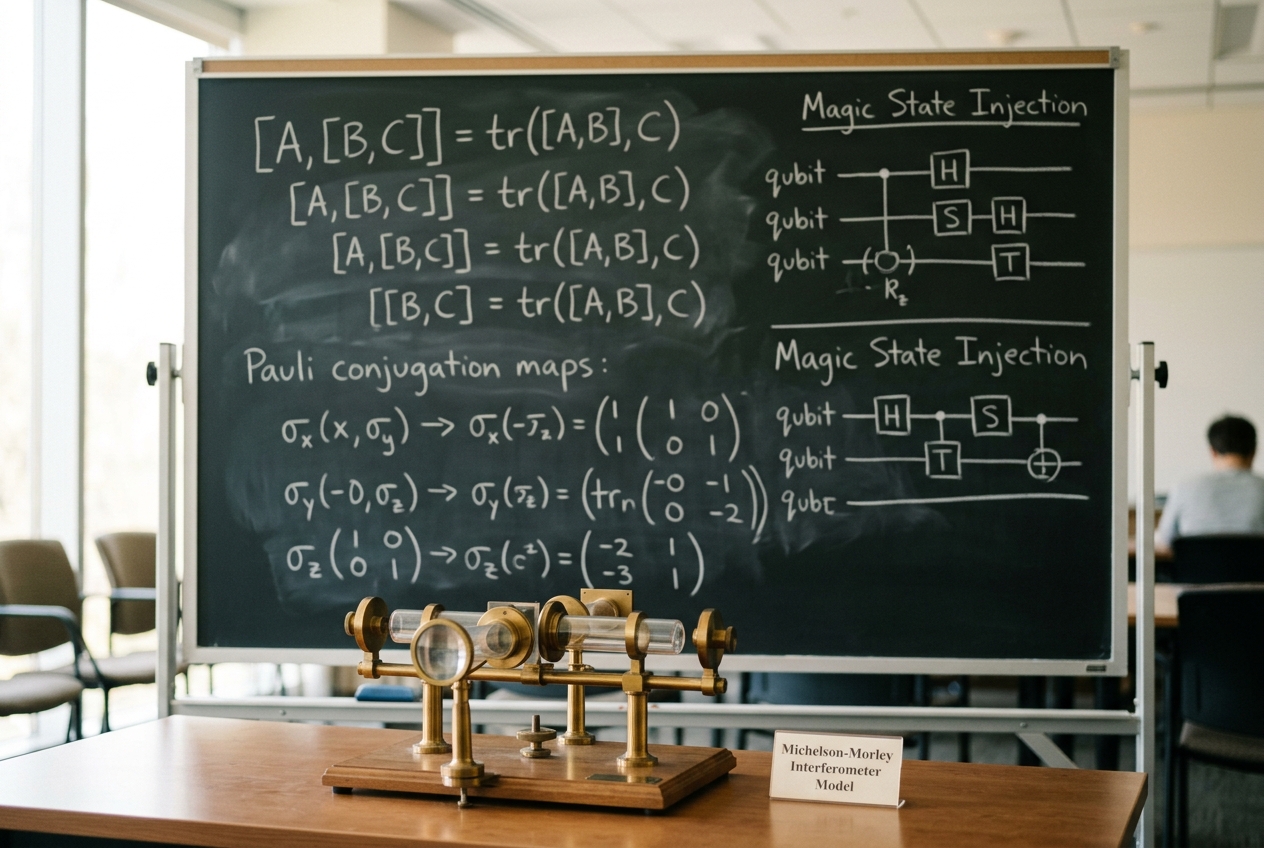
To understand why building a practical quantum computer is so extraordinarily difficult, one must confront a surprising truth: most quantum operations are not actually powerful. In fact, an enormous swath of quantum mechanics can be simulated efficiently on an ordinary laptop. The true exponential power of quantum computation lies strictly across a mathematical threshold. Understanding this threshold—and learning how to cross it without letting environmental noise destroy fragile quantum calculations—is the grand challenge of twenty-first-century physics.
The Idea in Plain English: The Mechanical Clockwork and the Secret Angle
To grasp why some quantum operations are computationally easy while others are impossibly hard, consider the difference between a mechanical clock and an analogue dial.
A mechanical clock moves in discrete, tidy increments. Its gears tick between specific, interlocking teeth—say, twelve hourly positions. If you turn the hands by sixty degrees or rotate the minute wheel by a full quarter-turn, the gear teeth land squarely in place. Tracking the motion of this clock is straightforward: you do not need to measure continuous motion; you only need to count the integer clicks of the gears.
A standard qubit—the fundamental unit of quantum information—is often visualized as a point on the surface of a three-dimensional sphere. While a classical bit can only be a binary zero or one (the north or south pole of the sphere), a qubit can point in any direction whatsoever.
Most operations that quantum engineers can apply to a qubit are like the clicks of that mechanical clock. These discrete 90-degree rotations flip a state cleanly from the north pole to the equator, or spin it around the vertical axis by neat right angles. Physicists call these orderly transformations Clifford operations. Because they swap cardinal directions on the sphere without pointing into the infinitely variable spaces between, a classical computer can track their behavior perfectly using simple bookkeeping.
However, if you only ever turn the hands of your clock by ninety degrees, you can never point to three minutes past two. You are trapped within a tiny, discrete subset of points. To unlock the full, continuous computational power of quantum mechanics—to access every possible orientation on that sphere—you must introduce fine, fractional rotations.
The moment you add even a single non-standard rotation, such as a 45-degree twist known as the $T$-gate, the discrete clockwork breaks wide open. You transition from a system that an ordinary laptop can predict in milliseconds to an exponentially complex quantum universe that no classical supercomputer on Earth can replicate.
The mathematical framework that classifies these operations from the easily predictable up to the universally powerful is the Clifford hierarchy.
How It Actually Works: The Mechanics of the Algebraic Ladder
In quantum information theory, quantum operations are represented as unitaries—matrices that preserve the total probability of a quantum state. In 1999, physicists Emanuel Knill, Raymond Laflamme, and Wojciech Zurek formally introduced a nested sequence of operations designed to classify these unitaries based on how they transform basic quantum errors. This structure is known as the Clifford hierarchy.
Level 1: The Pauli Foundation
At the base of the ladder, denoted as Level 1, sits the Pauli group on $n$ qubits, written mathematically as $\mathcal{P}_n$. The Pauli group consists of the fundamental single-qubit transformations: - The identity operator ($I$), which leaves a qubit unchanged. - The bit-flip operator ($X$), which swaps zero and one. - The phase-flip operator ($Z$), which inverts the quantum phase. - The combined bit-and-phase flip operator ($Y$), accompanied by global phase multipliers ($\pm 1, \pm i$).
For a system of multiple qubits, the Pauli group consists of all tensor products of these operators. In physical quantum computers, environmental noise—such as stray thermal photons or magnetic fluctuations—manifests almost entirely as random, unwanted Pauli operations.
Level 2: The Clifford Group
Level 2 of the hierarchy, denoted as $\mathcal{C}_2$, is the celebrated Clifford group. Mathematically, the Clifford group is defined as the normalizer of the Pauli group within the broader space of all possible unitary operations.
In plain terms: if you take any basic Pauli error $P$, apply a Clifford operation $U$, and then reverse the operation, the result is guaranteed to transform that error into another basic Pauli error $P'$.
The Clifford group is generated by three foundational quantum gates: 1. The Hadamard gate ($H$), which creates equal superpositions between zero and one. 2. The Phase gate ($S$), which applies a 90-degree rotation around the vertical axis. 3. The Controlled-NOT gate ($\text{CNOT}$), which entangles two distinct qubits.
In 1998, quantum theorists discovered a profound limitation known as the Gottesman-Knill theorem on Wikipedia. The theorem proves that any quantum circuit constructed entirely out of Clifford operations acting on standard zero-states—even circuits involving thousands of qubits and dense networks of entanglement—can be simulated in polynomial time on an ordinary classical computer.
Clifford operations alone provide zero quantum speedup. They are the tidy clicks of the mechanical clock.
The Inductive Definition of the Hierarchy
To ascend beyond Level 2, the hierarchy is defined recursively. For any integer level $k \ge 2$, a unitary transformation $U$ belongs to the $k$-th level of the Clifford hierarchy, written as $\mathcal{C}_k$, if conjugating any Pauli operator by $U$ yields an operation that sits comfortably within the level immediately below it:
$$\mathcal{C}k = \left{ U \in \mathcal{U}(2^n) \;\middle|\; \forall P \in \mathcal{P}_n,\; U P U^\dagger \in \mathcal{C}{k-1} \right}$$
This recursive definition reveals an elegant mathematical structure: - Level 1 ($\mathcal{C}_1$): The Pauli group $\mathcal{P}_n$. - Level 2 ($\mathcal{C}_2$): The Clifford group, which maps Level 1 back into Level 1. - Level 3 ($\mathcal{C}_3$): Unitary operations that map Level 1 into Level 2. - Level $k$ ($\mathcal{C}_k$): Unitary operations that map Level 1 into Level $k-1$.
A rigorous analysis of this structure is documented across foundational literature, accessible via Wikipedia's breakdown of the Clifford hierarchy and university curricula such as MIT OpenCourseWare's Quantum Information Theory curriculum.
Why Level 3 and Beyond Are Not Groups
In modern algebra, a group is a set of operations where combining any two elements always produces another element inside that same set. The Pauli operations (Level 1) form a group. The Clifford operations (Level 2) form a group.
Crucially, for all levels $k \ge 3$, the set $\mathcal{C}_k$ is not a group.
If you take two distinct Level 3 operations and multiply them together, their combined action frequently falls completely outside Level 3. For instance, while the single-qubit $T$-gate resides in Level 3, combining it with the Hadamard gate from Level 2 generates arbitrary rotations that spill into an infinite algebraic space.
Level 3 contains the essential non-Clifford operations required for universal quantum computation: - The $T$-gate ($\pi/8$ phase gate): Represented as a diagonal matrix with diagonal entries $(1, e^{i\pi/4})$, satisfying $T^2 = S$. - The Toffoli gate (Controlled-Controlled-NOT): A three-qubit gate that flips a target qubit only if two control qubits are in the state one, serving as the basis for reversible classical logic. - The Controlled-Controlled-$Z$ gate ($\text{CCZ}$): A symmetric three-qubit operation that flips the sign of the quantum state only when all three qubits are active.
By the Solovay-Kitaev theorem, adding any single Level 3 gate to the Level 2 Clifford group allows a quantum computer to approximate any possible unitary operation to arbitrary precision. Level 3 is the gateway to computational supremacy.
The Eastin-Knill Theorem and the Fault-Tolerant Bottleneck
If Level 3 gates are all that is required for universal quantum computing, why not simply construct physical hardware that implements them natively?
The answer lies in a fundamental impossibility result known as the Eastin-Knill theorem. In physical quantum hardware, qubits are perpetually disrupted by environmental decoherence. To protect information, thousands of physical qubits are woven together into single "logical qubits" using quantum error-correcting codes, such as surface codes.
The safest, most natural way to perform a gate on a logical qubit is transversally—applying an operation independently to each physical qubit in the code block. Transversal operations are inherently fault-tolerant because an error on one physical component cannot spread horizontally to corrupt its neighbors.
The Eastin-Knill theorem proves that no quantum error-correcting code can implement a universal set of gates transversally.
Any chosen code can implement transversal gates from, at most, a specific tier of the Clifford hierarchy: - Standard 2D surface codes can perform Clifford gates (Level 2) transversally, but cannot execute Level 3 gates transversally. - Specialized 3D color codes or Reed-Muller codes can perform the Level 3 $T$-gate or Toffoli gate transversally, but lose the ability to perform transversal Hadamard gates from Level 2.
Because physical protection strictly sequesters logical gates into algebraic silos, quantum engineers cannot build a universal computer using transversal physical operations alone.
Circumventing the Wall: Engineering Level 3 Gates
To break through this mathematical barrier, quantum computer architects have developed sophisticated techniques to import Level 3 operations into protected Clifford architectures.
1. Magic State Distillation
Instead of applying a noisy $T$-gate directly to fragile data, quantum factories prepare specialized ancilla qubits in an idealized superposition called a "magic state":
$$|T\rangle = \cos\left(\frac{\pi}{8}\right)|0\rangle + \sin\left(\frac{\pi}{8}\right)|1\rangle$$
Because these raw states are noisy, hundreds of them are fed into an error-filtering circuit known as a Bravyi-Kitaev distillation routine. The distillation circuit runs pure Clifford operations on the noisy states, measuring error syndromes and discarding contaminated qubits until a pristine, highly pure magic state emerges.
2. Gate Teleportation
Once a pure magic state $|T\rangle$ is distilled, it is entangled with the target logical data qubit using a standard Clifford CNOT gate. Measuring the ancilla qubit collapses the system, deterministically teleporting the non-Clifford 45-degree rotation into the data qubit. If the measurement yields an unwanted bit-flip, it is corrected using an adaptive Clifford phase gate ($S$).
Through this process, non-Clifford operations are executed using 100% fault-tolerant Clifford gates and consumed resource states.
3. Code Switching and Gauge Fixing
An alternative architecture avoids distillation by actively translating quantum information between two distinct error-correcting codes during computation. By switching back and forth between a 2D surface code (which executes transversal Cliffords) and a 3D color code (which executes transversal Level 3 gates), the system achieves universality without relying on massive magic state factories.
4. Compiler $T$-Count Optimization
Because distilling a single magic state requires up to 90% of all physical qubits and runtime in a fault-tolerant system, modern quantum software compilers treat Level 3 operations as an expensive currency. Using graphical formalisms such as the ZX-calculus and phase polynomial optimizations, compilers rewrite quantum algorithms to cancel redundant $T$-gates, minimizing the total $T$-count and $T$-depth before the instructions ever reach physical hardware.
Real-World Applications Today (2024–2026)
The mathematics of the Clifford hierarchy is no longer confined to whiteboard proofs; it directly governs the hardware roadmaps and compiler pipelines of leading quantum computing enterprises today.
1. IBM Quantum and Qiskit Compilation Infrastructure
At IBM Quantum, research teams are scaling multi-qubit superconducting processors while tackling the Clifford compilation bottleneck. Through the open-source IBM Quantum Documentation platform, engineers utilize advanced synthesis algorithms that convert arbitrary molecular Hamiltonians into optimized Clifford+T sequences. By optimizing phase polynomials and commuting Clifford operators, IBM's compiler reduces the required $T$-count by over 40%, directly lowering the overhead needed for near-term quantum utility demonstrations in materials science.
2. Google Quantum AI: Surface Code Magic State Factories
Google Quantum AI's multi-year roadmap focuses on scaling superconducting "Sycamore" and next-generation architectures past the physical error threshold. Google’s theoretical and experimental work, published across leading journals such as Nature, centers on building real-time magic state distillation factories. Their experimental demonstrations in logical qubit memory are engineered specifically to provide the high-fidelity input states required to drive Level 3 gate teleportation.
3. Quantinuum and Microsoft: Fault-Tolerant Code Switching
Trapped-ion pioneer Quantinuum, collaborating with Microsoft Azure Quantum, has demonstrated logical qubits with record-low error rates. Rather than relying exclusively on brute-force magic state distillation, their research exploits the all-to-all connectivity of trapped ions to execute code switching and gauge fixing. By transitioning logical information between 2D and 3D color codes, they have successfully demonstrated transversal Level 3 non-Clifford operations with physical fidelities that surpass standard physical gate thresholds.
4. PsiQuantum: Silicon Photonic Resource Factories
PsiQuantum's utility-scale architecture is founded on silicon photonics, using waveguides and optical switches manufactured in standard semiconductor foundries. In a photonic quantum computer, basic Clifford operations are implemented through optical beam splitters and phase shifters. Because photonic qubits cannot sit idly in memory, PsiQuantum has architected vast, dedicated optical pipelines where more than 90% of the chip's physical footprint is reserved for continuous magic state distillation, manufacturing the flow of Level 3 resource states needed to run Shor's algorithm and chemistry simulations.
What This Means for You
While the algebraic mechanics of normalizers and non-group unitaries may seem distant from daily life, the Clifford hierarchy directly dictates the timeline for when quantum technology will transform the real world.
Consider modern cybersecurity. The public-key cryptography that safeguards global financial transactions, medical records, and national infrastructure relies on integer factorization and discrete logarithms. To break an RSA-2048 encryption key using Shor's algorithm, a quantum computer does not merely need 4,000 qubits; it requires the execution of roughly billions of fault-tolerant Level 3 $T$-gates.
Because every single one of those $T$-gates requires distilling and teleporting a magic state through thousands of physical operations, scientists know that building a machine capable of threatening global communications requires scaling systems to roughly one million physical qubits. This mathematical reality provides world governments and financial institutions with a precise, predictable window to transition global data networks to post-quantum cryptographic standards.
Similarly, when quantum computers eventually unlock ambient-condition fertilizers or novel enzyme simulations, those breakthroughs will be made possible by compiler engineers squeezing the last non-Clifford rotation out of an optimized Level 3 circuit. The efficiency of crossing the Clifford barrier determines whether an industrial simulation takes five weeks or five hundred years.
Today's Takeaway
The exponential promise of quantum computation does not reside in generic quantum superposition, but across a strictly defined algebraic boundary: the Clifford hierarchy. While low-tier Clifford operations provide the orderly, error-protecting clockwork of quantum error correction, they remain entirely simulable by classical supercomputers. True quantum power begins only at Level 3, where non-Clifford operations introduce the continuous, non-orthogonal geometry needed for universal computation. Because nature forbids any single error-correcting code from executing these operations natively, the entire future of practical quantum computing rests on our ability to distill, optimize, and teleport these precious Level 3 gates into the fault-tolerant architectures of tomorrow.