BB84 Protocol: Establishing Unconditionally Secure Cryptographic Keys Through Conjugate Measurement Bases and Privacy Amplification
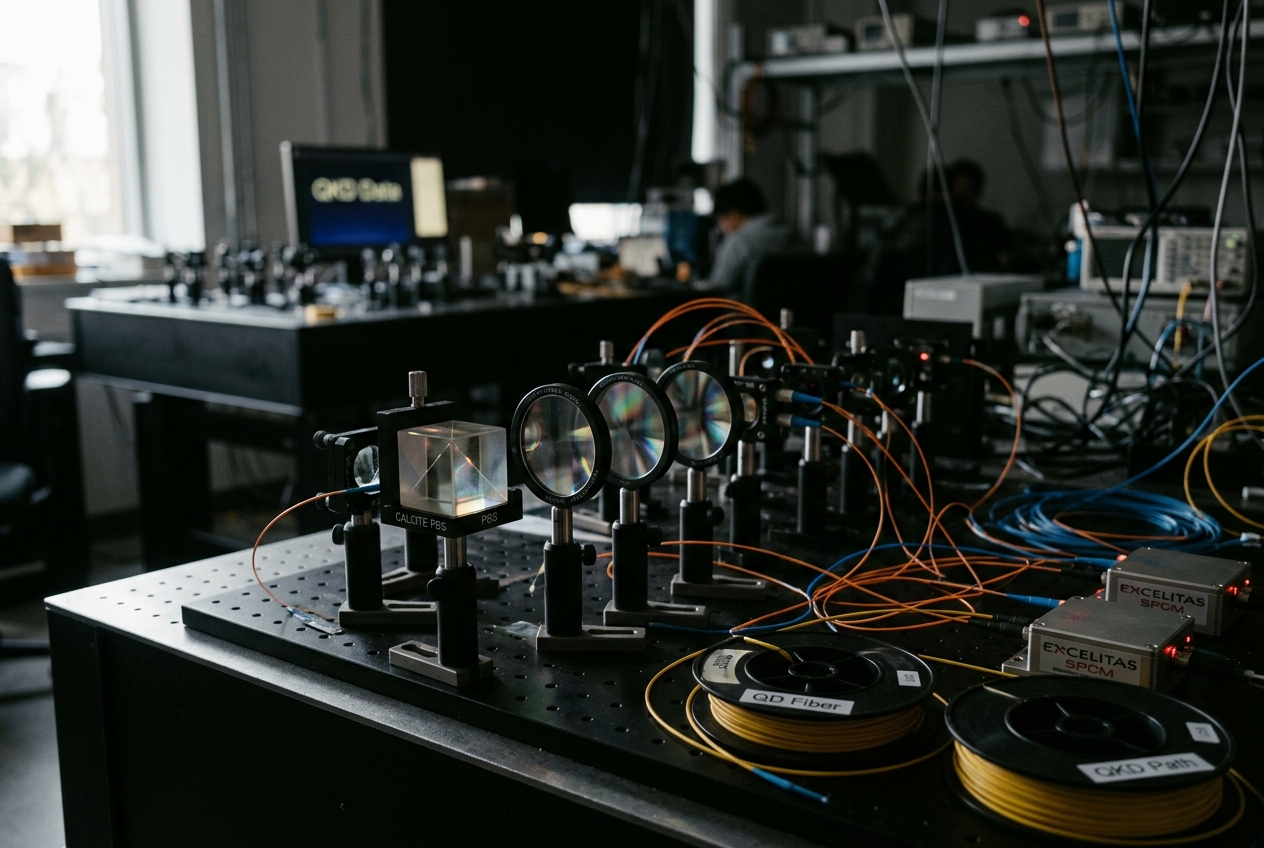
1. Opening Hook — Why You Should Care
Every single second of every day, trillions of dollars move across global financial networks, diplomatic cables transmit state secrets, and billions of people entrust their medical records, passwords, and private conversations to digital locks. Virtually every lock protecting modern civilization rests on a single mathematical bet: that factoring enormous prime numbers and computing discrete logarithms is so difficult that even the fastest supercomputer on Earth would take millions of years to break the code.
That bet is about to expire.
In 1994, mathematician Peter Shor proved that a sufficiently capable quantum computer could slice through our modern public-key encryption standards—such as RSA and Elliptic Curve Cryptography—in a matter of hours. While fault-tolerant quantum computers capable of breaking 2048-bit RSA keys remain under active development in advanced laboratories, the threat is not confined to some distant decade. Hostile intelligence agencies and criminal syndicates are actively engaged in what cybersecurity analysts call "Harvest Now, Decrypt Later" (HNDL) campaigns: siphoning and archiving oceans of encrypted military, financial, and personal data today, waiting for the morning a quantum processor goes live to unlock every secret retroactively.
If the mathematical foundations of our digital world are fragile, where can we turn for permanence? The answer lies not in more complex mathematical riddles, but in the fundamental laws of nature itself. Forty years ago, physicists Charles Bennett and Gilles Brassard formulated a scheme known as the BB84 protocol. By encoding cryptographic keys onto individual, fragile particles of light, the BB84 protocol created a communications channel whose security is guaranteed not by computational complexity, but by the bedrock principles of quantum mechanics. To intercept a message protected by BB84 without being caught, an adversary would have to break the laws of physics.
2. The Idea in Plain English
To understand why quantum cryptography offers unconditional security, imagine trying to eavesdrop on a conversation whispered in the dark. In our everyday classical world, if someone leaves an unsealed letter on a desk, you can pick it up, photograph every page with a smartphone, place the envelope back precisely where you found it, and walk away. The recipient will open the letter completely unaware that a third party has copied every word. Digital data operates identically: an electronic bit—a 0 or a 1—can be intercepted, duplicated a million times, and forwarded without leaving a single fingerprint.
Quantum mechanics fundamentally outlaws this kind of invisible snooping.
Think of a quantum bit, or qubit, not as a printed letter, but as a coin spinning furiously in mid-air. While it spins, it is not simply "heads" or "tails"; it exists in a fluid blend of both possibilities at once—a condition known as superposition. If you want to know what the coin says, you have to catch it and slam it flat onto the table. The moment your hand touches the coin, its flight is over: you force it to become either heads or tails. You cannot observe its delicate spin without permanently altering its motion.
In physics, this fragility is governed by two profound cornerstones:
- The Heisenberg Uncertainty Principle: You cannot measure one property of a quantum particle without irreversibly scrambling its complementary, or conjugate, property. In plain terms: measuring the color of the quantum coin inevitably randomizes its shape.
- The No-Cloning Theorem: Formalized by Wootters, Zurek, and Dieks in 1982, the no-cloning theorem proves that it is mathematically impossible to create an identical, perfect replica of an arbitrary, unknown quantum state. You cannot make a carbon copy of a quantum photon before you measure it.
When Alice sends Bob a secret key encoded into single photons of light, an eavesdropper—conventionally named Eve—faces an impossible dilemma. She cannot clone the photon to read later. If she intercepts it and measures it herself, her measurement violently collapses the particle's quantum state, introducing physical errors into the stream. Alice and Bob do not have to guess if someone is listening; Eve's very curiosity leaves a glaring, indelible mark in their transmission statistics.
3. How It Actually Works — The Mechanics
The BB84 protocol uses polarized photons to establish a shared, secret random key between two distant parties. Polarizing light simply means constraining the direction in which its electromagnetic wave oscillates—much like sliding a rope through a vertical or horizontal fence picket.
The Two Conjugate Bases
Alice and Bob agree to use two distinct measurement frameworks, known as conjugate non-orthogonal bases.
- The Computational Basis (Rectilinear / $Z$-Basis):
- Horizontal polarization represents the binary bit
0, denoted in quantum Dirac notation as $|0\rangle$. - Vertical polarization represents the binary bit
1, denoted as $|1\rangle$. - The Hadamard Basis (Diagonal / $X$-Basis):
- Diagonal polarization ($+45^\circ$) represents binary
0, denoted as $|+\rangle = \frac{1}{\sqrt{2}}(|0\rangle + |1\rangle)$. - Anti-diagonal polarization ($-45^\circ$ or $135^\circ$) represents binary
1, denoted as $|-\rangle = \frac{1}{\sqrt{2}}(|0\rangle - |1\rangle)$.
Because these two coordinate systems are tilted at a $45^\circ$ angle relative to one another, they are mutually unbiased. If Alice prepares a photon in the computational basis (say, $|0\rangle$) and Bob measures it in the computational basis, Bob is guaranteed to measure $|0\rangle$ with $100\%$ fidelity.
However, if Alice sends $|0\rangle$ and Bob measures it in the diagonal Hadamard basis, the laws of quantum measurement dictate that the photon will collapse into $|+\rangle$ with $50\%$ probability or into $|-\rangle$ with $50\%$ probability. Bob's result will be pure white noise, completely random and uncorrelated with Alice's bit.
The Step-by-Step Protocol Pipeline
To forge an unbreakable cryptographic key across optical fiber or free space, Alice and Bob execute a precise five-stage sequence:
Step 1: Quantum State Preparation and Transmission
Alice generates a long string of true random classical bits. For each bit, she tosses a fair coin to choose which basis to use ($Z$ or $X$). She modulates a single-photon light source to encode the bit and fires the photon across the quantum channel to Bob.
Step 2: Randomized Measurement
Bob receives each photon. Because he cannot know in advance which basis Alice chose without asking her, he independently and randomly selects either the $Z$-basis or the $X$-basis for his measurement apparatus and records his measurement outcome.
Step 3: Basis Sifting
Once all photons have arrived, Alice and Bob communicate over a public, classical channel (like an ordinary internet connection). Crucially, they do not reveal the bit values they sent or measured; they only announce the bases they used for each photon index. * Whenever Alice and Bob happened to choose the same basis, Bob's measurement outcome is theoretically identical to Alice's bit. They keep these bits. * Whenever they chose different bases, Bob's measurement produced random noise. They discard these bits.
On average, their bases match $50\%$ of the time. The remaining sequence of matched bits is termed the sifted key.
Step 4: Parameter Estimation and the Quantum Bit Error Rate (QBER)
If no eavesdropper touched the photons and the optical equipment were ideal, Alice's sifted string and Bob's sifted string would be identical. To verify this, Alice and Bob sacrifice a small, randomly sampled subset of their sifted bits, disclosing them publicly to calculate the Quantum Bit Error Rate (QBER):
$$\text{QBER} = \frac{\text{Number of Discrepant Sifted Bits in Sample}}{\text{Total Number of Sampled Bits}}$$
If the calculated QBER is higher than what can be accounted for by ambient optical fiber loss and detector noise, Alice and Bob know an eavesdropper has intervened. They immediately abort the protocol and discard all data.
Mathematical Derivation: The Cost of Eavesdropping
Let us analyze mathematically what happens when Eve attempts an intercept-resend attack. In this scenario, Eve intercepts every photon sent by Alice, measures it, and prepares a fresh photon in the state she observed to forward to Bob.
Because Eve does not know Alice's basis choice, she must guess her measurement basis randomly: * Eve chooses basis $Z$ with probability $P(B_E = Z) = 0.5$. * Eve chooses basis $X$ with probability $P(B_E = X) = 0.5$.
Let us trace the probability tree for a single sifted bit where Alice and Bob both chose the $Z$-basis (meaning this bit survives sifting):
-
Case A: Eve guesses the correct basis ($P = 0.5$) * Alice sends $|0\rangle$ (in $Z$). * Eve measures in $Z$, obtaining $|0\rangle$ with probability $1.0$. * Eve forwards a new $|0\rangle$ photon to Bob. * Bob measures in $Z$, obtaining $|0\rangle$ with probability $1.0$. * Error introduced = $0\%$.
-
Case B: Eve chooses the incorrect basis ($P = 0.5$) * Alice sends $|0\rangle$ (in $Z$). * Eve measures in $X$. The state $|0\rangle$ expressed in the $X$-basis is $\frac{1}{\sqrt{2}}(|+\rangle + |-\rangle)$. * Eve measures $|+\rangle$ with probability $|\langle + | 0 \rangle|^2 = \frac{1}{2}$, or $|-\rangle$ with probability $|\langle - | 0 \rangle|^2 = \frac{1}{2}$. * Eve sends her measured state (say, $|+\rangle$) to Bob. * Bob measures in his chosen basis ($Z$). The state $|+\rangle$ expressed in the $Z$-basis is $\frac{1}{\sqrt{2}}(|0\rangle + |1\rangle)$. * Bob measures $|0\rangle$ with probability $|\langle 0 | + \rangle|^2 = \frac{1}{2}$ (correct bit), and measures $|1\rangle$ with probability $|\langle 1 | + \rangle|^2 = \frac{1}{2}$ (error). * Error introduced under Case B = $50\%$.
Combining these mutually exclusive paths, the total expected error rate that Eve introduces into the sifted key is:
$$\text{QBER}_{\text{intercept-resend}} = P(\text{Eve wrong basis}) \times P(\text{Bob error} \mid \text{Eve wrong basis}) = \frac{1}{2} \times \frac{1}{2} = \frac{1}{4} = 25\%$$
The 25% Signature: If Eve eavesdrops on every photon using an intercept-resend attack, she unavoidably corrupts exactly $25\%$ of the sifted key. An error rate this massive stands out like a beacon against normal fiber thermal noise (which is typically $1\%$ to $3\%$).
Information-Theoretic Bounds and Post-Processing
What if Eve does not eavesdrop on every photon, but attempts subtle, partial measurements using quantum probes and entanglement?
In 2000, Peter Shor and John Preskill published their landmark Shor-Preskill security proof, mapping BB84 directly to Calderbank-Shor-Steane (CSS) quantum error-correcting codes and entanglement purification protocols. They proved that as long as the asymptotic QBER is strictly below:
$$\text{QBER}_{\text{threshold}} \approx 11.0\%$$
Alice and Bob can distill a shorter, perfectly secret key about which Eve has zero information. If the measured QBER exceeds $11.0\%$, the mutual information between Alice and Eve exceeds what can be purged, and no secure key can be extracted.
When the measured error rate is safely below $11\%$, the raw sifted bits undergo two vital classical post-processing stages:
- Information Reconciliation (Error Correction): Alice and Bob execute interactive parity-check protocols—such as the Cascade algorithm or modern Low-Density Parity-Check (LDPC) codes—over the classical channel. This corrects discrepancies caused by environmental noise without revealing the bit values themselves.
- Privacy Amplification: Even if Eve gained a few fractional bits of information during transmission or reconciliation, Alice and Bob compress their reconciled key using a family of universal-2 hash functions (such as randomly generated Toeplitz matrices). Privacy amplification mathematically squeezes the key down, shrinking Eve's potential information exponentially to less than $2^{-s}$, where $s$ is an arbitrary security parameter.
The resulting distilled key is information-theoretically secure: its secrecy is absolute, immune to infinite computing power.
4. Real-World Applications Today
Quantum key distribution has graduated from tabletop university experiments to commercial infrastructure deployed beneath city streets and beamed across satellite constellations. Between 2024 and 2026, several critical domains are driving the real-world deployment of BB84 and related QKD protocols:
1. Metropolitan Financial Backbones (JPMorgan Chase & Toshiba)
Global investment banks transfer trillions of dollars daily between distributed data centers. In commercial hubs like London and Tokyo, institutions such as JPMorgan Chase, in partnership with hardware leaders like Toshiba, have deployed fiber-optic QKD metropolitan rings. By continuously generating fresh BB84 keys at rates of thousands of bits per second, these networks encrypt live high-frequency trading streams and high-value interbank settlements using the unbreakable One-Time Pad (OTP) cipher. The quantum advantage is straightforward: the encryption protecting these financial transfers cannot be broken by future supercomputers or quantum algorithms.
2. Space-to-Ground Satellite Networks (ESA EAGLE-1 & China's Micius)
Optical fibers naturally absorb light; after roughly 100 kilometers of glass fiber, single photons attenuate to nearly zero, and conventional electronic signal repeaters would destroy quantum superposition. To span continents without repeaters, the European Space Agency (ESA) with its EAGLE-1 satellite project, alongside groundbreaking milestones by the Chinese Academy of Sciences using the Micius quantum satellite, have established free-space optical quantum links. Orbiting satellites fire polarized single photons through the vacuum of space down to ground telescopes, demonstrating continental-scale BB84 key distribution between Europe, Asia, and ground stations across thousands of kilometers.
3. Sovereign Critical Infrastructure (BT Group & ID Quantique)
Telecommunications giants such as Britain’s BT Group, collaborating with pioneering quantum security firm ID Quantique, have built operational commercial quantum networks across industrial corridors. These networks protect electrical utility grids, smart water networks, and government communication backbones. By insulating command-and-control links with physical quantum keys, critical infrastructure is shielded against state-sponsored sabotage.
4. Hybrid Cloud Networks (AWS Center for Quantum Networking & IBM)
Major cloud providers are integrating quantum networking into hyperscale data architectures. The AWS Center for Quantum Networking and research initiatives at IBM Quantum Learning are pioneering hybrid architectures. These systems combine software-based Post-Quantum Cryptography (PQC) mathematical algorithms with hardware-based BB84 quantum channels, ensuring defense-in-depth: if a hidden mathematical flaw is ever found in a post-quantum algorithm, the quantum physical layer remains impenetrable.
For readers seeking deeper academic treatments of these quantum mechanics fundamentals, comprehensive course materials are freely available through MIT OpenCourseWare's Quantum Physics Sequence and research journals such as Nature Quantum Information.
5. What This Means for You
It is easy to dismiss quantum cryptography as an exotic tool reserved for central banks, satellite engineers, and intelligence agencies. But quantum communication has a profound, personal bearing on your everyday digital life.
Consider your personal data permanence. When you sign a mortgage, undergo genomic sequencing to check for hereditary illnesses, or register your biometric fingerprint with a passport agency, that data must remain secret not for five or ten years, but for your entire natural life—and perhaps the lives of your children.
If an adversary captures your encrypted genomic profile today over a standard classical fiber link, they can store it in a server farm. When a quantum computer emerges in 2035, they will decrypt your genetic blueprints, exposing private health predispositions retroactively.
Quantum key distribution ends this threat. Because BB84 keys are generated dynamically through physical quantum interaction and verified on the spot, past keys cannot be broken retroactively by future technological breakthroughs. The secrecy of a quantum-secured transaction is permanent. As quantum networks expand from specialized industrial corridors into national fiber backbones, the digital infrastructure underlying your personal health records, digital identity, and life savings will transition from vulnerable mathematical promises to the immutable certainties of the physical universe.
6. Today's Takeaway
The BB84 protocol represents a historic turning point in the history of cryptography: it frees human privacy from the unending arms race between code-makers and code-breakers. For thousands of years, every cipher ever conceived was eventually broken by a cleverer mind or a faster machine; BB84 changes the rules of engagement entirely by anchoring security not in the limitation of human computation, but in the unyielding laws of quantum physics. An eavesdropper attempting to steal a BB84 key is not fighting an algorithm—they are fighting the structure of the universe itself.