Area Law for Entanglement Entropy: Governing Ground-State Correlations and Boundary Scaling in Many-Body Quantum Systems
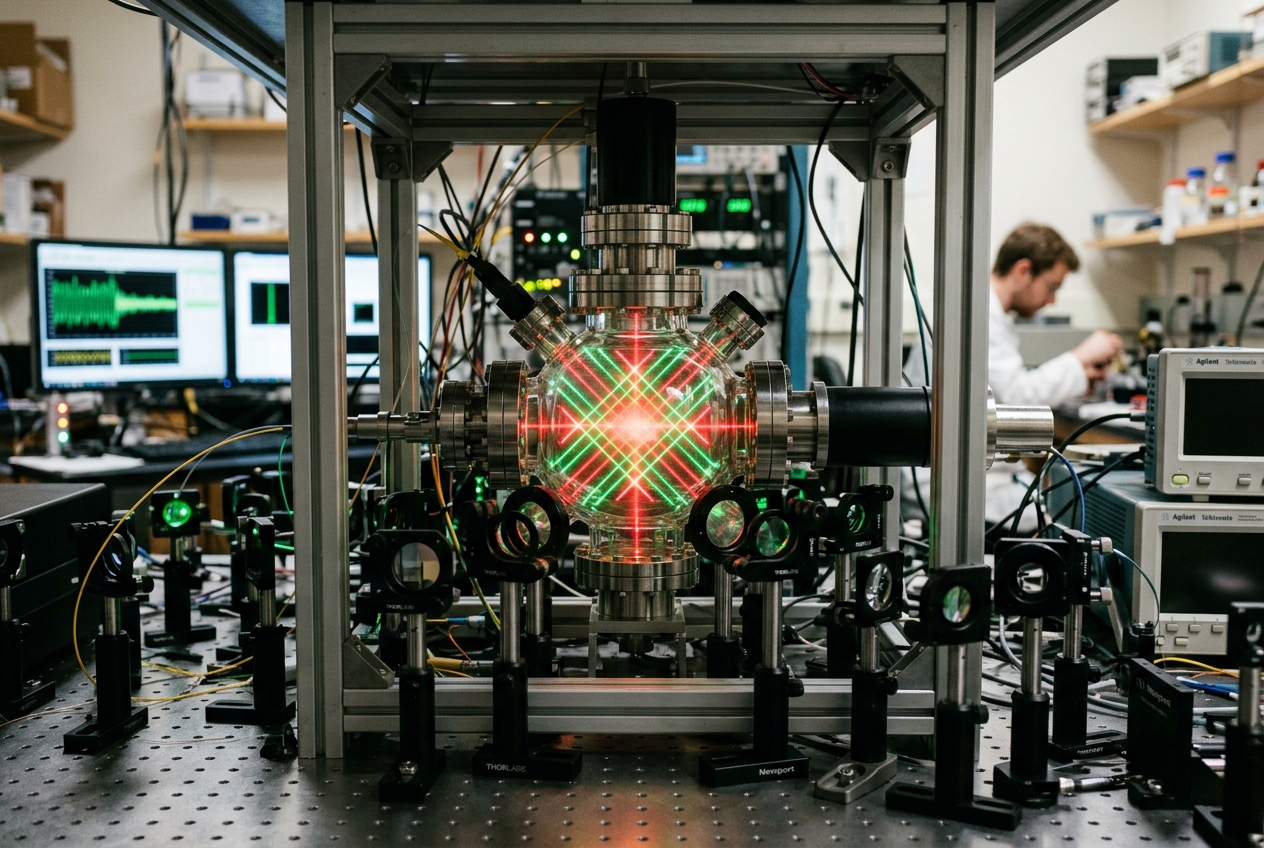
Yet, our universe remains stubbornly understandable. Classical supercomputers can simulate the behavior of complex crystal lattices, chemists can predict reaction pathways, and quantum engineers can design functioning logical qubits. This computational miracle rests upon a foundational law of quantum geometry known as the Area Law for Entanglement Entropy. Far from filling the entire three-dimensional volume of matter with chaotic, impenetrable correlations, nature imposes an astonishingly strict boundary condition: in the lowest-energy states of physical matter, quantum entanglement gathers almost entirely along the geometric surfaces separating one region of space from another. By restricting quantum information to a thin perimeter, the area law guarantees that the physics of our world lives in a microscopic, computationally accessible corner of mathematical reality.
The Idea in Plain English
To understand why the area law is so profound, one must first picture what quantum mechanics looks like when left completely unconstrained.
Imagine a ballroom containing one thousand dancers. In a completely randomized quantum state—what physicists describe as a Haar-distributed pure state—every single dancer is intimately gossiping and coordinating footwork simultaneously with all other nine hundred and ninety-nine dancers. If you draw a chalk line across the middle of the floor to divide the ballroom into two equal zones, Region $A$ and Region $B$, and ask how much shared, secret information crosses that boundary, the answer scales with the total number of dancers inside Region $A$. Because every dancer on side $A$ maintains entangled connections with dancers on side $B$, the shared entanglement entropy scales with the volume (the total count of particles). In theoretical physics, this maximal information density is governed by Page's theorem, which proves that generic quantum states are saturated with volume-law entanglement.
Ground states of physical matter—substances chilled to absolute zero, resting at their lowest possible energy configuration—behave in a fundamentally different manner. The fundamental forces of nature are strictly local: an electron in a crystal lattice interacts directly only with its immediate neighbors via Coulomb repulsion or magnetic exchange, rather than instantaneously linking with an atom across the room.
Because interactions are local, the quantum correlations they forge are short-ranged. If you chill the ballroom to its ground state, dancers in the deep interior of Region $A$ only hold hands with their adjacent neighbors; they are entirely unaware of Region $B$. The only individuals sharing quantum entanglement across the chalk line are the dancers standing shoulder-to-shoulder directly along the dividing line. Consequently, the quantum entanglement entropy between the inside and the outside does not scale with the volume of the region. Instead, it scales strictly with the area of its boundary.
In technical terms, the von Neumann entanglement entropy measures the degree of quantum uncertainty or missing information experienced by an observer who can only see inside Region $A$, while the rest of the universe ($B$) remains hidden. The area law states that this entropy is proportional to the geometric surface area $\partial A$ of the boundary dividing them.
How It Actually Works — The Mechanics
The mathematical architecture behind the area law reveals why low-energy quantum systems can be compressed and simulated with extreme efficiency, as well as the exact conditions under which this geometric rule exhibits profound, universal deviations.
1. The Baseline Area Law
In a spatial lattice of spatial dimension $d$, let a quantum system be described by a local Hamiltonian whose energy spectrum features a non-zero "spectral gap"—a finite energy difference $\Delta E > 0$ separating the ground state from the lowest excited state. If we partition the lattice into a spatial subregion $A$ and its complement $B$, the reduced density matrix of region $A$ is obtained by tracing out the degrees of freedom belonging to $B$: $\rho_A = \text{Tr}_B(|\Psi\rangle\langle\Psi|)$.
The von Neumann entanglement entropy $S(\rho_A) = -\text{Tr}(\rho_A \log \rho_A)$ quantifies the quantum entanglement across the cut. The area law dictates that this entropy grows no faster than the boundary surface area $|\partial A|$:
$$S(\rho_A) \le \alpha \, |\partial A|$$
In plain language, this equation calculates the quantum information contained in the cut and predicts that the entropy is capped by a constant $\alpha$ multiplied by the surface area of the boundary $|\partial A|$, completely independent of how many millions of particles reside within the interior of region $A$.
2. Hastings' 1D Proof and the Power of Tensor Networks
For decades, the area law was an empirical observation and an unproven conjecture. In 2007, mathematical physicist Matthew Hastings published a breakthrough proof in Physical Review Letters establishing that the area law holds rigorously for all one-dimensional gapped local quantum spin chains.
Hastings' proof harnessed the Lieb-Robinson bound, a fundamental theorem showing that in lattice quantum systems, information has an effective "speed of light." Even without relativistic invariance, perturbations cannot propagate across a lattice instantaneously; they are confined within an effective spacetime lightcone. Combined with the spectral gap $\Delta E$, the Lieb-Robinson bound forces all connected correlation functions to decay exponentially with spatial distance $r$:
$$\langle \mathcal{O}i \mathcal{O}{i+r} \rangle - \langle \mathcal{O}i \rangle \langle \mathcal{O}{i+r} \rangle \sim e^{-r/\xi}$$
Here, $\xi \approx v_{LR}/\Delta E$ represents the correlation length, where $v_{LR}$ is the Lieb-Robinson velocity. In one spatial dimension, the boundary $|\partial A|$ between a segment and the rest of an infinite line consists merely of two discrete boundary points. Because the boundary area is a zero-dimensional set of points (a constant $|\partial A| = 2$), Hastings proved that the entanglement entropy in 1D gapped systems is bounded by a constant value, $S \le S_{\text{max}}$, regardless of whether the segment contains ten spins or ten billion spins.
This mathematical result provides the rigorous foundation for one of computational physics' greatest triumphs: the Density Matrix Renormalization Group (DMRG) algorithm and Matrix Product States (MPS). Because the entanglement across any 1D cut is bounded by a constant, the state's Schmidt decomposition requires only a finite number of quantum states to achieve arbitrary precision. The many-body wavefunction can be compressed into a linear chain of low-rank matrices, reducing an otherwise intractable exponential problem into a polynomial calculation that runs in minutes on an ordinary laptop. Pedagogical derivations of these compression bounds can be explored via MIT OpenCourseWare.
3. Critical Systems and Conformal Field Theory (CFT)
What occurs when a physical system undergoes a continuous quantum phase transition and the spectral gap collapses to zero ($\Delta E \to 0$)? At this critical juncture, the correlation length diverges to infinity ($\xi \to \infty$), and quantum fluctuations become scale-invariant across all distances.
When the gap closes in one dimension, the strict constant area law experiences a universal logarithmic violation. Formulated by Christoph Holzhey, Finn Larsen, and Frank Wilczek, and later generalized by Pasquale Calabrese and John Cardy using Conformal Field Theory (CFT) in 1+1 dimensions, the entanglement entropy of a spatial block of length $L$ embedded within an infinite critical chain becomes:
$$S(L) = \frac{c}{3} \log\left(\frac{L}{a}\right) + s_0$$
In this expression, $a$ is the microscopic lattice spacing, $s_0$ is a non-universal constant, and $c$ is the conformal central charge—a universal integer or fraction that counts the fundamental quantum degrees of freedom of the underlying field theory (such as $c=1/2$ for the critical transverse-field Ising model, or $c=1$ for the free massless boson). This logarithmic scaling represents the subtle transition from the strict boundary constraint of gapped systems toward the runaway entanglement of critical regimes.
4. Two Dimensions, PEPS, and Topological Order
Extending these concepts to two-dimensional systems ($d=2$) introduces rich geometric and physical structure. For a 2D gapped lattice, the boundary $|\partial A|$ is a closed one-dimensional perimeter loop of length $L_{\text{perim}}$. The boundary area law dictates that $S(A) \sim \alpha L_{\text{perim}}$.
To represent such 2D states numerically, physicists developed Projected Entangled Pair States (PEPS), which tile two-dimensional tensor networks across planar geometries. While contracting 2D tensor networks is formally computationally hard (#P-hard), the area-law foundation allows variational approximations that capture ground-state correlations far beyond the reach of exact diagonalizations.
In exotic states of matter exhibiting topological order—such as fractional quantum Hall liquids, quantum spin liquids, and the Kitaev toric code—the area law contains a sub-leading correction that reveals the deepest structural secrets of the quantum vacuum. As independently discovered by Alexei Kitaev and John Preskill, and Michael Levin and Xiao-Gang Wen, the entanglement entropy of a smooth region $A$ in a topological phase obeys:
$$S(A) = \alpha |\partial A| - \gamma$$
Here, $\alpha |\partial A|$ is the standard non-universal perimeter contribution, while $\gamma \ge 0$ is the topological entanglement entropy. The quantity $\gamma$ is universal and scale-invariant; it is mathematically defined as $\gamma = \log \mathcal{D}$, where $\mathcal{D} = \sqrt{\sum_i d_i^2}$ is the total quantum dimension of all anyonic quasiparticle excitations in the topological phase.
By computing this alternating sum of entropies across overlapping regions, all local boundary perimeters and sharp corner anomalies cancel out exactly, isolating the pure topological invariant $\gamma$. Groundbreaking analyses of these topological phases are documented extensively across Nature.
Real-World Applications Today
The boundary restriction of quantum entanglement is not merely an elegant mathematical theorem; it is an active engineering framework driving the development of next-generation quantum computing, advanced materials, and precision metrology.
1. Verification of Logical Quantum Processors
- Institutions: IBM Quantum and the University of Waterloo.
- Objective: Benchmarking and verifying intermediate-scale quantum devices (100 to 1,000+ qubits) executing quantum error-correcting surface codes.
- The Quantum Advantage: Full classical simulation of 127-qubit quantum states is impossible under volume-law scaling. However, because surface-code ground states adhere to strict 2D area laws with small topological corrections, classical tensor network simulators (such as Matrix Product Operators and PEPS algorithms implemented in open-source platforms like Qiskit) can simulate and benchmark noisy quantum circuits. Engineers verify whether physical qubits are correctly generating topological entanglement without needing to represent the intractable full Hilbert space.
2. Unraveling High-Temperature Superconductors
- Institutions: The Flatiron Institute (Center for Computational Quantum Physics), Max Planck Institute of Quantum Optics, and Harvard University.
- Objective: Solving the two-dimensional Fermi-Hubbard model to discover the mechanism behind high-temperature cuprate superconductivity.
- The Quantum Advantage: The Hubbard model on a 2D square lattice represents strongly correlated electrons where standard mean-field approximations fail. By exploiting area-law entanglement limits via advanced 2D tensor networks (PEPS and infinite DMRG), computational physicists can systematically eliminate volume-law artifacts. This enables high-precision mapping of magnetic stripe phases and d-wave superconducting pairing orders on classical supercomputers, narrowing down candidate chemical structures for room-temperature conductors.
3. Direct Entanglement Tomography in Neutral-Atom Simulators
- Institutions: Harvard University, QuEra Computing, and MIT.
- Objective: Experimentally measuring many-body entanglement entropy and identifying quantum spin liquid phases in programmable Rydberg atom arrays.
- The Quantum Advantage: Using optical tweezers to position individual rubidium atoms in 2D arrays, researchers induce Rydberg blockades to engineer local, gapped Hamiltonians. By implementing randomized measurement protocols—applying random local unitary rotations followed by projective measurements—experimentalists reconstruct the second-order Rényi entropy across arbitrary spatial subregions. They have directly observed the perimeter-scaling area law and measured the topological entanglement entropy signature $\gamma$, confirming the synthesis of exotic topologically ordered matter in the laboratory.
4. Simulation of Metalloenzyme Active Centers for Catalyst Design
- Institutions: Google Quantum AI and BASF.
- Objective: Simulating the electronic structure of the FeMo-cofactor in nitrogenase, the bacterial enzyme that breaks down atmospheric nitrogen at room temperature.
- The Quantum Advantage: The active catalytic site of nitrogenase involves complex transition-metal clusters with high electronic correlation. Standard quantum chemistry density functional theory (DFT) is unreliable due to strong static correlation. By arranging molecular orbitals along an optimized 1D entanglement graph, DMRG algorithms leverage the area law to capture localized entanglement between d-orbitals. This allows chemists to determine the low-lying energy states of synthetic nitrogen-fixation catalysts, paving the way for energy-efficient industrial fertilizers.
What This Means for You
It is tempting to view the area law as a specialized curiosity reserved for theoretical physicists scribbling on blackboards. In reality, it is the invisible mathematical boundary condition that makes the modern technological world comprehensible.
Consider what the alternative would mean. If the ground states of everyday physical matter exhibited volume-law entanglement, nature would be hopelessly opaque. Every electron in the silicon chips powering your smartphone, every carbon bond in an oncology drug, and every lithium ion inside an electric vehicle battery would be inextricably entangled with the entire bulk of its surroundings. The computational cost to simulate, optimize, or predict the behavior of any chemical compound would scale exponentially with the number of atoms. Computer-aided drug discovery would not exist; new battery chemistries would have to be guessed via blind trial and error over centuries; and materials science would grind to an absolute halt.
Because the area law holds, nature is locally compressible. The critical properties of matter depend primarily on what occurs across boundaries and interfaces, rather than on the unbridled chaos of the bulk interior. When a pharmaceutical company models how an antibody latches onto a viral spike protein, or when a clean-tech startup designs an ultra-dense solid-state electrolyte, they are directly exploiting the fact that quantum information is perimeter-bound. The area law is the physical reason that human beings, equipped with modest computational tools, can decipher and engineer the quantum building blocks of the material world.
Today's Takeaway
The universe does not drown its low-energy states in a sea of unconstrained quantum chaos; instead, local physical laws confine quantum entanglement to the geometric perimeters dividing space. This foundational area law is the mathematical bridge that transforms an otherwise impossibly complex exponential reality into a structured, compressible world—enabling modern supercomputers to simulate complex molecules, guiding the creation of fault-tolerant quantum hardware, and revealing the topological fabric of our universe.