Zhou Jin Elbow Strike Force: Short-Range Kinetic Acceleration, Olecranon Fascial Vectoring, and Rotational Ground Force Transmission in Classical Neigong
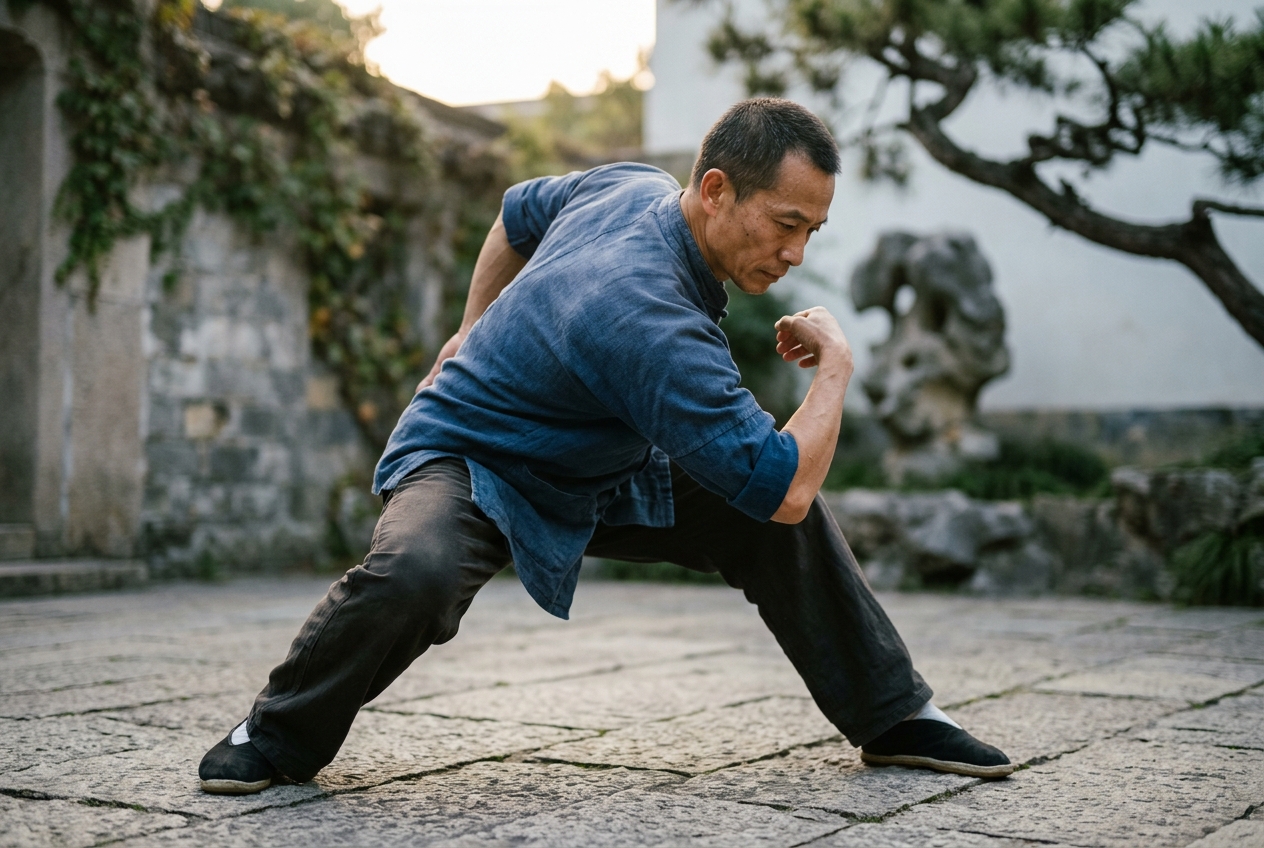
In traditional Chinese medicine and Neigong theory, this movement unites the anchoring root of the feet—specifically the Yongquan (湧泉, or "Bubbling Well" point located on the sole)—with the rotational power of the Dantian (丹田, the body's physical and energetic center of gravity located in the lower abdomen) and the opening of the Kua (胯, the inguinal crease and hip joints). When these anatomical hubs synchronize with the breath, the practitioner discharges tremendous force over zero practical distance without relying on superficial muscular exertion.
                   [ THE KINETIC VECTOR CHAIN OF ZHOU JIN ]

(DISCHARGE APEX)
             Olecranon Process (Elbow Tip) <=== Spiral Arm Fascia
                     ^
                     | (Scapular Anchor: Serratus Anterior & Latissimus)
             Spinal Tensegrity Column (Helical Torque)
                     ^
                     | (Intra-Abdominal Pressure & Pelvic Piston)
             Dantian Core & Inguinal Crease (Song Kua)
                     ^
                     | (Ground Reaction Force Transmission)
             Femur & Tibia Alignment (Knee Open / Stable)
                     ^
             Yongquan Point (Plantar Fascial Root / Earth Grounding)
Step-by-Step Practice Guide
Mastering the mechanics of Zhou Jin requires systematic neuromuscular re-education. Below is a progressive solo Daoyin (guided somatic movement) protocol designed to integrate the whole-body kinetic chain.
1. Fundamental Postural Matrix and Grounding Setup
Begin by standing in a balanced neutral posture (Wuji Stance). * Foot Placement: Position your feet parallel, precisely hip-to-shoulder width apart, with your body weight evenly distributed across the tripod of each foot: the base of the big toe, the base of the small toe, and the calcaneus (heel). * Rooting the Yongquan: Relax the arches of your feet slightly without collapsing inward, creating a gentle suction cup effect over the Kidney-1 (Yongquan) acupoint. According to clinical studies cataloged by the National Center for Biotechnology Information (NCBI), establishing stable plantar mechanoreceptor contact directly enhances proprioceptive postural control and neuromuscular efficiency throughout the kinetic chain. * Releasing the Pelvis (Song Kua): Soften your hip creases as if preparing to sit on a high barstool. Do not tuck the tailbone aggressively; allow the sacrum to hang naturally downward under the influence of gravity, decompressing the lumbar vertebrae. * Cranial Suspension (Baihui): Imagine an invisible cord lightly lifting the crown of your head (Baihui point), gently drawing the chin back and lengthening the cervical spine.
2. The Core Daoyin Drills: The Eight Directional Variations of Zhou Jin
Classical Neigong categorizes elbow energy into eight distinct directional vectors (Ba Xiang Zhou). Each variation alters the spatial pathway of the olecranon process while maintaining identical rooting and core rotational mechanics.
                           UPWARD LIFTING
                             (Tiao Zhou)
                                  ^
          DIAGONAL SHEARING       |       FORWARD PIERCING
             (Xie Zhou) \         |         / (Ding Zhou)
                         \        |        /
    OUTWARD SWEEPING <----- [ OLECRANON ] -----> INWARD FOLDING
       (Heng Zhou)       /     CENTROID    \       (Guo Zhou)
                        /         |         \
         CIRCULAR ROLLING         |       BACKWARD THRUSTING
            (Pan Zhou)            v          (Hou Zhou)
                           DOWNWARD PRESSING
                              (Chen Zhou)
I. Forward Piercing Energy (Ding Zhou / 頂肘)
- Setup: Step your left foot forward into a natural bow stance, keeping 60% of your weight in the rear leg.
- Execution: As you initiate a soft exhalation, press down through the rear Yongquan, rotate your rear hip forward, and allow the right elbow to pierce directly along your central axis. The forearm folds tightly against the chest, with the palm facing inward toward your sternum.
- Key Vector: A straight, horizontal line penetrating directly through the focal point of the olecranon process.
II. Downward Pressing Energy (Chen Zhou / 沈肘)
- Setup: Stand in a symmetrical parallel stance with knees softened.
- Execution: Inhale to elongate the spine; on the exhale, sink your pelvic floor and contract the lower abdominal wall inward and upward. Drive the elbows straight downward alongside the ribcage, anchoring the tip of the olecranon toward the hips.
- Key Vector: Vertical downward gravitational vector coupled with latissimus dorsi activation, rooting the entire shoulder girdle into the pelvis.
III. Upward Lifting Energy (Tiao Zhou / 挑肘)
- Setup: Neutral staggered stance with the right foot slightly advanced.
- Execution: Root through the front heel. As your hips rotate slightly toward the left, elevate the right elbow apex vertically along the sagittal plane, skimming close to your midline. The hand drops relaxed toward the right ear, forearm completely folded.
- Key Vector: Ascending vertical kinetic shear driven by pelvic extension and thoracic elongation.
IV. Outward Horizontal Sweeping (Heng Zhou / 橫肘)
- Setup: Shoulder-width parallel stance.
- Execution: Shift 70% of your weight into the left foot, sink the left Kua, and unwind the pelvis clockwise. The right elbow swings in a horizontal arc across the frontal plane, propelled strictly by the rotational torque of the waist and hips rather than the shoulder muscles.
- Key Vector: Centrifugal transverse force vector parallel to the floor.
V. Inward Folding and Wrapping (Guo Zhou / 裹肘)
- Setup: Bow stance with the lead hand extended loosely.
- Execution: Exhale and draw the lead elbow inward across your chest toward the opposite shoulder, wrapping the ribcage with the arm like a protective shield while maintaining a hollow chest and rounded upper back (Han Xiong Ba Bei).
- Key Vector: Inward centripetal compression focusing kinetic mass into the anatomical center.
VI. Backward Thrusting Energy (Hou Zhou / 後肘)
- Setup: Parallel stance with arms resting at the waist.
- Execution: Drive the hips back by creasing the Kua simultaneously as the right heel pushes into the floor. Fire the right elbow straight backward along the sagittal line, keeping the elbow tight to the flank.
- Key Vector: Linear posterior horizontal vector utilizing ground reaction rebound.
VII. Diagonal Shearing Energy (Xie Zhou / 斜肘)
- Setup: Staggered diagonal stance.
- Execution: Blend the upward lifting (Tiao) and horizontal sweeping (Heng) vectors. As the torso twists along an oblique axis, project the olecranon upward and across at a 45-degree angle.
- Key Vector: Multi-planar helical shear crossing the body's midline.
VIII. Circular Grinding and Rolling (Pan Zhou / 盤肘)
- Setup: Stable horse-riding stance (Mabu).
- Execution: Trace a continuous, overlapping figure-eight pattern with the apex of both elbows sequentially. The movement must be driven seamlessly by the continuous figure-eight oscillation of the hips and sacrum.
- Key Vector: Continuous circumductive rotational force governed by toroidal fascial elastic recoil.
3. Breath Coordination Protocol
To synchronize physiological pressure with mechanical delivery, utilize the classical method of Reverse Abdominal Breathing (Ni Fushi Huxi): 1. The Inhalation Phase (Coiling / Yin): Inhale smoothly through the nose over 4 seconds. As you draw air in, subtly draw the lower abdominal wall (the area two inches below the navel) inward toward the lumbar spine while relaxing the pelvic floor. Feel the connective tissues across the back and flank expand like a pressurized cylinder. 2. The Exhalation Phase (Discharge / Yang): Exhale sharply through the nose or with a soft, guttural "Heng" or "Ha" sound over 1–2 seconds. Expand the lower abdomen outward against your core musculature while simultaneously bearing down lightly with the diaphragm. This instantaneous surge of intra-abdominal pressure locks the torso into a solid hydraulic piston, stabilizing the spine at the precise moment of kinetic discharge. Guidance on these breathwork frameworks is widely documented through clinical compendiums hosted by the World Health Organization Traditional Medicine Strategy.
4. Diagnostic Self-Checks & Common Fault Corrections
| Fault Observed | Anatomical Mechanism of Failure | Diagnostic Correction |
|---|---|---|
| Shoulder Elevation ("Shrugging") | Overactivation of upper trapezius and levator scapulae; disconnects scapula from the thoracic wall. | Depress and Anchor the Scapula: Actively engage the serratus anterior and lower trapezius. Ensure the shoulder blade glides downward toward the rear hip pocket before initiating the strike. |
| Isolated Arm Pulling / Muscular Drive | Glenohumeral joint fires independently; kinetic chain breaks at the waist, resulting in high joint wear and negligible mass transfer. | Lock the Joint Angle: Freeze the elbow bend at roughly 45 to 60 degrees. Rotate only the pelvis and torso; let the elbow move solely as a passenger on the rotating core structure. |
| Unrooted or Floating Stance | Arches collapse or heels lift, breaking ground reaction force transmission from the Yongquan. | Deepen the Kua Fold: Sink 10% deeper into your hips. Maintain constant ground contact across the tripod of the foot; imagine roots sinking 3 feet into the earth beneath you. |
| Spinal Buckling / Lumbar Hyperextension | Lack of intra-abdominal pressure causes the lower back to arch upon impact, risking disc compression. | Engage the Abdominal Piston: Maintain an upright neutral spine. Compress the abdominal wall to brace the lumbar spine dynamically against impact forces. |
5. Somatic Sensation Milestones
As neuromuscular pathways habituate to this structural alignment, observe the following progressive somatic milestones: * Heaviness (Chen): An immediate sense that your arms have acquired the density of lead or solid wood, accompanied by a lowered center of gravity. * Tingling and Microvascular Warmth (Re / Ma): A noticeable prickling or warm sensation radiating through the forearm, palms, and fingertips, signifying vasodilation resulting from the release of chronic muscular tension and autonomic balance regulation, a phenomenon often described in standard Taijiquan biomechanical overviews. * Elastic Recoil (Tanxing): The experiential realization that your limbs are connected by taut rubber bands rather than rigid levers, allowing kinetic force to snap effortlessly through the olecranon tip without localized strain.
Why It Works: The Body Science
The explosive efficacy of Zhou Jin is fully explicable through modern musculoskeletal biomechanics, materials science, and neurophysiology. Rather than relying on mystical concepts, internal martial arts leverage exact physical laws to generate massive short-range kinetic output.
+-------------------------------------------------------------------------+
|                  BIOMECHANICAL PROFILE: ZHOU JIN                       |
|                                                                         |
|  Kinetic Parameter     Classical Expression     Physiological Substrate |
|  -----------------     --------------------     ----------------------- |
|  Ground Coupling       Yongquan Root            Plantar Grip / GRF      |
|  Torque Generation     Dantian Zhuan Dong       Core Transverse Shear   |
|  Shock Absorption      Spinal Tensegrity        Fascial Biotensegrity   |
|  Visceral Bracing      Ni Fushi Huxi            Intra-Abdominal Pressure|
|  Impact Vector         Olecranon Focus          Bony Kinetic Apex       |
+-------------------------------------------------------------------------+
Ground Reaction Force (GRF) and the Kinetic Chain
Every physical strike must obey Newton’s Third Law of Motion: force cannot be exerted without an equal and opposite counterforce. In an arm-dominated strike, the counterforce pushes the practitioner backward because the arm lacks structural anchoring. In authentic Zhou Jin, the strike begins at the earth interface. By driving downward into the Yongquan point, the practitioner elicits a Ground Reaction Force (GRF) vector that travels upward through the rigid bones of the lower leg, across the stabilized knee, and into the pelvis.
Pelvic Modulation via Song Kua and Dantian Torque
The pelvis and hip joints represent the primary mechanical gearbox of the human body. The injunction to Song Kua (relax and open the inguinal crease) releases the hip capsule, allowing the femur to articulate smoothly without dragging the lumbar spine into compensatory torsion. As the deep rotators of the hip (obturator internus, quadratus femoris, piriformis) and the abdominal obliques fire synchronously, they create massive rotational torque around the vertical axis of the body. This rotational acceleration is transferred directly into the ribcage and shoulder girdle.
Myofascial Tensegrity and Spiral Vectoring
The human body does not operate as an isolated collection of individual muscles acting on rigid bones; it functions as a continuous, prestressed biotensegrity network. Connective tissue fascial sheets wrap and interlink every muscle group. According to research on structural myofascial anatomy available through Wikipedia's analysis of Tensegrity, tension is distributed continuously across a closed system of compression struts (bones) suspended within a continuous tensile matrix (fascia and tendons).
   [ GROUND ] ===> [ TIBIA/FEMUR ] ===> [ PELVIC GEARBOX ]
                                                ||
                                                || (Rotational Shear)
                                                \/
   [ OLECRANON ] <=== [ SPIRAL FASCIA ] <=== [ SPINE TENSEGRITY ]
During Zhou Jin, the force generated by the hips is transmitted along the Spiral Line and the Deep Back Arm Line, as characterized in modern fascial research documented by the National Center for Biotechnology Information (NCBI) on Myofascial Force Transmission. Because the elbow is fully flexed, the long lever of the forearm is eliminated, converting the upper arm into a short, rigid, triangle-shaped strut. The olecranon process becomes the apex of this triangular truss, allowing kinetic energy to discharge instantaneously with zero loss through joint flexion.
Visceral and Spinal Protection via Intra-Abdominal Pressure (IAP)
When an elbow strike impacts a solid target, a massive reactive shockwave travels backward into the striker's body. If the striker is loose or structurally compromised, this shockwave can herniate intervertebral discs or jam the delicate glenohumeral (shoulder) joint.
Zhou Jin circumvents this through synchronized breath pressurization. By employing Reverse Abdominal Breathing at the moment of discharge, the diaphragm descends while the transversus abdominis and pelvic floor co-contract. This creates a high-pressure pneumatic core—a mechanism thoroughly detailed in PubMed Central studies on Intra-Abdominal Pressure. This pressurized intra-abdominal cylinder braces the lumbar spine anteriorly, while the latissimus dorsi and serratus anterior lock the scapula flat against the posterior ribcage. Consequently, the reactive shockwave bypasses vulnerable joints and dissipates harmlessly down through the musculoskeletal column directly back into the ground.
Classical Lineage & Historical Context
The mastery of short-range kinetic force (Cun Jin / 寸勁) via the elbow occupies a revered position across multiple lineages of classical Chinese martial and Neigong traditions. While often popularized as a raw combat technique, its historical origins lie in monastic and internal cultivation systems focused on optimizing human structural integrity and internal energy (Qi) circulation.
Elbow power is formalized as the seventh of the canonical "Eight Methods" (Ba Fa / 八法) in Taijiquan—namely Peng (Ward-off), Lu (Rollback), Ji (Press), An (Push), Cai (Pluck), Lie (Split), Zhou (Elbow), and Kao (Shoulder/Body Strike). In the classical Ming and Qing Dynasty treatises, traditionally attributed to masters such as Wang Zongyue and later preserved in the Wu and Yang family lineages, Zhou is designated as the primary close-range fallback when long-range ward-off forces are collapsed or neutralized by an opponent.
+-------------------------------------------------------------------------+
|                  THE EIGHT CLASSICAL METHODS (BA FA)                    |
|                                                                         |
|   Cardinal Energies (Four Sides):                                       |
|     1. Peng (Ward-Off)       2. Lu (Rollback)                           |
|     3. Ji (Press)            4. An (Push)                               |
|                                                                         |
|   Corner Energies (Four Corners):                                       |
|     5. Cai (Pluck)           6. Lie (Split)                             |
|     7. Zhou (Elbow Force)    8. Kao (Shoulder Strike)                   |
+-------------------------------------------------------------------------+
Simultaneously, the ferocious northern internal style of Bajiquan (Eight Extremities Fist), historically cultivated in Hebei Province, elevated elbow methods to their absolute zenith. In Bajiquan, practitioners train the "Six Big Openings" (Liu Da Kai) and "Eight Big Elbows" (Ba Da Zhou). The legendary lineage master Li Shuwen (1862–1934), renowned for his peerless short-range striking power, was famously recorded as stating that mastery of the elbow requires complete dissolution of arm-based pride: "The hand reaches, but does not strike; the real force arrives when the core and elbow collapse the space between Heaven and Earth."
In the foundational Neigong treatise Neigong Jing (Internal Work Classic), passed down through martial scholar circles, the transmission of force is immortalized in the classical maxim:
"The root is in the feet, issued through the legs, governed by the waist, and expressed through the fingers and joints."
When applied to Zhou Jin, the elbow replaces the fingers as the primary expressive terminal, providing an unyielding, unbreakable focal point that reflects hundreds of years of empirical biomechanical refinement. For those wishing to study these holistic movement frameworks further, the National Qigong Association (NQA) provides comprehensive historical educational resources and institutional curricula.
Today’s Practice Commitment
To integrate the biomechanics and somatic benefits of Zhou Jin into your daily life, commit to the following five-minute calibration protocol tomorrow morning before drinking your first coffee or tea:
+-------------------------------------------------------------------------+
|                  DAILY 5-MINUTE ZHOU JIN CALIBRATION                    |
|                                                                         |
|  Minute 01:00 — Neutral Wuji Stance & Diaphragmatic Breath Grounding   |
|  Minute 02:00 — Unilateral Pelvic Twisting with Scapular Anchoring      |
|  Minute 03:00 — Forward Piercing Vector (Ding Zhou) - 10 reps / side    |
|  Minute 04:00 — Circular Grinding Vector (Pan Zhou) - Continuous 60s   |
|  Minute 05:00 — Return to Stillness (Zhan Zhuang) & Somatic Scan        |
+-------------------------------------------------------------------------+
- Minute 1: Grounding Setup. Stand in Wuji posture. Spend sixty seconds connecting with the tripod of your feet, softening the Kua, and taking long, slow breaths into your lower belly.
- Minute 2: Core Isolation. Place your hands behind your back. Practice rotating your hips and waist 30 degrees to the left and right while maintaining steady, grounded contact at the Yongquan point.
- Minute 3: Forward Piercing Integration (Ding Zhou). Perform 10 slow, deliberate repetitions of the Forward Piercing Elbow on each side. Focus purely on driving the movement from the rear foot through the Dantian, keeping the shoulder completely relaxed.
- Minute 4: Circular Flow (Pan Zhou). Flow gently through the continuous figure-eight grinding pattern for sixty seconds, letting your spine undulate like an integrated wave.
- Minute 5: Integration and Stillness. Return to standing stillness (Zhan Zhuang). Rest your hands over your lower Dantian, close your eyes, and observe the sensations of warmth, blood flow, and grounded structural stability pulsing through your body.
Notice how this brief, five-minute alignment resets your posture, clears mental fatigue, and establishes a grounded, resilient physical presence that endures throughout your entire day.