Neiguan Cavity Inner Pass: Antebrachial Fascial Decompression, Cardiopulmonary Autonomic Entrainment, and Median Nerve Pathway Integration in Classical Neigong
       =======================================================
       ANATOMICAL TOPOGRAPHY OF THE INNER PASS (NEIGUAN / PC6)
       =======================================================
                 [ Flexor Carpi Radialis Tendon ]
                                |
       ------------------------( )----------------------------
          <<< Distal (Hand)             Proximal (Elbow) >>>
       -------------------------------------------------------
               * [ NEIGUAN / PC6 ] (Depth: Median Nerve)
       -------------------------------------------------------
          <<< Distal (Hand)             Proximal (Elbow) >>>
       ------------------------( )----------------------------
                                |
                  [ Palmaris Longus Tendon ]

       * Location: Exactly 2 cun (~3 finger-widths) proximal
         to the transverse wrist crease, directly superficial
         to the median nerve and deep antebrachial fascia.
       =======================================================
Within the theoretical framework of Traditional East Asian Medicine documented by the World Health Organization Traditional Medicine benchmarks, Neiguan is designated as the Luo-Connecting (network-linking) point of the Hand Jueyin Pericardium channel (Shou Jueyin Xinbao Jing) and the confluent, master opening point of the Yin Wei Mai (the Yin Linking Vessel). In classical physiological terms, the Pericardium is known as Xin Bao Luo—the structural and functional "envelope" or protector of the Heart. While the Heart (Xin) houses the Shen (the conscious spirit, mental clarity, and affective presence), the Pericardium mediates the Heart’s interactions with the external environment, absorbing physical and emotional shocks.
When emotional constraint (Qi Yu) or structural distortion compresses this pathway, the Middle Dantian—the energetic and anatomical epicenter located at the center of the chest at the sternal junction (Shanzhong, RN17)—becomes constricted. Somatically, this presents as dyspnea, esophageal tightness, tachycardia, and psychological unease. Cultivating the Neiguan cavity through internal martial arts (Neijiaquan) and medical Daoyin exercises serves to vent this thoracic pressure, anchor turbulent Shen, and harmonize communication between the upper, middle, and lower somatic reservoirs.
STEP-BY-STEP PRACTICE GUIDE: CULTIVATING NEIGUAN IN MOTION AND STILLNESS
To experience the restorative benefits of Neiguan, incorporate this progressive protocol into your standing meditation (Zhan Zhuang) or personal Daoyin routine. The exercise requires no specialized equipment—only a quiet space and deliberate somatic attention.
=========================================================================
          SOMATIC ATTUNEMENT SUMMARY: NEIGUAN NEUROMUSCULAR ENGAGEMENT
=========================================================================
Phase 1: Palpatory Measurement & Mechanical Decompression (2 Minutes)
Phase 2: Micro-Torsional Radial-Ulnar Spiraling (3 Minutes)
Phase 3: Embracing the Sphere (Cheng Bao Zhuang) Yi Projection (5 Minutes)
-------------------------------------------------------------------------
Primary Biomarkers:
  * Respiratory rate down-regulation (4–6 breaths/min)
  * Vagal tone elevation (High-Frequency HRV expansion)
  * Fascial shear relaxation across the Deep Front Arm Line (DFAL)
=========================================================================
Phase 1: Precision Topographical Palpation and Fascial Release
- Establish the Stance: Stand with your feet parallel, hip-width apart, knees unlocked with a slight 5-degree flexion, and pelvis neutrally suspended so the sacrum drops gently toward the floor. Rest your tongue lightly against the hard palate behind the upper incisors to close the micro-circulatory energetic circuit (Ren-Du connection).
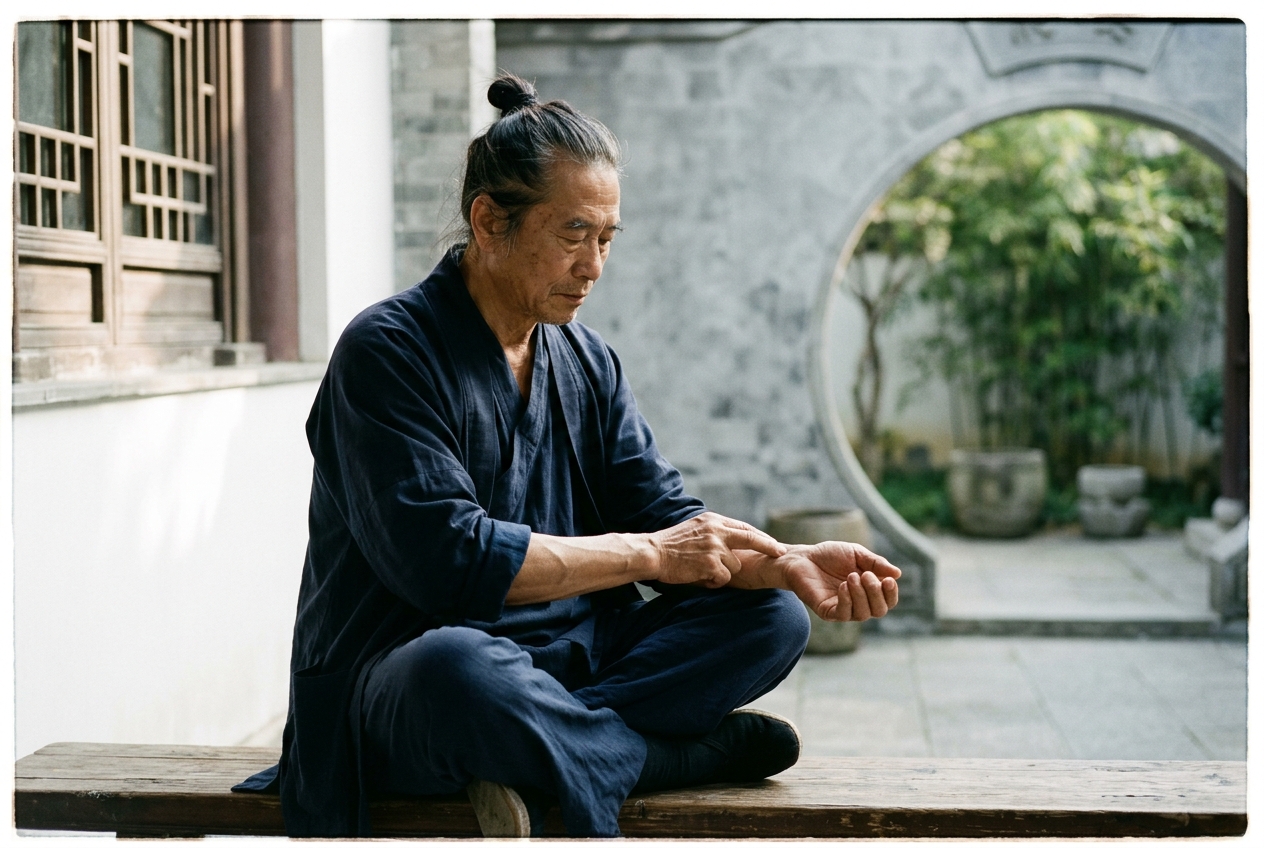
- Measure the Cavity: Elevate your left forearm horizontally before your solar plexus. Lay the index, middle, and ring fingers of your right hand flat across the anterior wrist crease. The point Neiguan sits exactly at the proximal border of your index finger, precisely two cun (individual proportional units, equivalent to the combined width of these three fingers) proximal to the transverse crease.
- Locate the Tendon Valley: Make a loose fist and gently flex your wrist against slight resistance to make the surface tendons spring into relief. You will see and feel two cord-like structures: the flexor carpi radialis (laterally, thumb side) and the palmaris longus (medially, pinky side). (Note: approximately 14% of the population congenitally lacks the palmaris longus; if absent, locate the point slightly medial to the prominent flexor carpi radialis tendon).
- Ischemic Mobilization: Relax your hand completely. Sink the tip of your right thumb perpendicularly into the inter-tendinous fissure to a depth of roughly one-half inch until you encounter a distinctive dull, radiating, neuro-fascial ache (the Deqi sensation). Maintain steady pressure while performing five slow, clockwise micro-rotations of the thumb, followed by five counter-clockwise rotations, synchronizing with long, unhurried exhalations. Switch arms and repeat on the right side.
Phase 2: Micro-Torsional Wrist Spiraling and Palmar Tensegrity
- Arm Architecture: Extend both arms out in front of your body at mid-chest height, elbows gently dropped below the wrists, forming a soft, curved arc as if loosely encircling a wide cedar trunk (Cheng Bao Zhuang or "Embracing the Tree" posture).
- Palmar Tensegrity Setup: Open the palms without inducing rigid tension. Gently hollow the center of the palm at the Laogong (PC8) cavity while maintaining a subtle outward extension through the tip of the middle finger (Zhongchong, PC9). This structural adjustment creates a biological dome structure across the metacarpophalangeal joints, taking slack out of the palmar aponeurosis.
- The Micro-Spiral Movement: On a slow, four-second inhalation into the lower abdomen (the Dantian, located two inches below the navel), initiate a micro-pronation of the forearms: rotate the radius over the ulna by just 3 to 5 degrees, expanding the dorsal wrist tissues and opening the space between the tendons at Neiguan.
- The Uncoiling Return: On a slow, six-second exhalation, initiate micro-supination: relax the antebrachial flexor compartment, allowing the radial edge of the forearm to spiral subtly upward and outward while sinking the chest (Han Xiong Ba Bei) and dropping the scapulae down the rib cage.
- Repetition: Complete 12 continuous breath cycles. Ensure the movement remains micro-somatic—an internal unwinding rather than a visible mechanical cranking of the wrist joints.
Phase 3: Yi (Intention) Projection from Laogong through Neiguan
- Static Integration: Freeze the external form of the posture in a balanced, comfortable mid-point of the spiral. Ensure the wrists are neither hyper-extended nor collapsed in flexion; the palmar surface should form an unbroken, buoyant plane with the inner forearm.
- Directing the Focus (Yi): Close your eyes partially, casting your gaze downward at a 45-degree angle. Direct your mental awareness (Yi) to the center of your palms (Laogong). Visualize a warm, viscous stream of energetic intention drawing inward from Laogong, filtering through the subterranean canal of Neiguan, traveling up the medial bicipital groove of the arm, crossing the anterior shoulder capsule, and collecting within the Middle Dantian at the center of the chest.
- Breath Integration: As you inhale, draw the intention from the palms through Neiguan into the chest. As you exhale, allow the intention to descend from the chest down to the lower Dantian and sink through the soles of the feet into the earth (Yongquan, KI1). Remain in this standing configuration for 5 to 10 minutes.
=========================================================================
           COMMON PRACTITIONER FAULTS AND BIOMECHANICAL CORRECTIONS
=========================================================================
FAULT 1: WRIST COLLAPSE (HYPERFLEXION OR SHARP EXTENSION)
  * Error: Bending the wrist backward beyond 45 degrees or letting it limp.
  * Consequence: Pinches the median nerve against the flexor retinaculum;
    chokes fascial transmission along the Deep Front Arm Line.
  * Correction: Maintain a hollow, supportive "dragon mouth" (*Hu Kou*)
    space between thumb and index finger, creating an unbroken hydraulic
    curve from the elbow to the middle fingertip.

FAULT 2: TENSILE OVER-GRIP IN THE ANTEBRACHIUM
  * Error: Clenching the fingers or over-straightening the metacarpals.
  * Consequence: Causes the flexor digitorum superficialis and profundus
    tendons to bind together, generating high-frequency neural static.
  * Correction: Relax the finger pads as if resting them upon buoyant
    silk cushions floating on calm water; feel the tendons separate.

FAULT 3: SCAPULAR ELEVATION AND CHEST EXPANSION
  * Error: Pushing the sternum outward or hiking the trapezius muscles.
  * Consequence: Triggers sympathetic autonomic dominance; breaks the
    energetic bridge between Neiguan and the Middle Dantian.
  * Correction: Drop the elbows (*Chen Jian Zhui Zhou*), soften the
    infrasternal angle of the ribs, and breathe into the posterior kidneys.
=========================================================================
Somatosensory Benchmarks: Reading Your Body's Biofeedback
As you practice this protocol, track the emergence of specific somatic sensations (Deqi and fascial unwinding):
- Localized Distension and Warmth: A heavy, expanding fullness around the Neiguan cavity indicates microvascular dilation and the release of isometric bracing within the antebrachial muscular compartments.
- Effervescent Tingling: Fine, carbonated micro-sensations traveling along the palmar surface toward the middle and index fingers indicate decompression of the median nerve trunk and the re-establishment of neural axonal flow.
- Deep Thoracic Sigh or Spontaneous Yawn: An involuntary deepening of the breath, accompanied by spontaneous swallowing or stomach rumbling (borborygmus), provides undeniable clinical confirmation of vagal nerve recruitment and parasympathetic dominance.
- Weightless Buoyancy in the Upper Limbs: As fascial adhesions shear open along the arm lines, the mechanical sensation of muscular effort vanishes, replaced by a hydraulic, floating suspension of the limbs supported by full-body tensegrity.
WHY IT WORKS: THE NEUROPHYSIOLOGICAL AND MYOFASCIAL MECHANISMS
The profound systemic effects elicited by mobilizing Neiguan are not mystical abstractions; they map directly onto well-documented pathways of modern neuromuscular physiology, autonomic neuroscience, and functional fascial anatomy. Research published through NCBI PubMed and analyzed by the National Center for Complementary and Integrative Health demonstrates that mechanical and sensory stimulation of PC6 produces distinct, measurable shifts in human neurobiology.
+-------------------------------------------------------------------------+
|                  NEURO-AUTONOMIC REFLEX PATHWAY OF PC6                  |
+-------------------------------------------------------------------------+
| [ Mechanical/Somatic Stimulation at Neiguan (PC6) ]                     |
|                                |                                        |
|                                v                                        |
| [ Median Nerve Afferent Recruitment (A-delta & C sensory fibers) ]       |
|                                |                                        |
|                                v                                        |
| [ Ascending Spinal Tracts -> Cervical Plexus (C6-T1) ]                  |
|                                |                                        |
|                                v                                        |
| [ Brainstem Integration: Nucleus Tractus Solitarii (NTS) ]              |
|                                |                                        |
|       +------------------------+------------------------+               |
|       |                                                 |               |
|       v                                                 v               |
| [ Dorsal Motor Nucleus ]                     [ Rostral Ventrolateral ]  |
| [ of Vagus Nerve (CN X) ]                    [ Medulla (Sympathetic) ]  |
|       |                                                 |               |
|       v                                                 v               |
| [ Parasympathetic Outflow ]                  [ Sympathetic Inhibition ] |
|  * Bradycardia (Slowed Heart Rate)            * Vasodilation            |
|  * Elevated HRV (HF Component)                * Reduced Blood Pressure  |
|  * Splanchnic Blood Flow Increase             * Cortisol Attenuation    |
+-------------------------------------------------------------------------+
1. Median Nerve Mobilization and Autonomic Cardioprotection
Anatomically, the Neiguan cavity is situated directly over the main trunk of the median nerve as it courses deep to the flexor retinaculum (transverse carpal ligament) and superficial to the flexor digitorum profundus. The median nerve arises from the medial and lateral cords of the brachial plexus, carrying somatic and autonomic fibers originating from the C6, C7, C8, and T1 spinal nerve roots.
When Neiguan is gently stimulated through palpatory decompression or dynamic micro-torsional fascial movement, mechanical shear forces recruit low-threshold myelinated A-beta and A-delta afferent fibers. These ascending signals traverse the dorsal root ganglia, ascend the spinothalamic tracts, and project directly into the Nucleus Tractus Solitarii (NTS) in the medulla oblongata.
The NTS serves as the central brainstem clearinghouse for cardiovascular and visceral autonomic regulation. From the NTS, excitatory interneurons project to the nucleus ambiguus and the dorsal motor nucleus of the vagus nerve (Cranial Nerve X), while simultaneously sending inhibitory GABAergic projections to the rostral ventrolateral medulla (RVLM)—the primary driver of systemic sympathetic tone.
The direct result of this neural cascade is a marked increase in vagal parasympathetic efferent outflow to the sinoatrial (SA) node of the heart. Clinical investigations into heart rate variability (HRV) consistently show that stimulation of the Neiguan point increases the high-frequency (HF) power spectrum—the gold-standard physiological marker of cardiac vagal tone—while suppressing the low-frequency to high-frequency (LF/HF) ratio associated with mental stress and sympathetic overdrive. Concurrently, it stabilizes respiratory sinus arrhythmia (RSA), synchronizing cardiac cycle micro-fluctuations with diaphragmatic excursion.
2. The Deep Front Arm Line and Myofascial Tensegrity
Beyond neurobiology, Neiguan functions as a vital mechanical node within the continuous fascial fabric of the human body. In the anatomical schema of fascial lines established by Thomas Myers, the pathway of the Hand Jueyin Pericardium sinew channel corresponds directly to the Deep Front Arm Line (DFAL).
       =======================================================
            MYOFASCIAL CONTINUITY OF THE PERICARDIUM (DFAL)
       =======================================================
       [ Sternochondral Junction / Pectoralis Minor / Ribs 3-5 ]
                                  |
                                  v
                    [ Clavipectoral Fascia / Axilla ]
                                  |
                                  v
               [ Coracobrachialis & Biceps Brachii ]
                                  |
                                  v
             [ Medial Antebrachial Septum & Pronator Teres ]
                                  |
                                  v
            [ NEIGUAN (PC6) - Inter-tendinous Flexor Sheath ]
                                  |
                                  v
              [ Flexor Retinaculum & Palmar Aponeurosis ]
                                  |
                                  v
                   [ Thenar / Palmar Eminence & Thenar Fascia ]
       =======================================================
The Deep Front Arm Line begins medially at the ribs 3, 4, and 5 via the pectoralis minor muscle, encompasses the dense clavipectoral fascia, travels down the anterior humerus through the coracobrachialis and biceps brachii, crosses the elbow joint via the medial antebrachial septum, and passes through the pronator teres and deep digital flexors before terminating in the thenar muscles and palmar fascia of the hand.
When an individual sits hunched over a workstation with rounded shoulders and flexed wrists, this entire myofascial track becomes shortened, desiccated, and locked in a shortened configuration. This mechanical shortening draws the coracoid process anteriorly and inferiorly, compressing the axillary space, pulling on the pericardial ligaments within the mediastinum, and physically restricting the downward excursion of the respiratory diaphragm.
Practicing the micro-torsional spiraling of Neiguan restores shear planes and promotes fluid rehydration between the palmaris longus, flexor carpi radialis, and flexor digitorum superficialis sheaths. Because fascia operates as a continuous, pre-stressed tensegrity system, decompressing the distal anchor of the DFAL at the wrist instantly transmits mechanical relief upstream, unwinding the bicipital sheath, softening the pectoralis minor, and releasing thoracic constriction around the pericardial sac and mediastinum.
3. Interstitial Fluid Dynamics and Mechanotransduction
At the microscopic level, applying gentle tensile shear to the connective tissue ground substance at Neiguan triggers cellular mechanotransduction. Mechanical tension applied to the extracellular matrix alters the conformation of transmembrane integrin proteins on local fibroblasts. This physical signal induces downstream biochemical cascades that down-regulate inflammatory cytokines, up-regulate collagenase to remodel fibrotic cross-links, and stimulate the secretion of hyaluronic acid. The resulting increase in interstitial hydration transforms the antebrachial compartment from a stiff, glued tissue into a supple, low-friction conduit for neural gliding and muscular transmission.
CLASSICAL LINEAGE & HISTORICAL CONTEXT
The functional integration of the Neiguan point represents the culmination of more than two millennia of systematic somatic observation within China's medical, Daoist, and martial traditions, as chronicled by the National Qigong Association and detailed in classical literature on the Wikipedia - Pericardium Channel.
+-------------------------------------------------------------------------+
|                  HISTORICAL EVOLUTION OF NEIGUAN DOCTRINE               |
+-------------------------------------------------------------------------+
|  ~100 BCE: Huangdi Neijing (Lingshu Chapter 10)                         |
|  * Establishes Hand Jueyin Luo-Connecting Vessel at 2 cun above wrist.  |
|  * Identifies somatic symptoms: Precordial pain, agitation, stiff neck. |
|                                |                                        |
|                                v                                        |
|  ~200 CE: Nanjing (Classic of Difficulties, Problem 28)                 |
|  * Codifies the Eight Extraordinary Vessels (Qi Jing Ba Mai).           |
|  * Links Neiguan to the Yin Wei Mai (Yin Linking Channel).              |
|                                |                                        |
|                                v                                        |
|  ~1580 CE: Zhenjiu Dacheng (Great Compendium of Acupuncture)            |
|  * Yang Jizhou pairs PC6 (Neiguan) with SP4 (Gongsun).                  |
|  * Establishes clinical mastery over diseases of the Chest and Stomach. |
|                                |                                        |
|                                v                                        |
|  17th–19th Century: Daoist Internal Martial Arts (Neijiaquan)           |
|  * Integration into Zhan Zhuang, Taijiquan, and Xingyiquan mechanics.   |
|  * Used to root the pulse, sink the chest, and discharge internal Jin.  |
+-------------------------------------------------------------------------+
Textual Foundations: From the Inner Canon to the Great Compendium
The earliest comprehensive textual description of the Neiguan channel pathway appears in the foundational medical treatise Huangdi Neijing (The Yellow Emperor's Inner Canon), compiled during the Han Dynasty (c. 1st century BCE). In the Lingshu (Miraculous Pivot, Chapter 10: "On the Channel Vessels"), Neiguan is formally designated as the Luo-Connecting point of the Hand Jueyin channel:
"The branch of the Hand Jueyin begins two cun above the wrist, exiting between the two tendons... When it is excess, there is precordial chest pain; when it is deficient, there is stiffness and irritability of the head and neck. Treat it at the Luo point."
The text recognized that Neiguan possesses a unique topological property: it is the anatomical pivot where the deep, internal trajectory of the Pericardium meridian branches outward to connect directly with its paired Yang counterpart, the Hand Shaoyang Sanjiao (Triple Burner) channel. Through this transverse Luo connection, working with Neiguan does not merely treat localized wrist or chest symptoms; it regulates systemic fluid metabolism, harmonizes thermal gradients across the upper, middle, and lower torso, and clears pathological heat from the bloodstream.
Centuries later, in the Nanjing (The Classic of Difficulties, Problem 28), classical theoreticians mapped the Eight Extraordinary Vessels (Qi Jing Ba Mai)—the deep, ancestral reservoirs of vitality that govern constitutional development, structural tensegrity, and deep emotional patterns. Within this matrix, Neiguan was identified as the confluent command point (Ba Mai Jiao Hui Xue) of the Yin Wei Mai (the Yin Linking Vessel).
The Yin Wei Mai traverses the interior aspect of the entire body, weaving together the Liver, Spleen, Kidney, and Conception (Ren) channels before anchoring in the throat and chest. The classical diagnostic canon summarized its emotional function simply: "When the Yin Wei Mai is diseased, the patient suffers from profound heartbreak, interior grief, and melancholy." By opening Neiguan, the ancient physician-practitioner unlocked the entire interior emotional link of the body, allowing repressed psychological distress (Yu) stored within visceral organs to discharge safely through somatic expression.
In the Ming Dynasty masterwork Zhenjiu Dacheng (The Great Compendium of Acupuncture and Moxibustion, 1601 CE) by Yang Jizhou, Neiguan was paired systematically with Gongsun (Spleen 4, the master point of the Chong Mai or Penetrating Vessel). Together, this master-couple point combination formed the premier clinical strategy for all disorders of the "Heart, Chest, and Stomach"—a formulation that remains standard in clinical acupuncture worldwide today.
The Internal Martial Arts Legacy: Xingyi, Taiji, and Bagua
Within the internal martial lineages (Neijiaquan)—most notably the Daoist Wudang traditions, Taijiquan, Xingyiquan, and Baguazhang—the physical opening of the Neiguan cavity was guarded as an essential trade secret for generating internal power (Fa Jin) and preventing combat fatigue.
In traditional Zhan Zhuang (standing post cultivation) developed within lineages such as Yiquan (Dachengquan) by master Wang Xiangzhai (1885–1963), students were strictly warned against allowing the wrist to "break" (Zhe Wan). A collapsed wrist severed the elastic continuity between the tendon-lines of the arm and the elastic fascial sheet of the back (Bei).
Masters taught that the intention must project outward through Laogong (PC8) while the physical structure remains anchored through Neiguan (PC6). This creates a structural condition termed Chen Jian Zhui Zhou (Sinking the Shoulders and Dropping the Elbows), accompanied by Han Xiong Ba Bei (Hollowing the Chest and Rounding the Back). When Neiguan is structurally opened, the thoracic cage decompresses, allowing the physical center of gravity and the internal Qi to settle firmly into the lower Dantian in the pelvic bowl. In martial confrontation, this somatic integration allowed the practitioner to absorb explosive incoming kinetic energy directly into their skeletal frame while maintaining calm emotional detachment, unswayed by the sympathetic surge of adrenaline.
TODAY'S PRACTICE COMMITMENT
To translate these classical somatic principles and modern neurophysiological insights into direct, experiential transformation, commit to the following structured protocol every day for the next seven days.
+-------------------------------------------------------------------------+
|                  DAILY 7-MINUTE NEIGUAN INTEGRATION PROTOCOL            |
+-------------------------------------------------------------------------+
| WHEN: Early morning immediately upon waking, or during the afternoon    |
|       energy lull (1:00 PM – 3:00 PM / Peak Small Intestine/Heart time). |
|                                                                         |
| DURATION: 7 Minutes total.                                              |
|                                                                         |
| PROTOCOL BREAKDOWN:                                                     |
|  * 0:00 - 2:00 (2 Mins): Bilateral Palpatory Decompression.              |
|    - 60 seconds on left PC6, 60 seconds on right PC6 with deep         |
|      diaphragmatic breathing (4s in, 6s out).                            |
|                                                                         |
|  * 2:00 - 4:00 (2 Mins): Dynamic Micro-Torsional Spiraling.             |
|    - Stand in neutral alignment; perform 12 synchronized micro-pronation |
|      and micro-supination cycles on the arm arcs.                       |
|                                                                         |
|  * 4:00 - 7:00 (3 Mins): Static Embracing the Sphere (Zhan Zhuang).    |
|    - Hold the arc posture; project intention from Laogong through       |
|      Neiguan to Middle Dantian, resting awareness in Lower Dantian.     |
+-------------------------------------------------------------------------+
Practitioner Observation Metric
Keep a concise somatic journal throughout your seven-day commitment. Note changes in the following markers before and immediately following your seven-minute session:
- Resting Heart Rate & Rhythm: Place your index finger on your radial pulse for 30 seconds. Note whether your pulse feels hard and rapid (sympathetic tone) or broad, supple, and rhythmic (parasympathetic tone).
- Breath Depth and Thoracic Freedom: Rate the ease of drawing a complete, unrestricted breath down to the pubic bone on a scale of 1 to 10.
- Mental Clarity & Emotional Reactivity: Track your subjective feeling of grounded calm when confronted with daily cognitive stressors.
By engaging Neiguan not as an abstract metaphysical point on an antique chart, but as a living neuro-fascial junction, you claim direct conscious access to your own autonomic control center. Through regular practice, the Inner Pass transforms from a simple anatomical landmark into an enduring, somatic sanctuary of grounded calm, balanced resilience, and vital coherence.