Mao Bu Cat Step Qigong: Eccentric Quadriceps Deceleration, Plantar Proprioceptive Rooting, and Pelvic Tensegrity in Classical Daoyin
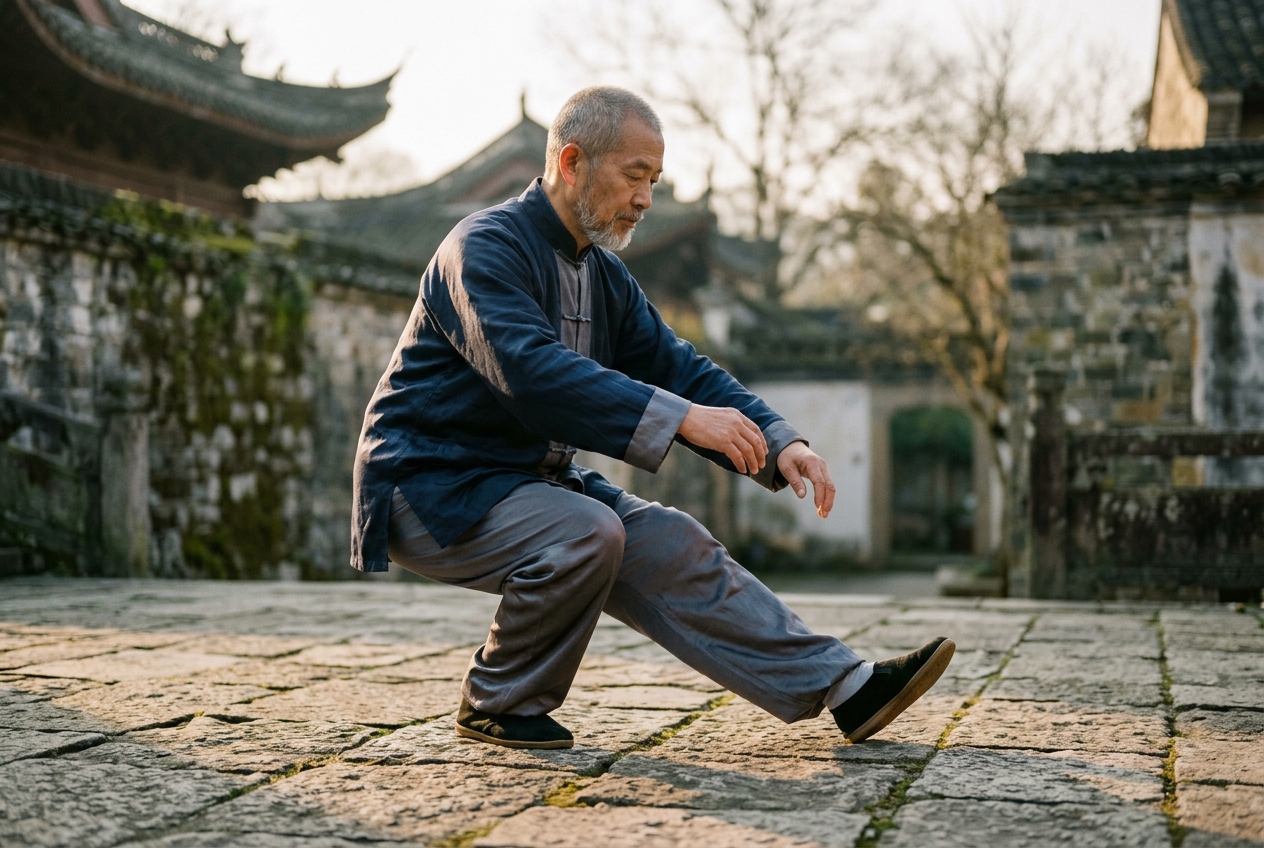
Unlike ordinary walking, where people perpetually fall forward into their next stride and rely on the abrupt skeletal collision of a heel-strike to arrest their momentum, the practitioner of Cat Step moves with continuous muscular deceleration and fluid joint integration. In classical Traditional Chinese Medicine and Daoist internal cultivation, this discipline is designed to separate the "substantial" (Shi, 实)—the loaded, energized, grounded limb—from the "insubstantial" (Xu, 虚)—the empty, receptive, floating limb. Through this uncompromising separation, the practitioner calms the central nervous system, cultivates deep fascial elasticity, and roots their energetic awareness into the earth.
       AXIAL ALIGNMENT & BIPHASIC WEIGHT DISTRIBUTION (MAO BU)

              [ Baihui (GV-20) Suspended Upward ]
                              |
                     ( Cervical Neutral )
                              |
                    [ Deep Front Line ]
                              |
               [ Mingmen (GV-4) Open / Flat ]
                              |
                 ( Lower Dantian Center )
                              / \
                             /   \
         [ SUBSTANTIAL / SHI ]   [ INSUBSTANTIAL / XU ]
          Loaded Stance Limb       Unloaded Stepping Limb
          - 100% Body Weight       - 0% Kinetic Load
          - Kua Folded & Deep      - Free Hip Articulation
          - Eccentric Quadriceps   - Subtalar Probing
          - Grounded via Yongquan  - Zero-Impact Placement
                     |                      |
             [ KID-1 Rooted ]         [ Feather Contact ]
Step-by-Step Somatic Protocol
Mastering the Cat Step requires retraining the autonomic reflexes of the lower extremities, the pelvis, and the axial spine. Perform the following step-by-step sequence barefoot or in flat, thin-soled shoes on a level surface.
+-----------------------------------------------------------------------------------+
|                        CORE SOMATIC PRINCIPLES OF MAO BU                          |
+-----------------------------------------------------------------------------------+
| 1. Axial Suspension (Xu Ling Ding Jin): Crown lifted, tailbone dropped.           |
| 2. Complete Separation (Shi / Xu): 100% weight in one leg; 0% in the other.      |
| 3. Inguinal Infolding (Song Kua): The hip crease folds like a closing book hinge.  |
| 4. Shockless Articulation: Controlled heel-to-toe or toe-to-heel gentle contact.  |
| 5. Core Hydraulic Drive: Movement originates from lower belly rotation (Dantian).|
+-----------------------------------------------------------------------------------+
1. The Preparatory Stance and Axial Suspension
Begin in the fundamental posture of Qigong (Wuji stance). Position the medial borders of your feet parallel, spaced precisely at hip-to-shoulder width. Soften the knees by two to three centimeters.
Establish Xu Ling Ding Jin (虚领顶劲)—the suspension of the crown. Imagine an unbroken silk thread pulling gently upward at the apex of the skull (Baihui, GV-20), elongating the cervical vertebrae and releasing tone in the suboccipital musculature. Concurrently, allow the sacrum and coccyx to hang downward as if weighted by a plumb line. This dual vector opens the lumbar curve, gently expanding the energetic gate of Mingmen (命门, GV-4) across the lower back. Co-activate the pelvic floor slightly at Huiyin (会阴, CV-1) to create a supportive internal floor for intra-abdominal pressure.
2. The Sinking Phase and Inguinal Crease (Kua) Infolding
Slowly shift 100% of your body mass into your left foot. As your weight pours down, do not allow the left hip to kick out laterally. Instead, "fold" the left inguinal crease—the anatomical junction where the thigh meets the pelvis, known in internal arts as the Kua (胯).
The left knee must track directly over the second toe, never collapsing inward. As the supporting left leg absorbs the full gravitational load, the quadriceps (vastus lateralis, vastus medialis, and rectus femoris) and the gluteus medius engage in sustained eccentric contraction, lowering your overall center of mass by two to four inches while keeping the torso strictly perpendicular to the floor.
3. The Unloaded Extension and Subtalar Articulation
With the left limb established as fully substantial (Shi), the right limb becomes entirely insubstantial (Xu). Peel the right foot off the floor without generating any compensatory tilt in the shoulders or pelvis. Draw the right knee forward and slightly inward along an arc, skimming the medial ankle past the supporting stance ankle.
Extend the right leg forward along a gentle forty-five-degree trajectory or directly along the sagittal line. As the right foot reaches outward, keep every ounce of body weight locked into the left leg. The right heel touches down onto the floor with absolute delicacy—as if testing the structural integrity of thin winter ice. The subtalar joint and midtarsal joints articulate softly, unrolling the sole from the lateral border to the metatarsal heads without transferring even a fraction of your body mass.
4. The Fluid Weight Transfer and Reverse Abdominal Breath Entrainment
Only after the right foot has established full, stable planar contact with the floor does the weight transfer begin. Coordinate this transition with reverse abdominal respiration (Ni Fu Shi Hu Xi).
As you prepare to move, inhale smoothly into the lower abdomen while gently drawing the perineum upward; as you exhale, rotate the lower belly (the lower Dantian, 丹田) slightly toward the direction of travel, driving the mass forward through the pelvic floor. The weight pours across from the left heel to the right foot like thick, warm oil moving from one vessel into another. The transition is linear, uninterrupted, and devoid of any vertical bobbing or lateral swaying.
5. Sensory Benchmarks: What to Feel and What It Means
As you sustain this walking protocol over multiple cycles, monitor your internal somatic feedback: * Deep Thermal Sensation (Warmth): A pervasive warmth spreading through the quadriceps, soles of the feet, and lower abdomen indicates peripheral vasodilation and the activation of the parasympathetic nervous system. * Microvascular Tingling (Deqi / Micro-Perfusion): A subtle, effervescent tingling sensation across the fingertips and plantar surfaces signals enhanced peripheral capillary flow and neurovascular decompression. * Heavy, Settled Rootedness (Chen): The distinct subjective feeling that your supporting foot has expanded into the earth signifies correct alignment of the ground reaction force vector directly through the skeletal architecture. * Elastic Fascial Buoyancy: A sensation of being suspended from above while spring-loaded from beneath indicates that dynamic tension has shifted from isolated voluntary muscle clenching into the continuous collagenous fascial network.
Diagnostic Corrections for Common Pathomechanical Deviations
+----------------------------------------------------------------------------------------------------+
|                             COMMON PATHOMECHANICAL ERRORS & CORRECTIONS                            |
+------------------------------------+----------------------------------+----------------------------+
| Deviation                          | Neuromechanical Cause            | Direct Corrective Cue      |
+------------------------------------+----------------------------------+----------------------------+
| Valgus Knee Collapse               | Weak gluteus medius; collapsed   | Spiral the stance knee out |
| (Knee tracking medial to toe)      | medial longitudinal foot arch.   | over 2nd toe; grab floor.  |
+------------------------------------+----------------------------------+----------------------------+
| Lateral Pelvic Shear               | Inability to fold the Kua; hip   | Deepen the inguinal crease;|
| (Hip hiking or jutting outward)    | hiking to clear the swing foot.  | keep anterior iliac level. |
+------------------------------------+----------------------------------+----------------------------+
| Premature Weight Transfer          | Insufficient eccentric strength; | Keep 100% load on back leg |
| ("Falling" forward onto the foot)  | kinetic rush and lack of root.   | until front foot is flat.  |
+------------------------------------+----------------------------------+----------------------------+
| Lumbar Hyper-Lordosis              | Tight psoas; anterior pelvic     | Drop sacrum; expand the    |
| (Over-arching the lower spine)     | tilt; unanchored core cylinder.  | Mingmen gate backward.     |
+------------------------------------+----------------------------------+----------------------------+
Why It Works: The Biomechanics and Body Science
The physiological and biomechanical elegance of Mao Bu lies in its radical transformation of ordinary human locomotion. Conventional gait relies heavily on an inverted pendulum model, wherein kinetic energy is repeatedly converted into potential energy through periodic collisions with the ground. In contrast, Cat Step functions on a continuous motorized damper model governed by eccentric neuromuscular control, fascial tensegrity, and autonomic entrainment.
       CONVENTIONAL GAIT vs. MAO BU (CAT STEP) KINETIC PROFILE

   Ground Impact Force (Newtons)
   ^
   |      /\ (Sharp Heel-Strike Collision Peak)
   |     /  \
   |    /    \        --- Conventional Bipedal Walking
   |   /      \       ___ Mao Bu Decelerated Stride
   |  /        \_________
   | /                   \
   |/                     \
   +-------------------------------------> Time (Milliseconds)
   |  ___________________________ (Smooth, flat kinetic baseline)
1. Eccentric Quadriceps Deceleration and Impact Elimination
During conventional bipedal gait, the heel strikes the ground with a force equal to 1.2 to 1.5 times the individual's total body weight. This instantaneous impact generates an acoustic and mechanical shockwave that travels upward through the calcaneus, tibia, patellofemoral joint, hip capsule, and spinal column.
In Mao Bu, the supporting leg maintains continuous, deep eccentric contraction across the quadriceps complex and the soleus muscle. By lowering the center of mass before foot extension, the kinetic energy of the swing leg is decelerated to near zero prior to surface contact. The foot is placed rather than dropped, eliminating the acute heel-strike shockwave and sparing the articular cartilage of the weight-bearing joints from repetitive micro-trauma.
2. Fascial Tensegrity: The Deep Front Line and Spiral Line
The human body operates not merely as a collection of isolated levers and pulleys, but as a biological tensegrity network where rigid compressive struts (bones) are suspended within a continuous, self-equilibrating sea of tensile connective tissue (fascia).
Mao Bu specifically recruits the Deep Front Line (DFL)—the myofascial core that ascends from the plantar surface of the foot via the tibialis posterior, traverses the popliteal space, passes through the adductor group, anchors across the psoas major and iliacus, integrates with the respiratory diaphragm, and terminates along the suboccipital and craniocervical fascial envelopes.
       DEEP FRONT LINE (DFL) RECRUITMENT IN MAO BU LOCOMOTION

         [ Suboccipital & Cervical Fascia (Suspension) ]
                              |
                     [ Pericardium & Neck ]
                              |
               [ Diaphragm (Phrenic Regulation) ]
                              |
               [ Psoas Major & Iliacus (Core Axis) ]
                              |
                 [ Pelvic Floor & Adductors ]
                              |
                [ Popliteal & Deep Posterior Leg ]
                              |
               [ Plantar Fascia & Yongquan (KID-1) ]
When the practitioner folds the Kua and anchors the pelvic floor, the Deep Front Line experiences uniform, pre-stressed mechanical tension. Simultaneously, the Spiral Line (SPL)—which wraps obliquely around the torso and legs—couples the rotational torque of the lower Dantian with the stance leg. The thoracolumbar fascia acts as a hydraulic spring, storing elastic potential energy during the infolding phase and releasing it smoothly during forward translation without requiring sudden bursts of metabolic energy.
3. Proprioceptive Recalibration and Vestibular Stabilization
The human balance apparatus relies on three sensory inputs: vision, the vestibular system of the inner ear, and peripheral proprioception from mechanoreceptors in joints, muscles, and skin. Standard walking often leads to sensory atrophy, as stiff footwear and repetitive movements desensitize the feet.
Mao Bu forces a radical neurosensory recalibration. By slowing locomotion to a fraction of normal speed and requiring absolute single-leg balance, the brain's motor cortex must dynamically process afferent signals from thousands of Ruffini endings, Pacinian corpuscles, and Golgi tendon organs situated in the foot arches and ankles. Research indexed across the National Center for Biotechnology Information demonstrates that slow-velocity, single-weighted somatic training significantly enhances dynamic postural stability, sensory organization scores, and cortical neuroplasticity in both athletic and aging cohorts.
4. Autonomic and Cardiorespiratory Entrainment
Cat Step integrates deep, low-frequency diaphragmatic breathing with motor output. When intra-abdominal pressure is modulated rhythmically against the pelvic floor and lumbar spine, the vagus nerve (Cranial Nerve X) receives continuous mechanical stimulation as it passes through the esophageal hiatus of the diaphragm.
This mechanical vagal stimulation increases parasympathetic outflow, downregulating sympathetic arousal, lowering resting arterial blood pressure, and increasing Heart Rate Variability (HRV). The practitioner achieves what modern psychophysiologists term the "flow state" or "coherence"—a condition of heightened alertness paired with profound neuromuscular relaxation.
Energetic Biocircuitry and Classical Lineage
The biomechanical mastery of the Cat Step is inseparable from its classical energetic foundation. Rooted in ancient Daoist internal alchemy (Neidan, 内丹) and therapeutic gymnastics (Daoyin, 导引), the practice was systematically refined during the Ming and Qing dynasties within the internal martial arts lineages of Taijiquan, Xingyiquan, and Baguazhang.
+-----------------------------------------------------------------------------------+
|                        CLASSICAL QI CIRCUITS IN CAT STEPPING                      |
+-------------------+-----------------------------+---------------------------------+
| Point / Vessel    | Anatomical Location         | Energetic & Somatic Function    |
+-------------------+-----------------------------+---------------------------------+
| Yongquan (KID-1)  | Plantar depression between  | Roots kinetic chain to ground;  |
|                   | 2nd and 3rd metatarsals.    | draws Earth Yin energy upward.  |
+-------------------+-----------------------------+---------------------------------+
| Zusanli (ST-36)   | 3 cun inferior to patella,  | Fortifies lower limb endurance; |
|                   | 1 fingerbreadth lateral.    | anchors descending Yang Qi.     |
+-------------------+-----------------------------+---------------------------------+
| Mingmen (GV-4)    | Interspinous space between  | Regulates systemic vitality;    |
|                   | L2 and L3 vertebrae.        | opens posterior lumbar gate.    |
+-------------------+-----------------------------+---------------------------------+
| Huiyin (CV-1)     | Midpoint of the central     | Seals lower energetic basin;    |
|                   | perineal body.              | regulates pelvic hydraulic floor|
+-------------------+-----------------------------+---------------------------------+
| Yin Qiao Mai      | Medial malleolus ascending  | Coordinates unilateral support, |
| (Yin Heel Vessel) | the medial lower limb axis. | motor tone, and bilateral balance|
+-------------------+-----------------------------+---------------------------------+
The Classical Dictum: "Step Like a Cat, Draw Silk Like Thread"
In the foundational Taijiquan Classics attributed to masters such as Wang Zongyue and Wu Yuxiang, the central operational principle is preserved in the aphorism: "Mai bu ru mao xing, yun jin ru chou si" (迈步如猫行,运劲如抽丝)—"Step with the light agility of a cat, and move dynamic force with the unbroken continuity of drawing raw silk from a cocoon."
                 CLASSICAL ENERGETIC BIOCIRCUITRY OF MAO BU

                       ( Baihui - Crown Portal GV-20 )
                                      ^
                                      |
                     [ Ren Mai & Du Mai Central Loop ]
                                      |
                       ( Mingmen - Lumbar Gate GV-4 )
                                      |
                      ( Lower Dantian Reservoir )
                                      |
                         ( Huiyin - Perineum CV-1 )
                                     / \
                                    /   \
                     [ Yin Qiao Mai ]   [ Insubstantial Leg ]
                                   /     \
                [ Zusanli (ST-36) ]       \
                                 /         \
            [ Yongquan (KID-1) Root ]     [ Light Planar Contact ]
The cat does not pounce with uncalibrated rigidity; it stalks with soft, silent joints, storing kinetic potential in its sinews (Jin, 筋) until the exact moment of delivery. In Daoist philosophy, moving silently is an energetic preservation strategy: mechanical collisions and jarring impacts scatter Qi (San Qi), whereas smooth, friction-free movement gathers and circulates vital energy throughout the internal organ reservoirs.
Acupoint Biocircuitry and Meridian Routing
During the execution of Mao Bu, four primary energetic hubs and one extraordinary vessel govern the biocircuitry:
- Yongquan (涌泉, KID-1 - "Bubbling Well"): Located in the depression formed when the foot is in plantar flexion, roughly at the junction of the anterior third and posterior two-thirds of the sole. When the supporting foot anchors into the floor, KID-1 acts as the energetic root, absorbing the grounding Yin energy of the earth and providing an open conduit through which somatic tension drains downward.
- Zusanli (足三里, ST-36 - "Leg Three Miles"): Situated on the anterolateral aspect of the lower leg, four finger-widths below the inferior patellar border. As the stance leg holds the body's mass in deep flexion, ST-36 acts as a kinetic grounding hub, stimulating metabolic endurance, tonifying overall Qi, and ensuring steady neuromuscular transmission.
- Mingmen (命门, GV-4 - "Gate of Life"): Positioned on the dorsal midline between the second and third lumbar spinous processes. By relaxing the sacrum and gently flattening the lumbar lordosis, this gate is opened mechanically and energetically, allowing primal vitality (Yuan Qi) to circulate between the kidneys and the lower abdominal reservoir.
- The Yin Qiao Mai (阴跷脉 - "Yin Heel / Yin Motility Vessel"): Originating directly beneath the medial malleolus at Zhaohai (KID-6) and ascending the medial aspect of the leg, through the perineum, chest, and face to the inner canthus of the eye. Classical Chinese medicine designates the Yin Qiao Mai as the primary vessel regulating single-sided leg control, muscular tone across the inner thighs, and the balance between kinetic rest and locomotion. Mao Bu serves as the direct physical cultivation method for charging and balancing this extraordinary meridian.
Clinical Rehabilitation and Geriatric Fall Prevention
The principles embodied in Mao Bu have emerged as a premier intervention in modern physical therapy, neuro-rehabilitation, and geriatric fall prevention. The World Health Organization actively recognizes traditional movement therapies as highly effective, low-cost modalities for non-communicable disease management and healthy aging.
+-----------------------------------------------------------------------------------+
|                        CLINICAL REHABILITATION OUTCOMES                           |
+------------------------------------+----------------------------------------------+
| Clinical Target                    | Mao Bu Therapeutic Mechanism                 |
+------------------------------------+----------------------------------------------+
| Dynamic Balance & Fall Prevention  | Elimination of double-weighted hesitation;   |
|                                    | strengthens single-limb base of support.     |
+------------------------------------+----------------------------------------------+
| Parkinsonian Gait & Freezing       | Visual/proprioceptive step placement breaks  |
|                                    | basal ganglia motor-blockade loops.          |
+------------------------------------+----------------------------------------------+
| Knee Osteoarthritis Rehabilitation | Eccentric muscular dampening reduces peak    |
|                                    | compressive forces on articular cartilage.   |
+------------------------------------+----------------------------------------------+
| Peripheral Neuropathy Recovery     | Intensive plantar mechanoreceptor activation |
|                                    | stimulates somatosensory neuroplasticity.    |
+------------------------------------+----------------------------------------------+
1. Eradicating the Pathophysiology of "Double-Weighting"
In geriatric populations and individuals with neurological balance disorders, falls frequently occur during the transitional phase of gait—the precise millisecond when weight is caught ambiguously between two feet. In classical internal martial arts, this dangerous state is known as Shuang Zhong (双重), or "double-weighting."
When an individual is double-weighted, neither foot is completely rooted, and neither foot is free to respond dynamically to unexpected surface perturbations. Mao Bu systematically rehabilitates this motor deficit by training the brain to maintain absolute, unambiguous single-weighting (Dan Zhong, 单重). Because the stepping foot is never loaded until it is securely anchored, the patient retains the muscular and postural capacity to retract or reposition the foot if an obstacle or slippery patch is encountered.
2. Neurological Rehabilitation in Parkinson's Disease and Stroke
For patients recovering from cerebrovascular accidents (stroke) or managing Parkinson's disease, conventional gait often degenerates into a shuffle characterized by festination, reduced stride length, and loss of arm swing. Mao Bu functions as a structured form of neuro-motor retraining. By requiring conscious Dantian initiation, deliberate hip-crease folding, and intentional subtalar articulation, the practice bypasses damaged autonomic motor pathways in the basal ganglia, recruiting prefrontal cortical networks to construct new motor patterns.
The National Qigong Association and integrative movement researchers emphasize that slow-velocity, mindful stepping restores confidence, alleviates the paralyzing "fear of falling" (ptophobia), and dramatically reduces the incidence of hip fractures among high-risk individuals.
Today's Practice Commitment
To translate these biomechanical and energetic principles into lasting somatic integration, you must embody the movement through regular, dedicated practice. Knowledge of the Cat Step remains purely theoretical until it is etched into the neural pathways of your lower limbs and the connective matrices of your fascia.
+------------------------------------------------------------------------------------+
|                         YOUR 7-MINUTE DAILY MAO BU PROTOCOL                        |
+--------+----------------------------+----------------------------------------------+
| Time   | Phase                      | Focus & Action                               |
+--------+----------------------------+----------------------------------------------+
| Min 1  | Wuji Alignment             | Suspend crown, drop tailbone, slow breath.   |
| Min 2  | Single-Leg Weight Pour     | Shift 100% load left; hover right foot.      |
| Min 3-5| The Mindful Cat Stride     | 10 slow forward steps, zero impact.          |
| Min 6  | Reverse Cat Stride         | 10 slow backward steps, probing with toes.   |
| Min 7  | Closing Integration        | Return to center, hands over lower belly.    |
+--------+----------------------------+----------------------------------------------+
Tomorrow morning, before your first cup of coffee or tea, set aside exactly seven minutes in a quiet room or hallway:
- Minute 1 (Postural Alignment): Stand in Wuji. Suspend the crown of your head, drop your tailbone, soften your knees, and take five slow, diaphragmatic breaths. Establish your central equilibrium.
- Minute 2 (Single-Leg Anchoring): Slowly pour your weight into your left leg. Fold the left Kua, feel your quadriceps engage eccentrically, and lift your right foot two centimeters off the floor. Hold this position for thirty seconds of quiet stability, feeling the root at Yongquan (KID-1). Switch sides and repeat for the right leg.
- Minutes 3–5 (Continuous Cat Stepping): Perform ten forward Cat Steps down the length of your room. Take at least fifteen seconds per single step. Ensure that each step is completely silent, that the stepping foot lands with zero weight transfer, and that your spine remains suspended smoothly like a pendulum moving across water.
- Minute 6 (The Retrograde Cat Step): Reverse the direction. Step backward using the exact same discipline: sink into the front leg, probe backward with the insubstantial toes, establish planar contact, and then smoothly draw your mass backward into the rear limb.
- Minute 7 (Closing & Grounding): Bring your feet parallel at shoulder width. Rest the palms of your hands over your lower abdomen (lower Dantian). Close your eyes. Feel the circulation of warmth in your thighs, the tingling micro-perfusion in your feet, and the calm, anchored stability throughout your entire nervous system.
Observe how your balance, your gait, and your mental clarity shift over the following hours. When you walk through the world with the precision, lightness, and internal power of the Cat Step, every stride becomes an act of moving meditation and physical regeneration.