Du Li Bu Single-Leg Stance Qigong: Unilateral Pelvic Stabilization, Plantar Proprioceptive Rooting, and Vestibular Neuromuscular Calibration in Classical Daoyin
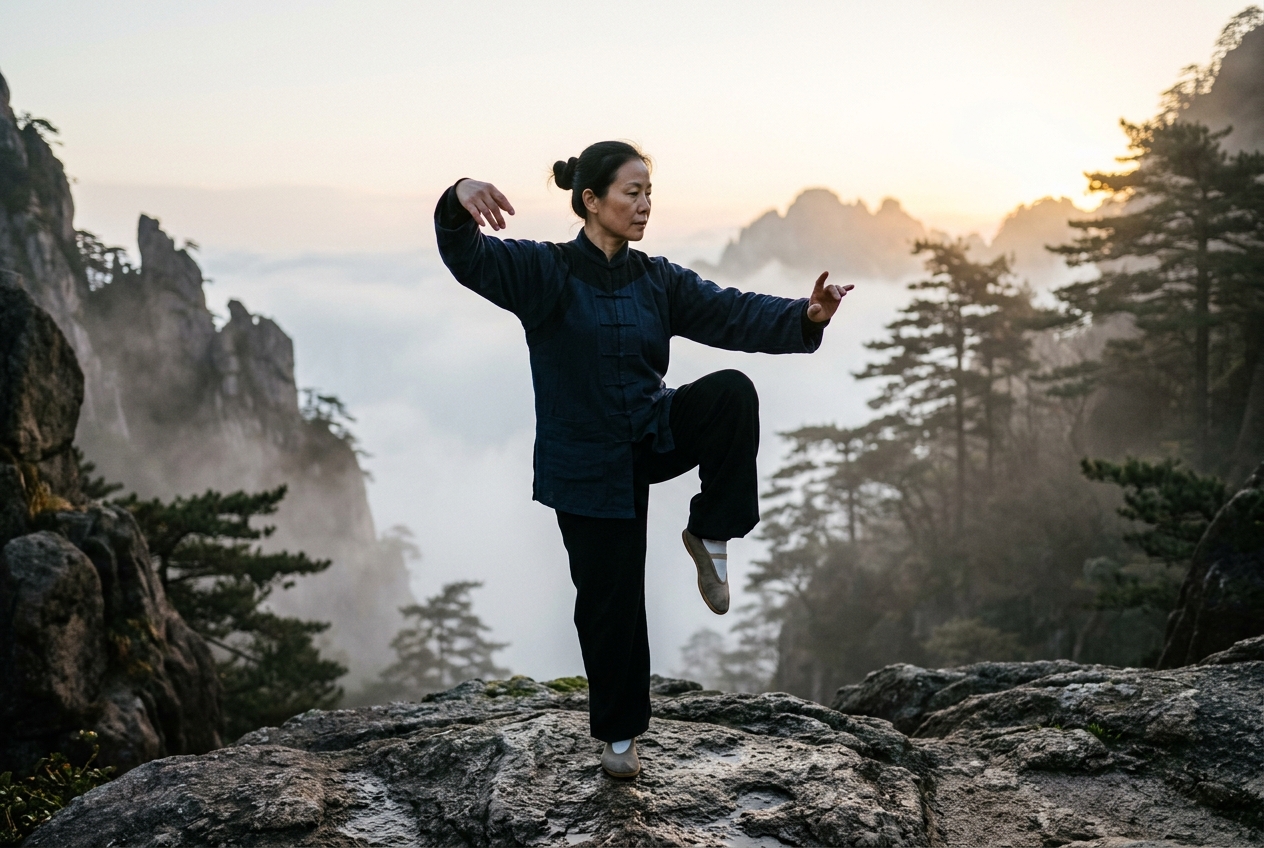
While modern fitness culture often treats single-leg exercises merely as localized challenges for athletic balance or ankle rehab, classical Daoyin (the ancient precursor to modern Qigong) and Neigong (internal cultivation) regard Du Li Bu as a master posture. It bridges external biomechanical architecture (Wai Jia) with internal physiological and bioenergetic transformation (Nei Jia). By halving the base of support and doubling the axial load upon a single limb, the body is compelled to dismantle superficial muscular holding patterns, activate deep core stabilizers, calibrate the nervous system, and open the vital meridian pathways of the lower body.
The Biomechanical Architecture of Unilateral Stance
To understand the profound somatic power of Du Li Bu, one must first examine the intricate musculoskeletal mechanics required to sustain unilateral equilibrium against gravitational torque.
       [ Baihui (DU-20) - Suspended Skyward ]
                        |
                 [ Neutral Spine ]
                        |
       [ Lower Dantian / Center of Mass ]
           /                         \
[ Folded Kua (Stance Hip) ]     [ Lifted Knee / Relaxed Ankle ]
           |
[ Knee Soft / Aligned Over Foot ]
           |
[ Subtalar Joint Micro-Adjusting ]
           |
       [ Yongquan (KI-1) - Rooted Earthward ]
When the body transitions from a bipedal stance to unipedal support, the base of support shrinks dramatically from a wide quadrilateral polygon to the narrow surface area of a single human plantar vault. The center of mass—located somatically within the lower Dantian (the physical center of gravity roughly two inches below the navel and three inches deep)—must be positioned precisely over this contracted base without provoking destructive shear forces across the axial skeleton.
This equilibrium is governed by the coxofemoral (hip) joint stabilization complex. The moment the contralateral foot leaves the floor, gravity exerts an immediate adduction torque upon the pelvis, threatening to drop the unsupported side downward in what clinical orthopedics classifies as a positive Trendelenburg sign. To maintain horizontal pelvic leveling, the stance leg recruits the gluteus medius, gluteus minimus, and tensor fasciae latae in powerful isometric and eccentric contractions. Simultaneously, the deep hip external rotators—a crucial stabilization cuff comprising the piriformis, gemelli superior and inferior, obturator internus and externus, and quadratus femoris—engage to stabilize the femoral head deep within the acetabular cup.
In classical Daoyin, this deep hip engagement is never achieved through aggressive muscular squeezing. Instead, it is cultivated through the somatic principle of Song Kua (relaxing and releasing the inguinal fold). By releasing the hip crease downward rather than tucking or thrusting the pelvis, the femoral head seats organically into the socket. This alignment prevents lateral pelvic sway, relieves pressure on the lumbar spine, and allows the vertical plumb-line axis (Zhong Zheng Ping Heng) to pass uninterrupted through the structural core of the body.
Further down the kinetic chain, stabilizing forces travel into the knee and ankle. The stance knee must maintain a state of Wei Qu (subtle micro-flexion), entirely avoiding mechanical hyperextension or closed-pack joint locking. This micro-flexion preserves the knee as an elastic shock absorber, recruiting the vastus medialis oblique and hamstrings in balanced co-contraction while protecting the cruciate ligaments and menisci.
At the base of the structure lies the subtalar joint and the three plantar arches (medial longitudinal, lateral longitudinal, and transverse). Rather than collapsing into pronation or rigidifying into excessive supination, the foot operates as a responsive tripod formed by the calcaneus, the head of the first metatarsal, and the head of the fifth metatarsal. The subtalar joint executes continuous, high-frequency micro-articular adjustments, driven by the tibialis posterior, peroneus longus, and intrinsic plantar flexors. This creates an unshakeable, dynamic interface with the ground that classical treatises describe as "rooting like an ancient pine."
Neuro-Vestibular Calibration and the Rooting Reflex
The physical stability cultivated in Du Li Bu is ultimately governed by the central nervous system's capacity for sensorimotor integration. Sustaining single-leg stillness demands continuous real-time calibration between three distinct sensory streams: visual input, vestibular spatial orientation, and somatosensory proprioception.
+-------------------------------------------------------------------------+
|                  TRI-SYSTEM SENSORIMOTOR INTEGRATION                   |
|                                                                         |
|   1. VESTIBULAR APPARATUS (Inner Ear)                                   |
|      Semicircular Canals & Otoliths -> Detect Angular/Linear Vector    |
|                                                                         |
|   2. PROPRIOCEPTIVE MECHANORECEPTORS (Plantar Surface & Fascia)         |
|      Merkel, Meissner, Ruffini & Pacinian -> Map Surface Pressure       |
|                                                                         |
|   3. CEREBELLAR INTEGRATION & MOTOR OUTPUT                              |
|      Vestibulospinal & Reticulospinal Tracts -> Subconscious Balance    |
+-------------------------------------------------------------------------+
Within the inner ear, the vestibular apparatus—specifically the three semicircular canals detecting angular acceleration and the otolith organs (utricle and saccule) sensing linear acceleration and gravitational pull—sends constant electrical afferents via the vestibular nerve to the vestibular nuclei in the brainstem. Concurrently, the stance foot's cutaneous and fascial layers discharge immense volumes of proprioceptive data. The plantar skin contains a dense concentration of mechanoreceptors: - Merkel discs, which register sustained mechanical pressure and surface texture; - Meissner corpuscles, which respond to low-frequency vibrations and skin slip; - Ruffini endings, which signal directional skin stretch and joint displacement; - Pacinian corpuscles, which detect high-frequency transient vibrations during balance shifts.
A substantial proportion of these mechanoreceptors are clustered directly over the anatomic depression between the second and third metatarsal bases—the precise locus of the primary Kidney meridian acupoint, Yongquan (涌泉, KI-1), translated as the "Bubbling Spring." In classical internal practice, Yongquan is described as the energetic and physical portal through which the practitioner anchors into the earth. Neurophysiologically, when the practitioner releases muscular tension in the foot and allows the center of pressure to settle over Yongquan, it maximizes the sensitivity of these plantar mechanoreceptors, sending pristine afferent feedback up through the dorsal column-medial lemniscal pathway.
These vestibular and proprioceptive signals converge within the cerebellum, specifically the vestibulocerebellum (flocculonodular lobe) and spinocerebellum. The cerebellum compares the intended postural state against real-time sensory reality, generating immediate, subconscious motor corrections transmitted down the vestibulospinal and reticulospinal tracts to the postural muscles of the spine and lower extremity.
When practitioners practice Du Li Bu with a soft, unfocused gaze (Ping Shi) or with eyes closed, the nervous system is stripped of its primary visual crutch. This forces an immediate, dramatic up-regulation of cerebellar computation and proprioceptive sensitivity. Over weeks of dedicated training, this neuroplastic adaptation sharpens reflex arcs, refines motor unit recruitment thresholds, and radically upgrades somatic body awareness, as documented in extensive proprioception research.
Bioenergetic Dynamics: Meridian Channel Flow and Earth Qi
Beyond its mechanical and neurological foundations, Du Li Bu serves as a primary vehicle for regulating the bioenergetic circulatory system mapped in Traditional Chinese Medicine (TCM) and recognized by the World Health Organization (WHO) Traditional Medicine benchmarks.
       ========================================================
                      LOWER LIMB MERIDIAN POLARITY
       ========================================================
       MEDIAL COMPRESSION (Yin)      | LATERAL EXTENSION (Yang)
       -----------------------------+--------------------------
       * Zu Shao Yin (Kidney)        | * Zu Shao Yang (Gallbladder)
       * Zu Jue Yin (Liver)          |   - Runs along lateral flank,
       * Zu Tai Yin (Spleen)         |     iliotibial tract, & hip.
       -----------------------------+--------------------------
       Draws cool, dense Earth Qi    | Discharges stagnant heat &
       upward through medial seam.   | smooths defensive Wei Qi.
       ========================================================
In the energetic taxonomy of Daoyin, the lower extremities act as the root system of human vitality. Six primary meridians traverse the legs: three Yin channels along the medial aspects, and three Yang channels along the lateral and posterior surfaces. During the unilateral weight-bearing of Du Li Bu, a distinct energetic polarity is established between the stance leg and the lifted leg:
-
The Three Leg Yin Meridians (Zu San Yin): The medial seam of the stance leg bears continuous, consolidated gravitational load. This compression activates and draws Earth Qi (Di Qi) upward through: - The Foot Shao Yin Kidney Channel (Zu Shao Yin), originating at Yongquan (KI-1), ascending the medial arch, and anchoring vitality into the lower back and adrenals; - The Foot Jue Yin Liver Channel (Zu Jue Yin), originating at Dadun (LV-1) on the big toe and traveling up the inner calf and thigh to govern the smooth flow of emotional and biological Qi and nourish the tendons; - The Foot Tai Yin Spleen Channel (Zu Tai Yin), ascending from Yinbai (SP-1) along the anterior-medial shin to nourish muscular tone, digestion, and systemic blood production.
-
The Shaoyang Gallbladder Channel (Zu Shao Yang): Concurrently, the lateral aspect of the stance hip and flank undergoes continuous structural tensile activation. The Gallbladder channel—which cascades down the temple, over the lateral ribcage, through the crucial Huantiao point (GB-30) at the hip joint, and down the iliotibial band to the fourth toe—is opened and cleared of stagnation. In classical theory, the Gallbladder channel governs sinew elasticity, lateral structural stability, and decisive mental clarity. The stabilization required in Du Li Bu acts as an internal pump, draining stagnant fire and metabolic waste from the lateral fascial chains.
-
Axial Polarity and the Microcosmic Current: As Earth Qi is drawn upward through the stance limb into the lower Dantian, an opposing energetic suspension occurs along the Governing Vessel (Du Mai). The crown point, Baihui (百会, DU-20, "Hundred Convergences"), feels lightly suspended from above, as though held by an invisible silk thread.
This establishes a profound vertical polarity between Heaven (Tian) and Earth (Di), with the human body serving as the conscious conduit. The downward sink of the coccyx aligns with Huiyin (CV-1) at the perineum, while the spine lengthens naturally. This alignment decompresses the intervertebral discs, gently opens the "Gate of Life" (Mingmen, DU-4) on the lower back, and allows biological life-force (Zheng Qi) to circulate smoothly throughout the entire vascular and fascial matrix.
Granular Step-by-Step Practice Guide
Follow these precise instructions to establish a safe, classical, and biomechanically sound Du Li Bu practice at home.
       ========================================================
                 ANATOMICAL ALIGNMENT VERIFICATION
       ========================================================
       [✓] Crown (Baihui / DU-20) suspended effortlessly skyward
       [✓] Chin slightly retracted, lengthening cervical spine
       [✓] Inguinal crease (Kua) softened, sinking into stance hip
       [✓] Coccyx gently dropped, flattening lumbar curvature
       [✓] Weight distributed evenly across tripod of the stance foot
       [✓] Center of gravity settled directly into Yongquan (KI-1)
       ========================================================
Phase 1: The Preparatory Stance (Wuji)
- Stand barefoot on a flat, non-slip surface. Place your feet precisely hip-width apart and parallel, with the outer borders of your feet pointing straight ahead.
- Allow your arms to rest naturally at your sides, with empty space beneath your armpits as if holding small bird eggs there (Xu Ye).
- Soften your gaze, resting your eyes on the horizon without fixing on any single object. Place the tip of your tongue against the upper palate just behind your front teeth to bridge the Conception (Ren) and Governing (Du) vessels.
- Establish diaphragmatic abdominal breathing: inhale gently through your nose for a count of four, feeling your lower belly expand in all 360 degrees; exhale smoothly for a count of six, feeling your belly naturally recede toward the spine. Settle your mind here for two full minutes.
Phase 2: The Weight Transfer
- Without leaning your upper body or tilting your shoulders, slowly shift 100% of your body weight into your left leg.
- Feel the three points of your left foot anchor into the floor. Soften your left knee into a micro-flexion of roughly 5 to 10 degrees.
- Sink your left Kua—feel the crease where your thigh meets your pelvis release inward and downward, allowing your weight to drop into the heel and midfoot.
- Allow your right foot to become completely empty (Xu), resting lightly on the tip of the big toe.
Phase 3: The Ascent and Hold (Du Li Bu)
- On an unhurried inhalation, smoothly draw your right knee upward in front of your chest until your right thigh rests parallel to the floor (a 90-degree angle at the hip and knee). If balance is compromised, raise the knee only to shin or mid-thigh height.
- Relax the right foot entirely, letting the toes point gently toward the earth without tension.
- Bring your hands into the classical protective posture: raise your left hand in front of your chest, palm facing inward toward your heart, while your right palm presses lightly downward toward the floor beside your right hip, establishing energetic balance.
- Maintain the posture for 30 to 60 seconds. Breathe continuously in a slow, oceanic rhythm. Never hold your breath.
- Keep your awareness anchored simultaneously in two locations: the crown of your head (Baihui) pulling upward toward the sky, and the sole of your left foot (Yongquan) rooting deep into the earth.
Phase 4: The Controlled Descent and Integration
- On a long, controlled exhalation, slowly lower the right foot to the floor, placing it down without a sound, precisely parallel to the left foot.
- Re-center your weight evenly across both legs into Wuji stance.
- Take two deep harmonizing breaths, noticing the distinct sensations of warmth, density, and flow between the two sides of your body.
- Repeat the entire sequence on the right leg, holding for an identical duration.
       ========================================================
                 DIAGNOSTIC FAULTS & ANATOMICAL CORRECTIONS
       ========================================================
       FAULT: Pelvic Drop (Trendelenburg Collapse)
       CORRECTION: Engage stance-side gluteus medius; sink the Kua.
       --------------------------------------------------------
       FAULT: Knee Valgus (Inward Buckling of Stance Knee)
       CORRECTION: Track knee directly over the second/third toe.
       --------------------------------------------------------
       FAULT: Lumbar Hyperextension (Arching Lower Back)
       CORRECTION: Release coccyx downward; engage lower Dantian.
       --------------------------------------------------------
       FAULT: Toe Gripping (Clawing the Floor)
       CORRECTION: Spread toes broad and flat; sink weight into KI-1.
       ========================================================
Sensations to Expect and Their Meanings
- Subtle Trembling or Involuntary Shaking: This is a classic neurogenic release and motor unit recalibration. It indicates that your deep stabilizers are waking up and replacing superficial muscular bracing. Embrace it with relaxed breathing.
- Deep Warmth in the Stance Leg and Foot: As the three Yin channels engage and local blood vessels dilate, arterial perfusion and Qi flow surge through the limb, producing a distinct, comforting thermal sensation.
- Tingling in the Fingers and Palms: A direct marker of autonomic balance. Down-regulation of sympathetic tone dilates peripheral micro-capillaries, generating mild electrical or pulsating sensations (Zhen Gan) at the extremities.
- Heaviness Below, Lightness Above (Chen Xia Qing Shang): The classical somatic goal of Neigong. Your lower body feels anchored like an anvil, while your spine, chest, and head feel light, buoyant, and free of tension.
Why It Works: The Western Physiological Mechanics
The profound restorative benefits of Du Li Bu are increasingly corroborated by modern clinical biomechanics, neurophysiology, and fascial research indexed across NCBI PubMed.
+-------------------------------------------------------------------------+
|                  PHYSIOLOGICAL SYSTEMS IN HARMONY                       |
|                                                                         |
|  * AUTONOMIC NERVOUS SYSTEM:                                            |
|    Deep diaphragmatic breathing stimulates vagal tone, increases HRV,   |
|    and reduces circulating serum cortisol.                             |
|                                                                         |
|  * OSSEOUS REMODELING & OSTEOGENESIS:                                   |
|    Single-limb axial loading triggers the piezoelectric effect,         |
|    stimulating osteoblast activity according to Wolff's Law.            |
|                                                                         |
|  * MYOFASCIAL TENSEGRITY:                                               |
|    Connects the Deep Front Line and Spiral Line, translating localized  |
|    ground reaction forces into full-body structural resilience.         |
+-------------------------------------------------------------------------+
1. Autonomic Regulation and Vagal Modulation
Single-leg standing induces a mild, deliberate physiological challenge that requires active, relaxed stabilization rather than a fight-or-flight stress reaction. When practiced alongside slow diaphragmatic breathing (at roughly 5.5 to 6 breaths per minute), the prolonged exhalations stimulate the pulmonary vagal nerve endings. This activates parasympathetic motor output, lowering heart rate, enhancing Heart Rate Variability (HRV), and blunting sympathetic overdrive. The practitioner learns to maintain an alert, quiet internal state while navigating structural instability.
2. Fascial Tensegrity: The Deep Front Line and Spiral Line
In the anatomical framework of structural integration and myofascial meridians, Du Li Bu trains continuous fascial tracks rather than isolated muscle groups. The stance leg activates the Deep Front Line—the body's structural core scaffold running from the plantar aspect of the tarsal bones, up through the posterior tibialis, popliteus, adductor hiatus, psoas major, iliacus, and respiratory diaphragm, terminating at the cranial base.
Simultaneously, the unilateral balance demands recruit the Spiral Line, which wraps around the torso and legs in a double helix. This fascial engagement distributes ground reaction forces through a resilient, whole-body tensegrity web.
3. Osseous Remodeling and Piezoelectric Osteogenesis
By concentrating the body's entire gravitational load onto a single femur, tibia, and calcaneus, Du Li Bu creates a safe, sustained axial load. Under the principles of Wolff's law, bone tissue adapts to the mechanical stresses placed upon it.
The compressive loading of the stance leg deforms the crystalline hydroxyapatite matrix within the bone, generating minute electrical potentials through the piezoelectric effect. These electrical charges stimulate osteoblast activity, encouraging mineral deposition and bone remodeling at the femoral neck and lumbar vertebrae—two critical fracture sites in aging populations.
4. Clinical Fall Prevention and Neuromuscular Reprogramming
Accidental falls represent one of the most severe health risks in older demographics worldwide. Balance impairment typically stems from a degradation of rapid-reaction stabilizing reflexes, reduced plantar mechanoreceptor sensitivity, and atrophy of the gluteus medius. Clinical trials validated by the National Qigong Association have consistently demonstrated that regular practice of unilateral Qigong forms significantly enhances dynamic gait stability, reduces postural sway, and sharply lowers fall incidence by rebuilding the neuromuscular pathways governing unilateral support.
Classical Lineage: The Historical Roots of the Stance
The single-leg posture is not a modern fitness invention; it is an ancient somatic technology refined over millennia within Chinese monastic, martial, and healing lineages.
                  ======================================
                     HISTORICAL EVOLUTION OF DU LI BU
                  ======================================

                  [ 168 BCE - Western Han Dynasty ]
                    Mawangdui Daoyin Tu Silk Text
                    - Avian postures imitating the crane
                                  |
                                  v
                  [ 2nd Century CE - Eastern Han ]
                    Hua Tuo's Wu Qin Xi (Five Animals)
                    - "Crane Stance" (He Xing) for lungs & balance
                                  |
                                  v
                  [ 14th - 19th Century - Ming/Qing ]
                    Taijiquan & Baguazhang Integration
                    - "Golden Rooster Stands on One Leg"
                    - Circular Neigong balance training
The earliest visual records of unilateral therapeutic exercises appear in the famous Daoyin Tu (导引图, "Guiding and Pulling Chart"), a painted silk scroll excavated from Mawangdui Tomb 3 in Hunan province, dating to 168 BCE during the Western Han Dynasty. Among its forty-four illustrated figures are practitioners standing on one limb, imitating the expansive balance of water birds to open the chest, promote digestion, and harmonize internal respiration.
In the 2nd century CE, the legendary physician Hua Tuo formalized these animal-inspired somatic observations into the Wu Qin Xi (五禽戏, "Five Animal Frolics"). Within the Crane section (He Xing), practitioners sustain unipedal balance while slowly unfolding the arms like wings. Hua Tuo designed these postures specifically to empty the pericardium, balance the heart and lung energetics, mobilize the lymphatics, and cultivate lightness in the joints.
By the Ming (1368–1644) and Qing (1644–1912) dynasties, single-leg postures were fully woven into the internal martial arts (Neijiaquan). In Taijiquan, the form Jin Ji Du Li (金鸡独立, "Golden Rooster Stands on One Leg") became a celebrated archetype for neutralizing incoming force by redirecting it into an unshakeable single-leg root. In Baguazhang, single-leg pauses during circular footwork were used to build extraordinary rotational core strength and cultivate the internal state of Zhong Ding—unshakable central equilibrium amidst perpetual movement.
Throughout these classical traditions, the physical single-leg stance was seen as a living metaphor for psychological and spiritual independence. To stand firmly on one leg is to discover one's own center of gravity, wholly autonomous from external crutches, rooted in the earth yet reaching effortlessly toward the sky.
Today's Practice Commitment
True somatic mastery is built not through sporadic intensity, but through quiet, daily consistency. You do not need dedicated workout attire or a gym membership to claim the benefits of this ancient practice.
Tomorrow morning, immediately after stepping out of bed and before you pour your first tea or coffee: - Stand in a quiet room or near an open window. - Spend 60 seconds establishing your breath in Wuji stance. - Transition into Du Li Bu on your left leg for 60 seconds. - Transition directly into Du Li Bu on your right leg for 60 seconds. - Close with 60 seconds of quiet, centered breathing with both hands resting over your lower belly (Dantian).
Notice how your body feels across the rest of your morning. Pay attention to the stability of your stride, the openness of your hips, the quiet clarity of your mind, and the grounded presence you carry into your day. With just four minutes of daily practice, you anchor yourself in a lineage of mindful movement thousands of years old—learning, breath by breath, to stand complete within yourself.