Cai Jin Pluck Force: Abrupt Gravitational Shearing, Helical Fascial Snapping, and Downward Kinetic Rooting in Classical Neigong
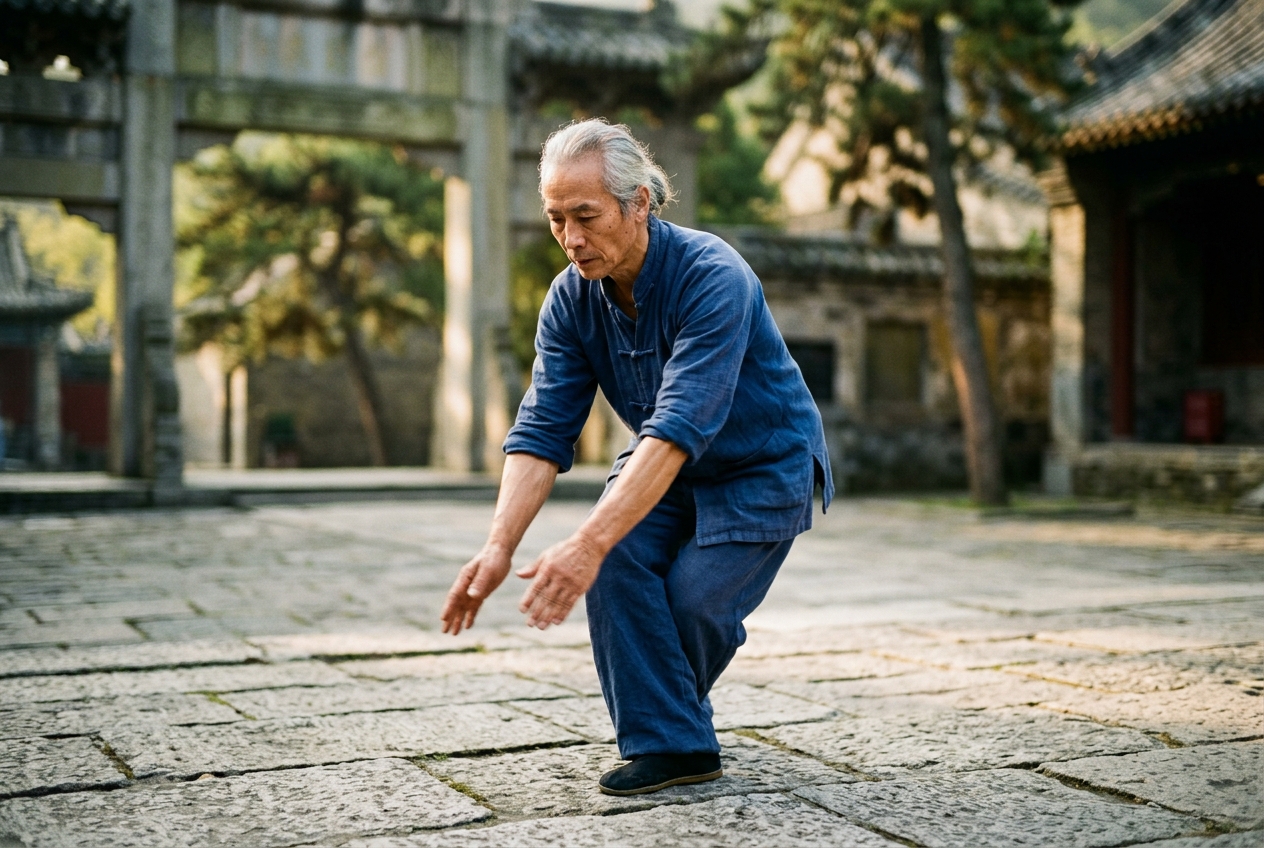
In the vocabulary of Traditional Chinese Medicine and Daoyin somatic arts, this dynamic relies on dropping the Qi (vital bio-mechanical energy) into the lower Dantian (the body's primary center of mass, located roughly two inches below the navel) while folding the Kua (the inguinal creases and deep hip joints). The feet remain married to the earth at the Yongquan point (the "Bubbling Well," or the kidney-1 meridian locus on the sole of the foot), ensuring that the sudden downward drop does not collapse the skeletal frame, but instead establishes instantaneous structural resonance with the ground.
The Biomechanical Architecture: A Step-by-Step Practice Guide
To cultivate this kinetic phenomenon without injury, Neigong masters developed standalone solo drills designed to systematically train the nervous system, recondition the fascial matrix, and align the skeletal levers. The following step-by-step solo drill, known classically as Cai Jin Daoyin (The Helical Sinking Pluck), can be practiced safely in any open space.
+-------------------------------------------------------------------------+
|                       CAI JIN: DIAGNOSTIC MATRIX                        |
+--------------------------+----------------------------------------------+
| Biomechanical Feature    | Somatic Execution Mechanism                  |
+--------------------------+----------------------------------------------+
| Primary Driver           | Instantaneous Kua release & gravity drop     |
| Fascial Pathway          | Thoracolumbar Aponeurosis & Deep Back Line   |
| Force Vector             | Abrupt, steep downward-helical shearing arc  |
| Ground Fulcrum           | Bilateral Yongquan (KID-1) plantar loading   |
| Primary Kinetic Hazard   | Glenohumeral elevation & spinal flexion      |
+--------------------------+----------------------------------------------+
Step 1: Establishing the Structural Root (Wuji Stance)
- Foot Positioning: Stand with your feet parallel, precisely hip-to-shoulder width apart. Distribute your body weight evenly across the "tripod" of each foot: the base of the big toe, the base of the little toe, and the center of the calcaneus (heel).
- Micro-Flexion: Soften your knee joints without bending them forward past the mid-foot; imagine your kneecaps floating rather than locking into hyperextension.
- Pelvic Neutrality: Gently release the sacrum downward as if it were weighted with a lead plumb line. Avoid excessive posterior pelvic tucking; simply allow the lumbar lordosis to flatten naturally, opening the space between the L4 and S1 vertebrae.
- Axial Decompression: Lightly press the crown of your head (Baihui) upward, gently tucking the chin to elongate the cervical spine. Let your arms hang effortlessly at your sides.
Step 2: The Coiling Ascent and Fascial Pre-Tensioning
- Inhalation and Expansion: Inhale smoothly through your nose over four counts, directing the breath into the lateral and posterior walls of your lower ribcage and abdomen (three-dimensional diaphragmatic expansion).
- Elevating the Limbs: Simultaneously float both hands upward to chest level, palms facing downward, fingers relaxed and slightly curved. The elbows must remain heavy and pointed toward the floor, maintaining an open, concave chest and broadened shoulder blades.
- Spiral Loading: As the hands reach chest height, rotate the wrists slightly inward, drawing the connective tissues of the arms, latissimus dorsi, and fascia into a state of balanced structural tension (pre-stress or peng).
Step 3: The Gravitational Drop and Instantaneous Kua Release
- The Dropping Reflex: Without any preliminary upward bobbing or muscular tensing, suddenly release the deep hip flexors (psoas major and iliacus) and let your pelvis drop 3 to 4 inches directly toward the ground. This must be an effortless surrender to gravitational acceleration ($g = 9.81\text{ m/s}^2$), not a forced muscular crouch.
- The Helical Snap: At the exact microsecond the pelvis drops, rotate both forearms outward (supinating slightly) while drawing the hands downward and backward in a steep, tight helical arc toward your anterior superior iliac spines (hip bones).
- The Terminal Stop: Abruptly arrest the downward drop at the bottom of the movement by stiffening the deep core and rooting through the heels. The hands halt crisply near hip height, palms turned obliquely inward and downward, with the elbows locked into the torso's bio-tensegral frame. The entire drop-and-snap sequence must occur in less than 250 milliseconds.
- Breath Coordination: Pair this drop with a sudden, explosive exhalation through the nose or a short, suppressed throat sound (Heng or Ha), which spikes intra-abdominal pressure and locks the axial skeleton into an unyielding kinetic pillar.
Step 4: Rebound and Somatic Checkpoints
- Sensory Scan: Immediately pause at the bottom of the movement. Do not reset right away. Observe the kinetic echoes rippling through your tissues.
- What to Feel: - Hyper-dense heaviness: An immediate sensation of having your feet rooted deep into the floorboards, as if your mass momentarily quadrupled. - Tingling and warmth: A rush of microvascular perfusion radiating down into the palmar surfaces and fingertips, caused by sudden neural disinhibition and blood flow surging after fascial decompression. - Elastic spine rebound: A noticeable sensation of decompression in the lumbar and thoracic joints as the downward drop creates a traction wave along the spinal column.
Diagnostic Structural Checkpoints and Technical Errors to Avoid
To ensure that the force generated is genuine somatic Jin (fascial-elastic force) rather than isolated muscular straining (Li), evaluate your mechanics against these essential diagnostic criteria:
- Mistake 1: Bicep and Shoulder Pulling: Beginners instinctively pull their hands down by contracting their biceps and latissimus dorsi. Correction: Keep the elbow angles relatively stable; let the hands drop exclusively because the torso and hips dropped. The arms serve purely as high-tensile steel cables connecting the opponent to your falling center of mass.
- Mistake 2: Lumbar Collapse and Spinal Flexion: Leaning forward at the waist or rounding the lower back during the drop. Correction: Maintain an erect vertical axis (Zhong Ding). The drop occurs purely through the folding of the hip joints (Kua) and the flexion of the knees, keeping the spine perpendicular to the floor.
- Mistake 3: Knee Valgus (Knees Collapsing Inward): Allowing the knees to buckle inward upon landing. Correction: Maintain external rotation torque through the femurs, keeping the knees tracking precisely over the second and third toes to protect the anterior cruciate and collateral ligaments.
- Mistake 4: Decelerating Too Early: Slowing down the movement before reaching the bottom out of fear of impact. Correction: Allow the acceleration to remain maximal until the instantaneous arrest at the base, utilizing the elastic stiffness of the tendon network to brake the motion safely.
Comparative Dynamics: Cai Jin vs. Lu Jin vs. Ji Jin
To understand Cai Jin, one must contrast its mechanical signature with the other core directional expressions (Ba Men, or Eight Gates) of classical Tai chi and Neigong, notably Lu Jin (Rollback Force) and Ji Jin (Pressing Force).
+---------------------------------------------------------------------------------+
|                        FORCE VECTOR COMPARATIVE ANALYSIS                        |
+---------------+------------------------+---------------------+------------------+
| Force Type    | Vector Geometry        | Neuromuscular Mode  | Mechanical Goal  |
+---------------+------------------------+---------------------+------------------+
| Cai Jin (採)  | Steep Downward-Helical | Abrupt Stretch-     | Kinetic Shearing |
|               | Shear Vector           | Shortening Snapping | & Axis Collapse  |
+---------------+------------------------+---------------------+------------------+
| Lu Jin (掤/履)| Parabolic Horizontal-  | Smooth Eccentric    | Momentum Drain & |
|               | Oblique Absorptive Arc | Yielding / Guiding  | Redirection      |
+---------------+------------------------+---------------------+------------------+
| Ji Jin (擠)   | Linear Convergent      | Explosive Isometric | Forward Mass     |
|               | Forward-Rising Thrust  | Kinetic Expansion   | Projection       |
+---------------+------------------------+---------------------+------------------+
- Lu Jin (Rollback Force, 履劲) operates as a continuous, parabolic absorptive arc. When meeting an incoming vector, Lu does not arrest or abruptly drop the force; rather, it adheres to the momentum, rotating the thoracic cage and shifting the center of gravity rearward along a horizontal-oblique plane. Lu is soft, viscous, and unbroken, acting like a revolving door that guides an opponent's force harmlessly into a void.
- Ji Jin (Press Force, 擠劲) is a direct, convergent linear propulsion. It gathers ground reaction force through the rear leg, channels it through the anterior fascial lines, and projects it forward and slightly upward through two converging points of structural contact (typically the forearm and opposite palm). It is expansive, pressurized, and repulsive.
- Cai Jin (Pluck Force, 採劲), by contrast, is discontinuous, explosive, and orthogonal to the opponent’s vector. It does not seek to guide the incoming force along its original trajectory (Lu), nor does it clash head-on (Ji). Instead, Cai applies an instantaneous downward and rearward shearing pulse at two separate points of leverage (such as the wrist and elbow, or neck and shoulder). This shearing couple destroys the opponent’s base by dragging their center of mass downward faster than their proprioceptive postural reflexes can adapt.
Why It Works: The Body Science and Neurobiomechanics
The efficacy of Cai Jin is not mystical; it is a direct consequence of well-documented neuromuscular, fascial, and physical principles validated across clinical somatic research documented by the National Center for Biotechnology Information (NCBI) and the National Center for Complementary and Integrative Health (NCCIH).
1. Fascial Viscoelasticity and the Thoracolumbar Spring
The human trunk is enveloped in a dense web of connective tissue known as the thoracolumbar fascia (TLF), an intricate, multi-layered diamond-shaped lattice that couples the latissimus dorsi, gluteus maximus, and contralateral internal obliques. When the practitioner drops their pelvis by suddenly releasing the Kua, the insertion points of the TLF undergo rapid eccentric elongation.
Connective tissues exhibit viscoelastic properties: when deformed rapidly, they resist with high tensile stiffness and store kinetic energy according to Hooke's Law of elasticity:
$$E = \frac{1}{2} k (\Delta x)^2$$
Where $E$ is the stored elastic potential energy, $k$ is the spring stiffness coefficient of the collagen matrix, and $\Delta x$ is the magnitude of fascial displacement. By relying on the sudden recoil of this biological spring rather than the sliding filaments of actin and myosin in active muscle contraction, Cai Jin produces a force spike that is nearly instantaneous and demands negligible metabolic ATP expenditure.
2. The Stretch-Shortening Cycle (SSC) and Golgi Tendon Dynamics
When muscles and tendons are stretched abruptly under load, they activate the stretch-shortening cycle (SSC). High-velocity elongation stimulates muscle spindles (primary Type Ia sensory afferents), triggering a monosynaptic stretch reflex that commands the motor neuron pool to contract the muscle with amplified power.
In untrained individuals, high force rates stimulate the Golgi Tendon Organs (GTOs), which reflexively inhibit further contraction to prevent muscle tearing (autogenic inhibition). However, dedicated Neigong conditioning recalibrates GTO sensitivity, allowing the practitioner to discharge maximum elastic strain energy through the distal joints without triggering defensive neuromuscular dampening.
3. Intra-Abdominal Pressure (IAP) as a Hydraulic Core
The sharp exhalation and pelvic floor elevation (Huiyin contraction) that coincide with the drop of the Kua create an instantaneous surge in intra-abdominal pressure. The diaphragm, the transverse abdominis, the multifidus, and the pelvic floor contract synchronously into a closed cylinder. This hydraulic pressure turns the soft abdominal cavity into a rigid, non-compressible cylinder. This pneumatic stiffening stabilizes the lumbar spine instantly, permitting 100% of the kinetic energy generated by the falling torso to be transmitted cleanly outward through the shoulder girdle and arms without leaking force through spinal buckling.
4. Ground Reaction Force (GRF) Coupling via Yongquan
Newton’s Third Law dictates that for every applied action, there is an equal and opposite reaction. When the practitioner’s mass accelerates downward, it drives immense force into the earth through the Yongquan (KID-1) locus on the anterior sole. The earth immediately returns a Ground Reaction Force (GRF) vector back up through the calcaneus, tibia, and pelvic bowl. By maintaining absolute structural integrity, the Neigong adept intercepts this upward ground reaction wave, vectoring it horizontally and downward through the opponent's limbs via a mechanical couple (shearing force).
Classical Lineage, Historical Context, and the Daoist Matrix
The systematic codification of Cai Jin emerged from the cross-pollination of Daoist internal health preservation (Yang Sheng) and Ming-Qing dynastic military combat systems. Rooted in ancient Daoyin breathing and stretching texts recovered from sites like the Mawangdui Han Dynasty tombs (circa 168 BCE), these practices were initially developed to prevent physical stasis, nourish joint cartilage, and harmonize internal organ function.
By the 17th century, master martial theorists in northern China—most prominently within the Chen Family lineage of Chenjiagou (Henan Province) and later the Yang and Wu traditions—synthesized these therapeutic exercises into martial forms. The classical treatise attributed to Master Wang Zongyue (The Taijiquan Classics) and the later expositions by Wu Yuxiang describe the Eight Core Energies (Ba Men) as manifestations of natural physical archetypes corresponding to the Eight Trigrams (Bagua) of the I Ching.
In this classical cosmology, Cai is paired with the trigram Qian (Heaven) or Kan (Water) depending on the lineage, symbolizing a sudden, overwhelming descent like a deluge bursting through a dyke, or the abrupt plucked harvesting of fruit from a high branch (hence the character 採, meaning "to pick, pluck, or gather").
The ancient masters recognized that true martial mastery required moving beyond voluntary muscular brute force (Li) toward the cultivation of Yi (focused cognitive intent) leading Qi (bio-mechanical fluid pressure) to mobilize Jin (organized structural tissue force). As the famous Neigong maxim records:
"Do not let the arms move of their own accord; the waist drops, the Kua folds, and the sky plucks the earth down."
Today, organizations like the National Qigong Association (NQA) and global health bodies evaluating integrative practices, such as the World Health Organization (WHO) Traditional Medicine Programme, recognize that these ancient internal movement paradigms offer profound benefits for postural rehabilitation, neuromuscular rehabilitation, and fall prevention in addition to their traditional martial applications.
Today’s Practice Commitment: The Five-Minute Morning Reset
To integrate the bio-tensegral power of Cai Jin into your own physiology, commit to a simple, five-minute morning protocol before consuming your first cup of coffee or opening a digital screen.
+-------------------------------------------------------------------------+
|                  FIVE-MINUTE MORNING CAI JIN REGIMEN                    |
+---------+--------------------+------------------------------------------+
| Minute  | Focus Area         | Action Protocol                          |
+---------+--------------------+------------------------------------------+
| 00-01   | Wuji Stance        | Stand quietly; align spine, release jaw, |
|         | Calibration        | sink mass into bilateral Yongquan.       |
| 01-03   | Slow-Motion Form   | Perform 10 repetitions of Cai Daoyin at  |
|         | & Fascial Tracing  | 20% speed, mapping pelvic drop to arms.  |
| 03-04   | Dynamic Kinetic    | Execute 10 crisp, full-speed pulses with |
|         | Discharge          | sharp nasal exhalations (Heng/Ha).       |
| 04-05   | Neutral Quietude   | Stand still in Wuji; observe warmth,     |
|         | & Integration      | microvascular rush, and spinal ease.     |
+---------+--------------------+------------------------------------------+
- Minute 0:00 to 1:00 (Calibration): Stand in the neutral Wuji posture. Breathe deeply into your lower abdomen, soften your hip creases, and mentally scan for and extinguish all superfluous tension in your shoulders, neck, and lower back.
- Minute 1:00 to 3:00 (Slow-Motion Mechanics): Execute 10 slow-motion repetitions of the Cai Jin Daoyin movement at roughly 20% speed. Focus exclusively on the sensory coupling between the folding of your Kua and the downward glide of your scapulae. Ensure your knees remain tracking true over your toes.
- Minute 3:00 to 4:00 (Dynamic Discharge): Perform 10 full-speed, explosive repetitions. Drop the hips with zero warning, snap the hands downward and backward, and release an authoritative, sharp breath through your nose. Feel your feet anchor hard into the floor at the terminal arrest of each repetition.
- Minute 4:00 to 5:00 (Integration): Return to still standing (Wuji). Close your eyes. Notice the sensation of grounded stability, the deep decompression of your lumbar spine, and the alert, calm focus that accompanies the activation of your deep postural myofascial lines.
By training the nervous system to coordinate gravity, connective tissue elasticity, and axial alignment, you cultivate a body that is relaxed yet structurally resilient—yielding like water, but capable of discharging dynamic power at a moment's notice.