Mølmer-Sørensen Gate: Driving Multi-Qubit Entanglement in Trapped Ions Via Bichromatic Optical Fields
1. Opening Hook — Why You Should Care
The global financial infrastructure, encrypted communications, and secure government archives share a single, fundamental vulnerability: they depend upon mathematical problems that classical supercomputers cannot solve in human lifespans. Factoring a 2,048-bit number using the fastest classical supercomputer on Earth would take hundreds of thousands of years. A fault-tolerant quantum computer running Shor's algorithm could accomplish the same task in an afternoon.
Yet the true promise of quantum computing extends far beyond breaking codes. In industrial chemistry, our inability to simulate quantum interactions accurately forces us to manufacture agricultural fertilizers via the century-old, energy-guzzling Haber-Bosch process—which alone consumes roughly 1 to 2 percent of all energy generated on our planet. Simulating the complex catalytic nitrogenase enzyme responsible for natural nitrogen fixation requires tracking entangled electrons whose quantum configurations overwhelm any classical memory bank.
To build a machine capable of such simulations, engineers must manipulate individual subatomic particles with surgical precision. At the forefront of this technological revolution sits the trapped-ion quantum computer, an architecture whose fundamental building block is an exquisitely choreographed interaction known as the Mølmer-Sørensen (MS) gate. Without this specific protocol, quantum computing using suspended atomic ions would remain an impractical laboratory curiosity. Understanding the Mølmer-Sørensen gate reveals how physicists transformed mechanical vibrations into quantum information conduits, turning microscopic strings of charged atoms into one of the most coherent computing engines ever constructed.
2. The Idea in Plain English
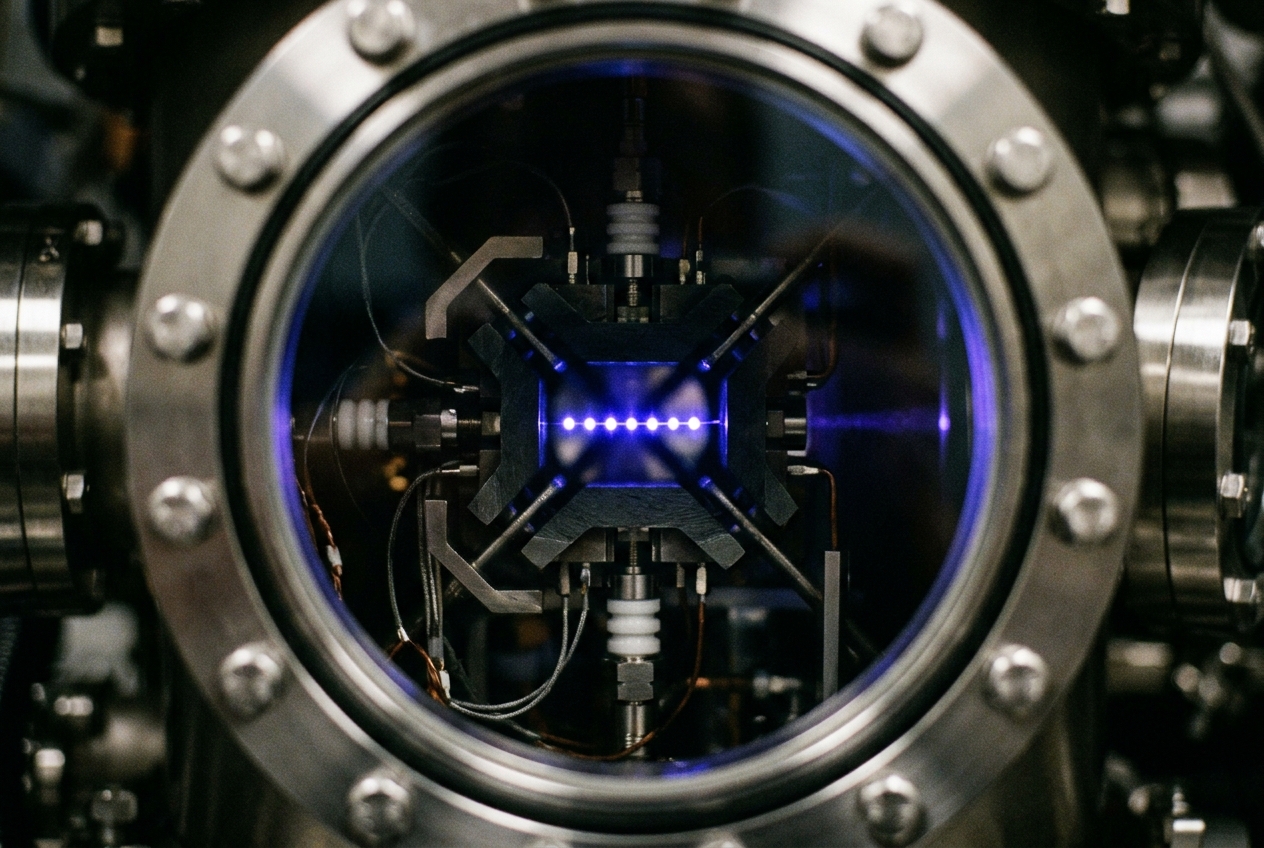
To understand how trapped-ion quantum computers work, imagine a string of beads suspended inside an invisible tube. Each bead is a single, positively charged atom (an ion) stripped of one electron. Because like charges repel each other, these ions push apart, but an oscillating electromagnetic trap squeezes them together, forcing them to sit in a stable, equidistant linear chain.
       Electric Trap Field (Confinement)
                     ↓
  [ + ] <=======> [ + ] <=======> [ + ] <=======> [ + ]
  Ion 1   Coulomb   Ion 2  Coulomb   Ion 3  Coulomb   Ion 4
         Repulsion        Repulsion        Repulsion
                     ↑
       Electric Trap Field (Confinement)
Within each individual ion, quantum information—a qubit (quantum bit)—is stored in its internal electronic energy levels. A classical bit is strictly a 0 or a 1, analogous to a coin resting flat on a table as heads or tails. A qubit, however, can exist in a superposition, a state where it acts like a coin spinning in mid-air, carrying probabilities of landing on either face simultaneously until a measurement forces it to declare a definite state.
The central engineering challenge is this: how do you execute a logic operation between two separate qubits when their host ions are held micrometers apart—an immense distance on atomic scales?
The ions cannot physically touch. However, because they are bound together by their mutual electrical repulsion, if you push one ion, the entire chain oscillates in unison, like beads connected by microscopic springs. These collective vibrational ripples are quantized; physicists call each individual packet of vibrational energy a phonon.
This shared motion acts as a phonon bus—a shared quantum telephone line running through the entire crystal.
In the late 1990s, early quantum computing protocols required cooling the ion chain down to its absolute quantum ground state (zero vibrational phonons), a fragile condition where the slightest thermal vibration would ruin the entire calculation. In 1999, Danish physicists Klaus Mølmer and Anders Sørensen published a landmark theoretical breakthrough in Physical Review Letters. They demonstrated that by illuminating two ions with a carefully tailored, two-tone laser field, one could drive the ions through a closed loop in their vibrational phase space.
By the time the laser pulse finishes, the vibrational motion returns completely to its starting point—erasing any residual motion or thermal disturbance—while leaving the internal electronic states of the two ions permanently entangled. The motion serves solely as an invisible catalyst.
3. How It Actually Works — The Mechanics
The Architecture of the Coulomb Crystal and the Lamb-Dicke Regime
The physical foundation of a trapped-ion processor is a radiofrequency (RF) Paul trap. By applying dynamic electric quadrupole potentials, the trap counteracts Earnshaw’s theorem (which proves that static electric fields cannot stably trap a charged particle in three dimensions). The resulting electrostatic equilibrium forces a string of laser-cooled ions (such as $^{171}\text{Yb}^+$ or $^{40}\text{Ca}^+$) into a 1D Coulomb crystal.
To describe the quantum mechanics of this system, we first examine the Lamb-Dicke regime, a core concept covered in advanced university courses like MIT OpenCourseWare Quantum Physics. When an ion absorbs or emits a photon of wavevector $\vec{k}$, it receives a mechanical momentum kick $\hbar \vec{k}$. If the spatial extent of the ion's wavepacket $\Delta x$ is much smaller than the wavelength $\lambda$ of the incoming laser light, the system satisfies the Lamb-Dicke criterion:
$$\eta = k \, z_0 = k \sqrt{\frac{\hbar}{2 m \nu}} \ll 1$$
Here, $\eta$ represents the dimensionless Lamb-Dicke parameter, $m$ is the single-ion mass, $\nu$ is the secular vibrational frequency of the chosen collective motional mode, and $z_0$ is the root-mean-square ground-state spatial spread. Inside the Lamb-Dicke limit, the laser interacts with the ion by either leaving the motional state unchanged (the carrier transition) or changing the phonon number by exactly one unit (the red sideband $\Delta n = -1$, and the blue sideband $\Delta n = +1$). Higher-order transitions ($\Delta n = \pm 2, \pm 3, \dots$) are strongly suppressed by powers of $\eta^2$.
Energy Level Diagram (Electronic + Motional):

|e, n+1>           |e, n>           |e, n-1>
         ^                 ^                 ^
         |                 |                 |
  Blue   |          Carrier|          Red    |
  Sideband                 |          Sideband
  (ω0 + ν)                 |          (ω0 - ν)
         |                 |                 |
         |                 v                 v
      |g, n+1>           |g, n>           |g, n-1>
The Bichromatic Laser Driving
To execute the Mølmer-Sørensen entangling gate, experimentalists shine a bichromatic laser field—a laser beam containing two distinct optical frequencies symmetrically detuned from the atomic resonance $\omega_0$ by a detuning value close to the vibrational frequency $\nu$:
$$\omega_{\text{blue}} = \omega_0 + \nu - \delta, \qquad \omega_{\text{red}} = \omega_0 - \nu + \delta$$
where $\delta \ll \nu$ is a small detuning parameter away from perfect sideband resonance.
When this bichromatic field illuminates ions $j \in {1, 2}$, the interaction Hamiltonian in the interaction picture (under both the rotating-wave approximation and the Lamb-Dicke approximation) takes the following elegant form:
$$H_I(t) = \frac{\hbar \Omega \eta}{2} \sum_{j=1}^2 \sigma_{x}^{(j)} \left( a \, e^{-i(\delta t - \phi_m)} + a^\dagger \, e^{i(\delta t - \phi_m)} \right)$$
In plain English: This equation calculates the rate at which the laser field simultaneously pushes the internal states of the two qubits (represented by the Pauli spin operator $\sigma_x$) while nudging the shared vibrational mode (represented by the phonon creation and annihilation operators $a^\dagger$ and $a$) back and forth at the beat frequency $\delta$.
Phase-Space Displacement Dynamics and Geometric Phase
Because the Hamiltonian at time $t_1$ does not commute with the Hamiltonian at time $t_2$, we evaluate the time-evolution operator $U(t)$ using the Magnus expansion. This expansion terminates cleanly at second order, yielding:
$$U(t) = \exp \left( -i \sum_{j=1}^2 \left( \alpha(t) a^\dagger - \alpha^*(t) a \right) \sigma_x^{(j)} - i \Phi(t) \, \sigma_x^{(1)} \sigma_x^{(2)} \right)$$
The function $\alpha(t)$ describes a displacement trajectory in the harmonic oscillator's motional phase space (a coordinate plane plotting the ion's position against its momentum):
$$\alpha(t) = \frac{\Omega \eta}{2 \delta} \left( 1 - e^{i \delta t} \right)$$
As time $t$ progresses from $0$ to the gate duration $\tau = \frac{2\pi}{\delta}$, the displacement vector $\alpha(t)$ traces out a complete, closed circular loop in phase space, returning precisely to the origin: $\alpha(\tau) = 0$.
Because the trajectory forms a closed loop, the motional state completely decouples from the spin qubits at the gate conclusion ($t = \tau$). The qubits retain no memory of the vibrational state. However, during the journey, the system acquires a state-dependent geometric phase $\Phi(\tau)$ proportional to the kinematic area enclosed within the phase-space trajectory:
$$\Phi(\tau) = \frac{\pi (\Omega \eta)^2}{\delta^2} = \frac{\pi}{4}$$
In plain English: By tuning the laser power $\Omega$ such that the enclosed area equals $\pi/4$, the time-evolution operator becomes the canonical two-qubit entangling gate:
$$U_{XX}\left(\frac{\pi}{2}\right) = \exp\left( -i \frac{\pi}{4} \sigma_x^{(1)} \sigma_x^{(2)} \right) = \frac{1}{\sqrt{2}} \begin{pmatrix} 1 & 0 & 0 & -i \ 0 & 1 & -i & 0 \ 0 & -i & 1 & 0 \ -i & 0 & 0 & 1 \end{pmatrix}$$
When applied to an initial unentangled state $|00\rangle$, this unitary evolution generates a maximally entangled Bell state:
$$|00\rangle \xrightarrow{U_{XX}} \frac{1}{\sqrt{2}} \left( |00\rangle - i |11\rangle \right)$$
Why the MS Gate Avoids Ground-State Cooling
In the original Cirac-Zoller gate proposed in 1995, an entangling operation required swapping a qubit state into the motional mode via an intermediate step that strictly demanded the vibrational bus be in its zero-point quantum ground state $|n=0\rangle$. If $n \ge 1$, the gate failed catastrophically.
In stark contrast, the Mølmer-Sørensen gate operates via simultaneous interference between two distinct second-order virtual quantum transition pathways: 1. Pathway A: $|gg, n\rangle \xrightarrow{\text{Blue}} |eg, n+1\rangle \xrightarrow{\text{Red}} |ee, n\rangle$ (Matrix element proportional to $\sqrt{n+1}$) 2. Pathway B: $|gg, n\rangle \xrightarrow{\text{Red}} |eg, n-1\rangle \xrightarrow{\text{Blue}} |ee, n\rangle$ (Matrix element proportional to $\sqrt{n}$)
The quantum transition amplitude is governed by the difference of the squares of these coupling pathways:
$$\mathcal{M}_{gg \to ee} \propto (\sqrt{n+1})^2 - (\sqrt{n})^2 = (n+1) - n = 1$$
The phonon quantum number $n$ cancels out entirely. The transition rate between electronic states is independent of the initial motional occupation number. Consequently, the Mølmer-Sørensen gate functions with near-unity fidelity even when the ions remain in a warm, thermal distribution of vibrational states, dramatically relaxing experimental refrigeration constraints.
+---------------------------------------------------------------------------------------+
|                       CIRAC-ZOLLER VS. MØLMER-SØRENSEN                                |
+-------------------------+-----------------------------------+-------------------------+
| Feature                 | Cirac-Zoller Gate (1995)          | Mølmer-Sørensen (1999)  |
+-------------------------+-----------------------------------+-------------------------+
| Motional Requirement    | Strict Ground State ($n=0$)       | Thermal Insensitive ($n>0$)|
| Pulse Sequence          | Multi-pulse sequential swap       | Single-pulse bichromatic|
| Intermediate Population | Real motional excitation          | Virtual phase-space loop|
| Vulnerability           | High sensitivity to phonon heating| Robust geometric phase  |
+-------------------------+-----------------------------------+-------------------------+
Primary Experimental Decoherence Channels
While theoretically robust, real-world trapped-ion systems encounter physical noise sources that limit gate fidelity:
- Laser Phase Noise and Frequency Drift: Fluctuations in the optical path length or laser phase directly modulate the geometric phase $\Phi(\tau)$, dephasing the entangled state.
- Anomalous Motional Heating: Electric field noise originating from microscopic surface contaminants on the trap electrodes injects random energy into the motional modes, distorting the phase-space trajectory.
- Off-Resonant Carrier Scattering: Spontaneous photon scattering from short-lived electronic auxiliary levels causes irreversible wavefunction collapse, fundamentally limiting optical qubit coherence.
Numerical Verification: QuTiP Simulation of the Mølmer-Sørensen Gate
The following complete, runnable Python script utilizes the QuTiP (Quantum Toolbox in Python) library to simulate the full unitary dynamics of two ions coupled to a truncated motional Fock space under bichromatic driving.
"""
Mølmer-Sørensen (MS) Entangling Gate Simulation in QuTiP
Simulates two trapped-ion qubits interacting via a single collective motional mode.
"""

import numpy as np
import qutip as qt

def simulate_molmer_sorensen():
    # --- System Parameters ---
    N_motional = 6        # Truncation dimension of the motional Fock space
    eta = 0.08            # Lamb-Dicke parameter
    delta = 2 * np.pi * 20e3  # Detuning from motional sideband (20 kHz)

    # Gate time tau chosen such that delta * tau = 2 * pi (closed phase-space loop)
    tau = 2 * np.pi / delta

    # Laser Rabi frequency calibrated to achieve Phi(tau) = pi/4
    # Condition: (eta * Omega / delta)^2 * pi = pi / 4  => Omega = delta / (2 * eta)
    Omega = delta / (2.0 * eta)

# --- Hilbert Space Operators ---
    # Qubit Pauli operators for Ion 1 and Ion 2
    sx1 = qt.tensor(qt.sigmax(), qt.qeye(2), qt.qeye(N_motional))
    sx2 = qt.tensor(qt.qeye(2), qt.sigmax(), qt.qeye(N_motional))

    # Motional mode annihilation operator
    a = qt.tensor(qt.qeye(2), qt.qeye(2), qt.destroy(N_motional))

    # --- Initial State Preparation ---
    # Electronic state: |g, g> = |0, 0>
    # Motional state: Thermal or ground state (here tested with ground state |0>)
    psi_spin_0 = qt.tensor(qt.basis(2, 0), qt.basis(2, 0))
    psi_motion_0 = qt.basis(N_motional, 0)
    psi_0 = qt.tensor(psi_spin_0, psi_motion_0)

# --- Time-Dependent Hamiltonian Definition ---
    # H_I(t) = hbar * Omega * eta / 2 * sum(sigma_x_j) * (a * exp(-i*delta*t) + a^dagger * exp(i*delta*t))
    H_coeff = 0.5 * Omega * eta

    # Time-independent operator components
    H_a = H_coeff * (sx1 + sx2) * a
    H_adag = H_coeff * (sx1 + sx2) * a.dag()

# Time-dependent string expressions for QuTiP
    def H_a_coeff(t, args):
        return np.exp(-1j * args['delta'] * t)

    def H_adag_coeff(t, args):
        return np.exp(1j * args['delta'] * t)

H = [
        [H_a, H_a_coeff],
        [H_adag, H_adag_coeff]
    ]

# --- Time Evolution ---
    times = np.linspace(0, tau, 250)
    args = {'delta': delta}

    result = qt.mesolve(H, psi_0, times, c_ops=[], args=args)
    final_state = result.states[-1]

# --- Analysis & Fidelity Evaluation ---
    # Trace out the motional mode to obtain the reduced 2-qubit density matrix
    rho_spin_final = final_state.ptrace([0, 1])

# Target maximally entangled Bell state: (|00> - i|11>) / sqrt(2)
    bell_target = (qt.tensor(qt.basis(2, 0), qt.basis(2, 0)) -
                   1j * qt.tensor(qt.basis(2, 1), qt.basis(2, 1))).unit()
    target_density_matrix = qt.ket2dm(bell_target)

gate_fidelity = qt.fidelity(rho_spin_final, target_density_matrix)**2

print("=" * 60)
    print(f"Mølmer-Sørensen Gate Simulation Results")
    print("=" * 60)
    print(f"Gate Duration (tau)      : {tau * 1e6:.2f} microseconds")
    print(f"Lamb-Dicke Parameter (eta): {eta}")
    print(f"Detuning (delta / 2pi)   : {delta / (2 * np.pi * 1e3):.2f} kHz")
    print(f"Target Bell State Fidelity: {gate_fidelity * 100:.4f}%")
    print("\nReduced Two-Qubit Density Matrix (Real Part):")
    print(np.round(rho_spin_final.full().real, 4))
    print("\nReduced Two-Qubit Density Matrix (Imaginary Part):")
    print(np.round(rho_spin_final.full().imag, 4))
    print("=" * 60)

if __name__ == "__main__":
    simulate_molmer_sorensen()
4. Real-World Applications Today
The Mølmer-Sørensen gate serves as the universal entangling engine powering contemporary commercial and academic trapped-ion quantum computers. Leading research institutions and enterprise quantum enterprises actively deploying MS gates include:
+----------------------------------------------------------------------------------------------------+
|                                INDUSTRIAL & RESEARCH DEPLOYMENTS (2024–2026)                       |
+-------------------+-----------------------------+--------------------------------------------------+
| Organization      | Hardware Architecture       | Core Application Frontier                        |
+-------------------+-----------------------------+--------------------------------------------------+
| Quantinuum        | Ytterbium / Barium Ions     | Fault-tolerant logical qubits and QEC color codes|
| IonQ              | Barium-137 Trapped Ions     | Quantum chemistry and battery material simulation|
| Oxford Ionics     | Electronic Microwave Ions   | Scalable on-chip semiconductor integration       |
| AQT (Innsbruck)   | Calcium-40 Optical Ions     | Precision quantum simulation for fundamental high|
|                   |                             | energy physics models                            |
+-------------------+-----------------------------+--------------------------------------------------+
1. Fault-Tolerant Quantum Error Correction at Quantinuum
Quantinuum’s H-Series hardware utilizes shuttled trapped-ion architectures to achieve two-qubit gate fidelities exceeding 99.9%. By cascading high-precision Mølmer-Sørensen gates across individual zone junctions, researchers have demonstrated non-abelian anyon braiding and fault-tolerant logical qubits encoded with distance-three quantum error-correcting codes, proving that physical errors can be suppressed in real-time.
2. Catalyst and Battery Chemistry Simulation at IonQ
Engineers at IonQ deploy all-to-all connected ion traps to model complex molecular orbital transitions. Because the Mølmer-Sørensen interaction enables direct entanglement between any arbitrary pair of ions along the chain without requiring physical swap gates, IonQ researchers simulate electrolyte degradation pathways in next-generation solid-state lithium-sulfur batteries with higher algorithmic efficiency than fixed-grid superconducting chips.
3. Integrated Microwave Gates at Oxford Ionics
Moving away from bulky optical lasers, Oxford Ionics implements microwave-driven Mølmer-Sørensen variants integrated directly into silicon microchips. By combining static magnetic field gradients with on-chip microwave waveguides, they eliminate optical phase instability and laser beam pointing noise, paving the way for standard semiconductor fabrication lines to produce quantum processors.
4. High-Energy Quantum Field Simulations at AQT and University of Innsbruck
Researchers at Alpine Quantum Technologies (AQT) and the University of Innsbruck utilize strings of $^{40}\text{Ca}^+$ ions to simulate lattice gauge theories and quantum chromodynamics. The MS gate allows physicists to observe simulated particle-antiparticle pair production out of a vacuum, uncovering topological phenomena that remain mathematically intractable for classical Monte Carlo algorithms.
For an extensive conceptual overview of ion trapping implementations across global labs, refer to the authoritative documentation on Wikipedia's Trapped Ion Quantum Computing Archive.
5. What This Means for You
It is easy to view quantum entanglement as an esoteric curiosity confined to ultra-cold physics laboratories. Yet the perfection of gates like the Mølmer-Sørensen protocol will quietly reshape everyday life over the next decade.
- Personalized Medicine and Accelerated Drug Discovery: Today, developing a life-saving drug takes over a decade and billions of dollars, largely spent on trial-and-error laboratory synthesis. High-fidelity quantum gates allow computers to model the exact quantum mechanics of how a complex drug molecule binds to a disease-causing viral protein, compressing years of lab work into weeks of targeted digital simulation.
- Securing Digital Privacy: Every encrypted transaction—from your mobile banking login to your healthcare records—must transition to post-quantum cryptographic standards before quantum hardware reaches cryptanalytic scale. Understanding the engineering maturity of trapped-ion gates provides the definitive benchmark for when organizations must migrate their security infrastructure.
- Clean Energy and Materials: Designing efficient catalysts for carbon capture and room-temperature electrical grids requires solving the quantum electronic behavior of solid-state crystalline lattices—a feat made possible only when two-qubit entangling gates operate with near-zero error rates.
6. Today's Takeaway
+---------------------------------------------------------------------------------------+
|                                    CORE TAKEAWAY                                      |
+---------------------------------------------------------------------------------------+
|  The Mølmer-Sørensen gate turns a potential vulnerability—thermal vibrational motion |
|  in a crystal—into a shared quantum highway. By executing closed geometric loops in   |
|  motional phase space with a two-tone laser, it permanently entangles atomic qubits   |
|  while returning their physical motion untouched, providing the error-resilient       |
|  foundation for modern trapped-ion quantum computing.                                 |
+---------------------------------------------------------------------------------------+
The Mølmer-Sørensen gate represents one of the most brilliant triumphs of modern quantum engineering: it recognizes that when isolated particles cannot interact directly, their shared collective environment can act as a catalyst for quantum logic. By transforming a linear string of Coulomb-coupled ions into an interconnected quantum processor, the MS gate proves that complex quantum states do not require fragile, noiseless isolation—they can be orchestrated with laser-tuned harmony.