Ling Shu Three Needling Methods: Navigating Tri-Level Tissue Stratification, Sancai Depth Energetics, and Precision Acupressure Protocols
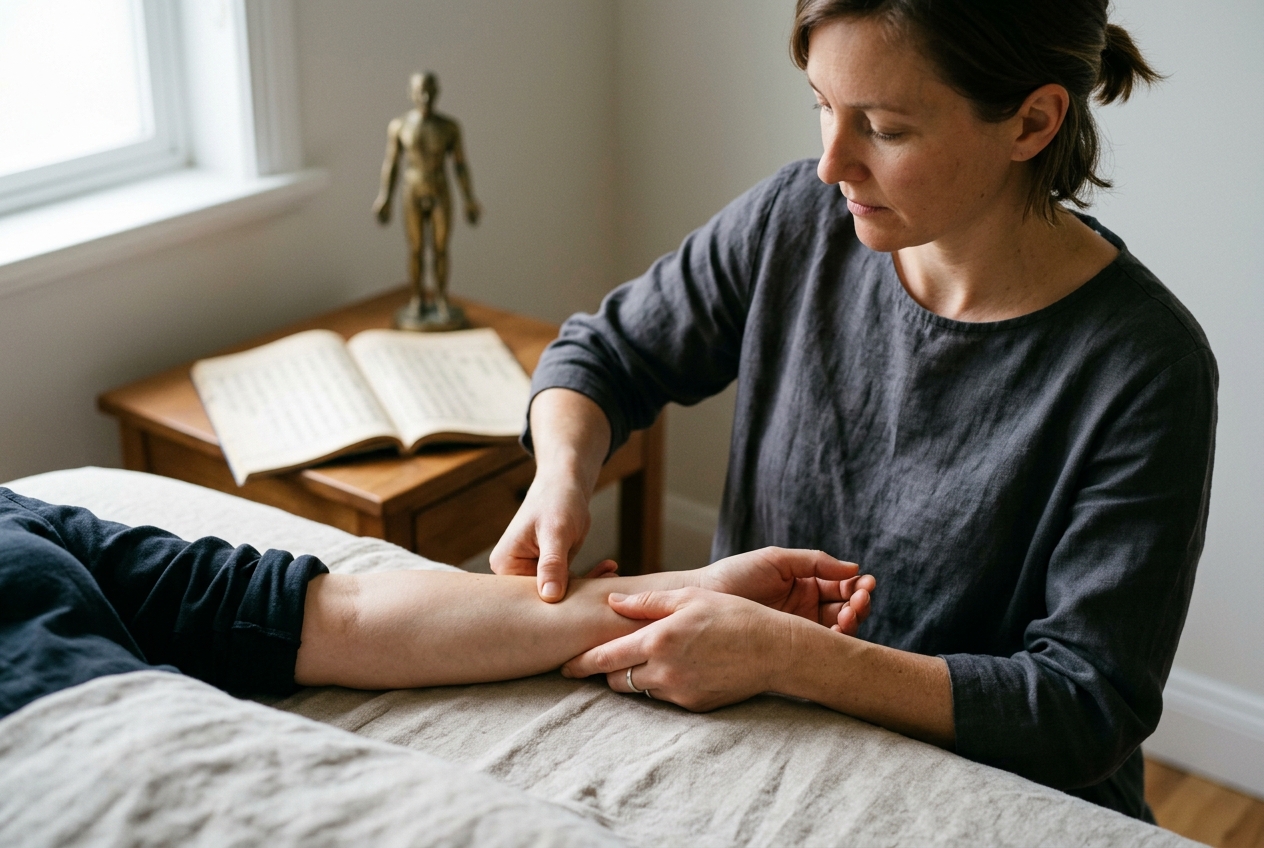
More profoundly, early medical scholars recognized that how one touches the living organism determines the nature of the biological response. In Chapter 7 of the Ling Shu (灵枢·官针, Guan Zhen or "The Official Needles"), compiled over two millennia ago as part of the foundational canon of East Asian medicine, classical authors articulated a sophisticated methodology known as the San Ci (三刺), or the "Three Needling Depths." This doctrine was not a mere geometric abstraction; it was a layered physiological framework that stratified therapeutic mechanical stimulation into three cosmic and somatic tiers: Heaven (Tian, 天), Humanity (Ren, 人), and Earth (Di, 地).
========================================================================================
THE TRIPARTITE STRATIFICATION OF MECHANICAL TRANSDUCTION (SAN CI / 三刺)
========================================================================================
STRATUM      TISSUE SUBSTRATE                CLASSICAL TARGET     MECHANORECEPTORS ENGAGED
----------------------------------------------------------------------------------------
HEAVEN (天)   Epidermal-Dermal Junction      Wei Qi (Defensive)   Meissner Corpuscles,
             (Superficial Cutaneous)                             Merkel Discs, C-Tactile
----------------------------------------------------------------------------------------
HUMANITY(人) Epimysial & Deep Fascia        Ying Qi (Nutritive)  Ruffini Endings,
             (Intramuscular Layer)                               Muscle Spindle Organs
----------------------------------------------------------------------------------------
EARTH (地)   Periosteum & Interosseous      Gu Qi (Primordial)   Pacinian Corpuscles,
             (Deep Perineural Sheath)                            Deep Interstitial Matrix
========================================================================================
When examined through the lens of modern neuromuscular histology and fascial mechanobiology, the San Ci model anticipates the findings of contemporary neuroscience with striking fidelity. By correlating the classical tripartite strata with the differential activation thresholds of specialized cutaneous, myofascial, and periosteal mechanoreceptors, we can demystify classical acupuncture principles. Furthermore, we can translate these sophisticated needle mechanics into exact, non-invasive acupressure protocols that anyone can apply to modulate nervous system tone, release fascial densification, and restore visceral equilibrium.
1. The Meridian Path: A Journey Through the Living Body
To understand how mechanical force reverberates through the organism, one must abandon the outdated notion that acupuncture channels are imaginary lines superimposed upon the skin. Contemporary histological and biomechanical research—spearheaded by researchers investigating connective tissue planes and interstitial fluid dynamics—demonstrates that traditional acupuncture points and meridians correspond with extraordinary precision to cleavage planes within the body's continuous fascial network. These are the natural anatomical highways where intermuscular septa meet, neurovascular bundles transit, and mechanical shear strain concentrates.
Consider four of the most clinically potent meridian pathways, described not in esoteric jargon, but through the palpable landscapes of your own musculoskeletal anatomy:
                  THE ANATOMICAL PATHWAYS OF FOUR MASTER MERIDIANS

         STOMACH (Yangming)                      PERICARDIUM (Jueyin)
  Eye Orbit -> Jaw -> Neck -> Thorax       Anterior Chest -> Axilla -> Biceps ->
  -> Abdomen -> Femoral Triangle ->       Volan Forearm (between flexor tendons)
  Tibialis Anterior -> 2nd Toe Margin     -> Palmar Center -> Middle Fingertip

      LARGE INTESTINE (Yangming)                   SPLEEN (Taiyin)
  Index Fingertip -> Dorsal Hand Web       Medial Big Toe -> Inner Foot Arch ->
  -> Radial Forearm -> Lateral Elbow       Posterior Tibial Margin -> Inner Knee
  -> Deltoid Insertion -> Face/Nose        -> Medial Thigh -> Abdomen -> Spleen
The Stomach Pathway (Yangming Foot Channel)
The Stomach channel begins just beneath the orbit of the eye, descends through the muscular terrain of the cheek and jaw, passes along the throat, and runs downward across the front of the ribcage and abdomen. Continuing into the lower extremity, it travels down the anterior aspect of the thigh, crosses the knee, and traces a direct line down the muscular ridge on the outside of your shinbone—the fleshy belly of the tibialis anterior muscle that aches after a day of marching over uneven terrain—before terminating at the lateral border of the second toe. This channel represents the primary structural conduit for metabolic processing, somatic grounding, and digestive motility.
The Pericardium Pathway (Jueyin Hand Channel)
Originating deep within the chest cavity near the pericardial sac, this internal axis emerges near the armpit, courses down the midline of the inner arm across the biceps, and descends through the center of the inner forearm. Here, it runs precisely within the soft valley between two prominent, cord-like flexor tendons (flexor carpi radialis and palmaris longus) that pop into view when you flex your wrist and squeeze your fingers together. It traverses the center of the palm and finishes at the tip of the middle finger. This pathway is the master regulator of cardiac autonomic balance, microvascular perfusion, and emotional equilibrium.
The Large Intestine Pathway (Yangming Hand Channel)
Starting at the radial corner of the index fingernail, this channel traces the firm dorsal edge of the index finger and climbs directly into the fleshy, triangular muscular web between the thumb and index finger. Ascending along the outer, thumb-side edge of the forearm, it passes over the lateral crease of the bent elbow, travels up the outer deltoid cap of the shoulder, traverses the neck, and crosses the midline of the face to terminate beside the opposite nostril. As a Yangming channel, it governs the clearance of systemic heat, cranial decongestion, and orofacial somatic tension.
The Spleen Pathway (Taiyin Foot Channel)
Originating at the medial nail corner of the big toe, the Spleen pathway ascends along the inner border of the foot, passes in front of the inner ankle bone, and tracks upward directly along the soft, tender posterior margin of the inner shinbone (tibia). It continues up the inside of the calf and knee, ascends the medial aspect of the thigh into the lower abdomen, and connects with the spleen and stomach organs before spreading across the lateral chest wall. This pathway is foundational for fluid metabolism, blood production, and pelvic myofascial tone.
2. The Histological Architecture of San Ci: Tripartite Mechanical Transduction
In Chapter 7 of the Ling Shu, the classical text sets forth the imperative: "Needling has three depths, corresponding to Heaven, Humanity, and Earth... The superficial layer disperses pathogenic factors from the surface; the intermediate layer draws forth the nutritive harmony of the channels; the deep layer anchors the structural foundation and commands the marrow."
When translated into contemporary tissue biomechanics, these three strata correspond directly to distinct anatomical layers, each populated by specific populations of somatosensory mechanoreceptors whose physiological activation depends on depth, vector, and shear force.
+---------------------------------------------------------------------------------------+
|                       HISTOLOGICAL CROSS-SECTION & RECEPTOR STRATA                    |
+---------------------------------------------------------------------------------------+
| [EPIDERMIS]   | Stratum Basale / Papillary Dermis                                     |
|               | Receptors: Merkel Discs (sustained touch), Meissner Corpuscles (slip) |
| HEAVEN (天)   | C-Tactile Afferents (unmyelinated, autonomic down-regulation)        |
|               | Target: Wei Qi (Immune mobilization, cutaneous perfusion)             |
+---------------+-----------------------------------------------------------------------+
| [FASCIA /     | Epimysium, Perimysium, Intermuscular Septa                            |
|  MUSCLE]      | Receptors: Ruffini Endings (lateral stretch), Muscle Spindle Organs   |
| HUMANITY (人) | Fibroblast Piezoelectric Response, Interstitial Fluid Wave            |
|               | Target: Ying Qi (Nutritive vascular flow, myofascial untangling)      |
+---------------+-----------------------------------------------------------------------+
| [PERIOSTEUM / | Deep Fascia, Interosseous Membrane, Perineural Sheath                |
|  BONE]        | Receptors: Pacinian Corpuscles (vibration/compression), Nociceptors   |
| EARTH (地)    | Mechanotransduction via bone-matrix piezoelectricity                  |
|               | Target: Gu Qi (Primordial structural anchoring, marrow tone)          |
+---------------------------------------------------------------------------------------+
The Stratum of Heaven (Tian / 天): The Cutaneous & Dermal Interface
The superficial stratum encompasses the epidermis and the papillary dermis. In classical physiology, this is the domain of Wei Qi (Defensive Qi)—the fast-circulating, bio-electrochemical barrier that governs thermoregulation, cutaneous microcirculation, and primary immune defense.
Histologically, this layer is dense with rapidly adapting Meissner corpuscles (sensitive to low-frequency flutter and light skin slippage) and slowly adapting Merkel discs (specialized for light, perpendicular indentation and high-resolution spatial tactile discrimination). Furthermore, this cutaneous zone contains unmyelinated C-tactile (CT) afferents, which project directly to the insular cortex to down-regulate sympathetic arousal. In therapeutic acupressure, engaging the Heaven stratum requires minimal compression—a feather-light contact that merely tensions the epidermis, displacing interstitial fluids across the papillary boundary without triggering muscular defense. This action mobilizes cutaneous microcirculation and calms hyperactive sensory gating.
The Stratum of Humanity (Ren / 人): The Epimysial & Myofascial Plane
The intermediate stratum penetrates the subcutaneous adipose tissue to engage the epimysium, the deep fascia, and the outer architecture of the skeletal muscle bellies. This is the anatomical domain of Ying Qi (Nutritive Qi), which circulates within the vascular channels and the interstitial fluids of connective tissue to nourish tissues and harmonize channel conduction.
Within this myofascial matrix reside the slowly adapting Type II Ruffini endings and the primary and secondary afferents of muscle spindle organs. Ruffini endings are exquisitely sensitive to continuous mechanical stretch and lateral shear strains within the collagenous ground substance. When mechanical pressure reaches this intermediate depth, it deforms the interstitial extracellular matrix, triggering piezoelectric charges across collagen fibrils and stimulating local fibroblasts to release adenosine—a potent endogenous anti-inflammatory and pain-relieving nucleotide documented in research on acupuncture mechanotransduction published in PMC. In acupressure, this level is felt as the spongy, resilient resistance of the muscle body; pressing here resolves muscular densification and restores myofascial gliding.
The Stratum of Earth (Di / 地): The Deep Periosteal & Interosseous Bed
The deepest stratum extends through the muscle compartments to reach the dense periosteum covering the bone, the interosseous membranes, and the deep adventitia surrounding major neurovascular bundles. In the Ling Shu, this stratum is the domain of Gu Qi (Grain/Primordial Qi) and the Marrow (Sui)—the biological reservoir of deep constitutional vitality, postural structural integrity, and autonomic stability.
Histologically, this profound layer is monitored by Pacinian corpuscles—onion-like, encapsulated nerve endings designed to detect rapid, deep vibrational changes and sudden shifts in high-amplitude compressive loading—alongside dense networks of metabolic and mechanosensitive free nerve endings embedded within the periosteum. When graduated, perpendicular pressure engages the periosteal interface without causing sharp trauma, it activates deep mechanosensory pathways that project via the spinothalamic tracts to the periaqueductal gray and hypothalamus, producing powerful systemic analgesia and a vagal autonomic reset.
3. Four Master Points: Precision Acupressure Protocols
Translating the San Ci doctrine into clinical acupressure requires structured manual protocols. Below are four of the most powerful master points on the human body, delineated by their topographical landmarks, distinctive mechanosensory markers, and tri-level compressive mechanics.
========================================================================================
                          SUMMARY OF MASTER ACUPRESSURE POINTS
========================================================================================
POINT        CHINESE NAME      BODY LOCATION                       PRIMARY CLINICAL FOCUS
----------------------------------------------------------------------------------------
ST36         Zusanli (足三里)    4 fingers below knee, 1 finger      Fatigue, Indigestion,
                                lateral to shinbone ridge           Autonomic Dysregulation
----------------------------------------------------------------------------------------
PC6          Neiguan (内关)     2 thumb-widths above wrist crease,  Anxiety, Heart Palpitations,
                                between two forearm tendons         Nausea, Sleep Disturbances
----------------------------------------------------------------------------------------
LI4          Hegu (合谷)        Mound between thumb & index finger, Tension Headaches, Facial
                                against second metacarpal bone      Tension, Acute Stress
----------------------------------------------------------------------------------------
SP6          Sanyinjiao (三阴交) 4 fingers above inner ankle, along  Pelvic Discomfort, Insomnia,
                                posterior edge of shinbone          Fluid Retention, Exhaustion
========================================================================================
1. ST36 (Zusanli / 足三里) — "Leg Three Miles"
Located along the Stomach channel, ST36 is celebrated across classical literature as the foremost point for building endurance, boosting digestive capacity, and restoring systemic vitality. Extensive modern investigations indexed in NCBI PubMed studies on autonomic neurophysiology demonstrate that manual stimulation of ST36 modulates systemic inflammation through the vagal-adrenal axis.
                    TOPOGRAPHICAL LOCATION OF ST36 (ZUSANLI)

                             [Patella / Kneecap]
                                      |
                     -- 4 finger-widths downward --
                                      |
         [Anterior Tibial Ridge] <----+----> [ST36: In the fleshy notch of
         (The sharp shinbone)         |      the Tibialis Anterior muscle]
                                      |
                              [Lateral Fibula]
- Location & Palpation: Sit with your knee bent at a 90-degree angle. Place the palm of your hand over your kneecap; your four fingers will rest naturally on the shin. ST36 is located roughly four finger-widths beneath the lower border of the patella, exactly one finger-breadth lateral to the sharp anterior ridge of the shinbone (tibia). You will find a distinct, fleshy depression in the belly of the tibialis anterior muscle.
- The De Qi Sensation: When correctly engaged, you will experience a profound, dull, spreading ache that radiates downward along the lateral edge of the shin, occasionally echoing into the top of the foot.
- Three-Stage Compressive Technique:
- Stage 1 (Heaven - 15 Seconds): Place the pad of your thumb lightly over the point. Apply gentle circular traction to the epidermis to engage the superficial cutaneous receptors.
- Stage 2 (Humanity - 45 Seconds): Slowly increase perpendicular pressure, sinking through the subcutaneous fat into the firm belly of the tibialis anterior. Maintain steady compression while taking slow, diaphragmatic breaths to engage muscle spindle organs.
- Stage 3 (Earth - 60 Seconds): Guide your thumb pad slightly medially, directing force toward the lateral face of the tibial bone shaft. Hold a firm, steady, unyielding pressure at this periosteal margin. You will feel a subtle "yielding" or softening of the local fascia—the tactile marker of tissue release. Maintain for one full minute, then release slowly in reverse order over 10 seconds.
- Daily Clinical Applications: Relieves post-prandial bloating, counters chronic lower-limb heaviness, combats systemic lethargy, and enhances autonomic stability during prolonged stress.
2. PC6 (Neiguan / 内关) — "The Inner Pass"
Situated on the Pericardium meridian, PC6 is the premier point for calming an overactive nervous system, regulating cardiovascular rhythm, and relieving visceral spasms of the upper gastrointestinal tract.
                    TOPOGRAPHICAL LOCATION OF PC6 (NEIGUAN)

                    [Distal Wrist Crease / Base of Palm]
                                      |
                     -- 2 thumb-widths upward --
                                      |
        [Flexor Carpi Radialis] <-----+-----> [Palmaris Longus Tendon]
                                      |
                            [ PC6: In the canyon
                              between both tendons ]
- Location & Palpation: Turn your forearm palm-up. Measure two thumb-widths upward from the distal wrist crease (the flexible skin fold where your hand joins your arm). PC6 lies directly between the two prominent tendons of the forearm (flexor carpi radialis and palmaris longus). If these tendons are difficult to see, press your thumb and pinky finger together while slightly bending your wrist forward; the cords will immediately stand out.
- The De Qi Sensation: A subtle, electric warmth, a deep feeling of muscular distension within the forearm compartment, and a spreading sensation of ease opening through the diaphragm and chest.
- Three-Stage Compressive Technique:
- Stage 1 (Heaven - 15 Seconds): Rest your thumb pad softly across the skin between the tendons. Apply a light, rhythmic, proximal-to-distal brush to mobilize superficial lymphatic fluid.
- Stage 2 (Humanity - 45 Seconds): Direct your thumb perpendicular to the skin, parting the two tendons and sinking into the deep flexor compartment (flexor digitorum superficialis). Apply sustained, moderate pressure to stimulate the Ruffini endings of the intertendinous fascial sheath.
- Stage 3 (Earth - 60 Seconds): Gently sink deeper toward the anterior interosseous membrane and the vicinity of the median nerve sheath. Note: If you feel a sharp, electric shock radiating into your middle finger, you are compressing the median nerve trunk directly. Slightly angle your vector 1 millimeter laterally or medially to engage the deep fascial bed rather than the nerve trunk itself. Hold this deep, anchoring pressure for 60 seconds while exhaling slowly.
- Daily Clinical Applications: Rapidly eases travel sickness and emotional nausea, settles nervous heart palpitations, alleviates chest tightness triggered by anxiety, and quiets racing thoughts before sleep.
3. LI4 (Hegu / 合谷) — "Joining Valley"
As the primary Yuan-Source point of the Large Intestine meridian, LI4 is renowned as the ultimate analgesic master point for conditions affecting the head, face, sensory organs, and cervical spine. Detailed clinical guidelines provided by the World Health Organization Acupuncture Benchmarks highlight its widespread utility in pain management.
                    TOPOGRAPHICAL LOCATION OF LI4 (HEGU)

                               [Thumb Webbing]
                                      |
                    -- Squeeze thumb against index --
                                      |
                         [Highest muscular mound]
                                      |
                       [LI4: Angle your thumb pad
                     under the 2nd Metacarpal Bone]
- Location & Palpation: Bring your thumb and index finger flat together. A muscular ridge will rise in the web between them. LI4 is located at the apex of this muscular mound. Alternatively, spread your hand wide and place the first crease of your opposite thumb into the webbing between your thumb and index finger; where your thumb tip comes down naturally is the location of the point.
- The De Qi Sensation: An unmistakable, intensely resonant, deep ache that frequently radiates along the back of the hand and upward along the radial edge of the forearm.
- Three-Stage Compressive Technique:
- Stage 1 (Heaven - 15 Seconds): Gently grasp the skin of the dorsal web between your opposite thumb and index finger, rolling the dermal layer to stimulate superficial Merkel discs.
- Stage 2 (Humanity - 45 Seconds): Sink your thumb into the central belly of the first dorsal interosseous muscle. Apply firm, steady, circular kneads (one circle every two seconds) to break down muscular hypertonicity.
- Stage 3 (Earth - 60 Seconds): Redirect your pressing vector: do not press straight down through the soft webbing. Instead, angle your thumb pad against the shaft of the second metacarpal bone (the bone leading to your index finger), hooking slightly underneath the bone's edge. This engages the rich periosteal mechanoreceptors. Hold this firm, therapeutic ache for 60 seconds with deep nasal breathing.
- Daily Clinical Applications: Relieves tension headaches, eases temporomandibular joint (TMJ) and jaw clenching, relieves sinus pressure, and clears mental stagnation during demanding cognitive tasks.
4. SP6 (Sanyinjiao / 三阴交) — "Three Yin Intersection"
SP6 occupies a unique anatomical and energetic junction: it is the convergence point of the three Yin meridians of the lower limb—the Spleen, Liver, and Kidney channels. It serves as a master regulator of fluid dynamics, pelvic circulation, and parasympathetic balance.
                    TOPOGRAPHICAL LOCATION OF SP6 (SANYINJIAO)

                               [Inner Knee]
                                    |
                                    |
                    [Shaft of the Medial Tibia Bone]
                                    |
                   -- 4 finger-widths above ankle --
                                    |
    [Medial Malleolus] <------------+------------> [SP6: In the soft trench
     (Inner ankle bone)                              behind the tibial bone]
- Location & Palpation: Sit comfortably with your ankle resting across the opposite knee. Locate the highest prominence of your inner ankle bone (medial malleolus). Place four fingers of your hand horizontally across your lower calf, starting with your pinky finger aligned with the ankle bone's peak. SP6 lies directly four finger-widths above the ankle, nestled in the soft muscular groove immediately behind the posterior border of the tibia (shinbone).
- The De Qi Sensation: A tender, warm, deeply relaxing throb that travels upward along the inner calf and spreads through the pelvic floor.
- Three-Stage Compressive Technique:
- Stage 1 (Heaven - 15 Seconds): Stroke the cutaneous skin softly upward along the medial edge of the bone to encourage venous and lymphatic return.
- Stage 2 (Humanity - 45 Seconds): Apply moderate perpendicular pressure into the muscular valley occupied by the tibialis posterior and flexor digitorum longus tendons.
- Stage 3 (Earth - 60 Seconds): Angle your thumb pad to hook forward, pressing directly into the posterior periosteal margin of the tibial bone. Hold this deep contact with continuous, unwavering pressure. As the tissue releases, you may feel an energetic softening and a drop in overall muscle tension throughout your legs and lower abdomen.
- Daily Clinical Applications: Relieves menstrual cramps and lower pelvic stagnation, reduces evening ankle swelling, soothes lower back tension, and induces deep parasympathetic relaxation before sleep.
4. The Autonomic & Digestive Reset Protocol
When daily stress accumulates, the body shifts into chronic sympathetic dominance: the breath becomes shallow, blood is shunted away from digestive organs, the neck and jaw lock up, and gastrointestinal motility slows to a crawl. The following targeted sequence synergizes the four master points into a coherent, 10-minute clinical routine designed to reset autonomic balance and restore digestive flow.
+---------------------------------------------------------------------------------------+
|                 EVENING NEURO-VISCERAL RESET PROTOCOL (10 MINUTES)                    |
+---------------------------------------------------------------------------------------+
| STEP 1: CRANIAL UNBURDENING                                                           |
| Target: LI4 (Hegu) | Duration: 2 Mins Total (1 min per hand)                          |
| Action: Angle vector toward 2nd metacarpal bone (Earth Stratum).                      |
| Purpose: Release jaw clenching, drain cranial tension, lower baseline pain signaling.|
+---------------------------------------------------------------------------------------+
| STEP 2: DIAPHRAGM & VAGAL CALMING                                                     |
| Target: PC6 (Neiguan) | Duration: 2 Mins Total (1 min per arm)                        |
| Action: Perpendicular descent between tendons into deep flexor bed (Humanity/Earth).  |
| Purpose: Open diaphragmatic excursion, slow heart rate, quiet somatic anxiety.       |
+---------------------------------------------------------------------------------------+
| STEP 3: VISCERAL PROPULSION & METABOLIC GROUNDING                                     |
| Target: ST36 (Zusanli) | Duration: 3 Mins Total (90 sec per leg)                      |
| Action: Three-phase graduated pressure against lateral tibial border.                 |
| Purpose: Stimulate gastric peristalsis, release abdominal distension, clear fatigue. |
+---------------------------------------------------------------------------------------+
| STEP 4: PELVIC EQUILIBRIUM & PARASYMPATHETIC INTEGRATION                              |
| Target: SP6 (Sanyinjiao) | Duration: 3 Mins Total (90 sec per leg)                    |
| Action: Hooking vector behind posterior tibial crest (Earth Stratum).                  |
| Purpose: Harmonize pelvic circulation, clear fluid stagnation, prepare brain for sleep.|
+---------------------------------------------------------------------------------------+
Protocol Execution Details:
- Posture: Lie comfortably on your back with a small pillow beneath your head and your knees slightly supported by a bolster, or recline in a supportive armchair.
- Breath Synchronization: Throughout the routine, employ a 4-7-8 breathing cadence (inhale quietly through the nose for 4 seconds, hold gently for 7 seconds, exhale smoothly through the mouth for 8 seconds). Time your deep Earth-level compression to begin precisely at the start of your exhalation, as the nervous system naturally down-regulates muscle tone during breathing out.
5. Safety, Sense, and Clinical Boundaries
While acupressure is one of the safest non-invasive modalities available, its power to alter neuromuscular tension, hormonal cascades, and vascular tone demands respect and anatomical precision.
+---------------------------------------------------------------------------------------+
|                        CRITICAL CLINICAL CAUTIONS & CONTRAINDICATIONS                 |
+---------------------------------------------------------------------------------------+
| PREGNANCY RESTRICTIONS:                                                               |
| * LI4 (Hegu) & SP6 (Sanyinjiao) are STRICTLY CONTRAINDICATED during pregnancy.        |
|   Classical texts and modern studies note their potent oxytocic and uterine-stimulating|
|   effects. (They may be used during active labor under professional supervision).     |
+---------------------------------------------------------------------------------------+
| TACTILE THRESHOLDS & TISSUE PRESERVATION:                                             |
| * Healthy Acupressure: Produces "De Qi" (dull ache, spreading warmth, heaviness).     |
| * Damaging Force: Sharp, lancinating, burning, or electric shock pain.                |
| * Never press into broken skin, active infections, varicose veins, or fresh bruises.  |
+---------------------------------------------------------------------------------------+
| PRACTITIONER REFERRAL RED FLAGS:                                                      |
| * Unexplained severe abdominal pain or persistent vomiting.                           |
| * Sudden, crushing chest tightness or neurological deficits (speech, vision, motor).   |
| * Unresolving, persistent chronic symptoms that do not yield to self-care.            |
+---------------------------------------------------------------------------------------+
Navigating Therapeutic Pressure vs. Tissue Trauma
A common misconception is that acupressure must be excruciating to be effective. The opposite is true: excessive force triggers defensive muscular splinting, elevates cortisol, and can cause microvascular bruising. The correct therapeutic sensation (De Qi) is often described as a "sweet ache"—a sensation that commands your attention and encourages deep breathing, rather than causing you to wince or pull away. If you feel a sharp, stabbing sensation, you are likely irritating a localized cutaneous nerve or compressing a blood vessel; gently shift your angle of approach.
6. Today's Takeaway: The Two-Minute Desk Reset
If you have only 120 seconds right now before returning to your workday, you can instantly break the cycle of stress-induced sympathetic overdrive using this streamlined application of the San Ci needling method:
+---------------------------------------------------------------------------------------+
|                           THE 120-SECOND SOMATIC RESET                                |
+---------------------------------------------------------------------------------------+
| 00:00 - 00:30 | HEAVEN LAYER (Cutaneous Awakenings)                                   |
|               | Rest your left thumb on LI4 (web of the right hand). Lightly stroke   |
|               | the skin in small circles. Close your eyes and inhale deeply.         |
| 00:30 - 01:15 | HUMANITY LAYER (Myofascial Engagement)                                |
|               | Sink your thumb into the muscle mound. Apply firm circular pressure.  |
|               | Drop your shoulders, unclamp your teeth, and soften your jaw.         |
| 01:15 - 02:00 | EARTH LAYER (Periosteal Anchoring)                                    |
|               | Angle your thumb directly against the index finger bone. Hold firm,   |
|               | steady, unyielding pressure for 45 seconds while taking three slow,   |
|               | complete exhalations. Feel the release across your temple and neck.   |
+---------------------------------------------------------------------------------------+
Switch hands whenever you have another moment, and observe the immediate physiological shift: a cooler, clearer mind, an open throat, and a grounded nervous system ready to engage with the demands of the day.
Authoritative References & Scientific Reading
- World Health Organization: WHO Standard Acupuncture Point Locations in the Western Pacific Region. Comprehensive international anatomical standardization of classical meridian topologies.
- Langevin, H. M., et al.: Relationship of Acupuncture Points and Meridians to Connective Tissue Planes. Landmark histological research demonstrating ultrasound verification of fascial cleavage planes at classical point sites.
- National Center for Biotechnology Information (NCBI PubMed): Fascia Mechanoreceptors and Neuromuscular Transduction. Detailed investigations into the neurobiology of Ruffini endings, Pacinian corpuscles, and interstitial fluid mechanics.
- Wikipedia Academic Compendium: Mechanoreceptors in Human Neurophysiology. Structural and functional classification of cutaneous and deep tissue sensory units.
- National Library of Medicine (PMC): Neuroanatomical Basis of Vagal Modulation via ST36 Stimulation. Modern mechanistic evaluations of the somato-autonomic reflex arcs triggered by somatic acupoint stimulation.