Lieque Cavity Broken Sequence: Brachioradial Fascial Decompression, Pulmonary Qi Dispersal, and Ren Mai Vessel Activation in Classical Neigong
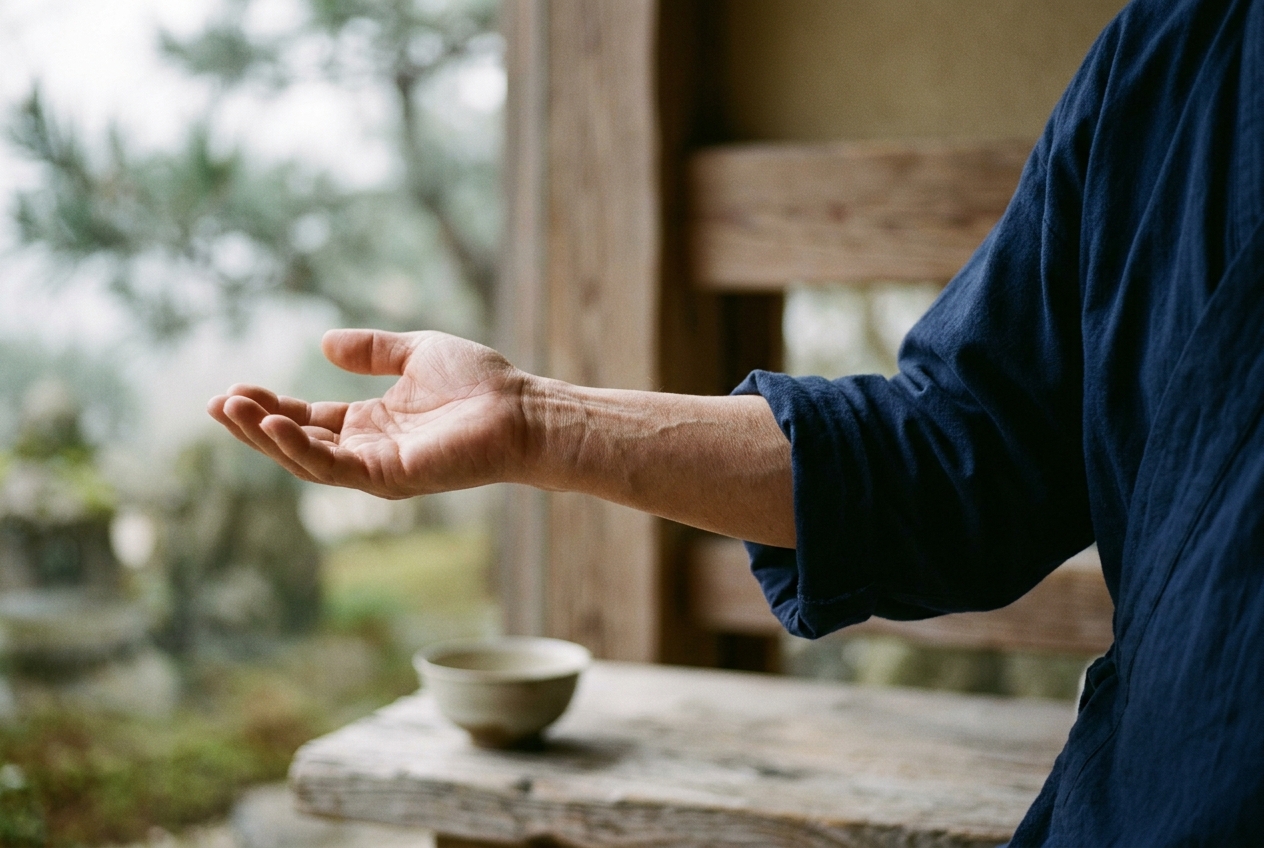
By using subtle, spiral adjustments of the wrist and elbow combined with diaphragmatic breathing (directing the breath deep into the lower belly, roughly two inches below the navel, known classically as the Dantian), you physically stretch and separate these entrapped tissues. This mechanical decompression relieves pressure on sensitive local nerve branches and allows the muscles along the arm to act like a continuous, elastic spring rather than a series of rigid, locked segments. As this muscular grip softens—a state the internal martial arts term Song (active neurofascial release without collapsing structural integrity)—the rib cage expands freely, breathing capacity deepens effortlessly, and the entire autonomic nervous system shifts from a state of fight-or-flight tension into deep parasympathetic restoration.
FUNCTIONAL NEURO-ANATOMY AND FASCIAL ARCHITECTURE
The classical point Lieque (LU7, 列缺), translated variously as "Broken Sequence," "Lightning Flash," or "Split Opening," is located anatomically 1.5 cun proximal to the styloid process of the radius. Topographically, it sits directly in the narrow groove between the tendon of the brachioradialis muscle and the tendon of the abductor pollicis longus (APL), immediately lateral to the radial artery and cephalic vein.
       [ Lateral Arm Kinetic Line / Taiyin-Yangming Fascial Matrix ]
                                     |
    +--------------------------------+--------------------------------+
    |                                                                 |
    v                                                                 v
[ Tendon of Brachioradialis ]                            [ Abductor Pollicis Longus ]
    |                                                                 |
    +-------------------> [[ LIEQUE (LU7) ]] <------------------------+
                                  |
            (1.5 cun proximal to Radial Styloid Process)
                                  |
      +---------------------------+---------------------------+
      |                           |                           |
      v                           v                           v
[ Superficial Radial Nerve ] [ Deep Front Arm Fascia ]   [ Luo-Collateral Conduit ]
 (Sensory Decompression)     (Inter-compartmental Glide)  (Interior-Exterior Vector)
At this specific anatomical crossing, the antebrachial investing fascia forms a dense fibrous retinacular bridge. Chronic repetitive pronation and static gripping patterns cause tenosynovial friction, leading to micro-adhesions between the brachioradialis sheath and the deeper first extensor compartment of the wrist (enclosing the abductor pollicis longus and extensor pollicis brevis). Piercing directly through this deep fascia to reach the subdermal layer is the superficial branch of the radial nerve (SBRN), which provides cutaneous innervation to the dorsal aspect of the radial half of the hand, the thumb, the index finger, and the radial side of the middle finger.
================================================================================
                    ANATOMICAL & NEUROVASCULAR SUMMARY: LU7
================================================================================
  Topographical Cleft   : Groove between Brachioradialis & Abductor Pollicis Longus
  Metric Location       : 1.5 cun (~2 fingers' width) proximal to Radial Styloid
  Neural Trajectory     : Piercing zone of Superficial Branch of Radial Nerve (SBRN)
  Vascular Relations    : Radial Artery collateral branches; Cephalic Vein tributary
  Myofascial Continuum  : Deep Front Arm Line (DFAL) bridging to Superficial Back Arm
================================================================================
When an untrained individual extends or rotates the arm under tension, the brachioradialis shortens, compressing the SBRN against the underlying radial periosteum and tethering the adjacent fascial septa. In contrast, classical Neigong utilizes precise micro-adjustments in radial-ulnar pronation and supination to decompress this inter-tendinous cleft. By dropping the elbow (Zhui Zhou, 坠肘) and extending the thumb's web space (Hu Kou, 虎口), the practitioner establishes reciprocal tension between the brachioradialis and abductor pollicis longus. This structural opening restores dynamic tenosynovial gliding along what modern fascial anatomist Thomas Myers categorizes as the Deep Front Arm Line and the Superficial Front Arm Line, freeing trapped neurovascular structures and transforming the arm into a pliable, tensegrity-driven kinetic conduit.
MERIDIAN DYNAMICS: LUO-COLLATERALS AND REN MAI CONFLUENCE
In classical acupuncture etiology documented in the Huangdi Neijing Lingshu (Spiritual Pivot, c. 1st century BCE), Lieque occupies an extraordinary status due to its triple energetic designation:
- The Luo-Connecting Point of the Hand Taiyin Channel: As the Luo point, Lieque gives rise to an energetic bifurcation—the Luo-Collateral—which departs from the Lung Meridian at the styloid process and crosses over the anatomical snuffbox to establish an interior-exterior functional connection with the Hand Yangming Large Intestine Meridian at Hegu (LI4) and Quchi (LI11). This energetic shunt balances Yin and Yang dynamics across the upper limb, regulating both pulmonary respiration and gastrointestinal peristalsis.
- The Confluent Opening Point (Ba Mai Jiao Hui Xue) of the Conception Vessel: Paired harmoniously with Zhaohai (KI6) on the Kidney channel, Lieque functions as the master key that unlocks the Conception vessel (Ren Mai, 任脉)—the "Sea of all Yin Channels" running along the anterior midline of the human torso. Opening Lieque releases energetic constriction along the throat, chest, solar plexus, and lower abdomen, mobilizing deep constitutional Yin fluid and anchoring ascending pathogenic heat.
- The Pivotal Command Point (Gao Wu Si Zong Xue) for Cranio-Cervical Pathologies: In the famous Ming Dynasty mnemonic Song of the Four Command Points (later expanded to Six), it is stated: "Tou Xiang Xun Lieque" (头项寻列缺)—"For disorders of the head and posterior neck, search Lieque." Through its dual connection to the Large Intestine channel and the primary Lung channel divergence, mobilizing this locus disperses pathogenic exterior wind-cold, releases suboccipital muscular guarding, and alleviates tension-type cervicogenic headaches.
                        [ LU7: THE TRIPLE CONDUIT ENGINE ]
                                         |
     +-----------------------------------+-----------------------------------+
     |                                   |                                   |
     v                                   v                                   v
[ LUO-CONNECTING POINT ]      [ CONFLUENT MASTER KEY ]        [ CRANIO-CERVICAL COMMAND ]
  Bifurcates to Large          Unlocks the Ren Mai              Releases Suboccipital Tension,
  Intestine Channel            (Conception Vessel);             Clears Pathogenic Wind,
  (LI4 Hegu / LI11 Quchi);     Regulates Thoracic Yin           Opens Cervical Kinetic Chain
  Balances Yin-Yang Arm Flow   & Deep Abdominal Core            ("Head & Neck Seek Lieque")
When pulmonary Qi becomes stagnant due to physical slouching, respiratory shallowing, or psychological distress, the lungs lose their classical physiological faculties of Xuan Fa (宣发, upward and outward dispersal of defensive Qi and fluids) and Su Jiang (肃降, downward clearing of Qi toward the kidneys). Decompressing Lieque restores this vital dual vectoring, driving the expansive dispersion of Qi to the peripheral cutaneous tissues while drawing clear ambient breath down into the visceral basin.
STEP-BY-STEP PRACTICE GUIDE: CLASSICAL NEIGONG METHODOLOGY
To mobilize the Lieque cavity and decompress the brachioradial fascial chain in your daily practice, follow these systematic protocols derived from authentic Wudang and classical internal martial traditions.
Protocol 1: Zhan Zhuang (Standing Post) Radial-Ulnar Spiral
- Establish the Root: Stand with your feet parallel, exactly shoulder-width apart. Unlock your knees slightly, drop your tailbone (Song Kua), and gently suspend the crown of your head as if drawn upward by a silk thread from above (Baihui, GV20).
- Embrace the Sphere (Cheng Bao Zhuang): Slowly raise both arms in front of your chest as if lightly holding an enormous paper lantern. Your palms face your chest, fingertips pointing toward one another with a distance of roughly three fist-widths between them.
- Set the Lieque Tension Vector: - Sink both elbows downward and slightly forward (Chen Jian Zhui Zhou); do not clamp them against your ribs or flare them upward. - Softly flex the wrists back toward you by approximately 15 degrees, allowing the base of the palms to sink (Chen Wan). - Expand the web space of both thumbs (Hu Kou) outward, creating a rounded, open arch between thumb and forefinger. - Gently roll your forearms into a micro-spiral: rotate the thumb-side edge of the wrist slightly forward while keeping the pinky-side edge anchored back toward your heart.
- Breath Coordination: - Inhale (4 seconds): Inhale slowly through your nose into the lower abdomen, feeling the pelvic floor softly expand. As the breath reaches capacity, feel the web space of the thumb and the Lieque notch widen. - Exhale (6 seconds): Exhale smoothly through the nose. Sense an elastic, spring-like pull releasing from Lieque, travelling down the front midline (Ren Mai), through the solar plexus, and settling firmly into the Dantian. - Duration: Maintain this posture for 10 to 15 minutes continuously.
================================================================================
                   COMMON MISTAKES & MICRO-ALIGNMENT CORRECTIONS
================================================================================
  MISTAKE: Elevating and tensing the trapezius and shoulder caps.
  CORRECTION: Consciously drop the scapulae downward and broaden the back ribs.

MISTAKE: Over-flexing the wrist, pinching the carpal tunnel and median nerve.
  CORRECTION: Maintain the "broken sequence" as a subtle hollow, not a sharp fold.

MISTAKE: Collapsing the thumb web (*Hu Kou*), slackening the brachioradialis line.
  CORRECTION: Imagine gently gripping a soft egg between your thumb and index finger.

MISTAKE: Chest breathing and hyperventilating the upper thoracic cage.
  CORRECTION: Direct diaphragmatic descent to the lower belly and lower back (*Mingmen*).
================================================================================
Protocol 2: The Sword-Finger Mudra (Jian Jue) Fascial Vectoring
The classical Taoist Sword-Finger mudra is not a decorative theatrical gesture, but a high-precision biomechanical tensioning technique engineered to isolate the Lung, Large Intestine, and Pericardium fascial sheaths.
              [ JIAN JUE / SWORD-FINGER STRUCTURAL LEVERAGE ]
                   Index & Middle: Extended like steel rods
                                 //
                                //
              Thumb Ring-Pinky: Folded into rooted base
                                |
             [[ Radial Styloid / Lieque Cavity Opened ]]
                                |
               Scapular Anchor: Latissimus Dorsi & Serratus
- Mudra Formation: Fold the ring finger and pinky finger into the center of the palm. Place the fleshy tip of your thumb over the fingernails of the ring and little fingers, forming a firm, compact lock. Keep the index and middle fingers completely straight and pressed flush together, extending them forward like a blade.
- Radial Projection: Extend the arm forward at a 45-degree downward angle. Consciously pull the radial styloid process slightly back toward your elbow while pushing the tips of the index and middle fingers forward.
- Sensory Signposts: You should feel an immediate, distinct, line-like stretch running from the lateral collarbone, down the biceps tendon, across the Lieque cleft, and terminating at the distal tip of the index finger. This is the physiological manifestation of Deqi (arrival of vital sensation) paired with full-chain myofascial pretensioning.
- Integration: Perform 12 slow, diaphragmatic breath cycles on each arm, alternating sides.
                                PROOF CALLOUT:
                   THE THREE SENSORY STAGES OF LIEQUE RELEASE
  Stage 1 (Initial 2 mins): Deep ischemic ache or cool tingling along the radial border.
  Stage 2 (5–8 mins)      : Sudden release of suboccipital tension and effortless saliva production.
  Stage 3 (10+ mins)      : Thermal radiant wave descending down the sternal midline (Ren Mai).
THE PHYSIOLOGICAL PROOF: FASCIAL MECHANOTRANSDUCTION AND NEURAL REGULATION
Modern scientific research compiled through institutions such as the National Center for Biotechnology Information and clinical studies documented by the World Health Organization provides a clear physiological framework for why this ancient manual decompression works so profoundly.
                     [ NEURO-FASCIAL TRANSDUCTION CASCADE ]
                                        |
    +-----------------------------------+-----------------------------------+
    |                                                                       |
    v                                                                       v
[ Biomechanical Vector ]                                    [ Neuro-Endocrine Response ]
  Micro-rotational forearm glide                              Superficial radial afferents
  shears antebrachial fascia.                                 modulate spinal trigeminal tract.
    |                                                                       |
    v                                                                       v
[ Mechanotransduction ]                                     [ Autonomic Down-Regulation ]
  Fibroblasts release Adenosine (ATP)                         Vagal outflow stimulates HRV,
  and down-regulate local inflammation.                       relaxes diaphragm, activates gut peristalsis.
When tensile stress is applied along a specific fascial plane during Neigong movements, interstitial fibroblasts experience mechanical shearing—a process known as mechanotransduction. This physical deformation induces intracellular biochemical cascades, leading to the sustained local release of adenosine and nitric oxide. Adenosine acts as an endogenous analgesic that dampens nociceptive signaling along the superficial radial nerve, while nitric oxide triggers local microvascular vasodilation, resulting in the characteristic subjective sensation of deep thermal warmth (Re Qi) during practice.
Simultaneously, mobilizing the lateral arm kinetic chain exerts direct mechanical traction on the deep cervical fascia and the pectoral girdle through the continuous fascial envelope described by musculoskeletal researchers. Because the superficial radial nerve converges at the dorsal root ganglia of the C6–C8 cervical spinal roots—which functionally cross-talk with the spinal trigeminal nucleus and the descending pathways of the vagus nerve—decompressing Lieque modulates central sympathetic tone. The heart rate variability (HRV) increases, baroreflex sensitivity improves, and the diaphragm descends effortlessly, allowing pulmonary gas exchange to increase without requiring compensatory hyperventilation.
CLASSICAL LINEAGE & HISTORICAL CONTEXT
The functional mapping of Lieque is one of the oldest recorded observations in somatic medicine. Its earliest canonical description appears in the Huangdi Neijing (Inner Canon of the Yellow Emperor), compiled during the Han Dynasty (202 BCE – 220 CE). In the Lingshu (Chapter 10, "On the Meridians"), the ancient physicians described how the branching vessel of the Lung channel originates above the wrist at Lieque, tracking the path of what we now identify as the cephalic vein and superficial radial sensory arborization.
================================================================================
                    HISTORICAL LINEAGE & TEXTUAL EVOLUTION
================================================================================
  Han Dynasty (c. 100 BCE)  : Huangdi Neijing Lingshu classifies LU7 as Luo Point.
  Jin Dynasty (282 CE)      : Zhenjiu Jiayi Jing by Huangfu Mi details topographical metrics.
  Song Dynasty (1026 CE)    : Wang Weiyi casts Bronze Acupuncture Statues standardizing LU7.
  Ming Dynasty (1529 CE)    : Gao Wu pens Zhenjiu Juying, formulating the Six Command Points.
  Ming Dynasty (1601 CE)    : Yang Jizhou publishes Zhenjiu Dacheng; codifies Ba Mai pairings.
================================================================================
During the Jin Dynasty, the physician-scholar Huangfu Mi codified its clinical indications in the monumental Zhenjiu Jiayi Jing (The Systematic Classic of Acupuncture and Moxibustion, 282 CE), noting its extraordinary capability to clear facial paralysis, respiratory wheezing, and stiffness of the neck. By the Song Dynasty (960–1279 CE), the imperial medical academy under Wang Weiyi cast the legendary life-sized Bronze Acupuncture Statues (Tongren), permanently fixing Lieque in imperial somatic pedagogy.
       "The Broken Sequence is the sudden fracture of heaven's clouds;
        When the lightning strikes, the celestial moisture descends to earth.
        So too does Lieque break the binding knot of the upper limb,
        Allowing the breath of Heaven to moisten the vessel of the Ren."
        — Attributed to Ming Master Yang Jizhou, *Zhenjiu Dacheng* (1601)
In the martial lineage of Daoist Neigong cultivated within the Wudang and Mount Emei sanctuaries, Lieque became known as the "Bowstring Notch." Masters realized that a warrior or meditator who collapsed this point would invariably suffer from stiffened shoulders, shallow chest breathing, and an unstable, easily uprooted kinetic center. Conversely, keeping Lieque perpetually open and buoyant—the core structural secret of Taijiquan's "Cloud Hands" (Yun Shou) and Baguazhang's "Single Changing Palm"—allowed kinetic ground-reaction forces from the legs to transmit through the back and spiral uninterrupted out through the fingertips. Modern somatic organizations like the National Qigong Association continue to preserve these classical paradigms, bridging traditional lineage wisdom with contemporary somatic education.
ADVANCED NEIGONG INTEGRATION: CLOUD HANDS SPIRAL DYNAMICS
To experience how Lieque operates within dynamic movement, integrate it into the classical exercise known across martial and health traditions as Cloud Hands (Yun Shou, 云手).
                 [ DYNAMIC CLOUD HANDS (YUN SHOU) WAVE ]

       [ Left Hand: Ascending Yin Phase ]        [ Right Hand: Descending Yang Phase ]
                   \                                        /
                    \                                      /
             (LU7 Decompressed & Sunk)             (LI4 Projected Outward)
                      \                                  /
                       +-------------[ DANTIAN ]--------+
                               (Core Pelvic Rotation)
- The Postural Crucible: Stand in a wide, relaxed stance with feet parallel, knees softly bent, and the weight distributed 50/50 through the bubbling spring points (Yongquan, KI1) on the soles of your feet.
- The Ascending Yin Phase: - As you rotate your waist (Yao) 45 degrees to the left, float your left hand upward until it is level with your eye line. - Softly supinate the left forearm so the palm turns toward your face. - At the apex of the turn, deliberately sink the left elbow and slightly pull the base of the thumb inward, opening the Lieque notch. Feel the inhalation naturally fill the left side of your rib cage and down into the left kidney.
- The Descending Yang Phase: - Rotate your waist back toward the right. As your torso turns, allow the left hand to sweep horizontally across your visual field like a drifting cloud. - Gently pronate the forearm so the palm turns diagonally downward and outward. - Maintain dynamic expansion across the thumb web (Hu Kou), keeping the Lieque cleft hollow and free of compression throughout the entire sweeping arc. - Exhale completely, sensing the warm descent of Qi through the Ren Mai midline into the lower belly.
- Repetition and Cadence: Practice 18 slow, rhythmic passes to each side, moving at a calm pace of roughly 10 seconds per lateral sweep.
TODAY'S PRACTICE COMMITMENT
Transformation in somatic discipline is the product of micro-consistency rather than sporadic intensity. To permanently decompress the brachioradial fascial sheath and awaken the Ren Mai conduit, commit to the following five-minute daily somatic protocol starting tomorrow morning:
================================================================================
                    YOUR 5-MINUTE MORNING LIEQUE CALIBRATION
================================================================================
  Minute 0:00 - 1:00 : Bilateral thumb-crossing interlock palpation & gentle SBRN glide.
  Minute 1:00 - 3:00 : Zhan Zhuang standing with active Hu Kou expansion (Cheng Bao Zhuang).
  Minute 3:00 - 5:00 : Dynamic Cloud Hands spirals (9 passes left, 9 passes right).
================================================================================
Execute this sequence immediately upon waking, prior to checking digital devices or consuming your first beverage. Throughout the day, notice how your breathing settles lower into your abdomen, how your shoulders naturally fall away from your ears, and how the chronic tension in the back of your neck gives way to a spacious, grounded, and resilient bodily presence.