Richardson Number & Clear-Air Turbulence Dynamics: How Dynamic Shear and Stratification Collapse Trigger Invisible High-Altitude Shaking
1. Opening Scene: The Treachery of Cobalt Skies
Standing atop a wind-scoured granite crest in the lee of the Sierra Nevada on a late October afternoon, the atmosphere presents an illusion of absolute serenity. The sky overhead is a pristine, cobalt blue, unobstructed by convective cumulus or moisture-laden storm heads. The air at this high elevation is thin, bone-dry, and bitingly cold, carrying the faint, metallic scent of desiccated pine needles and ozone. At ground level, the wind is barely a whisper—a deceptive lull that belies the invisible atmospheric torrent roaring eight miles above.
Look closely at the highest reaches of the troposphere, near thirty-five thousand feet, where the only visible vestige of motion is a filament of cirrus uncinus—a delicate, silken "mare’s tail" drawn out across the horizon. Suddenly, the pristine filament contorts. Without the slightest change in ambient sunlight or ground-level barometric pressure, the wisps of ice crystals buckle into an intricate, repeating series of miniature oceanic curls, resembling breaking crests suspended frozen in space.
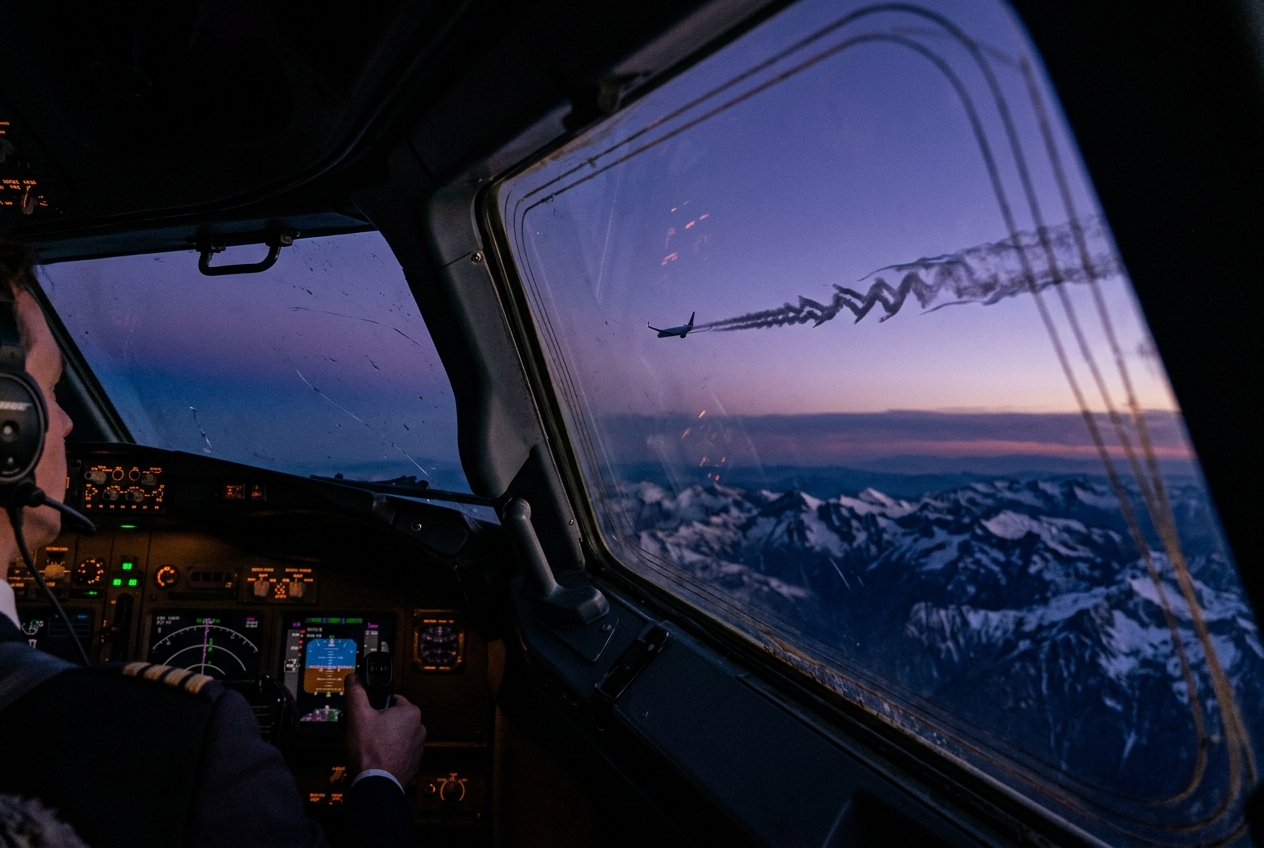
Directly beneath that pristine sky, an airliner cruising at Mach 0.82 encounters this frictionless interface. Within a fraction of a second, the aircraft’s wings transition from smooth, laminar airflow into a chaotic maelstrom of violent vertical accelerations. Coffee cups become airborne projectiles, structural airframes groan under sudden multi-g loading, and the aircraft drops tens of meters in a heartbeat. There was no storm on the radar, no towering cumulonimbus, and no cloud to warn the flight crew. The aircraft has plunged into the violent, invisible cataract of Clear-Air Turbulence (CAT)—a kinetic seizure born of fluid mechanics operating in total transparency.
2. What's Actually Happening: The Fluid Physics of the Invisible Ocean
To comprehend how violent turbulence erupts within an ostensibly empty sky, one must abandon the intuitive notion of air as an empty void and visualize the atmosphere as a vast, stratified, multi-layered ocean of gas.
Think of the atmosphere as a monumental layered cake, where each horizontal tier possesses a distinct density and temperature. Under standard conditions, gravity enforces strict order: cold, dense air settles near the bottom, while warm, buoyant air rests comfortably above. This gravitational layering is known as buoyant static stability. If you take a parcel of air in a stable atmosphere and nudge it downward, it finds itself surrounded by denser air and bobs right back up, much like a submerged cork popping to the surface of a pond. Conversely, if you push it upward into less dense surroundings, it becomes heavier than its neighbors and sinks back down. Gravity acts as an invisible spring, dampening vertical disturbances and preserving smooth, laminar stratification.
+-----------------------------------------------------------------------+
|                THE STRATIFIED FLUID PARADOX                           |
|                                                                       |
|  Restoring Buoyancy (Gravity & Density Stratification)                |
|  vs.                                                                  |
|  Disruptive Kinematics (Vertical Wind Shear & Kinetic Energy)         |
+-----------------------------------------------------------------------+
However, the atmosphere is never truly at rest. Driven by planetary temperature contrasts between the equator and the poles, narrow ribbons of high-velocity wind—known as jet streams—surge through the upper troposphere at speeds exceeding two hundred knots. These jet streams do not move uniformly. A jet stream possesses an intense core of maximum velocity, flanked above, below, and at its margins by significantly slower air masses.
This spatial differential creates vertical wind shear—a steep change in horizontal wind speed or direction with increasing altitude. Imagine placing a deck of playing cards on a table and dragging your palm across the top card. The top cards slide rapidly, while the lower cards remain stationary, forcing the intermediate cards to tilt, slide, and rotate against one another.
When vertical wind shear becomes excessively fierce across a thin vertical boundary, it engages in an existential tug-of-war with static stability: 1. The Stabilizing Force: Buoyant stratification works tirelessly to keep the layers flat, separate, and organized. 2. The Destabilizing Force: The kinetic energy of the sheared wind attempts to roll the interface over, tripping the fluid into vortices.
When wind shear overpowers buoyant stability, the boundary between the two air streams begins to undulate like wind blowing over the open ocean. These growing interfacial ripples are known as Kelvin-Helmholtz waves. As the velocity differential drags the wave crests forward faster than the troughs can follow, the waves curl, amplify non-linearly, and eventually break like surf crashing upon a shallow reef.
When these massive atmospheric billows shatter, their organized kinetic energy instantaneously collapses into a chaotic cascade of three-dimensional eddies spanning hundreds of meters down to millimeters. To an aircraft traversing this boundary, the result is instantaneous, severe clear-air turbulence.
3. The Science: Stratification, Kinematics, and the Richardson Number
To rigorously quantify the exact tipping point where an orderly, stratified atmosphere surrenders to turbulent chaos, dynamic meteorologists rely on the interplay of thermodynamic stability and kinematic shear.
Equation 1: The Brunt-Väisälä Frequency ($N$)
Before analyzing shear, we must measure the intrinsic "springiness" or buoyant static stability of the atmospheric column. This is quantified by the Brunt-Väisälä frequency ($N$), which represents the fundamental oscillation frequency of an air parcel displaced adiabatically within a stably stratified fluid layer.
In dry atmospheric dynamics, the square of the Brunt-Väisälä frequency ($N^2$) is expressed as:
$$N^2 = \frac{g}{\theta} \frac{\partial \theta}{\partial z}$$
Where: * $g$ is the acceleration due to gravity ($9.80665 \text{ m s}^{-2}$). * $\theta$ is the potential temperature of the air parcel (the temperature an air parcel would attain if brought adiabatically to a standard reference pressure of $1000 \text{ hPa}$, measured in Kelvin, $\text{K}$). * $\frac{\partial \theta}{\partial z}$ is the vertical gradient of potential temperature with height $z$ ($\text{K m}^{-1}$).
Physical Interpretation:
- When $\frac{\partial \theta}{\partial z} > 0$, potential temperature increases with height. Consequently, $N^2 > 0$, $N$ is a real number, and the atmosphere is statically stable. Displaced parcels oscillate harmonically with frequency $N$.
- When $\frac{\partial \theta}{\partial z} = 0$, $N^2 = 0$, representing a dry neutral atmosphere where displaced parcels experience no restoring force.
- When $\frac{\partial \theta}{\partial z} < 0$, $N^2 < 0$, yielding an imaginary frequency that signals absolute static instability (convective overturning).
Worked Example: Upper Troposphere Stability
Consider an upper-tropospheric layer near the cruising altitude of commercial aircraft ($34,000 \text{ ft}$ or $\approx 10,360 \text{ m}$), beneath the tropopause. Radiosonde sounding data reveals: * Mean layer potential temperature: $\theta = 330 \text{ K}$ * Potential temperature at base ($z_1 = 10,000 \text{ m}$): $\theta_1 = 328 \text{ K}$ * Potential temperature at top ($z_2 = 11,000 \text{ m}$): $\theta_2 = 332 \text{ K}$
Calculate the vertical gradient: $$\frac{\partial \theta}{\partial z} = \frac{332 \text{ K} - 328 \text{ K}}{11,000 \text{ m} - 10,000 \text{ m}} = \frac{4 \text{ K}}{1,000 \text{ m}} = 0.004 \text{ K m}^{-1}$$
Substituting into the Brunt-Väisälä formulation: $$N^2 = \frac{9.81 \text{ m s}^{-2}}{330 \text{ K}} \times 0.004 \text{ K m}^{-1} = 2.973 \times 10^{-2} \times 0.004 \approx 1.189 \times 10^{-4} \text{ s}^{-2}$$
Extracting the natural buoyant frequency: $$N = \sqrt{1.189 \times 10^{-4} \text{ s}^{-2}} \approx 0.0109 \text{ rad s}^{-1}$$
The period of oscillation $\tau$ for a displaced air parcel is: $$\tau = \frac{2\pi}{N} = \frac{2 \times 3.14159}{0.0109 \text{ s}^{-1}} \approx 576 \text{ seconds} \approx 9.6 \text{ minutes}$$
An air parcel bumped out of equilibrium will serenely bob up and down with a nearly ten-minute period, preserved by robust static stability.
Equation 2: The Gradient Richardson Number ($Ri$) and the Miles-Howard Criterion
While $N^2$ quantifies the buoyant force suppressing vertical motion, kinematic wind shear provides the kinetic energy necessary to destabilize the flow. The vertical kinematic shear squared, denoted as $S^2$, is computed from the orthogonal horizontal wind components ($u$ for zonal/east-west, $v$ for meridional/north-south):
$$S^2 = \left( \frac{\partial u}{\partial z} \right)^2 + \left( \frac{\partial v}{\partial z} \right)^2 = \left| \frac{\partial \mathbf{V}_h}{\partial z} \right|^2$$
The non-dimensional ratio of these competing physical mechanisms is the Gradient Richardson Number ($Ri$), formulated as:
$$Ri = \frac{N^2}{S^2} = \frac{\frac{g}{\theta} \frac{\partial \theta}{\partial z}}{\left( \frac{\partial u}{\partial z} \right)^2 + \left( \frac{\partial v}{\partial z} \right)^2}$$
In 1961, mathematicians John W. Miles and Louis N. Howard published a foundational hydrodynamic proof known as the Miles-Howard Theorem. Their rigorous linear stability analysis of inviscid, stably stratified parallel shear flows established a universal mathematical law:
$$\mathbf{Ri > 0.25 \implies \text{Flow is dynamically stable against small perturbations}}$$ $$\mathbf{Ri \le 0.25 \implies \text{Necessary condition for dynamic shear instability and wave breaking}}$$
When $Ri$ drops below the critical threshold of $0.25$ ($1/4$), the kinetic energy extractable from the sheared mean flow exceeds the work required to lift denser fluid over lighter fluid. Perturbations spontaneously extract energy from the background shear, culminating in non-linear growth and turbulent kinetic energy (TKE) dissipation.
Worked Example: Critical Shear Breakdown
Using the static stability calculated previously ($N^2 = 1.189 \times 10^{-4} \text{ s}^{-2}$), let us compute the exact vertical wind shear required to trigger dynamic shear instability ($Ri \le 0.25$).
Setting $Ri = 0.25$: $$0.25 = \frac{N^2}{S^2} \implies S^2 = \frac{N^2}{0.25} = 4 N^2$$ $$S = \sqrt{4 \times (1.189 \times 10^{-4} \text{ s}^{-2})} = \sqrt{4.756 \times 10^{-4} \text{ s}^{-2}} \approx 0.0218 \text{ s}^{-1}$$
To convert this shear value into operational aviation units: $$S = 0.0218 \text{ s}^{-1} = 21.8 \text{ m s}^{-1} \text{ per } 1,000 \text{ meters of vertical ascent}$$
Converting to knots per thousand feet: * $21.8 \text{ m s}^{-1} \approx 42.4 \text{ knots}$ * $1,000 \text{ meters} \approx 3,280.84 \text{ feet}$ $$\text{Vertical Shear} = \frac{42.4 \text{ kt}}{3.28084 \text{ kft}} \approx 12.9 \text{ knots per 1,000 feet}$$
If a jet stream core introduces a vertical speed difference of merely $13 \text{ knots}$ over a vertical depth of $1,000 \text{ feet}$ (or $\approx 39 \text{ knots}$ over a typical $3,000 \text{ ft}$ flight level change), the Richardson number collapses below $0.25$. Laminar flow terminates abruptly, and severe Kelvin-Helmholtz wave breaking ensues.
Synoptic and Mesoscale CAT Genesis Mechanisms
Clear-air turbulence does not occur randomly; it is organized by specific large-scale and mesoscale dynamics:
-
Upper-Level Jet Streaks and Ageostrophic Circulations: Within localized wind speed maxima along the jet axis (jet streaks), air parcels accelerate into the streak entrance region and decelerate in the exit region. This creates strong ageostrophic transverse circulations. In the cyclonic-shear side of the jet core, vertical shear is amplified while horizontal deformation stretches the flow, driving local $Ri$ values down to critical levels.
-
Dynamic Tropopause Folds: During intense cyclogenesis, an intrusion of dry stratospheric air with high potential vorticity plunges downward into the troposphere, forming a tropopause fold. The intense thermal gradient across this fold produces an extremely sharp vertical wind shear zone via the thermal wind relation: $$\frac{\partial \mathbf{V}_g}{\partial \ln p} = -\frac{R_d}{f} \left( \mathbf{k} \times \nabla_p T \right)$$ This localized baroclinic zone collapses the local Richardson number, generating widespread severe CAT along the boundary.
-
Mountain Wave Breaking and Resonant Trapping: When strong winds blow perpendicular to an elongated mountain range within a stably stratified atmosphere, vertically propagating gravity waves are excited. As these waves ascend into lower-density air aloft, their amplitude grows exponentially to conserve kinetic energy flux. If the wave encounters a critical layer (where the horizontal phase speed of the wave equals the ambient background wind speed, or where $Ri < 0.25$), the wave breaks violently, producing severe rotor turbulence in the middle and upper troposphere.
-
Operational Forecasting Metrics: The Ellrod-Knapp Index: Operational meteorologists at agencies such as the NOAA Aviation Weather Center and the Met Office utilize automated diagnostic indices to predict CAT. The widely adopted Ellrod-Knapp Turbulence Index ($TI$) couples vertical wind shear with horizontal deformation and convergence: $$TI = \text{VWS} \times \left( \text{DEF} + \text{CVG} \right)$$ Where: * $\text{VWS} = \left| \frac{\partial \mathbf{V}}{\partial z} \right|$ (Vertical Wind Shear) * $\text{DEF} = \sqrt{\left(\frac{\partial u}{\partial x} - \frac{\partial v}{\partial y}\right)^2 + \left(\frac{\partial v}{\partial x} + \frac{\partial u}{\partial y}\right)^2}$ (Total Deformation: stretching + shearing) * $\text{CVG} = -\left(\frac{\partial u}{\partial x} + \frac{\partial v}{\partial y}\right)$ (Horizontal Convergence)
These numerical model forecasts are continually validated in real time against Pilot Weather Reports (PIREPs) and automated aircraft Eddy Dissipation Rate (EDR) telemetry according to World Meteorological Organization reporting standards.
4. Practical Outdoor Guidance: Reading the Unseen Waves from Ground and Cockpit
While clear-air turbulence is invisible to conventional weather radar, the observant outdoor practitioner, mountaineer, sailor, or aviator can detect its distinct kinematic footprints.
Visual Sky Signatures
- Transverse Banding in Cirrus (Herringbone Sky): Look for thin cirrus streaks oriented perpendicular to the main cirrus track. When a jet stream core is undergoing severe horizontal deformation and shear, it organizes high-altitude ice crystals into transverse bands resembling the ribs of a fish skeleton. This visual pattern is a definitive indicator of an active CAT field.
- Kelvin-Helmholtz Billow Clouds (Fluctus): Frequently forming along the tops of altocumulus or thin stratocumulus decks, these ephemeral clouds display textbook wave-breaking crests. They provide a direct, visible confirmation that the atmospheric layer has crossed the $Ri < 0.25$ threshold.
- Standing Lenticular Clouds (Altocumulus Standing Lenticularis - ACSL): When observing mountains, smooth, stationary, almond-shaped clouds hovering downwind of a ridge indicate powerful mountain gravity waves. If the trailing downwind edge of the lenticular cloud appears frayed, turbulent, or ragged, the mountain wave is breaking aloft, generating severe clear-air turbulence downstream.
Instrumental Observations
- Barometric Oscillations: While macro-scale synoptic fronts produce smooth pressure tendencies over hours, an active gravity-wave regime causes high-precision digital barometers to oscillate erratically by $0.1 \text{ to } 0.5 \text{ hPa}$ over periods of several minutes. These micro-pressure surges signal trapped lee waves and shear instability aloft.
- Stellar Scintillation at Zenith: On a pristine, cloudless night, observe the stars directly overhead (zenith). Under quiet laminar flow, zenith stars shine with a steady, tranquil luminescence. If zenith stars twinkle rapidly (high-frequency scintillation), turbulent eddies with varying refractive indices are actively shearing across the upper troposphere.
5. Today's Meteorological Rule of Thumb
The Clear-Air Richardson Axiom:
"When looking up at a cloud-free sky, remember that tranquility is an optical illusion: whenever vertical wind shear across a layer exceeds twelve knots per thousand feet, buoyant stability shatters, the Richardson number collapses below one-quarter, and the invisible sky breaks into violent oceanic surf."
Authoritative References & Further Reading
- Explore real-time turbulence forecasts and PIREPs at the NOAA Aviation Weather Center.
- Learn hydrodynamic wave theory and stability criteria via Wikipedia: Richardson Number.
- Review commercial aviation hazard mitigation protocols on Skybrary: Clear Air Turbulence.
- Study international meteorological observation standards through the World Meteorological Organization.
- Understand operational jet stream dynamics with the UK Met Office.