Transient Luminous Events & Red Sprite Dynamics: How Massive Positive Discharges and Mesospheric Dielectric Breakdown Ignite High-Altitude Glows
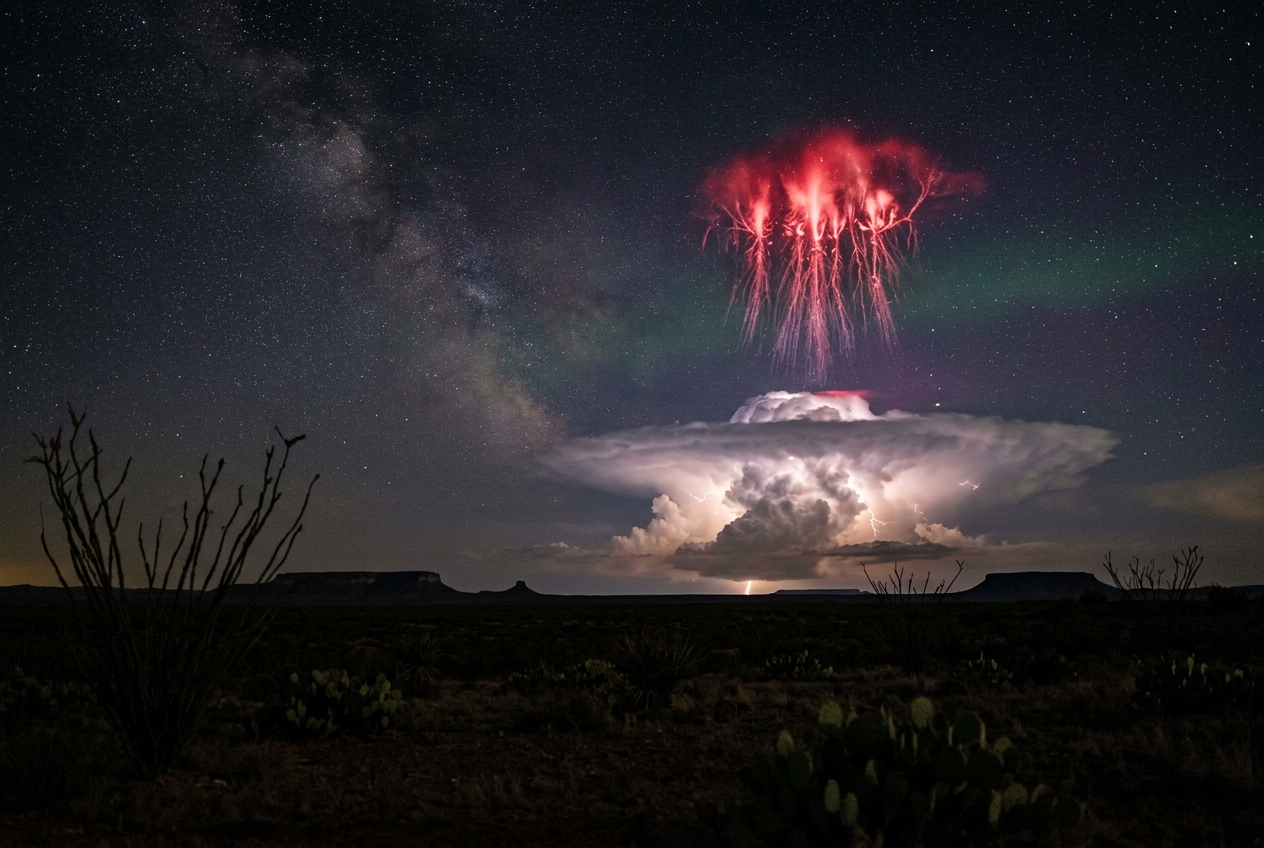
Two hundred kilometres south of a nocturnal convective storm system, the night air sits cool, fragrant, and undisturbed. Out on the open prairie, the ground retains the gentle thermal residue of late summer, releasing the dry, herbaceous perfume of sun-baked grasses into a crystalline atmosphere. Above, the celestial vault is absolute in its clarity: the Milky Way unspools its pale ribbon of stellar dust from horizon to zenith, sharp and untroubled by turbulence. Yet to the distant north, the skyline tells a radically different story.
Low across the northern rim of the world, towering anvil clouds of an expansive Mesoscale Convective System (MCS) breach the troposphere, rising like dark, silhouetted mountains against the starry backdrop. Every few seconds, the interior of these colossal clouds illuminates with a muted, diffuse glow—sheet lightning flickering harmlessly across thousands of square kilometres of anvil. The physical distance renders the thunder completely inaudible; the observer stands in total, cathedral silence, feeling only a gentle, descending catabatic breeze kissing the back of the neck as ambient barometric pressure stabilizes.
Then, in a fraction of a heartbeat—lasting less than the blink of an eye—the space above the storm erupts.
Directly above the seemingly calm cloud tops, stretching into the pristine, starry blackness of the mesosphere fifty miles high, a colossal structure of luminous crimson light flashes into existence. It takes the shape of an immense, incandescent jellyfish: a glowing central bell crowned with delicate halos, trailing dozens of intricate, tendril-like filaments that plunge thirty miles downward toward the stratosphere. Before the human visual cortex can fully process the geometry, the apparition dissolves back into the dark void.
This is a red sprite: a high-altitude electrical discharge that represents one of the most spectacular, complex, and elusive manifestations of atmospheric electrodynamics on Earth.
       Altitude (km)
          100  +---------------------------------------+  Lower Ionosphere (D-Region)
               |             . - ~ - .                 |  Elve / Halo Zone
           80  |          .-'  BELL   '-.              |
               |         (   RED SPRITE  )             |  Crimson Emission
           60  |          \  / | | \  /                |  (N2 1st Positive: 650-780nm)
               |           ||  | |  ||  Tendrils       |
           40  |           ||  | |  ||                 |  Blue Transition Tips
               |           '   | |   '                 |  Stratosphere
           20  |         ............. Anvil Top       |  Tropopause
               |       (  + + + + + +  ) Stratiform    |  Troposphere
            0  +======[=== Cloud-to-Ground ===]========+  Earth Ground
What Is Actually Happening: The Giant Planetary Capacitor
To make sense of this fleeting phantom, we must step back from the upper atmosphere and imagine the entire planetary system as a layered electrical circuit.
Think of the Earth and the upper atmosphere as two conducting plates in an enormous, planet-sized capacitor. The ground beneath our feet is an electrical conductor, constantly accumulating negative charge. Sixty miles above our heads lies the ionosphere—a layer of the atmosphere so thoroughly bombarded by solar ultraviolet and X-ray radiation that free electrons wander freely, turning the thin air into a conductive, electrified ceiling. Between these two giant conductors lies fifty miles of dense, insulating air: the troposphere, stratosphere, and mesosphere.
Under fair-weather conditions, the global electrical circuit maintains a quiet, steady downward electric field of around 100 to 130 volts per metre near the ground. But when a giant thunderstorm forms, it acts like a massive mechanical generator. Deep within the storm's convective core, millions of colliding ice crystals, soft hail pellets (graupel), and supercooled water droplets rip electrons away from one another. Lighter ice crystals carry positive charge upward into the expansive anvil cloud, while heavier graupel carries negative charge toward the middle and lower sections of the storm.
In a typical storm, cloud-to-ground lightning discharges negative charge from the cloud base to the earth. But in massive, mature storm complexes—particularly the sprawling stratiform regions of mesoscale convective systems that can span entire states—a vast reservoir of positive charge accumulates across thousands of square miles of cloud top.
When an exceptionally powerful positive cloud-to-ground stroke (+CG) violently dumps dozens to hundreds of coulombs of positive charge straight into the ground, the electrical balance between the cloud and the ionosphere is catastrophically upended.
Imagine stretching an enormous elastic sheet between the cloud top and the ionosphere, holding it tightly in equilibrium. The sudden lightning bolt instantly cuts the bottom anchor of that tension. An immense electrostatic shockwave—a Quasi-Electrostatic (QE) field—is suddenly unmasked above the storm, projecting upward into the upper atmosphere. In the thin, near-vacuum air of the mesosphere, this field exceeds the air's ability to resist electrical breakdown. The atmosphere yields, and the thin gases light up like the glowing tube of a neon sign spanning thirty vertical miles.
The Science of Upper-Atmospheric Electrodynamics
To understand why red sprites ignite precisely between 50 and 85 kilometres in altitude—and why ordinary lightning cannot trigger them—we must examine the quantitative relationship between charge displacement, atmospheric density, and dielectric breakdown.
1. The Quasi-Electrostatic (QE) Field and Charge Moment Change
When a positive cloud-to-ground lightning stroke occurs, it neutralizes charge $Q$ previously situated at an effective altitude $z_q$ within the cloud's stratiform reservoir. According to electrostatic image theory, this rapid removal of charge is mathematically equivalent to introducing a dipole of opposite polarity at the moment of discharge.
The physical parameter governing the magnitude of the resulting electric field in the mesosphere is not the peak current of the lightning bolt alone, but rather the Charge Moment Change ($\Delta M_q$), defined as the product of the neutralized charge and its source altitude:
$$\Delta M_q = Q \cdot z_q$$
In plain English: a modest amount of electrical charge drained from very high in the cloud produces the exact same electric field in the upper atmosphere as an immense amount of charge drained from near the ground.
      +CG Discharge Geometry & Charge Moment

      Altitude
         z
         ^            IONOSPHERE (Conducting Layer)
         |     -------------------------------------------
         |
         |         E_meso (Intense Upward Quasi-Electrostatic Field)
         |                      |||
         |
      z_q|-------(+) Stratiform Positive Charge Reservoir (+Q)
         |        |
         |        |  +CG Stroke (Dumps +Q to Ground)
         |        v
       0 +------------------------------------------------- EARTH (Ground)
Worked Example: Calculating the Charge Moment Change Threshold
Decades of field research published by the American Meteorological Society and the National Oceanic and Atmospheric Administration (NOAA) confirm that initiating dielectric breakdown in the nighttime mesosphere requires a critical Charge Moment Change ($\Delta M_{q,\text{crit}}$) of approximately 600 to 1,000 $\text{C}\cdot\text{km}$.
Let us test two realistic thunderstorm scenarios:
-
Case A (Standard Convective Stroke): A typical negative stroke drains $Q = 20\text{ Coulombs}$ from a localized convective pocket at an altitude of $z_q = 5\text{ km}$. $$\Delta M_q = 20\text{ C} \times 5\text{ km} = 100\text{ C}\cdot\text{km}$$ Result: $\Delta M_q \ll 600\text{ C}\cdot\text{km}$. The induced electric field in the mesosphere is far too weak to overcome the dielectric resistance of air. No sprite forms.
-
Case B (Mesoscale Stratiform Positive Stroke): An energetic positive stroke taps into a broad stratiform anvil reservoir, draining $Q = 120\text{ Coulombs}$ from an altitude of $z_q = 8\text{ km}$. $$\Delta M_q = 120\text{ C} \times 8\text{ km} = 960\text{ C}\cdot\text{km}$$ Result: $\Delta M_q > \Delta M_{q,\text{crit}}$. The electrostatic field projected into the mesosphere exceeds the local dielectric breakdown threshold, igniting an avalanche of relativistic electrons and producing a magnificent red sprite.
2. Atmospheric Dielectric Breakdown Scaling
Why do sprites ignite at an altitude of 75 kilometres rather than at 20 or 40 kilometres? The answer lies in the fundamental dependence of the dielectric breakdown threshold on ambient air density.
At sea level, air is a formidable insulator. Initiating a spark requires an electric field ($E_{k0}$) of roughly $3.2 \times 10^6\text{ Volts per metre}$ ($32\text{ kV/cm}$). However, as one ascends through the atmosphere, the molecular density of air drops exponentially following the barometric law:
$$\rho(z) = \rho_0 \exp\left(-\frac{z}{H}\right)$$
where $\rho_0$ is sea-level air density, $z$ is altitude, and $H \approx 7.2\text{ km}$ represents the atmospheric scale height.
The critical electric field required to initiate ionization breakdown ($E_k(z)$) scales directly with local air density $\rho(z)$, because free electrons accelerate over longer mean free paths between collisions in thinner air:
$$E_k(z) = E_{k0} \left(\frac{\rho(z)}{\rho_0}\right) = E_{k0} \exp\left(-\frac{z}{H}\right)$$
In plain English: as the air thins out with height, the electric field needed to tear electrons from nitrogen molecules drops by orders of magnitude.
Worked Example: Dielectric Breakdown at 75 km Altitude
Let us calculate the critical breakdown field at the core altitude of a red sprite ($z = 75\text{ km}$):
- Compute the density ratio: $$\frac{\rho(75\text{ km})}{\rho_0} = \exp\left(-\frac{75}{7.2}\right) = \exp(-10.417) \approx 3.0 \times 10^{-5}$$
- Calculate the local breakdown threshold $E_k(75\text{ km})$: $$E_k(75\text{ km}) = (3.2 \times 10^6\text{ V/m}) \times (3.0 \times 10^{-5}) \approx 96\text{ V/m}$$
3. The Relaxation Timescale Race
A critical temporal dynamic determines whether a sprite can successfully materialize before the atmosphere dissipates the accumulated charge.
Every layer of the atmosphere possesses a characteristic dielectric relaxation timescale ($\tau_\sigma$), which defines how quickly free atmospheric ions rearrange to cancel out an imposed electric field:
$$\tau_\sigma(z) = \frac{\varepsilon_0}{\sigma(z)}$$
where $\varepsilon_0 = 8.854 \times 10^{-12}\text{ F/m}$ is the vacuum permittivity, and $\sigma(z)$ is the electrical conductivity of air at altitude $z$.
- In the lower stratosphere ($z < 30\text{ km}$): Atmospheric conductivity is exceedingly low, meaning $\tau_\sigma$ is on the order of minutes to hours. However, the air is too dense for the electric field to reach breakdown ($E < E_k$).
- In the ionosphere ($z > 90\text{ km}$): Free electron density is high, making conductivity large. The relaxation timescale $\tau_\sigma$ is less than a microsecond ($< 1\ \mu\text{s}$). The electric field is neutralized almost instantaneously by ionospheric currents before extensive breakdown streamers can develop.
- In the mesosphere ($z \approx 50 - 85\text{ km}$): The relaxation timescale is between 1 and 100 milliseconds—perfectly matching the duration of lightning charge removal from the cloud ($t_{\text{discharge}} \approx 2 - 10\text{ ms}$).
Because the electric field persists longer than the time required to build electron avalanches, double-ended plasma streamers ignite and propagate, generating the intricate structure of the sprite.
       Altitude vs. Characteristic Timescales

       Altitude (km)
          100 |  tau_sigma < 1 microsecond  (Conductive: Field shielded instantly)
           80 |  tau_sigma ~ 1 - 10 ms       <--- SPRITE BREAKDOWN ZONE
           60 |  tau_sigma ~ 0.1 - 1 s       (Field exceeds breakdown, slow relaxation)
           40 |  tau_sigma ~ minutes        (Field cannot reach high breakdown threshold)
           20 |  tau_sigma ~ hours          (Extremely insulating, high breakdown threshold)
4. Molecular Spectroscopy: Why Sprites Glow Crimson and Blue
The distinctive colors of red sprites are a direct fingerprint of quantum transitions within molecular nitrogen ($N_2$), which comprises roughly 78% of the mesosphere.
                    N2 Molecular Energy Transitions in TLEs

      State Energy
          ^
          |      [ N2+ Ionized State (B 2Sigma_u+) ]
          |                 |
          |                 |  First Negative System (Violet / Blue: 391.4 nm, 427.8 nm)
          |                 v  High Electric Fields (Streamer Tips)
          |      [ N2+ Ground State (X 2Sigma_g+) ]
          |
          |      [ N2 Neutral Excited State (B 3Pi_g) ]
          |                 |
          |                 |  First Positive System (Crimson Red: 650 - 780 nm)
          |                 v  Moderate Fields (Sprite Bell & Columns)
          |      [ N2 Metastable State (A 3Sigma_u+) ]
          |
       0  +---------------------------------------------------
When high-energy electrons accelerated by the QE field collide with neutral nitrogen molecules, they kick the molecules into higher electronic energy states:
-
The Crimson Body and Head ($N_2$ First Positive System): In the main body and upper columns (55–80 km), ambient electric fields excite neutral molecular nitrogen into the triplet state: $$e^- + N_2(X\ ^1\Sigma_g^+) \to N_2(B\ ^3\Pi_g) + e^-$$ As these excited molecules relax back down to the lower metastable state ($A\ ^3\Sigma_u^+$), they emit photons predominantly in the red and near-infrared spectrum between 650 nm and 780 nm: $$N_2(B\ ^3\Pi_g) \to N_2(A\ ^3\Sigma_u^+) + h\nu\quad (\text{Red Light})$$ At altitudes above 60 km, atmospheric density is sufficiently low that these excited states can radiate photons before colliding with other molecules (a process known as collisional quenching). This gives sprites their signature ruby-red radiance.
-
The Blue Tendril Tips ($N_2^+$ First Negative System): At the downward-propagating tips of sprite streamers (40–55 km), electric fields become highly concentrated at the sharp plasma points, exceeding several times the breakdown value ($E \gg E_k$). These intense fields possess enough energy to ionize nitrogen molecules completely, exciting them into the ionized state $N_2^+(B\ ^2\Sigma_u^+)$. When these ions relax to their ground state ($X\ ^2\Sigma_g^+$), they emit violet-blue light at 391.4 nm and 427.8 nm: $$N_2^+(B\ ^2\Sigma_u^+) \to N_2^+(X\ ^2\Sigma_g^+) + h\nu\quad (\text{Blue Light})$$ Because dense air at lower altitudes rapidly quenches these emissions, the blue glow is confined almost exclusively to the fast-moving streamer tips as they reach toward the stratosphere.
The Upper-Atmospheric Bestiary: A Taxonomy of TLEs
Red sprites are part of a broader family of high-altitude optical phenomena known collectively as Transient Luminous Events (TLEs), first verified scientifically in 1989 by researchers at the University of Minnesota and documented extensively by NASA and the World Meteorological Organization (WMO).
                 Upper-Atmospheric Lightning Family

     100 km +-------------------------------------------------------+
            |  (================== ELVE ==================)         |  90-100 km (EMP Ring)
            |                 .- ~ ~ -.  Sprite Halo                |  75-85 km
      80 km |                (  SPRITE )                            |  50-85 km (QE Breakdown)
            |                 / | | | \                             |
      60 km |                |  | | |  |                            |
            |                '  | | |  '   /| GIGANTIC              |
      40 km |                   | | |     / | JET                   |  20-80 km (Direct Upward
            |                             | |                       |            Discharge)
      20 km |     [ ANVIL CLOUD ]         | |                       |  Tropopause
            +====(=== + + + + ===)========[+]=======================+
                   TROPOSPHERE           Thunderstorm Core
| Phenomenon | Altitude Range | Primary Physical Driver | Optical Signature & Duration |
|---|---|---|---|
| Red Sprite | 50 – 85 km | Quasi-Electrostatic (QE) field following large $+CG$ charge removal ($\Delta M_q > 600\text{ C}\cdot\text{km}$). | Intricate red columnar/tendril structure; duration 5 – 50 ms. |
| Elve | 90 – 100 km | Electromagnetic Pulse (EMP) from rapid current rise ($dI/dt$) in lightning channel heating the lower ionosphere. | Expanding doughnut/ring of light up to 300 km wide; duration $< 1\text{ ms}$. |
| Sprite Halo | 75 – 85 km | Initial diffuse breakdown by QE field before streamer instability forms filaments. | Faint, amorphous red saucer or pancake preceding a sprite; duration 1 – 3 ms. |
| Gigantic Jet | 15 – 90 km | Direct upward leader discharge establishing a conductive plasma channel from thundercloud tops to the ionosphere. | Tree-like blue-and-red jet connecting troposphere directly to mesosphere; duration 100 – 500 ms. |
Practical Observational Mathematics and Field Geometry
To successfully witness and photograph a red sprite, an observer must leverage precise geometric calculations. Because sprites occur dozens of miles above thunderstorms, observing them requires looking over the top of a storm from a substantial distance, rather than looking directly into the tempest.
       Observational Sightline Geometry

       Sprite Top (80 km)
             *
             | \
             |   \  Line of Sight (Angle theta)
             |     \
       Storm (15 km)| \
             [Anvil]   \
             |          \
             |           \
       ======+=============o Observer (Distance d = 200 km)
             EARTH CURVATURE
1. Line-of-Sight Elevation Calculation
The angular elevation ($\theta$) at which a sprite appears above the horizontal horizon depends on the distance to the storm ($d$), the sprite's target altitude ($z_s$), and Earth's radius ($R_E \approx 6,371\text{ km}$):
$$\theta \approx \arctan\left(\frac{z_s - \frac{d^2}{2 R_E}}{d}\right)$$
In plain English: Earth's curvature lowers the apparent position of the sprite in your sky, so you must aim your lens just a few degrees above the distant storm's silhouetted cloud top.
Worked Example: Aiming an Optical System
An observer stands $d = 250\text{ km}$ away from an active mesoscale convective system. The sprite's primary emission centroid is located at $z_s = 70\text{ km}$.
- Compute the Earth curvature drop: $$\Delta z_{\text{drop}} = \frac{d^2}{2 R_E} = \frac{(250)^2}{2 \times 6,371} = \frac{62,500}{12,742} \approx 4.90\text{ km}$$
- Calculate effective apparent altitude: $$z_{\text{eff}} = 70\text{ km} - 4.90\text{ km} = 65.10\text{ km}$$
- Compute the angular elevation ($\theta$): $$\theta = \arctan\left(\frac{65.10}{250}\right) = \arctan(0.2604) \approx 14.6^\circ$$
Practical Outdoor Guidance: The Art of Sprite Chasing
Witnessing or recording a transient luminous event from the field is one of the most rewarding pursuits in observational meteorology.
+------------------------------------------------------------------------------------+
|                         SPRITE OBSERVATION FIELD PROTOCOL                          |
+------------------------------------------------------------------------------------+
| OPTIMAL DISTANCE  | 150 to 300 km from the active convective core.                 |
| SKY CONDITIONS    | Pristine, cloud-free local horizon pointing toward storm.      |
| RADAR SIGNATURE   | Mature MCS with large trailing stratiform precipitation zone.  |
| LIGHTNING PROFILE | Frequent +CG discharges with peak currents > +50 kA.           |
| CAMERA SETTINGS   | Lens: 24-50mm f/1.2 to f/1.8 | ISO: 3200-12800 | Exp: 1-2 sec. |
+------------------------------------------------------------------------------------+
1. Identifying the Ideal Storm System
Not every thunderstorm produces sprites. Pulse summer airmass storms and small supercells rarely generate the sprawling charge reservoirs necessary for high Charge Moment Changes.
- Look for Mature Mesoscale Convective Systems (MCS): Consult real-time radar composites from services like the National Weather Service or Met Office. Target large squall lines or convective complexes that have transitioned into their mature, decaying phase, characterized by an extensive "trailing stratiform" precipitation region behind the leading convective line.
- Monitor Lightning Network Data: Red sprites are overwhelmingly driven by positive cloud-to-ground (
+CG) lightning strikes. Access live lightning detection feeds (such as the GOES Geostationary Lightning Mapper or ground-based networks) and monitor for high-current positive strokes ($I_{\text{peak}} > +50\text{ kA}$).
2. Positioning and Environmental Cues
- Establish Baseline Geometry: Set up your observing post between 150 km and 300 km from the stratiform anvil shield. If you are closer than 100 km, the towering cumulonimbus anvil will obstruct your line of sight to the mesosphere. If you are farther than 400 km, atmospheric extinction and Earth's curvature will drop the sprite below the horizon.
- Ensure Local Sky Clarity: Your local sky must be exceptionally dark and cloud-free in the direction of the storm. Low haze, stratocumulus, or local light pollution will completely wash out the faint, millisecond-scale emissions of the sprite.
- Barometer and Wind Signals: Your local barometer should be steady or slowly rising under stable surface air, ensuring your local column remains free of condensation, while your line of sight peers into the low-pressure instability hundreds of miles away.
3. Photographic Capture Strategy
Human eyes are poorly adapted to register red wavelengths at millisecond durations due to the scotopic shift (the Purkinje effect) of night-adapted vision. A modern digital camera sensor, however, is extraordinarily sensitive to the 650–780 nm emission band:
- Lens Selection: Use a fast prime lens (24mm, 35mm, or 50mm) with an aperture of $f/1.2$, $f/1.4$, or $f/1.8$.
- Exposure Parameters: Set your camera to high sensitivity (ISO 3200 to 12800) and use short continuous exposures between 1.0 and 2.0 seconds. Longer exposures increase the risk of background noise and skyglow washing out the faint, fleeting flash of the sprite.
- Continuous Interval Shooting: Run an automated intervalometer on continuous loop. Because sprites last less than 50 milliseconds, catching them relies on continuous shutter coverage during active stratiform $+CG$ barrage periods.
Today's Meteorological Rule of Thumb
The Red Sprite Principle: Whenever a sprawling, mature thunderstorm system displays widespread stratiform anvil lightning more than 150 kilometres away, do not gaze into the storm core—train your eyes into the clear, dark sky 10 to 20 degrees above the anvil top. Where massive positive lightning drains the cloud below, the thin air of the mesosphere will yield to the unseen voltage of the planet, igniting the crimson fires of the upper atmosphere.