Polar Stratospheric Clouds & Nacreous Cloud Dynamics: How Extreme Winter Supercooling and Nitric Acid Hydrates Forge Iridescent High-Altitude Veils
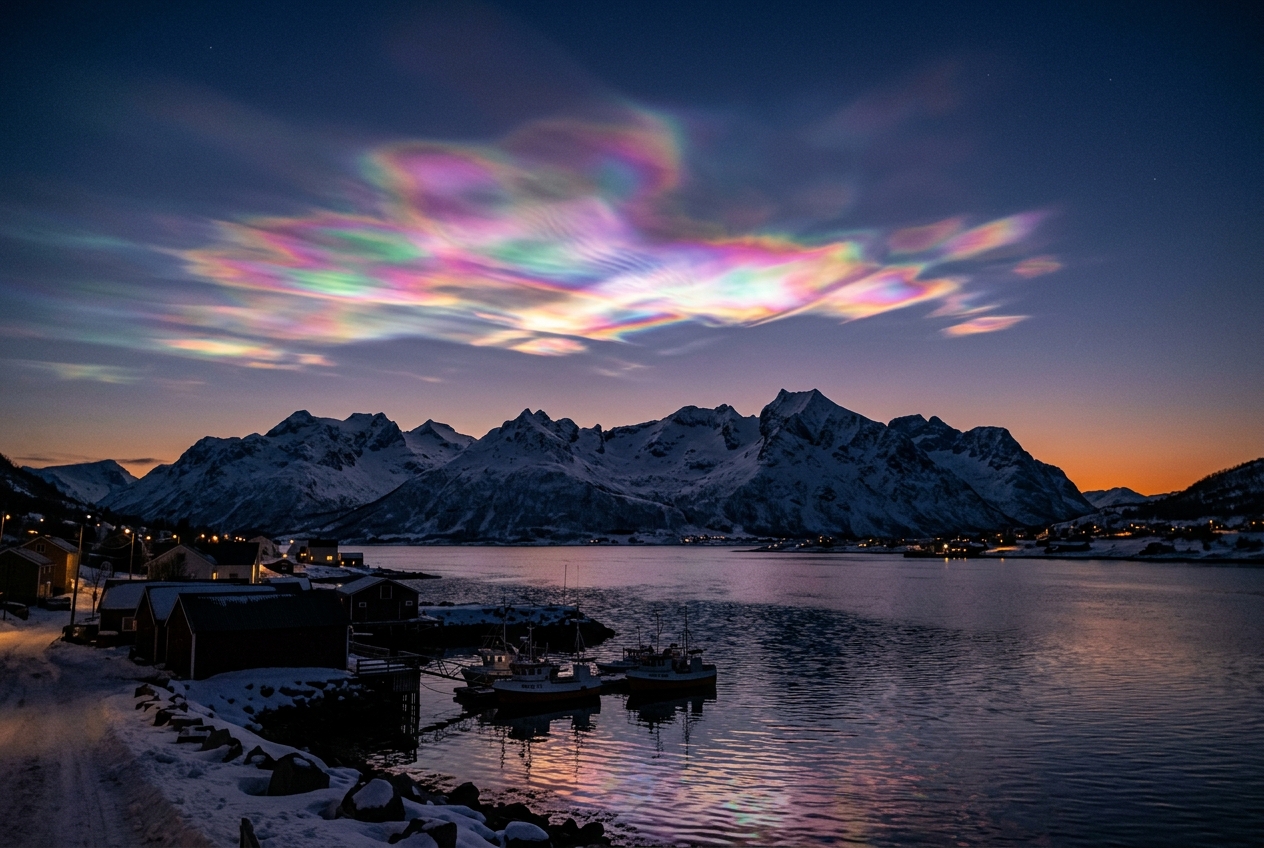
1. The Twilight Inversion: An Arctic Observation
Stand on a wind-scoured ridge outside Tromsø or Abisko in the deep freeze of mid-January, and the sensory reality of the high Arctic winter closes in with crystalline sharpness. The air at the surface is heavy, still, and biting at $-25^\circ\text{C}$. In the absence of direct sunlight, the landscape is rendered in monochrome: navy shadows over packed snow, the faint chemical tang of woodsmoke lingering in the dense surface inversion, and the utter stillness that characterizes an atmosphere trapped in a deep nocturnal boundary layer.
As the sun dips three, four, then six degrees below the southern horizon, the tropospheric clouds—the familiar grey stratocumulus and jagged altostratus that have drifted eastward from the Norwegian Sea—gradually lose their pale twilight sheen. One by one, they surrender to the advancing shadow of the Earth, transforming into pitch-black silhouettes against the fading sky. By all standard meteorological intuition, the celestial canvas should now extinguish entirely, giving way to the cold stars and the pale green ribbons of the aurora borealis.
       [Solar Rays passing high above Earth's curved limb]
                   \               /
                    \   STRATOSPHERE (15–25 km)  ---> [Glowing PSCs / Nacreous Clouds]
                     \           /                     (Direct Sunlight in Twilight)
                      \         /
-----------------------\-------/-------------------------------------------------------
     TROPOSPHERE        \     /                  ---> [Tropospheric Clouds in Shadow]
                         \   /                         (Dark Silhouettes)
~~~~~~~~~~~~~~~~~~~~~~~~~~\~/~~~~~~~~~~~~~~~~~~~~~~~~~~~~~~~~~~~~~~~~~~~~~~~~~~~~~~~~~~
     EARTH'S SURFACE       X                     ---> [Observer in Freezing Darkness]
Yet high above this gathering darkness, suspended at an altitude that seems unnatural for weather, a brilliant tapestry of mother-of-pearl illumination suddenly awakens.
Floating between 15 and 25 kilometres above the frozen tundra, these clouds do not merely reflect the dying light; they burn with vivid, iridescent hues. Pure magenta bleeds into electric turquoise; bands of incandescent peach and liquid emerald undulate across delicate, lenticular sheets. They appear fixed and unmoving, like stained glass welded into the upper stratosphere, shimmering with intense chromatic purity long after the lower atmosphere has slipped into night.
To the untrained eye, the display appears celestial and benign—an ethereal winter marvel known historically to Arctic seafarers and northern communities as nacreous or "mother-of-pearl" clouds. But to the atmospheric physicist, this chromatic spectacle signals something far more turbulent: an extreme thermodynamic anomaly where the high-latitude stratosphere has cooled to the very edge of physical limits, setting into motion an intricate chain of heterogeneous chemical reactions capable of devouring Earth’s protective ozone shield.
2. What Is Actually Happening: The Stratospheric Prism
To understand why these clouds exist—and why they glow when the world below is dark—one must first examine the vertical structure of the atmosphere and the geometry of a curved planet.
Think of the atmosphere as a vast, multi-storey building where the ground floor is the troposphere and the upper penthouse is the stratosphere, separated by a dynamic ceiling called the tropopause. Nearly all everyday weather—rain, snow, thunder, and cumulus towers—is strictly confined to the troposphere. In this lower layer, air cools as it rises, moisture is abundant, and convection churns the atmosphere continuously.
The stratosphere above is fundamentally different. It is an ultra-dry, stratified desert, desiccated by its passage through the freezing tropical tropopause. Under ordinary conditions, the stratosphere contains less than 5 parts per million of water vapour—making it hundreds of times drier than the core of the Sahara Desert. Furthermore, the stratosphere is characterized by a permanent temperature inversion: ozone absorbs ultraviolet solar radiation, heating the air from the top down. Because warm, buoyant air sits above colder air, vertical mixing is strongly suppressed. Clouds simply cannot form in this dry, stable domain under standard meteorological conditions.
+-----------------------------------------------------------------------------+
|                          THE VERTICAL STRATIFICATION                        |
|                                                                             |
|  Alt (km)                                                                   |
|   30 |                                                                      |
|      |   STRATOSPHERE                                                       |
|   25 |   - Extreme dryness (~5 ppmv H2O)                                    |
|      |   - Polar Stratospheric Clouds form here (15–25 km)                  |
|   20 |     when temperatures drop below 195 K (-78°C)                       |
|      |                                                                      |
|   15 |----------------------------------------- TROPOPAUSE (8–10 km Polar)  |
|      |                                                                      |
|   10 |   TROPOSPHERE                                                        |
|      |   - 99% of atmospheric water vapour                                  |
|    5 |   - Standard weather systems, storm fronts, cumulus                  |
|      |                                                                      |
|    0 +========================================= EARTH'S SURFACE             |
+-----------------------------------------------------------------------------+
The radiant twilight illumination observed from the ground is a product of simple, elegant geometry. Because the Earth is spherical, the boundary between day and night (the solar terminator) tilts with altitude. When the sun sinks below the horizon for a ground observer, the Earth’s solid body blocks direct rays from reaching the troposphere.
However, at an altitude of 20 to 25 kilometres, the horizon is physically depressed by several degrees. Sunlight continues to stream horizontally through the upper stratosphere unhindered, striking these high-altitude particles from beneath. The glowing clouds act as radiant projection screens, suspended in direct sunlight while the observer below stands in astronomical twilight.
Why, then, are the colours so strikingly iridescent compared to the dull whites and greys of common tropospheric clouds?
Tropospheric clouds are chaotic collections of water droplets spanning wildly diverse diameters, from 5 to over 50 micrometres. When sunlight strikes this polydisperse soup, light of all wavelengths is scattered equally in all directions through non-selective geometric and diffuse scattering, blending the rays into flat white or grey.
By contrast, the ice crystals and droplets within Polar Stratospheric Clouds grow in an environment of extreme stillness, forming at nearly identical rates across broad spatial sheets. This creates an extraordinarily monodisperse size distribution, where billions of adjacent particles possess virtually the exact same radius (typically between 1 and 3 micrometres).
When sunlight encounters this uniform grid of microscopic spheres, light waves diffract coherently around each particle. Different wavelengths (colours) bend at precisely distinct angles depending on their size relative to the particle diameter. As these diffracted waves propagate downward to the observer’s eye, they undergo constructive and destructive interference. The result is pure, separated spectral wavelengths—intense pastel pinks, emerald greens, and violets—painted across the twilight sky in concentric rings of mother-of-pearl iridescence.
3. The Science: Thermodynamics, Optics, and Heterogeneous Catalysis
Beyond their visual splendour, Polar Stratospheric Clouds represent complex thermodynamic and microphysical systems classified under the World Meteorological Organization (WMO) International Cloud Atlas. Their formation is governed by strict phase equilibria in the $H_2SO_4 - HNO_3 - H_2O$ chemical system.
3.1 Thermodynamic Classifications: Type I and Type II
PSCs are categorized into distinct microphysical and chemical regimes based on their composition and phase state:
- Type Ia (Solid Nitric Acid Trihydrate - NAT): Composed of crystalline hydrates of nitric acid ($HNO_3 \cdot 3H_2O$). They nucleate at temperatures below approximately $195\text{ K}$ ($-78^\circ\text{C}$). Because NAT nucleation on background stratospheric sulfate aerosols (SSA) involves overcoming a substantial kinetic barrier, Type Ia clouds often exhibit low particle number densities ($N \sim 10^{-4}\text{ to }10^{-2}\text{ cm}^{-3}$) but can grow to large radii ($r > 3\ \mu\text{m}$). These large particles sediment rapidly under gravity, physically removing reactive nitrogen from the stratosphere in an irreversible process known as denitrification.
- Type Ib (Liquid Supercooled Ternary Solutions - STS): As the stratospheric temperature drops below $192\text{ K}$, ambient background liquid sulfate aerosols continuously and reversibly absorb large quantities of gaseous nitric acid and water vapour without undergoing a first-order phase transition to a crystal. This forms a liquid ternary solution ($H_2SO_4 / HNO_3 / H_2O$). Type Ib particles possess high number densities ($N \sim 10\text{ cm}^{-3}$) and smaller radii ($r \sim 0.5\ \mu\text{m}$), presenting vast surface areas for chemical reactions.
- Type II (Pure Water-Ice Nacreous Clouds): Formed when the stratosphere undergoes extreme cooling below the frost point of water, $T_{ice} \approx 188\text{ K}$ ($-85^\circ\text{C}$). Because stratospheric water vapour mixing ratios are meager (typically $4.5 - 5.5\text{ ppmv}$), water cannot condense until this severe thermal threshold is breached. These are the true nacreous clouds, whose high monodispersity and rapid orographic growth produce the most dramatic optical iridescence.
3.2 The Hanson-Mauersberger Equilibrium for NAT Condensation
The condensation of solid Nitric Acid Trihydrate is governed by the equilibrium vapor pressures of its gaseous constituents over the solid phase:
$$HNO_3(g) + 3H_2O(g) \rightleftharpoons HNO_3 \cdot 3H_2O(s)$$
The thermodynamic coexistence relationship developed by Hanson and Mauersberger (1988) provides the formulation for the saturation vapor pressure of nitric acid over solid NAT as a function of temperature $T$ and the partial pressure of ambient water vapor $P_{H_2O}$:
$$\log_{10}(P_{HNO_3}) = m(T) \log_{10}(P_{H_2O}) + b(T)$$
Where the temperature-dependent slope $m(T)$ and intercept $b(T)$ are parameterized as:
$$m(T) = -2.7836 - 8.80 \times 10^{-4} T$$
$$b(T) = 38.9855 - \frac{11397}{T} + 9.179 \times 10^{-3} T$$
Here, partial pressures $P_{HNO_3}$ and $P_{H_2O}$ are expressed in Torr ($1\text{ Torr} \approx 1.33322\text{ hPa} = 133.322\text{ Pa}$).
+-----------------------------------------------------------------------------+
|               WORKED THERMODYNAMIC PROOF: NAT EQUILIBRIUM                   |
+-----------------------------------------------------------------------------+
| Consider an isobaric surface in the lower polar stratosphere at p = 50 hPa  |
| (altitude ~20 km).                                                          |
|                                                                             |
| 1. Ambient Mixing Ratios:                                                   |
|    - Water Vapour:  chi_H2O  = 5.0 ppmv = 5.0 x 10^-6                       |
|    - Nitric Acid:   chi_HNO3 = 10.0 ppbv = 10.0 x 10^-9                     |
|                                                                             |
| 2. Compute Ambient Partial Pressures:                                       |
|    P_H2O  = (5.0 x 10^-6) * 50 hPa = 2.50 x 10^-4 hPa                       |
|           = (2.50 x 10^-4 hPa) / 1.33322 = 1.875 x 10^-4 Torr              |
|                                                                             |
|    P_HNO3 = (10.0 x 10^-9) * 50 hPa = 5.00 x 10^-7 hPa                      |
|           = (5.00 x 10^-7 hPa) / 1.33322 = 3.750 x 10^-7 Torr              |
|                                                                             |
| 3. Evaluate Equilibrium at T = 195.0 K:                                     |
|    m(195) = -2.7836 - (8.80 x 10^-4 * 195) = -2.9552                        |
|    b(195) = 38.9855 - (11397 / 195) + (9.179 x 10^-3 * 195)                |
|           = 38.9855 - 58.4462 + 1.7899 = -17.6708                           |
|                                                                             |
|    log10(P_H2O) = log10(1.875 x 10^-4) = -3.7270                           |
|                                                                             |
|    log10(P_sat,HNO3) = (-2.9552 * -3.7270) - 17.6708                        |
|                      = 11.0139 - 17.6708 = -6.6569                          |
|                                                                             |
|    P_sat,HNO3 = 10^(-6.6569) = 2.203 x 10^-7 Torr                           |
|                                                                             |
| 4. Saturation Ratio Determination:                                          |
|    S_NAT = P_HNO3 / P_sat,HNO3                                              |
|    S_NAT = (3.750 x 10^-7 Torr) / (2.203 x 10^-7 Torr) = 1.702              |
|                                                                             |
| RESULT: S_NAT > 1.0. The air is supersaturated with respect to NAT at       |
| 195.0 K. Nitric Acid Trihydrate crystals are thermodynamically stable and   |
| will nucleate and grow.                                                     |
+-----------------------------------------------------------------------------+
3.3 Mie Scattering and Monodisperse Optical Interference
The brilliant spectral iridescence of Type II nacreous clouds is governed by Mie scattering theory, which describes the scattering of electromagnetic radiation by spherical particles whose size is comparable to the wavelength of incident light ($\lambda \approx 0.4 - 0.7\ \mu\text{m}$).
The scattering behavior is parameterized by the non-dimensional size parameter $x$:
$$x = \frac{2\pi r}{\lambda}$$
Where $r$ is the particle radius and $\lambda$ is the incident wavelength.
When sunlight passes around a single uniform spherical droplet, the scattered intensity $I(\theta, \lambda)$ as a function of the scattering angle $\theta$ relative to the forward direction exhibits sharp local extrema produced by the interference of electric and magnetic multipole fields:
$$\sin(\theta_m) \approx \frac{(m + 0.22)\lambda}{2r}$$
Where $m = 1, 2, 3 \dots$ denotes the successive diffraction ring orders.
+-----------------------------------------------------------------------------+
|                WORKED OPTICAL PROOF: CHROMATIC SEPARATION                  |
+-----------------------------------------------------------------------------+
| Consider a monodisperse nacreous cloud with particle radius r = 1.80 um.    |
| We calculate the angular position (theta_1) of the first-order intensity    |
| maximum for two distinct visible wavelengths:                               |
|                                                                             |
| 1. Blue Light (lambda_blue = 0.45 um):                                      |
|    sin(theta_1,blue) = (1.22 * 0.45 um) / (2 * 1.80 um)                    |
|                      = 0.549 / 3.60 = 0.1525                                |
|    theta_1,blue      = arcsin(0.1525) = 8.77 degrees                        |
|                                                                             |
| 2. Red Light (lambda_red = 0.65 um):                                        |
|    sin(theta_1,red)  = (1.22 * 0.65 um) / (2 * 1.80 um)                    |
|                      = 0.793 / 3.60 = 0.2203                                |
|    theta_1,red       = arcsin(0.2203) = 12.72 degrees                       |
|                                                                             |
| 3. Angular Separation:                                                      |
|    Delta_theta = 12.72 deg - 8.77 deg = 3.95 degrees                        |
|                                                                             |
| RESULT: The 3.95-degree angular dispersion cleanly separates blue and red   |
| light across the sky. If the particle size distribution were broad          |
| (polydisperse, sigma_g > 1.4), these angular rings would overlap, washing   |
| the scattered light into a uniform white. Because sigma_g < 1.10 in PSCs,   |
| pure, saturated spectral bands are observed.                                |
+-----------------------------------------------------------------------------+
3.4 Synoptic Polar Vortex Dynamics and Mountain Waves
The global engine enabling these extreme temperatures is the wintertime polar vortex—a massive, cyclonic low-pressure system spanning the mid-to-high stratosphere centered over the pole.
During the polar night, the absence of solar heating combined with continuous thermal longwave emission to space drives intense radiational cooling. The vortex develops strong circumpolar jet streams with tangential winds exceeding $80\text{ m/s}$ along the vortex edge (the polar night jet). This jet acts as an impermeable dynamic barrier, isolating the polar air mass from the warmer, ozone-rich air of the mid-latitudes.
       [ STRATOSPHERIC POLAR NIGHT JET (~80 m/s) ]
      --------------------------------------------->
                       |
                       v  (Isolated Core: T < 195 K)
     +----------------------------------------------------+
     |                                                    |
     |   SYNOPTIC COLD POOL                               |
     |   - Radiational cooling drives T down to ~190 K    |
     |   - Type Ia (NAT) and Type Ib (STS) form           |
     |                                                    |
     +----------------------------------------------------+
                       ^
                       |  Orographic Gravity Waves
      ~ ~ ~ ~ ~ ~ ~ ~ ~|~ ~ ~ ~ ~ ~ ~ ~ ~ ~ ~ ~ ~ ~ ~ ~ ~
     [ SCANDINAVIAN / TRANSANTARCTIC MOUNTAIN RANGE ]
                       |
       Surface Wind ===+===> (Air forced upward,
                              expands & cools adiabatically
                              by 5–10 K -> T < 188 K: Type II Ice)
While synoptic radiational cooling inside the vortex easily pushes temperatures below the $195\text{ K}$ threshold required for Type I clouds, it rarely reaches the $188\text{ K}$ frost point needed for Type II ice clouds in the Arctic.
This is where mesoscale mountain waves (orographic gravity waves) become essential. When strong synoptic winds in the troposphere strike major topographic barriers (such as the Scandinavian Mountains, the Greenland Ice Sheet, or the Transantarctic Mountains), air is forced vertically upward.
Because the stratified atmosphere is stably buoyant, this displaced air oscillates as it propagates upward into the lower stratosphere. As the air parcels ascend in the wave crests, they undergo rapid localized adiabatic expansion and cooling:
$$\Delta T \approx -\left(\frac{g}{c_p}\right) \Delta z$$
This localized dynamic lift cools air parcels by an additional $5\text{ to }10\text{ K}$, plunging temperatures below the $188\text{ K}$ ice frost point. In these localized, freezing wave crests, water vapor flashes into dense, monodisperse ice crystals, generating the stationary, wave-like nacreous clouds detailed in research by the NASA Earth Observatory.
3.5 The Catalytic Engine of Ozone Depletion
The critical environmental significance of Polar Stratospheric Clouds lies in atmospheric chemistry. Under ordinary conditions, chlorine emitted from anthropogenic chlorofluorocarbons (CFCs) is trapped in unreactive "reservoir species," primarily hydrochloric acid ($HCl$) and chlorine nitrate ($ClONO_2$):
$$HCl + ClONO_2 \xrightarrow{\text{Gas Phase}} \text{Extremely Slow (Virtually Zero)}$$
In the gas phase, these reservoir molecules collide infrequently and cannot react, rendering them harmless to ozone.
+-----------------------------------------------------------------------------+
|                 HETEROGENEOUS CHLORINE ACTIVATION ON PSCs                   |
+-----------------------------------------------------------------------------+
|                                                                             |
|   1. Inactive Reservoir Molecules:                                          |
|      HCl(g) + ClONO2(g)                                                     |
|                                                                             |
|   2. Heterogeneous Adsorption on PSC Ice/NAT Surface:                       |
|      =================== [ PSC PARTICLE SURFACE ] ===================       |
|                                                                             |
|   3. Fast Heterogeneous Surface Reaction:                                   |
|      HCl(ads) + ClONO2(ads)  ----->  Cl2(g) + HNO3(solid)                   |
|                                        |                                    |
|   4. Desorption into Gas Phase:        |                                    |
|      Molecular Chlorine (Cl2) enters gas phase; Nitric Acid trapped in ice  |
|                                                                             |
|   5. Polar Spring Sunbreak (Photolysis):                                    |
|      Cl2 + h*nu (UV-Vis Sunlight) -----> 2 Cl* (Active Chlorine Radicals)   |
|                                                                             |
|   6. Catalytic Ozone Depletion Cycle:                                       |
|      Cl* + O3  -----> ClO* + O2                                             |
|      ClO* + ClO* + M -----> (ClO)2 + M                                      |
|      (ClO)2 + h*nu -----> ClOO + Cl*                                        |
|      ClOO + M -----> Cl* + O2                                               |
|      --------------------------------------------------------------------   |
|      NET: 2 O3 + h*nu -----> 3 O2                                           |
|                                                                             |
+-----------------------------------------------------------------------------+
As documented by the UK Met Office and the Scientific Assessment of Ozone Depletion by UNEP/WMO, when PSCs condense, their surfaces serve as heterogeneous catalytic platforms. Gaseous $HCl$ dissolves directly into the cold STS droplets or adsorbs onto the crystalline NAT/ice lattice, reacting rapidly with $ClONO_2$:
$$HCl(ads) + ClONO_2(g) \xrightarrow{\text{PSC Surface}} Cl_2(g) + HNO_3(s)$$
$$ClONO_2(g) + H_2O(s) \xrightarrow{\text{PSC Surface}} HOCl(g) + HNO_3(s)$$
These reactions accomplish two catastrophic transformations: 1. Chlorine Activation: Inert reservoir chlorine is converted into photolytically labile molecular chlorine ($Cl_2$) and hypochlorous acid ($HOCl$), which desorb back into the gas phase. 2. Denoxification & Denitrification: Reactive nitrogen oxide species are converted into solid nitric acid ($HNO_3$) and sequestered inside the cloud crystals. When large Type Ia particles sediment downward into the troposphere, they permanently remove nitrogen from the lower stratosphere. Without nitrogen dioxide ($NO_2$) available to re-bind free chlorine back into $ClONO_2$, chlorine remains in its active, destructive state for months.
When the polar sun returns in the spring, solar photons ($h\nu$) photolyze the accumulated $Cl_2$:
$$Cl_2 + h\nu \longrightarrow 2Cl^\bullet$$
Each free chlorine radical ($Cl^\bullet$) initiates a catalytic cycle, destroying upwards of $100,000$ ozone molecules ($O_3$) before being neutralized. The stunning iridescent clouds of midwinter are nothing less than the physical staging ground for the spring ozone hole.
4. Practical Outdoor Guidance for High-Latitude Observers
Observing Polar Stratospheric Clouds requires a deliberate combination of geographical positioning, solar alignment, and meteorological timing.
+-----------------------------------------------------------------------------+
|                     OBSERVER'S TWILIGHT GEOMETRY MATRIX                     |
|                                                                             |
|  Solar Angle (Deg)   Sky Condition               PSC Visibility Potential   |
|  -----------------   -------------               ------------------------   |
|  0° to -1° (Sunset)  Tropospheric glare strong   Poor (Overwhelmed by light)|
|  -1° to -6° (Civil)  Troposphere enters shadow   OPTIMAL: Peak Iridescence  |
|  -6° to -12°(Naut.)  Deep twilight               High contrast; deep violet |
|  <-12° (Astro.)      Full night                  Fades (Sun exits 25 km)    |
+-----------------------------------------------------------------------------+
What to Look For in the Sky
- Timing: Observations are most successful between December and February in the Northern Hemisphere (latitudes $> 60^\circ\text{N}$, such as northern Scotland, Scandinavia, Alaska, and Canada) and between June and September in Antarctica.
- Solar Depression Window: The optimal viewing window occurs during civil twilight, precisely when the sun is $1^\circ\text{ to }6^\circ$ below the local horizon. During this window, the line-of-sight tropospheric clouds are in deep shadow, while the stratospheric layer at $20\text{ km}$ remains fully illuminated.
- Visual Morphology: Look for ultra-high, stationary lenticular or cirrocumulus-like sheets that do not drift with the prevailing surface wind. Unlike standard tropospheric iridescence (which appears as pale, washed-out pastels within $10^\circ$ of the sun), PSC iridescence displays vivid, saturated pinks, cyans, and emerald greens that persist across wide arcs ($20^\circ - 50^\circ$) away from the solar azimuth.
Synoptic and Instrument Indicators
- Barometer: Look for a strong synoptic pressure gradient across a nearby mountain barrier. A deep Atlantic low-pressure system moving east over northern Scandinavia paired with high pressure to the south generates the powerful, perpendicular tropospheric cross-mountain flow required to trigger stratospheric gravity waves.
- Surface Thermometer: Surface temperature is not a direct driver of PSCs, but a persistent, stable surface arctic inversion (freezing, dead-calm air at ground level) often coincides with clear tropospheric skies, providing a clear viewing window to the stratosphere.
- Stratospheric Temperature Maps: Monitor public meteorological analyses (such as ECMWF or NOAA 30 hPa and 50 hPa temperature charts). If 50 hPa temperatures over your region drop below $-78^\circ\text{C}$ ($195\text{ K}$), Type I PSCs are actively forming; if they plunge below $-85^\circ\text{C}$ ($188\text{ K}$), pristine Type II nacreous displays are imminent.
5. Today's Meteorological Rule of Thumb
When tropospheric clouds fade into ink-black silhouettes after sunset, any high, stationary cloud that continues to burn with pure, iridescent pastel pinks and emeralds is suspended in the stratosphere above 15 kilometres—signaling temperatures colder than $-78^\circ\text{C}$ and the active chemical priming of the polar vortex.
Authoritative References and Data Resources
- World Meteorological Organization (WMO) International Cloud Atlas: Polar Stratospheric Clouds
- NOAA Chemical Sciences Laboratory: Polar Stratospheric Cloud Chemistry Assessments
- NASA Earth Observatory: Polar Stratospheric Cloud Dynamics and Observations
- UK Met Office: Classification and Physics of Nacreous Clouds
- UNEP / WMO Scientific Assessment of Ozone Depletion