Köhler Theory & Cloud Condensation Nuclei Activation: How Solute and Curvature Effects Govern Droplet Growth and Cloud Formation
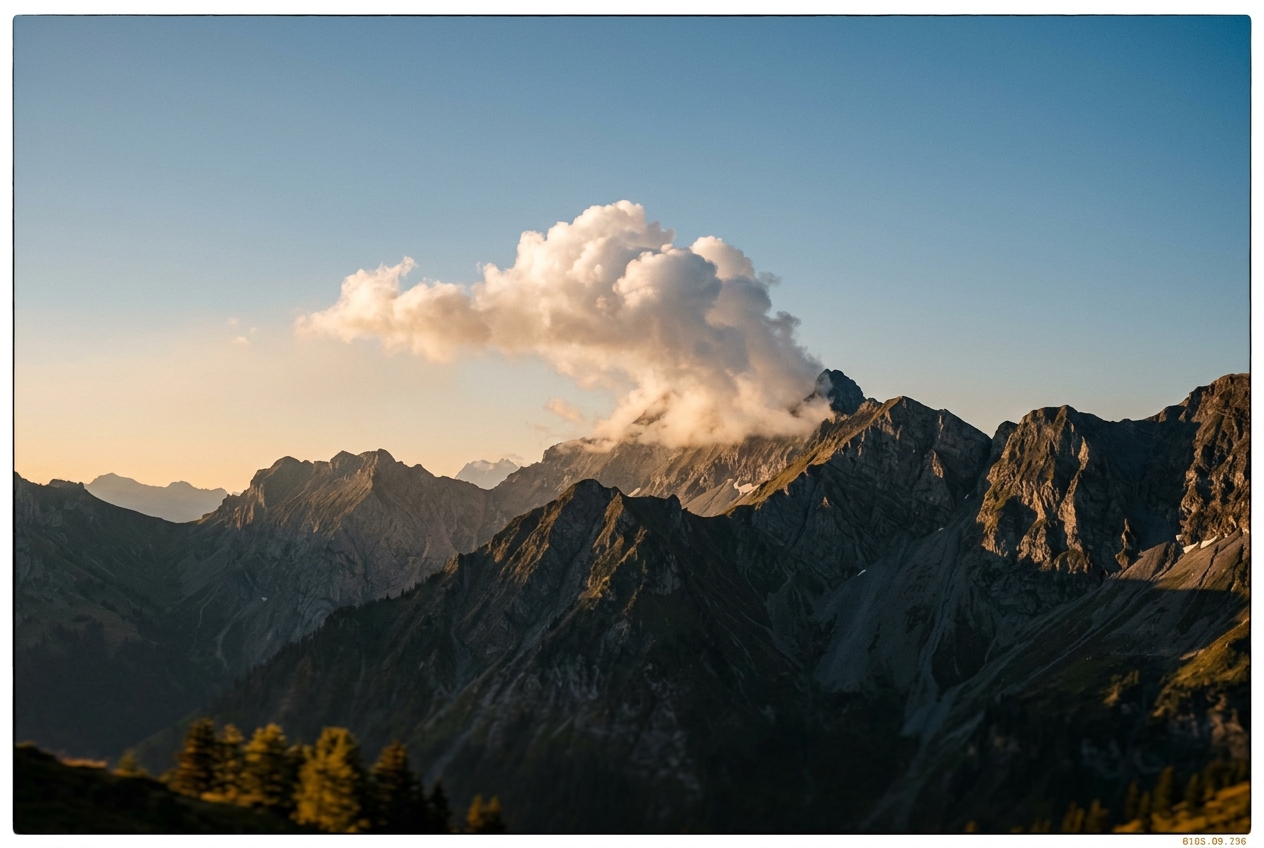
1. Opening Scene: The Ridge at Three O’Clock
Stand upon the crest of an open moorland ridge on a midsummer afternoon, and you can feel the sky preparing its machinery. The morning’s sluggish heat, radiating from sun-baked peat and dry heather, has begun to give way to an intermittent, restless draft. It arrives not as a prevailing wind, but as a series of buoyant upward pulses—warm thermals tearing away from the valley floor and rushing skyward at four meters per second.
If you watch the horizon, the sapphire blue of the upper atmosphere is losing its crystalline clarity, softening into a milky, opalescent haze. Then, quite suddenly, the pressure drops by a fraction of a millibar. The skin on the back of your neck cools as the relative humidity climbs, carrying with it the unmistakable, earthy perfume of petrichor—the scent of geosmin and plant oils swept upward from parched soil.
Look directly overhead. At precisely one thousand two hundred meters above the valley floor, the invisible becomes visible. There is no gentle, gradual fade from transparency to mist; rather, there is a razor-sharp, horizontal datum line etched across the sky. Below this threshold lies empty, transparent air. Above it, towering cumulus congestus billow with chalk-white brilliance, their bases sheared flat as if sliced by a glasscutter.
Millions of kilograms of water are materializing out of thin air every second. Yet, if the atmosphere above you were chemically pure—composed solely of pristine nitrogen, oxygen, and water vapor—not a single droplet could exist. The sky would remain deceptively, barrenly clear, despite being saturated to the bursting point. Every cloud you have ever seen is a physical impossibility cheated into existence by a speck of floating dirt.
2. What’s Actually Happening: The Molecular Tightrope
To understand why clouds exist, one must first confront the grand paradox of cloud physics: pure water vapor cannot condense into water droplets under normal atmospheric conditions.
In schoolroom physics, we are taught that when warm air rises, it expands and cools adiabatically. When its temperature falls to the dew point, the relative humidity reaches 100%, and water vapor condenses into liquid. In the real atmosphere, this textbook simplicity is an outright fiction.
Imagine water vapor as a swarm of hyperactive children darting across a schoolyard. In the vapor phase, thermal kinetic energy keeps them moving too rapidly to cling to one another. As the air cools, the children lose speed and begin bumping into one another. Occasionally, two or three will collide and link hands, forming an embryonic liquid cluster—a microscopic droplet consisting of merely a few hundred molecules.
Here, thermodynamics sets a brutal trap known to physicists as the curvature catastrophe.
A droplet that has just been born is unimaginably small—less than a single nanometer in diameter. At this scale, nearly every water molecule in the cluster resides on the exterior surface, exposed to the open air. Because the droplet is so sharply curved, the surface molecules have very few liquid neighbors to bond with. Instead of being held securely within a cohesive liquid cage, they are exposed at steep angles, held by weak, incomplete hydrogen bonds.
The surface tension of the droplet acts like an over-inflated, ultra-stiff rubber balloon. The pressure inside this molecular sphere is immensely higher than the pressure outside. As a consequence, the water molecules on this hyper-curved surface evaporate back into the vapor phase almost instantly—billions of times faster than they can condense. For a purely homogeneous droplet of pure water to survive, the ambient air would need to be supersaturated to an astonishing 300% or 400% relative humidity. In our atmosphere, where upward-rising air currents rarely generate supersaturations exceeding 1% or 2%, every microscopic cluster of pure water evaporates the instant it forms.
How does the atmosphere bypass this thermodynamic barrier? It employs a Trojan horse: Cloud Condensation Nuclei (CCN).
Floating throughout every cubic centimeter of atmospheric air are hundreds to thousands of microscopic aerosol particles: crystalline sea salt hurled into the marine boundary layer by bursting whitecap bubbles, ammonium sulfate created by forest emissions and coal combustion, and mineral dust swept from desert basins.
When a hygroscopic (water-attracting) aerosol particle meets humid air, water vapor does not need to build a droplet from scratch. Instead, the water dissolves the aerosol, creating a concentrated chemical solution droplet. According to fundamental physical chemistry, solute molecules physically displace water molecules at the droplet surface, lowering the chemical potential and drastically retarding the rate of evaporation.
This creates a dynamic tug-of-war: 1. The Kelvin Curvature Effect: Pushes water molecules off the curved surface, demanding higher humidity to maintain the droplet. 2. The Raoult Solute Effect: Binds water molecules tightly to the dissolved salt ions, allowing the droplet to survive in low humidity.
The mathematical synthesis of these two opposing forces is the bedrock of cloud physics: Köhler Theory.
3. The Science: Derivation of the Köhler Equilibrium
For atmospheric scientists and meteorology students, the life and death of a cloud droplet is governed by the classical equation formulated in 1936 by Swedish meteorologist Hilding Köhler.
To quantify this behavior, we analyze the saturation ratio $S = e / e_\infty$, where $e$ is the ambient water vapor pressure and $e_\infty$ is the equilibrium saturation vapor pressure over a flat sheet of pure water at temperature $T$. The supersaturation $s$ is defined as $s = S - 1$ (frequently expressed as a percentage, where $s = 0.002$ corresponds to $0.2\%$ supersaturation or $100.2\%$ relative humidity).
3.1 The Kelvin Curvature Term
The equilibrium vapor pressure $e_s(r)$ over a pure, curved droplet of radius $r$ is described by the classical Kelvin equation:
$$\ln\left(\frac{e_s(r)}{e_\infty}\right) = \frac{2\sigma_{w/a} M_w}{\rho_w R T r} = \frac{A}{r}$$
Where: * $\sigma_{w/a}$ is the surface tension of the water-air interface ($\approx 0.0728 \text{ N m}^{-1} \text{ at } 20^\circ\text{C}$) * $M_w$ is the molecular weight of water ($0.018015 \text{ kg mol}^{-1}$) * $\rho_w$ is the density of liquid water ($1000 \text{ kg m}^{-3}$) * $R$ is the universal gas constant ($8.3145 \text{ J mol}^{-1} \text{ K}^{-1}$) * $T$ is absolute temperature in Kelvin
The curvature parameter $A$ has units of length:
$$A = \frac{2 \sigma_{w/a} M_w}{\rho_w R T} \approx \frac{3.3 \times 10^{-7}}{T} \text{ meters}$$
At $T = 293.15 \text{ K}$ ($20^\circ\text{C}$), $A \approx 1.08 \times 10^{-9} \text{ m} = 1.08 \text{ nm}$. For an embryonic cluster of radius $r = 1 \text{ nm}$, $\ln(S) = 1.08 / 1.0 = 1.08$, which translates to $S = e^{1.08} \approx 2.94$—a required relative humidity of nearly $300\%$.
3.2 Raoult’s Law and the Solute Effect
When a dry aerosol particle of mass $m_s$, density $\rho_s$, and molar mass $M_s$ completely dissolves within a droplet of radius $r$, the mole fraction of water $x_w$ dictates the reduction in vapor pressure. Under the dilute approximation, the Raoult depression is parameterized as:
$$\frac{e_s'(r)}{e_s(r)} \approx 1 - \frac{B}{r^3}$$
Where the solute parameter $B$ is given by:
$$B = \frac{3 i \nu m_s M_w}{4 \pi \rho_w M_s} = \frac{3 i \nu \rho_s r_d^3 M_w}{\rho_w M_s}$$
Here, $i$ is the van 't Hoff factor (accounting for ionic dissociation, e.g., $i \approx 2$ for $\text{NaCl} \to \text{Na}^+ + \text{Cl}^-$, and $i \approx 3$ for $(\text{NH}_4)_2\text{SO}_4 \to 2\text{NH}_4^+ + \text{SO}_4^{2-}$), $\nu$ is the stoichiometric dissociation number, and $r_d$ is the dry aerosol radius.
3.3 The Combined Köhler Equation
Combining the Kelvin curvature term and the Raoult solute term yields the foundational Köhler theory equation:
$$\ln\left(\frac{e}{e_\infty}\right) = \frac{A}{r} - \frac{B}{r^3}$$
Since the fractional supersaturations in clouds are small ($\ln S \approx S - 1 = s$), we use the Taylor expansion approximation:
$$s(r) = S(r) - 1 \approx \frac{A}{r} - \frac{B}{r^3}$$
3.4 Critical Radius and Critical Supersaturation
The Köhler curve displays a distinct local maximum. To find this critical inflection point, we differentiate $s(r)$ with respect to droplet radius $r$ and set the derivative to zero:
$$\frac{ds}{dr} = -\frac{A}{r^2} + \frac{3B}{r^4} = 0$$
$$A r^2 = 3B \implies r_c = \sqrt{\frac{3B}{A}}$$
Substituting this critical radius $r_c$ back into the Köhler equation gives the critical supersaturation ($s_c$):
$$s_c = \frac{A}{\sqrt{3B/A}} - \frac{B}{\left(\sqrt{3B/A}\right)^3} = \frac{A^{3/2}}{\sqrt{3B}} - \frac{A^{3/2}}{3\sqrt{3B}} = \frac{2}{3} A \sqrt{\frac{A}{3B}} = \sqrt{\frac{4 A^3}{27 B}}$$
🔬 Physical Interpretation of the Critical Point
- $r < r_c$ (Stable Haze): The slope $ds/dr > 0$. If the ambient supersaturation increases, the droplet grows slightly to a new stable radius where evaporation balances condensation. If ambient humidity drops, it shrinks. It is a stable, unactivated haze droplet.
- $r > r_c$ (Activated Cloud Droplet): The slope $ds/dr < 0$. Once an updraft forces the ambient supersaturation past $s_c$, the droplet crosses the energy barrier. Now, as the droplet grows larger, the vapor pressure required to maintain equilibrium decreases. The droplet enters an unstable, runaway state of rapid diffusional growth, swelling into a macroscopic cloud droplet ($r > 10\ \mu\text{m}$) limited only by the rate at which water molecules can diffuse through the air.
3.5 Step-by-Step Worked Example: Activating a Sea Salt Aerosol
Let us walk through a real-world calculation for a marine aerosol particle composed of pure Sodium Chloride ($\text{NaCl}$) suspended in an ascending thermal at $T = 293.15 \text{ K}$ ($20^\circ\text{C}$).
Given Parameters:
- Dry aerosol radius: $r_d = 0.05\ \mu\text{m} = 5.0 \times 10^{-8} \text{ m}$
- Density of $\text{NaCl}$: $\rho_s = 2165 \text{ kg m}^{-3}$
- Molar mass of $\text{NaCl}$: $M_s = 0.05844 \text{ kg mol}^{-1}$
- Molar mass of water: $M_w = 0.018015 \text{ kg mol}^{-1}$
- van 't Hoff factor for $\text{NaCl}$: $i = 2$
- Kelvin parameter: $A = 1.08 \times 10^{-9} \text{ m}$
Step 1: Calculate the Dry Aerosol Mass ($m_s$)
$$V_d = \frac{4}{3} \pi r_d^3 = \frac{4}{3} \pi (5.0 \times 10^{-8} \text{ m})^3 \approx 5.236 \times 10^{-22} \text{ m}^3$$
$$m_s = \rho_s V_d = (2165 \text{ kg m}^{-3})(5.236 \times 10^{-22} \text{ m}^3) \approx 1.134 \times 10^{-18} \text{ kg}$$
Step 2: Compute the Solute Term ($B$)
$$B = \frac{3 i m_s M_w}{4 \pi \rho_w M_s} = \frac{3 \times 2 \times (1.134 \times 10^{-18} \text{ kg}) \times (0.018015 \text{ kg mol}^{-1})}{4 \pi \times (1000 \text{ kg m}^{-3}) \times (0.05844 \text{ kg mol}^{-1})}$$
$$B = \frac{1.226 \times 10^{-19}}{734.4} \approx 1.669 \times 10^{-22} \text{ m}^3$$
Step 3: Determine the Critical Radius ($r_c$)
$$r_c = \sqrt{\frac{3B}{A}} = \sqrt{\frac{3 \times (1.669 \times 10^{-22} \text{ m}^3)}{1.08 \times 10^{-9} \text{ m}}} = \sqrt{4.636 \times 10^{-13} \text{ m}^2} \approx 6.81 \times 10^{-7} \text{ m} = 0.681\ \mu\text{m}$$
Step 4: Determine the Critical Supersaturation ($s_c$)
$$s_c = \sqrt{\frac{4 A^3}{27 B}} = \sqrt{\frac{4 \times (1.08 \times 10^{-9} \text{ m})^3}{27 \times (1.669 \times 10^{-22} \text{ m}^3)}} = \sqrt{\frac{5.039 \times 10^{-27}}{4.506 \times 10^{-21}}} = \sqrt{1.118 \times 10^{-6}} \approx 1.057 \times 10^{-3}$$
$$s_c = 0.106\% \quad (\text{Equivalent to a Relative Humidity of } 100.106\%)$$
===================================================================
                  KÖHLER ACTIVATION SUMMARY BOX
===================================================================
Dry Nucleus:         NaCl (r_d = 0.05 µm)
Critical Diameter:   d_c = 1.36 µm (Swelled tenfold prior to activation)
Activation Threshold: S_c = 100.106% RH (Requires only 0.1% supersaturation!)
Outcome:             Uncontrolled runaway condensation into cloud droplet
===================================================================
3.6 Microphysical Regimes: Maritime Cleanliness vs. Continental Pollution
The sensitivity of $s_c$ to aerosol mass explains why clouds look, behave, and rain entirely differently depending on where their air mass originated.
- The Maritime Regime: Over open oceans, CCN concentrations are low ($N_{\text{CCN}} \sim 50\text{ to }100 \text{ cm}^{-3}$), dominated by coarse, highly hygroscopic sea salt particles. Because few aerosols compete for the rising vapor, maximum supersaturation ($S_{\text{max}}$) in updrafts reaches higher levels ($0.5\%\text{ to }1.0\%$). Droplets rapidly activate and grow to large radii ($r > 15\text{--}20\ \mu\text{m}$). At this size, gravitational settling differences allow larger droplets to sweep up smaller ones via the collision-coalescence process, triggering warm rain within twenty minutes of cloud birth.
- The Continental & Polluted Regime: Over industrial landmasses, combustion produces thousands of fine sulfate and nitrate particles per cubic centimeter ($N_{\text{CCN}} \sim 1000\text{ to }3000 \text{ cm}^{-3}$). The available liquid water is partitioned among millions of competing nuclei. Each droplet is starved of vapor and stalls at a sub-critical or narrow size distribution ($r \sim 4\text{ to }6\ \mu\text{m}$). Collision efficiencies between equal-sized microscopic droplets are virtually zero. Rain is suppressed, clouds persist longer, and the massive increase in total droplet surface area dramatically enhances cloud reflectivity—a phenomenon celebrated in climate science as the Twomey effect (the first aerosol indirect climate forcing).
4. Practical Outdoor Guidance: Reading the Microphysics in the Field
You do not need an aircraft-mounted Forward Scattering Spectrometer Probe to witness Köhler activation in action. An astute observer with a handheld barometer, a sling psychrometer, and keen eyes can diagnose cloud microphysics directly from the hillside.
1. Pinpointing the Lifting Condensation Level (LCL)
The razor-flat base of fair-weather cumulus marks the exact geometric surface where rising air parcels cross $S \ge S_c$. You can calculate the height of this activation deck using the classic dry-adiabatic surface dew-point spread formula:
$$z_{\text{LCL}} \approx 125 \times (T_{\text{ambient}} - T_{\text{dew}}) \text{ meters}$$
(or roughly $220 \times (T - T_d)$ in feet).
If your surface temperature is $24^\circ\text{C}$ and your psychrometer measures a dew point of $14^\circ\text{C}$, the spread is $10^\circ\text{C}$. The activation plane will establish itself at precisely $1,250\text{ meters}$ above ground level.
2. Differentiating Equilibrium Haze from Activated Cloud
- The Swelling Haze Phase ($75\%\text{ to }98\% \text{ RH}$): As a thermal approaches the condensation level, hygroscopic aerosols swell along the stable, sub-critical branch of the Köhler curve ($r < r_c$). This swelling causes forward Mie scattering of sunlight. Look toward the sun at an angle of 30°: a whitish-blue glare washing out the horizon indicates unactivated, equilibrium solution droplets.
- The Activation Edge ($S \ge S_c$): The moment the parcel breaches $s_c$, droplet radius jumps by orders of magnitude in seconds. The mean free path of light collapses from kilometers to centimeters. The boundary changes from diffuse haze to an optically dense, crisp white caul with razor-sharp margins. If a cumulus cloud exhibits ragged, fuzzy, indistinct edges, it indicates strong dry-air entrainment: dry environmental air is mixing into the cloud flank, dropping $S$ below $S_c$, and causing activated cloud droplets to plunge backward over the Köhler peak into evaporating haze.
3. Estimating Precipitation Potential from Cloud Hue
- Silvery-White, High-Contrast Clouds: High CCN concentration (continental). Droplets are tiny, highly reflective, and collision-coalescence is locked. Rain is unlikely in the immediate hour.
- Dark, Rapidly Greying Undersides with Low Bases: Low CCN maritime air mass or clean post-frontal air. Rapid collision-coalescence is generating large millimetric raindrops that absorb and scatter light downward, signaling an imminent downpour.
5. Summary Reference: Authoritative Meteorological Sources
For students, aviators, and field naturalists wishing to explore atmospheric thermodynamic charts and official observational standards, consult the following authoritative repositories:
- World Meteorological Organization (WMO) International Cloud Atlas: The global standard for cloud classification, optical phenomena, and cloud-base definitions.
- Met Office Cloud Formation and Atmospheric Dynamics: Comprehensive guide to thermodynamic ascent, lapse rates, and cloud types.
- NOAA National Weather Service Glossary: Standardized meteorological definitions of lifting condensation level, supersaturation, and aerosol classifications.
- Köhler Theory Mathematical Foundations on Wikipedia: Formal thermodynamic derivations of the Kelvin and Raoult equilibrium relations.
- The Twomey Effect and Aerosol-Cloud Interactions: Comprehensive background on cloud albedo modification and aerosol indirect forcing.
6. Today’s Meteorological Rule of Thumb
💡 The Observer's Golden Rule of Condensation
"Purity is the enemy of clouds: without a speck of salt or soot to defeat the Kelvin curve, the sky would need three hundred percent humidity to make a drop of rain. When you see a flat cloud base, you are looking at the exact altitude where chemistry conquered surface tension."