Green Flash & Atmospheric Dispersion Dynamics: How Prismatic Refraction and Rayleigh Extinction Isolate Fleeting Emerald Twilight Rays
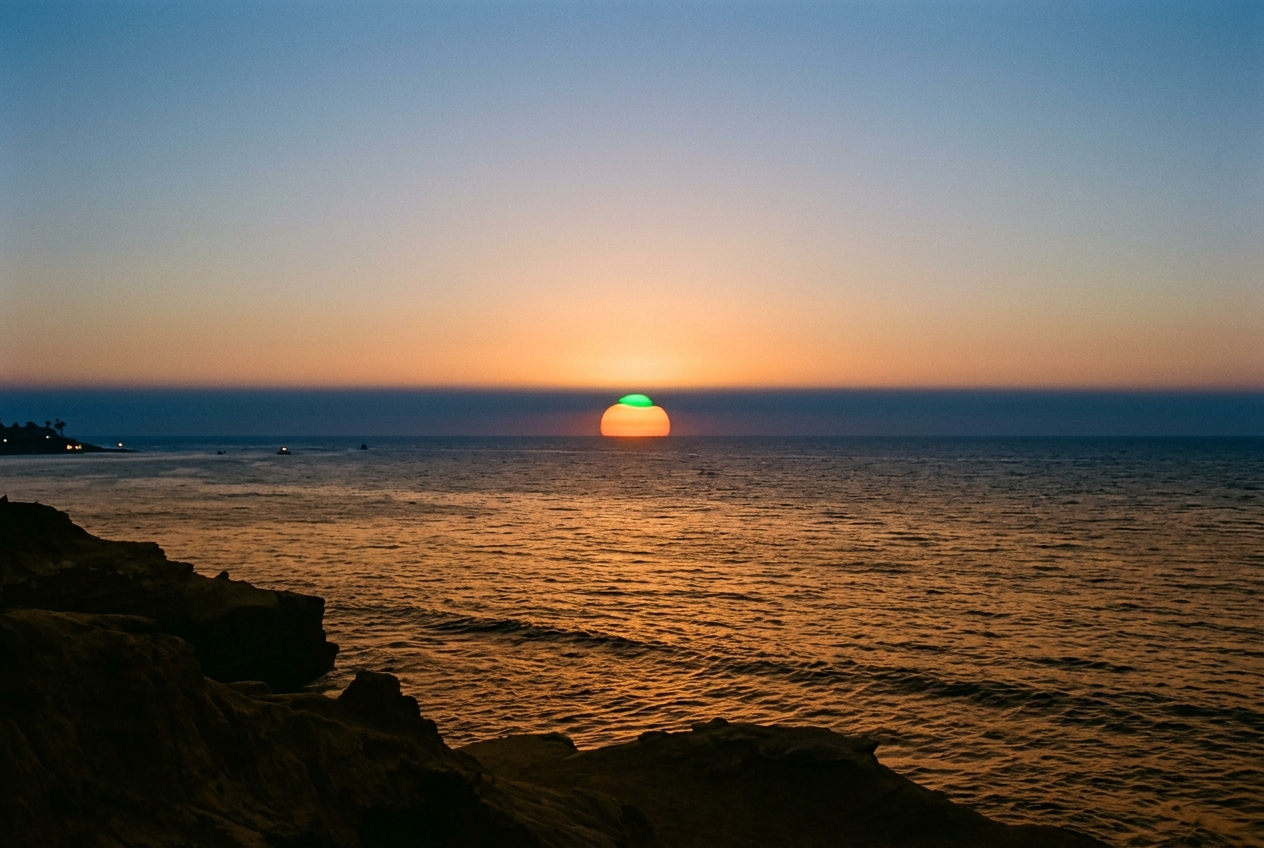
Standing on a wind-scoured coastal promontory at the edge of the Pacific as twilight approaches, the sensory theater of the boundary layer becomes unmistakable. The brisk afternoon sea breeze, having steadily forced cool, moisture-laden maritime air against the headland, begins to slacken. A perceptible chill descends across the exposed rocks as ground-level radiative cooling accelerates. The ambient pressure holds steady at 1018 hectopascals, while the western horizon reveals itself not as a hazy blur, but as a razor-sharp, cobalt-tinted line where an unobstructed ocean meets a cloudless lower troposphere.
As the sun settles into its final descent toward the astronomical horizon, its appearance warves and mutates. The blinding yellow orb of midday softens into a deep, striated amber, progressively compressed into an oblate oval as if pressed between invisible glass plates. In these terminal seconds, as the upper rim of the solar disc hovers merely fractions of an arcminute above the water, the familiar warm spectrum suddenly collapses. For an ephemeral interval—lasting perhaps one or two seconds—the final sliver of solar light detaches, shifts violently from orange through yellow, and ignites into an intense, incandescent emerald beacon before extinguishing into the dusk.
This transient phenomenon, long dismissed in folklore as an optical illusion or physiological afterimage of retinal fatigue, is in truth an exquisite manifestation of fluid mechanics, electromagnetic dispersion, and molecular scattering. Far from a subjective hallucination, the green flash represents Earth’s planetary atmosphere operating simultaneously as a spherical dispersive prism, an absorbing optical filter, and a meteorological magnifying lens.
1. What Is Actually Happening: The Atmosphere as a Prismatic Lens
To grasp why the setting sun produces an emerald crown, one must look at the air not as an empty void, but as a physical optical medium.
Think of the atmosphere as an enormous, concentric, layered cake wrapped around the curve of the Earth. The lowest layer, resting directly against the ocean surface, is compressed by the weight of all the air above it, making it dense and tightly packed with gas molecules. As one climbs higher in altitude, the air thins out and becomes progressively less dense.
When a beam of pure white sunlight travels through the vacuum of space, all its constituent colors—from the long, lazy waves of red light to the short, rapid ripples of blue and violet—travel at the identical speed of light ($c \approx 3 \times 10^8\text{ m/s}$). However, the moment this light strikes the curved upper boundary of Earth's atmosphere at a shallow angle, it enters a denser medium and slows down. Crucially, it does not slow down uniformly across all wavelengths.
Because shorter wavelengths of light (violet, blue, and green) interact more vigorously with the electromagnetic fields of nitrogen and oxygen molecules, they experience more resistance. Consequently, they slow down slightly more than the longer wavelengths (orange and red). According to Snell's law of refraction, the light that slows down the most is bent—or refracted—the most sharply toward the ground.
                                 [VACUUM OF SPACE]
                                  White Light Beam
                                      \
                                       \
  Upper Atmosphere                      \  Slight Bending
 - - - - - - - - - - - - - - - - - - - - \ - - - - - - - - - - - - - - - - - -
  Mid Troposphere                         \
                                           \  Differential Dispersion:
                                            \  - Red bends least
 - - - - - - - - - - - - - - - - - - - - - - \ -  - Green bends moderately - -
  Dense Surface Air                           \ \ \ - Blue/Violet bends most
                                               \ \ \
                                                \ \ \
                                                [OBSERVER]
                                              Red sets first,
                                            Green vanishes last
As the sun sinks toward the horizon, its light strikes the atmosphere at an extreme, glancing angle. The atmosphere acts like a giant glass prism: it splits the single solar disc into an infinite stack of overlapping colored discs. The red solar disc is bent the least, meaning it appears lowest in the sky and dips below the horizon first. The orange, yellow, green, blue, and violet discs are refracted progressively higher. At the absolute final moment of sunset, the red and orange sun has already sunk below the geometric horizon, leaving only the uppermost rim of short-wavelength light poised above the water.
The Paradox: Why Green and Not Violet?
If violet and blue light are refracted most strongly and therefore sit at the very highest tip of the prismatic stack, why does an observer almost never witness a "violet flash" or a "blue flash"?
The answer lies in atmospheric extinction along the line of sight. When the sun is high in the sky at noon, its rays traverse an air mass ($m$) equal to $1$—a direct, relatively thin vertical column of air. But when looking directly at the setting sun on the horizon, the light must travel tangentially through an immense cross-section of the planetary boundary layer and troposphere. The optical path length increases by nearly forty-fold ($m \approx 38$).
Along this massive gauntlet of air, two distinct selective filtration mechanisms eliminate the shortest wavelengths:
- Rayleigh Scattering: As formulated by Lord Rayleigh, the probability that a photon will be scattered out of the direct line of sight by air molecules is inversely proportional to the fourth power of its wavelength ($\sigma_R \propto \lambda^{-4}$). Because violet light ($\lambda \approx 400\text{ nm}$) has a wavelength roughly half that of red light ($\lambda \approx 700\text{ nm}$), it is scattered away roughly $(700/400)^4 \approx 9.4$ times more efficiently. Over an optical path of several hundred kilometers through dense air, nearly $100\%$ of violet and blue photons are scattered away into the surrounding sky, leaving the direct solar beam stripped of its shortest waves.
- Ozone Chappuis-Band Absorption: High in the stratosphere, ozone molecules possess an electronic absorption band (the Chappuis band) spanning the yellow and orange spectrum ($500\text{ nm}$ to $700\text{ nm}$, peaking near $600\text{ nm}$). While weak during normal vertical viewing, this absorption band becomes intensely active over the extreme horizontal path length of sunset, carving out the orange and yellow light.
Green light ($\lambda \approx 530\text{–}550\text{ nm}$) sits in a miraculous optical sweet spot: it is of sufficiently long wavelength to survive the gauntlet of Rayleigh scattering, yet positioned just outside the peak absorption of the Chappuis ozone band. With red and orange already below the horizon, and violet and blue scattered into oblivion, green emerges as the solitary survivor on the horizon's edge.
2. The Science: Refractive Geometry, Air Mass, and Thermal Mirage Lenses
To understand the exact mechanics of the green flash, we must examine the quantitative laws governing astronomical refraction, optical dispersion, and thermal lapse rates.
Dispersion and Astronomical Refraction
The refractive index of air, $n(\lambda)$, at standard temperature ($T_0 = 273.15\text{ K}$) and standard pressure ($P_0 = 1013.25\text{ hPa}$) is classically described by the Gladstone-Dale relation and modern dispersion formulas (such as the Edlén or Ciddor equations). To a first-order approximation:
$$(n(\lambda) - 1) \times 10^8 = 6432.8 + \frac{2949810}{146 - \lambda^{-2}} + \frac{25540}{41 - \lambda^{-2}}$$
where $\lambda$ is expressed in micrometers ($\mu\text{m}$). For a standard maritime atmosphere at sea level, the refractive index varies across the visible spectrum from $n \approx 1.000297$ for deep red ($680\text{ nm}$) to $n \approx 1.000305$ for blue-green ($500\text{ nm}$).
Under standard standard temperature and pressure lapse profiles, total astronomical refraction—the angular elevation offset $R(z_0)$ between an object's true astronomical zenith angle $z_0$ and its apparent refracted zenith angle—is governed at the horizon ($z_0 \approx 90^\circ$) by Bennett's or Saastamoinen's formulations documented by the Met Office and the World Meteorological Organization. For an observer at sea level, standard horizon refraction lifts the entire solar disc by approximately $34\text{ arcminutes}$ ($0.567^\circ$), an amount greater than the apparent diameter of the sun itself ($\sim 32\text{ arcminutes}$).
Because $n$ varies with wavelength, the total astronomical refraction is spectrally dependent:
$$R(\lambda) \approx (n(\lambda) - 1) \tan z_0$$
The vertical chromatic separation $\Delta R$ between the red limb ($\lambda_r = 656\text{ nm}$) and the blue-green limb ($\lambda_g = 500\text{ nm}$) under a standard standard atmosphere is:
$$\Delta R = R(\lambda_g) - R(\lambda_r) \approx 34\text{ arcmin} \times \left( \frac{n(500\text{ nm}) - n(656\text{ nm})}{n(500\text{ nm}) - 1} \right) \approx 35\text{ to }40\text{ arcseconds}$$
Equation 1: Beer-Lambert-Bouguer Transmission Across Horizon Air Mass
The spectral intensity $I(\lambda)$ reaching the observer's eye is governed by the Beer-Lambert-Bouguer extinction law:
$$I(\lambda) = I_0(\lambda) \cdot \exp\left[ -m \cdot \left( \tau_R(\lambda) + \tau_O(\lambda) + \tau_A(\lambda) \right) \right]$$
Where: - $I_0(\lambda)$ is the extraterrestrial solar spectral irradiance. - $m$ is the relative optical air mass (the ratio of the actual atmospheric path length to the vertical zenith path; $m \approx 38.0$ at the horizon under spherical geometry). - $\tau_R(\lambda)$ is the molecular Rayleigh optical depth per unit air mass. - $\tau_O(\lambda)$ is the stratospheric ozone optical depth (Chappuis band). - $\tau_A(\lambda)$ is the aerosol optical depth (Mie scattering).
Rayleigh optical depth is quantitatively defined as:
$$\tau_R(\lambda) \approx 0.008735 \cdot \lambda^{-4.08}$$
Worked Numerical Example: Let us compute the direct atmospheric transmission $T(\lambda) = I(\lambda)/I_0(\lambda) = \exp[-m \cdot \tau_R(\lambda)]$ at the astronomical horizon ($m = 38$) for clean, aerosol-free air, comparing violet ($\lambda = 400\text{ nm} = 0.400\ \mu\text{m}$) and green ($\lambda = 540\text{ nm} = 0.540\ \mu\text{m}$):
-
For Violet ($\lambda = 0.400\ \mu\text{m}$): $$\tau_R(0.400) = 0.008735 \cdot (0.400)^{-4.08} \approx 0.008735 \cdot 42.22 \approx 0.3688$$ Total optical thickness along horizon path: $$\tau_{\text{total, violet}} = 38 \times 0.3688 \approx 14.01$$ Transmission fraction: $$T(400\text{ nm}) = e^{-14.01} \approx 8.23 \times 10^{-7} \quad (0.000082\%)$$
-
For Green ($\lambda = 0.540\ \mu\text{m}$): $$\tau_R(0.540) = 0.008735 \cdot (0.540)^{-4.08} \approx 0.008735 \cdot 12.35 \approx 0.1079$$ Total optical thickness along horizon path: $$\tau_{\text{total, green}} = 38 \times 0.1079 \approx 4.10$$ Transmission fraction: $$T(540\text{ nm}) = e^{-4.10} \approx 0.0166 \quad (1.66\%)$$
The calculated ratio of surviving green light to violet light under pure Rayleigh conditions is:
$$\frac{T(540\text{ nm})}{T(400\text{ nm})} = \frac{1.66 \times 10^{-2}}{8.23 \times 10^{-7}} \approx 20,170$$
Green photons reach the observer's eye with more than twenty thousand times the intensity of violet photons. When combined with the Chappuis absorption of yellow light, the surviving transmission peak narrows into an isolated band between $520\text{ nm}$ and $560\text{ nm}$—rendering the surviving rim an unmistakable emerald hue.
The Mirage Magnifier: Ray Curvature and Vertical Temperature Lapse Rates
As noted, an angular dispersion of $\sim 35\text{ arcseconds}$ is insufficient on its own to produce a striking flash visible across miles of sea. The critical second ingredient is optical magnification caused by an atmospheric mirage.
A light ray traversing a vertical temperature gradient $dT/dz$ experiences a continuous curvature $\kappa = 1/\rho$, where $\rho$ is the radius of curvature of the ray. According to ray-tracing optics in non-homogeneous media:
$$\kappa = -\frac{1}{n} \frac{dn}{dz} \approx -\frac{dn}{dz}$$
By differentiating the ideal gas law and Gladstone-Dale relation with respect to geometric height $z$:
$$\frac{dn}{dz} = -(n - 1) \left[ \frac{g}{R_d T} + \frac{1}{T} \frac{dT}{dz} \right]$$
where $g = 9.80665\text{ m/s}^2$ is gravitational acceleration, $R_d \approx 287.05\text{ J/(kg}\cdot\text{K)}$ is the specific gas constant for dry air, and $T$ is temperature in Kelvin.
                                [LIGHT RAY TRAJECTORIES]
 (A) STANDARD ATMOSPHERE               (B) INFERIOR MIRAGE (Warm Sea)
  dT/dz = -0.0065 K/m                   dT/dz << -0.034 K/m (Super-adiabatic)

Cool Air (Higher density)              Cool Air (High density, high n)
      \                                      \
       \  Mild downward bend                  \  Upward concave curvature
        \  (Curvature < Earth)                 \  near surface (Ray bounces)
         \                                      \___/
  Mild Surface                           Warm Sea Surface (Low density, low n)
When air density decreases with altitude at standard rates ($dT/dz \approx -0.0065\text{ K/m}$), light rays bend downward toward the center of the Earth with a radius of curvature roughly four to five times Earth's radius ($\rho \approx 4 R_E$). However, when an anomalous vertical temperature gradient exists near the surface, the ray curvature can change dramatically:
- Super-Adiabatic Gradient ($dT/dz < -0.034\text{ K/m}$): If the sea surface is significantly warmer than the overlying air, a sharp temperature drop occurs in the lowest few meters. Here, density increases rapidly with height, causing $dn/dz > 0$. The light rays bend upward (concave up). This creates an inferior mirage, projecting an inverted image of the setting sun below the true object.
- Thermal Inversion ($dT/dz > +0.114\text{ K/m}$): If a layer of warm air overlies cold air, density drops precipitously with height. Ray curvature exceeds the curvature of the Earth itself ($\rho < R_E$), causing rays to bend sharply downward. This creates a superior mirage or a mock mirage, projecting magnified or multiple upright and inverted slices of the solar limb above the true horizon.
3. The Four Meteorological Classes of Green Flashes
Detailed classifications established by atmospheric opticists, including research cataloged by Andrew T. Young at SDSU and documented through the NOAA Global Monitoring Laboratory, divide green flashes into four distinct physical categories based on their underlying thermal structure.
1. The Inferior-Mirage Green Flash
- Atmospheric State: The ocean surface is notably warmer than the marine boundary layer air ($T_{\text{sea}} - T_{\text{air}} \ge 2\text{ to }5^\circ\text{C}$). A super-adiabatic lapse rate is established within the lowest $1\text{ to }2\text{ meters}$ above the surface.
- Optical Morphology: As the lower limb of the sun nears the horizon, an inverted mirage of the sun rises from below the horizon to meet it, forming an hourglass or Greek vase ("Etruscan vase") shape. As the sun sinks further, the upper corners of the clipped solar disc fold together. The vertical magnification produced by the mirage's fold catastrophe stretches the $35\text{-arcsecond}$ green dispersion strip into a distinct, brilliant green oval or pair of green "horns" that linger for $1\text{ to }2\text{ seconds}$.
- Observer Vantage: Low elevation relative to the water line (e.g., on a beach, ship deck, or coastal bench $2\text{ to }10\text{ meters}$ above sea level).
2. The Mock-Mirage Green Flash
- Atmospheric State: A strong, elevated temperature inversion layer exists aloft (typically between $20\text{ and }200\text{ meters}$ elevation), where warm continental or descending air sits above a cooler marine boundary layer ($dT/dz \gg 0$).
- Optical Morphology: As the upper edge of the sun crosses the thermal inversion layer, the differential refraction creates a horizontal strip or "notch" that appears to detach from the top of the sun. This detached flat segment becomes pure emerald green before shrinking and dissolving. Because multiple inversion layers can exist concurrently, observers often record two or three stacked mock-mirage flashes sequentially.
- Observer Vantage: The observer must be situated above the base of the inversion layer looking down through it across a long horizontal path length (e.g., on a seaside cliff, coastal mountain highway, or lighthouse tower $50\text{ to }300\text{ meters}$ high).
3. The Ducting (Novaya Zemlya) Green Flash
- Atmospheric State: An exceptionally strong, sustained thermal inversion layer with large horizontal extent creates an atmospheric "duct" where ray curvature matches the curvature of the Earth over hundreds of kilometers.
- Optical Morphology: Rays of green light are trapped within the boundary waveguide, traveling far past the geometric horizon. The sun appears distorted into flat rectangular plates or layered bands, and the green flash can endure for an astonishing $10\text{ to }30\text{ seconds}$, or even persist intermittently as an observer walks along an elevation contour. First famously recorded during polar expeditions (such as the Novaya Zemlya effect), it occasionally appears across mid-latitude coastal waters during strong anticyclonic subsiding conditions.
4. The Green Ray
- Atmospheric State: A combination of a strong superior mirage and an exceptionally clear, pristine atmosphere with nearly zero aerosol content (Mie optical depth $\tau_A \approx 0$).
- Optical Morphology: At the instant of the flash, a narrow, pencil-thin beam of green light shoots vertically upward from the horizon into the twilight sky to a height of several degrees. This rare phenomenon occurs when the miraged green fringe acts as an illuminated slit source whose light is collimated and scattered along a shallow haze layer or clean column of air directly above the horizon.
4. Practical Field Guidance for Outdoor Observers
Spotting a green flash requires neither high-end astronomical equipment nor exotic expeditions, but rather a keen understanding of atmospheric cues, local micro-meteorology, and strict eye safety.
What to Look for in the Atmosphere and Horizon
- Horizon Definition: The single most critical precondition is a clean, sharp, distant horizon. If the setting sun turns a deep, muddy red or dark crimson while still several degrees above the horizon, atmospheric aerosol extinction (dust, haze, or smoke) is too high. Under high turbidity, green light is extinguished along with blue. The ideal sunset begins with a sun that remains bright yellow or pale orange all the way to the water's edge.
- Solar Disc Distortion: Watch the shape of the sun during the final $2\text{ to }3\text{ minutes}$ of descent: * If the bottom of the sun flattens and grows a "foot" or base that reaches down to meet the horizon (forming an inverted omega $\Omega$ shape), an inferior mirage is active. Prepare for an inferior-mirage flash at the lowest possible vantage point. * If the edges of the sun appear stepped, notched, or sliced horizontally like layered wafers, one or more thermal inversions are active. Step up to an elevated headland or higher vantage to position your sightline through the inversion plane for a mock-mirage flash.
Instrument Readings to Monitor
- Barometer: High-pressure systems ($> 1020\text{ hPa}$) characterized by broad atmospheric subsidence create strong thermal inversions and stable boundary layers, ideal for mock-mirage and ducting flashes.
- Thermometer ($T_{\text{sea}}$ vs $T_{\text{air}}$): Check coastal buoy telemetry (such as from NOAA NDBC). If the sea surface temperature is higher than the ambient air temperature ($T_{\text{sea}} - T_{\text{air}} \ge 2^\circ\text{C}$), an inferior mirage is virtually guaranteed over calm water. If the air is significantly warmer than the water, look for superior and mock mirages from elevated lookouts.
- Wind: Calm conditions to light breezes ($< 5\text{ to }8\text{ knots}$) prevent turbulent mechanical mixing of boundary layer air, preserving the laminar thermal gradients necessary for sharp optical surfaces.
Critical Optical Safety Protocol
Never stare directly at the un-attenuated sun with the naked eye, and NEVER track the setting sun through unfiltered binoculars, telephoto lenses, or telescopes. Doing so risks irreversible photochemical and thermal retinal burns.
- Keep your gaze directed slightly away from the sun, or shield your eyes until only the final upper $10\%$ of the solar disc remains visible above the horizon.
- Glancing at the sun only during its final $3\text{ to }5\text{ seconds}$ of setting prevents your retinal cone cells from bleaching (which induces a false reddish-purple afterimage that can mask or mimic green hues).
- If using high-magnification telephoto lenses or cameras, view exclusively through an electronic LCD screen or digital viewfinder, never through an optical glass viewfinder.
5. Today's Meteorological Rule of Thumb
[!TIP] The Horizon Clarity Rule: If the sun remains bright yellow or brilliant pale orange until its final contact with a crisp ocean horizon, the air is clean enough for green light to survive; if the disc turns dark red or vanishes into a hazy soup before touching the water, Rayleigh scattering and aerosols have consumed the flash.
The green flash is not a lucky accident of nature, but the predictable, deterministic physics of a planetary atmosphere. When the thermodynamics of the boundary layer align with astronomical geometry, the horizon transforms into a grand spectrometer—offering those who understand the sky a fleeting, brilliant glimpse of pure emerald twilight.
Authoritative References and Further Reading
- Detailed optical proofs and observational taxonomies: Andrew T. Young's Green Flash Research at SDSU
- Global atmospheric observation standards: World Meteorological Organization (WMO)
- Solar radiation and atmospheric monitoring datasets: NOAA Global Monitoring Laboratory
- Atmospheric optics and refraction physics: Wikipedia: Green Flash and Wikipedia: Atmospheric Refraction
- Boundary layer thermodynamics and meteorological observation: Met Office UK Meteorological Archive