Fallstreak Holes & Supercooled Droplet Glaciation: How Localized Adiabatic Expansion and Ice Crystal Cascades Carve Expanding Voids in Altocumulus Decks
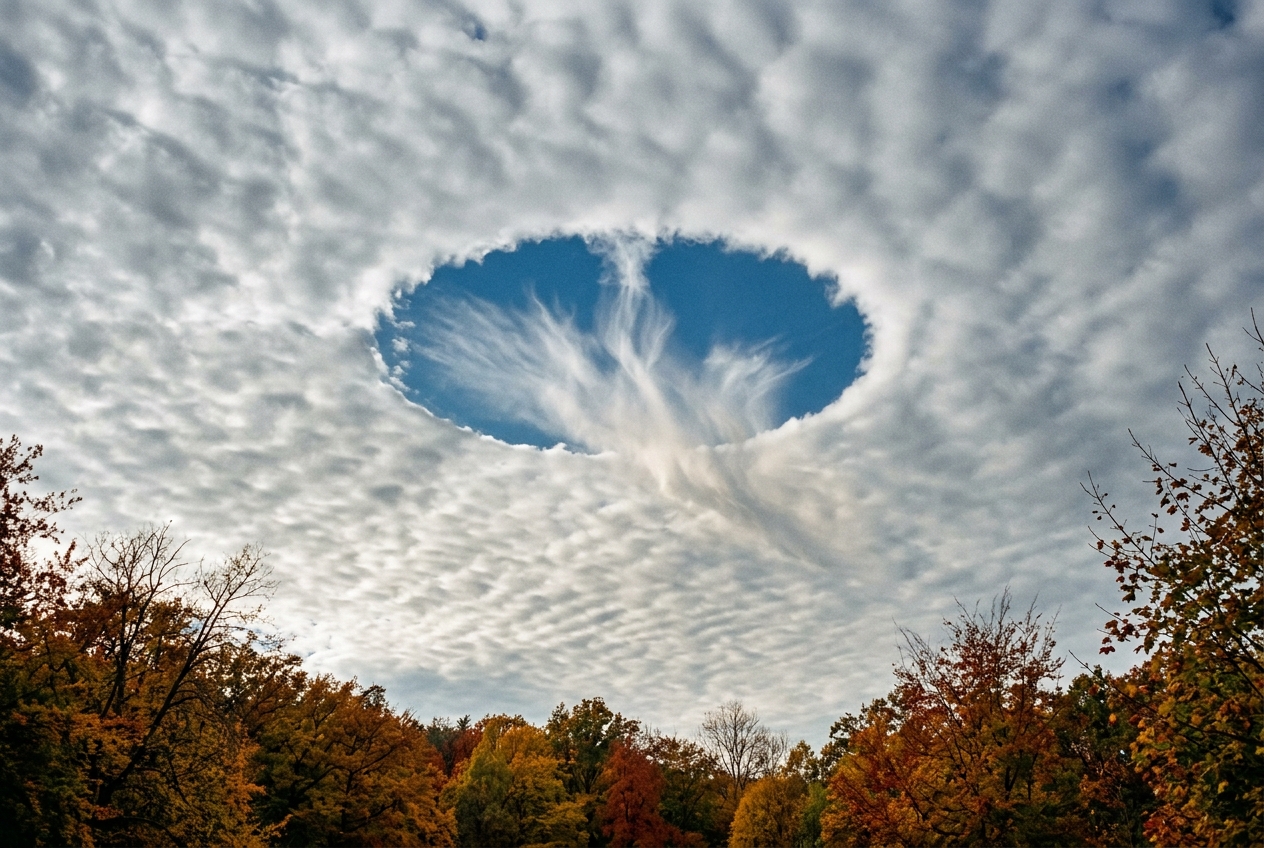
On a quiet, wind-scoured afternoon in late November, the sky above the undulating hills of the English South Downs presented a seamless sheet of altocumulus stratiformis perlucidus. From horizon to horizon, the cloud canopy stretched like a vast, quilted pavement of dull pearl, dappled with thousands of tiny, ripple-like cloudlets. The air at ground level was sharp and still, hovering just above four degrees Celsius, carrying the damp, earthen scent of rotting beech leaves and drying flint. There was no precipitation, no squall line on the horizon, and no barometric drama registered on the dial of a pocket aneroid barometer. To any casual walker, the heavens appeared static, locked in the quiet stasis of an autumnal high-pressure ridge.
       UNTOUCHED ALTOCUMULUS SHEET (Supercooled Droplets at -15°C)
  ~~~~~~~~~~~~~~~~~~~~~~~~~~~~~~~~~~~~~~~~~~~~~~~~~~~~~~~~~~~~~~~~~
             \             AIRCRAFT PASSAGE             /
              \    (Adiabatic Expansion Chills to -40°C)   /
  ~~~~~~~~~~~~~~\                                         /~~~~~~~~~~~~
  Liquid Cloud   \         GROWING CAVUM APERTURE        / Liquid Cloud
  Evaporates      \         (Subsaturated for H2O)      /  Evaporates
  ~~~~~~~~~~~~~~~  \                                   /   ~~~~~~~~~~~~
                    \      CENTRAL GLACIATION CORE    /
                     \       (Ice Crystal Plume)     /
                      \                             /
                       \     FALLSTREAK / VIRGA    /
                        :  .  *  .  *  .  *  .  *  :
                        : *  .  *  .  *  .  *  . * :
                        :   *  .  *  .  *  . *   . :
                             (Sundog / Parhelion)
Then, without sound or seismic warning, the canopy fractured.
Directly overhead, a circular incision appeared in the cloud deck as though stamped out by an immense, invisible cookie-cutter. Over the course of fifteen minutes, this modest aperture dilated into an amphitheatre of pure blue sky over two kilometres wide. The perimeter of the hole remained astonishingly crisp, an elliptical cliff of grey cloud standing against the void. Inside this clearing, however, the sky was not entirely empty. From the centre of the breach hung a ghostly, cascading veil of brilliant white filaments—a silky, fibrous tassel drifting downward through the azure opening like the tentacles of a colossal, suspended jellyfish. As late-afternoon sunlight struck these descending plumes, a blinding splash of rainbow-tinted light ignited along the hole’s southern edge: a solitary, glowing parhelion, or sundog, suspended in isolation beneath an otherwise grey firmament.
This striking spectacle is known formally in the World Meteorological Organization International Cloud Atlas as cavum, and colloquially among aviators and meteorologists as a fallstreak hole or hole-punch cloud. While historically mistaken for flying saucers, localized missile launches, or clandestine atmospheric experiments, the phenomenon is a masterclass in atmospheric thermodynamics and non-equilibrium microphysics: a runaway chain reaction sparked when modern aviation pierces one of the atmosphere’s most delicate metastable states.
What’s Actually Happening: The Cloud That Forgot to Freeze
To understand how a steel aircraft can dissolve miles of cloud in a matter of minutes, one must first dismantle a common scientific misconception: the idea that liquid water automatically turns to ice at zero degrees Celsius.
In the free troposphere, pure water droplets do not freeze at zero degrees. Water requires an architectural template—a microscopic impurity known as an ice nucleating particle (INP), such as a speck of mineral dust, an aerosolised clay platelet, or a biological spore—to help its molecules overcome the energetic barrier of arranging themselves into a solid hexagonal lattice. In the pristine mid-levels of the atmosphere, between 2,000 and 6,000 metres aloft, these freezing templates are exceptionally scarce.
Consequently, clouds floating at temperatures between $-10^\circ\text{C}$ and $-35^\circ\text{C}$ are frequently composed entirely of liquid water. Meteorologists call this supercooled liquid water (SLW). These droplets exist in a precarious state of thermodynamic suspended animation, known as metastability. Think of a supercooled cloud as a vast room filled with mousetraps, each primed with a ping-pong ball. The room is quiet and stable; the traps do not spring on their own. But introduce a single sudden disturbance, and the entire system cascades into instant, irreversible transformation.
+-------------------------------------------------------------------------+
|                  THE METASTABLE SUPERCOOLED REGIME                      |
|                                                                         |
|   0°C                      -15°C                      -38.5°C           |
|  [---------------------------|---------------------------|--------->    |
|   Heterogeneous Nucleation    Metastable Cloud Deck       Homogeneous   |
|   (Requires Active INPs)     (Supercooled Liquid Water)   Freezing Limit|
|                               Aircraft Passage Triggers   (All Droplets |
|                               Flash Glaciation Cascade    Freeze Inst.) |
+-------------------------------------------------------------------------+
When an aircraft ascends or descends through this supercooled layer, its engines and wings do not warm the air; they violently cool it. As air accelerates over the curved upper surface of an airfoil or spins off the tips of propellers and wing flaps, its local pressure plummets. Under the laws of fluid dynamics, when a parcel of air expands adiabatically (without exchanging heat with its surroundings), its temperature drops instantaneously.
If this aerodynamic cooling drives the local parcel temperature below the critical homogeneous nucleation threshold of $-38.5^\circ\text{C}$ (roughly $-40^\circ\text{C}$), the water molecules no longer require any mineral dust to freeze. They spontaneously collapse into billions of microscopic ice crystals within a fraction of a second.
Once these pioneer ice crystals emerge, a predatory thermodynamic mechanism takes over: the Wegener-Bergeron-Findeisen (WBF) process. Because water molecules bind more tightly within a solid crystal lattice than within a liquid droplet, the saturation vapour pressure over ice is substantially lower than that over liquid water at the same sub-zero temperature.
In plain terms: ice is far "drier" and far more absorbent than liquid water. The newborn ice crystals act like microscopic moisture vacuums, greedily pulling water vapour directly out of the surrounding air. In response, the surrounding supercooled liquid cloud droplets find themselves in air that has suddenly become parched; they evaporate into vapour to replace the deficit, only for that newly released vapour to be instantly consumed by the growing ice crystals.
Within minutes, billions of liquid droplets vanish into thin air, leaving behind an expanding, crystal-clear aperture. Meanwhile, the gorged ice crystals grow heavy, falling out of the cloud deck in a fibrous curtain of virga—the central fallstreak.
The Science: Aerodynamic Refrigeration and Microphysical Cascades
For those seeking to explore the quantitative mechanics governing this atmospheric rupture, the phenomenon unfolds across three linked physical steps: aerodynamic cooling, vapour pressure divergence, and crystal deposition kinetics.
1. Aerodynamic Expansion and Flash Freezing
The initial trigger relies on the compressible flow of air over lifting surfaces. As an aircraft flies through an altocumulus deck at true airspeed $v_\infty$, the local flow velocity $v$ over the wing's suction peak or around trailing vortex cores accelerates dramatically. Applying the steady-flow energy equation for an ideal gas under adiabatic conditions, the localized temperature drop $\Delta T$ experienced by an air parcel is given by:
$$\Delta T = -\frac{v^2 - v_\infty^2}{2 C_p}$$
where $C_p$ is the specific heat capacity of dry air at constant pressure ($1005\text{ J}\cdot\text{kg}^{-1}\cdot\text{K}^{-1}$). In the core of intense wingtip vortices or across the supersonic blade tips of turboprop aircraft, localized pressure drops are severe.
                                  AIRFLOW OVER AIRFOIL
                               Velocity Accelerates (v >> v_inf)
                                Pressure Plummets (P -> P_min)
                              . - - - - - - - - - - - .
                           . '                         ' .
     Airflow (v_inf) ---> /   _________________________   \ ---> Exhaust
                         |   /                         \   |
                         |  /      AIRCRAFT WING        \  |
                          \ \___________________________/ /
                           .                             .
                              ' - - - - - - - - - - - '
                               Adiabatic Cooling Zone:
                               Delta_T = -v^2 / (2 * C_p)
                         Chills Ambient Air past -40°C Threshold
Consider a commercial turbofan aircraft penetrating an altocumulus deck situated at an altitude of 5,500 metres, where ambient pressure $P_0 = 500\text{ hPa}$ and ambient temperature $T_0 = -15^\circ\text{C}$ ($258.15\text{ K}$). Around the tips of the wings and flaps during high-lift descent, localized vortex core velocities can exceed induced tangential speeds of $u_\theta \approx 70\text{ m}\cdot\text{s}^{-1}$.
Across the blade tips of a descending turboprop transport, local flow acceleration relative to the ambient air often reaches $v \approx 225\text{ m}\cdot\text{s}^{-1}$. Calculating the resulting aerodynamic temperature depression:
$$\Delta T \approx -\frac{(225\text{ m}\cdot\text{s}^{-1})^2}{2 \times 1005\text{ J}\cdot\text{kg}^{-1}\cdot\text{K}^{-1}} = -\frac{50625}{2010} \approx -25.2\text{ K}$$
This instantaneous thermal drop plunges the air passing through the propeller wash from its ambient $-15^\circ\text{C}$ down to:
$$T_{\text{local}} = -15^\circ\text{C} - 25.2^\circ\text{C} = -40.2^\circ\text{C}$$
Because $T_{\text{local}} \le -38.5^\circ\text{C}$, the supercooled droplets trapped within this airflow cross the homogeneous freezing threshold. Spontaneous nucleation occurs without requiring any foreign particulate matter. In less than a second, millions of cubic metres of air are seeded with pristine ice embryos.
2. The Saturation Vapour Pressure Deficit ($\Delta e_s$)
The rapid evacuation of the surrounding cloud deck is governed by the Clausius-Clapeyron equation, which dictates the equilibrium vapour pressure over liquid water ($e_{s,w}$) versus hexagonal ice ($e_{s,i}$). For any temperature $T$ (in Kelvin below freezing), the saturation vapour pressures can be accurately parameterized via the Goff-Gratch formulations:
$$e_{s,w}(T) = e_0 \exp\left[\frac{L_v}{R_v}\left(\frac{1}{T_0} - \frac{1}{T}\right)\right]$$
$$e_{s,i}(T) = e_0 \exp\left[\frac{L_s}{R_v}\left(\frac{1}{T_0} - \frac{1}{T}\right)\right]$$
Here, $L_v \approx 2.50 \times 10^6\text{ J}\cdot\text{kg}^{-1}$ is the latent heat of vaporization, $L_s \approx 2.83 \times 10^6\text{ J}\cdot\text{kg}^{-1}$ is the latent heat of sublimation, $R_v = 461.5\text{ J}\cdot\text{kg}^{-1}\cdot\text{K}^{-1}$ is the specific gas constant for water vapour, and $e_0 = 6.112\text{ hPa}$ at $T_0 = 273.15\text{ K}$.
Because $L_s > L_v$, the saturation curve for ice diverges downward from that of liquid water as temperatures drop.
+-------------------------------------------------------------------------+
|                  SATURATION VAPOUR PRESSURE REGIME                      |
|                                                                         |
|  Vapour Pressure (hPa)                                                  |
|   ^                                                                     |
|   |                      / e_s,w (Water Saturation Curve)               |
|   |                     /                                               |
|   |                    /      Vapour Deficit Region:                    |
|   |                   /  *    Air is SUPERSATURATED for Ice (S_i > 1)   |
|   |                  /  *     Air is SUBSATURATED for Water (S_w < 1)   |
|   |                 /  *                                                |
|   |                / *   e_s,i (Ice Saturation Curve)                   |
|   |               /*                                                    |
|   +--------------/------------------------------------------------->    |
|               -30°C         -15°C (Max Deficit)       0°C  Temp         |
+-------------------------------------------------------------------------+
At the cloud deck temperature of $T = -15^\circ\text{C}$ ($258.15\text{ K}$): - Saturation vapour pressure over water: $e_{s,w}(-15^\circ\text{C}) \approx 1.912\text{ hPa}$ - Saturation vapour pressure over ice: $e_{s,i}(-15^\circ\text{C}) \approx 1.652\text{ hPa}$
The resulting vapour pressure deficit is:
$$\Delta e_s = e_{s,w} - e_{s,i} = 1.912\text{ hPa} - 1.652\text{ hPa} = 0.260\text{ hPa}$$
This thermodynamic gap establishes a relative humidity with respect to ice ($RH_i$) within the ambient cloud of:
$$RH_i = \frac{e_{s,w}}{e_{s,i}} \times 100\% = \frac{1.912}{1.652} \times 100\% \approx 115.7\%$$
The ambient cloud air is supersaturated with respect to ice by nearly $16\%$.
3. Depositional Mass Growth and Cavum Propagation
Driven by this steep vapour gradient, the ice crystals grow via direct vapour deposition. The mass growth rate $\frac{dm}{dt}$ of an individual hexagonal ice crystal modeled as an oblate spheroid with electrostatic capacitance $C$ is given by the classical diffusion equation:
$$\frac{dm}{dt} = \frac{4 \pi C (S_i - 1)}{\left(\frac{L_s}{R_v T} - 1\right)\frac{L_s}{K T} + \frac{R_v T}{e_{s,i}(T) D_v}}$$
where $S_i = \frac{e}{e_{s,i}}$ is the saturation ratio over ice, $K$ is the thermal conductivity of air ($0.024\text{ W}\cdot\text{m}^{-1}\cdot\text{K}^{-1}$), and $D_v$ is the diffusivity of water vapour in air ($\approx 2.1 \times 10^{-5}\text{ m}^2\cdot\text{s}^{-1}$).
As ice crystals absorb vapour, the ambient vapour pressure $e$ drops below $e_{s,w}$ ($1.912\text{ hPa}$). The surrounding liquid droplets immediately find themselves in a subsaturated environment ($RH_w < 100\%$). Under these conditions, the liquid droplet radius $r$ diminishes according to the Maxwellian evaporation rate:
$$r \frac{dr}{dt} = \frac{S_w - 1}{F_k + F_d}$$
where $S_w = \frac{e}{e_{s,w}} < 1$. For typical altocumulus cloud droplets with initial radii $r_0 \approx 5\text{ to }8\,\mu\text{m}$, total evaporation occurs within 10 to 30 seconds.
+=========================================================================+
|             THERMODYNAMIC MASS-FLUX BALANCE BOX                         |
+=========================================================================+
|  Ambient Deck Temp: -15.0°C        |  Ambient Pressure: 500 hPa         |
|  Liquid Equilibrium e_s,w: 1.91 hPa|  Ice Equilibrium e_s,i: 1.65 hPa   |
|  Ice Supersaturation: +15.7%       |  Liquid Droplet Lifespan: < 25 sec |
|  Mean Crystal Growth: ~1.2 um/s    |  Terminal Settling Vel: 0.85 m/s   |
|  Cavum Radial Growth: 1.5 - 3.2 m/s|  Dominant Habit: Hexagonal Plates  |
+=========================================================================+
As the newly formed ice crystals expand to diameters exceeding $100\,\mu\text{m}$, their mass overcomes the weak cloud updrafts. Their terminal settling velocity $v_t$, governed by the balance between gravitational force and aerodynamic drag at low Reynolds numbers, reaches:
$$v_t = \frac{2 \rho_{\text{ice}} g r_{\text{eff}}^2}{9 \eta_{\text{air}}} \approx 0.5\text{ to }1.2\text{ m}\cdot\text{s}^{-1}$$
The falling crystals form the characteristic central virga curtain. Latent heat released during deposition ($\approx 2.83\text{ MJ}\cdot\text{kg}^{-1}$ of ice) warms the air within the glaciated column slightly ($0.2\text{ to }0.5\text{ K}$), inducing weak buoyancy anomalies and turbulent mixing along the hole's perimeter. This radial circulation feeds fresh supercooled droplets into the glaciating boundary, driving an outward propagation rate of the hole's rim at speeds of $1.0\text{ to }3.5\text{ m}\cdot\text{s}^{-1}$ ($3.6\text{ to }12.6\text{ km}\cdot\text{h}^{-1}$). The hole continues to expand until wind shear, subsidence, or a transition to unsaturated ambient air halts the microphysical chain reaction.
Practical Outdoor Guidance: Spotting and Reading the Glaciation Trail
Spotting a cavum formation requires no specialized laboratory equipment, but it does demand an understanding of sky conditions, atmospheric layering, and local aviation patterns. Whether you are an amateur naturalist, a coastal sailor, or a mountain walker, the following field guide will help you identify, track, and interpret these events.
                  ANATOMY OF A MATURE CAVUM APERTURE

                      Sharp Evaporative Boundary
                            |
   ALTOCUMULUS DECK         v           BLUE SKY           ALTOCUMULUS DECK
  [==================]               . - - - - .          [==================]
  [Supercooled Liquid]              '           '         [Supercooled Liquid]
  [===== -15°C ======]             /             \        [===== -15°C ======]
                                  /   SUNLIGHT    \
                                 |        \        |
                                  \        \      /
                                   \     ___v____/
                                    ' . ( Parhelion ) . '
                                         \ * * * /
                                          \ * * /
                                           \ * /  <--- Descending Hexagonal
                                            \ /        Ice Crystal Virga
                                             V
1. Identifying the Ideal Sky Canvas
Cavum cannot form in common low-level stratocumulus or deep rain clouds. Search for thin, stratiform mid-level cloud sheets: * Target Cloud Genera: Altocumulus stratiformis (often displaying a speckled, curdled, or "mackerel" texture) and high-based Cirrocumulus. * Visual Clues of Supercooling: The cloud sheet should appear thin and semi-translucent, allowing the disc of the sun to be visible with sharp margins. If the cloud exhibits corona rings (small, concentric coloured rings clinging closely to the sun or moon), the layer is composed of uniform liquid water droplets—the ideal fuel for glaciation. * Cloud Base Altitude: Typically between 2,500 and 6,000 metres (8,000 to 20,000 feet).
2. Monitoring Instruments and Synoptic Conditions
- Barometric Setting: Cavum is most frequently observed on the periphery of slow-moving anticyclones (high-pressure systems) or within the stable warm sectors ahead of approaching warm fronts. Look for steady or slowly falling barometric pressures ($1016\text{ to }1028\text{ hPa}$) with minimal surface gustiness.
- Aviation Geometry: Circular holes appear when an aircraft ascends or descends through the cloud deck at a steep angle (such as planes climbing out of or descending into regional airports). Long, straight, or canal-like clearings occur when an aircraft cruises horizontally through a shallow supercooled layer. Tracking flight corridors using public ADS-B transponder maps will often reveal that a newly formed rift aligns precisely with the track of a recent turboprop or jet climb-out.
+-------------------------------------------------------------------------+
|                  FIELD OBSERVATION PROTOCOL CHECKLIST                   |
+-------------------------------------------------------------------------+
| [ ] 1. SCAN for Altocumulus perlucidus decks with distinct sun disc     |
| [ ] 2. VERIFY presence of corona (confirms liquid water composition)    |
| [ ] 3. LOCATE regional airport arrival/departure corridors overhead     |
| [ ] 4. INSPECT central virga tendrils for 22° parhelia (sundogs)        |
| [ ] 5. TRACK expansion: Measure angular diameter over 15-minute intervals|
+-------------------------------------------------------------------------+
3. Anticipating Fleeting Optical Displays
When observing a cavum fallstreak, position yourself so the falling virga column is aligned between your eye and the sun. Because the Bergeron-Findeisen process fosters slow, pristine depositional growth, the falling ice crystals almost universally assume the form of flat, hexagonal plate prisms. As these plates settle through the air, aerodynamic drag forces them to orient horizontally, with their broad faces parallel to the ground.
This uniform orientation creates natural prisms. Look for: * Parhelia (Sundogs): Bright, coloured spots of light appearing at an angular distance of $22^\circ$ to the left or right of the sun, directly embedded within the descending fallstreak. * Circumzenithal Arcs: If the sun is low (less than $32^\circ$ above the horizon), look directly overhead for an intense, upside-down rainbow arc formed by light entering the flat top faces of the plate crystals and exiting their vertical side faces. * Sub-Suns: When viewing a cavum from an elevated vantage point (such as an aircraft or mountain summit), look downward onto the ice fallstreak to spot an unrefracted, blinding white reflection of the sun mirrored off the falling crystals.
Today’s Meteorological Rule of Thumb
The Ice-and-Aperture Axiom: Whenever you observe a thin, speckled altocumulus sheet on a quiet, sub-zero afternoon, look along active flight paths: if an aircraft pierces this supercooled layer, aerodynamic expansion will chill the air past $-40^\circ\text{C}$, triggering a runaway Bergeron cascade that consumes the liquid cloud, carves a widening circular void, and drops a curtain of ice prisms into the clear air beneath.
Atmospheric Physics Reference & Further Reading
- Detailed cloud classifications and official microphysical definitions are maintained by the World Meteorological Organization (WMO) Cloud Atlas.
- Educational resources on cloud thermodynamics, ice nucleation thresholds, and droplet states can be explored through the Met Office Cloud Guide and the NOAA National Weather Service Glossary.
- Mathematical formulations for the Bergeron-Findeisen process and vapor-ice equilibria are archived in the American Meteorological Society (AMS) Glossary of Meteorology.
- Satellite imagery and high-altitude photography of extensive cavum fields across continental air corridors can be accessed via NASA Earth Observatory and comprehensive historical documentation on Wikipedia: Fallstreak Hole.