Circumhorizontal Arc & Ice Crystal Prism Optics: How 90° Refraction and Solar Elevation Thresholds Forge Vibrant Spectral Ribbons
By Alexander Vance, Science Correspondent
I. THE MIDDAY APPARITION: AN OPENING ENCOUNTER
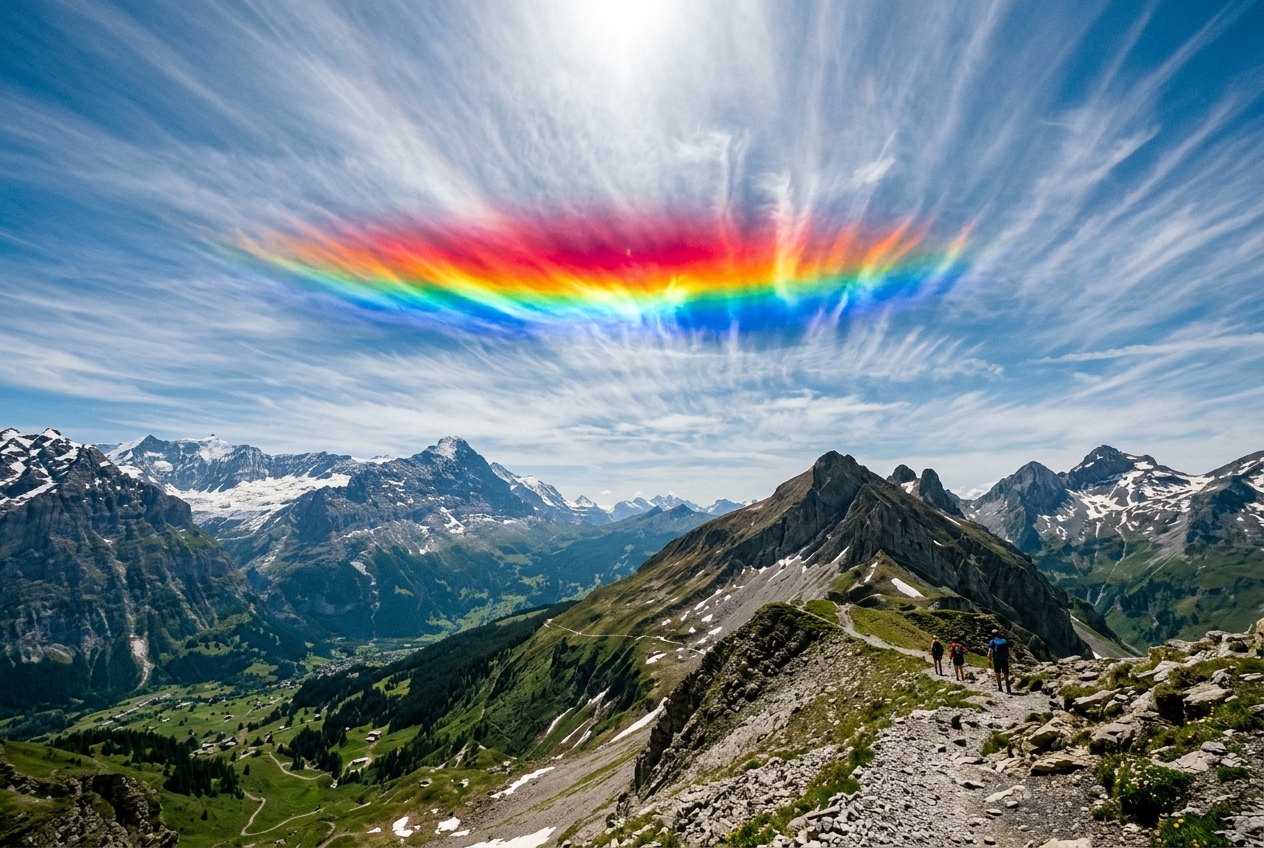
Stand beneath the high zenith of a midsummer noon in the temperate latitudes, and the atmosphere presents an illusion of static, sweltering calm. The asphalt radiates waves of refractive turbulence, the cicadas maintain their dry, resonant drone, and the midday sun—incandescent, oppressive, and positioned almost sixty-five degrees above the southern horizon—drowns the vault of heaven in blinding azure. To look directly upward is impossible. Yet, if one directs their gaze southward, approximately twenty degrees above the level horizon, the pale cerulean ceiling suddenly ruptures into an astonishing, unearthly ribbon of spectral luminescence.
       [ HIGH NOON SUN ] (Solar Elevation h_s > 58°)
              \
               \  Incident Solar Ray
                \
   ~ ~ ~ ~ ~ ~ ~ v ~ ~ ~ ~ ~ ~ ~ ~ ~ ~ ~ ~ ~ ~ ~ ~ ~ ~ ~ ~ ~ ~ ~ ~ ~ ~
     CIRRUS DECK (9,000 m, -25°C): Horizontally Aligned Hexagonal Plates
   ~ ~ ~ ~ ~ ~ ~ ~ ~ ~ ~ ~ ~ ~ ~ ~ ~ ~ ~ ~ ~ ~ ~ ~ ~ ~ ~ ~ ~ ~ ~ ~ ~ ~
                 |
                 | 90° Refraction (Prism Entry: Side, Exit: Bottom)
                 v
   ===================================================================
     CIRCUMHORIZONTAL ARC: Brilliant Vivid Ribbon (Parallel to Horizon)
   ===================================================================
                                      \
                                       \ (Observer Line of Sight ~22°)
                                        v
                                   [ OBSERVER ]
This is not a conventional rainbow. There is no curtain of falling summer rain, no dark anvil of a retreating cumulonimbus, and no curved bow arcing across the sky opposite the sun. Instead, suspended within a gossamer, nearly invisible veil of high-altitude cirrus fibratus drifting nine kilometres above the Earth, a vast, horizontal band of pure colour blazes parallel to the earth. The ribbon stretches dozens of degrees across the azimuth, displaying a chromatic purity and saturation that outshines nearly all other optical phenomena in the terrestrial atmosphere. The uppermost fringe burns with an intense, razor-sharp crimson, transitioning smoothly downward through luminous amber, emerald green, and deep cobalt, before terminating in a faint wash of violet that melts into the lower haze.
To the uninitiated observer, the phenomenon—known colloquially as the "fire rainbow" and formally classified in atmospheric physics as the circumhorizontal arc (CHA)—appears supernatural. It seems as though a segment of a primary rainbow has been severed, ironed completely flat, and pinned horizontally against the high troposphere. Yet this brilliant atmospheric display is the consequence of rigid crystallographic symmetry, hydrodynamic stability at low Reynolds numbers, and strict geometric boundary conditions imposed by Snell’s law of refraction.
II. WHAT IS ACTUALLY HAPPENING: NATURE’S FLOATING PRISMS
To grasp how this horizontal fire is kindled, one must first strip away the misconception that it shares a mechanism with the common rainbow. A conventional rainbow arises from liquid, spherical raindrops acting as reflective lenses; incoming sunlight enters a spherical drop, undergoes internal reflection at the rear curved wall, and refracts back toward an observer standing with their back to the sun.
The circumhorizontal arc, documented comprehensively within the World Meteorological Organization International Cloud Atlas, relies on an entirely different physical architecture: the collective, coordinated action of billions of microscopic, solid ice prisms suspended in the freezing upper troposphere.
                   HEXAGONAL ICE PLATE GEOMETRY

                         Top Basal Face (1)
                            +----------+
                           /            \
             Prism Face   /              \  Prism Face
                (3)      +                +     (5)
                         |                |
                         |                |
                         \                /
                          \              /
                           +----------+
                        Bottom Basal Face (2)

      Ray Path for CHA: Enters Vertical Prism Face (3-8)
                        Exits Horizontal Bottom Basal Face (2)
Think of the upper atmosphere as a vast, turbulent ocean of air, nine to twelve thousand metres above our heads, where ambient temperatures plunge below $-20^\circ\text{C}$. In this realm, water vapour does not condense into round liquid droplets; it deposits directly into crystalline ice. Under specific thermodynamic regimes, water molecules assemble into microscopic hexagonal plates—flat, pristine six-sided wafers of solid ice, reminiscent of miniature stop signs whose thickness is merely a fraction of their diameter.
When an ordinary piece of paper falls through the air, it tumbles chaotically. But when an ultra-thin, microscopic plate settles through a fluid under the gentle pull of gravity, aerodynamic drag forces it to align horizontally. It glides through the upper air with its broad, flat faces parallel to the ground below, behaving like a miniature parachute.
Each aligned crystal functions as an orthogonal optical prism: - Its six vertical perimeter walls stand perpendicular to the ground. - Its top and bottom basal faces lie strictly horizontal.
When sunlight strikes the vertical side face of one of these floating crystals at a sufficiently steep angle, the light penetrates the ice, travels diagonally through the crystal interior, and exits through the bottom horizontal face. In doing so, the ray passes through two optical interfaces oriented at an exact $90^\circ$ angle to one another.
Because ice has a higher refractive index than the surrounding air, it bends the incoming white light, splitting it into its constituent wavelengths through optical dispersion. Red light bends the least; violet light bends the most. Because billions of these microscopic plates are all floating at the exact same horizontal attitude across hundreds of square kilometres of cirrus cloud, their individual refractions reinforce one another coherently. The human eye perceives this coordinated refraction as a colossal, horizontal band of pure spectral colour suspended in the heavens.
III. THE SCIENCE: ICE MICROPHYSICS, FLUID DYNAMICS, AND OPTICAL DERIVATION
For those seeking to understand the deeper physics, the circumhorizontal arc represents a remarkable confluence of crystal habit growth kinetics, low-Reynolds-number aerodynamics, and classical Snell-Descartes refraction geometry.
1. Ice Crystal Morphology and Aerodynamic Orientation
The formation of the circumhorizontal arc requires a specific crystal habit: thin hexagonal plate crystals ($c/a \ll 1$, where $c$ represents the vertical crystallographic optic axis and $a$ represents the horizontal basal axes). According to the classic Nakaya crystal morphology diagram maintained by the American Meteorological Society Glossary of Meteorology, plate-like habit growth is strictly confined to two tropospheric temperature regimes: 1. Between $0^\circ\text{C}$ and $-4^\circ\text{C}$ (thick plates) 2. Between $-10^\circ\text{C}$ and $-30^\circ\text{C}$ (thin, broad hexagonal plates)
In high-altitude cirrus clouds—typically forming between 8,000 and 12,000 metres where ambient temperatures range from $-20^\circ\text{C}$ to $-35^\circ\text{C}$—hexagonal plates grow via vapour deposition. For the circumhorizontal arc to form with high optical clarity, these plates must possess pristine, optically flat basal ${0001}$ and prism ${10\bar{1}0}$ faces, with diameters typically spanning $50\,\mu\text{m}$ to $500\,\mu\text{m}$.
                 AERODYNAMIC ORIENTATION OF FALLING PLATES

                        Velocity Vector (Settling) = v_t
                                      |
                                      v
                             +-----------------+  <-- Top Basal Face
                             |    ICE PLATE    |
                             +-----------------+  <-- Bottom Basal Face
                                 ^   ^   ^   ^
                                 |   |   |   |
                                Aerodynamic Drag

    [Torque equilibrium stabilizes broad basal faces perpendicular to flow]
The crucial prerequisite for the arc is the aerodynamic alignment of these crystals. As an ice plate falls through the viscous upper troposphere, its motion is governed by the Navier-Stokes equations at low to moderate Reynolds numbers ($Re < 1$ to $Re \approx 10$), defined as:
$$Re = \frac{\rho_{\text{air}} v_t d}{\mu_{\text{air}}}$$
where $\rho_{\text{air}}$ is the air density, $v_t$ is the terminal settling velocity (typically $0.1$ to $0.5\,\text{m/s}$), $d$ is the crystal diameter, and $\mu_{\text{air}}$ is the dynamic viscosity of air.
At these low Reynolds numbers, viscous skin friction and pressure drag generate a restoring hydrodynamic torque whenever the plate tilts. The plate experiences maximum aerodynamic drag when its broad basal face is oriented perpendicular to the direction of relative airflow (i.e., horizontal).
Any angular perturbation induces a non-symmetric pressure distribution across the leading face, generating an aerodynamic restoring couple that forces the plate back into horizontal equilibrium. In stable, non-turbulent cirrus decks, this fluid-dynamic stabilization restricts rotational wobbling to a standard deviation of tilt angle $\sigma_\theta < 1^\circ$. This rigid orientation is what distinguishes plate-induced halo arcs from the diffuse $22^\circ$ circular halo, which is produced by tumbling, randomly oriented crystals.
2. The Orthogonal $90^\circ$ Refraction Geometry
The optical train of the circumhorizontal arc involves refraction through a $90^\circ$ wedge formed by one vertical prism side face ${10\bar{1}0}$ and the lower horizontal basal face ${0001}$.
                 DETAILED INTERNAL RAY-TRACING GEOMETRY

                     Solar Ray (Elevation h_s)
                           \
                            \
                             \  θ_1 = h_s (from horizontal normal)
     Vertical Face            \
       +-----------------------+-------------------------+
       |                        \                        |
       |                         \ Refracted Ray (θ_2)   |
       |                          \                      |
       |                           \                     |
       |  ICE INTERIOR              \                    |
       |  (n_ice ≈ 1.31)             \                   |
       |                              \ θ_3 = 90° - θ_2  |
       +-------------------------------+-----------------+ Bottom Face
                                        \
                                         \ Refracted into Air (θ_4)
                                          \
                                           v  Emergent Ray to Observer
Let us contrast this directly with other prominent atmospheric halo phenomena: - Circumhorizontal Arc (CHA): Light enters a vertical prism side face and exits the bottom horizontal basal face ($90^\circ$ prism angle). Operates only at high solar elevations ($h_s > 57.8^\circ$). - Circumzenithal Arc (CZA): The exact inverted optical twin of the CHA. Light enters the horizontal top basal face and exits a vertical prism side face ($90^\circ$ prism angle). Operates only at low solar elevations ($h_s < 32.2^\circ$). - $22^\circ$ Halo and Sundogs (Parhelia): Light enters a vertical prism face and exits an alternate prism face separated by $60^\circ$ ($60^\circ$ prism angle).
3. Mathematical Proof of the Solar Elevation Cutoff ($h_s \ge 57.8^\circ$)
The most profound and definitive physical property of the circumhorizontal arc is its strict mathematical threshold: it cannot appear if the solar elevation angle is less than $57.8^\circ$ above the horizon. If the sun is at $57.7^\circ$, the arc is physically impossible, as the internally refracted light undergoes Total Internal Reflection (TIR) at the lower basal face.
Let us construct the step-by-step mathematical proof using the principles of geometric optics and Snell's Law.
Let: - $h_s$ be the solar elevation angle above the astronomical horizon. - $n_{\text{air}} \approx 1.000$ be the refractive index of ambient air. - $n \approx 1.309$ (for red light, $\lambda = 656.3\,\text{nm}$) to $1.317$ (for violet light, $\lambda = 404.7\,\text{nm}$) be the refractive index of hexagonal ice $I_h$.
+-------------------------------------------------------------------------+
|                  MATHEMATICAL DERIVATION SUMMARY                        |
|                                                                         |
|  1. Entrance Snell's Law:     sin(h_s) = n · sin(θ_2)                   |
|  2. Geometry of 90° Wedge:    θ_3 = 90° - θ_2  ==>  sin(θ_3) = cos(θ_2) |
|  3. Critical Angle Limit:     sin(θ_3) <= 1 / n                         |
|  4. Substitution:             cos(θ_2) <= 1 / n                         |
|  5. Identity:                 1 - sin^2(θ_2) <= 1 / n^2                 |
|  6. Combine with Snell:       1 - (sin^2(h_s) / n^2) <= 1 / n^2         |
|  7. Solar Elevation Cutoff:   sin(h_s) >= sqrt(n^2 - 1)                 |
+-------------------------------------------------------------------------+
Step 1: Refraction at the Vertical Entrance Face
The incident solar ray descends at angle $h_s$ relative to the horizontal plane. Because the entrance face is strictly vertical, the surface normal to this entrance face lies in the horizontal plane. Therefore, the angle of incidence $\theta_1$ measured relative to the entrance normal is precisely equal to the solar elevation angle:
$$\theta_1 = h_s$$
Applying Snell's Law at the vertical interface:
$$1.000 \cdot \sin(h_s) = n \cdot \sin(\theta_2)$$
$$\sin(\theta_2) = \frac{\sin(h_s)}{n}$$
where $\theta_2$ is the angle of refraction inside the ice, measured relative to the horizontal normal.
Step 2: Internal Geometry at the Lower Basal Face
The ray propagates through the crystal lattice until it intercepts the lower basal face. The surface normal of this lower basal face is strictly vertical. Because the entrance normal is horizontal and the exit normal is vertical, the two normals are orthogonal ($90^\circ$ apart).
By simple Euclidean geometry, the angle of incidence $\theta_3$ at the internal lower basal face, measured relative to the vertical normal, is the complementary angle of $\theta_2$:
$$\theta_3 = 90^\circ - \theta_2$$
Taking the sine of both sides and applying standard trigonometric co-function identities:
$$\sin(\theta_3) = \sin(90^\circ - \theta_2) = \cos(\theta_2)$$
Using the fundamental Pythagorean trigonometric identity $\cos(\theta_2) = \sqrt{1 - \sin^2(\theta_2)}$:
$$\sin(\theta_3) = \sqrt{1 - \sin^2(\theta_2)}$$
Substituting our expression for $\sin(\theta_2)$ from Step 1:
$$\sin(\theta_3) = \sqrt{1 - \frac{\sin^2(h_s)}{n^2}}$$
Step 3: Total Internal Reflection Boundary Condition
For the light ray to refract out of the crystal into the free air below, the internal incidence angle $\theta_3$ must not exceed the critical angle of total internal reflection, $\theta_c$, defined by:
$$\sin(\theta_c) = \frac{1}{n}$$
For transmission to occur, we must satisfy the inequality:
$$\sin(\theta_3) \le \sin(\theta_c) = \frac{1}{n}$$
Substituting our geometric equation for $\sin(\theta_3)$:
$$\sqrt{1 - \frac{\sin^2(h_s)}{n^2}} \le \frac{1}{n}$$
Squaring both sides of the inequality:
$$1 - \frac{\sin^2(h_s)}{n^2} \le \frac{1}{n^2}$$
Rearranging the terms to isolate $\sin^2(h_s)$:
$$1 - \frac{1}{n^2} \le \frac{\sin^2(h_s)}{n^2}$$
Multiplying the entire inequality by $n^2$:
$$n^2 - 1 \le \sin^2(h_s)$$
Taking the positive square root:
$$\sin(h_s) \ge \sqrt{n^2 - 1}$$
Taking the inverse sine gives the fundamental equation for the critical solar elevation cutoff:
$$h_{s,\text{min}} = \arcsin\left(\sqrt{n^2 - 1}\right)$$
4. Worked Calculation for Red and Violet Light
Let us substitute realistic, empirical values for the refractive index of atmospheric ice, as catalogued by Atmospheric Optics by Les Cowley:
For Red Light ($\lambda = 656.3\,\text{nm}, n_{\text{red}} = 1.3091$): 1. Compute $n^2$: $$(1.3091)^2 = 1.71374$$ 2. Subtract 1: $$1.71374 - 1 = 0.71374$$ 3. Take the square root: $$\sqrt{0.71374} = 0.84483$$ 4. Compute the arcsine: $$h_{s,\text{min}}(\text{red}) = \arcsin(0.84483) = 57.65^\circ$$
For Violet Light ($\lambda = 404.7\,\text{nm}, n_{\text{violet}} = 1.3170$): 1. Compute $n^2$: $$(1.3170)^2 = 1.73449$$ 2. Subtract 1: $$1.73449 - 1 = 0.73449$$ 3. Take the square root: $$\sqrt{0.73449} = 0.85702$$ 4. Compute the arcsine: $$h_{s,\text{min}}(\text{violet}) = \arcsin(0.85702) = 58.99^\circ$$
Theoretical Proof Result: The circumhorizontal arc begins to ignite at its red edge when the sun reaches $h_s = 57.7^\circ$. However, the full visible spectrum cannot emerge until the solar elevation clears $58.99^\circ \approx 58.0^\circ$. Below $57.7^\circ$, all rays striking the vertical face undergo $100\%$ total internal reflection at the bottom face, remaining trapped inside the ice plate and escaping harmlessly through secondary side faces without forming an arc.
5. Optimal Solar Elevation ($h_s = 67.9^\circ$) and Minimum Deviation
As the sun climbs higher above the $57.8^\circ$ threshold, the exit angle $\theta_4$ shifts from a grazing horizontal trajectory toward a steeper downward path. The total angular deviation of the ray, $D$, is given by:
$$D = (h_s - \theta_2) + (\theta_4 - \theta_3) = h_s + \theta_4 - 90^\circ$$
When the solar elevation reaches $h_s \approx 67.9^\circ$, the optical path through the $90^\circ$ prism achieves symmetric passage (minimum deviation condition).
Let us calculate this state: 1. At $h_s = 67.9^\circ$, $\sin(\theta_2) = \frac{\sin(67.9^\circ)}{1.310} = \frac{0.9265}{1.310} = 0.7072 \implies \theta_2 = 45.0^\circ$. 2. The internal basal incidence angle is $\theta_3 = 90^\circ - 45.0^\circ = 45.0^\circ$. 3. By symmetry, the exiting refraction angle in air is $\sin(\theta_4) = 1.310 \cdot \sin(45.0^\circ) = 1.310 \cdot 0.7071 = 0.9263 \implies \theta_4 = 67.9^\circ$.
Under this symmetric configuration: - The ray traverses the internal crystal lattice at an exact $45^\circ$ angle. - Optical caustics reach maximum concentration, generating the peak physical intensity and spectral purity of the arc. - The total deviation is $D_{\text{min}} = 67.9^\circ + 67.9^\circ - 90^\circ = 45.8^\circ$. - The circumhorizontal arc appears suspended at an altitude of $h_{\text{arc}} = h_s - D_{\text{min}} = 67.9^\circ - 45.8^\circ = \mathbf{22.1^\circ}$ above the horizon.
IV. GEOGRAPHICAL AND SEASONAL OBSERVATIONAL LIMITS
Because the circumhorizontal arc requires a solar elevation $h_s \ge 57.8^\circ$, its occurrence on Earth is heavily constrained by astronomical geometry and latitude.
LATITUDE VS MAXIMUM SOLAR ELEVATION (Summer Solstice, Declination δ = +23.44°)

Latitude (North)      Max Solar Altitude (h_max)       CHA Visibility Window
  =============================================================================
  90° N (North Pole)            23.44°                   IMPOSSIBLE (Never)
  60° N (Oslo, St. Petersburg)  53.44°                   IMPOSSIBLE (Never)
  55.6° N (Solar Boundary)      57.80°                   Threshold Limit (0 min)
  51.5° N (London)              61.94°                   ~140 hours / year
  40.7° N (New York, Madrid)    72.74°                   ~700 hours / year
  29.8° N (Houston, Cairo)      83.64°                   ~1,200 hours / year
  0.0°  (Equator)               66.56° (at equinox 90°)  Year-round potential
The maximum solar elevation $h_{\text{max}}$ attained at local solar noon on any day of the year for an observer at latitude $\phi$ is governed by the solar declination angle $\delta$:
$$h_{\text{max}} = 90^\circ - |\phi - \delta|$$
During the Northern Hemisphere's summer solstice, the sun attains its maximum positive declination of $\delta = +23.44^\circ$. Substituting the critical cutoff condition $h_{\text{max}} \ge 57.8^\circ$:
$$57.8^\circ \le 90^\circ - \phi + 23.44^\circ$$
$$\phi \le 113.44^\circ - 57.8^\circ = \mathbf{55.64^\circ}$$
The Geodetic Boundary: Observers located poleward of $55.64^\circ\text{ N}$ or $55.64^\circ\text{ S}$ can never, under any celestial circumstances, witness a circumhorizontal arc from ground level.
Inhabitants of Scotland, Scandinavia, the Baltic States, Alaska, and Canada's Yukon territory are barred by celestial mechanics from ever viewing a circumhorizontal arc from their home terrain. For an observer in London ($51.5^\circ\text{ N}$), the sun rises above $57.8^\circ$ for only about 140 total hours between mid-May and late July, restricted to a brief two-hour window around solar noon.
Conversely, in mid-latitude and subtropical regions such as Los Angeles ($34^\circ\text{ N}$), Houston ($30^\circ\text{ N}$), or Mumbai ($19^\circ\text{ N}$), the sun exceeds the $57.8^\circ$ threshold for up to five hours daily from March through September, providing extensive observational opportunities whenever suitable cirrus formations occur.
V. OBSERVER FIELD DIAGNOSTICS & APPARATUS
For field naturalists, meteorologists, and outdoor observers, distinguishing a true circumhorizontal arc from superficial atmospheric look-alikes is an essential skill. Several other optical phenomena produce iridescent or colourful skies, but their physical signatures differ markedly under close examination.
+----------------------------------------------------------------------------------------------------+
|                               OPTICAL PHENOMENON DIAGNOSTIC MATRIX                                 |
+----------------------+--------------------------+-----------------------+--------------------------+
| Phenomenon           | Primary Mechanism        | Angular Geometry      | Required Solar Elevation |
+----------------------+--------------------------+-----------------------+--------------------------+
| Circumhorizontal Arc | 90° Refraction (Plates)  | Flat band, ~22° below | h_s > 57.8° (Strict)     |
| Cloud Iridescence    | Droplet/Crystal Diffract | Irregular pastel zone | Any solar elevation      |
| Infralateral Arc     | 90° Refraction (Columns) | Curved bow-tie flanks | h_s > 0°                 |
| Circumzenithal Arc   | 90° Refraction (Plates)  | Upside-down smile     | h_s < 32.2° (Strict)     |
+----------------------+--------------------------+-----------------------+--------------------------+
           VISUAL COMPARISON: CIRCUMHORIZONTAL VS INFRALATERAL ARCS

       [ SUN (h_s = 65°) ]


                . - ~ ~ ~ - .
            . '               ' .   <-- 46° Halo Circle (Theoretical)
          /                       \
         /                         \
        ;   INFRALATERAL ARC        ;   INFRALATERAL ARC
        |   (Curving upward)        |   (Curving upward)
        :      \               /    :
         \      ' .         . '    /
          \         ~ - - ~       /
   ===================================================================
     CIRCUMHORIZONTAL ARC (Wide, perfectly flat horizontal band)
   ===================================================================
   ------------------------ HORIZON ----------------------------------
Diagnostic 1: Confirming the Solar Elevation Threshold
Before asserting the detection of a circumhorizontal arc, check your local solar elevation angle using an ephemeris tool, astronomical app, or the NOAA Solar Position Calculator. If $h_s < 58^\circ$, the feature cannot be a circumhorizontal arc.
Diagnostic 2: Differentiating from Cloud Iridescence
Cloud iridescence is a diffraction phenomenon occurring within youthful altocumulus or cirrocumulus clouds composed of small, uniform liquid water droplets or tiny random ice crystals. - Iridescence: Characterized by pastel shades (baby pinks, pale mint greens, pearlescent mother-of-pearl tones) arranged in chaotic patches or concentric fringes encircling the cloud margins, often near the sun. - Circumhorizontal Arc: Displays spectral purity and saturation comparable to a lab-grade diffraction grating, with an orderly vertical stacking: deep red on top, pure blue/violet below, spanning horizontally across uniform cirrus.
Diagnostic 3: Differentiating from Infralateral Arcs
When sunlight refracts through horizontally oriented hexagonal column crystals (singly oriented columns or Parry orientation), it produces infralateral arcs. - At high solar elevations ($h_s > 60^\circ$), the infralateral arcs flank the southern sky and can touch the circumhorizontal arc. - However, infralateral arcs curve distinctly upward at their lateral edges, resembling the upturned wings of a bird, whereas the circumhorizontal arc remains straight and strictly parallel to the horizon.
Diagnostic 4: Polarization Analysis
Because the light undergoes dual refraction through an orthogonal prism without internal metallic reflection, the emerging rays are strongly linearly polarized parallel to the arc's horizontal length. Rotating a standard linear polarizing filter or wearing polarized sunglasses will cause the circumhorizontal arc to dramatically extinguish and rekindle as the polarization axis is rotated $90^\circ$, providing immediate confirmation of its refractive origin.
Diagnostic 5: Synoptic Barometry and Cirrus Identification
The optimal setting for viewing circumhorizontal arcs is within the advancing pre-warm-frontal cirrus shield (specifically Cirrostratus nebulosus or Cirrus fibratus) associated with a mature mid-latitude cyclone. - Barometer: Look for a slowly falling barometer (e.g., dropping 1 to 2 hPa over three hours), signalling the arrival of upper-level moisture. - Anemometer & Upper Wind: Surface winds typically back from north-westerly to south-easterly, while high-altitude cirrus feathers streak from the south-west at speeds exceeding 50 knots along the jet stream axis. This smooth, laminar upper-level flow provides the calm, shear-free micro-environment required for ice plates to settle without turbulent tumbling.
VI. TODAY'S METEOROLOGICAL RULE OF THUMB
The Observer's Solstice Canon:
"When the summer sun climbs past two-thirds of the vertical vault ($h_s > 58^\circ$) and a gossamer veil of cirrus glides out of the south, look twenty degrees above the horizon: if the floating ice plates are still, the sky will burn with flat fire."
Key Authority Resources for Further Exploration
- Detailed microphysical taxonomy and halo classification: World Meteorological Organization Cloud Atlas
- Ray-tracing algorithms and crystal refractive models: Atmospheric Optics by Les Cowley
- UK and European observational climatology: Met Office UK Halo Phenomena Guide
- Standard meteorological definitions and thermodynamic terms: AMS Glossary of Meteorology
- High-resolution satellite imagery of cirrus dynamics: NASA Earth Observatory