Belt of Venus & Earth's Shadow Dynamics: How Backscattered Solar Rays and Stratospheric Ozone Absorption Forge Twilight Anti-Solar Arcs
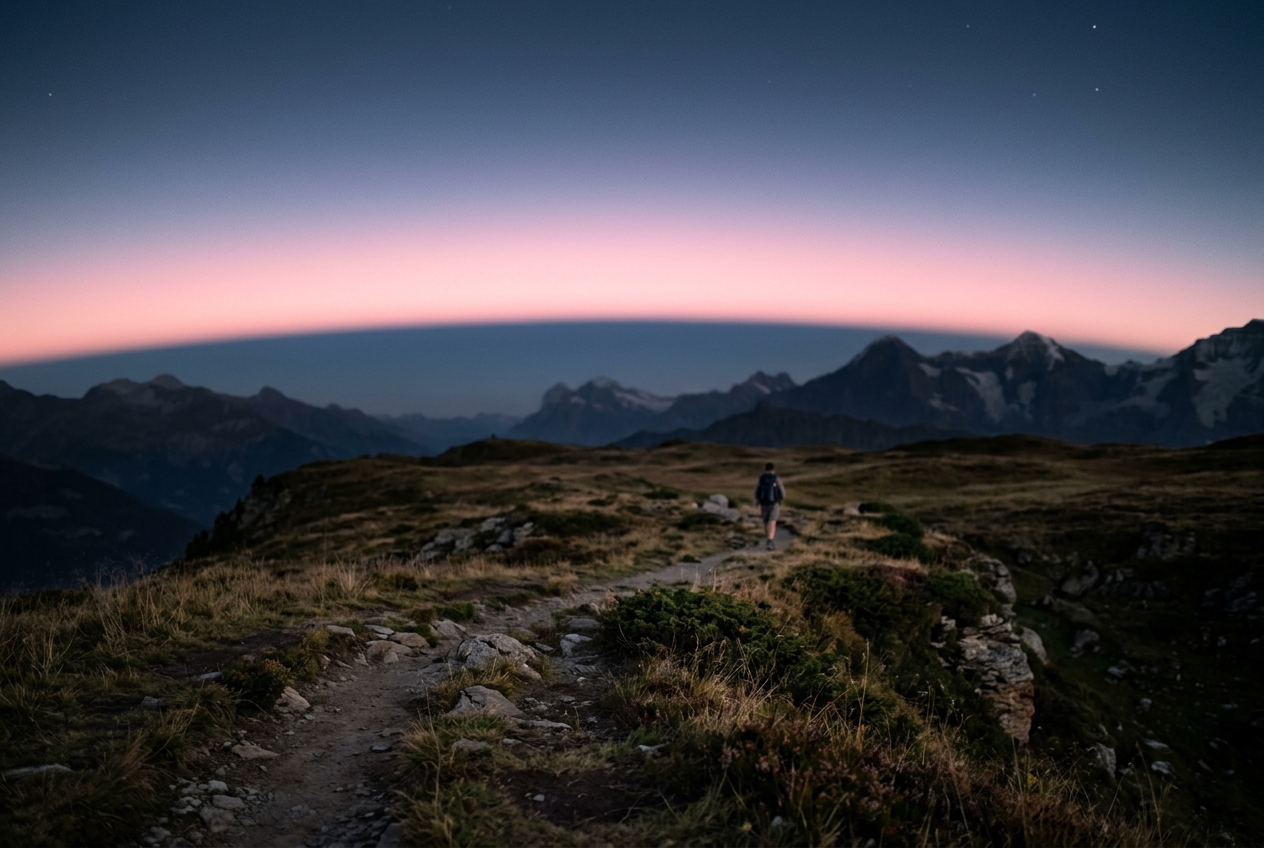
Stand atop an exposed ridgeline or along an open eastern coastline just as the sun touches the western horizon. The ambient warmth that sustained the late afternoon begins to slip away; a brisk catabatic breeze stirs through the grass as radiative cooling chills the ground beneath your boots. The air sharpens with the scent of condensing moisture and cooling earth. Instinctively, most observers gaze westward, captivated by the fiery spectacle of sunset.
                          WEST                                                 EAST
   [ Setting Sun ] -------------------- (Observer) -------------------- [ Antisolar Horizon ]
    Azimuth ~270°                                                         Azimuth ~090°
Yet the true atmospheric drama unfolds if you turn precisely 180 degrees to face the antisolar horizon.
In the east, where the day is retreating, the sky does not simply fade into a murky grey. Instead, resting directly against the landscape is a heavy, slate-blue band that hugs the terrain like a bank of distant mountains. Above this cool, steel-toned foundation stretches an ethereal, glowing arch of delicate pastel pink and apricot, arching across nearly forty degrees of azimuth. As the minutes tick past and the western sky deepens to burnt orange, this dual-toned ribbon does not remain static. It climbs. Steadily and silently, the dark blue segment swells upward, pushing the pink fringe before it into the upper vault of the heavens. You are not merely observing a palette shift in the evening air; you are standing on the surface of a spinning world and witnessing the geometric projection of the planet itself rising into the upper atmosphere.
2. What’s Actually Happening: The Sky as a Planetary Canvas
To grasp what takes place during this twilight transition, one must step back from the local landscape and envision Earth suspended in the solar wind.
                                  ATMOSPHERIC CROSS-SECTION

 Low-Angle Sunlight ======> [ Upper Troposphere / Stratosphere ] ===> Pink Backscatter (Belt of Venus)
                                      |
===========================> [ Solid Earth Boundary ]
                                      |
                              ( Earth's Umbra )              ===> Dark Slate-Blue Segment
Think of the planet as an enormous sphere held before a distant, brilliant spotlight. Behind the Earth stretches an immense, tapering cone of planetary shadow—the umbra. When you stand on the surface during the day, you are positioned on the illuminated face of the sphere. But as the planet rotates your vantage point away from the sun, your local horizon tilts upward relative to the solar beam.
When the sun dips beneath the western horizon, the solid body of Earth begins to block the direct solar rays from reaching the lower layers of the eastern atmosphere. The low-altitude air in the east falls into Earth’s shadow. Because there is no direct sunlight to illuminate the aerosol particles and gas molecules in that lower pocket of air, that region appears noticeably dark. This is the dark segment—the literal shadow of our planet projected onto its own sky.
Meanwhile, high above this shadowed zone, the upper reaches of the troposphere and the lower stratosphere remain in full, direct sunlight. The solar rays grazing the curve of the globe must travel through an immense path of dense lower air before reaching these high eastern altitudes.
Think of the atmosphere as a layered filter. As white sunlight plunges along this long, grazing path, the shorter blue and violet light waves are scattered away in all directions by gas molecules. By the time the beam emerges on the other side of the horizon to strike the high eastern sky, only the longest, hardiest wavelengths—the warm pinks, reds, and oranges—remain.
The air molecules and high-altitude aerosols in that sunlit upper zone catch these reddened rays and bounce them back down toward your eyes. This luminous, rose-tinted border that separates the rising shadow of the Earth from the deep blue sky above is known historically as the Belt of Venus (or the anti-twilight arch).
3. The Science: Planetary Geometry and Spectral Transmission
For atmospheric scientists and quantitative field observers, the motion and colour palette of the antisolar twilight arch are governed by two distinct physical regimes: the Euclidean geometry of the planetary umbra and the selective wavelength filtering of molecular scattering and stratospheric gas absorption.
                             GEOMETRY OF THE PLANETARY SHADOW

                                   Shadow Boundary Ray
                      ---------------------------------------------> High Atmosphere
                     /                                               h (Shadow Height)
                    /  Tangent Point                                .
                   /                                               .
     [ Sun ] ---- / ----------------------------- Earth Surface --+
                 /                                 .             /
                /                                 .             /
               /                                 .             / R
              /                                 .  R          /
             / θ (Solar Depression)            .             /
            +---------------------------------O-------------+
                                        (Earth Centre)
The Umbral Height Derivation
To calculate the altitude $h$ above the antisolar horizon to which Earth’s shadow reaches for a given solar depression angle $\theta$, we consider a spherical Earth of mean radius $R \approx 6,371\text{ km}$. Let the center of the Earth be at point $O$. The observer is located on the twilight terminator. As the sun sinks to an angular depression $\theta$ below the astronomical horizon, the terminator ray grazes the tangent point on Earth’s limb.
From the right-angled triangle formed by the Earth's centre $O$, the tangent point of grazing sunlight, and the point in the antisolar sky at height $h$ directly along the observer's local zenith/horizon plane:
$$\cos\theta = \frac{R}{R + h}$$
Rearranging this expression gives the exact geometric formula for the rising shadow height $h$:
$$R + h = \frac{R}{\cos\theta} = R \sec\theta$$
$$h(\theta) = R(\sec\theta - 1)$$
For small solar depression angles ($\theta \ll 1\text{ radian}$), we can evaluate the secant function via its Taylor series expansion:
$$\sec\theta \approx 1 + \frac{\theta^2}{2} + \mathcal{O}(\theta^4)$$
Substituting this approximation yields the parabolic height equation:
$$h(\theta) \approx \frac{1}{2} R \theta^2$$
Worked Example: The Shadow at Civil Twilight
Consider an observer monitoring the eastern sky when the sun has dropped $\theta = 2.5^\circ$ below the western horizon. Converting $\theta$ to radians: $$\theta = 2.5^\circ \times \left(\frac{\pi}{180^\circ}\right) \approx 0.043633\text{ rad}$$
Applying the exact formulation: $$h(2.5^\circ) = 6371 \times \left(\sec(2.5^\circ) - 1\right)\text{ km}$$ $$\sec(2.5^\circ) = \frac{1}{\cos(2.5^\circ)} \approx \frac{1}{0.999048} \approx 1.0009527$$ $$h(2.5^\circ) \approx 6371 \times 0.0009527 \approx 6.07\text{ km}$$
At a solar depression of just $2.5^\circ$, the boundary of Earth's shadow has already ascended past $6\text{ km}$ in altitude—cutting straight through the mid-troposphere. At $\theta = 5.0^\circ$, this height climbs rapidly: $$h(5.0^\circ) = 6371 \times (\sec(5.0^\circ) - 1) \approx 6371 \times (1.0038198 - 1) \approx 24.34\text{ km}$$ The shadow boundary has now ascended entirely through the troposphere and sits firmly in the middle stratosphere.
Because the Earth rotates through $360^\circ$ of longitude every 24 hours, the angular velocity of solar depression is:
$$\omega = \frac{360^\circ}{1440\text{ minutes}} = 0.25^\circ\text{ per minute} = 1.0^\circ\text{ every 4 minutes}$$
Consequently, during the equinoxes at the equator, the planetary shadow climbs across the celestial sphere at an apparent rate of $1^\circ$ every four minutes, creating a palpable, real-time vertical displacement of the dusk boundary.
Atmospheric Extinction and Rayleigh Scattering
The warm chromatic signature of the Belt of Venus is dictated by Rayleigh scattering, where the scattering cross-section $\sigma_R$ for particles much smaller than the wavelength of light ($\lambda$) is inversely proportional to the fourth power of the wavelength:
$$\sigma_R(\lambda) \propto \frac{1}{\lambda^4}$$
When sunlight enters the atmosphere tangentially at twilight, the optical path length—termed the relative optical air mass $M(\theta)$—increases dramatically compared to the overhead noon sun ($M \approx 1$). For a grazing ray illuminating the antisolar twilight sky, the air mass traverses values between $M \approx 38$ and $M \approx 40$.
                              SPECTRAL EXTINCTION PROFILE

   Incoming Solar Ray
   [ 400 nm Blue ]  -------> [ Scatter Loss: High (1/λ⁴) ] ======> Diffused away along path
   [ 550 nm Green ] -------> [ Moderate Loss             ] ======> Heavily attenuated
   [ 700 nm Red ]   ---------------------------------------------> Reaches High Stratosphere
                                                                           |
                                                                           v (Backscatter)
                                                                     [ BELT OF VENUS ]
The spectral transmission $T(\lambda)$ through an atmosphere with optical depth $\tau(\lambda)$ is governed by the Beer-Lambert-Bouguer law:
$$T(\lambda) = \exp\left[ -M(\theta) \cdot \tau_R(\lambda) \right]$$
Because blue light ($\lambda = 450\text{ nm}$) experiences approximately $(700/450)^4 \approx 5.86$ times greater extinction than deep red light ($\lambda = 700\text{ nm}$), direct sunlight traversing 40 air masses is stripped almost entirely of its short-wavelength photons. The residual beam that skims above the tangent point is intensely reddened. When this filtered beam illuminates the aerosols and gas molecules of the upper troposphere (between 8 and 18 km), these particles execute Rayleigh and Mie backscattering at a scattering angle $\Theta \approx 180^\circ$, directing a delicate pastel rose hue back to the observer.
The Chappuis Band: Why the Shadow is Slate-Blue, Not Black
A longstanding puzzle in twilight physics was why the dark segment inside Earth's shadow displays an intense steel- or slate-blue hue rather than pitch blackness or murky green.
The answer lies in stratospheric ozone chemistry. While Rayleigh scattering explains why sky light is blue during the day, twilight illumination inside the umbra is dominated by diffuse light scattered from high overhead and filtered through the Chappuis absorption band of the ozone layer ($O_3$), located primarily between 15 and 30 km altitude.
                           THE CHAPPUIS ABSORPTION MECHANISM

   Diffused Twilight Beam:
   [ 400-480 nm Blue ]  =========================================> TRANSMITTED (Unattenuated)
   [ 550-610 nm Yellow/Orange ] ---> [ Absorbed by O₃ Molecules ]  ==> EXTINCT
   [ 650-750 nm Red ]   =========================================> WEAK ABSORPTION
                                                                           |
                                                                           v
                                                            Resulting Shadow Colour:
                                                            Deep Slate / Steel-Blue
The Chappuis band exhibits an absorption spectrum spanning the visible wavelengths between $500\text{ nm}$ and $700\text{ nm}$, peaking prominently near $600\text{ nm}$ (the orange-yellow spectrum).
As high-altitude ambient skylight passes obliquely through the ozone layer to illuminate the air within the shadow cone, ozone preferentially absorbs the yellow and orange photons. This selective absorption removes the intermediate wavelengths that would otherwise turn the twilight segment a neutral grey or dirty brown, leaving a pure, cool slate-blue signature across the antisolar horizon.
4. Practical Outdoor Guidance: Field Diagnostics for the Observer
Observing the ascent of the planetary shadow and the Belt of Venus requires no specialist optical equipment, but maximizing the diagnostic value of the experience demands careful attention to atmospheric conditions, viewing windows, and shadow morphology.
+---------------------------------------------------------------------------------------+
|                             TWILIGHT OBSERVATION PHASES                               |
+-------------------+-------------------------------------------------------------------+
| Solar Depression  | Sky Features Observed (East)                                      |
+-------------------+-------------------------------------------------------------------+
| 0.0° - 1.0°       | Sun sets in West. Subtle darkening of eastern horizon boundary.  |
| 1.0° - 3.0°       | Prime Belt of Venus: Bright rose-pink band, sharp slate base.     |
| 3.0° - 5.0°       | Shadow boundary diffuses; pink arch broadens and fades aloft.     |
| > 6.0°            | End of Civil Twilight: Earth shadow merges into astronomical night.|
+-------------------+-------------------------------------------------------------------+
Optimal Viewing Windows and Calculations
The prime viewing window occurs during early civil twilight, specifically when the solar depression angle $\theta$ is between $1^\circ$ and $5^\circ$. * At $\theta < 1^\circ$: The shadow remains submerged beneath ground-level haze and local topography. * At $\theta = 2^\circ\text{ to }3^\circ$: The contrast between the slate-blue dark segment and the pink arch reaches its maximum chromatic saturation. * At $\theta > 5^\circ$: The shadow has climbed beyond $24\text{ km}$, into regions of vanishingly low molecular density, causing the pink backscatter to diffuse into the general indigo canopy of approaching night.
To calculate the onset of your viewing window, consult astronomical ephemerides provided by institutions like the National Oceanic and Atmospheric Administration (NOAA) or the Met Office. At mid-latitudes ($45^\circ\text{ N/S}$), the sun sinks at roughly $1^\circ$ every 5 to 6 minutes depending on the season, affording an optimal observation window of approximately 20 to 25 minutes after sunset.
Atmospheric and Aerosol Diagnostics
The structure and vibrancy of the anti-twilight arch serve as an immediate proxy for regional atmospheric stability and particulate loading:
- High Barometric Pressure and Clean Air: Under stable anticyclonic conditions (barometer reading $> 1020\text{ hPa}$) characterized by low boundary-layer humidity and minimal aerosol optical depth, the boundary between the dark segment and the Belt of Venus is razor-sharp. The pink band exhibits a delicate, translucent pastel hue.
- Boundary-Layer Inversions: When a surface temperature inversion is present (identifiable by calm surface winds and climbing temperatures on an ascent), trapped particulate matter creates a dirty grey-brown fringe at the very base of the dark segment, compressing the apparent height of the pink band.
- Volcanic Aerosols: Following major explosive volcanic eruptions that inject sulfur dioxide ($SO_2$) into the stratosphere—such as the historical events monitored by the World Meteorological Organization—the Belt of Venus transforms into an intense, glowing lavender or deep magenta arch that persists far into nautical twilight ($\theta > 6^\circ$).
Differentiating Planetary Shadows from Topographical Shadows
Field observers often confuse the true planetary dark segment with localized cloud shadows or mountain projections. Use these criteria to distinguish them:
- Azimuthal Extent: The planetary shadow is globally continuous, spanning a broad arc of over $120^\circ$ of the eastern horizon. Localized mountain peaks (such as Mt. Rainier or Mount Teide) cast narrow, triangular shadow wedges that project upward through the Belt of Venus.
- Notch Formations: Large cumulonimbus cloud decks along the western horizon (hundreds of kilometres behind the observer) can intercept the grazing sunbeams, casting crepuscular shadow rays that appear as distinct vertical gaps or "notches" cut into the pink arch opposite them.
- Curvature: The upper edge of the dark segment always forms an arch that matches the spherical contour of the Earth, bowed slightly upward at the exact antisolar point.
                 DIFFERENTIATING SHADOW STRUCTURES IN THE EAST

  [ Uniform Belt of Venus ]              [ Cloud Notch Anomaly ]
  ~~~~~~~~~~~~~~~~~~~~~~~~~              ~~~~~~~~    ~~~~~~~~~~~
  =========================              ========\  /===========
     (Planetary Shadow)                    (Umbra)\/(Cloud Cast)