Atmospheric Glories & Brocken Spectre Dynamics: How Complex Angular Backscattering and Droplet Surface Waves Forge Spectral Halos Around Antisolar Shadows
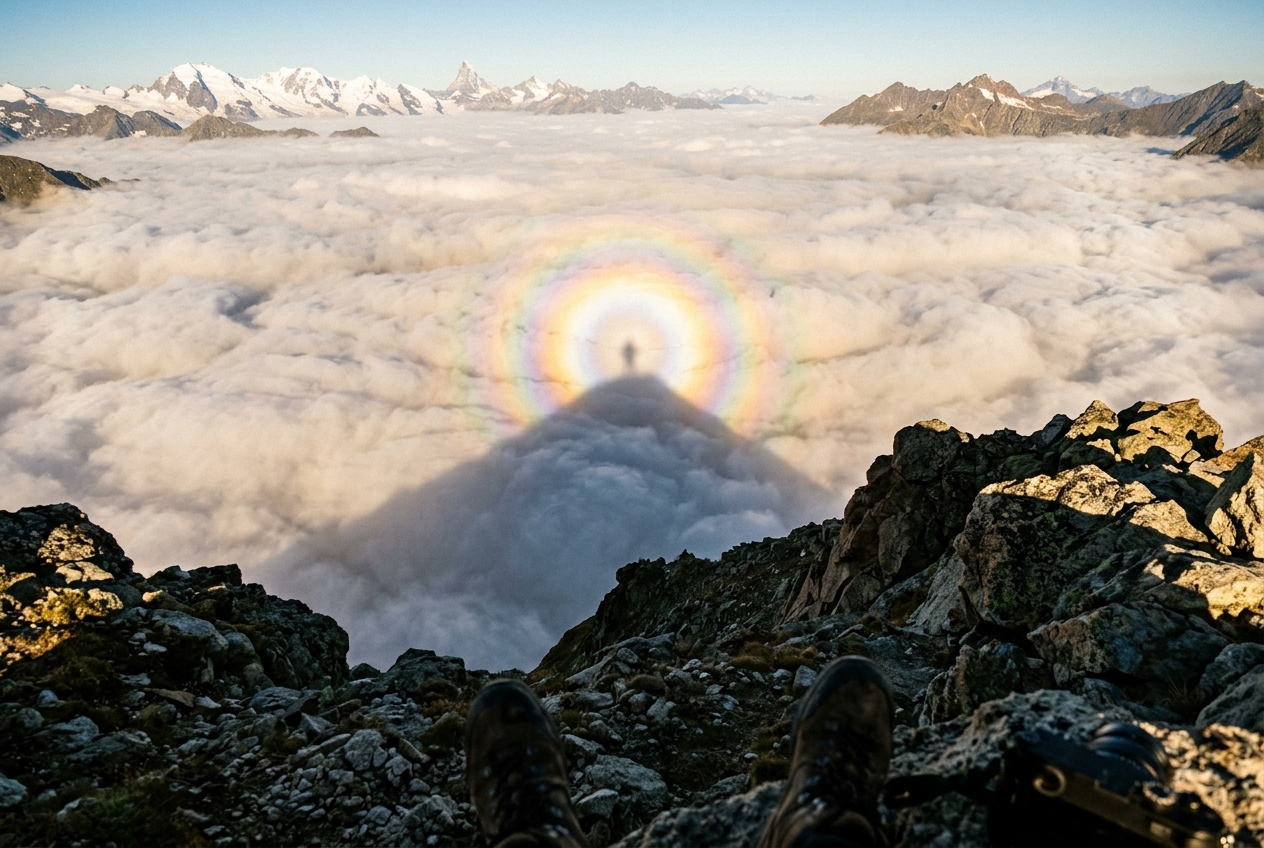
1. Opening Scene
Standing upon the knife-edge ridge of Crib Goch in Eryri as dawn breaks, your senses register a sharp transition in the mountain atmosphere. The biting, dry wind that buffeted your ascent across the scree suddenly slackens into an eerie, laminar calm. Below the northern precipice lies a vast, unbroken sea of stratocumulus cloud—a dense thermal inversion blanket filling the Llanberis pass with what mountaineers call a temperature inversion. The air around your face is crisp, cold, and clear, scented faintly with damp slate, yet merely ten paces down the slope, the world dissolves into an opaque, churning white vapor.
                                 [ Low-Angle Morning Sun ]
                                             \
                                              \  Incident Solar Rays
                                               \
          Observer on Ridge                     \
             o                                   v
            /|\  ===========================>  [ Antisolar Point ]
            / \   Parallel Shadow Projection        (o)  <-- Multi-Hued Glory Rings
       ____________                                / | \ <-- Brocken Spectre Shadow
      /            \                              /  |  \
     /  Rock Face   \    ====================== [ Fog Bank Surface ] =====================
    /                \                           (Uniform Droplet Cloud Top)
As the sun crests the eastern horizon behind you, throwing long, amber rays across the summit, you turn your back to the light and glance down into the void of fog. There, suspended directly in the mist beneath the cliff, looms a monstrous, dark silhouette. It mimics your every movement: raise an ice axe, and the shadowy titan raises a towering limb in immediate synchronization.
Surrounding the head of this spectral figure is not a pale halo, but a brilliant, concentric series of chromatic rings. A glowing white-gold core gives way to rings of violet, turquoise, yellow, and a distinct outer red ring, repeating into a fainter second and third concentric tier. As convective breaths in the valley gently lift the fog bank, the shadowy phantom appears to breathe, surging forward and expanding before receding into the vaporous depth. You are witnessing one of nature’s most elusive optical couplings: the Brocken spectre, crowned by an atmospheric glory.
2. What's Actually Happening — Plain English First
To understand why this vision feels so supernatural—and why it baffled 18th-century natural philosophers who first documented it on the Brocken peak of Germany’s Harz Mountains—we must separate the shadow from the halo.
The towering phantom, known universally as the Brocken spectre, is purely an optical illusion of scale and perspective. Think of your shadow on a sunny afternoon cast against a flat brick wall: your eyes easily judge how far away the wall is, and your brain instantly calculates your shadow’s true size.
When you stand on a high precipice above a cloud bank, however, your shadow is projected onto a three-dimensional, semi-transparent screen of water droplets that spans many meters in depth. Because the mist has no trees, buildings, or horizon lines to provide reference points, your visual cortex struggles to determine where the shadow actually falls. If your brain mistakenly assumes the shadow is resting on a distant mountain ridge miles away, perspective geometry forces your mind to perceive your shadow as a colossal giant towering hundreds of feet high, even though it is simply your own silhouette projected onto nearby vapor.
       Light Path at the Droplet Boundary (Glory Backscattering)

              Grazing Ray
       ====================> . - ~ - .   Evanescent Surface Wave
                           /           \  (Circumnavigating the perimeter)
                          |   Droplet   | ---> Acoustic/Surface Orbit
                           \     r     /
       <==================== ` - ~ - '   Phase-Shifted Tangential Exit
         Backscattered Ray               (Constructive Interference at 180°)
The radiant, rainbow-like halo encircling the shadow’s head—the glory—is fundamentally different. Unlike a standard rainbow, which relies on coarse geometric reflection and refraction inside large raindrops, the glory is a delicate wave phenomenon.
Imagine tossing a pebble into a still pond and watching the ripple hit a circular post. The water waves do not simply bounce straight back; they bend around the curve of the post, hug its circumference, and collide on the other side, sending a new pattern of concentric ripples backward toward where the pebble landed.
When sunlight strikes microscopic cloud droplets suspended in the fog, light waves graze the edges of each tiny spherical sphere. These light waves cling to the water's surface as "surface waves," travel around the droplet's rim, and escape backward toward the sun. Because the light waves exit from opposite sides of millions of identical droplets simultaneously, their peaks and troughs cross paths, canceling out some colors and reinforcing others. Because your eyes sit directly on the line connecting the sun to the cloud, you see these reinforced colors as concentric rings of light centered precisely on your own head.
3. The Science (for those who want to go deeper)
To rigorously explain why a glory forms—and why it differs fundamentally from other atmospheric displays—we must step into electromagnetic scattering theory and cloud microphysics.
3.1 Optical Lineages: Rainbows, Coronae, and Glories
Atmospheric optical phenomena are categorized by the dominant physical mechanism governing the interaction between photon wave packets and hydrometeors:
| Phenomenon | Primary Physical Mechanism | Hydrometeor Size ($r$) | Typical Angular Location |
|---|---|---|---|
| Rainbow | Geometric ray optics (internal reflection & refraction) | $100\ \mu\text{m} \le r \le 2\text{ mm}$ (Raindrops) | $\approx 42^\circ$ from antisolar point |
| Corona | Forward Fraunhofer diffraction | $2\ \mu\text{m} \le r \le 20\ \mu\text{m}$ (Cloud droplets) | $1^\circ\text{–}10^\circ$ around the Sun / Moon |
| Glory | Complex Mie scattering (Surface-wave tunneling & backscatter resonance) | $4\ \mu\text{m} \le r \le 25\ \mu\text{m}$ (Monodisperse cloud droplets) | $1^\circ\text{–}5^\circ$ around the antisolar point |
A standard rainbow operates in the realm of geometric optics ($r \gg \lambda$). Rays enter a macroscopic droplet, undergo refraction, reflect internally off the back wall, and exit at a minimum angle of deviation (the caustic locus), forming the classical $42^\circ$ primary bow. Geometric optics predicts zero intensity for backward glory rings because purely central geometric back-reflections lack the requisite phase-delay mechanisms to produce wide-angle chromatic interference.
Conversely, the corona is generated by forward Fraunhofer diffraction, where light passing around the perimeter of a water droplet interferes constructively in the forward direction ($0^\circ$ deflection), creating bright rings surrounding the solar or lunar disk.
The glory occurs at the exact anti-solar point ($\theta = 180^\circ$). Because geometric ray tracing fails to account for the intensity and angular distribution of the glory, one must employ the full electromagnetic wave equations pioneered by Gustav Mie in 1908.
3.2 Van de Hulst’s Surface-Wave Theory and Mie Resonances
In 1947, the Dutch astronomer Hendrik C. van de Hulst formulated a physical model explaining the glory’s backscattering mechanism without requiring millions of numerical Legendre polynomial evaluations.
When a plane electromagnetic wave encounters a spherical water droplet of radius $r$ (where the size parameter $x = \frac{2\pi r}{\lambda} \approx 50\text{–}300$), light rays striking at near-grazing incidence (impact parameter $b \approx r$) undergo electromagnetic tunneling across the droplet boundary.
These trapped photons propagate along the curved water-air interface as evanescent surface waves. As they circumnavigate the droplet’s periphery, they continuously shed radiation tangentially at the critical angle into the droplet and across the opposite limb.
After completing a path of approximately $180^\circ$ (plus internal chords), rays emerging from diametrically opposed edges of the droplet interfere with one another in the backward direction. The circular perimeter of the droplet behaves as a coherent, ring-shaped antenna. The interference of light emitted from this toroidal source creates an angular intensity distribution centered on the antisolar point, mathematically characterized by Bessel functions:
$$I(\theta) \propto \left[ J_1\left(\frac{2\pi r}{\lambda} \sin\theta\right) \right]^2$$
Where: - $I(\theta)$ is the backscattered radiant intensity at an angular deviation $\theta$ from the antisolar point. - $J_1$ is the first-order Bessel function of the first kind. - $r$ is the droplet radius. - $\lambda$ is the wavelength of the incident light. - $\theta$ is the angular radius of the observed glory ring.
3.3 The Mathematics of Cloud Sizing
Because the positions of the bright and dark glory rings are dictated by the roots and extrema of Bessel functions, we can derive a direct relationship between the angular radius of a ring and the physical size of the cloud droplets generating it.
The angular half-width $\theta_n$ of the $n$-th bright ring extrema can be expressed through the asymptotic relation:
$$\theta_n \approx \left(n + 0.22\right) \frac{\lambda}{2r}$$
Where: - $\theta_n$ is the angular radius of the $n$-th bright ring (in radians). - $n$ is the order of the ring ($n = 1$ for the innermost bright ring, $n = 2$ for the second ring). - $\lambda$ is the optical wavelength of the light observed. - $r$ is the mean cloud droplet radius.
Step-by-Step Mathematical Walkthrough:
Suppose an observer on a summit or looking out an aircraft window measures the angular radius of the first ($n = 1$) outer red ring of a glory using an inclinometer or calibrated camera sensor, finding $\theta_1 = 3.0^\circ$.
We wish to calculate the mean radius $r$ of the cloud droplets forming this optical pattern.
-
Convert the measured angular radius to radians: $$\theta_1 = 3.0^\circ \times \left(\frac{\pi\text{ rad}}{180^\circ}\right) = 0.05236\text{ rad}$$
-
Select the appropriate wavelength for red light: $$\lambda_{\text{red}} \approx 650\text{ nm} = 0.650\ \mu\text{m}$$
-
Isolate droplet radius $r$ in the angular ring equation: $$r = \frac{(n + 0.22)\lambda}{2\theta_n}$$
-
Substitute the observed values ($n = 1$, $\lambda = 0.650\ \mu\text{m}$, $\theta_1 = 0.05236\text{ rad}$): $$r = \frac{(1 + 0.22) \times 0.650\ \mu\text{m}}{2 \times 0.05236\text{ rad}}$$ $$r = \frac{1.22 \times 0.650\ \mu\text{m}}{0.10472} = \frac{0.793\ \mu\text{m}}{0.10472} \approx 7.57\ \mu\text{m}$$
-
Determine droplet diameter ($D = 2r$): $$D = 2 \times 7.57\ \mu\text{m} \approx 15.14\ \mu\text{m}$$
================================================================================
                           MICROPHYSICAL DERIVATION RESULT
================================================================================
  Measured 1st Ring Red Angle (theta_1) :  3.0 degrees (0.0524 rad)
  Reference Wavelength (lambda_red)     :  0.650 microns (650 nm)
  Calculated Mean Droplet Radius (r)    :  7.6 microns (0.0076 mm)
  Calculated Mean Droplet Diameter (D)  :  15.1 microns
  Microphysical Regime                  :  Quiescent, Stratiform Cloud Top
================================================================================
If the observer measures a tighter outer ring of $\theta_1 = 1.5^\circ$, the corresponding droplet radius doubles to $r \approx 15.1\ \mu\text{m}$ ($D \approx 30.3\ \mu\text{m}$), demonstrating that the angular diameter of the glory is inversely proportional to the droplet size.
Smaller droplets produce wide, sprawling glory rings; larger droplets yield compressed, tightly packed rings.
3.4 Brocken Geometry and the Illusion of Colossal Scale
The Brocken spectre is governed by classical projective geometry combined with depth-cue deprivation.
Because the Sun is approximately $1.496 \times 10^8\text{ km}$ distant, incident solar rays arriving at an observer on Earth are essentially parallel (diverging by only $0.53^\circ$, the angular width of the solar disk). When an observer standing at point $P(x_0, y_0, z_0)$ casts a shadow onto an inclined fog surface at distance $L$, the physical dimensions of the shadow cast on the fog are nearly identical to the cross-sectional dimensions of the observer's body:
$$H_{\text{shadow}} \approx H_{\text{observer}} + L \tan\left(0.53^\circ\right) \approx H_{\text{observer}} + 0.00925 L$$
For a fog bank $20\text{ meters}$ away, a $1.8\text{ m}$ person casts a shadow that is physically only $1.98\text{ meters}$ tall on the fog surface.
                               PARALLEL SOLAR RAYS
  -------------------------------------------------------------------------->
                         Observer (Height = H)
  ---------------------------> [Head] ------------------------> [Head Shadow]
                                 |                                    |
                                 |                             Physical Shadow
                                 |                               (Height ~ H)
  ---------------------------> [Feet] ------------------------> [Feet Shadow]
  -------------------------------------------------------------------------->
                               |<--------- Distance L --------->|
                                          (Fog Surface)
Why, then, does the shadow appear colossal? 1. Absence of Stereoscopic Depth Cues: The surface of a fog layer consists of diffuse, constantly shifting water particles. The human visual system relies on binocular disparity, texture gradients, and familiar perspective cues to establish depth. In a cloud bank, all depth cues vanish. 2. Horizon Projection Bias: When the human brain cannot locate the physical projection plane, it defaults to placing the object at the optical horizon (many kilometers away). If an object subtending an angular height of $\alpha \approx 5.7^\circ$ is perceived to be at $L = 500\text{ meters}$ rather than $L = 20\text{ meters}$, the brain reconstructs its physical height as: $$H_{\text{perceived}} = L_{\text{perceived}} \times \tan(\alpha) = 500\text{ m} \times \tan(5.7^\circ) \approx 50\text{ meters}$$ The observer experiences the vivid, unshakeable illusion of a fifty-meter giant suspended in the sky. 3. Antisolar Alignment: The observer's eyes lie precisely on the line connecting the solar disk to the center of the shadow's head. Consequently, if multiple people stand along the same ridge, each person sees a glory only around their own shadow's head. The rays backscattering from the droplets return strictly along the anti-solar trajectory toward the individual observer's pupils.
3.5 Cloud Microphysics: The Monodispersity Criterion
Glories are far less common than rainbows because they require an exceptionally narrow droplet size distribution—a condition known in cloud physics as monodispersity.
In typical precipitating clouds or turbulent cumulus updrafts, droplets range in radius from $r = 2\ \mu\text{m}$ to $r = 50\ \mu\text{m}$. Because each droplet size produces glory rings at different angular radii ($\theta \propto 1/r$), a wide distribution of droplet sizes causes the colored bands to overlap and wash out into diffuse, unstructured white light (a white fogbow).
   Relative
   Droplet
   Number
     ^
     |             Monodisperse Cloud Top (sigma_r / r < 0.10)
     |                 ===> VIBRANT GLORY RINGS FORMED
     |                      |
     |                     / \
     |                    /   \
     |                   /     \
     |                  /       \    Polydisperse Cloud (sigma_r / r > 0.35)
     |                 /         \   ===> RINGS WASH OUT INTO WHITE FOGBOW
     |               ./           \.__________________
     +----------------------------------------------------> Droplet Radius (r)
                    7.0   7.6   8.2 microns
According to data curated by the World Meteorological Organization (WMO) International Cloud Atlas, a multi-ringed glory requires the relative standard deviation of droplet radii (the dispersion coefficient) to satisfy:
$$\frac{\sigma_r}{\bar{r}} < 0.10$$
Where $\bar{r}$ is the mean radius and $\sigma_r$ is the standard deviation of droplet size within the scattering volume.
This microphysical criterion is satisfied almost exclusively at the top boundary of non-turbulent, stratiform cloud decks or quiescent radiation fogs capped by a strong thermal inversion.
In these stable layers, vertical mixing is suppressed by a positive hydrostatic stability parameter ($N^2 > 0$, where $N$ is the Brunt–Väisälä frequency). All droplets at the cloud top experience identical radiative cooling rates and water vapor supersaturations, condensing at uniform rates and maintaining an identical radius across square kilometers of cloud surface.
4. Practical Outdoor Guidance
Whether navigating alpine summits or observing cloud decks from an airliner, you can actively identify and measure these optical phenomena using basic field techniques.
       Visual Guide to Measuring Glory Rings in the Field

                 [ Center: Shadow of Observer / Head ]
                             (  +  )
                              / | \

           <------------ theta_1 ------------>
          [ Outer Red Edge of First Ring Tier ]
          (Measure with an outstretched fist ~ 10 deg or two fingers ~ 3 deg)
4.1 What to Look for in the Sky and Topography
- Antisolar Alignment: To locate a glory or Brocken spectre, the sun must be low in the sky (early morning or late afternoon, typically solar elevation $< 25^\circ$) and positioned directly behind your back.
- Topographic Drops: You need a sheer drop-off or steep ridge where the line of sight extends downward into an underlying mist, valley fog, or stratocumulus deck.
- Aviation Observation: From a commercial flight, look out the window on the side of the aircraft opposite the sun. When the aircraft flies above a cloud deck, the glory will appear centered on the shadow of your airplane on the cloud surface.
4.2 Instrument Readings to Watch
- Aneroid Barometer / Altimeter: Watch for steady, high atmospheric pressure ($> 1020\text{ hPa}$) associated with an anticyclonic subsidence inversion. If your altimeter indicates a sudden temperature rise as you ascend above a certain altitude, you have crossed the inversion base into the dry, stable air above the cloud top.
- Thermometer & Hygrometer: A sharp drop in relative humidity (e.g., from $95\%$ to $< 40\%$) combined with an increase in ambient temperature as you climb onto a ridge confirms that the cloud deck below is quiescent and capped by an inversion—the ideal condition for uniform droplet radii.
- Wind Direction & Velocity: Look for light, laminar winds ($< 5\text{ knots}$) at the ridge crest. Turbulent, gusty winds rip the cloud boundary apart, mixing droplets of diverse sizes and destroying the monodispersity required for sharp glory rings.
4.3 Field Rules of Thumb
- The Outstretched Hand Angle Estimator: At arm’s length, the width of your index fingernail subtends approximately $1.0^\circ$, two fingers subtend roughly $3.0^\circ$, and a closed fist subtends roughly $10.0^\circ$.
- If the first red ring of a glory fits neatly within the width of two fingers ($3.0^\circ$), the underlying cloud droplets have a radius of approximately $7.5\ \mu\text{m}$ to $8.0\ \mu\text{m}$. If the glory ring expands to the width of an entire fist ($10.0^\circ$), the droplets are extremely small ($r \approx 2.3\ \mu\text{m}$), indicating a freshly forming mist layer.
- Additional observational resources and atmospheric radiation databases can be explored via the UK Met Office Optical Phenomena Guide and the NOAA Global Monitoring Laboratory.
5. Today's Meteorological Rule of Thumb
The Rule of the Ring’s Diameter: When viewing an atmospheric glory, the angular width of the iridescent rings is inversely proportional to the size of the cloud droplets. Wide, sprawling rings reveal tiny, newly condensed droplets, while tight, compact rings announce mature, larger cloud droplets poised on the brink of coalescence.