Atmospheric Coronae & Fraunhofer Diffraction Dynamics: How Monodisperse Cloud Droplets Diffract Light Into Iridescent Solar and Lunar Rings
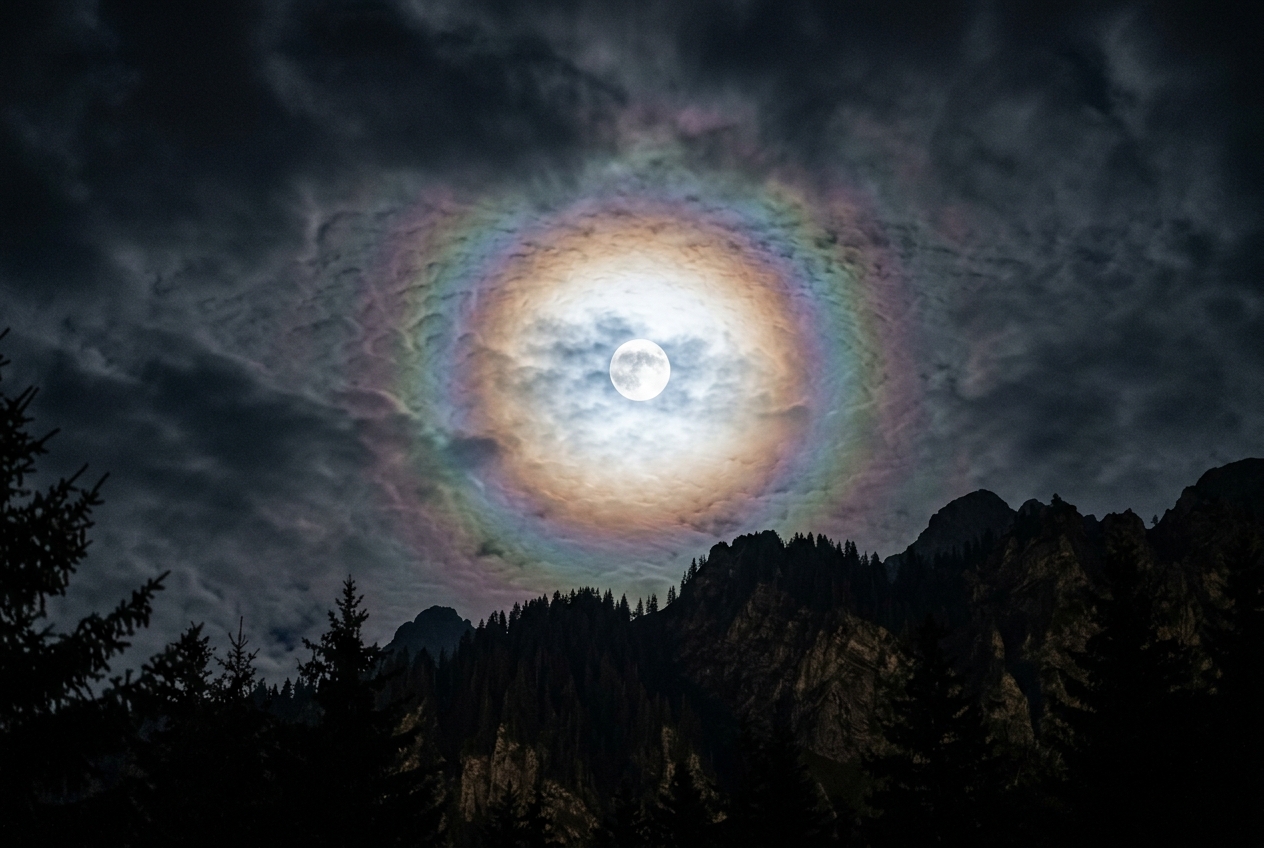
On a late October twilight along the spine of the Pennines, the moorland air cools with sudden, palpable intent. The scent of damp peat and crushed bracken rises on a laminar breeze that has backed quietly from the northwest into the south-southwest over the preceding three hours. In the valley below, chimney smoke that had climbed vertically at midday now bends and flattens against a descending thermal inversion. A subtle heaviness gathers in the sinuses—the imperceptible yet unmistakable physiological tell of an encroaching barometric trough. Looking upward through the gathering dusk, the gibbous moon does not merely illuminate the sky; it commands a radiant, miniature spectacle.
                       WAVE INTERFERENCE GEOMETRY

   Incident Plane Wave             Droplet (d)            Focal Plane / Retina
   ====================>              .-.
   ====================>             ( d ) ========>   Central Maximum (Aureole)
   ====================>              '-'  \ \
   ====================>                    \ \====>   1st Minimum (Dark Band)
                                             \=====>   1st Ring (Red Fringe)
Filtered through a translucent veil of mid-level cloud, the lunar disk is encircled by a tight, luminous collar of pearl-white light. This central glow, termed the aureole, terminates in a delicate rim of toasted amber and chestnut red. Beyond that first perimeter lies a fainter, concentric sequence of spectral rings: a cool wash of violet and viridian green yielding seamlessly to an outer perimeter of soft ruby. The entire optical disk spans barely the width of three fingers held against the sky at arm’s length. To the casual stroller, this celestial bullseye is a poetic omen of wet weather; to the trained outdoor observer, it is an open-air laboratory bench—a real-time, naked-eye measurement of cloud microphysics written across the night sky in the language of wave mechanics.
What’s Actually Happening: Plain English First
To comprehend the corona, one must first dismantle a widespread confusion among outdoor enthusiasts: the distinction between a halo and a corona. While both phenomena encircle celestial light sources, their physical origins belong to entirely different domains of physics.
+-------------------------------------------------------------------------+
|                    HALO vs. CORONA: KEY DISTINCTIONS                    |
+-------------------+-----------------------------------------------------+
| Feature           | Halo (Geometric Optics)   | Corona (Wave Optics)    |
+-------------------+-----------------------------------------------------+
| Cloud Medium      | Cirrostratus (Ice)        | Altostratus (Water)     |
| Particle Shape    | Hexagonal prisms/plates   | Spherical liquid drops  |
| Mechanism         | Refraction & Reflection   | Fraunhofer Diffraction  |
| Typical Radius    | 22° or 46° (Broad)        | 1° to 8° (Compact)      |
| Color Order       | Red inside, Blue outside  | Blue inside, Red outside|
+-------------------+-----------------------------------------------------+
Halos are creations of geometric optics. They occur when sunlight or moonlight passes through hexagonal ice crystals floating within high, sub-zero cirrostratus decks at altitudes exceeding 6,000 metres. These crystals act as microscopic glass prisms, refracting light rays through precise angles of minimum deviation (most commonly 22° and 46°). In a halo, red light is bent least and blue light most, placing the crisp red edge on the inside of the ring, closest to the moon.
A corona, by contrast, is a triumph of pure wave optics. It occurs when light traverses clouds composed not of jagged ice prisms, but of microscopic, spherical liquid water droplets suspended in mid-tropospheric altostratus or altocumulus clouds. The light does not travel through these droplets to create the pattern; rather, the light waves bend around them.
Think of light not as straight, rigid arrows, but as gentle, uniform ripples travelling across the surface of a still pond. If those ripples encounter a field of wooden posts protruding from the water, the wavefronts do not simply stop dead and leave neat, sharp-edged rectangular shadows behind each post. Instead, the ripples curl around the curved flanks of each obstruction. As the curled wavelets spread into the space behind the posts, they collide with wavelets curling in from the opposite side.
Where the crest of one wavelet coincides precisely with the crest of another, they reinforce each other, building a higher, more energetic wave—a phenomenon known as constructive interference. Where a crest meets a trough, the water flattens out into absolute stillness—destructive interference.
When monochromatic light skirts around billions of microscopic water droplets in a cloud, this interference pattern projects onto the human retina as an alternating sequence of bright illumination and dark voids. Because white light from the sun or moon is a composite of different wavelengths, each colour bends at a slightly different angle. Blue light, possessing a shorter wavelength ($\approx 450\text{ nanometres}$), forms tighter, narrower rings. Red light, with its longer wavelength ($\approx 650\text{ nanometres}$), bends more broadly outward. Consequently, every concentric ring of a corona exhibits a distinct chromatic hierarchy: cool blue-green on the inner flank, culminating in a distinct brownish-red fringe along the outer perimeter.
      LIGHT CURVING AROUND DROPLET (BABINET'S DIFFRACTION)

                     Wavefront
                     |  |  |  |
                     |  |  |  |  .-""""-.
                     |  |  |  | /        \
      Light Path ----+--+--+-> |  Water   |
                     |  |  |  | | Droplet | ----> Shadow Zone
      Light Path ----+--+--+-> \  (d)    /
                     |  |  |  |  '-....-'
                     |  |  |  |     |
                     |  |  |  |     +-------> Waves bend around perimeter,
                                              interfering constructively
                                              and destructively downstream.
The physical engine permitting an opaque liquid sphere to generate the exact same diffraction pattern as an open aperture of identical dimensions is governed by Babinet’s principle. Formulated by the French physicist Jacques Babinet in 1837, the theorem demonstrates that the diffraction pattern produced by an opaque obstacle is mathematically identical in intensity distribution to that produced by a hole in an opaque screen of the exact same size and shape, save for the unbounded central beam. Thus, a cloud droplet functions optically as an individual circular pinhole carved into the sky.
Yet there is a critical microphysical caveat. A choir sounds harmonious only when every singer sings the same note. If a cloud consists of droplets of wildly varying sizes—what meteorologists classify as a polydisperse distribution—the large droplets cast narrow rings while the small droplets cast wide rings. The overlapping spectral bands smudge together, cancelling out the pure colours and degenerating into a muddy, washed-out glare. To witness sharp, vibrant, multi-ringed coronae, the cloud must be strictly monodisperse: populated by droplets of remarkably uniform diameter, all born simultaneously in a gentle, laminar updraft.
The Science: Wave Mechanics and the Airy Relation
To quantify the corona with mathematical precision, we model the phenomenon through the analytical framework of Fraunhofer diffraction by a circular aperture. When plane waves of monochromatic light with wavelength $\lambda$ strike a spherical water droplet of diameter $d$, the intensity $I$ of the scattered light at an observation angle $\theta$ relative to the incident forward direction is dictated by the classical Airy disk intensity distribution:
$$I(\theta) = I_0 \left( \frac{2 J_1(x)}{x} \right)^2$$
where $I_0$ represents the peak intensity at the optical axis ($\theta = 0$), $J_1$ denotes the Bessel function of the first kind of order one, and $x$ is the dimensionless size-angle parameter:
$$x = \frac{\pi d}{\lambda} \sin\theta$$
   DIFFRACTION INTENSITY PROFILE: I(θ) / I_0

   Intensity
     ^
 1.0 |      | (Aureole Central Maximum)
     |     / \
 0.5 |    /   \
     |   /     \
 0.1 |  /       \            (1st Secondary Ring)
0.017+--+-------+----\-------/---\-----------------> Angle (θ)
     0        x=3.83        x=5.14
           (1st Minimum)  (1st Maximum)
The destructive interference nodes—the dark rings that isolate each bright concentric zone—occur precisely at the roots of the first-order Bessel function, where $J_1(x) = 0$. The first non-trivial zero of $J_1(x)$ occurs at $x \approx 3.8317$.
Setting $x = \frac{\pi d}{\lambda} \sin\theta = 3.8317$, we isolate the angular position of the first diffraction minimum ($\theta_1$):
$$\sin\theta_1 = \frac{3.8317}{\pi} \frac{\lambda}{d} \approx 1.220 \frac{\lambda}{d}$$
Because the angular radii of atmospheric coronae are typically small (generally $\theta < 10^\circ$, or $< 0.175\text{ radians}$), we can invoke the small-angle approximation $\sin\theta \approx \theta$ (measured in radians). This yields the fundamental operational equation of atmospheric coronametry:
$$\theta_1 \approx 1.22 \frac{\lambda}{d}$$
The subsequent bright rings (diffraction maxima) occur near the extrema of $\frac{J_1(x)}{x}$, with the first outer ring reaching its peak intensity at $x \approx 5.136$, corresponding to:
$$\sin\theta_{\text{max}, 1} \approx 1.635 \frac{\lambda}{d}$$
Higher-order dark minima follow systematically at $x \approx 7.016$ ($\sin\theta_2 \approx 2.23 \frac{\lambda}{d}$) and $x \approx 10.173$ ($\sin\theta_3 \approx 3.24 \frac{\lambda}{d}$).
+-------------------------------------------------------------------------+
|                  DIFFRACTION NODES FOR CIRCULAR DROPLETS                |
+-------------------+-----------------------+-----------------------------+
| Feature           | Dimensionless Arg (x) | Angular Position (sin θ)    |
+-------------------+-----------------------+-----------------------------+
| 1st Dark Minimum  | 3.832                 | 1.220 λ / d                 |
| 1st Bright Ring   | 5.136                 | 1.635 λ / d                 |
| 2nd Dark Minimum  | 7.016                 | 2.233 λ / d                 |
| 2nd Bright Ring   | 8.417                 | 2.679 λ / d                 |
| 3rd Dark Minimum  | 10.173                | 3.238 λ / d                 |
+-------------------+-----------------------+-----------------------------+
Worked Field Calculation: Sizing Cloud Droplets from the Ground
Imagine standing on a hillside beneath a nocturnal altostratus veil. Using your fist and fingers calibrated against known star separations, you estimate the angular radius from the centre of the moon to the distinct outer red boundary of the first corona ring to be $\theta = 4.0^\circ$.
Because the reddish fringe marks the transition into the first diffraction minimum for mid-spectrum light (or the maximum for red wavelengths), we evaluate the system at the standard reference wavelength for the red termination of the ring, $\lambda = 0.65\,\mu\text{m}$ ($650\text{ nm} = 6.5 \times 10^{-7}\text{ m}$).
Step 1: Convert angular measurement to radians. $$\theta = 4.0^\circ \times \left( \frac{\pi\text{ rad}}{180^\circ} \right) = 0.06981\text{ rad}$$
Step 2: Solve the Airy relation for droplet diameter ($d$). $$\theta_1 \approx 1.22 \frac{\lambda}{d} \implies d \approx \frac{1.22 \lambda}{\theta_1}$$
Step 3: Substitute the field parameters. $$d \approx \frac{1.22 \times 0.65\,\mu\text{m}}{0.06981} = \frac{0.793\,\mu\text{m}}{0.06981} \approx 11.36\,\mu\text{m}$$
With a single glance, without tethered balloons or airborne optical spectrometers, you have determined that the cloud overhead consists of uniform water droplets approximately $11.4\,\mu\text{m}$ in diameter.
+-------------------------------------------------------------------------+
|                      WORKED FIELD RESULT SUMMARY                        |
+-------------------------------------------------------------------------+
| Observed Parameter: Angular Radius to 1st Dark Band (θ) = 4.0°          |
| Assumed Effective Wavelength (λ)                        = 0.650 µm      |
| Calculated Mean Cloud Droplet Diameter (d)              = 11.4 µm       |
| Microphysical State: Immature, stable Altostratus deck (no drizzle)     |
+-------------------------------------------------------------------------+
If, forty minutes later, you observe that the red ring has contracted inward to a radius of $\theta = 2.0^\circ$ ($0.0349\text{ rad}$), recalculating reveals:
$$d \approx \frac{0.793\,\mu\text{m}}{0.0349} \approx 22.7\,\mu\text{m}$$
The mean droplet diameter has doubled. In cloud physics, droplet volume scales with the cube of the diameter ($V \propto d^3$). A doubling in diameter represents an eightfold increase in individual droplet water mass—a direct diagnostic of rapid condensation and droplet coalescence.
The Stratospheric Anomaly: Bishop’s Rings
While tropospheric water droplets typically measure between 10 and 40 micrometres across, nature occasionally mounts a vast diffraction experiment on a global scale using an entirely different aerosol medium.
       BISHOP'S RING: STRATOSPHERIC AEROSOL DIFFRACTION

                   Solar Rays
                   ==========>    [ SO2 Gas Plume ]
                   ==========>           |
                   ==========>           v (Photochemical Oxidation)
                   ==========>    [ H2SO4 Submicron Aerosols ]
                   ==========>    [        d ≈ 1.0 - 2.0 µm  ]
                                         |
                                         +--> Giant Corona: θ ≈ 10° - 20°
Following cataclysmic volcanic events—such as the 1883 detonation of Krakatoa in the Sunda Strait, the 1991 eruption of Mount Pinatubo, or the 2022 phreatomagmatic blast of Hunga Tonga–Hunga Haʻapai—millions of tonnes of sulfur dioxide gas are injected directly into the dry stratosphere. Over subsequent weeks, photochemical oxidation transforms this gas into a globally circulating haze of submicron sulfuric acid ($H_2SO_4$) aerosols with diameters averaging between $1.0\,\mu\text{m}$ and $2.0\,\mu\text{m}$.
When the unclouded sun shines through this stratospheric veil, it produces a colossal, faint optical ring termed a Bishop's Ring, first catalogued by the Reverend Sereno Edwards Bishop in Honolulu following the Krakatoa eruption. Because the aerosol particles are an order of magnitude smaller than cloud droplets ($d \approx 1.5\,\mu\text{m}$ versus $d \approx 15\,\mu\text{m}$), the Airy relation dictates that the diffraction angles must be an order of magnitude larger:
$$\theta_1 \approx 1.22 \times \frac{0.55\,\mu\text{m}}{1.5\,\mu\text{m}} \approx 0.447\text{ rad} \approx 25.6^\circ$$
A Bishop’s Ring manifests not as an intimate collar hugging the luminary, but as an immense, diffuse halo spanning 10° to 25° in radius, exhibiting a washed-out bluish interior and a broad, coppery-red outer perimeter. Observing such a structure through cloudless skies provides immediate evidence of high-altitude stratospheric aerosol loading, months after a volcanic injection. Further explorations of these exotic scattering regimes are documented across atmospheric optics compendiums at Atmospheric Optics and the UK Met Office.
Practical Outdoor Guidance: Synoptic Diagnosis in the Field
The atmospheric corona is far more than a passive visual curiosity; it is a dynamic barometer of thermodynamic stability and precipitation development. When observing an evolving sky, structure your field assessment around three analytical dimensions:
+-------------------------------------------------------------------------+
|                  CORONAMETRIC WEATHER FORECAST MATRIX                   |
+-------------------+-----------------------+-----------------------------+
| Visual Pattern    | Microphysical State   | Meteorological Implication  |
+-------------------+-----------------------+-----------------------------+
| Contracting Rings | Droplets growing via  | Warm front approaching;     |
| (Radius shrinks)  | coalescence (d > 25µm)| rain within 6–12 hours.     |
+-------------------+-----------------------+-----------------------------+
| Expanding Rings   | Droplets evaporating  | Cloud dissipation; dry air  |
| (Radius widens)   | or shearing (d < 10µm)| entrainment; clearing skies.|
+-------------------+-----------------------+-----------------------------+
| Multi-ringed,     | Monodisperse droplet  | Stable laminar layer;       |
| Vibrant Colors    | population (uniform)  | uniform non-turbulent lift. |
+-------------------+-----------------------+-----------------------------+
| Blurry, Muddy     | Polydisperse droplet  | Convective mixing; entrained|
| White Aureole     | spectrum (turbulent)  | turbulent air; instability. |
+-------------------+-----------------------+-----------------------------+
1. What to Look For: Geometry and Chromatic Purity
- Measure Angular Extent: Use simple hand geometry at arm’s length to track the outer red fringe.
- The tip of the little finger spans approximately $1.0^\circ$.
- Three middle fingers held together span approximately $5.0^\circ$.
- A clenched fist spans approximately $10.0^\circ$.
- Evaluate Ring Multiplicity: Count the concentric ring repetitions. A single aureole with a muddy perimeter signifies a broad droplet spectrum (droplet diameters spanning $5\,\mu\text{m}$ to $40\,\mu\text{m}$ simultaneously). Two, three, or four crisp, repeating spectral rings indicate extreme monodispersity, pointing to a very young, dynamically quiescent cloud sheet formed by gentle, uniform isentropic lifting.
2. Instrument Cross-Referencing
Synchronize your visual observations with standard portable meteorological instruments: * The Barometric Trend: If the corona rings are contracting while your pocket altimeter or barometer shows a steady pressure drop ($>1.5\text{ hPa per 3 hours}$), you are positioned beneath the warm conveyor belt of an approaching mid-latitude depression. The cloud base will progressively lower, transitioning from altostratus to nimbostratus. * Surface Wind Shift: In the Northern Hemisphere, an advancing warm front is corroborated by surface winds backing from west/northwest to south/southeast, accompanied by a reduction in dewpoint depression (surface relative humidity climbing toward 100%). * Tracking with National Weather Authorities: Compare local observations against regional radar mosaics and surface analyses published by agencies such as the NOAA National Weather Service or the World Meteorological Organization.
                 WARM FRONTAL PASSAGE CHRONOLOGY

   Cirrus/Cirrostratus      Altostratus Deck       Nimbostratus Deck
   (Ice Crystals)           (Water Droplets)       (Precipitation)
   [ 22° Halo Seen ]        [ Corona Shrinks ]     [ Obscured Skies ]
   ----------------------------------------------------------------->
   d = N/A (Ice)            d: 10µm ---> 35µm      d > 100µm (Raindrops)
   Time to Rain: 18-24h     Time to Rain: 4-8h     Precipitation Active
3. The Sailor’s and Mountaineer’s Heuristic
When traversing terrain or coastal waters where digital forecast connectivity is unavailable, the corona provides an unambiguous clock for precipitation onset:
- If the corona appears in mid-level cloud and remains static in diameter over two hours, the cloud layer is in thermodynamic equilibrium; precipitation is not imminent.
- If the corona visibly tightens over the span of 60 to 90 minutes, collision-coalescence is accelerating aloft. The microscopic droplets are aggregating toward the $100\,\mu\text{m}$ threshold where terminal fall velocity overcomes cloud updrafts. Expect continuous stratiform rain or drizzle within 4 to 8 hours.
Today’s Meteorological Rule of Thumb
"A shrinking corona warns of a growing drop; when the rings draw near, the rain will soon fall."
When the optical ring contracts toward the moon, cloud droplets are swelling through rapid condensation and coalescence—signalling an advancing warm front and rain within hours. If the ring widens and sharpens, the cloud is evaporating into dry air, heralding clear and fair weather.