Zuo Wang Sitting in Oblivion: Sensory Deafferentation, Cortical Quieting, and Primordial Emptiness in Classical Daoist Meditation
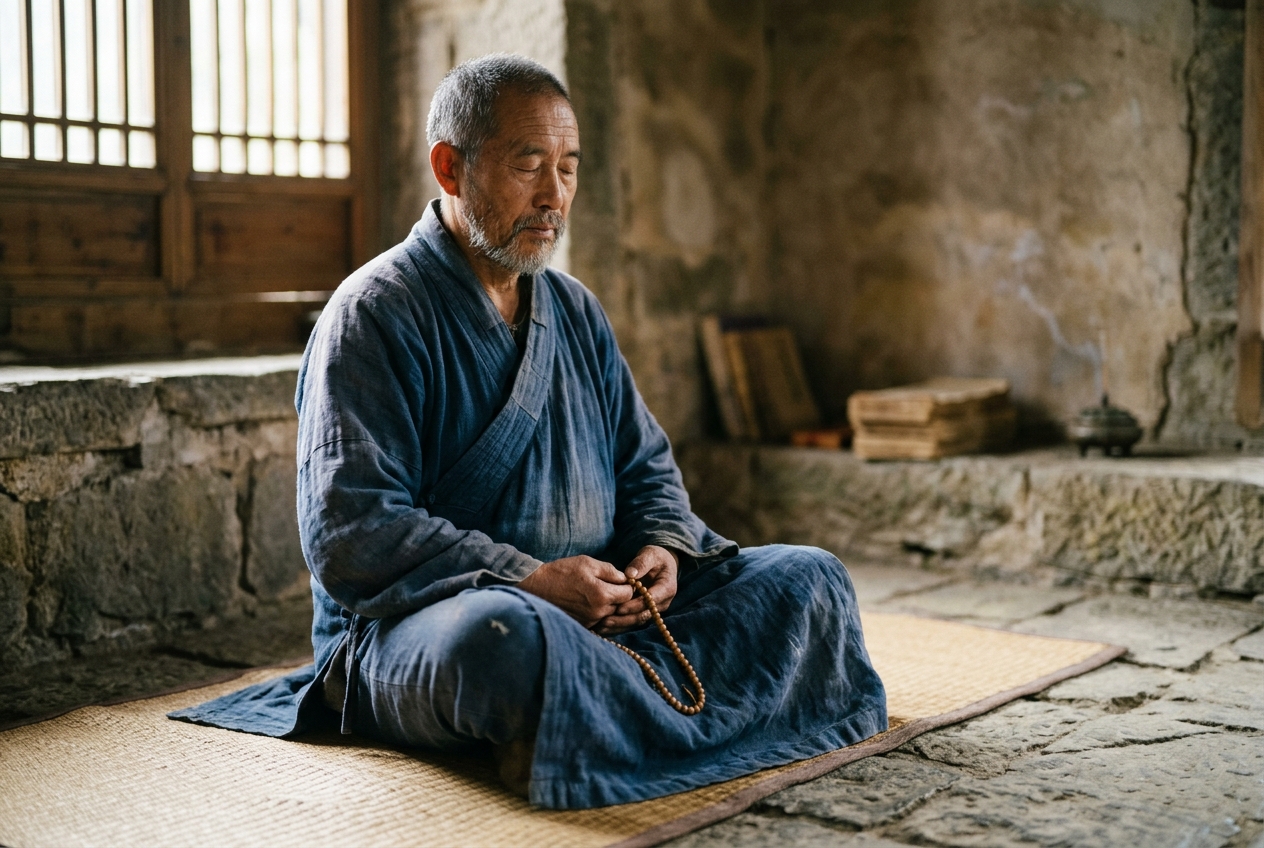
To understand Zuo Wang, it helps to demystify traditional terminology into felt physiological experience. In Daoist philosophy and Traditional Chinese Medicine, human experience is governed by Xin (心, the heart-mind or discursive intellect), Yi (意, focused mental intention and willpower), Qi (氣, bioelectric vitality and circulating breath), and Shen (神, radiant conscious awareness). Most conventional meditative and martial practices rely on Yi to guide Qi—actively leading warmth, breath, and sensation through specific pathways such as the Microcosmic Orbit. Zuo Wang, by contrast, operates on the principle of Wu Wei (無為, effortless non-action or spontaneous alignment). By relinquishing the conscious effort of the Yi, our innate vitality (Yuan Qi, or primordial energy) ceases to encounter somatic resistance and naturally condenses into the Lower Dantian—the body's physical and energetic gravitational center located roughly two inches below the navel—before permeating the central vertical core of the torso (Zhong Mai).
                      BIO-AXIAL ALIGNMENT FOR ZUO WANG

                                   [+] Baihui (Crown Point)
                                    |  Suspended from Above
                           (o)-(o)  |  Half-Open Dissolved Gaze
                             ---    |  Soft Palatal Seal (Magpie Bridge)
                               \    |
                                \   |  Cervical Spine Lengthened
                                 \  |
                                  [===] Sunk Chest / Broad Scapulae
                                    |
                                   / \ Thoracolumbar Decompression
                                  /   \
                                 | (*) | Lower Dantian Center
                                  \   /  (Passive Yuan Qi Condensation)
                                   \ /
                                   [=] Sacral Plumb Line / Perineum (Huiyin)
                                   / \
                                  /   \ Stable Grounded Base
Step-by-Step Practice Guide: The Somatic Cultivation Protocol
Entering Zuo Wang is not an intellectual exercise; it is an organic, postural, and neuro-somatic descent into stillness. Set aside fifteen to thirty minutes in a quiet, temperate room free from direct drafts.
1. Establishing the Bio-Axial Foundation
- Base Posture: Sit on a firm, supportive cushion (zafu) with legs loosely crossed in the Burmese, half-lotus, or full-lotus position. If sitting in a chair, place your feet flat on the floor, hip-width apart, ensuring your knees are slightly lower than your hips to prevent pelvic retroversion.
- The Spinal Plumb Line: Imagine your sacrum weighted like a plumb bob dropping straight into the center of the earth, while the crown of your head (Baihui, GV-20) is suspended effortlessly from the sky. This naturally opens the lumbar spine and gently tucks the chin, decompressing the suboccipital region and brainstem.
- The Palatal Seal (Magpie Bridge): Rest the tip of your tongue against the hard palate just behind the upper teeth. This connects the Conception (Ren Mai) and Governing (Du Mai) energetic channels while stimulating salivary secretion and triggering cranial parasympathetic pathways.
- The Dissolved Gaze (Yiguang): Keep your eyelids approximately one-third to half open. Do not stare at a specific spot on the floor. Instead, allow your peripheral field of vision to broaden until edges and forms soften into an ambient wash of light and shadow. This prevents the drowsy torpor (hunchen) caused by tightly closed eyes while eliminating the visual grasping caused by hyper-fixation.
- Weightless Arms: Rest your hands on your knees, or cradle your left hand inside your right hand with the tips of your thumbs lightly touching to form an open oval across your lower lap. Drop your shoulders down and slightly round the upper back, creating a gentle hollow in the chest that allows the diaphragm to descend freely.
2. The Mechanics of Sensory Deafferentation
Once the physical posture is stable, cease making adjustments. The progression into oblivion occurs through subtle perceptual transitions:
- Passive Auditory Widening: Instead of listening to specific ambient sounds (traffic, ticking clocks, distant birds), receive the entire auditory landscape simultaneously as a unified acoustic field. Hear sound arising and passing within vast, empty space.
- Suboccipital and Ocular Release: Consciously soften the micro-muscles of the eyes and the base of the skull. As these muscles relax, you disengage the visual tracking reflex that keeps the analytical brain in a state of continuous vigilance.
- Breath Naturalization: Relinquish all deliberate pacing, counting, or deep breathing techniques. Allow respiration to become shallow, silky, and imperceptible. The breath breathes itself; you are merely the silent witness to the subtle rise and fall of the lower abdominal wall.
- Disidentification from Mental Chatter: When thoughts arise—whether memories, anxieties, or abstract philosophies—do not suppress them or construct dialogues with them. Treat thoughts like clouds drifting across an unconditioned sky. Refuse to provide mental intention (Yi). Deprived of attention, the neurological momentum of discursive thinking gradually expends itself.
3. Navigating Altered Perceptual Phenomena
As somatic boundaries soften, you may encounter specific subjective milestones. Understanding these prevents fear or fixation: * Dissolution of Physical Periphery: The sensory distinction between skin and external atmosphere becomes indeterminate. Limbs may feel vast, hollow, or non-existent. This is a normal consequence of parietal sensory deafferentation. * Apochromatic Clarity: A field of clear, luminous, non-chromatic brightness often appears across the visual cortex, unattached to external light sources. Daoist texts refer to this as the "Luminescence of the Void" (Xushi Shengtai). Remain neutral; do not chase the light. * Temporal Suspension: A half-hour sitting may feel like two minutes, or a single second may feel boundless. This reflects the quieting of cortical chronometers tied to sequential narrative processing.
4. Grounding and Safe Emergence
Never snap abruptly out of Zuo Wang. Abrupt disruption can cause transient vascular headaches or nervous system disorientation (Qi stagnation): 1. Slowly draw your internal focus back to your physical center at the Lower Dantian. 2. Deepen your inhalation through the nose, gently expanding the lower abdomen and directing awareness downward into the soles of your feet (Yongquan, KI-1). 3. Rub your palms briskly together until hot, then cup them over your eyes to bathe the retinas in warmth. Gently stroke your face, ears, and back of the neck. 4. Rotate your ankles and wrists, rock your pelvis slowly side-to-side, and stand up only when full tactile sensation and spatial orientation have returned.
+-----------------------------------------------------------------------------------+
|                        SUMMARY OF ZUO WANG PRACTICE PHASES                        |
+-----------------------------------------------------------------------------------+
| Phase 1: Bio-Axial Alignment  -> Suspend crown, seal palate, sink chest, relax   |
| Phase 2: Sensory Softening    -> Widen gaze, open peripheral audio, drop focus    |
| Phase 3: Non-Dual Oblivion    -> Cease mental intention (Yi), allow DMN quieting  |
| Phase 4: Conscious Grounding  -> Warm palms, anchor into soles of feet (Yongquan) |
+-----------------------------------------------------------------------------------+
Why It Works — The Body Science & Neuro-Somatic Mechanisms
Modern neuroscience, autonomic physiology, and biomechanics provide a compelling contemporary lexicon for the transformations described by ancient Daoist adepts. When we examine Zuo Wang under a scientific lens, its outcomes correlate directly with verifiable shifts in neural network dynamics, fascial tensegrity, and autonomic balance.
       CONVENTIONAL DISCURSIVE COGNITION vs. ZUO WANG SOMATIC STATE

    [ Active Thinking / Ego-Narration ]      [ Zuo Wang / Non-Dual Oblivion ]
    +---------------------------------+      +---------------------------------+
    | - High DMN Coherence (mPFC-PCC) |      | - DMN Downregulation / Quieting |
    | - High Beta Waves (13-30 Hz)    | ===> | - Global Alpha-Theta Synchrony  |
    | - Sympathetic Tone / Vigilance  |      | - Parasympathetic Vagal Peak    |
    | - Micro-Muscular Tension Guard  |      | - Fascial Viscoelastic Release  |
    +---------------------------------+      +---------------------------------+
1. Downregulation of the Default Mode Network (DMN)
The neurobiological core of the discursive ego resides within the Default Mode Network (DMN), an interconnected anatomical web primarily comprising the medial prefrontal cortex (mPFC), the posterior cingulate cortex (PCC), the precuneus, and the inferior parietal lobule. The DMN generates autobiographical memory, temporal projection (worrying about the future), and self-referential rumination.
Neuroimaging investigations published on the NCBI PubMed Central database demonstrate that non-directive, open-awareness meditative states produce a rapid and sustained suppression of metabolic activity across the DMN's key nodes. In Zuo Wang, when you stop entertaining the stream of "I-making" thoughts, functional connectivity between the mPFC and PCC declines dramatically. The narrative self falls away, leaving unconditioned, non-referential baseline awareness intact.
2. Thalamocortical Gating and Parietal Deafferentation
Under ordinary conditions, the somatosensory cortex and the superior parietal lobule construct a real-time three-dimensional map of your physical body in space, delineating "self" from "environment." By maintaining absolute postural stillness and softening ocular focus, you initiate sensory deafferentation. The thalamus, which serves as the brain's sensory clearinghouse, decreases the transmission of peripheral afferent signals to the cortex. Consequently, the posterior parietal lobes lose the tactile and proprioceptive data needed to maintain distinct physical boundaries. This correlates precisely with the subjective sensation of "dropping limbs and physical form" (duo zhitil).
3. Autonomic Nervous System: Vagal Dominance and Respiratory Sinus Arrhythmia
The bio-axial posture of Zuo Wang decompresses the craniocervical junction, optimizing flow through the jugular foramen where the vagus nerve (Cranial Nerve X) exits the skull. Combined with the natural cessation of chest breathing and the adoption of passive diaphragmatic excursions, this shifts autonomic balance from sympathetic fight-or-flight activation into deep parasympathetic rest-and-digest dominance. Clinical reviews on autonomic regulation via NCBI PubMed illustrate that this vagal upregulation enhances Heart Rate Variability (HRV) and deepens respiratory sinus arrhythmia, lowering systemic blood pressure, reducing serum cortisol, and triggering systemic cellular repair.
4. Neuro-Oscillatory Coherence: The Alpha-Theta Bridge
During normal waking consciousness, the brain operates primarily in desynchronized beta waves (13–30 Hz), reflecting active calculation and environmental monitoring. As the practitioner sinks into Zuo Wang, electroencephalography (EEG) recordings reveal a swift transition to high-amplitude, global alpha rhythms (8–12 Hz), particularly across the occipital and parietal regions. With prolonged stillness, this alpha state transitions into phase-synchronized theta waves (4–8 Hz) across the frontal midline and temporal lobes. This alpha-theta synchrony is the neural signature of lucid hypnagogia—a state of profound physiological rest combined with vivid, non-conceptual mental clarity.
5. Fascial Tensegrity and Interstitial Fluid Dynamics
Beyond the central nervous system, Zuo Wang exerts a profound effect on the musculoskeletal and connective tissue systems. Chronic stress causes the myofascial web—particularly the deep thoracolumbar fascia, psoas complex, and suboccipital fascial bands—to hold persistent micro-contractions. By relaxing intentional motor control (Yi), these tonic contractions unlock. The body's connective tissues shift from rigid structural armor into a state of fluid viscoelastic tensegrity. Interstitial fluid and lymphatic circulation increase across cellular matrices, providing the somatic substrate for the unrestricted, effortless settling of Qi.
Classical Lineage & Textual Analysis
The historical lineage of Zuo Wang represents one of the most sophisticated philosophical and contemplative traditions in East Asian intellectual history. Far from being a vague folk remedy, it was formulated in foundational Classical texts and refined within Tang Dynasty Daoist monastic academies.
                     HISTORICAL EVOLUTION OF ZUO WANG

     WARPING STATES ERA (c. 4th Century BCE)
     Zhuangzi (庄子) / "The Great Ancestral Master" (Da Zong Shi)
     - Yan Hui outlines: "Duo zhiti, chu congming..." (Drop limbs, cast off intellect)
     - Core philosophical definition of non-dual union with the Dao (Great Thoroughfare)
                           |
                           v
     TANG DYNASTY SHANGQING SYNTHESIS (c. 8th Century CE)
     Sima Chengzhen (司马承祯, 647-735 CE) / Zuowanglun (坐忘论)
     - Seven-Stage Systematic Contemplative Taxonomy (Jingxin -> Dedao)
     - Synthesis of Lao-Zhuang Daoism with Tiantai Buddhist Meditative Epistemology
                           |
                           v
     CONTEMPORARY SOMATIC & INTEGRATIVE SCIENCE
     - Recognized by global somatic modalities and traditional health institutes
     - Documented by the National Qigong Association and WHO Traditional Medicine initiatives
1. The Zhuangzian Foundation: The Dialogue of Yan Hui and Confucius
The earliest textual appearance of Zuo Wang occurs in the inner chapters of the Zhuangzi (c. 4th century BCE), specifically in Chapter 6, Da Zong Shi (大宗師, "The Great Ancestral Master"). In this celebrated allegorical passage, Confucius's brilliant disciple, Yan Hui, reports his progressive spiritual development:
顏回曰:「墮肢體,黜聰明,離形去知,同於大通,此謂坐忘。」
Yan Hui said: "I smash my limbs and physical form, drive out intelligence and perception, cast off physical form and intellect, and become identical with the Great Thoroughfare. This is what I call sitting in oblivion."
In this seminal declaration, Zhuangzi articulates the core epistemological pivot of classical Daoism. The phrase duo zhiti (墮肢體, "dropping limbs and physical structure") signifies the release of somatic grasping and the transcending of bodily identification. Chu congming (黜聰明, "dismissing sharp sensory intelligence") refers to switching off the calculating, evaluative faculty that constantly categorizes experience into dualities of good and bad, self and other. To become "identical with the Great Thoroughfare" (tong yu datong) is to dissolve the artificial boundaries of the ego and dwell directly in the open, unconditioned flow of the Dao.
2. Sima Chengzhen and the Tang Dynasty Synthesis: The Zuowanglun
While Zhuangzi presented Zuo Wang as an intuitive, radical philosophical stance, it was systematized nearly a millennium later by the 12th Shangqing Daoist Patriarch, Sima Chengzhen (司馬承禎, 647–735 CE). Living during the cultural and intellectual zenith of the Tang Dynasty, Sima Chengzhen synthesized classical Lao-Zhuang metaphysics with the meticulous psychological analysis of Tiantai Buddhist Zhiguan (stopping and seeing) meditation, composing the definitive manual: the Zuowanglun (坐忘論, Treatise on Sitting in Oblivion).
+-----------------------------------------------------------------------------------+
|               THE SEVEN DEVELOPMENTAL STAGES OF SIMA CHENGZHEN'S ZUOWANGLUN       |
+----+-------------------+----------------------------------------------------------+
| #  | Stage (Pinyin/Han)| Epistemological & Somatic Definition                     |
+----+-------------------+----------------------------------------------------------+
| 1. | Jingxin (敬信)    | Respectful Faith: Establishing initial trust in the Dao  |
| 2. | Duanyuan (斷緣)   | Severing Ties: Relinquishing non-essential entanglements |
| 3. | Shouxin (收心)    | Gathering the Mind: Retracting attention from senses     |
| 4. | Jianshi (簡事)    | Simplifying Affairs: Living with unencumbered frugality  |
| 5. | Zhenguan (真觀)   | True Observation: Cultivating dispassionate insight      |
| 6. | Taiding (泰定)    | Supreme Stability: Anchoring in unshakeable stillness    |
| 7. | Dedao (得道)      | Attaining the Dao: Total non-dual integration with Truth |
+----+-------------------+----------------------------------------------------------+
Sima Chengzhen laid out seven rigorous developmental stages through which the practitioner moves from worldly distraction to complete transcendence:
- Jingxin (敬信, Respectful Faith): The cultivation of profound, humble confidence in the underlying unity of the Dao. Without authentic reverence and trust in natural spontaneity, the mind remains restless and resistant to letting go.
- Duanyuan (斷緣, Severing External Ties): The conscious disengagement from unnecessary worldly obligations, superficial social dynamics, and mental preoccupations that continually stir the passions and deplete vital energy.
- Shouxin (收心, Gathering the Mind): The active gathering back of the wandering senses. Sima Chengzhen compares the untrained mind to a wild animal; here, the practitioner gently draws scattered awareness back from external stimuli into interior stillness.
- Jianshi (簡事, Simplifying Affairs): The structural reorganization of one's daily life to minimize complexity. By reducing material desires and external drama, the practitioner removes the external triggers that agitate mental tranquility.
- Zhenguan (真觀, True Observation / Objective Insight): The emergence of lucid, dispassionate observation. The practitioner observes internal sensations, emotions, and external phenomena without projecting personal bias, attachment, or aversion. One sees that all conditioned phenomena are impermanent, empty of an independent self, and inherently changing.
- Taiding (泰定, Supreme Stability / Great Stillness): The state where meditative stillness becomes unwavering and self-sustaining. In Taiding, quietude no longer depends on quiet surroundings; the heart-mind remains undisturbed even when encountering external chaos or sudden circumstance.
- Dedao (得道, Attainment of the Dao): The culmination of the path. All residual sense of a separate, isolated observer dissolves completely into the unconditioned source of existence. The boundary between practitioner and cosmos vanishes; one embodies the Dao effortlessly in every gesture, breath, and action.
Through this seven-fold framework, Sima Chengzhen elevated Zuo Wang from an obscure hermetic practice into an enduring, systematic contemplative science. Today, institutions such as the National Qigong Association (NQA) and traditional medicine researchers recognized under the World Health Organization (WHO) Traditional Medicine Strategy continue to acknowledge these classical methodologies as sophisticated frameworks for holistic psycho-somatic health.
Today's Practice Commitment: Your First Step into Oblivion
The true elegance of Zuo Wang lies in its accessibility: it requires no specialized equipment, incense, or complex doctrinal affiliations—only your sincere willingness to put down the burden of doing.
Tomorrow morning, before you check your phone, open your inbox, or pour your first cup of tea or coffee, give yourself a sacred, ten-minute container of absolute non-doing:
- Sit quietly on a chair or cushion with your spine naturally erect.
- Set your palatal seal, widen your gaze into soft peripheral awareness, and place your hands comfortably in your lap.
- For the next ten minutes, do not attempt to improve yourself, fix a problem, heal your body, or achieve enlightenment.
- When thoughts flutter into view, let them go without judgment. Let your muscles soften, let your breath settle into your lower belly, and allow your entire being to rest completely in oblivion.
Notice the distinct quality of physical lightness, emotional ease, and clear mental space that accompanies you as you step back into your day. In an accelerated world obsessed with constant production and relentless striving, sitting in oblivion is not a withdrawal from reality—it is the ultimate return to life itself.