Zi Wu Liu Zhu: Navigating Midnight-Noon Ebb-Flow Dynamics, Chronobiological Open Points, and Precision Acupressure Protocols
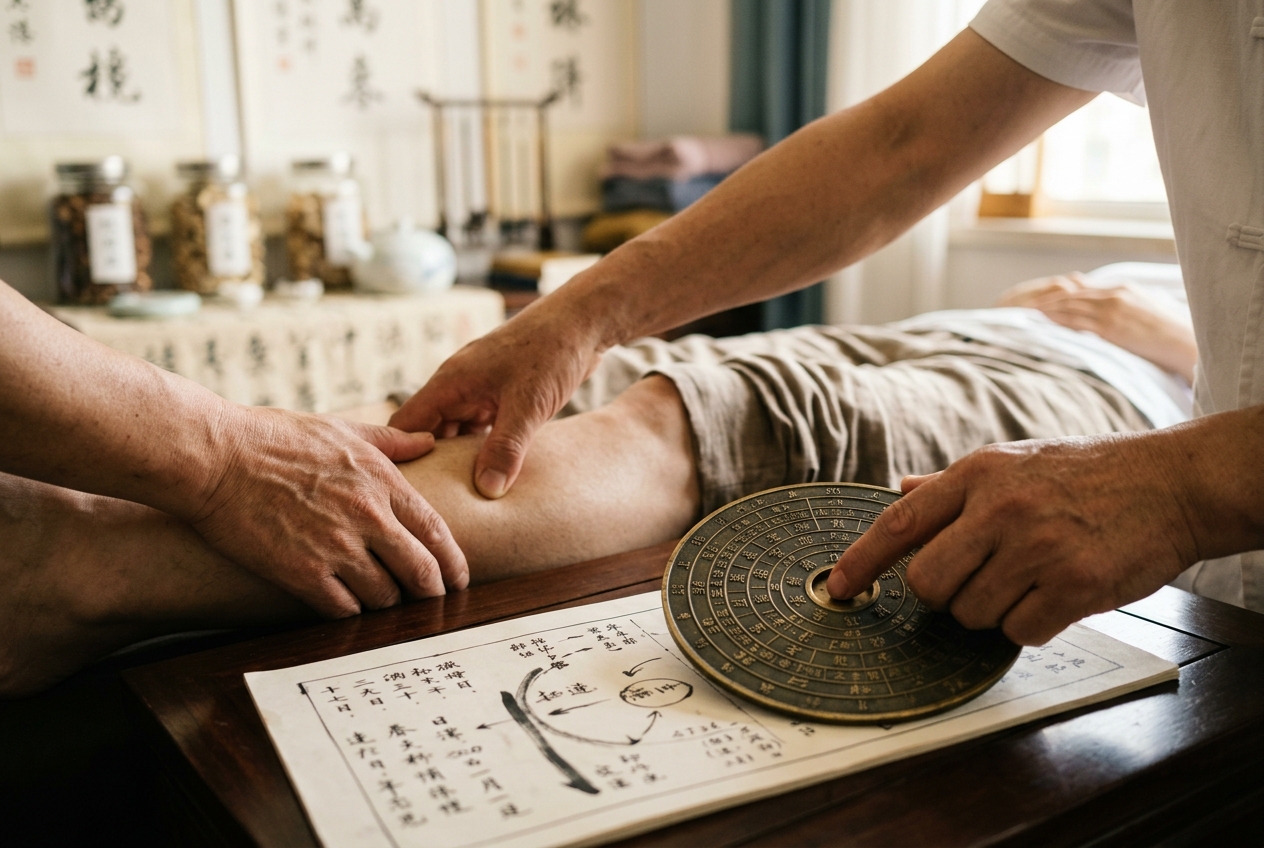
1. Opening — A Problem This Solves Today
If you regularly jolt awake at 3:15 AM with a racing mind, experience an unshakable cognitive slump at 2:00 PM despite adequate sleep, or suffer from stubborn postprandial bloating that defies dietary restriction, you are not merely suffering from generic fatigue. You are experiencing circadian desynchrony within your physiological channels.
Modern life imposes an artificial temporal grid: blue-lit screens prolong our waking state past midnight, meals are consumed asynchronously relative to digestive enzyme surges, and shift work fractures evolutionary sleep-wake cycles. The body, however, does not measure time through the arbitrary tick of a quartz watch or a calendar alert. It measures time through self-sustaining transcription-translation biochemical feedback loops in every cell, coordinated by the central suprachiasmatic nucleus and mirrored across peripheral microvascular capillary beds.
Centuries before Western chronobiology mapped molecular clock genes such as PER1 and CRY1, classical Chinese medicine developed an exquisite mathematical and hydrodynamic science known as Zi Wu Liu Zhu (子午流注, "Midnight-Noon Ebb-Flow"). This system recognizes that the human bio-energetic matrix is not static. Blood (Xue) and metabolic vital propulsion (Qi) wax and wane through the twelve primary meridians in an invariant, rhythmic tide.
By understanding this chronobiological map, you do not need invasive clinical interventions to restore physiological equilibrium. Using non-invasive, precisely timed manual pressure on the classical Five Shu transport points (Wu Shu Xue), you can access the autonomic nervous system, regulate visceral perfusion, and resolve stubborn daily complaints by synchronizing somatic interventions with the body's native chronobiological tides.
2. Historical Foundations and Theoretical Architecture
The theoretical architecture of Zi Wu Liu Zhu rests upon the fundamental cosmology of Chinese medicine: the non-dualistic continuum between the macrocosm (the celestial cycles of the sun, moon, and seasons) and the microcosm (human physiological self-regulation).
The earliest foundations appear in the canonical Han Dynasty texts Huangdi Neijing (The Yellow Emperor’s Inner Classic), specifically the Suwen (Plain Questions) and Lingshu (Spiritual Pivot). Lingshu Chapter 41 (Wei Qi Xing) and Chapter 76 (Wei Qi) detail how defensive Qi (Wei Qi) and nutritive Qi (Ying Qi) complete fifty full circulatory cycles through the body every twenty-four hours—twenty-five cycles during the diurnal Yang phase and twenty-five during the nocturnal Yin phase.
+---------------------------------------------------------------------------------------+
| DOCTRINAL FOUNDATION: LINGSHU CHAPTER 1                                               |
| "The movement of Qi is like the flow of water; it springs forth at the Well (Jing),   |
| trickles at the Spring (Ying), pours at the Stream (Shu), courses along at the River   |
| (Jing), and empties inward at the Sea (He)."                                          |
+---------------------------------------------------------------------------------------+
During the Jin-Yuan medical renaissance, this philosophical framework was converted into a rigorous, predictive clinical algorithm. In 1153 CE, physician He Ruoyu (何若愚) authored the seminal Ziwu Liuzhu Zhenjing (Acupuncture Classic of Midnight-Noon Ebb-Flow), formalizing the mathematical correspondence between the Heavenly Stems and Earthly Branches and the opening of specific acupuncture points. He Ruoyu's work was subsequently refined and expanded by the master acupuncturist Dou Hanqing (窦汉卿, 1196–1280 CE) in his treatises Zhenjing Zhinan (Guide to the Classics of Acupuncture) and Bafa Feiteng (Eight Methods of Soaring Flight).
At the core of this doctrine lies the Zi-Wu Polarity Axis: * Zi (子) corresponds to midnight (23:00–01:00), the winter solstice, the absolute zenith of Yin, and the initial, subtle rebirth of Yang within the Gallbladder channel (Foot Shaoyang). In Five-Phase correspondence, Zi embodies the primordial depth of Water. * Wu (午) corresponds to noon (11:00–13:00), the summer solstice, the absolute zenith of Yang, and the initial emergence of Yin within the Heart channel (Hand Shaoyin). Wu embodies the radiant warmth of Fire.
The dynamic tension between Zi and Wu forms the master physiological axis across which all twelve meridians, organ networks (Zang-Fu), and the sixty-six Five Shu transport points continually oscillate.
3. The Mathematical Engine: Najia Fa and Nazhi Fa Calculation Methodologies
The practical application of Zi Wu Liu Zhu relies on two primary open-point calculation algorithms: Nazhi Fa (The Hour-Branch / Fixed Diurnal Method) and Najia Fa (The Day-Stem / Generating Cycle Method). Both systems govern the hydrodynamic opening of the 66 Five Shu Transport Points.
HYDRODYNAMIC PROGRESSION OF THE FIVE SHU TRANSPORT POINTS
========================================================================================
Point Type   Location            Fluid Dynamic Metaphor        Biomechanical Action
----------------------------------------------------------------------------------------
Jing-Well    Ungual extremities  Water bubbling from a spring  Dynamic Qi emergence/clearing
Ying-Spring  Digital webbing     Trickling mountain stream     Clearing pathogenic heat/fire
Shu-Stream   Ankles and wrists   Porous, rapid pouring stream  Transporting defensive Qi
Jing-River   Forearms and shins  Deep, wide coursing river     Harmonizing cough, voice, joints
He-Sea       Elbows and knees    Vast ocean confluence         Directing Qi inward to Zang-Fu
========================================================================================
The 66 Five Shu Points Classification
The Five Shu points represent specific loci between the fingertips/toes and the elbows/knees where the meridian's bio-energetic flow transitions from superficial velocity to deep visceral confluence:
$$\text{Yin Channels: } \text{Jing (Wood)} \to \text{Ying (Fire)} \to \text{Shu (Earth)} \to \text{Jing-River (Metal)} \to \text{He-Sea (Water)}$$
$$\text{Yang Channels: } \text{Jing (Metal)} \to \text{Ying (Water)} \to \text{Shu (Wood)} \to \text{Jing-River (Fire)} \to \text{He-Sea (Earth)}$$
(Note: Yang channels incorporate a sixth distal locus—the Yuan-Source point—yielding 5 points $\times$ 6 Yin channels = 30 points, plus 6 points $\times$ 6 Yang channels = 36 points, totaling 66 classical chronopuncture points).
Algorithm A: Nazhi Fa (The Earthly Branch / Diurnal Organ Clock Method)
Nazhi Fa is the most direct, accessible chronobiological method. It maps the twelve two-hour segments (Shi Chen) of the 24-hour solar day to the sequential flow of nutritive Qi through the twelve primary channels.
THE 24-HOUR DIURNAL ORGAN CIRCLING (NAZHI FA MATRIX)
========================================================================================
Hour Window   Branch   Organ / Meridian System    Horary Point (Ben Xue)   Phase Nature
----------------------------------------------------------------------------------------
03:00–05:00   Yin (寅)  Lung (Hand Taiyin)         Taiyuan (LU9)            Metal on Metal
05:00–07:00   Mao (卯) Large Intestine (Hand Yangming) Erjian (LI2)         Water on Metal
07:00–09:00   Chen (辰) Stomach (Foot Yangming)    Zusanli (ST36)           Earth on Earth
09:00–11:00   Si (巳)  Spleen (Foot Taiyin)       Taibai (SP3)             Earth on Earth
11:00–13:00   Wu (午)  Heart (Hand Shaoyin)       Shaofu (HT8)             Fire on Fire
13:00–15:00   Wei (未) Small Intestine (Hand Taiyang) Yanggu (SI5)          Fire on Fire
15:00–17:00   Shen (申) Bladder (Foot Taiyang)     Kunlun (BL60)            Fire on Water
17:00–19:00   You (酉) Kidney (Foot Shaoyin)      Yingu (KI10)             Water on Water
19:00–21:00   Xu (戌)  Pericardium (Hand Jueyin)  Laogong (PC8)            Fire on Fire
21:00–23:00   Hai (亥) Triple Burner (Hand Shaoyang) Zhigou (TE6)           Fire on Fire
23:00–01:00   Zi (子)  Gallbladder (Foot Shaoyang) Zulinqi (GB41)          Wood on Wood
01:00–03:00   Chou (丑) Liver (Foot Jueyin)        Daling / Xingjian (LV2)  Fire on Wood
========================================================================================
Under Nazhi Fa, clinical point selection utilizes three primary strategies: 1. Horary Stimulation (Ben Xue): Stimulating the point whose Five-Phase element matches the intrinsic element of the active channel during its peak two-hour window (e.g., tonifying Zusanli [ST36, Earth] between 07:00 and 09:00 during the Stomach [Earth] hour). 2. Mother-Son Tonification (Bu Mu): Tonifying the "Mother" element point during the active hour when organ deficiency is present (e.g., tonifying Taiyuan [LU9, Earth] to nourish Lung [Metal], since Earth generates Metal). 3. Child-Son Sedation (Xie Zi): Dispersing the "Child" element point during the active hour when organ excess or heat is present (e.g., dispersing Chize [LU5, Water] during the 03:00–05:00 window to sedate acute pulmonary heat, since Metal generates Water).
Algorithm B: Najia Fa (The Day-Stem / Generating Cycle Method)
Najia Fa is a sophisticated, cyclical mathematical model that allocates the Ten Heavenly Stems (Tiangan: Jia, Yi, Bing, Ding, Wu, Ji, Geng, Xin, Ren, Gui) to the primary channels according to ancient mnemonic equations:
$$\text{Jia/膽 (GB), Yi/肝 (LV), Bing/小腸 (SI), Ding/心 (HT), Wu/胃 (ST),}$$ $$\text{Ji/脾 (SP), Geng/大腸 (LI), Xin/肺 (LU), Ren/膀胱 (BL), Gui/腎 (KI).}$$
When a Heavenly Stem rules a particular day, the chronobiological cycle initiates at the Jing-Well point of the corresponding channel at the appropriate hour stem. As the hour stems advance through the daytime cycle, points "open" (Kai Xue) along the Five-Phase generating lineage ($Wood \to Fire \to Earth \to Metal \to Water$).
When an hour stem encounters a channel of opposite polarity, the algorithm applies the Principle of Mutual Stem Combination (Tiangan Hehua), diverting the open point to the paired Yuan-Source point (Yuan Xue). This ensures continuous circulation of Qi across both Yin and Yang matrices without stagnation.
4. The Meridian Path: A Journey Through the Body
To practice chrono-acupressure effectively, you do not need complex anatomical terminology. You need an intuitive, tactile map of how these energetic pathways flow across your own body.
Consider the great foundational pathway of the Lung (Hand Taiyin) and Large Intestine (Hand Yangming) axis, which governs our interface with the external environment:
- The Origin at the Chest: The pathway begins deep within the solar plexus, rises past the stomach, and emerges just below your collarbone in the triangular hollow between your shoulder muscle and your upper chest wall.
- The Descent Down the Arm: It glides down the front-facing, soft inner surface of your bicep—the sensitive skin that faces upward when your palm is open.
- The Elbow and Forearm Gateway: It crosses the elbow crease just to the outer edge of your prominent central bicep tendon, then tracks down the outer edge of your inner forearm along the radial bone.
- The Hand Terminus: It passes across the wrist crease right where you feel the pulsing radial artery, courses across the fleshy base of your thumb pad (the thenar eminence), and terminates at the outer corner of your thumbnail.
- The Yang Return Loop: From the tip of the adjacent index finger, the paired Large Intestine pathway picks up the current. It travels up the firm, muscular outer ridge of the forearm, climbs over the cap of the shoulder, scales the side of the neck, and crosses under the nose to settle beside the opposite nostril.
This continuous loop—descending along the soft Yin interior and ascending along the firm Yang exterior—repeats across all twelve channels, connecting your feet, trunk, back, and head in a continuous web of kinetic and bio-electric signaling.
5. Key Loci for Immediate Chronobiological Activation
The following five master points represent the most versatile, clinically validated Five Shu, Yuan-Source, and crossing loci on the human body according to World Health Organization acupuncture standards.
1. Zusanli (ST36 — "Leg Three Miles")
- Classification: He-Sea Point (Earth Element on Earth Meridian), Horary Point (Ben Xue).
- Location: Sit with your knees bent at 90 degrees. Place four fingers of your hand horizontally across your shin, starting directly below the bottom edge of your kneecap. Locate the outer vertical ridge of your shinbone. Move one thumb-width outward into the soft, muscular groove of the tibialis anterior muscle.
- Somatic Confirmation: When pressing firmly inward and slightly toward the bone, you will feel a distinctive, deep dull ache that radiates downward toward the second and third toes.
- Manual Technique: Apply sustained, circular thumb pressure, angling the vector slightly upward toward your knee. Maintain firm pressure for 2 to 3 minutes.
- Peak Chrono-Window: 07:00–09:00 (Chen Hour — Stomach Meridian).
- Primary Utility: Relieves severe postprandial lethargy, chronic digestive weakness, systemic fatigue, and gastrointestinal distress.
2. Taichong (LV3 — "Great Surge")
- Classification: Shu-Stream Point (Earth Element), Yuan-Source Point.
- Location: Place your index finger on the skin webbing between your big toe and second toe. Slide your finger upward along the groove between the two long foot bones toward your ankle for about 1.5 to 2 inches until your finger drops into a distinct, sensitive depression just before the bones join.
- Somatic Confirmation: This point is exceptionally tender in individuals experiencing heightened stress. You will feel a sharp, radiant ache accompanied by a localized warming or tingling sensation across the top of the foot.
- Manual Technique: Apply firm, downward pressure combined with counter-clockwise kneading to disperse stagnated liver tension. Maintain for 1.5 to 2 minutes per foot.
- Peak Chrono-Window: 01:00–03:00 (Chou Hour — Liver Meridian) or during its diurnal midday polar reflex at 13:00–15:00.
- Primary Utility: Mitigates acute emotional irritability, tension headaches centered behind the eyes, jaw clenching (bruxism), and autonomic hyperarousal.
3. Sanyinjiao (SP6 — "Three Yin Intersection")
- Classification: Group Luo-Connecting Point of the Spleen, Liver, and Kidney Meridians.
- Location: Locate the highest, most prominent point of your inner ankle bone (medial malleolus). Place the width of four fingers flat against your inner leg, positioned horizontally above the ankle bone. Locate the point directly behind the rear border of the inner shinbone (tibia).
- Somatic Confirmation: A pronounced, bruised, tender sensation will manifest immediately upon light-to-medium contact, often sending a gentle ascending warmth up the inner calf.
- Manual Technique: Use steady, perpendicular compression with the pad of your thumb. Avoid rapid pumping. Hold a continuous, calming pressure for 2 minutes while practicing slow, diaphragmatic breathing.
- Peak Chrono-Window: 09:00–11:00 (Si Hour — Spleen Meridian) or 17:00–19:00 (You Hour — Kidney Meridian).
- Primary Utility: Harmonizes pelvic congestion, relieves lower abdominal cramping, eases menstrual discomfort, and calms late-night emotional restless anxiety.
4. Neiguan (PC6 — "Inner Pass")
- Classification: Luo-Connecting Point of the Pericardium, Confluent Point of the Yin Link (Yinwei) Vessel.
- Location: Turn your palm upward. Lay three fingers horizontally across your wrist, with your ring finger aligned along the primary distal wrist crease. The point sits directly below your index finger, exactly midway between the two prominent, cord-like tendons in the center of your forearm (flexor carpi radialis and palmaris longus).
- Somatic Confirmation: Firm pressure produces a distinct, electrical tingling sensation that travels upward into the forearm and downward into the palm and middle finger.
- Manual Technique: Press deeply between the two tendons using the tip of your thumb. Angle the pressure slightly toward your elbow. Hold for 2 minutes on each wrist.
- Peak Chrono-Window: 19:00–21:00 (Xu Hour — Pericardium Meridian).
- Primary Utility: Rapidly stabilizes palpitations, chest tightness from acute panic, motion sickness, nausea, and evening nervous agitation.
5. Hegu (LI4 — "Joining Valleys")
- Classification: Yuan-Source Point of the Large Intestine (Metal Meridian).
- Location: Spread your hand flat. Look at the fleshy web between your thumb and index finger. Bring your thumb tightly against your index finger: a small mound of muscle will bulge upward. The point is located at the absolute peak of that muscular bulge. Alternatively, place the first crease of your opposite thumb on the web margin and press downward into the muscle.
- Somatic Confirmation: A deep, spreading, dull sensation (Deqi) that frequently radiates into the index finger or up the forearm toward the jaw.
- Manual Technique: Pinch the web deeply between your opposite thumb (on top of the hand) and index finger (supporting the palm underneath). Apply firm, steady, pulsing circular pressure for 1 to 2 minutes per hand.
- Peak Chrono-Window: 05:00–07:00 (Mao Hour — Large Intestine Meridian).
- Primary Utility: Resolves acute frontal headaches, dental discomfort, sinus congestion, neck stiffness, and facial tension.
6. Actionable Chrono-Acupressure Protocols
Applying Zi Wu Liu Zhu does not require guessing. Follow this systematic workflow to calculate open points and apply therapeutic combinations for common modern conditions.
Calculating Your True Solar Time
Before selecting a point based on the Earthly Branch windows: 1. Identify your local standard time. 2. Adjust for Daylight Saving Time (subtract 1 hour if currently active). 3. Calculate the longitudinal offset from your time zone’s central meridian (add 4 minutes per degree east, subtract 4 minutes per degree west). This yields True Solar Time (Zhen Taiyang Shi), matching your body's physiological organ clock.
Clinical Protocol: The Midnight-Noon Insomnia & Exhaustion Reset
+---------------------------------------------------------------------------------------+
| TARGET SYNDROME: 03:00 AM Waking, Late-Night Brain Fog, and Exhausted Restlessness    |
| PATHOLOGY: Yin-Yang Non-Communication across the Zi-Wu Axis (Heart-Kidney Discord)    |
+---------------------------------------------------------------------------------------+
EVENING SEQUENCE SUMMARY TABLE
========================================================================================
Step   Locus               Action      Vector & Duration            Physiological Aim
----------------------------------------------------------------------------------------
1      LV3 (Taichong)      Sedating    Counter-clockwise, 90s/foot  Downregulates sympathetics
2      PC6 (Neiguan)       Harmonizing Steady compressive, 120s/arm Increases vagal tone (HRV)
3      KI1 (Yongquan)      Nourishing  Deep circular friction, 120s Anchors somatic awareness
========================================================================================
Follow this step-by-step protocol in bed at approximately 21:30–22:00 (during the Triple Burner window, leading into the Gallbladder/Kidney nocturnal phase):
- Posture: Recline comfortably in a dimly lit, quiet room with pillows supporting your knees.
- Step 1 — Sedate the Liver Gate (LV3): * Reach down to your feet. Locate LV3 (Taichong) on both feet. * Apply firm, counter-clockwise circular pressure with your thumbs for 90 seconds per foot. * Mechanism: Clears lingering emotional agitation and decreases sympathetic motor tone.
- Step 2 — Harmonize the Inner Gate (PC6): * Bring your hands to your chest. Locate PC6 (Neiguan) on your left wrist. * Apply steady, unhurried, rhythmic pressure for 2 minutes, matching your breath to a 4-second inhale and 6-second exhale. Repeat on the right wrist for 2 minutes. * Mechanism: Stabilizes heart rate variability (HRV) and calms cortical hyper-reactivity.
- Step 3 — Anchor the Somatic Current (KI1 — Yongquan): * Locate the central depression on the sole of each foot (at the junction of the anterior third and posterior two-thirds of the footbed). * Rub each locus briskly with your palm or knuckle for 2 minutes until a noticeable warm flush spreads across the soles. * Mechanism: Draws ascending cerebral Yang downward into the primordial Kidney Water root.
7. Modern Chronobiological and Neurofascial Correlates
Contemporary biomedical research increasingly corroborates the classical tenets of Zi Wu Liu Zhu. The ancient concept of a dynamic "tide" of Qi and Blood aligns closely with modern discoveries in molecular clock genetics, perivascular fluid dynamics, and connective tissue neurophysiology.
1. Molecular Clock Machinery and Epigenetic Gating
Every nucleated mammalian cell contains an autonomous molecular clock driven by a Transcription-Translation Feedback Loop (TTFL). The transcription factors CLOCK and BMAL1 heterodimerize to activate the transcription of the period (PER1, PER2, PER3) and cryptochrome (CRY1, CRY2) genes.
Research indexed in NCBI PubMed chronobiology literature demonstrates that manual and electrical stimulation of Five Shu acupuncture points modulates the rhythmic expression of PER1, PER2, and BMAL1 in peripheral visceral organs.
Applying mechanical pressure during the peak horary window operates as an epigenetic and mechanical zeitgeber (time-giver), synchronizing desynchronized peripheral organ clocks with the central hypothalamic suprachiasmatic nucleus.
2. Neurofascial Mechanotransduction and Nitric Oxide Pulsing
Acupuncture meridians do not exist as isolated energetic lines; they map directly along the intermuscular and perivascular cleavage planes of the deep fascial system as demonstrated by modern neurofascial research.
When manual acupressure is applied at Five Shu loci (e.g., ST36 or PC6): 1. Mechanotransduction: Mechanical deformation of interstitial collagen bundles activates integrin receptors on surrounding fibroblasts. 2. Piezoelectric Signaling: This induces calcium ion influxes and triggers cellular signaling cascades across connective tissue planes. 3. Endothelial Shear Stress: Physical compression increases local endothelial shear stress, prompting rapid enzymatic synthesis of Nitric Oxide (NO). 4. Circadian Perfusion: Nitric oxide release exhibits pronounced circadian rhythmicity, peaking during the specific organ's horary phase and causing rhythmic microvascular vasodilation and localized interstitial fluid circulation.
3. Autonomic Tone and Vagal Modulation
Non-invasive chrono-acupressure systematically shifts balance within the Autonomic Nervous System (ANS). Controlled trials evaluating points like PC6 and ST36 demonstrate significant increases in high-frequency (HF) heart rate variability—a direct physiological biomarker of parasympathetic (vagal) activation—along with a concurrent reduction in low-frequency (LF) sympathetic discharge.
By timing stimulation to specific Earthly Branch phases, the clinician leverages the nervous system's varying daily receptivity to rebalance autonomic tone and reduce cortisol levels.
8. Safety, Contraindications, and Clinical Prudence
While non-invasive chrono-acupressure is remarkably safe, correct application requires clinical awareness and adherence to established precautions:
========================================================================================
CRITICAL CLINICAL PRECAUTIONS & CONTRAINDICATIONS
========================================================================================
Target Population / Scenario        Contraindicated Loci / Practices       Clinical Rationale
----------------------------------------------------------------------------------------
Pregnancy (All trimesters)          LI4 (Hegu), SP6 (Sanyinjiao),          Down-bearing kinetic vector;
                                    BL60 (Kunlun), BL67 (Zhiyin)           stimulates uterine contractions
Broken skin, phlebitis, fractures   Direct local compression               Risk of tissue trauma or thrombus
Severe cardiovascular instability   Aggressive dispersing sedation         Risk of vasovagal reflex
Suspected acute surgical abdomen    Self-treatment without triage          Delays emergency intervention
========================================================================================
Calibrating Manual Force
- Appropriate Sensation: Effective acupressure should evoke the classical Deqi (得气) sensation—a comfortable, deep, dull ache, mild distension, or gentle warmth.
- Excessive Force: Sharp, piercing pain, bruising, or involuntary muscle guarding indicates excessive pressure. Always ease back and allow the tissue to yield naturally to your thumb.
- When to Seek Immediate Medical Evaluation: Acupressure is a powerful regulatory modality, but it cannot replace emergency medical intervention. Never use self-acupressure to manage crushing retrosternal chest pain, sudden unilateral neurological deficits, severe acute abdominal pain, high persistent fevers, or unexplained bleeding.
9. Today’s Takeaway: Your 2-Minute Reset
You do not need to master the entire mathematical matrix to experience the tangible benefits of Zi Wu Liu Zhu today.
+---------------------------------------------------------------------------------------+
| YOUR 120-SECOND CHRONO-ACUPRESSURE PRACTICE                                          |
| Target Locus: Hegu (LI4 — "Joining Valleys")                                          |
| Primary Utility: Clears Mental Fog, Eases Screen Fatigue, Relieves Frontal Tension    |
+---------------------------------------------------------------------------------------+
- Locate: Rest your left hand on your desk. Place your right thumb into the fleshy webbing between your left thumb and index finger, curling your right index finger underneath to support the palm.
- Engage: Squeeze firmly into the center of the muscular web until you find the sweet spot—a noticeable, spreading, dull ache.
- Breathe & Knead: Close your eyes. Take three slow, expansive belly breaths. Apply gentle, continuous circular friction for 60 seconds.
- Switch: Repeat on your right hand for 60 seconds.
Notice the subtle release of tension across your forehead, jaw, and neck. You have just engaged the neurofascial and chronobiological circuitry of your body, synchronizing your somatic vessel with its timeless diurnal rhythm.
Authoritative References and Further Reading
- World Health Organization. WHO Standard Acupuncture Point Locations in the Western Pacific Region. World Health Organization, 2008. https://www.who.int/publications/i/item/9789241547840
- National Center for Biotechnology Information (NCBI) PubMed Central. Circadian Clock Genes and Acupuncture Chronomedicine. https://pubmed.ncbi.nlm.nih.gov/30172154/
- Langevin, H. M., & Yandow, J. A. Relationship of Acupuncture Points and Meridians to Connective Tissue Planes. The Anatomical Record, 2002. https://pubmed.ncbi.nlm.nih.gov/17069151/
- Wikipedia. Traditional Chinese Medicine: Five Shu Points and Meridian Theory. https://en.wikipedia.org/wiki/Traditional_Chinese_medicine
- Wikipedia. The Sexagenary Cycle and Chinese Chronobiological Astronomy. https://en.wikipedia.org/wiki/Sexagenary_cycle