Zhong Ding Central Equilibrium: Dynamic Gravitational Axis Alignment, Vestibular Neuromuscular Calibration, and Core Dantian Balance in Classical Neigong
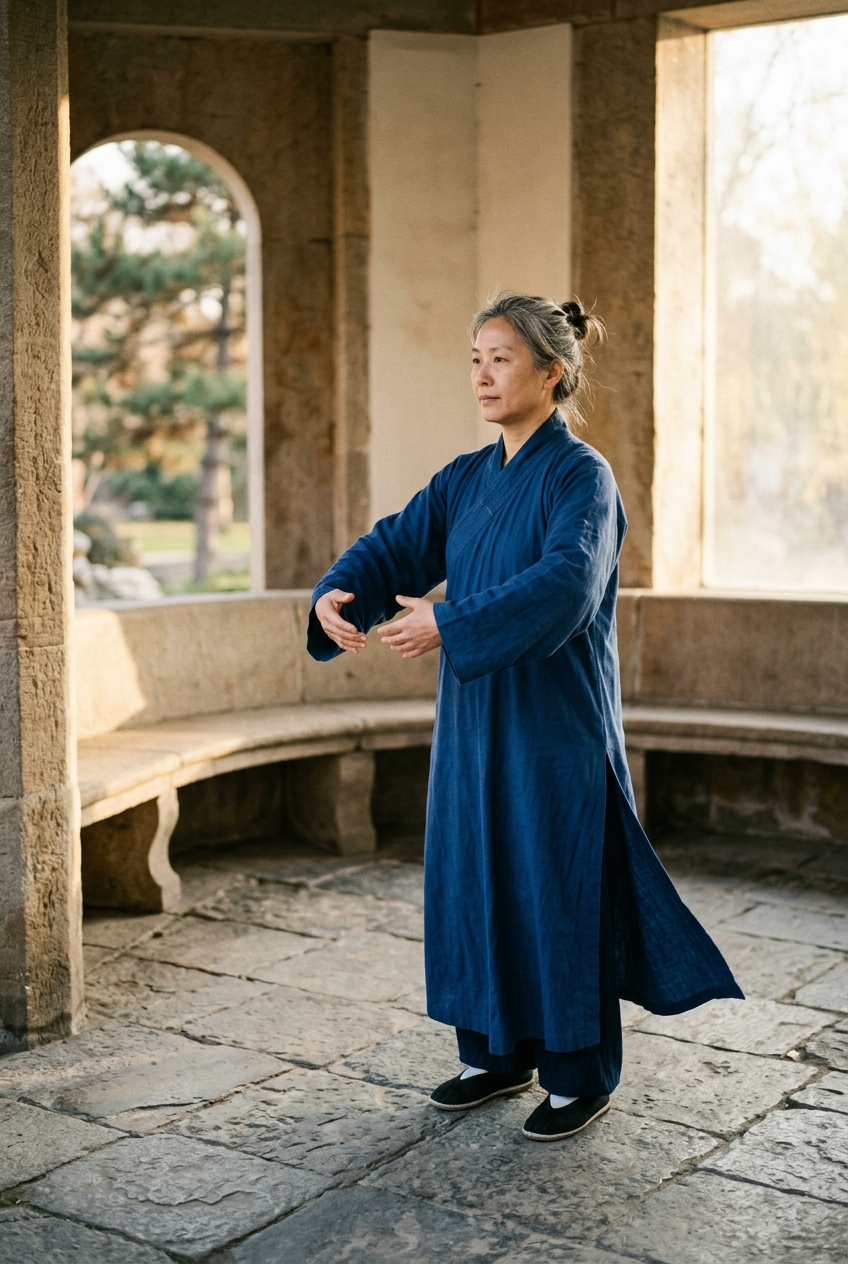
To understand Zhong Ding, one must first dismantle the modern Western misconception of posture as a fixed, frozen silhouette. In traditional movement systems such as Taijiquan and Qigong, posture is not an act of holding oneself rigid; it is an uninterrupted conversation between your internal bio-mechanics and the downward pull of the earth. In plain terms, instead of using your superficial skeletal muscles to forcefully prop yourself upright, you learn to release those muscles so that your skeleton, ligaments, and deep connective tissue sheets support your weight like a well-tensioned suspension bridge.
       [ Baihui (DU 20) - Suspended Crown ]
                       |
               ( Cervical Spine )
                       |
             ( Thoracic Decompression )
                       |
         [ Mingmen / Lower Dantian ]
                       |
           ( Open Kua / Pelvic Floor )
                  /         \
        ( Relaxed Femurs & Knees )
                /             \
    [ Yongquan (KD 1) ]   [ Yongquan (KD 1) ]
When this alignment is achieved, several fundamental physiological and energetic shifts occur simultaneously. The lower Dantian—the body’s physical center of mass located roughly two inches below the navel and deep within the pelvic basin—settles into a stable, weighted resting state. The Kua (the inguinal creases and hip joints) softens, creating a supple hinge that absorbs ground force. Simultaneously, the crown of the head at the acupoint Baihui (DU 20) feels buoyantly suspended from above, gently lengthening the spine. Rather than fighting gravity, the body integrates with it, freeing the breath, calming the nervous system, and preparing the organism for instantaneous, fluid movement in any direction.
Step-by-Step Practice Guide: Calibrating Your Dynamic Plumb Line
Cultivating Zhong Ding requires methodical, progressive somatic training. The classical pedagogy moves systematically from absolute stillness (Wuji), through expansive postural alignment (Hunyuan), into the differentiation of substantial and insubstantial weight (Xu and Shi), and finally into kinetic stepping mechanics. The following protocol provides a complete diagnostic curriculum for calibrating central equilibrium at home.
================================================================================
           SOMATIC CALIBRATION CHECKLIST FOR ZHONG DING
================================================================================
[1] Base of Support: Tri-point foot contact over Yongquan (KD 1)
[2] Inguinal Crease: Open, un-pinched Kua resting on a level pelvis
[3] Lumbar Curve: Lengthened Mingmen via gentle sacral decompression
[4] Thoracic Vault: Hollowed chest (Han Xiong) and relaxed scapulae
[5] Cranial Apex: Baihui suspended upward, chin retracted to lengthen neck
================================================================================
Phase 1: Establishing the Wuji and Hunyuan Foundations (Static Calibration)
- Foot Geometry and Plantar Grounding: Stand barefoot or in flat, thin-soled shoes on a level surface. Position your feet parallel, outer edges aligned with the lateral borders of your shoulders. Distribute your body weight evenly across the three primary weight-bearing zones of each foot: the calcaneus (heel), the first metatarsal head (ball of the foot), and the fifth metatarsal head (outer base of the little toe). Allow the arch of the foot to remain active and domed, sinking your sensory awareness into the kidney meridian point Yongquan (KD 1, or "Bubbling Spring"), located in the anterior depression of the sole.
- Releasing the Pelvic Sling (Song Kua): Avoid the common error of tucking your pelvis aggressively forward via gluteal contraction. Instead, allow the sacrum to drop vertically as if weighted by a plumb line. Feel the front creases of your hips (Kua) soften and hollow out, as though you were about to sit upon the edge of a tall barstool. This slight release flattens the excessive inward arch of the lumbar spine, opening the energetic gateway known as Mingmen (DU 4, "Gate of Life") and creating a spacious, relaxed lower back.
- Suspension of the Cranial Vault: Gently tuck the chin toward the throat without bowing the head, lengthening the suboccipital musculature at the base of the skull. Imagine the highest point of your cranium (Baihui) being lifted delicately by an unbroken silk cord suspended from the sky. This creates axial decompression throughout the cervical and thoracic vertebrae.
- Embracing the Sphere (Hunyuan Zhuang): Raise both arms in front of your chest as if lightly embracing the trunk of a broad cedar tree. Keep the palms facing inward toward your sternum, fingertips pointing toward one another with a four-inch gap between them. Drop the elbows below the level of the wrists (Chen Zhou), and allow the scapulae to glide laterally away from the spine, creating a gentle broadening across the upper back (Ba Bei) while releasing the anterior chest musculature (Han Xiong). Maintain this stance for 5 to 10 minutes, breathing quietly into the lower abdomen.
Phase 2: Differentiating Substantial and Insubstantial (Xu Shi)
Once static verticality is calibrated, Zhong Ding must be maintained across transitional weight shifts. In classical Daoist theory, equilibrium is preserved only through the clear differentiation of Shi (full/substantial) and Xu (empty/insubstantial).
- The Hydraulic Shift: From the Hunyuan posture, without altering the height of your head or tilting your torso, slowly shift 70 percent of your weight into your right leg. Do not lean your upper body laterally. Instead, allow the right Kua to fold deeper, as though your right hip socket were a descending hydraulic piston absorbing your mass.
- Releasing the Insubstantial Limb: As your right leg becomes solid and rooted (Shi), the left leg becomes buoyant and free of structural load (Xu). The left foot remains resting on the floor, but its tissues are emptied of compressive force.
- Preserving the Axial Column: Verify that your vertical plumb line—running from Baihui through your perineum (Huiyin, REN 1)—has shifted horizontally across space as a unified, vertical cylinder. Your shoulders must remain parallel to the floor, without the right shoulder dropping or the left hip hiking upward. Slowly transition the weight across to the left leg, taking four seconds to travel through the 50/50 midpoint, observing the continuous preservation of your internal center.
Phase 3: Dynamic Stepping Mechanics (Mao Bu / Cat Stepping)
- Unweighting Without Pushing: Shift your total body weight (100%) into your left foot, sinking fully into the left hip crease. Ensure the left knee tracks strictly in line with the second toe and does not collapse inward.
- The Aerial Reach: Lift the right foot without leaning backward. Extend the right leg forward along a subtle diagonal track, touching the right heel down to the floor with complete gentleness—like a cat stepping onto thin ice. At this precise moment, 100% of your weight remains supported by the left leg; if someone were to pull the right foot away, you would not fall.
- Rolling the Plumb Line: Smoothly transition your center of mass forward by pressing through the left foot and unfolding the right Kua, rolling the right sole down from heel to toe. Transfer 60% of your mass onto the forward right foot while maintaining an upright, de-rotated lumbar spine. Your Zhong Ding has now traversed space without a single moment of structural vulnerability or kinetic collapse.
Diagnostic Errors and Somatic Corrections
- Error 1: Excessive Lumbar Hyper-Lordosis ("Duck Stance")
- Mechanism: Forcing the chest out while allowing the pelvis to tilt anteriorly, compressing the L4-S1 vertebrae.
- Correction: Exhale completely, soften the sternum, and imagine your tailbone sinking straight into the earth like a heavy anchor, widening the space across the lower back.
- Error 2: Anterior Ankle Leaning
- Mechanism: Leaning the entire rigid body forward from the ankle joints, which overloads the gastrocnemius and activates fight-or-flight postural reflexes.
- Correction: Draw the center of mass back until the weight rests directly over the front edge of the heel and the Yongquan depression; verify your toes can wiggle freely inside your shoes.
- Error 3: Trapezius Hypertonicity
- Mechanism: Holding the arms using the upper trapezius and levator scapulae muscles rather than the deep fascial webbing of the back.
- Correction: Consciously drop the tips of your elbows toward the floor. Imagine heavy warm sand pouring down from your neck, across your shoulders, and out through your fingertips.
Somatic Sensations: What You Will Feel
As your alignment locks into true Zhong Ding, you will encounter a distinct sequence of somatic markers: * Deep Warmth and Micro-Tingling: A pervasive sensation of warmth and gentle electrical buzzing in the palms and soles of the feet, caused by peripheral vasodilation and the release of chronic vasoconstrictive muscle holding patterns. * Visceral Sinking (Chen): A sensation of heaviness in the lower abdomen and pelvis, accompanied by a paradoxical lightness and floating clarity in the head and upper spine (Ling). * Spontaneous De-Gasping: The sudden, involuntary release of deep sighs or spontaneous yawning, indicating the sudden activation of the parasympathetic branch of the nervous system as muscular bracing dissolves.
Why It Works: The Neuro-Biomechanics of Equilibrium
The transformative power of Zhong Ding is not mystical; it is rooted directly in human neurophysiology, biotensegrity, and autonomic regulation, as documented in contemporary studies accessible through the National Library of Medicine (PubMed).
                 +-----------------------------------+
                 |    NEUROSENSORY EQUILIBRIUM TRIAD |
                 +-----------------------------------+
                                   |
         +-------------------------+-------------------------+
         |                         |                         |
         v                         v                         v
+------------------+     +--------------------+    +-------------------+
| Plantar Afferents|     | Muscle Spindles    |    | Vestibular System |
| (Yongquan / KD1) |     | (Deep Multifidi)   |    | (Otoliths/Canals) |
| Pressure Mapping |     | Micro-Adjustments  |    | Spatial Gravity   |
+------------------+     +--------------------+    +-------------------+
         |                         |                         |
         +-------------------------+-------------------------+
                                   |
                                   v
             [ Central Integration in Cerebellum & Reticular Core ]
                                   |
                                   v
             [ Minimum-Energy Equilibrium / Zero Shear Strain ]
1. The Neurosensory Calibration Triad
Postural stability relies upon the real-time integration of three sensory inputs within the central nervous system: * High-Density Plantar Mechanoreception: The soles of the feet, particularly around the Yongquan locus, contain some of the highest concentrations of slow-adapting and fast-adapting mechanoreceptors (Merkel discs and Meissner corpuscles) in the human body. Standing with relaxed, uncramped feet magnifies the fidelity of cutaneous pressure mapping, providing the brainstem with micro-spatial data on gravitational loading. * Paravertebral Proprioceptive Spindles: The deep, intrinsic stabilizing muscles of the spine—specifically the rotatores, interspinales, and multifidi—possess an exceptionally dense distribution of muscle spindles. When the spine is held in a relaxed, de-lordosed vertical axis, these spindles transmit instantaneous feedback regarding micro-shears, enabling subconscious postural adjustments that consume almost zero metabolic energy. * Vestibular Balance Integration: By suspending the cranium at Baihui and tucking the chin, the horizontal semicircular canals and the otolith organs (utricle and saccule) of the inner ear are brought into an anatomically neutral plane. This neutral orientation minimizes vestibular sensory noise, allowing the cerebellum to coordinate motor output with optimal efficiency.
2. Biotensegrity and the Deep Front Fascial Line
In conventional biomechanics, the body was long modeled as a brick-and-mortar stack of bones bearing compressive weight. Contemporary anatomical science increasingly embraces the concept of biotensegrity—a structural principle where rigid compression elements (bones) float within a continuous sea of tensile components (fascia, tendons, and muscles).
Zhong Ding directly engages what anatomists term the Deep Front Line—the body's structural myofascial core. This continuous fibrous highway ascends from the plantar surfaces of the toes, wraps through the deep posterior compartment of the calf, scales the medial adductor group, traverses the pelvic floor at Huiyin (REN 1), integrates with the psoas and the respiratory diaphragm, scales the anterior longitudinal ligament of the spine, and anchors beneath the cranial base.
When you calibrate Zhong Ding, you tension this internal fascial sheath like a tuned musical string. The mechanical load of the upper body is no longer borne by pinching the intervertebral discs; instead, it is distributed uniformly across the entire fascial web. This decompression relieves chronic impingement on spinal nerve roots, halts degenerative disc wear, and restores metabolic fluid exchange throughout the cartilage matrices of the spine.
3. Autonomic Down-Regulation and Diaphragmatic Liberation
When an individual stands with poor postural alignment—such as anterior pelvic tilt, rounded shoulders, or a forward head carriage—the superficial skeletal muscles must fire continuously to prevent the body from toppling forward under gravity. This persistent muscular hypertonicity signals chronic physiological stress to the central nervous system, keeping the sympathetic "fight-or-flight" branch activated.
By returning the center of mass to its optimal locus over the base of support, Zhong Ding dissolves the need for compensatory muscular contraction. The pelvic floor (Huiyin) and the thoracic diaphragm, structurally coupled through fascial attachments, are released from their secondary roles as emergency postural stabilizers. The diaphragm can now perform full-amplitude excursions downward into the abdominal cavity on inhalation, massaging the visceral organs and rhythmically modulating intra-abdominal pressure.
This unhindered mechanical excursion stimulates the cardiac and celiac branches of the vagus nerve (CN X). As demonstrated in clinical protocols recognized by the World Health Organization, this somatic vagal stimulation elevates Heart Rate Variability (HRV), reduces salivary cortisol, lowers systemic blood pressure, and shifts the autonomic nervous system into a profound, restorative parasympathetic state.
Classical Lineage: The Martial and Philosophical Roots of Zhong Ding
The foundational theory of Zhong Ding emerged not from modern sports science laboratories, but from centuries of empirical martial research and Daoist meditative inquiry. Its most articulate historical documentation appears within the treasured collection of aphorisms known as the Taijiquan Classics, authored by master practitioners including Wang Zongyue (fl. 18th century) and Wu Yuxiang (1812–1880).
In classical martial cosmology, Zhong Ding constitutes the pivotal hub of the Five Strategic Directions (Wu Bu, 五步), which correlate directly with the Five Elements (Wu Xing):
================================================================================
                    THE FIVE STRATEGIC DIRECTIONS (WU BU)
================================================================================
Directional Vector   Chinese Name   Five-Phase Element   Kinetic Quality
--------------------------------------------------------------------------------
Advance              Jin (進)       Metal (金)           Forward Penetration
Retreat              Tui (退)       Wood (木)            Yielding Evasion
Look to the Left     Gu (顧)        Water (水)           Peripheral Awareness
Gaze to the Right    Pan (盼)       Fire (火)            Anticipatory Shift
Central Equilibrium  Zhong Ding (中定) Earth (土)          Rooted Axis / Hub
================================================================================
In the classic treatise Taijiquan Lun (Attributed to Wang Zongyue), the master states:
"Stand like a balanced scale, move actively like a chariot wheel. If you drop your weight to one side, you are responsive; if you are double-weighted, you stagnate."
The classical masters realized that all forward momentum (Jin), backward retreat (Tui), and lateral diversion (Gu / Pan) are doomed to kinetic failure if they originate from an unstable center. Without Zhong Ding, an advancing step overcommits your balance, a retreat pulls you off your feet, and a lateral turn exposes your flank. Central equilibrium is the silent center of the wheel: while the rim spins furiously across the landscape, the axle remains perfectly poised in calm stillness.
In the philosophical cosmology of Daoism, Zhong Ding is the somatic manifestation of the transition from Wuji (the undifferentiated absolute void) to Taiji (the generative dance of dynamic yin and yang). By resting in Zhong Ding, the practitioner maintains harmony between the ascending yang forces (the suspension of Baihui) and the descending yin forces (the rooting of Yongquan). Organizations such as the National Qigong Association continue to preserve these lineage teachings, verifying that this internal balance is the bedrock upon which both martial power (Fa Jin) and longevity practices (Yang Sheng) are cultivated.
Clinical Outcomes: Fall Prevention, Chronic Pain, and Neuromuscular Reprogramming
The therapeutic applications of Zhong Ding have made it a focal point of contemporary neuro-rehabilitation and geriatric medicine. Extensive clinical research into internal arts practices, cataloged extensively on Wikipedia: Tai chi, demonstrates measurable interventions across three critical medical domains:
+-------------------------------------------------------------------------------+
|                      MEASURABLE CLINICAL OUTCOMES                            |
+-------------------------------------------------------------------------------+
| [1] Fall Risk Reduction: 40-50% decrease in geriatric balance loss            |
| [2] Chronic Pain Relief: Spinal decompression alleviates axial lumbar load    |
| [3] Autonomic Reset: Vagal nerve stimulation elevates HRV & lowers cortisol   |
+-------------------------------------------------------------------------------+
- Dramatic Reduction in Fall Incidence: Accidental falls represent the leading cause of injury-related mortality in individuals over the age of 65. The primary etiology of falls is not simply muscular weakness, but the degradation of proprioceptive acuity and an inability to rapidly differentiate substantial and insubstantial weight. By training the dynamic stepping mechanics of Zhong Ding, patients reprogram their ankle strategies, awaken dormant mechanoreceptors at the base of the feet, and learn to catch their center of mass smoothly before structural balance is lost.
- Alleviation of Non-Specific Lower Back Pain: Chronic lumbar pain is overwhelmingly driven by asymmetric compressive loading, pelvic torsion, and tonic spasm of the superficial erector spinae. Sinking the Kua and lengthening the Mingmen releases the psoas major from its hyper-contracted protective state, creates vertical intervertebral spacing, and reactivates the transverse abdominis and deep pelvic floor muscles as a unified, natural weight belt.
- Reprogramming the Stress Response: Individuals suffering from generalized anxiety disorder and trauma often present with an anteriorly displaced center of gravity, elevated shoulders, and apical chest breathing. Practicing central equilibrium physically grounds the organism. By altering the somatic input sent upward via the spinothalamic tracts, the brain recognizes that the physical self is secure, structurally stable, and grounded in the present moment, interrupting cyclical loops of mental rumination and autonomic panic.
Today’s Practice Commitment: The Five-Minute Morning Alignment
Do not allow this understanding of central equilibrium to remain an abstract, intellectual theory. Somatic knowledge is written into the nervous system solely through direct, embodied repetition.
================================================================================
                    YOUR 5-MINUTE MORNING RESET PROTOCOL
================================================================================
Minute 01:00 — Grounding: Establish parallel feet, unlock knees, sense Yongquan
Minute 02:00 — Pelvic Release: Soften Kua, sink tailbone, open Mingmen
Minute 03:00 — Axial Elongation: Suspend Baihui, soften chest, drop shoulders
Minute 04:00 — Hunyuan Embrace: Raise arms, breathe deeply into lower Dantian
Minute 05:00 — Sensory Integration: Close eyes, observe stillness within balance
================================================================================
Tomorrow morning, immediately after waking and before taking your first sip of tea or coffee, step onto a flat floor with bare feet.
- Set a timer for precisely five minutes.
- Arrange your feet parallel, sink your awareness down into the Yongquan points on the soles of your feet, and allow the creases of your hips to soften.
- Feel your cranium suspend effortlessly from above at Baihui, letting your shoulders melt down your back like warm wax.
- Bring your hands over your lower belly, resting one palm over the other directly beneath your navel.
- For five uninterrupted minutes, do nothing more than breathe smoothly through your nose into the bottom of your pelvis, feeling your weight rest effortlessly upon your bones and connective tissues.
As you step away from this brief standing practice and move into your day, carry that dynamic plumb line with you. Notice how you stand while waiting in line, how you sit in your office chair, and how you step across the pavement. In every moment of physical exertion or mental turbulence, your center of equilibrium is waiting—silent, stable, and completely effortless—just beneath your feet.